Nutrient  R emoval from  S laughterhouse  W astewater in an  I ntermittently  A erated  S equencing  Ba tch  R eactor
Outline Introduction Method 1. Laboratory-Scale Sequencing Batch Reactors (SBR) System 2. Slaughterhouse Wastewater 3. Operation of the System 4. Analytical Methods Results and Discussions 1. Overall Performance of the SBR Reactor 2. Cycle Performance Conclusions Reference
Introduction Slaughterhouses produce high-strength wastewater. The amount of wastewater generated per cow is approximately  2  m 3  per day . In pig slaughterhouses,  1.6 – 8.3  m 3   of water per tonne . S laughterhouse  w astewater can be variable . - S uspended  S olids  (SS) - Chemical Oxygen Demand  ( COD ) - Total Nitrogen  ( TN ) - Total Phosphorus  ( TP )
Introduction O n-site biological treatment  by  European Commission - R emove  O rganic  C arbon  (C) - R emove  N utrients The European Commission also recommends that  Sequencing Batch Reactors  (SBRs) be amongst the  Best Available Techniques  (BATs) for Slaughterhouse wastewater treatment.
Introduction SBRs are capable o f: - R emoving   organic C - R emoving   nutrients - R emoving   SS - H ave low capital - Low  operational costs SBRs are not able to remove nitrogen (N) as efficiently as COD. Anoxic heterotrophic denitrifiers reduce nitrate-N (NO 3 -N)/nitrite-N (NO 2 -N), which is produced in the preceding operational cycle and remains in the reactor after the draw phase, to nitrogen gas (N 2 )
Introduction P accumulating organisms (PAOs) will compete with denitrifiers for rbCOD for anaerobic P release. A conventionally operated SBR can be changed to an intermittently aerated SBR, where one complete operational cycle comprises four phases – fill, react, settle and draw. If the DO in the reactor tank is controlled properly by means of intermittent aeration, NH 4 -N will be partially oxidized to NO 2 -N and then in the mixing period, NO 2 -N will be reduced to N 2  gas. the performance of a laboratory-scale, intermittently aerated SBR for simultaneous N and P removal from slaughterhouse water was investigated.
Method Laboratory- S cale  Sequencing Batch Reactors   (SBR) System Slaughterhouse  W astewater Operation of the  S ystem Analytical  M ethods
Method Laboratory- S cale  Sequencing Batch Reactors   (SBR) System
Method Collected from the conditioning tank in the wastewater treatment plant (WTP) Reduce COD and N Tertiary treatment (chemical coagulation) Reduce P The WTP comprises: - Preliminary treatment (screening and dissolved air flotation) - A conditioning tank - Primary treatment (sedimentation) - Secondary treatment (conventional activated sludge pre-denitrification process) Slaughterhouse  W astewater
Method Operation of the  S ystem
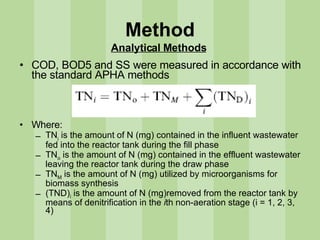
Method COD, BOD5 and SS were measured in accordance with the standard APHA methods Where: TN i  is the amount of N (mg) contained in the influent wastewater fed into the reactor tank during the fill phase TN o  is the amount of N (mg) contained in the effluent wastewater leaving the reactor tank during the draw phase TN M  is the amount of N (mg) utilized by microorganisms for biomass synthesis (TND) i  is the amount of N (mg)removed from the reactor tank by means of denitrification in the  i th non-aeration stage (i = 1, 2, 3, 4) Analytical  M ethods
Results and  D iscussions Overall  P erformance of the SBR  R eactor Cycle  P erformance
Results and  D iscussions Overall  P erformance of the SBR  R eactor
Results and  D iscussions Cycle  P erformance
Conclusions At an influent OLR of 1.2 g COD/(L d), average effluent concentrations of COD, TN and TP were 150 mg/L, 15 mg/L and 0.8 mg/L, respectively. This represented COD, TN and TP removals of 96%, 96% and 99%, respectively. A nitrogen balance was carried out and showed that 66% of N removed was due to denitrification and 34% was consumed by microorganisms for biomass synthesis. Partial nitrification occurred in the system, possibly due to the intermittent aeration pattern employed in the SBR system. 95% of N removal by means of  denitrification was via NO2-N.
Reference Nutrient Removal from Slaughterhouse Wastewater in an Intermittently Aerated Sequencing Batch Reactor - Bioresource Technology, Volume 99, Issue 16, November 2008, Pages 7644-7650 J . P .  Li, M . G .  Healy, X . M .  Zhan, M .  Rodgers

Nutrient Removal

  • 1.
    Nutrient Removal from S laughterhouse W astewater in an I ntermittently A erated S equencing Ba tch R eactor
  • 2.
    Outline Introduction Method1. Laboratory-Scale Sequencing Batch Reactors (SBR) System 2. Slaughterhouse Wastewater 3. Operation of the System 4. Analytical Methods Results and Discussions 1. Overall Performance of the SBR Reactor 2. Cycle Performance Conclusions Reference
  • 3.
    Introduction Slaughterhouses producehigh-strength wastewater. The amount of wastewater generated per cow is approximately 2 m 3 per day . In pig slaughterhouses, 1.6 – 8.3 m 3 of water per tonne . S laughterhouse w astewater can be variable . - S uspended S olids (SS) - Chemical Oxygen Demand ( COD ) - Total Nitrogen ( TN ) - Total Phosphorus ( TP )
  • 4.
    Introduction O n-sitebiological treatment by European Commission - R emove O rganic C arbon (C) - R emove N utrients The European Commission also recommends that Sequencing Batch Reactors (SBRs) be amongst the Best Available Techniques (BATs) for Slaughterhouse wastewater treatment.
  • 5.
    Introduction SBRs arecapable o f: - R emoving organic C - R emoving nutrients - R emoving SS - H ave low capital - Low operational costs SBRs are not able to remove nitrogen (N) as efficiently as COD. Anoxic heterotrophic denitrifiers reduce nitrate-N (NO 3 -N)/nitrite-N (NO 2 -N), which is produced in the preceding operational cycle and remains in the reactor after the draw phase, to nitrogen gas (N 2 )
  • 6.
    Introduction P accumulatingorganisms (PAOs) will compete with denitrifiers for rbCOD for anaerobic P release. A conventionally operated SBR can be changed to an intermittently aerated SBR, where one complete operational cycle comprises four phases – fill, react, settle and draw. If the DO in the reactor tank is controlled properly by means of intermittent aeration, NH 4 -N will be partially oxidized to NO 2 -N and then in the mixing period, NO 2 -N will be reduced to N 2 gas. the performance of a laboratory-scale, intermittently aerated SBR for simultaneous N and P removal from slaughterhouse water was investigated.
  • 7.
    Method Laboratory- Scale Sequencing Batch Reactors (SBR) System Slaughterhouse W astewater Operation of the S ystem Analytical M ethods
  • 8.
    Method Laboratory- Scale Sequencing Batch Reactors (SBR) System
  • 9.
    Method Collected fromthe conditioning tank in the wastewater treatment plant (WTP) Reduce COD and N Tertiary treatment (chemical coagulation) Reduce P The WTP comprises: - Preliminary treatment (screening and dissolved air flotation) - A conditioning tank - Primary treatment (sedimentation) - Secondary treatment (conventional activated sludge pre-denitrification process) Slaughterhouse W astewater
  • 10.
  • 11.
    Method COD, BOD5and SS were measured in accordance with the standard APHA methods Where: TN i is the amount of N (mg) contained in the influent wastewater fed into the reactor tank during the fill phase TN o is the amount of N (mg) contained in the effluent wastewater leaving the reactor tank during the draw phase TN M is the amount of N (mg) utilized by microorganisms for biomass synthesis (TND) i is the amount of N (mg)removed from the reactor tank by means of denitrification in the i th non-aeration stage (i = 1, 2, 3, 4) Analytical M ethods
  • 12.
    Results and D iscussions Overall P erformance of the SBR R eactor Cycle P erformance
  • 13.
    Results and D iscussions Overall P erformance of the SBR R eactor
  • 14.
    Results and D iscussions Cycle P erformance
  • 15.
    Conclusions At aninfluent OLR of 1.2 g COD/(L d), average effluent concentrations of COD, TN and TP were 150 mg/L, 15 mg/L and 0.8 mg/L, respectively. This represented COD, TN and TP removals of 96%, 96% and 99%, respectively. A nitrogen balance was carried out and showed that 66% of N removed was due to denitrification and 34% was consumed by microorganisms for biomass synthesis. Partial nitrification occurred in the system, possibly due to the intermittent aeration pattern employed in the SBR system. 95% of N removal by means of denitrification was via NO2-N.
  • 16.
    Reference Nutrient Removalfrom Slaughterhouse Wastewater in an Intermittently Aerated Sequencing Batch Reactor - Bioresource Technology, Volume 99, Issue 16, November 2008, Pages 7644-7650 J . P . Li, M . G . Healy, X . M . Zhan, M . Rodgers