Using Nurses to Support Rapid
ART Scale up in Zambia
Mary Morris
Nursing and QA/QC Coordinator
Centre for Infectious Disease Research in
Zambia (CIDRZ)
The University of Alabama at
Birmingham
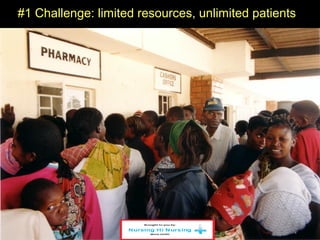
#1 Challenge: limited resources, unlimited patients
Lusaka
• 2,000,000 inhabitants
• Adult (15-49) HIV prevalence = 22%
• Prevalence among children ~ =6%
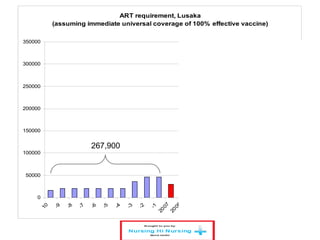
• Estimated number HIV-infected = 267,900
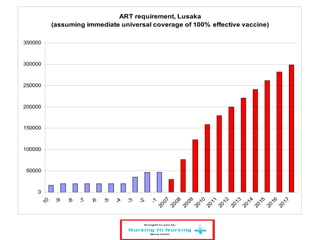
ART requirement, Lusaka
(assuming immediate universal coverage of 100% effective vaccine)
0
50000
100000
150000
200000
250000
300000
35000010
-9
-8
-7
-6
-5
-4
-3
-2
-1
2007
2008
2009
2010
2011
2012
2013
2014
2015
2016
2017
267,900
ART requirement, Lusaka
(assuming immediate universal coverage of 100% effective vaccine)
0
50000
100000
150000
200000
250000
300000
35000010
-9
-8
-7
-6
-5
-4
-3
-2
-1
2007
2008
2009
2010
2011
2012
2013
2014
2015
2016
2017
The “ARVs in Vending Machines”
Problem
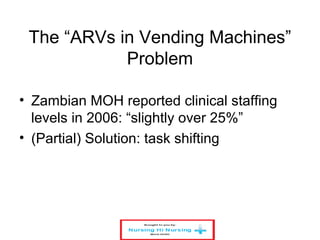
• Zambian MOH reported clinical staffing
levels in 2006: “slightly over 25%”
• (Partial) Solution: task shifting
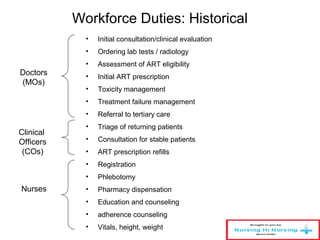
Workforce Duties: Historical
• Initial consultation/clinical evaluation
• Ordering lab tests / radiology
• Assessment of ART eligibility
• Initial ART prescription
• Toxicity management
• Treatment failure management
• Referral to tertiary care
• Triage of returning patients
• Consultation for stable patients
• ART prescription refills
• Registration
• Phlebotomy
• Pharmacy dispensation
• Education and counseling
• adherence counseling
• Vitals, height, weight
Doctors
(MOs)
Nurses
Clinical
Officers
(COs)
• Initial consultation/clinical evaluation
• Ordering lab tests / radiology
• Assessment of ART eligibility
• Initial ART prescription
• Toxicity management
• Treatment failure management
• Referral to tertiary care
• Triage of returning patients
• Consultation for stable patients
• ART prescription refills
• Registration
• Phlebotomy
• Pharmacy dispensation
• Education and counseling
• adherence counseling
• Vitals, height, weight
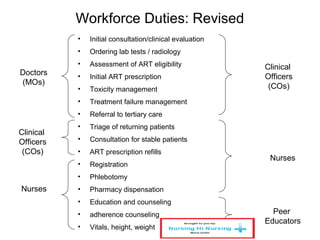
Doctors
(MOs)
Nurses
Clinical
Officers
(COs)
Clinical
Officers
(COs)
Nurses
Peer
Educators
Workforce Duties: Revised
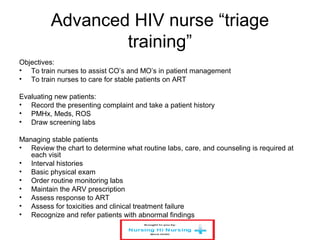
Advanced HIV nurse “triage
training”
Objectives:
• To train nurses to assist CO’s and MO’s in patient management
• To train nurses to care for stable patients on ART
Evaluating new patients:
• Record the presenting complaint and take a patient history
• PMHx, Meds, ROS
• Draw screening labs
Managing stable patients
• Review the chart to determine what routine labs, care, and counseling is required at
each visit
• Interval histories
• Basic physical exam
• Order routine monitoring labs
• Maintain the ARV prescription
• Assess response to ART
• Assess for toxicities and clinical treatment failure
• Recognize and refer patients with abnormal findings
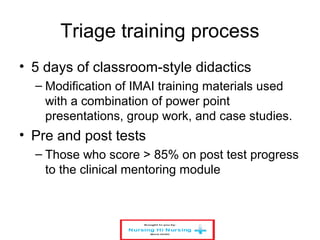
Triage training process
• 5 days of classroom-style didactics
– Modification of IMAI training materials used
with a combination of power point
presentations, group work, and case studies.
• Pre and post tests
– Those who score > 85% on post test progress
to the clinical mentoring module
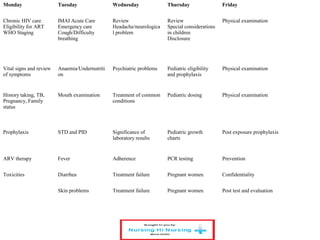
Monday Tuesday Wednesday Thursday Friday
Chronic HIV care
Eligibility for ART
WHO Staging
IMAI Acute Care
Emergency care
Cough/Difficulty
breathing
Review
Headache/neurologica
l problem
Review
Special considerations
in children
Disclosure
Physical examination
Vital signs and review
of symptoms
Anaemia/Undernutriti
on
Psychiatric problems Pediatric eligibility
and prophylaxis
Physical examination
History taking, TB,
Pregnancy, Family
status
Mouth examination Treatment of common
conditions
Pediatric dosing Physical examination
Prophylaxis STD and PID Significance of
laboratory results
Pediatric growth
charts
Post exposure prophylaxis
ARV therapy Fever Adherence PCR testing Prevention
Toxicities Diarrhea Treatment failure Pregnant women Confidentiality
Skin problems Treatment failure Pregnant women Post test and evaluation
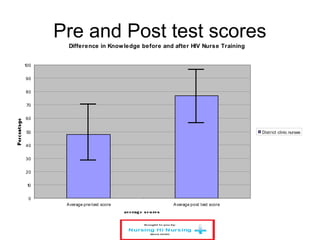
Pre and Post test scores
Difference in Knowledge before and after HIV Nurse Training
0
10
20
30
40
50
60
70
80
90
100
Average pre-test score Average post test score
averag e sc ores
District clinic nurses
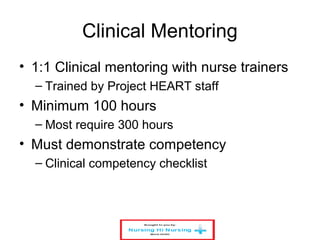
Clinical Mentoring
• 1:1 Clinical mentoring with nurse trainers
– Trained by Project HEART staff
• Minimum 100 hours
– Most require 300 hours
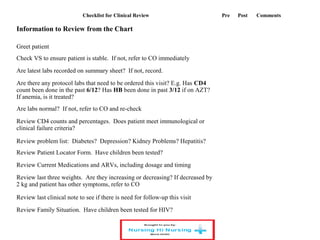
• Must demonstrate competency
– Clinical competency checklist
Checklist for Clinical Review Pre Post Comments
Information to Review from the Chart
Greet patient
Check VS to ensure patient is stable. If not, refer to CO immediately
Are latest labs recorded on summary sheet? If not, record.
Are there any protocol labs that need to be ordered this visit? E.g. Has CD4
count been done in the past 6/12? Has HB been done in past 3/12 if on AZT?
If anemia, is it treated?
Are labs normal? If not, refer to CO and re-check
Review CD4 counts and percentages. Does patient meet immunological or
clinical failure criteria?
Review problem list: Diabetes? Depression? Kidney Problems? Hepatitis?
Review Patient Locator Form. Have children been tested?
Review Current Medications and ARVs, including dosage and timing
Review last three weights. Are they increasing or decreasing? If decreased by
2 kg and patient has other symptoms, refer to CO
Review last clinical note to see if there is need for follow-up this visit
Review Family Situation. Have children been tested for HIV?
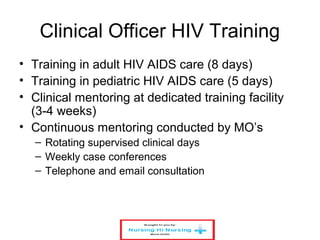
Clinical Officer HIV Training
• Training in adult HIV AIDS care (8 days)
• Training in pediatric HIV AIDS care (5 days)
• Clinical mentoring at dedicated training facility
(3-4 weeks)
• Continuous mentoring conducted by MO’s
– Rotating supervised clinical days
– Weekly case conferences
– Telephone and email consultation
Basic Nurse Training
• Adult and pediatric HIV and ART
management
– IMAI and patient management skills
• Counseling skills, psychosocial, referral,
and adherence
• QA/QC
• Some go on to “triage training”
Peer Educators
• HIV-infected (mostly) members of the
clinic community who work for the project
• Duties include
– Group education
– Counseling
– Following up late patients
– New: registering patients, vital signs
Task shifting in Lusaka
• Almost all ART care is provided by non-MD
clinicians
• Clinical officers, nurses, and peer educators
• Optimal staffing for clinic with 3000 patients on
ART
– 2 clinical officers, 5 nurses, 3 peer educators in AM
– 1 clinical officer, 3 nurses, and 2 peer educators in
PM
Monitoring and Evaluation
• In order to monitor nurse managed care
nurses record the PTID of all patients that
they see. Mentors routinely review those
files to assess the quality of care given.
• At present all nurses trained and their
mentors are being assessed by a nurse
practitioner from the US.
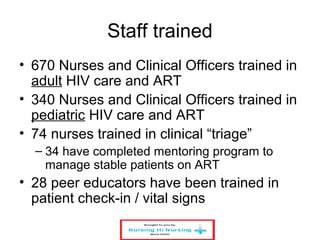
Staff trained
• 670 Nurses and Clinical Officers trained in
adult HIV care and ART
• 340 Nurses and Clinical Officers trained in
pediatric HIV care and ART
• 74 nurses trained in clinical “triage”
– 34 have completed mentoring program to
manage stable patients on ART
• 28 peer educators have been trained in
patient check-in / vital signs
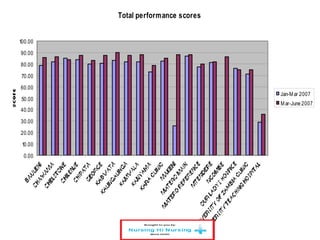
Total performance scores
0.00
10.00
20.00
30.00
40.00
50.00
60.00
70.00
80.00
90.00
100.00
Jan-Mar 2007
Mar-June 2007
Monitoring and Evaluation
• Quarterly performance reports generated
for each site allow us to monitor trends in
performance in each clinic.
• This can be attributed to improved
knowledge and skills of nurses and
improved data entry.
Summary
• Nurses are a key component of the healthcare
workforce
• General nursing training in Zambia does not
teach patient management (or even physical
examination)
• Most nurses need 3 months of intensive
mentoring to become competent in caring for
stable patients on ART
• Nurses can learn these skills, and once they do
they do it well
Our views have increased the mark
of the 20,000
Thank you viewers
Looking forward to franchise,
collaboration, partners.
This platform has been started by Parveen
Kumar Chadha with the vision that nobody
should suffer the way he has suffered because of
lack and improper healthcare facilities in India.
We need lots of funds manpower etc. to make
this vision a reality please contact us. Join us as
a member for a noble cause.
Contact us:- 011-25464531, 9818569476
E-mail:- nursingnursing@yahoo.in

Nursing training

  • 1.
    Using Nurses toSupport Rapid ART Scale up in Zambia Mary Morris Nursing and QA/QC Coordinator Centre for Infectious Disease Research in Zambia (CIDRZ) The University of Alabama at Birmingham
  • 2.
    #1 Challenge: limitedresources, unlimited patients
  • 3.
    Lusaka • 2,000,000 inhabitants •Adult (15-49) HIV prevalence = 22% • Prevalence among children ~ =6% • Estimated number HIV-infected = 267,900
  • 5.
    ART requirement, Lusaka (assumingimmediate universal coverage of 100% effective vaccine) 0 50000 100000 150000 200000 250000 300000 35000010 -9 -8 -7 -6 -5 -4 -3 -2 -1 2007 2008 2009 2010 2011 2012 2013 2014 2015 2016 2017 267,900
  • 6.
    ART requirement, Lusaka (assumingimmediate universal coverage of 100% effective vaccine) 0 50000 100000 150000 200000 250000 300000 35000010 -9 -8 -7 -6 -5 -4 -3 -2 -1 2007 2008 2009 2010 2011 2012 2013 2014 2015 2016 2017
  • 7.
    The “ARVs inVending Machines” Problem • Zambian MOH reported clinical staffing levels in 2006: “slightly over 25%” • (Partial) Solution: task shifting
  • 8.
    Workforce Duties: Historical •Initial consultation/clinical evaluation • Ordering lab tests / radiology • Assessment of ART eligibility • Initial ART prescription • Toxicity management • Treatment failure management • Referral to tertiary care • Triage of returning patients • Consultation for stable patients • ART prescription refills • Registration • Phlebotomy • Pharmacy dispensation • Education and counseling • adherence counseling • Vitals, height, weight Doctors (MOs) Nurses Clinical Officers (COs)
  • 9.
    • Initial consultation/clinicalevaluation • Ordering lab tests / radiology • Assessment of ART eligibility • Initial ART prescription • Toxicity management • Treatment failure management • Referral to tertiary care • Triage of returning patients • Consultation for stable patients • ART prescription refills • Registration • Phlebotomy • Pharmacy dispensation • Education and counseling • adherence counseling • Vitals, height, weight Doctors (MOs) Nurses Clinical Officers (COs) Clinical Officers (COs) Nurses Peer Educators Workforce Duties: Revised
  • 10.
    Advanced HIV nurse“triage training” Objectives: • To train nurses to assist CO’s and MO’s in patient management • To train nurses to care for stable patients on ART Evaluating new patients: • Record the presenting complaint and take a patient history • PMHx, Meds, ROS • Draw screening labs Managing stable patients • Review the chart to determine what routine labs, care, and counseling is required at each visit • Interval histories • Basic physical exam • Order routine monitoring labs • Maintain the ARV prescription • Assess response to ART • Assess for toxicities and clinical treatment failure • Recognize and refer patients with abnormal findings
  • 11.
    Triage training process •5 days of classroom-style didactics – Modification of IMAI training materials used with a combination of power point presentations, group work, and case studies. • Pre and post tests – Those who score > 85% on post test progress to the clinical mentoring module
  • 12.
    Monday Tuesday WednesdayThursday Friday Chronic HIV care Eligibility for ART WHO Staging IMAI Acute Care Emergency care Cough/Difficulty breathing Review Headache/neurologica l problem Review Special considerations in children Disclosure Physical examination Vital signs and review of symptoms Anaemia/Undernutriti on Psychiatric problems Pediatric eligibility and prophylaxis Physical examination History taking, TB, Pregnancy, Family status Mouth examination Treatment of common conditions Pediatric dosing Physical examination Prophylaxis STD and PID Significance of laboratory results Pediatric growth charts Post exposure prophylaxis ARV therapy Fever Adherence PCR testing Prevention Toxicities Diarrhea Treatment failure Pregnant women Confidentiality Skin problems Treatment failure Pregnant women Post test and evaluation
  • 13.
    Pre and Posttest scores Difference in Knowledge before and after HIV Nurse Training 0 10 20 30 40 50 60 70 80 90 100 Average pre-test score Average post test score averag e sc ores District clinic nurses
  • 14.
    Clinical Mentoring • 1:1Clinical mentoring with nurse trainers – Trained by Project HEART staff • Minimum 100 hours – Most require 300 hours • Must demonstrate competency – Clinical competency checklist
  • 15.
    Checklist for ClinicalReview Pre Post Comments Information to Review from the Chart Greet patient Check VS to ensure patient is stable. If not, refer to CO immediately Are latest labs recorded on summary sheet? If not, record. Are there any protocol labs that need to be ordered this visit? E.g. Has CD4 count been done in the past 6/12? Has HB been done in past 3/12 if on AZT? If anemia, is it treated? Are labs normal? If not, refer to CO and re-check Review CD4 counts and percentages. Does patient meet immunological or clinical failure criteria? Review problem list: Diabetes? Depression? Kidney Problems? Hepatitis? Review Patient Locator Form. Have children been tested? Review Current Medications and ARVs, including dosage and timing Review last three weights. Are they increasing or decreasing? If decreased by 2 kg and patient has other symptoms, refer to CO Review last clinical note to see if there is need for follow-up this visit Review Family Situation. Have children been tested for HIV?
  • 16.
    Clinical Officer HIVTraining • Training in adult HIV AIDS care (8 days) • Training in pediatric HIV AIDS care (5 days) • Clinical mentoring at dedicated training facility (3-4 weeks) • Continuous mentoring conducted by MO’s – Rotating supervised clinical days – Weekly case conferences – Telephone and email consultation
  • 17.
    Basic Nurse Training •Adult and pediatric HIV and ART management – IMAI and patient management skills • Counseling skills, psychosocial, referral, and adherence • QA/QC • Some go on to “triage training”
  • 18.
    Peer Educators • HIV-infected(mostly) members of the clinic community who work for the project • Duties include – Group education – Counseling – Following up late patients – New: registering patients, vital signs
  • 19.
    Task shifting inLusaka • Almost all ART care is provided by non-MD clinicians • Clinical officers, nurses, and peer educators • Optimal staffing for clinic with 3000 patients on ART – 2 clinical officers, 5 nurses, 3 peer educators in AM – 1 clinical officer, 3 nurses, and 2 peer educators in PM
  • 20.
    Monitoring and Evaluation •In order to monitor nurse managed care nurses record the PTID of all patients that they see. Mentors routinely review those files to assess the quality of care given. • At present all nurses trained and their mentors are being assessed by a nurse practitioner from the US.
  • 21.
    Staff trained • 670Nurses and Clinical Officers trained in adult HIV care and ART • 340 Nurses and Clinical Officers trained in pediatric HIV care and ART • 74 nurses trained in clinical “triage” – 34 have completed mentoring program to manage stable patients on ART • 28 peer educators have been trained in patient check-in / vital signs
  • 22.
  • 23.
    Monitoring and Evaluation •Quarterly performance reports generated for each site allow us to monitor trends in performance in each clinic. • This can be attributed to improved knowledge and skills of nurses and improved data entry.
  • 24.
    Summary • Nurses area key component of the healthcare workforce • General nursing training in Zambia does not teach patient management (or even physical examination) • Most nurses need 3 months of intensive mentoring to become competent in caring for stable patients on ART • Nurses can learn these skills, and once they do they do it well
  • 25.
    Our views haveincreased the mark of the 20,000 Thank you viewers Looking forward to franchise, collaboration, partners.
  • 26.
    This platform hasbeen started by Parveen Kumar Chadha with the vision that nobody should suffer the way he has suffered because of lack and improper healthcare facilities in India. We need lots of funds manpower etc. to make this vision a reality please contact us. Join us as a member for a noble cause.
  • 27.
    Contact us:- 011-25464531,9818569476 E-mail:- nursingnursing@yahoo.in

Editor's Notes

  • #10 MOH Gen Nursing Council