Differentiated service delivery-Advanced
HIV disease(DSD)
March / 2024
Chagni
Presentation Outline
 Introduction on DSD Model
 Rational for DSD model implementation
 Classification of DSD models
 Eligibility criteria
 DSD for Advanced HIV Disease
 LF_LAM testing for RVI clients
 Update on Common OI diagnosis and Mx
 Cryptococcal meningitis
 PCP
 CNS Toxoplasmosis
Introduction-What is differentiated care?
Client-centered:
 Differentiated care is a client- centered approach that simplifies
and adapts HIV services across the cascade to reflect the
preferences and expectations of various groups of people living
with HIV.
 It reduces unnecessary burdens on the health system.
 The health system can refocus resources to those most in need.
Rationale...
To reach 95-95-95:
 Clients who are not currently on treatment need to access
ART within a service delivery model that meets their needs
and expectations.
 Different packages of care are essential to address these
diverse needs –it’s time to deliver differently.
 Differentiated care applies across the HIV continuum
to all the 95-95-95 targets
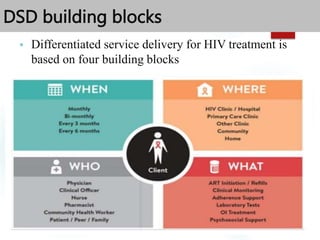
DSD building blocks
 Differentiated service delivery for HIV treatment is
based on four building blocks
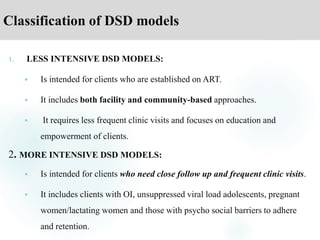
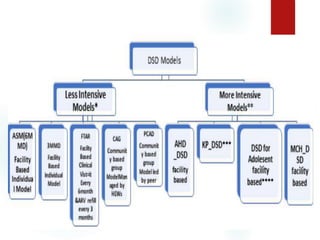
Classification of DSD models
1. LESS INTENSIVE DSD MODELS:
 Is intended for clients who are established on ART.
 It includes both facility and community-based approaches.
 It requires less frequent clinic visits and focuses on education and
empowerment of clients.
2. MORE INTENSIVE DSD MODELS:
 Is intended for clients who need close follow up and frequent clinic visits.
 It includes clients with OI, unsuppressed viral load adolescents, pregnant
women/lactating women and those with psycho social barriers to adhere
and retention.
Eligibility criteria for less intensive DSD models
 Patients who are on ART at least six months
 No current illness, which does not include well-controlled
chronic health conditions
 Good understanding of lifelong adherence; adequate adherence
counseling provided (a patient with adherence of 95% for the last 6
months)
 Evidence of treatment success (at least one suppressed viral load
result (i.e. < 50 c/ml) and if no Viral Load result, a patient with
CD4 cell count above 200 cells/millimeter cubes).
Eligibility criteria for less intensive DSD models…
 Children with age greater than five years
 A Patient who doesn’t have current Opportunistic
Infections
 A Patient with no adverse drug reactions and doesn’t
need careful clinical monitoring.
 A Patient who is willing or provide consent to get the
ART service based on his/her preferred DSD models.
Appointment Spacing Model (ASM/6MMD)
 Stable clients will be appointed every six months for clinical visit
and medication refill.
 Clients in this model should get additional supports like arrangement
of treatment supporter at home level among their family members
 Arrangement of adherence reminders like alarm and education on
how to maintain the drug quality at home level.
 Clients should be counseled and encouraged to disclose their
status and to participate in peer support groups or to be a member
of PLHIV associations.
Three Months ARV Dispensing (3MMD)
 Clients who are eligible but not willing to be enrolled in 6 MMD
(ASM) will be appointed every three months for both clinical
visit and medication refill.
 For clients requiring Cotrimoxazole, a 3-6-month supply should
be provided at the same time as ART pickup. TPT should also be
given in multi-month intervals at the same time as ART pickup.
Fast Track ARV Drugs Refill Model
 FTAR is one of the facility based Differentiated Service
Delivery Models of HIV care where patients categorized as
stable make clinical visit once every six months but collect
their medication every three months from pharmacy
 The facility-based fast track system for ART refills can
provide an opportunity for those ASM clients who, for
various reasons, faced difficulty in taking all of the prescribed
six-months of ARV drugs to their home at once from the ART
pharmacy as in the ASM framework.
Health Extension Professional Managed Community ART refill
group (HEP_CAG)
 Community ART refill groups (CAGs) are groups comprising of stable
clients on ART living in the same community/locality that have a shared
understanding.
 This model is managed by health extension professionals who already have
roles in HIV testing and other HIV service provision as one of their
packages.
 The ART refill is for three months and each CAG will have one community
refill in between the heath facility visits that will happen every six months.
 Clients can return or referred to the facility at any point in the cycle for any
issues that may arise between scheduled health facility visits.
Peer lead community based ART distribution/Group (PCAD/G
 The peer led Community based ART distribution (PCAD) groups are groups of
PLHIV comprising of stable clients living in the same community/ locality.
 In PCAD, group members will take turns to pick up ARVs at the health
facility and distribute among the other group members in the community.
 Each client will get clinical evaluation and lab monitoring service as per the
standard of care package.
 They will manage their own health and take action with the support of
community and facility-based healthcare workers and this will help to align
with the clinical consultation visits at health facilities as the recommended, in
our set up is every six months.
More intensive DSD models
 DSD for adolescents has three core elements which
include
 ART refill,
 Clinical consultation and
 Psychosocial support.
 This model is coordinated by trained health care workers
(HCWs), and regularly meet on weekends and share
psychosocial supports.
DSD for adolescents
 During this peer session, adolescents interact, learn and share
experience among their peers and from facilitators.
 Understanding the treatment, adherence to treatment and viral
suppression are main parts of their discussion.
 Making the clinical, ARV refill and viral load monitoring service
available over the weekends together with the psychosocial
support program will make comprehensive HIV service a one stop
shopping model for adolescents living with HIV.
Eligibility criteria for Adolescent clients on DSD model:
 Adolescent clients who disclosed their HIV status and
willing or provide consent to get the ART service based on his
or her preferred DSD models.
 Health care facility where there is functional OTZ/pediatric
psychosocial support program,
 Adolescents, 10- 19 years, fully disclosed, enrolled in the
pediatric psychosocial support/OTZ program,
 No restriction on stability- including both with suppressed
and unsuppressed viral load test result
DSD for key population (for FSWs)
» Designing person-centered DSD prevention, testing/linkage, and
treatment models that are attuned to the issues of stigma and
access specific to FSW will be critical to ensuring equity
and achieving HIV epidemic control.
» Confidentiality clinics and drop in centers (DICs)
Differentiated Service Delivery (DSD) in PMTCT
PMTCT DSD includes the following activities
1. Multi Month Dispensing (3MMD) for PMTCT
2. Point of Care (POC) for VL Testing , among Pregnant
/BF Women
3. Point of Care (POC) EID for HEIs
4. Family Planning integration
DSD for Advanced HIV Disease
 All HIV positive patients with
 CD4 cell count <200 cells/mm3 OR
 WHO clinical stage 3 or 4 disease aged more than five years
 All children younger than five years old with HIV are
considered as having advanced HIV disease
 For patients with advanced HIV disease, the frequency
of clinical visit is recommended every month.
Burden of AHD
 In Ethiopia,
 Among adults aged 15-64 years living with HIV, 35.8% had
immunosuppression with CD4 count less than 350 cells/mm3
 Among adults who reported they were unaware of their HIV-positive
status, 22.0% had severe immunosuppression—a CD4 count less than
200 cells/mm3
 33% of newly enrolled adult clients were assessed as having WHO
Stage III or IV at presentation
 A significant proportion of AIDS related deaths are attributed
to advanced HIV Disease.
 TB and CCM are the major causes of AIDS related mortality
Components to consider when designing a
DSD model for advanced HIV
Consider the building blocks (when, where, who and what) for each
of the following components of a service delivery model for
advanced HIV:
© Identifying advanced HIV disease
© Clinical package to screen, prevent and treat advanced HIV disease
© Rapid ART initiation/ or regimen switch
© Linkage to ongoing care
© Post initiation/ switch follow up
CD4 count testing criteria to diagnose AHD and
determine eligibility for the AHD package
For new clients initiating ART
 At baseline for all PLHIV.
For those who are treatment experienced:
 Reengaged to treatment after 28 days or greater of ART
interruption.
 Children under five years of age on ART.
 Persistent unsuppressed viral load (two viral load VL
>1,000 within 3-6 months).
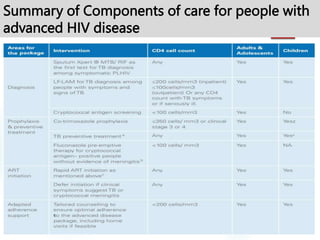
Summary of Components of care for people with
advanced HIV disease
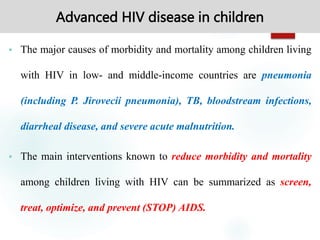
Advanced HIV disease in children
 The major causes of morbidity and mortality among children living
with HIV in low- and middle-income countries are pneumonia
(including P. Jirovecii pneumonia), TB, bloodstream infections,
diarrheal disease, and severe acute malnutrition.
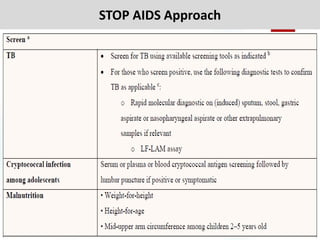
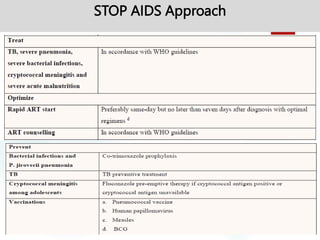
 The main interventions known to reduce morbidity and mortality
among children living with HIV can be summarized as screen,
treat, optimize, and prevent (STOP) AIDS.
STOP AIDS Approach
STOP AIDS Approach
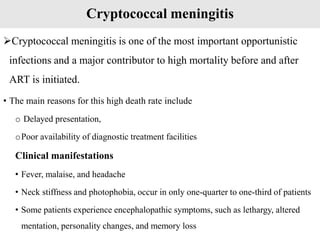
Cryptococcal meningitis
Cryptococcal meningitis is one of the most important opportunistic
infections and a major contributor to high mortality before and after
ART is initiated.
• The main reasons for this high death rate include
o Delayed presentation,
oPoor availability of diagnostic treatment facilities
Clinical manifestations
• Fever, malaise, and headache
• Neck stiffness and photophobia, occur in only one-quarter to one-third of patients
• Some patients experience encephalopathic symptoms, such as lethargy, altered
mentation, personality changes, and memory loss
Diagnosis
 The opening pressure may be markedly elevated.
 CSF analysis
 Protein 30-150 mg/dl
 WBC 0-100 /mm3 (monocyte)
 Culture positive 95-100%
 Indian ink positive 60-80%
 Cryptococcal Ag > 95 % sensitive and specific
Management of Cryptococcal meningitis
Induction phase:- Rapidly clear the organism from the body
• A single high dose (10 mg/kg) of Liposomal Amphotericin B with 14 days of
flucytosine (100 mg/kg per day divided into four doses per day) and
fluconazole (1200 mg/daily for adults; 12 mg/kg per day for children and
adolescents up to a maximum of 800 mg daily) should be used as the
preferred induction regimen.
If Liposomal Amphotericin B is not available:
• A short-course (one-week) induction regimen with Amphotericin B
deoxycholate (1.0 mg/kg per day) and flucytosine (100 mg/kg per day,
divided into four doses per day) followed by 1 week of fluconazole (1200
mg/day for adults, 12 mg/kg/day for children and adolescents, up to a
maximum dose of 800mg daily
Management of Cryptococcal meningitis
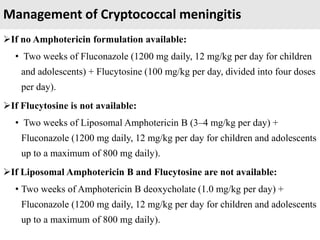
If no Amphotericin formulation available:
• Two weeks of Fluconazole (1200 mg daily, 12 mg/kg per day for children
and adolescents) + Flucytosine (100 mg/kg per day, divided into four doses
per day).
If Flucytosine is not available:
• Two weeks of Liposomal Amphotericin B (3–4 mg/kg per day) +
Fluconazole (1200 mg daily, 12 mg/kg per day for children and adolescents
up to a maximum of 800 mg daily).
If Liposomal Amphotericin B and Flucytosine are not available:
• Two weeks of Amphotericin B deoxycholate (1.0 mg/kg per day) +
Fluconazole (1200 mg daily, 12 mg/kg per day for children and adolescents
up to a maximum of 800 mg daily).
Consolidation phase
 Ensure disease is fully suppressed
 Fluconazole (400–800 mg daily for adults or 6–12 mg/kg
per day for children and adolescents up to a maximum of 800
mg daily) is recommended for the consolidation phase (for
eight weeks following the induction phase).
Maintenance phase(or secondary prophylaxis)
Prevents recurrence of disease after treatment; this phase is also
known as secondary prophylaxis
Fluconazole (200 mg daily for adults or 6 mg/kg per day for
adolescents and children) is recommended for the maintenance phase.
Discontinuation of maintenance treatment will be when
 Patients are stable
 Adherent to ART and anti-fungal maintenance treatment for at
least one year and
 Have a CD4 cell count of greater than or equal to 200 cells/mm3
(two measurements six months apart).
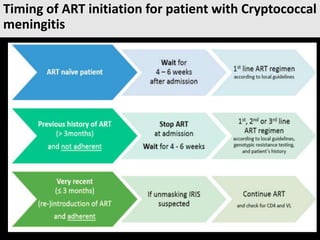
Timing of ART initiation for patient with Cryptococcal
meningitis
Immediate ART initiation is not recommended among adults,
adolescents and children living with HIV who have cryptococcal
meningitis because of the risk of increased mortality and should be
deferred 4–6 weeks from the initiation of antifungal treatment.
Paradoxical cryptococcal immune reconstitution inflammatory
syndrome occurs among 10–50% of people with cryptococcal disease
initiating ART and is associated with high mortality
Timing of ART initiation for patient with Cryptococcal
meningitis
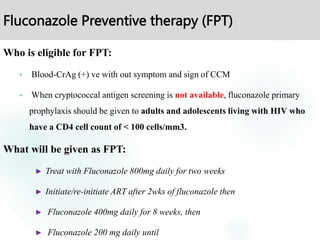
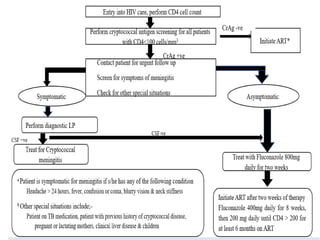
Fluconazole Preventive therapy (FPT)
Who is eligible for FPT:
 Blood-CrAg (+) ve with out symptom and sign of CCM
 When cryptococcal antigen screening is not available, fluconazole primary
prophylaxis should be given to adults and adolescents living with HIV who
have a CD4 cell count of < 100 cells/mm3.
What will be given as FPT:
► Treat with Fluconazole 800mg daily for two weeks
► Initiate/re-initiate ART after 2wks of fluconazole then
► Fluconazole 400mg daily for 8 weeks, then
► Fluconazole 200 mg daily until
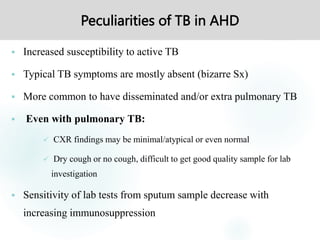
Peculiarities of TB in AHD
 Increased susceptibility to active TB
 Typical TB symptoms are mostly absent (bizarre Sx)
 More common to have disseminated and/or extra pulmonary TB
 Even with pulmonary TB:
 CXR findings may be minimal/atypical or even normal
 Dry cough or no cough, difficult to get good quality sample for lab
investigation
 Sensitivity of lab tests from sputum sample decrease with
increasing immunosuppression
TB dx by LF_LAM
 Lipoarabinomannan (LAM) is;
 Released from metabolically active or those that are being
degraded bacteria
 It has structural epitopes that are unique to MTB
 LAM is found in blood and sputum as well as in urine but
 WHO approved only urine for TB diagnostic test by Urine LF-LAM test
 LAM levels in urine are known to be elevated in people with HIV–
TB co-infection, and increase as CD4 counts decrease
Criteria for eligibility for Urine LF-LAM testing
 All PLHIV with signs and symptoms of TB (pulmonary and/or
extra-pulmonary) or
 Seriously ill or
 Irrespective of signs and symptoms of TB who have a CD4 cell
count of less than
» Out patient setting: CD4≤100 cells/mm3
» Inpatient Settings: CD4< 200 cells/mm3
 All under five children
Pneumocystis pneumonia (PCP)
 Pneumocystis pneumonia is caused by Pneumocystis jirovecii
Clinical presentations
 History
 Insidious onset of low-grade fever, dry cough, dyspnea exacerbated by exertion.
 Physical examination reveals
 Fever, Tachypnea & tachycardia, scattered rales in the lungs, but examination of
the lungs can appear normal in some patients.
 In children highest incidence is seen between 2-6 months of age and is
characterized by abrupt onset of fever, tachypnea, dyspnea and cyanosis
Diagnosis of PCP
 Presumptive diagnosis of PCP is based on clinical judgment and typical chest X-
ray finding revealing a peri-hilar interstitial infiltration with tendency to spread
outwards
 Note that the chest X-ray can be normal in 20% of patients
 Definitive diagnosis of PCP is based on demonstration of the organism from an
induced sputum sample using special stains like Giemsa stain
 Treatment
Use Trimethoprim 15-25 mg/kg, three or four times daily for 21 days.
 In severely ill patients with marked respiratory distress prednisolone has to be
given simultaneously
Toxoplasmic encephalitis (TE)
 Toxoplasmic encephalitis (TE) is caused by the protozoan
Toxoplasma gondii.
 Disease appears to occur almost exclusively because of
reactivation of latent tissue cysts
Clinical Manifestations
 The most common clinical presentation of T. gondii infection is
 Focal encephalitis with headache, confusion, or motor weakness
and fever.
 Patients may also present with non-focal manifestations, including
only non-specific headache and psychiatric symptoms.
 Focal neurological abnormalities may be present on physical
examination, and
 In the absence of treatment, disease progression results in seizures,
stupor, and coma.
Diagnosis
 HIV-infected patients with TE are almost uniformly seropositive for anti-
toxoplasma immunoglobulin G (IgG) antibodies.
 Anti-toxoplasma immunoglobulin M (IgM) antibodies usually are absent.
 Diagnosis of CNS toxoplasmosis requires
o a compatible clinical syndrome;
o identification of one or more mass lesions by CT, MRI, or other
radiographic testing; and
o detection of the organism in a clinical sample..
Diagnosis…
 In the absence of imaging support, empirical
treatment is justified when patients present with
focal neurological findings and the CD4 count is <
200 cells μL.
 Failure to respond to conventional therapy, based
on presumptive clinical diagnosis within a week or
two of initiation of therapy, suggests the diagnosis
to be unlikely
Treatment
 Trimethoprim/sulfamethoxazole 80/400, oral, 4 tablets 12 hourly
for 28 days, followed by 2 tablets 12 hourly for 3 months in adults.
 Children: 10mg of trimethoprim + 50mg of sulfamethoxazole/kg
per dose every 12 hours for 28 days followed by maintenance
therapy at 50% reduced dosage for three months.
 Adjunctive corticosteroids should be used for patients with
radiographic evidence of midline shift, signs of critically elevated
intracranial pressure or clinical deterioration within the first 48
hours of therapy
 Secondary prophylaxis: use co-trimoxazole 960mg daily for
adults
THANK YOU

Differenciated Service Delivery model.pptx

  • 1.
    Differentiated service delivery-Advanced HIVdisease(DSD) March / 2024 Chagni
  • 2.
    Presentation Outline  Introductionon DSD Model  Rational for DSD model implementation  Classification of DSD models  Eligibility criteria  DSD for Advanced HIV Disease  LF_LAM testing for RVI clients  Update on Common OI diagnosis and Mx  Cryptococcal meningitis  PCP  CNS Toxoplasmosis
  • 3.
    Introduction-What is differentiatedcare? Client-centered:  Differentiated care is a client- centered approach that simplifies and adapts HIV services across the cascade to reflect the preferences and expectations of various groups of people living with HIV.  It reduces unnecessary burdens on the health system.  The health system can refocus resources to those most in need.
  • 4.
    Rationale... To reach 95-95-95: Clients who are not currently on treatment need to access ART within a service delivery model that meets their needs and expectations.  Different packages of care are essential to address these diverse needs –it’s time to deliver differently.  Differentiated care applies across the HIV continuum to all the 95-95-95 targets
  • 5.
    DSD building blocks Differentiated service delivery for HIV treatment is based on four building blocks
  • 6.
    Classification of DSDmodels 1. LESS INTENSIVE DSD MODELS:  Is intended for clients who are established on ART.  It includes both facility and community-based approaches.  It requires less frequent clinic visits and focuses on education and empowerment of clients. 2. MORE INTENSIVE DSD MODELS:  Is intended for clients who need close follow up and frequent clinic visits.  It includes clients with OI, unsuppressed viral load adolescents, pregnant women/lactating women and those with psycho social barriers to adhere and retention.
  • 8.
    Eligibility criteria forless intensive DSD models  Patients who are on ART at least six months  No current illness, which does not include well-controlled chronic health conditions  Good understanding of lifelong adherence; adequate adherence counseling provided (a patient with adherence of 95% for the last 6 months)  Evidence of treatment success (at least one suppressed viral load result (i.e. < 50 c/ml) and if no Viral Load result, a patient with CD4 cell count above 200 cells/millimeter cubes).
  • 9.
    Eligibility criteria forless intensive DSD models…  Children with age greater than five years  A Patient who doesn’t have current Opportunistic Infections  A Patient with no adverse drug reactions and doesn’t need careful clinical monitoring.  A Patient who is willing or provide consent to get the ART service based on his/her preferred DSD models.
  • 10.
    Appointment Spacing Model(ASM/6MMD)  Stable clients will be appointed every six months for clinical visit and medication refill.  Clients in this model should get additional supports like arrangement of treatment supporter at home level among their family members  Arrangement of adherence reminders like alarm and education on how to maintain the drug quality at home level.  Clients should be counseled and encouraged to disclose their status and to participate in peer support groups or to be a member of PLHIV associations.
  • 11.
    Three Months ARVDispensing (3MMD)  Clients who are eligible but not willing to be enrolled in 6 MMD (ASM) will be appointed every three months for both clinical visit and medication refill.  For clients requiring Cotrimoxazole, a 3-6-month supply should be provided at the same time as ART pickup. TPT should also be given in multi-month intervals at the same time as ART pickup.
  • 12.
    Fast Track ARVDrugs Refill Model  FTAR is one of the facility based Differentiated Service Delivery Models of HIV care where patients categorized as stable make clinical visit once every six months but collect their medication every three months from pharmacy  The facility-based fast track system for ART refills can provide an opportunity for those ASM clients who, for various reasons, faced difficulty in taking all of the prescribed six-months of ARV drugs to their home at once from the ART pharmacy as in the ASM framework.
  • 13.
    Health Extension ProfessionalManaged Community ART refill group (HEP_CAG)  Community ART refill groups (CAGs) are groups comprising of stable clients on ART living in the same community/locality that have a shared understanding.  This model is managed by health extension professionals who already have roles in HIV testing and other HIV service provision as one of their packages.  The ART refill is for three months and each CAG will have one community refill in between the heath facility visits that will happen every six months.  Clients can return or referred to the facility at any point in the cycle for any issues that may arise between scheduled health facility visits.
  • 14.
    Peer lead communitybased ART distribution/Group (PCAD/G  The peer led Community based ART distribution (PCAD) groups are groups of PLHIV comprising of stable clients living in the same community/ locality.  In PCAD, group members will take turns to pick up ARVs at the health facility and distribute among the other group members in the community.  Each client will get clinical evaluation and lab monitoring service as per the standard of care package.  They will manage their own health and take action with the support of community and facility-based healthcare workers and this will help to align with the clinical consultation visits at health facilities as the recommended, in our set up is every six months.
  • 15.
    More intensive DSDmodels  DSD for adolescents has three core elements which include  ART refill,  Clinical consultation and  Psychosocial support.  This model is coordinated by trained health care workers (HCWs), and regularly meet on weekends and share psychosocial supports.
  • 16.
    DSD for adolescents During this peer session, adolescents interact, learn and share experience among their peers and from facilitators.  Understanding the treatment, adherence to treatment and viral suppression are main parts of their discussion.  Making the clinical, ARV refill and viral load monitoring service available over the weekends together with the psychosocial support program will make comprehensive HIV service a one stop shopping model for adolescents living with HIV.
  • 17.
    Eligibility criteria forAdolescent clients on DSD model:  Adolescent clients who disclosed their HIV status and willing or provide consent to get the ART service based on his or her preferred DSD models.  Health care facility where there is functional OTZ/pediatric psychosocial support program,  Adolescents, 10- 19 years, fully disclosed, enrolled in the pediatric psychosocial support/OTZ program,  No restriction on stability- including both with suppressed and unsuppressed viral load test result
  • 18.
    DSD for keypopulation (for FSWs) » Designing person-centered DSD prevention, testing/linkage, and treatment models that are attuned to the issues of stigma and access specific to FSW will be critical to ensuring equity and achieving HIV epidemic control. » Confidentiality clinics and drop in centers (DICs)
  • 19.
    Differentiated Service Delivery(DSD) in PMTCT PMTCT DSD includes the following activities 1. Multi Month Dispensing (3MMD) for PMTCT 2. Point of Care (POC) for VL Testing , among Pregnant /BF Women 3. Point of Care (POC) EID for HEIs 4. Family Planning integration
  • 20.
    DSD for AdvancedHIV Disease  All HIV positive patients with  CD4 cell count <200 cells/mm3 OR  WHO clinical stage 3 or 4 disease aged more than five years  All children younger than five years old with HIV are considered as having advanced HIV disease  For patients with advanced HIV disease, the frequency of clinical visit is recommended every month.
  • 21.
    Burden of AHD In Ethiopia,  Among adults aged 15-64 years living with HIV, 35.8% had immunosuppression with CD4 count less than 350 cells/mm3  Among adults who reported they were unaware of their HIV-positive status, 22.0% had severe immunosuppression—a CD4 count less than 200 cells/mm3  33% of newly enrolled adult clients were assessed as having WHO Stage III or IV at presentation  A significant proportion of AIDS related deaths are attributed to advanced HIV Disease.  TB and CCM are the major causes of AIDS related mortality
  • 22.
    Components to considerwhen designing a DSD model for advanced HIV Consider the building blocks (when, where, who and what) for each of the following components of a service delivery model for advanced HIV: © Identifying advanced HIV disease © Clinical package to screen, prevent and treat advanced HIV disease © Rapid ART initiation/ or regimen switch © Linkage to ongoing care © Post initiation/ switch follow up
  • 23.
    CD4 count testingcriteria to diagnose AHD and determine eligibility for the AHD package For new clients initiating ART  At baseline for all PLHIV. For those who are treatment experienced:  Reengaged to treatment after 28 days or greater of ART interruption.  Children under five years of age on ART.  Persistent unsuppressed viral load (two viral load VL >1,000 within 3-6 months).
  • 24.
    Summary of Componentsof care for people with advanced HIV disease
  • 25.
    Advanced HIV diseasein children  The major causes of morbidity and mortality among children living with HIV in low- and middle-income countries are pneumonia (including P. Jirovecii pneumonia), TB, bloodstream infections, diarrheal disease, and severe acute malnutrition.  The main interventions known to reduce morbidity and mortality among children living with HIV can be summarized as screen, treat, optimize, and prevent (STOP) AIDS.
  • 26.
  • 27.
  • 28.
    Cryptococcal meningitis Cryptococcal meningitisis one of the most important opportunistic infections and a major contributor to high mortality before and after ART is initiated. • The main reasons for this high death rate include o Delayed presentation, oPoor availability of diagnostic treatment facilities Clinical manifestations • Fever, malaise, and headache • Neck stiffness and photophobia, occur in only one-quarter to one-third of patients • Some patients experience encephalopathic symptoms, such as lethargy, altered mentation, personality changes, and memory loss
  • 29.
    Diagnosis  The openingpressure may be markedly elevated.  CSF analysis  Protein 30-150 mg/dl  WBC 0-100 /mm3 (monocyte)  Culture positive 95-100%  Indian ink positive 60-80%  Cryptococcal Ag > 95 % sensitive and specific
  • 30.
    Management of Cryptococcalmeningitis Induction phase:- Rapidly clear the organism from the body • A single high dose (10 mg/kg) of Liposomal Amphotericin B with 14 days of flucytosine (100 mg/kg per day divided into four doses per day) and fluconazole (1200 mg/daily for adults; 12 mg/kg per day for children and adolescents up to a maximum of 800 mg daily) should be used as the preferred induction regimen. If Liposomal Amphotericin B is not available: • A short-course (one-week) induction regimen with Amphotericin B deoxycholate (1.0 mg/kg per day) and flucytosine (100 mg/kg per day, divided into four doses per day) followed by 1 week of fluconazole (1200 mg/day for adults, 12 mg/kg/day for children and adolescents, up to a maximum dose of 800mg daily
  • 31.
    Management of Cryptococcalmeningitis If no Amphotericin formulation available: • Two weeks of Fluconazole (1200 mg daily, 12 mg/kg per day for children and adolescents) + Flucytosine (100 mg/kg per day, divided into four doses per day). If Flucytosine is not available: • Two weeks of Liposomal Amphotericin B (3–4 mg/kg per day) + Fluconazole (1200 mg daily, 12 mg/kg per day for children and adolescents up to a maximum of 800 mg daily). If Liposomal Amphotericin B and Flucytosine are not available: • Two weeks of Amphotericin B deoxycholate (1.0 mg/kg per day) + Fluconazole (1200 mg daily, 12 mg/kg per day for children and adolescents up to a maximum of 800 mg daily).
  • 32.
    Consolidation phase  Ensuredisease is fully suppressed  Fluconazole (400–800 mg daily for adults or 6–12 mg/kg per day for children and adolescents up to a maximum of 800 mg daily) is recommended for the consolidation phase (for eight weeks following the induction phase).
  • 33.
    Maintenance phase(or secondaryprophylaxis) Prevents recurrence of disease after treatment; this phase is also known as secondary prophylaxis Fluconazole (200 mg daily for adults or 6 mg/kg per day for adolescents and children) is recommended for the maintenance phase. Discontinuation of maintenance treatment will be when  Patients are stable  Adherent to ART and anti-fungal maintenance treatment for at least one year and  Have a CD4 cell count of greater than or equal to 200 cells/mm3 (two measurements six months apart).
  • 34.
    Timing of ARTinitiation for patient with Cryptococcal meningitis Immediate ART initiation is not recommended among adults, adolescents and children living with HIV who have cryptococcal meningitis because of the risk of increased mortality and should be deferred 4–6 weeks from the initiation of antifungal treatment. Paradoxical cryptococcal immune reconstitution inflammatory syndrome occurs among 10–50% of people with cryptococcal disease initiating ART and is associated with high mortality
  • 35.
    Timing of ARTinitiation for patient with Cryptococcal meningitis
  • 36.
    Fluconazole Preventive therapy(FPT) Who is eligible for FPT:  Blood-CrAg (+) ve with out symptom and sign of CCM  When cryptococcal antigen screening is not available, fluconazole primary prophylaxis should be given to adults and adolescents living with HIV who have a CD4 cell count of < 100 cells/mm3. What will be given as FPT: ► Treat with Fluconazole 800mg daily for two weeks ► Initiate/re-initiate ART after 2wks of fluconazole then ► Fluconazole 400mg daily for 8 weeks, then ► Fluconazole 200 mg daily until
  • 38.
    Peculiarities of TBin AHD  Increased susceptibility to active TB  Typical TB symptoms are mostly absent (bizarre Sx)  More common to have disseminated and/or extra pulmonary TB  Even with pulmonary TB:  CXR findings may be minimal/atypical or even normal  Dry cough or no cough, difficult to get good quality sample for lab investigation  Sensitivity of lab tests from sputum sample decrease with increasing immunosuppression
  • 39.
    TB dx byLF_LAM  Lipoarabinomannan (LAM) is;  Released from metabolically active or those that are being degraded bacteria  It has structural epitopes that are unique to MTB  LAM is found in blood and sputum as well as in urine but  WHO approved only urine for TB diagnostic test by Urine LF-LAM test  LAM levels in urine are known to be elevated in people with HIV– TB co-infection, and increase as CD4 counts decrease
  • 40.
    Criteria for eligibilityfor Urine LF-LAM testing  All PLHIV with signs and symptoms of TB (pulmonary and/or extra-pulmonary) or  Seriously ill or  Irrespective of signs and symptoms of TB who have a CD4 cell count of less than » Out patient setting: CD4≤100 cells/mm3 » Inpatient Settings: CD4< 200 cells/mm3  All under five children
  • 41.
    Pneumocystis pneumonia (PCP) Pneumocystis pneumonia is caused by Pneumocystis jirovecii Clinical presentations  History  Insidious onset of low-grade fever, dry cough, dyspnea exacerbated by exertion.  Physical examination reveals  Fever, Tachypnea & tachycardia, scattered rales in the lungs, but examination of the lungs can appear normal in some patients.  In children highest incidence is seen between 2-6 months of age and is characterized by abrupt onset of fever, tachypnea, dyspnea and cyanosis
  • 42.
    Diagnosis of PCP Presumptive diagnosis of PCP is based on clinical judgment and typical chest X- ray finding revealing a peri-hilar interstitial infiltration with tendency to spread outwards  Note that the chest X-ray can be normal in 20% of patients  Definitive diagnosis of PCP is based on demonstration of the organism from an induced sputum sample using special stains like Giemsa stain  Treatment Use Trimethoprim 15-25 mg/kg, three or four times daily for 21 days.  In severely ill patients with marked respiratory distress prednisolone has to be given simultaneously
  • 43.
    Toxoplasmic encephalitis (TE) Toxoplasmic encephalitis (TE) is caused by the protozoan Toxoplasma gondii.  Disease appears to occur almost exclusively because of reactivation of latent tissue cysts
  • 44.
    Clinical Manifestations  Themost common clinical presentation of T. gondii infection is  Focal encephalitis with headache, confusion, or motor weakness and fever.  Patients may also present with non-focal manifestations, including only non-specific headache and psychiatric symptoms.  Focal neurological abnormalities may be present on physical examination, and  In the absence of treatment, disease progression results in seizures, stupor, and coma.
  • 45.
    Diagnosis  HIV-infected patientswith TE are almost uniformly seropositive for anti- toxoplasma immunoglobulin G (IgG) antibodies.  Anti-toxoplasma immunoglobulin M (IgM) antibodies usually are absent.  Diagnosis of CNS toxoplasmosis requires o a compatible clinical syndrome; o identification of one or more mass lesions by CT, MRI, or other radiographic testing; and o detection of the organism in a clinical sample..
  • 46.
    Diagnosis…  In theabsence of imaging support, empirical treatment is justified when patients present with focal neurological findings and the CD4 count is < 200 cells μL.  Failure to respond to conventional therapy, based on presumptive clinical diagnosis within a week or two of initiation of therapy, suggests the diagnosis to be unlikely
  • 47.
    Treatment  Trimethoprim/sulfamethoxazole 80/400,oral, 4 tablets 12 hourly for 28 days, followed by 2 tablets 12 hourly for 3 months in adults.  Children: 10mg of trimethoprim + 50mg of sulfamethoxazole/kg per dose every 12 hours for 28 days followed by maintenance therapy at 50% reduced dosage for three months.  Adjunctive corticosteroids should be used for patients with radiographic evidence of midline shift, signs of critically elevated intracranial pressure or clinical deterioration within the first 48 hours of therapy  Secondary prophylaxis: use co-trimoxazole 960mg daily for adults
  • 48.