USING EXAM SOFT TO
REMEDIATE THE
NURSING STUDENT FOR
SUCCESS
Laura Logan, MSN, RN, CCRN
SO YOU HAVE A FACE WITH A
NAME.
INFORM STUDENTS OF THE
EXPECTATIONS
 Passing score is: 75 or greater.
 Expect a drug calculation question first!
 
WHERE TO START
 Use the Opportunities and Strengths Report to show the student where these are
present.
 Require students who are at risk or have failed the exam to review the incorrect items
no later than the next exam, with the faculty.
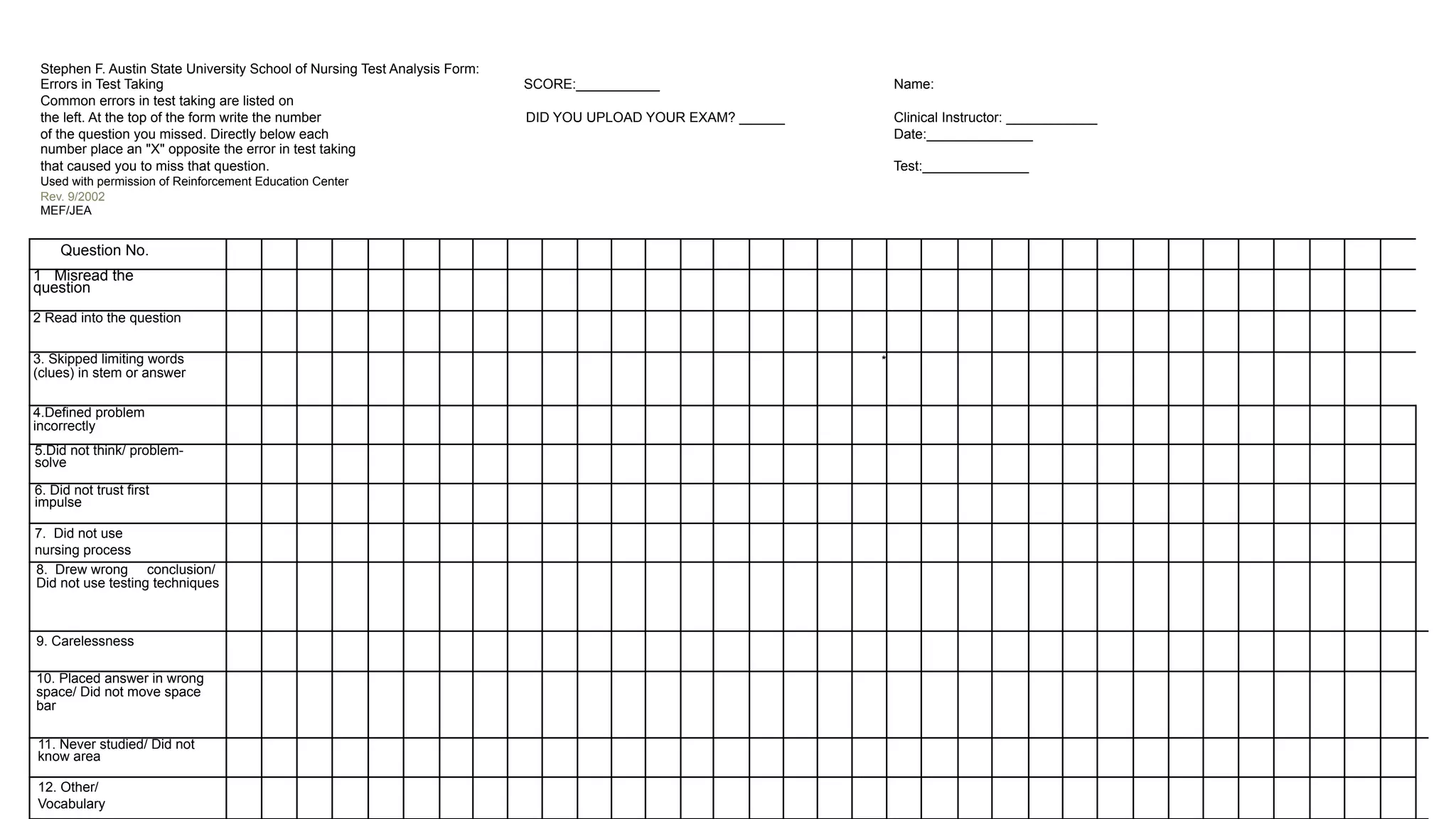
 After each exam, require the students to complete an item analysis form.
Question No.
1 Misread the
question
2 Read into the question
3. Skipped limiting words
(clues) in stem or answer
*
4.Defined problem
incorrectly
5.Did not think/ problem-
solve
6. Did not trust first
impulse
7. Did not use
nursing process
8. Drew wrong conclusion/
Did not use testing techniques
9. Carelessness
10. Placed answer in wrong
space/ Did not move space
bar
11. Never studied/ Did not
know area
12. Other/
Vocabulary
Stephen F. Austin State University School of Nursing Test Analysis Form:
Errors in Test Taking SCORE:___________ Name:
Common errors in test taking are listed on
the left. At the top of the form write the number DID YOU UPLOAD YOUR EXAM? ______ Clinical Instructor: ____________
of the question you missed. Directly below each Date:______________
number place an "X" opposite the error in test taking
that caused you to miss that question. Test:______________
Used with permission of Reinforcement Education Center
Rev. 9/2002
MEF/JEA
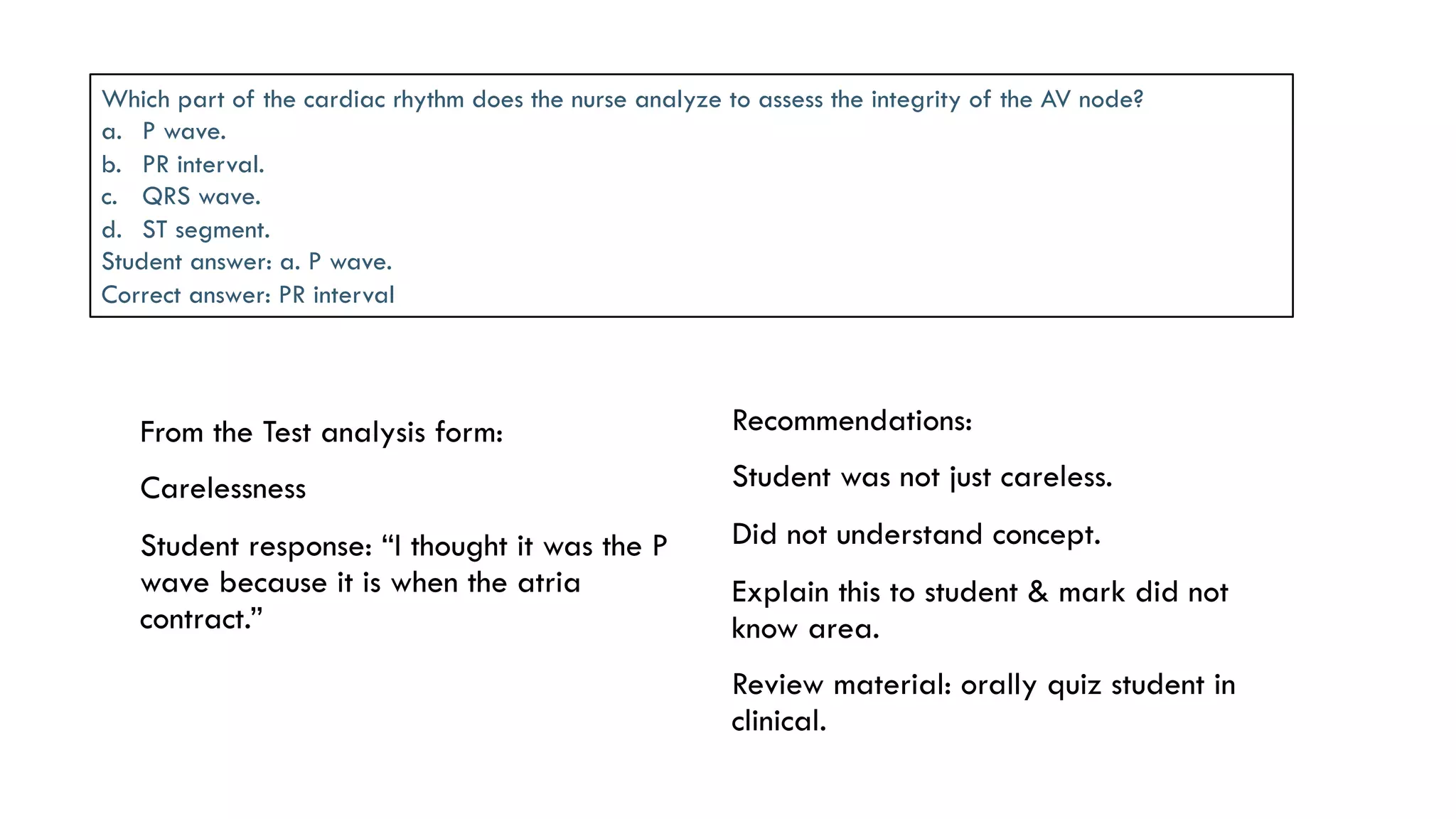
 From the Test analysis form:
 Carelessness
 Student response: “I thought it was the P
wave because it is when the atria
contract.”
 Recommendations:
 Student was not just careless.
 Did not understand concept.
 Explain this to student & mark did not
know area.
 Review material: orally quiz student in
clinical.
Which part of the cardiac rhythm does the nurse analyze to assess the integrity of the AV node?
a.  P wave.
b.  PR interval.
c.  QRS wave.
d.  ST segment.
Student answer: a. P wave.
Correct answer: PR interval
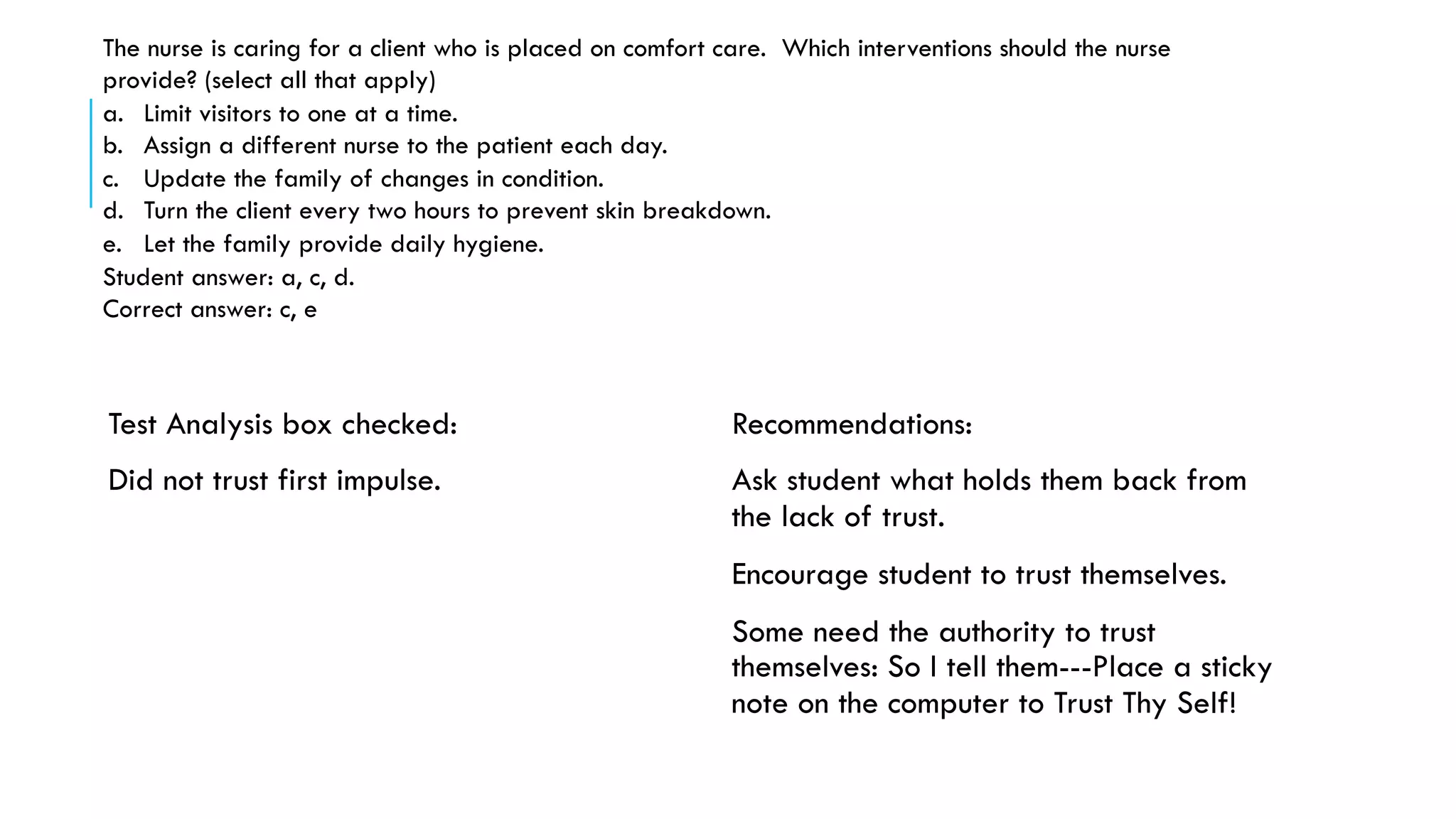
 Test Analysis box checked:
 Did not trust first impulse.
 Recommendations:
 Ask student what holds them back from
the lack of trust.
 Encourage student to trust themselves.
 Some need the authority to trust
themselves: So I tell them---Place a sticky
note on the computer to Trust Thy Self!
The nurse is caring for a client who is placed on comfort care. Which interventions should the nurse
provide? (select all that apply)
a.  Limit visitors to one at a time.
b.  Assign a different nurse to the patient each day.
c.  Update the family of changes in condition.
d.  Turn the client every two hours to prevent skin breakdown.
e.  Let the family provide daily hygiene.
Student answer: a, c, d.
Correct answer: c, e
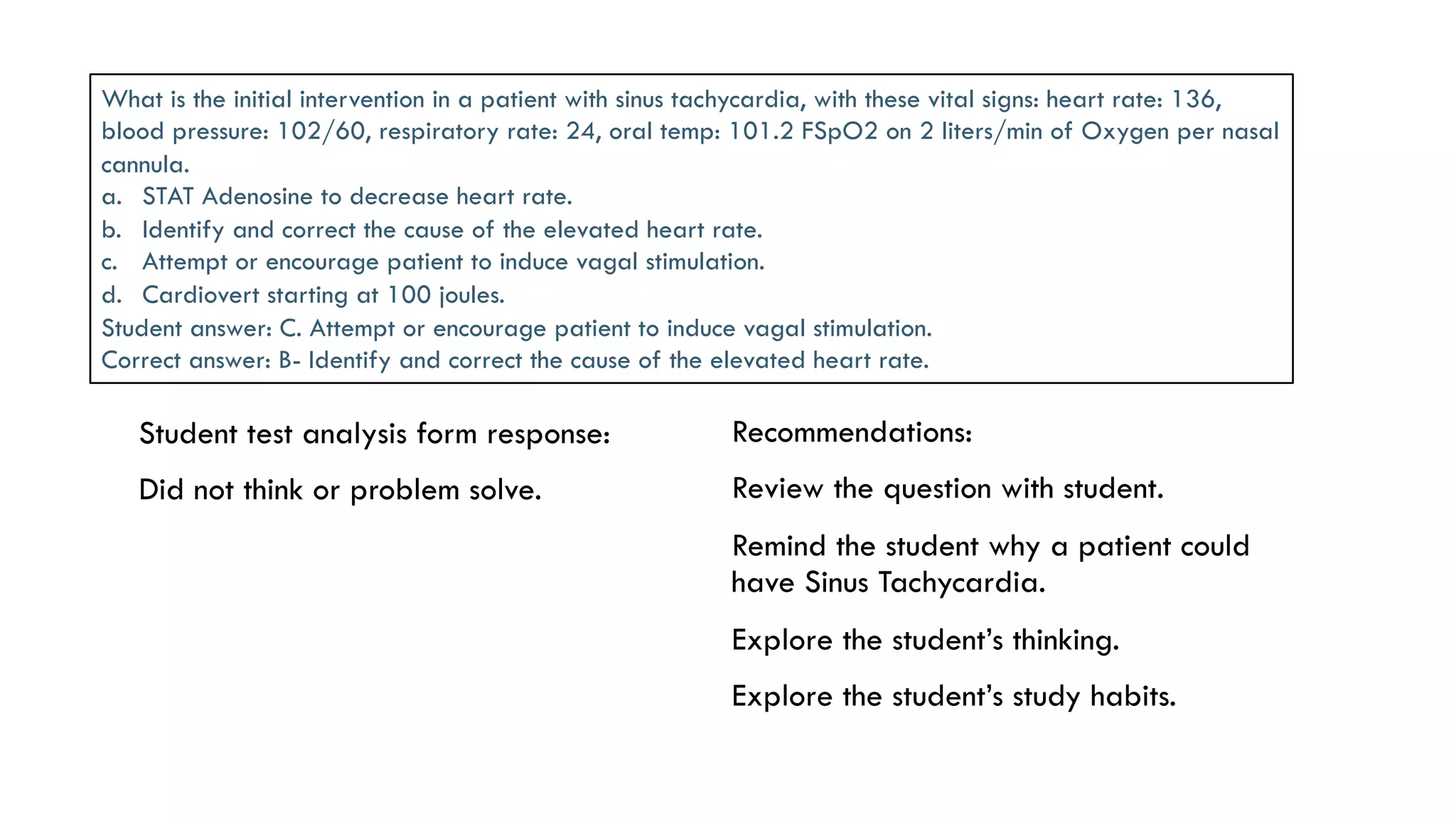
 Student test analysis form response:
 Did not think or problem solve.
 Recommendations:
 Review the question with student.
 Remind the student why a patient could
have Sinus Tachycardia.
 Explore the student’s thinking.
 Explore the student’s study habits.
What is the initial intervention in a patient with sinus tachycardia, with these vital signs: heart rate: 136,
blood pressure: 102/60, respiratory rate: 24, oral temp: 101.2 FSpO2 on 2 liters/min of Oxygen per nasal
cannula.
a.  STAT Adenosine to decrease heart rate.
b.  Identify and correct the cause of the elevated heart rate.
c.  Attempt or encourage patient to induce vagal stimulation.
d.  Cardiovert starting at 100 joules.
Student answer: C. Attempt or encourage patient to induce vagal stimulation.
Correct answer: B- Identify and correct the cause of the elevated heart rate.
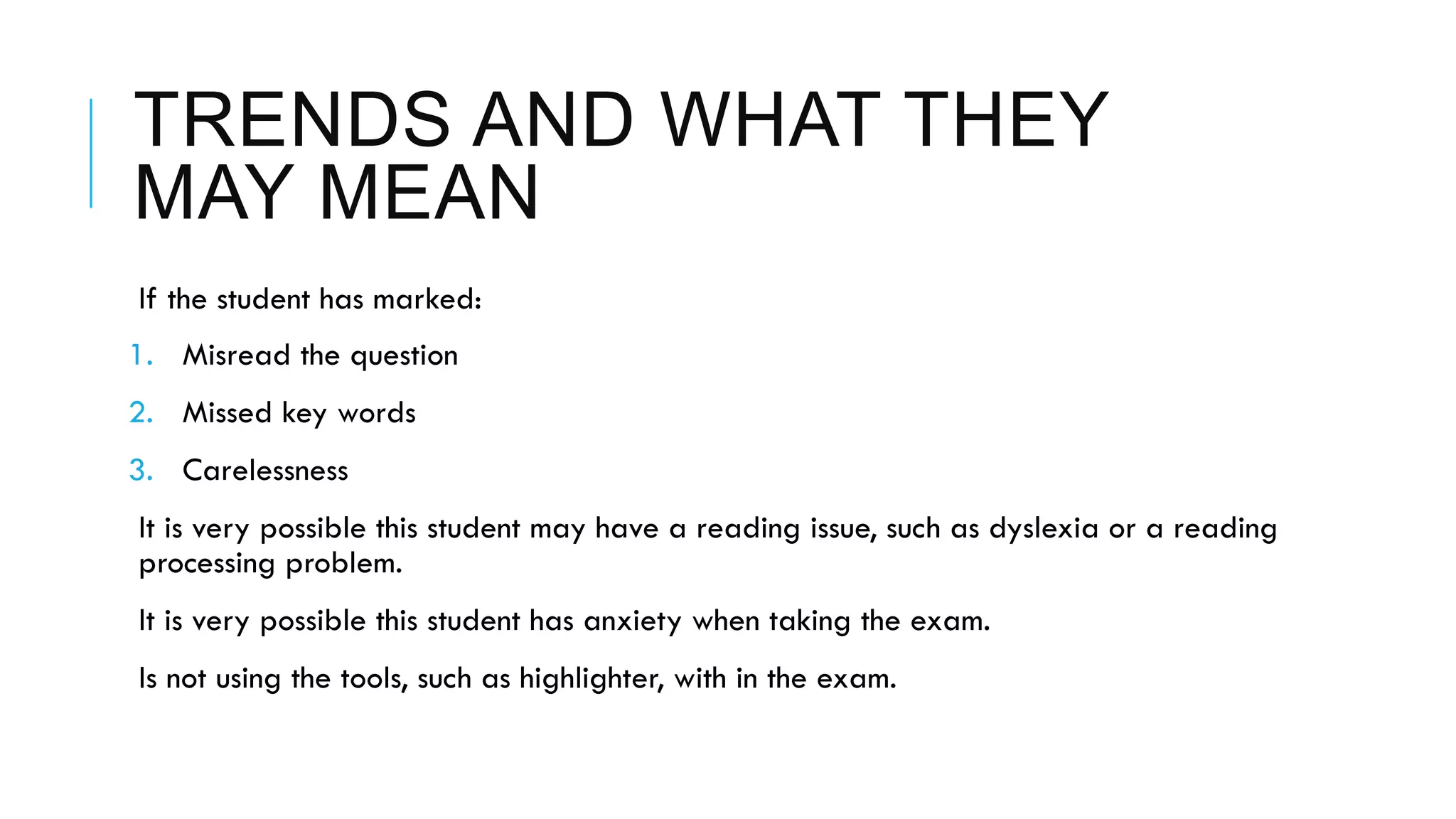
TRENDS AND WHAT THEY
MAY MEAN
 If the student has marked:
1.  Misread the question
2.  Missed key words
3.  Carelessness
 It is very possible this student may have a reading issue, such as dyslexia or a reading
processing problem.
 It is very possible this student has anxiety when taking the exam.
 Is not using the tools, such as highlighter, with in the exam.
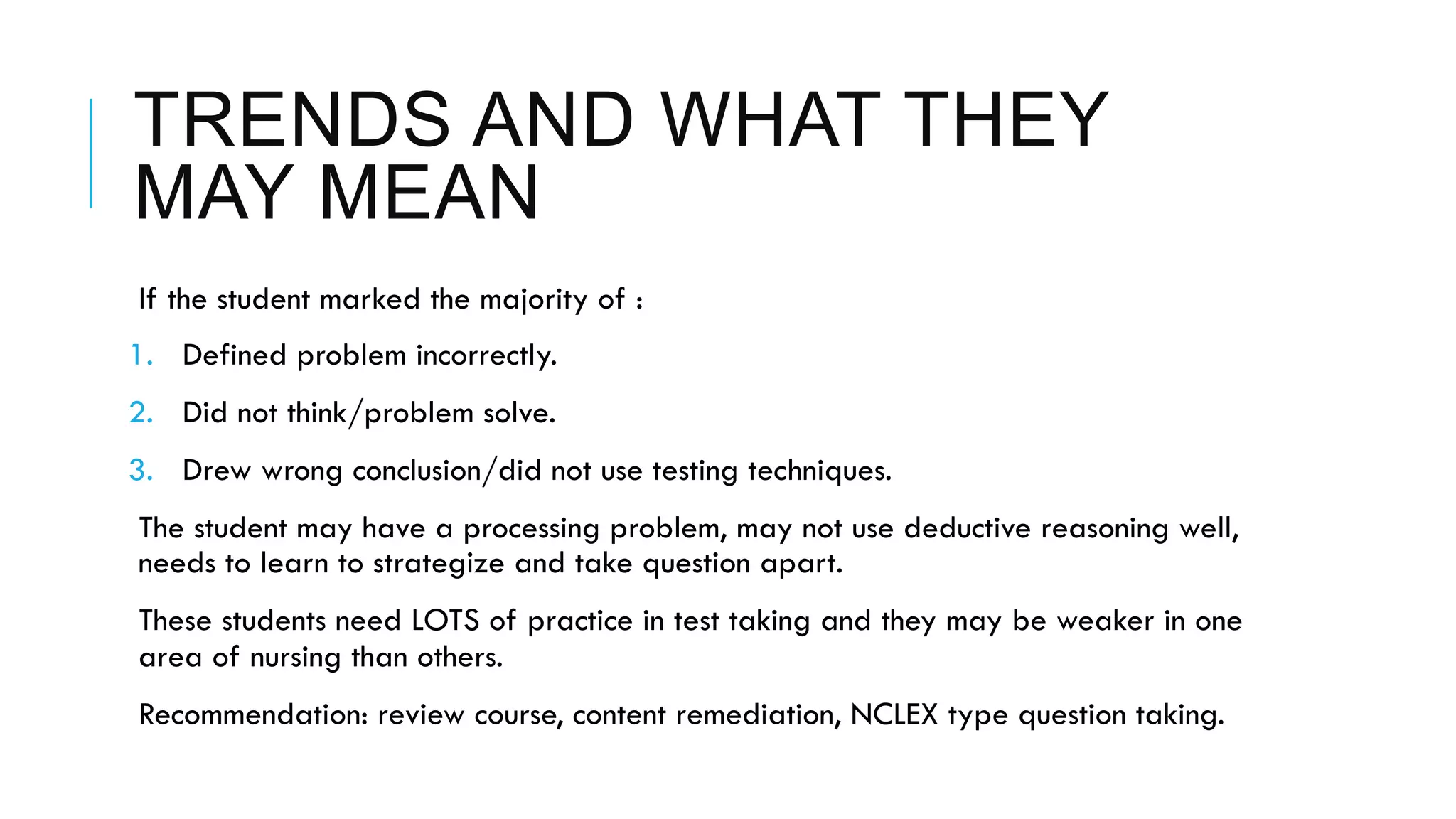
TRENDS AND WHAT THEY
MAY MEAN
 If the student marked the majority of :
1.  Defined problem incorrectly.
2.  Did not think/problem solve.
3.  Drew wrong conclusion/did not use testing techniques.
 The student may have a processing problem, may not use deductive reasoning well,
needs to learn to strategize and take question apart.
 These students need LOTS of practice in test taking and they may be weaker in one
area of nursing than others.
 Recommendation: review course, content remediation, NCLEX type question taking.
TRENDS AND WHAT THEY
MEAN
 Student marks:
 Did not trust first impulse or changed my answer.
 This student is not confident in their knowledge. They may be excellent clinical
students, however test taking is where their confidence waivers.
What we can do:
Ask them the question without showing them the answer items. Most of the time they
get it correct. So, then you can emphasize, they know the information.
This shows them they CAN answer correctly.
Note above the computer screen is often helpful..
TRENDS AND WHAT THEY
MAY MEAN
 If the student marks:
• Read into the question.
 Recommendation: This is not clinical, or what your grandfather experienced. IT is in
the 406 Hospital, or 335 Community, or in 330 Nursing Facility. When they take
NCLEX: it is in the NCLEX hospital, community setting, or assignment board. NOT
WHAT THEY HAVE EXPERIENCED.
 Students want to add to and ask “well, what if the blood pressure is 80/40, when the
question does not provide this information. Ask the student: “where in the question
does it say this?’
TIPS TO HELP STUDENTS
 Anxiety is huge and it is real.
 Explain to students all humans have mental health issues. It is HOW we cope that is
important.
 Teach them coping skills, many have poor coping skills and many have none.
 Teach then about negative self talk.
 Replacing negative self talk with positive encouraging words.
 Make encouragement cards
 Wear a rubber band—when thinking negatively, pop the band to remind themselves
to replace it with a positive thought.
TIPS
• Use aromatherapy.
• Use basics:
  Sleep well before the exam, eat well, do not quiz before the exam.
• Encourage student to come to the test without notes!
• Encourage them to use ear plugs if they are easily distracted by others.
• Encourage them to do a practice or mock test at home the night before the exam.
• If they struggle with drug calculations, encourage them to practice every day and
then the day of the exam to wake up and do at least three drug calculations.
LASTLY…..
 Don’t’ give up on them! Many of these student have huge hurdles to overcome.
 Many of them are overwhelmed with low self esteem, poor self image, and have not
had anyone in their life before you, who encouraged them.
 Many of them are the products of parents who did projects for them, plowed the way
for them, or over saw their educational path. Now they are left without the rudder to
guide the path.
 They are smart, capable, and we need to give them a coping and strategy that will
help them succeed.
THANK YOU!
CREDITS
 Test analysis form: used with permission of Reinforcement Education Center, Rev. 9/02
 MEF/JEA
 Straker, Kathleen, C., and Kelman, Eugenia, G., (2007) Vital Skills Study Strategies
Every Nursing Student Must Know. Houston, Texas: Karista Press.
For More Information:
Call: 1.866.429.8889
Email: info@examsoft.com
Visit: learn.examsoft.com

Nursing Student Remediation Made Easy with Embedded Assessment

  • 1.
    USING EXAM SOFTTO REMEDIATE THE NURSING STUDENT FOR SUCCESS Laura Logan, MSN, RN, CCRN
  • 2.
    SO YOU HAVEA FACE WITH A NAME.
  • 3.
    INFORM STUDENTS OFTHE EXPECTATIONS  Passing score is: 75 or greater.  Expect a drug calculation question first!  
  • 4.
    WHERE TO START  Usethe Opportunities and Strengths Report to show the student where these are present.  Require students who are at risk or have failed the exam to review the incorrect items no later than the next exam, with the faculty.  After each exam, require the students to complete an item analysis form.
  • 5.
    Question No. 1 Misreadthe question 2 Read into the question 3. Skipped limiting words (clues) in stem or answer * 4.Defined problem incorrectly 5.Did not think/ problem- solve 6. Did not trust first impulse 7. Did not use nursing process 8. Drew wrong conclusion/ Did not use testing techniques 9. Carelessness 10. Placed answer in wrong space/ Did not move space bar 11. Never studied/ Did not know area 12. Other/ Vocabulary Stephen F. Austin State University School of Nursing Test Analysis Form: Errors in Test Taking SCORE:___________ Name: Common errors in test taking are listed on the left. At the top of the form write the number DID YOU UPLOAD YOUR EXAM? ______ Clinical Instructor: ____________ of the question you missed. Directly below each Date:______________ number place an "X" opposite the error in test taking that caused you to miss that question. Test:______________ Used with permission of Reinforcement Education Center Rev. 9/2002 MEF/JEA
  • 6.
     From the Testanalysis form:  Carelessness  Student response: “I thought it was the P wave because it is when the atria contract.”  Recommendations:  Student was not just careless.  Did not understand concept.  Explain this to student & mark did not know area.  Review material: orally quiz student in clinical. Which part of the cardiac rhythm does the nurse analyze to assess the integrity of the AV node? a.  P wave. b.  PR interval. c.  QRS wave. d.  ST segment. Student answer: a. P wave. Correct answer: PR interval
  • 7.
     Test Analysis boxchecked:  Did not trust first impulse.  Recommendations:  Ask student what holds them back from the lack of trust.  Encourage student to trust themselves.  Some need the authority to trust themselves: So I tell them---Place a sticky note on the computer to Trust Thy Self! The nurse is caring for a client who is placed on comfort care. Which interventions should the nurse provide? (select all that apply) a.  Limit visitors to one at a time. b.  Assign a different nurse to the patient each day. c.  Update the family of changes in condition. d.  Turn the client every two hours to prevent skin breakdown. e.  Let the family provide daily hygiene. Student answer: a, c, d. Correct answer: c, e
  • 8.
     Student test analysisform response:  Did not think or problem solve.  Recommendations:  Review the question with student.  Remind the student why a patient could have Sinus Tachycardia.  Explore the student’s thinking.  Explore the student’s study habits. What is the initial intervention in a patient with sinus tachycardia, with these vital signs: heart rate: 136, blood pressure: 102/60, respiratory rate: 24, oral temp: 101.2 FSpO2 on 2 liters/min of Oxygen per nasal cannula. a.  STAT Adenosine to decrease heart rate. b.  Identify and correct the cause of the elevated heart rate. c.  Attempt or encourage patient to induce vagal stimulation. d.  Cardiovert starting at 100 joules. Student answer: C. Attempt or encourage patient to induce vagal stimulation. Correct answer: B- Identify and correct the cause of the elevated heart rate.
  • 9.
    TRENDS AND WHATTHEY MAY MEAN  If the student has marked: 1.  Misread the question 2.  Missed key words 3.  Carelessness  It is very possible this student may have a reading issue, such as dyslexia or a reading processing problem.  It is very possible this student has anxiety when taking the exam.  Is not using the tools, such as highlighter, with in the exam.
  • 10.
    TRENDS AND WHATTHEY MAY MEAN  If the student marked the majority of : 1.  Defined problem incorrectly. 2.  Did not think/problem solve. 3.  Drew wrong conclusion/did not use testing techniques.  The student may have a processing problem, may not use deductive reasoning well, needs to learn to strategize and take question apart.  These students need LOTS of practice in test taking and they may be weaker in one area of nursing than others.  Recommendation: review course, content remediation, NCLEX type question taking.
  • 11.
    TRENDS AND WHATTHEY MEAN  Student marks:  Did not trust first impulse or changed my answer.  This student is not confident in their knowledge. They may be excellent clinical students, however test taking is where their confidence waivers. What we can do: Ask them the question without showing them the answer items. Most of the time they get it correct. So, then you can emphasize, they know the information. This shows them they CAN answer correctly. Note above the computer screen is often helpful..
  • 12.
    TRENDS AND WHATTHEY MAY MEAN  If the student marks: • Read into the question.  Recommendation: This is not clinical, or what your grandfather experienced. IT is in the 406 Hospital, or 335 Community, or in 330 Nursing Facility. When they take NCLEX: it is in the NCLEX hospital, community setting, or assignment board. NOT WHAT THEY HAVE EXPERIENCED.  Students want to add to and ask “well, what if the blood pressure is 80/40, when the question does not provide this information. Ask the student: “where in the question does it say this?’
  • 13.
    TIPS TO HELPSTUDENTS  Anxiety is huge and it is real.  Explain to students all humans have mental health issues. It is HOW we cope that is important.  Teach them coping skills, many have poor coping skills and many have none.  Teach then about negative self talk.  Replacing negative self talk with positive encouraging words.  Make encouragement cards  Wear a rubber band—when thinking negatively, pop the band to remind themselves to replace it with a positive thought.
  • 14.
    TIPS • Use aromatherapy. • Use basics:  Sleep well before the exam, eat well, do not quiz before the exam. • Encourage student to come to the test without notes! • Encourage them to use ear plugs if they are easily distracted by others. • Encourage them to do a practice or mock test at home the night before the exam. • If they struggle with drug calculations, encourage them to practice every day and then the day of the exam to wake up and do at least three drug calculations.
  • 15.
    LASTLY…..  Don’t’ give upon them! Many of these student have huge hurdles to overcome.  Many of them are overwhelmed with low self esteem, poor self image, and have not had anyone in their life before you, who encouraged them.  Many of them are the products of parents who did projects for them, plowed the way for them, or over saw their educational path. Now they are left without the rudder to guide the path.  They are smart, capable, and we need to give them a coping and strategy that will help them succeed.
  • 16.
  • 17.
    CREDITS  Test analysis form:used with permission of Reinforcement Education Center, Rev. 9/02  MEF/JEA  Straker, Kathleen, C., and Kelman, Eugenia, G., (2007) Vital Skills Study Strategies Every Nursing Student Must Know. Houston, Texas: Karista Press.
  • 18.
    For More Information: Call:1.866.429.8889 Email: info@examsoft.com Visit: learn.examsoft.com