EAC 2018 | Fort Lauderdale | June 27-29
Thank you for joining.
The webinar will begin shortly.
Using the NCLEX-RN Exam Blueprint as a
Guide for Testing in a Baccalaureate
Nursing Program
Sherri Ward, DNP, RN
Clinical Assistant Professor
University of Arkansas for Medical Sciences, College of Nursing
UPON COMPLETION OF THIS PRESENTATION, PARTICIPANTS WILL:
 Understand how to establish categories in ExamSoft
 Use those categories to set-up the exam blueprint
 Mimic licensure exam blueprints
 Use ExamSoft reporting features to track student strengths
and opportunities for improvement
UAMS CON
 University of Arkansas for Medical Sciences College of Nursing
 BSN, RN-BSN, MNSc, DNP, PhD programs
 BSN program has around 240 students on Little Rock, AR campus
and a small satellite campus
 Attrition rate is less than 10%
UAMS CON
 NCLEX-RN pass rate 95.6% in 2017 (153/160)
 Other success strategies in place
 How can we supplement those and keep our scores where they are
or even higher
NEW TESTING SOFTWARE
 Spring 2014 – ExamSoft Demonstration
 Security issues with current learning management system testing platform
 College of Medicine and College of Pharmacy already using ExamSoft
 ExamSoft piqued our interest because:
 Question categories
 Test plan blueprints
 Reporting functions
PILOT EXAMSOFT
 UAMS CON baccalaureate council faculty voted to pilot
 One junior course – Peds x3 rotations
 Two senior course – Care and Management of Adults & Critical Care
 Fall 2014, Spring 2015
 Bring outcomes to council and vote in Spring 2015
 Post-presentation to faculty
 Ease of Use
 Features
 Student Feedback
 Comparison to current learning management system testing platform
SUBCOMMITTEE
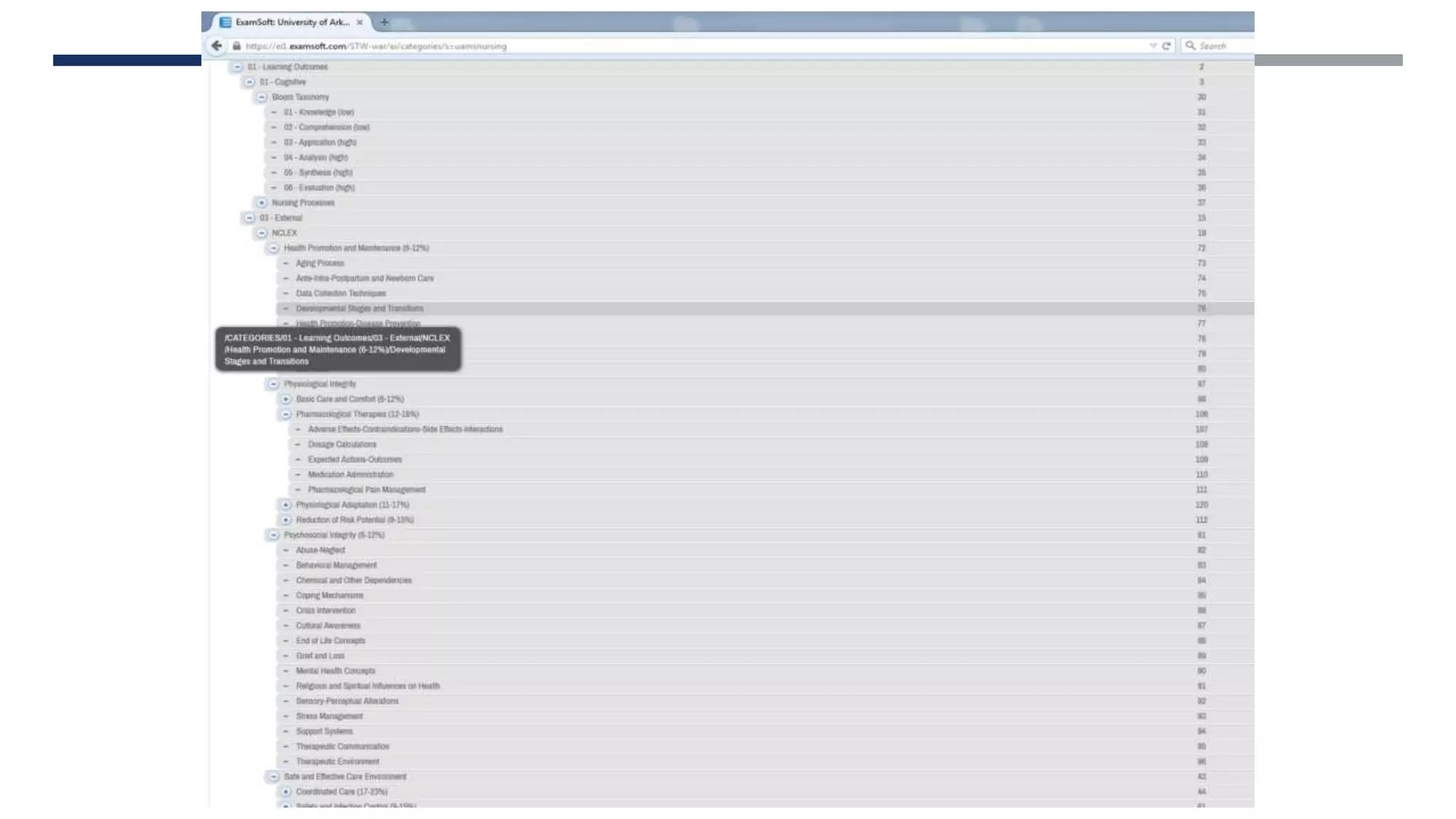
 How do we set-up the ExamSoft database?
 Many exam strategies still under discussion – baby steps
 Nursing faculty are responsible for categorizing their own
questions and building their own exams
 Other colleges have support staff for this
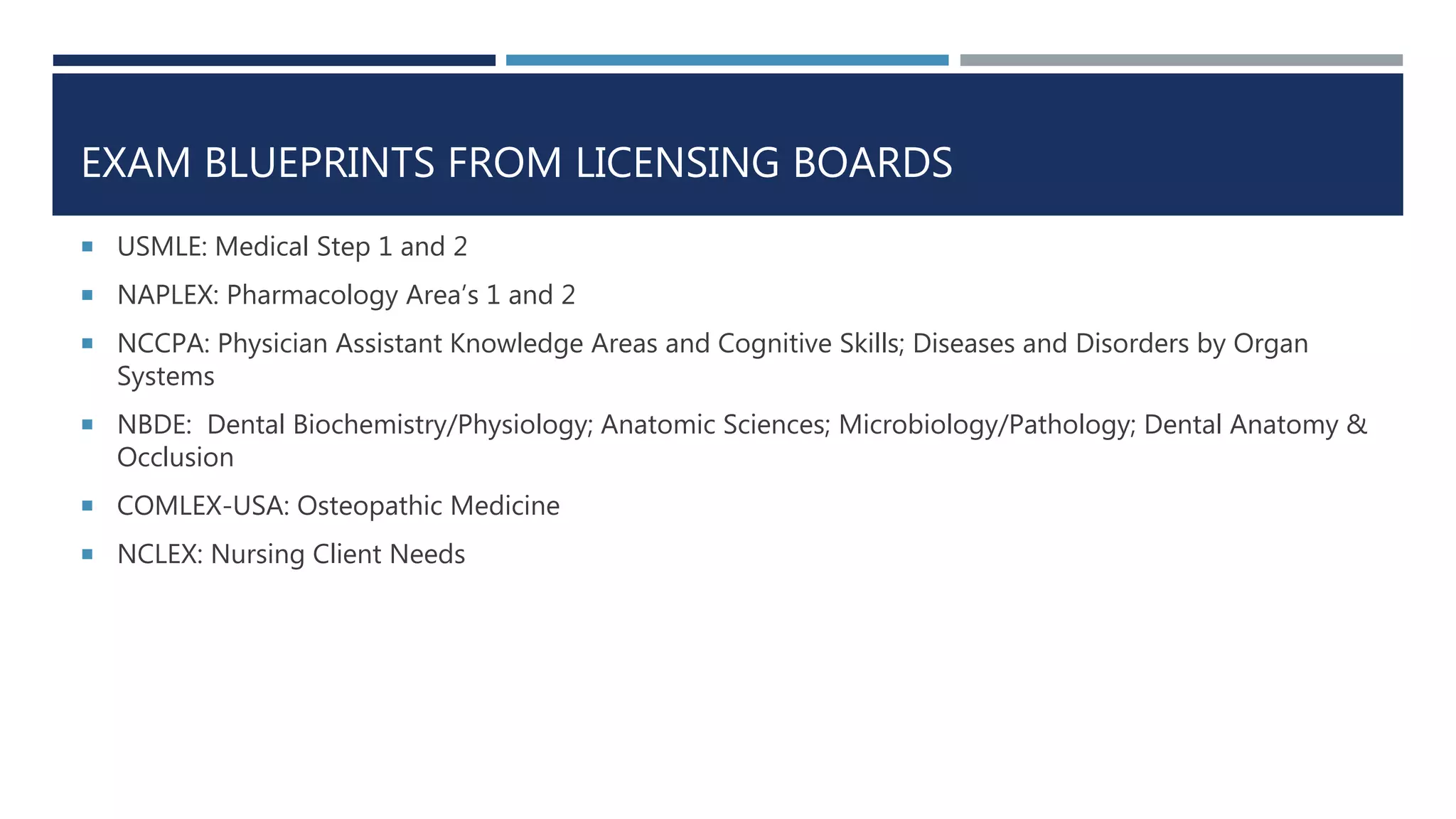
EXAM BLUEPRINTS FROM LICENSING BOARDS
 USMLE: Medical Step 1 and 2
 NAPLEX: Pharmacology Area’s 1 and 2
 NCCPA: Physician Assistant Knowledge Areas and Cognitive Skills; Diseases and Disorders by Organ
Systems
 NBDE: Dental Biochemistry/Physiology; Anatomic Sciences; Microbiology/Pathology; Dental Anatomy &
Occlusion
 COMLEX-USA: Osteopathic Medicine
 NCLEX: Nursing Client Needs
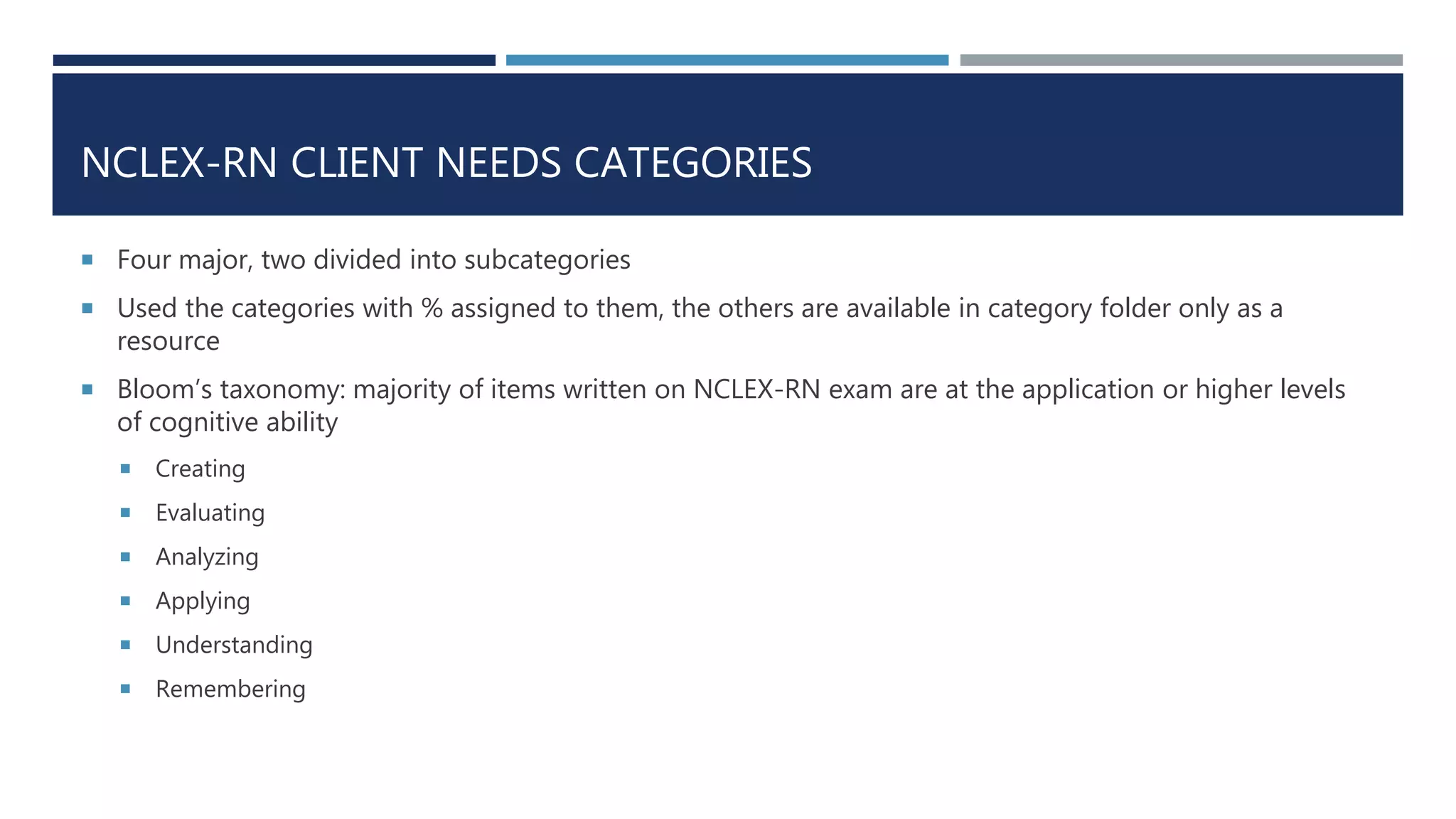
NCLEX-RN CLIENT NEEDS CATEGORIES
 Four major, two divided into subcategories
 Used the categories with % assigned to them, the others are available in category folder only as a
resource
 Bloom’s taxonomy: majority of items written on NCLEX-RN exam are at the application or higher levels
of cognitive ability
 Creating
 Evaluating
 Analyzing
 Applying
 Understanding
 Remembering
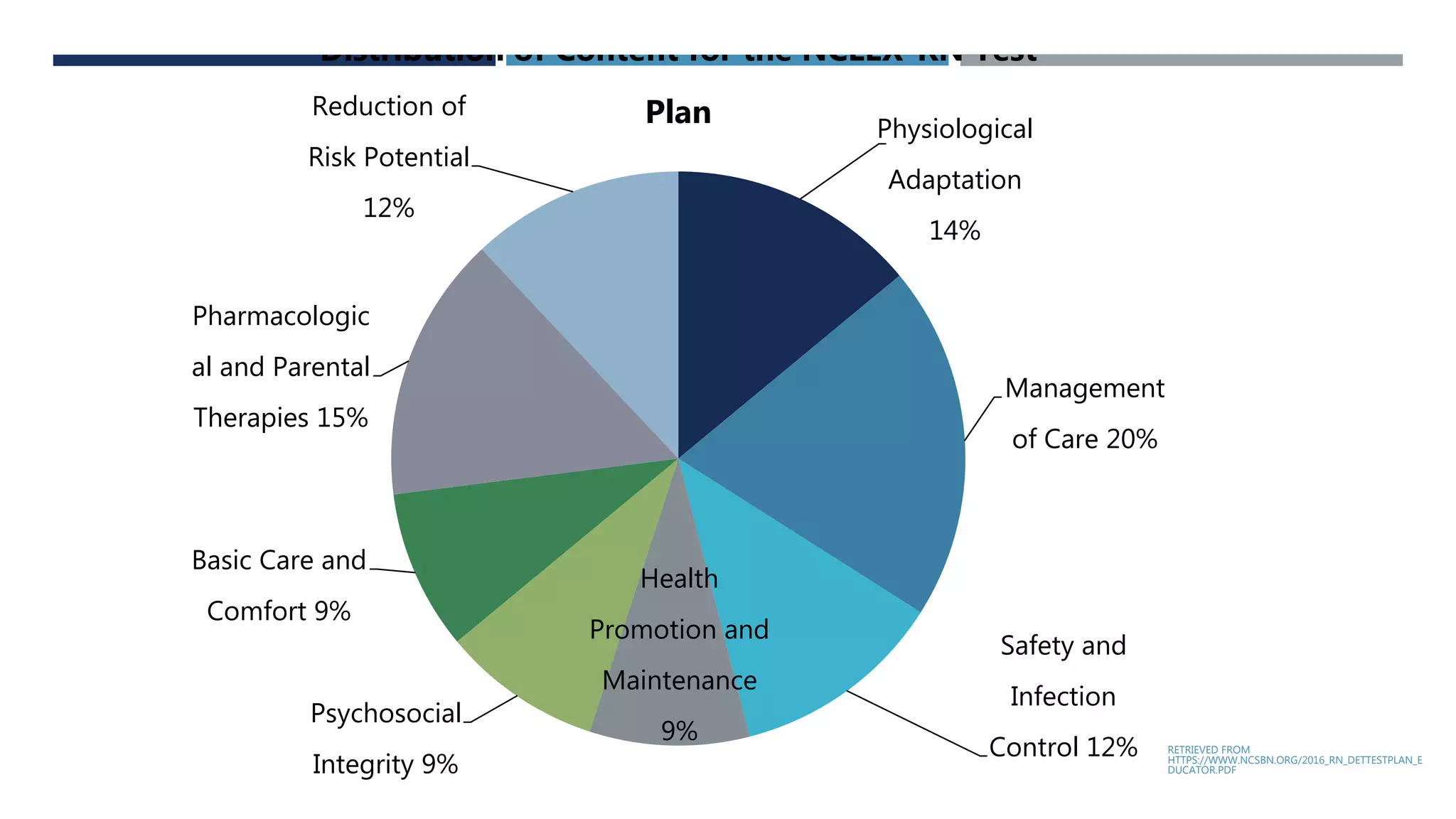
Physiological
Adaptation
14%
Management
of Care 20%
Safety and
Infection
Control 12%
Health
Promotion and
Maintenance
9%
Psychosocial
Integrity 9%
Basic Care and
Comfort 9%
Pharmacologic
al and Parental
Therapies 15%
Reduction of
Risk Potential
12%
Distribution of Content for the NCLEX-RN Test
Plan
RETRIEVED FROM
HTTPS://WWW.NCSBN.ORG/2016_RN_DETTESTPLAN_E
DUCATOR.PDF
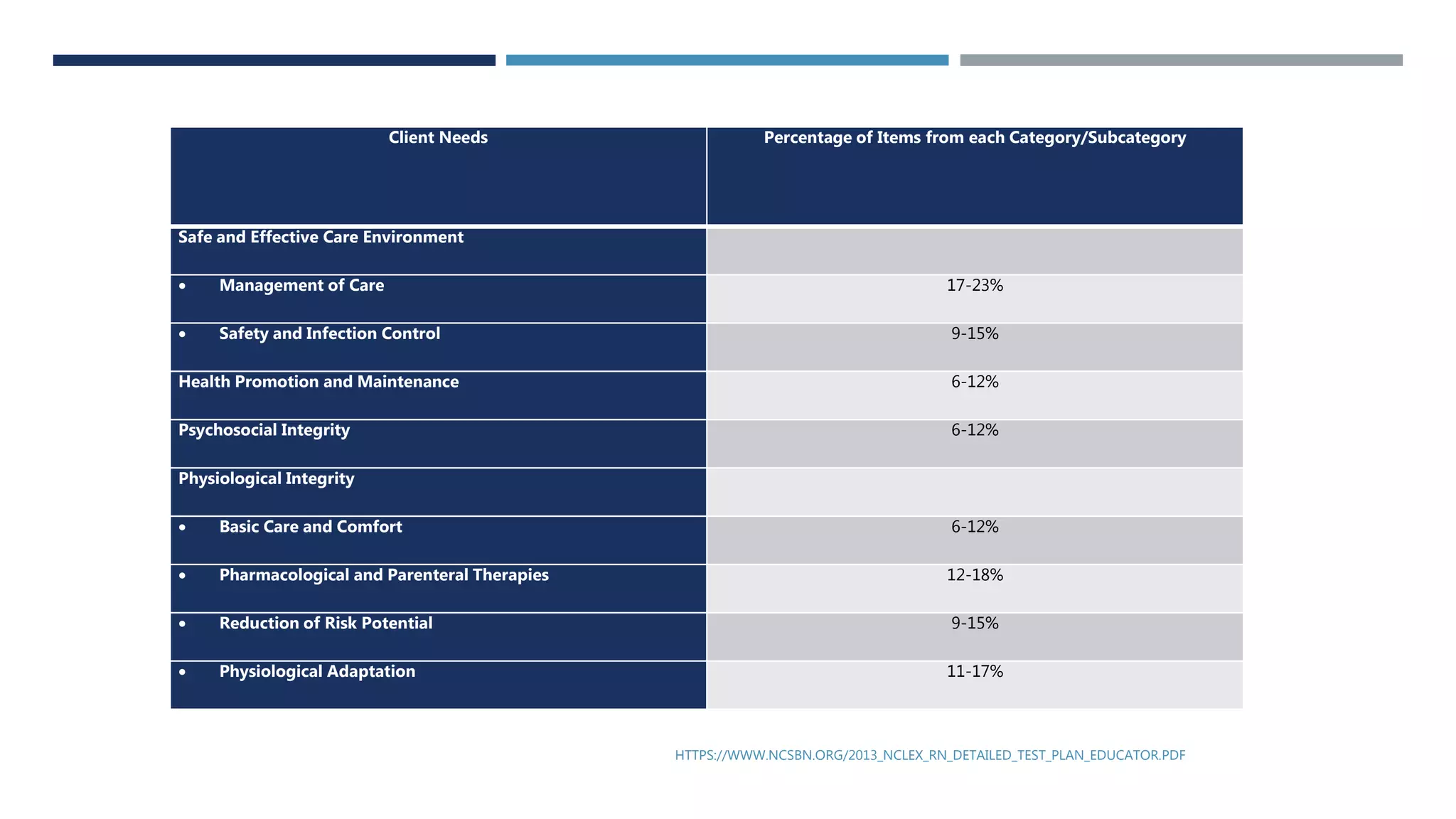
Client Needs Percentage of Items from each Category/Subcategory
Safe and Effective Care Environment
 Management of Care 17-23%
 Safety and Infection Control 9-15%
Health Promotion and Maintenance 6-12%
Psychosocial Integrity 6-12%
Physiological Integrity
 Basic Care and Comfort 6-12%
 Pharmacological and Parenteral Therapies 12-18%
 Reduction of Risk Potential 9-15%
 Physiological Adaptation 11-17%
HTTPS://WWW.NCSBN.ORG/2013_NCLEX_RN_DETAILED_TEST_PLAN_EDUCATOR.PDF
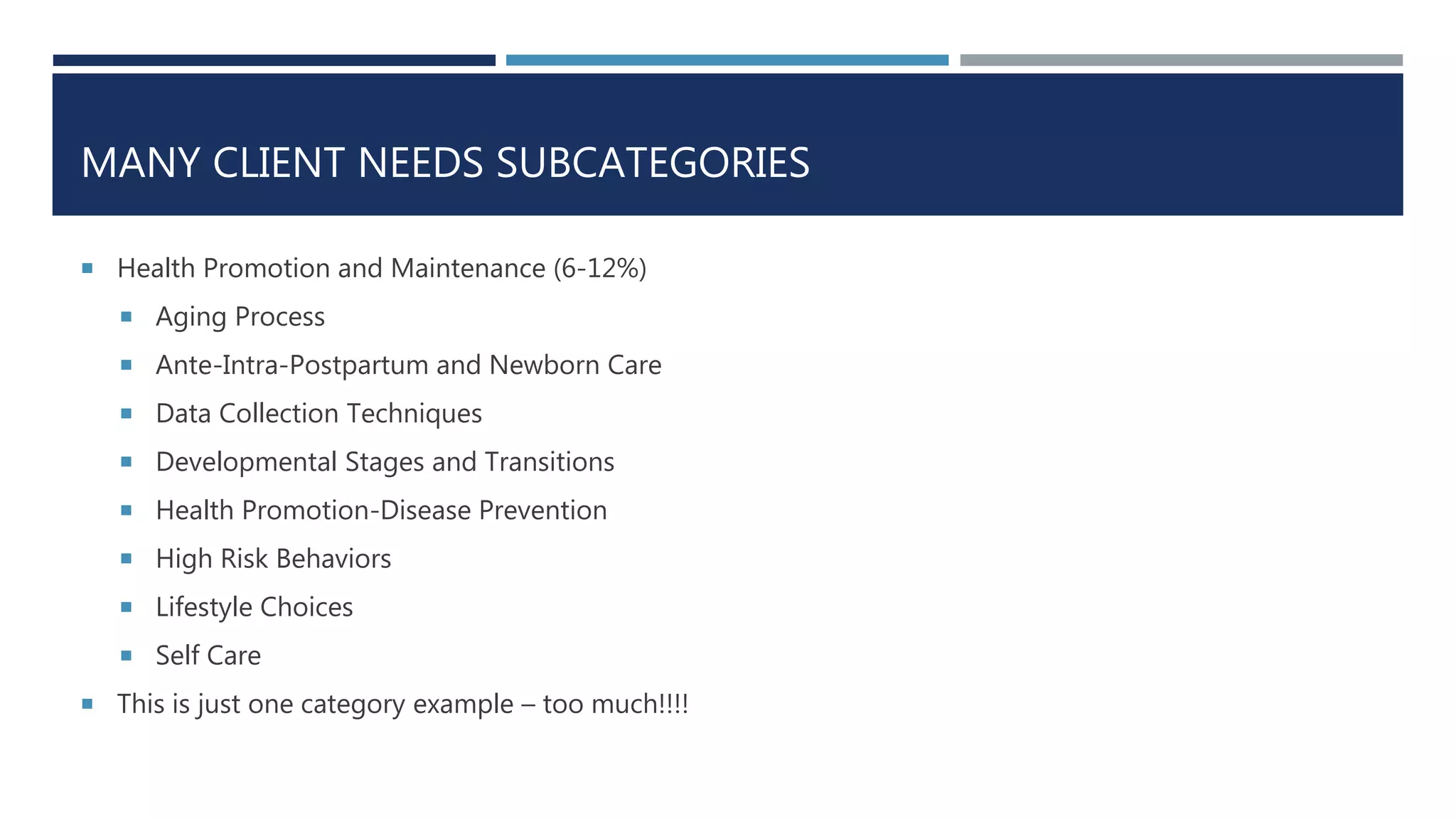
MANY CLIENT NEEDS SUBCATEGORIES
 Health Promotion and Maintenance (6-12%)
 Aging Process
 Ante-Intra-Postpartum and Newborn Care
 Data Collection Techniques
 Developmental Stages and Transitions
 Health Promotion-Disease Prevention
 High Risk Behaviors
 Lifestyle Choices
 Self Care
 This is just one category example – too much!!!!
INTEGRATION
 The following fundamentals of nursing practice are integrated throughout the
Client Needs categories and subcategories:
 Nursing Process
 Caring
 Communication and Documentation
 Teaching/Learning
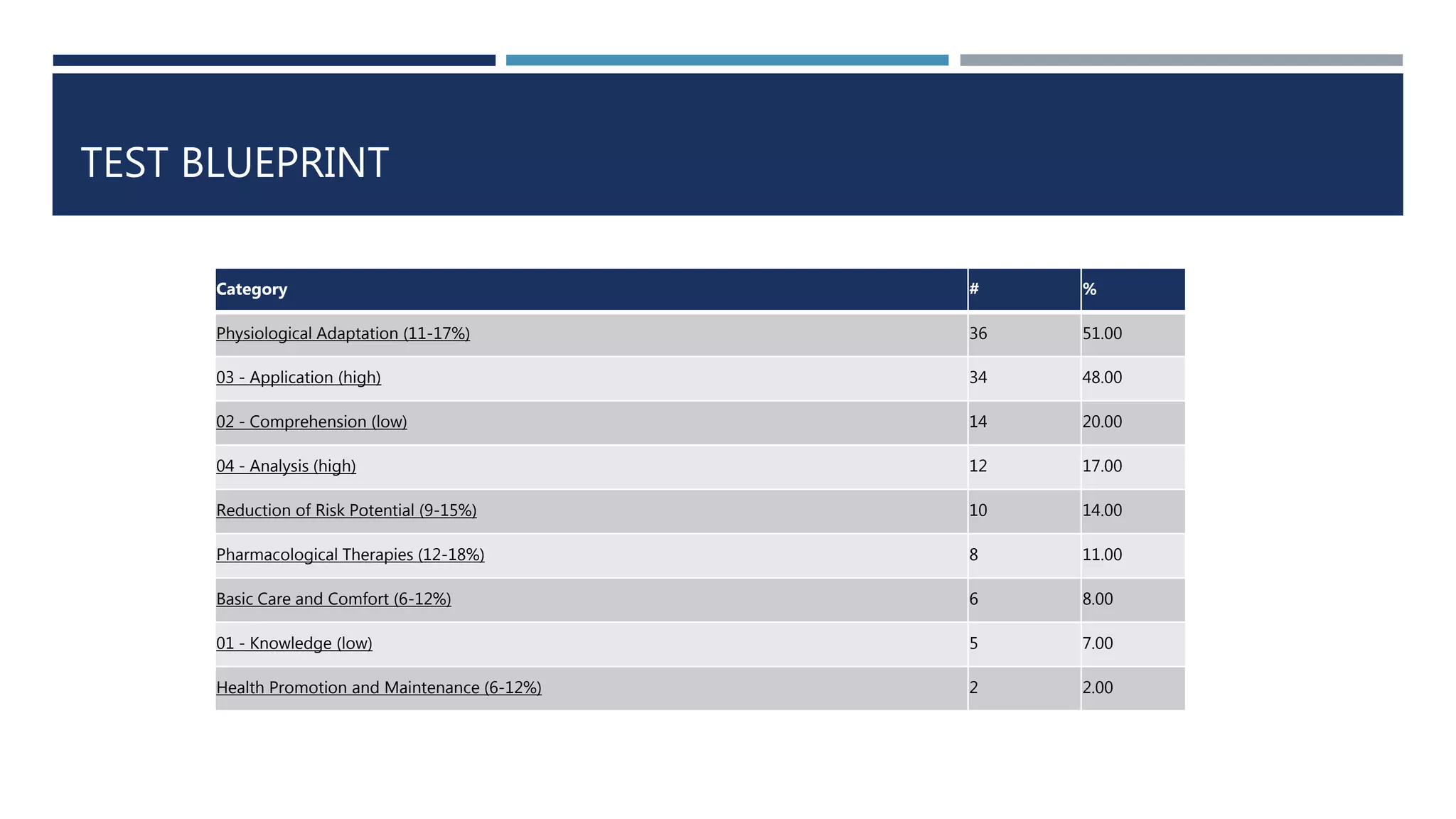
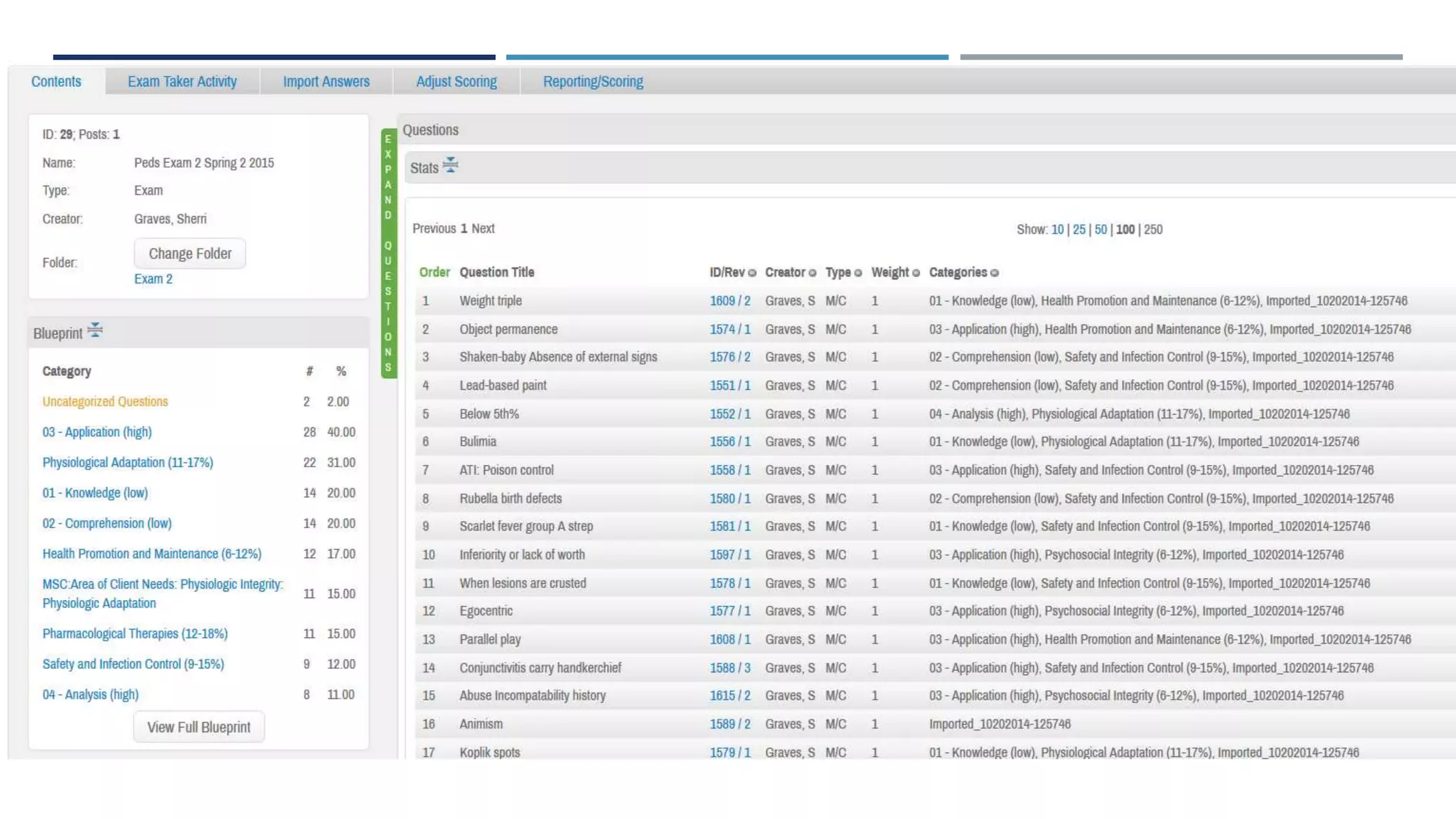
TEST BLUEPRINT
Category # %
Physiological Adaptation (11-17%) 36 51.00
03 - Application (high) 34 48.00
02 - Comprehension (low) 14 20.00
04 - Analysis (high) 12 17.00
Reduction of Risk Potential (9-15%) 10 14.00
Pharmacological Therapies (12-18%) 8 11.00
Basic Care and Comfort (6-12%) 6 8.00
01 - Knowledge (low) 5 7.00
Health Promotion and Maintenance (6-12%) 2 2.00
CATEGORIES
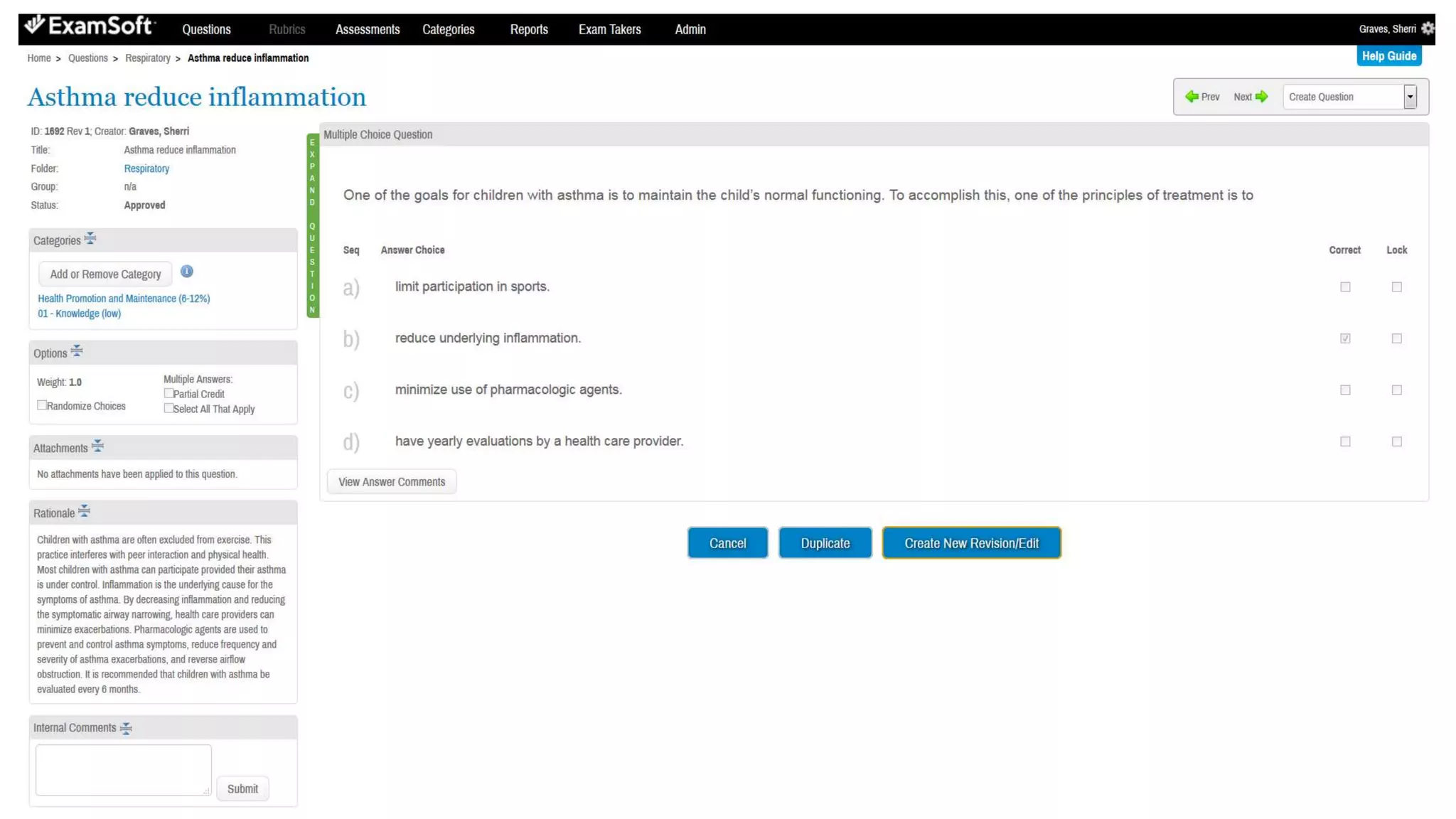
 Which categories are appropriate for each question? If not correctly assigned
we fail to meet our objective
 Most test banks have categories preassigned
 The National Council of State Boards of Nursing provides a Test Development
and Item Writing Course
REPORTING FEATURES
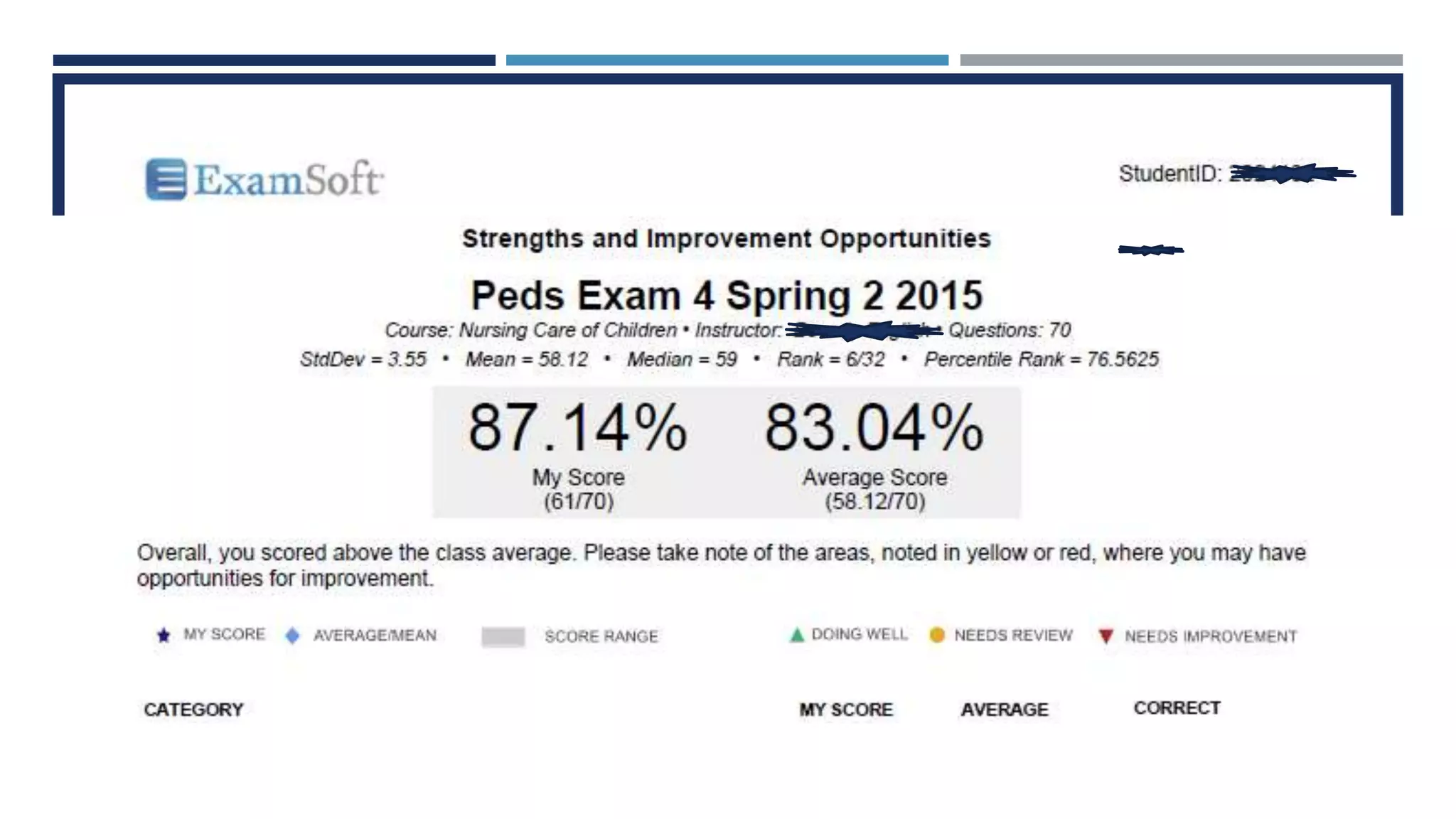
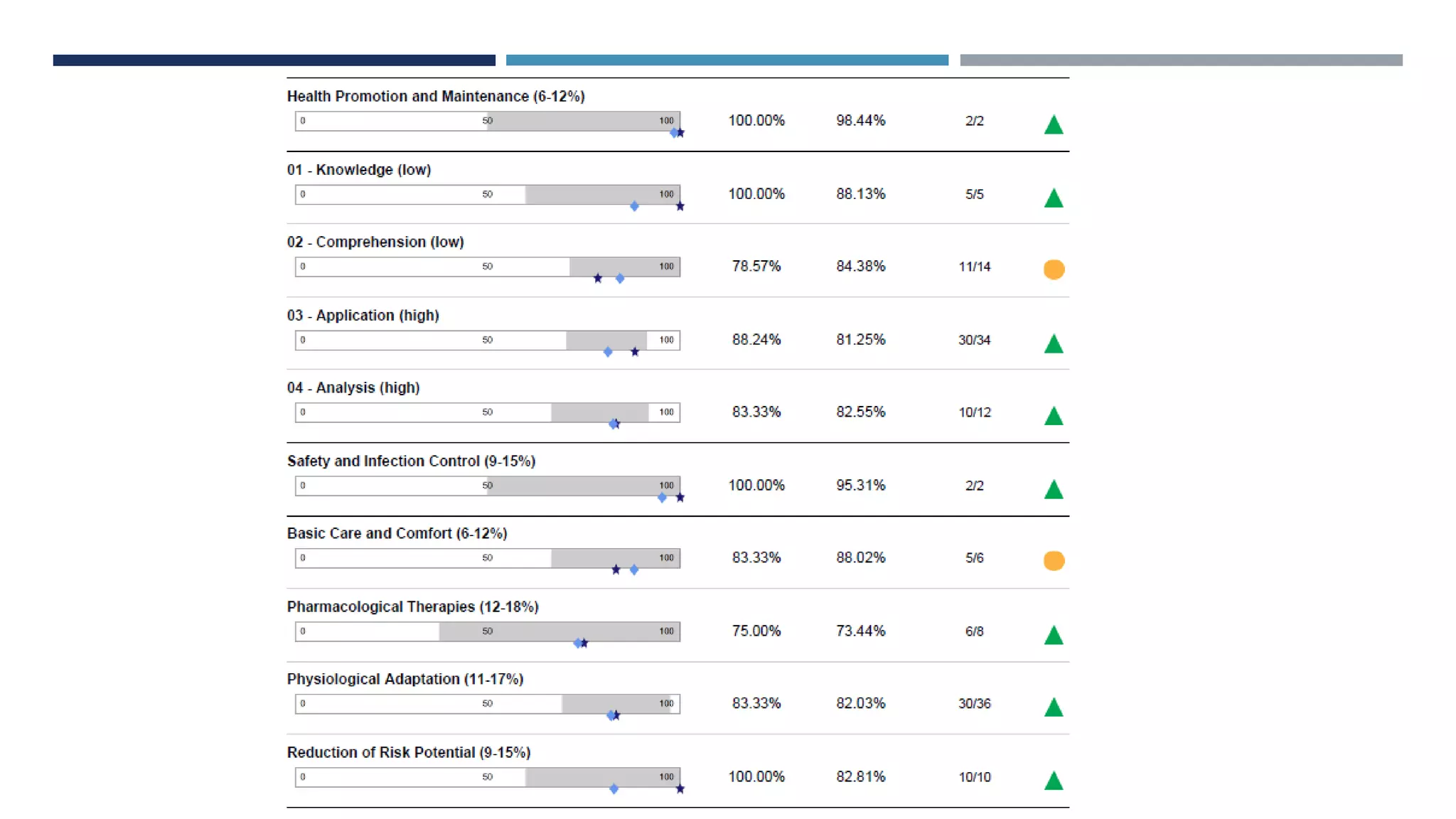
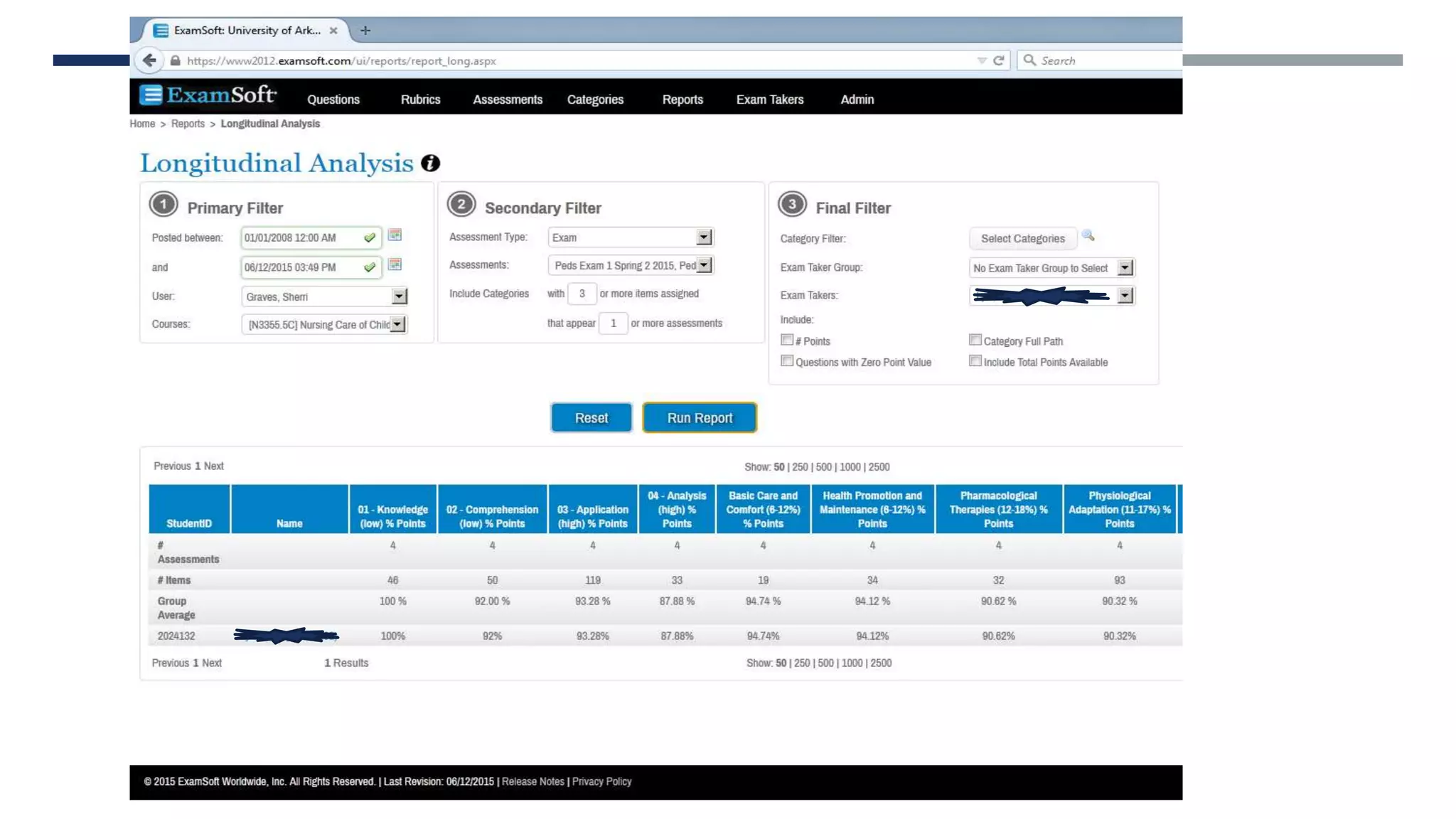
 Strengths and Opportunities reports for students
 Per exam
 Longitudinally
 Student comprehension
 Educate on the front end and frequently throughout the program
 Print the first report and review
 Have student bring a copy to one-on-one meeting if falling into high risk
category
LONGITUDINAL REPORTS
 Can run report at any time during the program
 Most beneficial during Capstone course as they prepare
for NCLEX-RN exam
MOVING FORWARD
 All courses live across two semesters
 Collect data
 Student adoption
 Do the exams mimic the NCLEX-RN blueprint?
 Look at pass rates
 Establish “best practice” guidelines
 Questions?
EAC 2018 | Fort Lauderdale | June 27-29

Using the NCLEX RN Blueprint as a Guide for Testing in a Nursing Baccalaureate Program

  • 1.
    EAC 2018 |Fort Lauderdale | June 27-29 Thank you for joining. The webinar will begin shortly. Using the NCLEX-RN Exam Blueprint as a Guide for Testing in a Baccalaureate Nursing Program Sherri Ward, DNP, RN Clinical Assistant Professor University of Arkansas for Medical Sciences, College of Nursing
  • 2.
    UPON COMPLETION OFTHIS PRESENTATION, PARTICIPANTS WILL:  Understand how to establish categories in ExamSoft  Use those categories to set-up the exam blueprint  Mimic licensure exam blueprints  Use ExamSoft reporting features to track student strengths and opportunities for improvement
  • 3.
    UAMS CON  Universityof Arkansas for Medical Sciences College of Nursing  BSN, RN-BSN, MNSc, DNP, PhD programs  BSN program has around 240 students on Little Rock, AR campus and a small satellite campus  Attrition rate is less than 10%
  • 4.
    UAMS CON  NCLEX-RNpass rate 95.6% in 2017 (153/160)  Other success strategies in place  How can we supplement those and keep our scores where they are or even higher
  • 5.
    NEW TESTING SOFTWARE Spring 2014 – ExamSoft Demonstration  Security issues with current learning management system testing platform  College of Medicine and College of Pharmacy already using ExamSoft  ExamSoft piqued our interest because:  Question categories  Test plan blueprints  Reporting functions
  • 6.
    PILOT EXAMSOFT  UAMSCON baccalaureate council faculty voted to pilot  One junior course – Peds x3 rotations  Two senior course – Care and Management of Adults & Critical Care  Fall 2014, Spring 2015  Bring outcomes to council and vote in Spring 2015  Post-presentation to faculty  Ease of Use  Features  Student Feedback  Comparison to current learning management system testing platform
  • 7.
    SUBCOMMITTEE  How dowe set-up the ExamSoft database?  Many exam strategies still under discussion – baby steps  Nursing faculty are responsible for categorizing their own questions and building their own exams  Other colleges have support staff for this
  • 8.
    EXAM BLUEPRINTS FROMLICENSING BOARDS  USMLE: Medical Step 1 and 2  NAPLEX: Pharmacology Area’s 1 and 2  NCCPA: Physician Assistant Knowledge Areas and Cognitive Skills; Diseases and Disorders by Organ Systems  NBDE: Dental Biochemistry/Physiology; Anatomic Sciences; Microbiology/Pathology; Dental Anatomy & Occlusion  COMLEX-USA: Osteopathic Medicine  NCLEX: Nursing Client Needs
  • 9.
    NCLEX-RN CLIENT NEEDSCATEGORIES  Four major, two divided into subcategories  Used the categories with % assigned to them, the others are available in category folder only as a resource  Bloom’s taxonomy: majority of items written on NCLEX-RN exam are at the application or higher levels of cognitive ability  Creating  Evaluating  Analyzing  Applying  Understanding  Remembering
  • 10.
    Physiological Adaptation 14% Management of Care 20% Safetyand Infection Control 12% Health Promotion and Maintenance 9% Psychosocial Integrity 9% Basic Care and Comfort 9% Pharmacologic al and Parental Therapies 15% Reduction of Risk Potential 12% Distribution of Content for the NCLEX-RN Test Plan RETRIEVED FROM HTTPS://WWW.NCSBN.ORG/2016_RN_DETTESTPLAN_E DUCATOR.PDF
  • 11.
    Client Needs Percentageof Items from each Category/Subcategory Safe and Effective Care Environment  Management of Care 17-23%  Safety and Infection Control 9-15% Health Promotion and Maintenance 6-12% Psychosocial Integrity 6-12% Physiological Integrity  Basic Care and Comfort 6-12%  Pharmacological and Parenteral Therapies 12-18%  Reduction of Risk Potential 9-15%  Physiological Adaptation 11-17% HTTPS://WWW.NCSBN.ORG/2013_NCLEX_RN_DETAILED_TEST_PLAN_EDUCATOR.PDF
  • 14.
    MANY CLIENT NEEDSSUBCATEGORIES  Health Promotion and Maintenance (6-12%)  Aging Process  Ante-Intra-Postpartum and Newborn Care  Data Collection Techniques  Developmental Stages and Transitions  Health Promotion-Disease Prevention  High Risk Behaviors  Lifestyle Choices  Self Care  This is just one category example – too much!!!!
  • 15.
    INTEGRATION  The followingfundamentals of nursing practice are integrated throughout the Client Needs categories and subcategories:  Nursing Process  Caring  Communication and Documentation  Teaching/Learning
  • 16.
    TEST BLUEPRINT Category #% Physiological Adaptation (11-17%) 36 51.00 03 - Application (high) 34 48.00 02 - Comprehension (low) 14 20.00 04 - Analysis (high) 12 17.00 Reduction of Risk Potential (9-15%) 10 14.00 Pharmacological Therapies (12-18%) 8 11.00 Basic Care and Comfort (6-12%) 6 8.00 01 - Knowledge (low) 5 7.00 Health Promotion and Maintenance (6-12%) 2 2.00
  • 18.
    CATEGORIES  Which categoriesare appropriate for each question? If not correctly assigned we fail to meet our objective  Most test banks have categories preassigned  The National Council of State Boards of Nursing provides a Test Development and Item Writing Course
  • 19.
    REPORTING FEATURES  Strengthsand Opportunities reports for students  Per exam  Longitudinally  Student comprehension  Educate on the front end and frequently throughout the program  Print the first report and review  Have student bring a copy to one-on-one meeting if falling into high risk category
  • 22.
    LONGITUDINAL REPORTS  Canrun report at any time during the program  Most beneficial during Capstone course as they prepare for NCLEX-RN exam
  • 24.
    MOVING FORWARD  Allcourses live across two semesters  Collect data  Student adoption  Do the exams mimic the NCLEX-RN blueprint?  Look at pass rates  Establish “best practice” guidelines  Questions?
  • 25.
    EAC 2018 |Fort Lauderdale | June 27-29