Test Taking
Strategies
THINKING IS THE HARDEST WORK THERE IS, WHICH IS THE PROBABLE
REASON WHY SO FEW ENGAGE IN IT.
-HENRY FORD
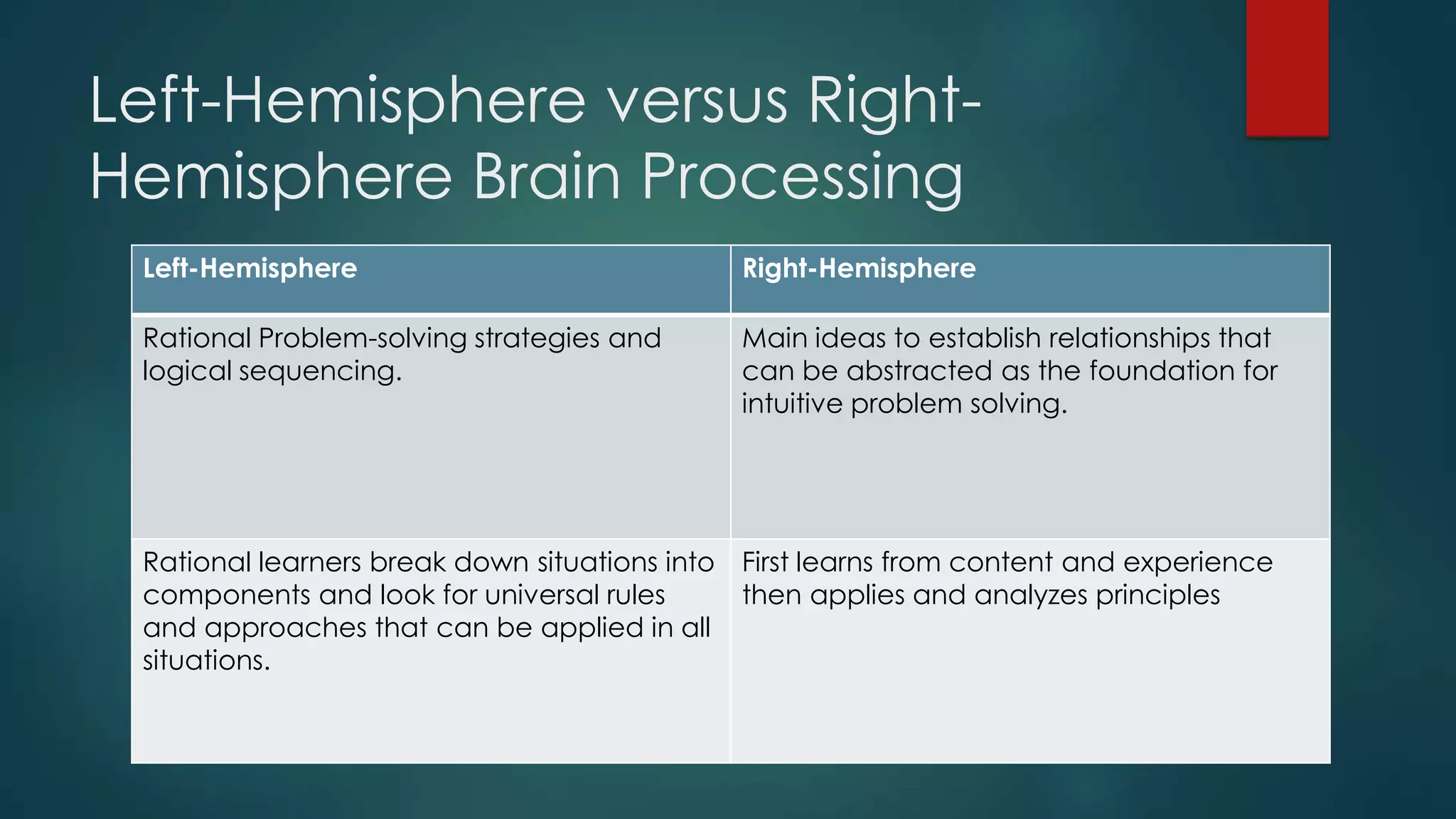
Left-Hemisphere versus RightHemisphere Brain Processing
Left-Hemisphere

Right-Hemisphere

Rational Problem-solving strategies and
logical sequencing.

Main ideas to establish relationships that
can be abstracted as the foundation for
intuitive problem solving.

Rational learners break down situations into First learns from content and experience
components and look for universal rules
then applies and analyzes principles
and approaches that can be applied in all
situations.
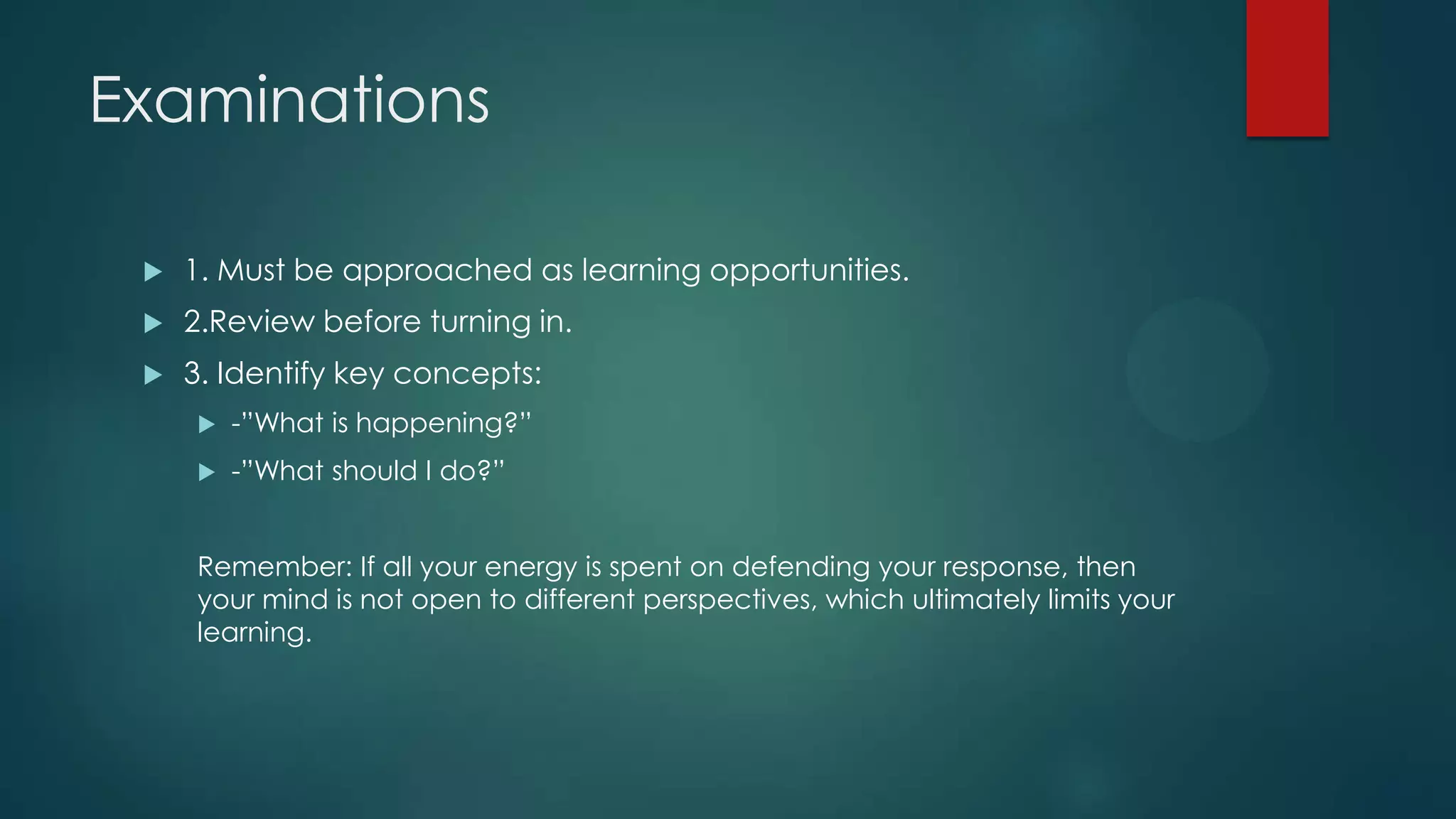
Examinations


1. Must be approached as learning opportunities.



2.Review before turning in.



3. Identify key concepts:


-”What is happening?”



-”What should I do?”

Remember: If all your energy is spent on defending your response, then
your mind is not open to different perspectives, which ultimately limits your
learning.
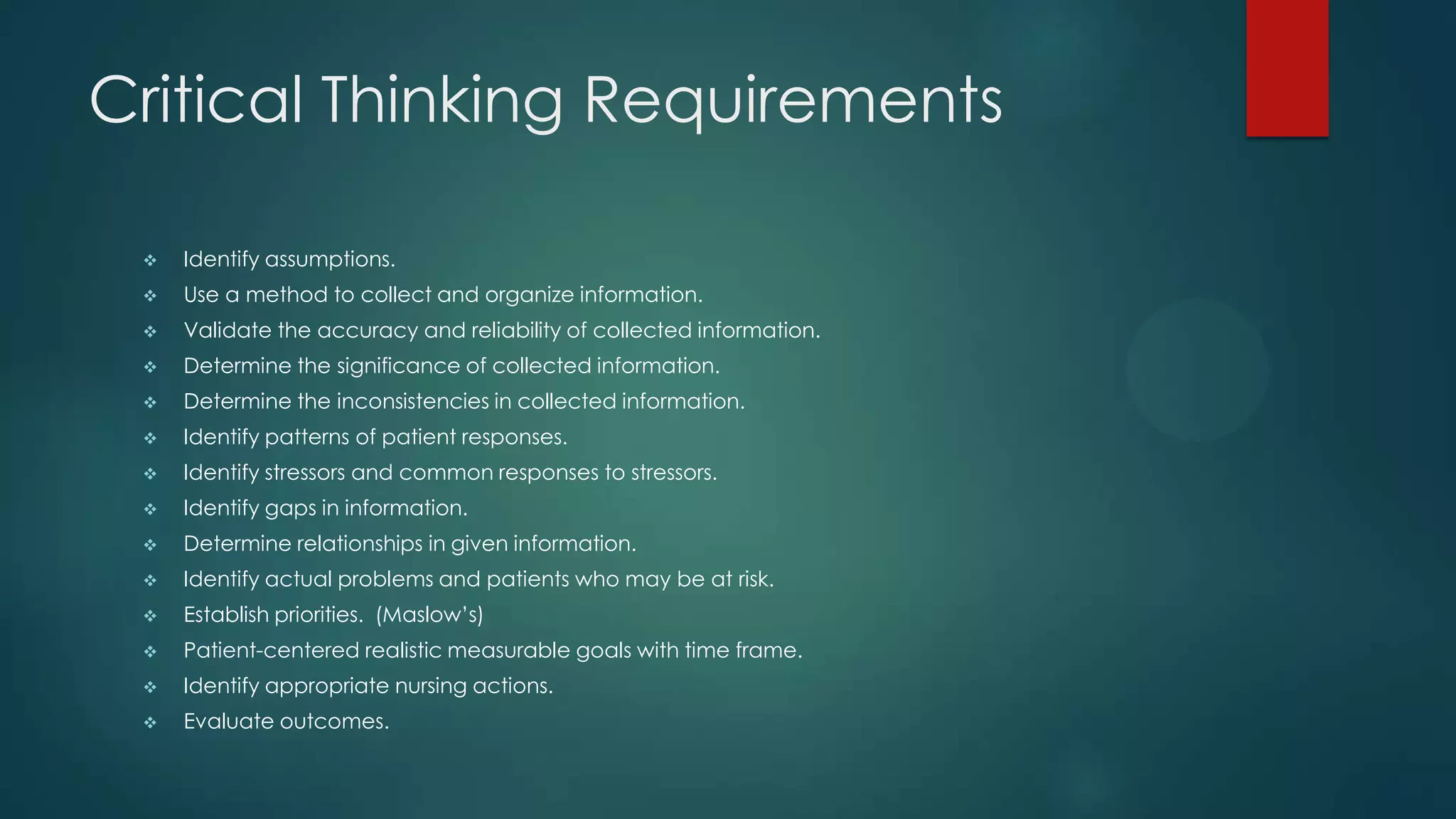
Critical Thinking Requirements


Identify assumptions.



Use a method to collect and organize information.



Validate the accuracy and reliability of collected information.



Determine the significance of collected information.



Determine the inconsistencies in collected information.



Identify patterns of patient responses.



Identify stressors and common responses to stressors.



Identify gaps in information.



Determine relationships in given information.



Identify actual problems and patients who may be at risk.



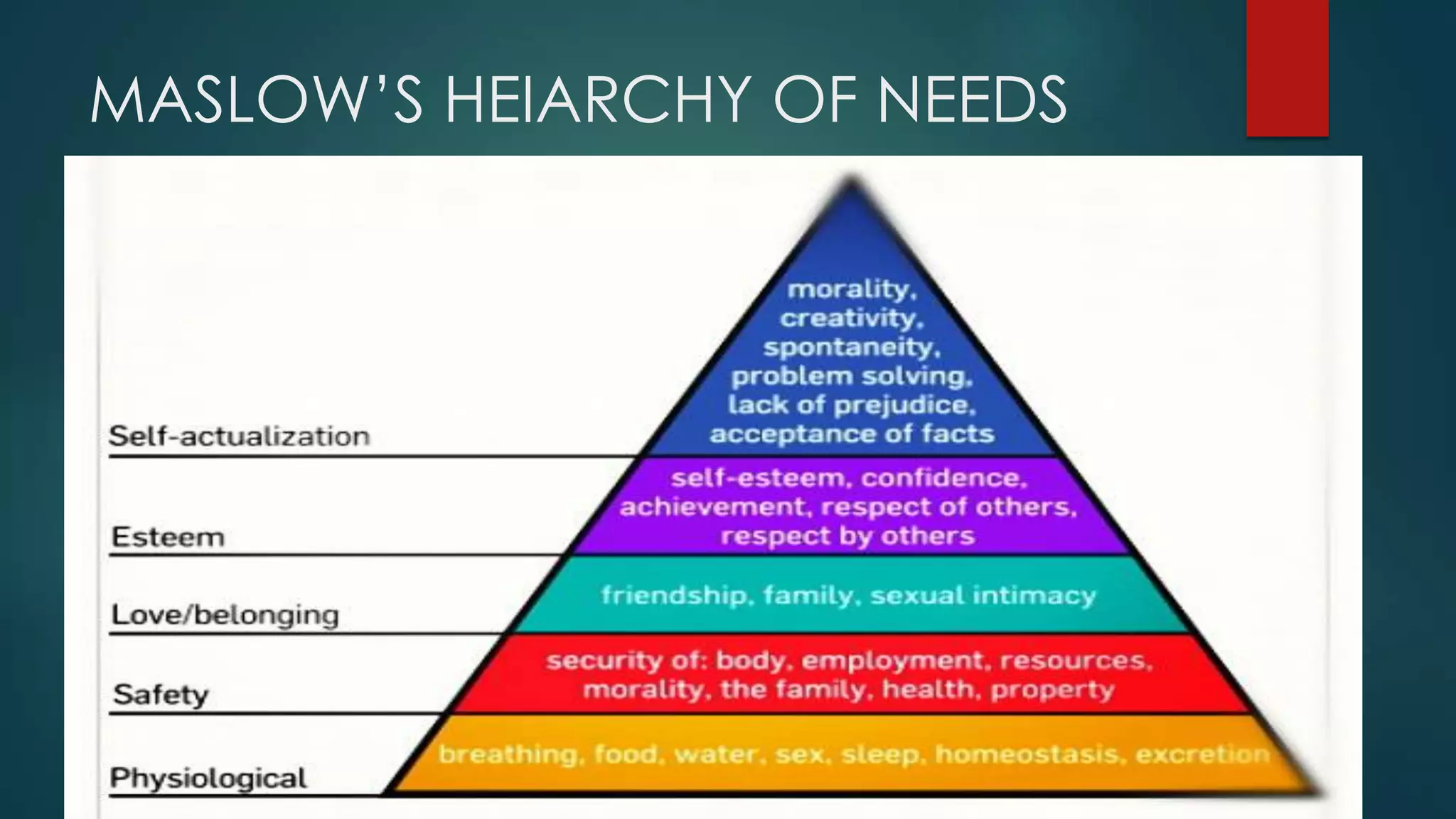
Establish priorities. (Maslow’s)



Patient-centered realistic measurable goals with time frame.



Identify appropriate nursing actions.



Evaluate outcomes.
MASLOW’S HEIARCHY OF NEEDS
Knowledge is a treasure, but
practice is the key to it
Applying Critical Thinking
Think of it this way:
“We cannot stand in the same river twice, because water rushes away
as new water takes its place and the rushing water changes the river
bed. The decisions we make today may not fit circumstances that
change tomorrow.”
IN OTHER WORDS; NO CLINICAL AND PATIENT SITUATION WILL BE
EXACTLY LIKE A PREVIOUS EXPERIENCE.

One different factor in a situation can change the entire landscape of
the situation.
Components of a Question


1. Item



2. Stem



3. Option



4. Correct Answer



5. Distractors
Item


The entire MCQ



Objective
STEM


This is first part of the item that asks the question.



Key words: FIRST, INITIALLY, BEST, PRIORITY, SAFEST AND MOST



These words occasionally are emphasized by an
underline, italics, Boldfaced, or CAPITALS.



Positive polarity words: Understand, apply or differentiate correct
information



Negative polarity:
Contraindicated, further, unacceptable, least, NOT, never, least, av
oid. These identify interventions that are unacceptable.
Option


The second part of the item



Possible responses



Options can be a sentence (Before performing a procedure, what should nurse
do 1st? Collect the equipment for procedure, position pt. for procedure, explain
procedure to pt., raise the bed to highest position)



Completes the sentence begun in the stem (The RN understands that the
primary etiology of obesity is? Lack of variety nutrients, glandular disorder
prevents weight loss, caloric intake that exceeds metabolic needs,
psychological prob that causes overeating)



Can be an incomplete sentence (which nursing intervention is common when
caring for all pts. w infections? Donning a mask, wearing a gown, washing
hands, discouraging visitors)



Just a single word (What is the nurse doing when formulating a nurse dx?
Planning, assessing, analyzing, implementing)
Correct Answer


There is one BEST correct answer
Distractors


Remaining answers which house incorrect answers



Designed to make you doubt and distract you away from the
correct answer.
Step 1: Identify the KEY CONCEPT
being tested


What is happening?



What should I do?



Need to: RERAME, CRITIQUE AND EVALUTATE STEM



ANSWER BEFORE LOOKING AT CHOICES
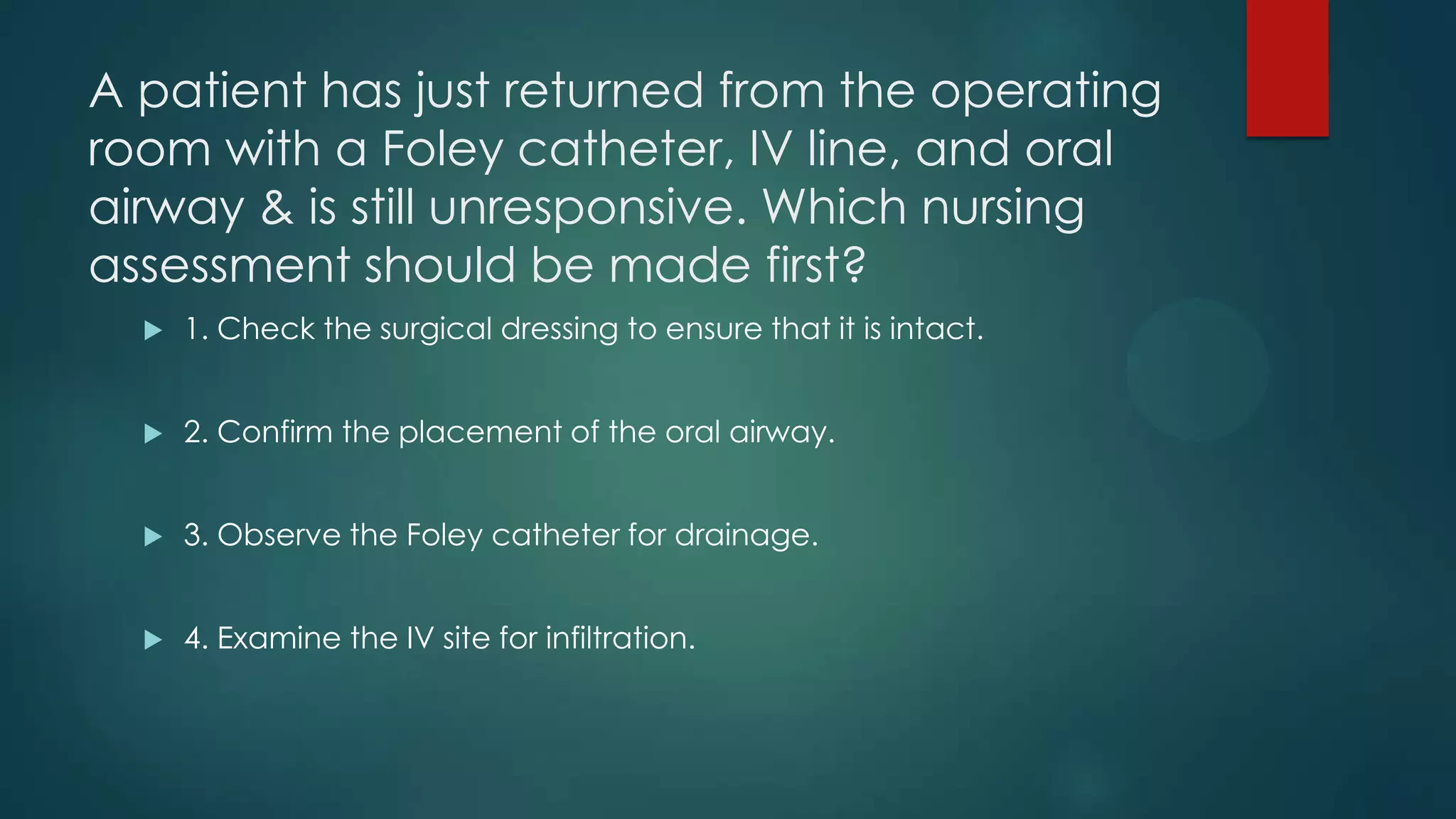
A patient has just returned from the operating
room with a Foley catheter, IV line, and oral
airway & is still unresponsive. Which nursing
assessment should be made first?


1. Check the surgical dressing to ensure that it is intact.



2. Confirm the placement of the oral airway.



3. Observe the Foley catheter for drainage.



4. Examine the IV site for infiltration.
KEY CONCEPT: Priority of care for
the unresponsive patient


Key words that answer What is Happening?
Postoperative patient
Oral airway
Unresponsive

Key words that answer What should I do?
Assessment
Should be made first
Question being asked: What assessment takes priority when caring
for an unresponsive postoperative patient with an oral airway?
ANSWER: Confirm placement of
oral airway


The abc’s of life support, which refer to Airway, Breathing and
Circulation, thus maintaining an airway takes PRIORITY.



Falls under Maslow’s hierarchy of needs with physiological needs;
BREATHING.
Explore The Consequences Of
Each Nursing Action In Each
Alternative


ASK MANY DIFFERENT QUESTIONS:



Is the action safe?



Is the action unsafe?



Is the statement true?



Is the statement false?



Is this a fact?



Is this an inference?
2. Avoid reading into the Question;
do not rewrite the question


Ask yourself:



Did I read additional information into the stem of question?



Did I have difficulty deciding among the options because I would
have done something completely different?



Did I delete an option because my experience was different from
the patient situation presented?



Did I view the question in light of a more sophisticated level of
curricular content than that being tested?



Did I view the patient scenario in more depth than necessary?
Change the Focus of the Question


To explore additional situations using MCQ is to change one of the
key facts in the stem of the question in order to alter the focus of the
question.




AND

Identify the next best option that answers the question.
Which is associated with a
physiological need of a patient
with a colostomy?


1. Disturbance in body image



2. Inadequate nutrition



3. Lack of knowledge



4. Skin breakdown
“Physiological” modifies the word
“need” and is the CLUE in the STEM


Therefore the correct answer is 4



SKIN BREAKDOWN
Change physiological to
psychological within the stem


Which is associated with a psychological need of a patient with a
colostomy?



1. Disturbance in body image



2. Inadequate nutrition



3. Lack of knowledge



4. Skin breakdown
Now the ENTIRE focus has changed


Correct answer is now 1 – Disturbance of body image



CLUE in the STEM is NOW:



PSYCHOLOGICAL
Cognitive Levels of Nursing
Questions


1. Knowledge



2. Comprehension



3. APPLICATION



4. Analysis (synthesis and evaluation)
Knowledge Questions


Require you to recall or remember information.



Commit facts to memory



Expect you to know: terminology, facts, classifications, principles
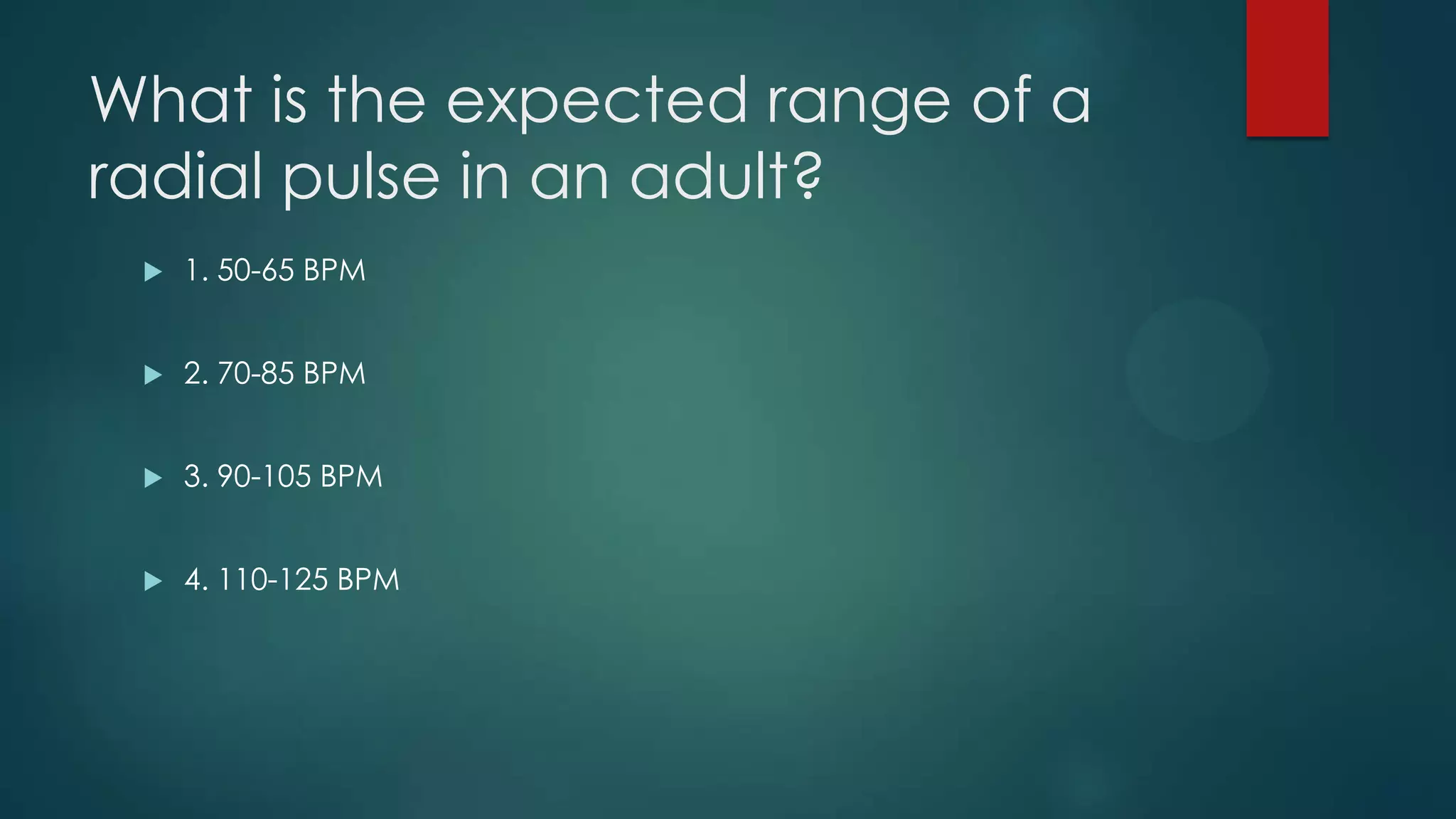
What is the expected range of a
radial pulse in an adult?


1. 50-65 BPM



2. 70-85 BPM



3. 90-105 BPM



4. 110-125 BPM
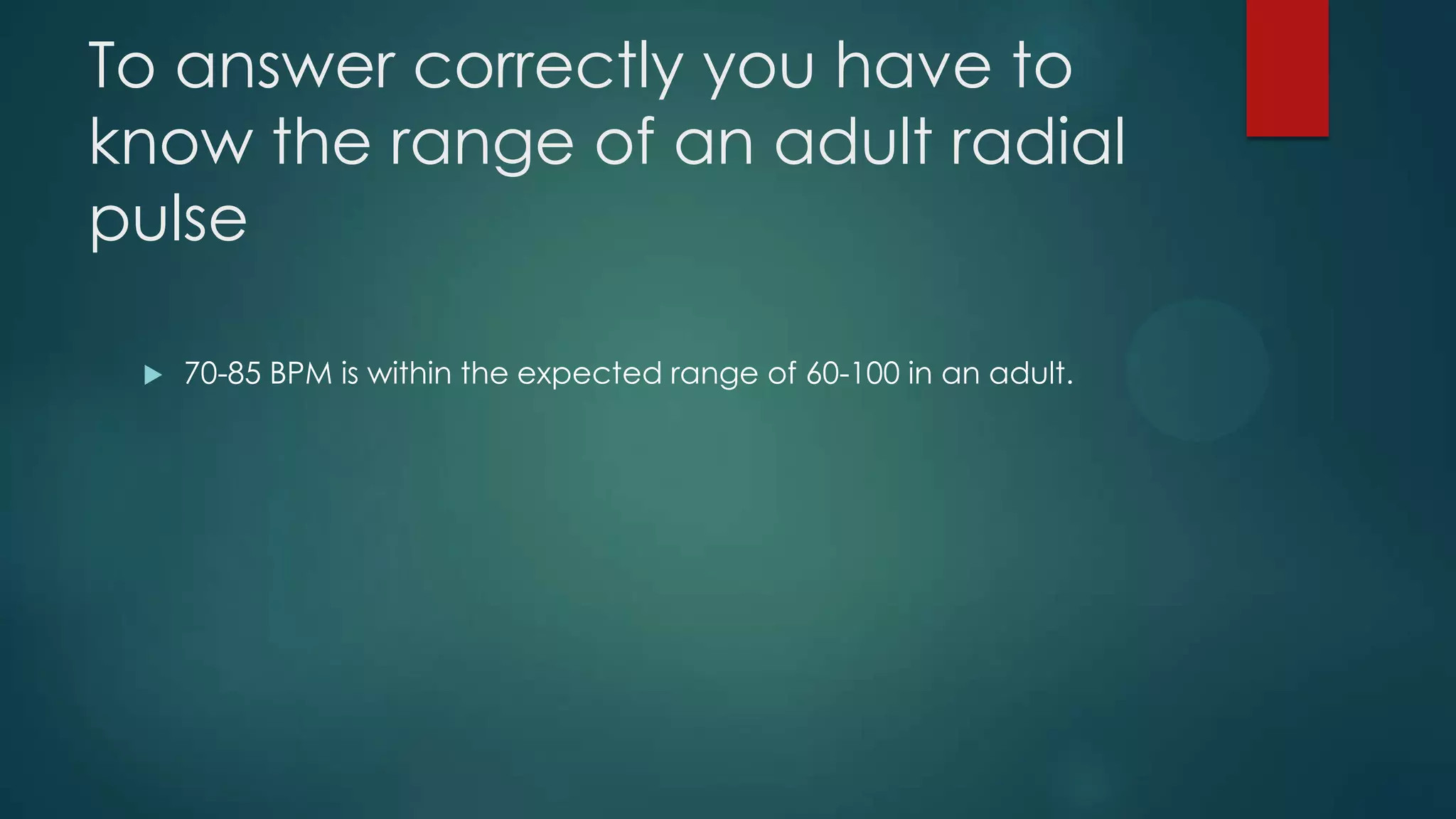
To answer correctly you have to
know the range of an adult radial
pulse


70-85 BPM is within the expected range of 60-100 in an adult.
To Increase your knowledge


Memorize



Use Alphabet cues



Use Acronyms



Acrostics



Mnemonics
Memorize


Use of repetition



Facilitate by using lists, flash cards or learning wheels
Alphabet Cues


CAB’s



3 P’s of diabetes:


Polyuria (U)



Polydipsia (T)



Polyphagia (H)
Acronyms; word formed from letters
of a series of statements


Infection remember the word INFECT:



I: Increased P/R/WBC



N: node enlarge



F: function impaired



E: erythema, edema and exudate



C: C/o pain



T: Temperature ↑
Acrostics: phrase or motto where
first word prompts memory for rest


Studying fat soluble vitamins remember motto:



“ALL DIETERS EAT KILOCALORIES”



A, D, E, AND K ARE FAT-SOLUABLE VITAMINS
Mnemonics: similar to acrostic
except not q word is r/t piece of
content


“There are 15 grains of sugar in 1 graham cracker” therefore



15 grains = 1 gram



HDL and LDL



Happy cholesterol and lousy cholesterol
COMPREHENSION QUESTIONS


Must understand the information



Commit facts to memory – as well as – translate, interpret,
determine implications of the information, consequences and
effects.
I.e.) A nurse uses the interviewing technique of clarification

when interviewing a patient. What is the nurse doing when this
communication technique is used?


1. Paraphrasing the patient’s message.



2. Restating what the patient has said.



3. Reviewing the patient’s communication.



4. Verifying what is implied by the patient.
You have to know:



Clarifying is a therapeutic tool that promotes communication
between the patient and the nurse (knowledge) & you must explain
why or how this facilitates communication (comprehension).
ANWER IS 4


4. Verifying what is implied by the patient.



CLARIFICATION IS A METHOD USED TO VERIFY THAT THE PATIENTS
MESSAGE IS UNDERSTOOD AS IT IS INTENDED



CAN BE USED TO GAIN MORE INFORMATION WITHOUT INTERPRETING
THE ORIGINAL STATEMENT.
***APPLICATION QUESTION***



Requires you to show, solve, modify, change, use or manipulate
information.



May be theories, technical principles, rules of procedures.



Test ability to use information that has been taught.
I.e.) A nurse is going to assist a heavy patient
higher in bed. What should the nurse do to
prevent self injury?


1. Keep the knees and ankles straight.



2. Straighten the knees while bending at the waist.



3. Place the feet together and keep knees bent.



4. Position the feet apart with one foot placed forward.
Answer: Must know & understand
principles of good body mechanics
4. Position the feet apart with one foot placed forward.
Both actions provide a wide base of support that promotes stability;
placing one foot in front of the other facilitates bending at the knees,
which permits the muscles of the legs, rather than back, to bear the
patient’s weight.
ANALYZE Information


Interpret a variety of data, recognize commonalities, differences
and interrelationships among presented ideas.



Learn to discriminate



Differ3enciate the significance of information
I.e.) BLOOD PRESSURE


First you will memorize the normal range (knowledge)



Then you develop an understanding of what factors influence and
produce a normal blood pressure (comprehension)



Then you identify a particular patient situation that necessitates
obtaining a BP (application)



Now differentiate among a variety of situations to determine which
has the highest priority for assessing the BP (analysis)
Analysis promotes higher acuity
thinking


Identify those differences:



Causes of hypertension each ↑ for different reason


Infection (↑ in metabolic rate)



Fluid retention (causes hypovolemia)



Anxiety (constricts the blood vessels)
PRACTICE TEST TAKING


Reinforces learning



Identifies learning



Understand and grasp concepts



Identifies nursing interventions



Applies principles



Analyzes information



Applies critical thinking skills
By Arthur Guiterman

“

BOTH MINDS AND FOUNTAIN
PENS WILL WORK WHEN
FILLED, BUT MINDS, LIKE FOUNTAIN
PENS, MUST BE FILLED.”

Introduction to nursing test taking strategies

  • 1.
    Test Taking Strategies THINKING ISTHE HARDEST WORK THERE IS, WHICH IS THE PROBABLE REASON WHY SO FEW ENGAGE IN IT. -HENRY FORD
  • 2.
    Left-Hemisphere versus RightHemisphereBrain Processing Left-Hemisphere Right-Hemisphere Rational Problem-solving strategies and logical sequencing. Main ideas to establish relationships that can be abstracted as the foundation for intuitive problem solving. Rational learners break down situations into First learns from content and experience components and look for universal rules then applies and analyzes principles and approaches that can be applied in all situations.
  • 3.
    Examinations  1. Must beapproached as learning opportunities.  2.Review before turning in.  3. Identify key concepts:  -”What is happening?”  -”What should I do?” Remember: If all your energy is spent on defending your response, then your mind is not open to different perspectives, which ultimately limits your learning.
  • 4.
    Critical Thinking Requirements  Identifyassumptions.  Use a method to collect and organize information.  Validate the accuracy and reliability of collected information.  Determine the significance of collected information.  Determine the inconsistencies in collected information.  Identify patterns of patient responses.  Identify stressors and common responses to stressors.  Identify gaps in information.  Determine relationships in given information.  Identify actual problems and patients who may be at risk.  Establish priorities. (Maslow’s)  Patient-centered realistic measurable goals with time frame.  Identify appropriate nursing actions.  Evaluate outcomes.
  • 5.
  • 6.
    Knowledge is atreasure, but practice is the key to it
  • 7.
    Applying Critical Thinking Thinkof it this way: “We cannot stand in the same river twice, because water rushes away as new water takes its place and the rushing water changes the river bed. The decisions we make today may not fit circumstances that change tomorrow.” IN OTHER WORDS; NO CLINICAL AND PATIENT SITUATION WILL BE EXACTLY LIKE A PREVIOUS EXPERIENCE. One different factor in a situation can change the entire landscape of the situation.
  • 8.
    Components of aQuestion  1. Item  2. Stem  3. Option  4. Correct Answer  5. Distractors
  • 9.
  • 10.
    STEM  This is firstpart of the item that asks the question.  Key words: FIRST, INITIALLY, BEST, PRIORITY, SAFEST AND MOST  These words occasionally are emphasized by an underline, italics, Boldfaced, or CAPITALS.  Positive polarity words: Understand, apply or differentiate correct information  Negative polarity: Contraindicated, further, unacceptable, least, NOT, never, least, av oid. These identify interventions that are unacceptable.
  • 11.
    Option  The second partof the item  Possible responses  Options can be a sentence (Before performing a procedure, what should nurse do 1st? Collect the equipment for procedure, position pt. for procedure, explain procedure to pt., raise the bed to highest position)  Completes the sentence begun in the stem (The RN understands that the primary etiology of obesity is? Lack of variety nutrients, glandular disorder prevents weight loss, caloric intake that exceeds metabolic needs, psychological prob that causes overeating)  Can be an incomplete sentence (which nursing intervention is common when caring for all pts. w infections? Donning a mask, wearing a gown, washing hands, discouraging visitors)  Just a single word (What is the nurse doing when formulating a nurse dx? Planning, assessing, analyzing, implementing)
  • 12.
    Correct Answer  There isone BEST correct answer
  • 13.
    Distractors  Remaining answers whichhouse incorrect answers  Designed to make you doubt and distract you away from the correct answer.
  • 14.
    Step 1: Identifythe KEY CONCEPT being tested  What is happening?  What should I do?  Need to: RERAME, CRITIQUE AND EVALUTATE STEM  ANSWER BEFORE LOOKING AT CHOICES
  • 15.
    A patient hasjust returned from the operating room with a Foley catheter, IV line, and oral airway & is still unresponsive. Which nursing assessment should be made first?  1. Check the surgical dressing to ensure that it is intact.  2. Confirm the placement of the oral airway.  3. Observe the Foley catheter for drainage.  4. Examine the IV site for infiltration.
  • 16.
    KEY CONCEPT: Priorityof care for the unresponsive patient  Key words that answer What is Happening? Postoperative patient Oral airway Unresponsive Key words that answer What should I do? Assessment Should be made first Question being asked: What assessment takes priority when caring for an unresponsive postoperative patient with an oral airway?
  • 17.
    ANSWER: Confirm placementof oral airway  The abc’s of life support, which refer to Airway, Breathing and Circulation, thus maintaining an airway takes PRIORITY.  Falls under Maslow’s hierarchy of needs with physiological needs; BREATHING.
  • 18.
    Explore The ConsequencesOf Each Nursing Action In Each Alternative  ASK MANY DIFFERENT QUESTIONS:  Is the action safe?  Is the action unsafe?  Is the statement true?  Is the statement false?  Is this a fact?  Is this an inference?
  • 19.
    2. Avoid readinginto the Question; do not rewrite the question  Ask yourself:  Did I read additional information into the stem of question?  Did I have difficulty deciding among the options because I would have done something completely different?  Did I delete an option because my experience was different from the patient situation presented?  Did I view the question in light of a more sophisticated level of curricular content than that being tested?  Did I view the patient scenario in more depth than necessary?
  • 20.
    Change the Focusof the Question  To explore additional situations using MCQ is to change one of the key facts in the stem of the question in order to alter the focus of the question.   AND Identify the next best option that answers the question.
  • 21.
    Which is associatedwith a physiological need of a patient with a colostomy?  1. Disturbance in body image  2. Inadequate nutrition  3. Lack of knowledge  4. Skin breakdown
  • 22.
    “Physiological” modifies theword “need” and is the CLUE in the STEM  Therefore the correct answer is 4  SKIN BREAKDOWN
  • 23.
    Change physiological to psychologicalwithin the stem  Which is associated with a psychological need of a patient with a colostomy?  1. Disturbance in body image  2. Inadequate nutrition  3. Lack of knowledge  4. Skin breakdown
  • 24.
    Now the ENTIREfocus has changed  Correct answer is now 1 – Disturbance of body image  CLUE in the STEM is NOW:  PSYCHOLOGICAL
  • 25.
    Cognitive Levels ofNursing Questions  1. Knowledge  2. Comprehension  3. APPLICATION  4. Analysis (synthesis and evaluation)
  • 26.
    Knowledge Questions  Require youto recall or remember information.  Commit facts to memory  Expect you to know: terminology, facts, classifications, principles
  • 27.
    What is theexpected range of a radial pulse in an adult?  1. 50-65 BPM  2. 70-85 BPM  3. 90-105 BPM  4. 110-125 BPM
  • 28.
    To answer correctlyyou have to know the range of an adult radial pulse  70-85 BPM is within the expected range of 60-100 in an adult.
  • 29.
    To Increase yourknowledge  Memorize  Use Alphabet cues  Use Acronyms  Acrostics  Mnemonics
  • 30.
    Memorize  Use of repetition  Facilitateby using lists, flash cards or learning wheels
  • 31.
    Alphabet Cues  CAB’s  3 P’sof diabetes:  Polyuria (U)  Polydipsia (T)  Polyphagia (H)
  • 32.
    Acronyms; word formedfrom letters of a series of statements  Infection remember the word INFECT:  I: Increased P/R/WBC  N: node enlarge  F: function impaired  E: erythema, edema and exudate  C: C/o pain  T: Temperature ↑
  • 33.
    Acrostics: phrase ormotto where first word prompts memory for rest  Studying fat soluble vitamins remember motto:  “ALL DIETERS EAT KILOCALORIES”  A, D, E, AND K ARE FAT-SOLUABLE VITAMINS
  • 34.
    Mnemonics: similar toacrostic except not q word is r/t piece of content  “There are 15 grains of sugar in 1 graham cracker” therefore  15 grains = 1 gram  HDL and LDL  Happy cholesterol and lousy cholesterol
  • 35.
    COMPREHENSION QUESTIONS  Must understandthe information  Commit facts to memory – as well as – translate, interpret, determine implications of the information, consequences and effects.
  • 36.
    I.e.) A nurseuses the interviewing technique of clarification when interviewing a patient. What is the nurse doing when this communication technique is used?  1. Paraphrasing the patient’s message.  2. Restating what the patient has said.  3. Reviewing the patient’s communication.  4. Verifying what is implied by the patient.
  • 37.
    You have toknow:  Clarifying is a therapeutic tool that promotes communication between the patient and the nurse (knowledge) & you must explain why or how this facilitates communication (comprehension).
  • 38.
    ANWER IS 4  4.Verifying what is implied by the patient.  CLARIFICATION IS A METHOD USED TO VERIFY THAT THE PATIENTS MESSAGE IS UNDERSTOOD AS IT IS INTENDED  CAN BE USED TO GAIN MORE INFORMATION WITHOUT INTERPRETING THE ORIGINAL STATEMENT.
  • 39.
    ***APPLICATION QUESTION***  Requires youto show, solve, modify, change, use or manipulate information.  May be theories, technical principles, rules of procedures.  Test ability to use information that has been taught.
  • 40.
    I.e.) A nurseis going to assist a heavy patient higher in bed. What should the nurse do to prevent self injury?  1. Keep the knees and ankles straight.  2. Straighten the knees while bending at the waist.  3. Place the feet together and keep knees bent.  4. Position the feet apart with one foot placed forward.
  • 41.
    Answer: Must know& understand principles of good body mechanics 4. Position the feet apart with one foot placed forward. Both actions provide a wide base of support that promotes stability; placing one foot in front of the other facilitates bending at the knees, which permits the muscles of the legs, rather than back, to bear the patient’s weight.
  • 42.
    ANALYZE Information  Interpret avariety of data, recognize commonalities, differences and interrelationships among presented ideas.  Learn to discriminate  Differ3enciate the significance of information
  • 43.
    I.e.) BLOOD PRESSURE  Firstyou will memorize the normal range (knowledge)  Then you develop an understanding of what factors influence and produce a normal blood pressure (comprehension)  Then you identify a particular patient situation that necessitates obtaining a BP (application)  Now differentiate among a variety of situations to determine which has the highest priority for assessing the BP (analysis)
  • 44.
    Analysis promotes higheracuity thinking  Identify those differences:  Causes of hypertension each ↑ for different reason  Infection (↑ in metabolic rate)  Fluid retention (causes hypovolemia)  Anxiety (constricts the blood vessels)
  • 45.
    PRACTICE TEST TAKING  Reinforceslearning  Identifies learning  Understand and grasp concepts  Identifies nursing interventions  Applies principles  Analyzes information  Applies critical thinking skills
  • 46.
    By Arthur Guiterman “ BOTHMINDS AND FOUNTAIN PENS WILL WORK WHEN FILLED, BUT MINDS, LIKE FOUNTAIN PENS, MUST BE FILLED.”