Mr.Bhushan A.Thombare
Lecturer
Community Health Nursing
MVP’S INE
TYPES OF SAMPLING TECHNIDUE
Types of Sampling Techniques
 A)Probability sampling technique
 1)Simple Random Sampl;ing
 2)Stratified random Sampling
 3)Systematic Random Sampling
 4) Cluster/Multistage Sampling
 5)Sequential sampling
 B) Nonprobability sampling techniques
 1) Purposive sampling
 2)Convenience sampling
 3) Consecutive sampling
 4) Quota Sampling
 5) Snowball sampling
 6)Volunteer sampling
 7) Genealogy sampling
CONCEPT OF PROBABILITY SAMPLING
TECHNIQUES
⚫It is based on the theory of probability.
⚫It involve random selection of the
elements/members of the population.
⚫In this, every subject in a population has equal
chance to be selected sampling for a study.
⚫In probability sampling techniques, the chances
of systematic bias is relatively less because
subject are randomly selected.
FEATURES OF PROBABILITY SAMPLING
TECHNIQUES
⚫ It is a technique where in the sample are gathered in a process
that given all the individuals in the population equal chances of
being selected.
⚫ In this sampling technique, the researcher must guarantee
that every individual has an equal opportunity for selection.
⚫ The advantage of using a random sample is the absence of
both systematic & sampling bias.
⚫ The effect of this is a minimal or absent systematic bias, which
is a difference between the results from the sample & those from
the population.
Simple random sampling
⚫ This is the most pure & basic probability sampling design.
⚫ In this type of sampling design, every member of population
has an equal chance of being selected as subject.
⚫ The entire process of sampling is done in a single step, with
each subject selected independently of the other members of
the population
⚫ There is need of two essential prerequisites to implement the
simple random technique: population must be homogeneous
& researcher must have list of the elements/members of the
accessible population.
The lottery method……
⚫It is most primitive & mechanical method.
⚫Each member of the population is assigned a
unique number.
⚫Each number is placed in a bowel or hat & mixed
thoroughly.
⚫The blind-folded researcher then picks
numbered tags from the hat.
⚫All the individuals bearing the numbers picked
by the researcher are the subjects for the study.
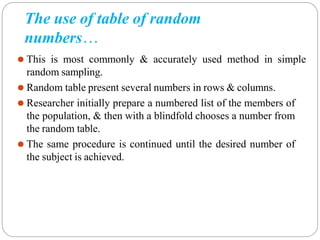
The use of table of random
numbers…
⚫ This is most commonly & accurately used method in simple
random sampling.
⚫ Random table present several numbers in rows & columns.
⚫ Researcher initially prepare a numbered list of the members of
the population, & then with a blindfold chooses a number from
the random table.
⚫ The same procedure is continued until the desired number of
the subject is achieved.
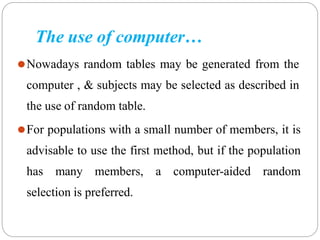
The use of computer…
⚫Nowadays random tables may be generated from the
computer , & subjects may be selected as described in
the use of random table.
⚫For populations with a small number of members, it is
advisable to use the first method, but if the population
has many members, a computer-aided random
selection is preferred.
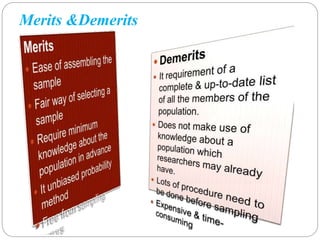
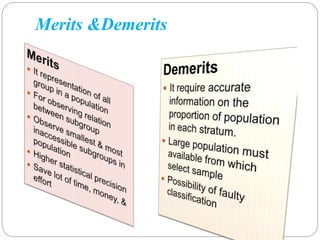
Merits &Demerits
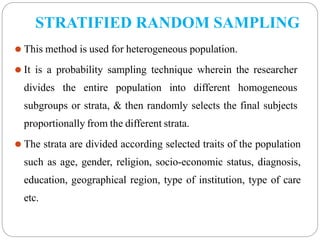
STRATIFIED RANDOM SAMPLING
⚫ This method is used for heterogeneous population.
⚫ It is a probability sampling technique wherein the researcher
divides the entire population into different homogeneous
subgroups or strata, & then randomly selects the final subjects
proportionally from the different strata.
⚫ The strata are divided according selected traits of the population
such as age, gender, religion, socio-economic status, diagnosis,
education, geographical region, type of institution, type of care
etc.
Merits &Demerits
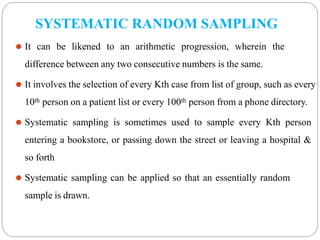
SYSTEMATIC RANDOM SAMPLING
⚫ It can be likened to an arithmetic progression, wherein the
difference between any two consecutive numbers is the same.
⚫ It involves the selection of every Kth case from list of group, such as every
10th person on a patient list or every 100th person from a phone directory.
⚫ Systematic sampling is sometimes used to sample every Kth person
entering a bookstore, or passing down the street or leaving a hospital &
so forth
⚫ Systematic sampling can be applied so that an essentially random
sample is drawn.
SYSTEMATIC RANDOM SAMPLING
Cntn….
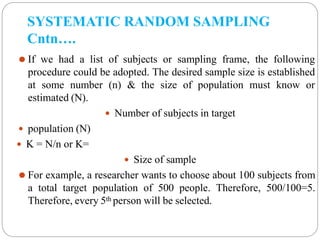
⚫ If we had a list of subjects or sampling frame, the following
procedure could be adopted. The desired sample size is established
at some number (n) & the size of population must know or
estimated (N).
 Number of subjects in target
 population (N)
 K = N/n or K=
 Size of sample
⚫ For example, a researcher wants to choose about 100 subjects from
a total target population of 500 people. Therefore, 500/100=5.
Therefore, every 5th person will be selected.
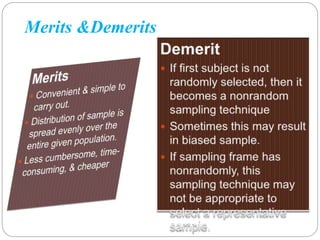
Merits &Demerits
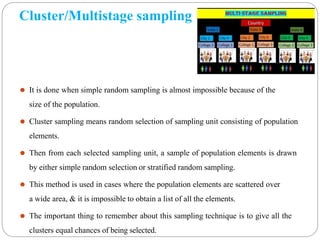
Cluster/Multistage sampling
⚫ It is done when simple random sampling is almost impossible because of the
size of the population.
⚫ Cluster sampling means random selection of sampling unit consisting of population
elements.
⚫ Then from each selected sampling unit, a sample of population elements is drawn
by either simple random selection or stratified random sampling.
⚫ This method is used in cases where the population elements are scattered over
a wide area, & it is impossible to obtain a list of all the elements.
⚫ The important thing to remember about this sampling technique is to give all the
clusters equal chances of being selected.
⚫ Geographical units are the most commonly used ones in
research. For example, a researcher wants to survey academic
performance of high school students in India.
 He can divide the entire population (of India) into different
clusters (cities).
 Then the researcher selects a number of clusters depending
on his research through simple or systematic random
sampling.
 31
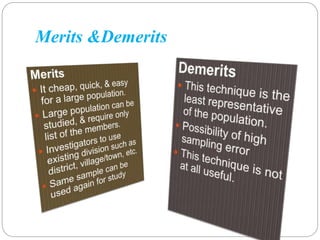
Cluster/Multistage sampling
Merits &Demerits
SEQUENTIAL SAMPLING
 This method of sample selection is slightly
different from other method.
 Here sample size is not fixed.
 The investigator initially select small sample
and tries out to make inferences if not able to
draw results he or she then adds more
subjects until clear cut result can be drawn.
Merits &Demerits
 Merits
 Facilitates to conduct a study on best possible smallest
representative sample.
 Demerits.
 With this sampling technique it is not possible to study
a phenomenon which needs to be studied at one point
of time.
NON-PROBABILTY SAMPLING
NURSING RESEARCH TYPES OF SAMPLING TECHNIQUE

NURSING RESEARCH TYPES OF SAMPLING TECHNIQUE

  • 1.
    Mr.Bhushan A.Thombare Lecturer Community HealthNursing MVP’S INE TYPES OF SAMPLING TECHNIDUE
  • 2.
    Types of SamplingTechniques  A)Probability sampling technique  1)Simple Random Sampl;ing  2)Stratified random Sampling  3)Systematic Random Sampling  4) Cluster/Multistage Sampling  5)Sequential sampling  B) Nonprobability sampling techniques  1) Purposive sampling  2)Convenience sampling  3) Consecutive sampling  4) Quota Sampling  5) Snowball sampling  6)Volunteer sampling  7) Genealogy sampling
  • 3.
    CONCEPT OF PROBABILITYSAMPLING TECHNIQUES ⚫It is based on the theory of probability. ⚫It involve random selection of the elements/members of the population. ⚫In this, every subject in a population has equal chance to be selected sampling for a study. ⚫In probability sampling techniques, the chances of systematic bias is relatively less because subject are randomly selected.
  • 4.
    FEATURES OF PROBABILITYSAMPLING TECHNIQUES ⚫ It is a technique where in the sample are gathered in a process that given all the individuals in the population equal chances of being selected. ⚫ In this sampling technique, the researcher must guarantee that every individual has an equal opportunity for selection. ⚫ The advantage of using a random sample is the absence of both systematic & sampling bias. ⚫ The effect of this is a minimal or absent systematic bias, which is a difference between the results from the sample & those from the population.
  • 6.
    Simple random sampling ⚫This is the most pure & basic probability sampling design. ⚫ In this type of sampling design, every member of population has an equal chance of being selected as subject. ⚫ The entire process of sampling is done in a single step, with each subject selected independently of the other members of the population ⚫ There is need of two essential prerequisites to implement the simple random technique: population must be homogeneous & researcher must have list of the elements/members of the accessible population.
  • 7.
    The lottery method…… ⚫Itis most primitive & mechanical method. ⚫Each member of the population is assigned a unique number. ⚫Each number is placed in a bowel or hat & mixed thoroughly. ⚫The blind-folded researcher then picks numbered tags from the hat. ⚫All the individuals bearing the numbers picked by the researcher are the subjects for the study.
  • 8.
    The use oftable of random numbers… ⚫ This is most commonly & accurately used method in simple random sampling. ⚫ Random table present several numbers in rows & columns. ⚫ Researcher initially prepare a numbered list of the members of the population, & then with a blindfold chooses a number from the random table. ⚫ The same procedure is continued until the desired number of the subject is achieved.
  • 9.
    The use ofcomputer… ⚫Nowadays random tables may be generated from the computer , & subjects may be selected as described in the use of random table. ⚫For populations with a small number of members, it is advisable to use the first method, but if the population has many members, a computer-aided random selection is preferred.
  • 10.
  • 11.
    STRATIFIED RANDOM SAMPLING ⚫This method is used for heterogeneous population. ⚫ It is a probability sampling technique wherein the researcher divides the entire population into different homogeneous subgroups or strata, & then randomly selects the final subjects proportionally from the different strata. ⚫ The strata are divided according selected traits of the population such as age, gender, religion, socio-economic status, diagnosis, education, geographical region, type of institution, type of care etc.
  • 12.
  • 13.
    SYSTEMATIC RANDOM SAMPLING ⚫It can be likened to an arithmetic progression, wherein the difference between any two consecutive numbers is the same. ⚫ It involves the selection of every Kth case from list of group, such as every 10th person on a patient list or every 100th person from a phone directory. ⚫ Systematic sampling is sometimes used to sample every Kth person entering a bookstore, or passing down the street or leaving a hospital & so forth ⚫ Systematic sampling can be applied so that an essentially random sample is drawn.
  • 14.
    SYSTEMATIC RANDOM SAMPLING Cntn…. ⚫If we had a list of subjects or sampling frame, the following procedure could be adopted. The desired sample size is established at some number (n) & the size of population must know or estimated (N).  Number of subjects in target  population (N)  K = N/n or K=  Size of sample ⚫ For example, a researcher wants to choose about 100 subjects from a total target population of 500 people. Therefore, 500/100=5. Therefore, every 5th person will be selected.
  • 15.
  • 16.
    Cluster/Multistage sampling ⚫ Itis done when simple random sampling is almost impossible because of the size of the population. ⚫ Cluster sampling means random selection of sampling unit consisting of population elements. ⚫ Then from each selected sampling unit, a sample of population elements is drawn by either simple random selection or stratified random sampling. ⚫ This method is used in cases where the population elements are scattered over a wide area, & it is impossible to obtain a list of all the elements. ⚫ The important thing to remember about this sampling technique is to give all the clusters equal chances of being selected.
  • 17.
    ⚫ Geographical unitsare the most commonly used ones in research. For example, a researcher wants to survey academic performance of high school students in India.  He can divide the entire population (of India) into different clusters (cities).  Then the researcher selects a number of clusters depending on his research through simple or systematic random sampling.  31 Cluster/Multistage sampling
  • 18.
  • 19.
    SEQUENTIAL SAMPLING  Thismethod of sample selection is slightly different from other method.  Here sample size is not fixed.  The investigator initially select small sample and tries out to make inferences if not able to draw results he or she then adds more subjects until clear cut result can be drawn.
  • 20.
    Merits &Demerits  Merits Facilitates to conduct a study on best possible smallest representative sample.  Demerits.  With this sampling technique it is not possible to study a phenomenon which needs to be studied at one point of time.
  • 21.