

NURSING PROCESS
and
CRITICAL THINKING
BY
Ms. SAPNA PAL, TUTOR, CON, KANPUR
Purpose
•To identify the client’s health status and actual or potential health
care problems or needs (through assessment).
•To establish plans to meet the identified needs.
•To deliver specific nursing interventions to meet those needs.
•To apply the best available caregiving evidence and promote human
functions and responses to health and illness (ANA, 2010).
•To protect nurses against legal problems related to nursing care
when the standards of the nursing process are followed correctly.
•To establish a database about the client’s health status, health concerns,
response to illness, and the ability to manage health care needs.
characteristics
•Patient-centered..
•Interpersonal.
•Collaborative
•Dynamic and cyclical
•Require critical thinking
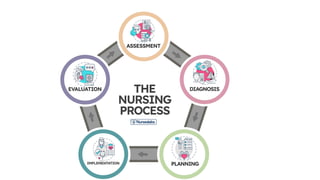
Assessment
• collecting, organizing, validating, and documenting the clients’ health
status.
• This data can be obtained in a variety of ways.
• Usually, when the nurse first encounters a patient, the nurse is
expected to assess to identify the patient’s health problems as well as
the physiological, psychological, and emotional state
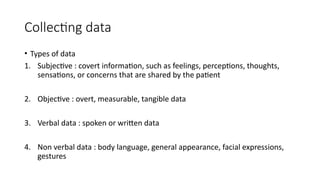
Collecting data
• Types of data
1. Subjective : covert information, such as feelings, perceptions, thoughts,
sensations, or concerns that are shared by the patient
2. Objective : overt, measurable, tangible data
3. Verbal data : spoken or written data
4. Non verbal data : body language, general appearance, facial expressions,
gestures
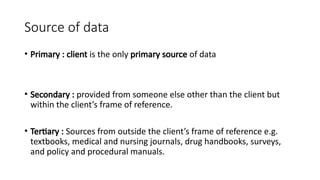
Source of data
• Primary : client is the only primary source of data
• Secondary : provided from someone else other than the client but
within the client’s frame of reference.
• Tertiary : Sources from outside the client’s frame of reference e.g.
textbooks, medical and nursing journals, drug handbooks, surveys,
and policy and procedural manuals.
Method of data collection
• Health interview
• Physical examination
• Observation
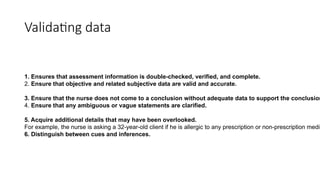
Validating data
1. Ensures that assessment information is double-checked, verified, and complete.
2. Ensure that objective and related subjective data are valid and accurate.
3. Ensure that the nurse does not come to a conclusion without adequate data to support the conclusion
4. Ensure that any ambiguous or vague statements are clarified.
5. Acquire additional details that may have been overlooked.
For example, the nurse is asking a 32-year-old client if he is allergic to any prescription or non-prescription medic
6. Distinguish between cues and inferences.
Documenting data
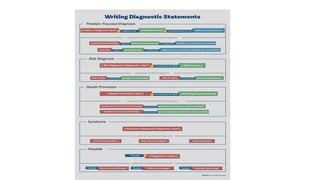
Diagnosis
• The nurse will analyze all the gathered information and diagnose the
client’s condition and needs.
• Diagnosing involves analyzing data, identifying health problems, risks,
and strengths, and formulating diagnostic statements about a patient’s
potential or actual health problem.
• More than one diagnosis is sometimes made for a single patient.
Formulating a nursing diagnosis by employing clinical judgment assists
in the planning and implementation of patient care.
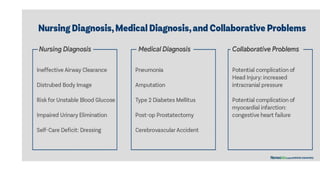
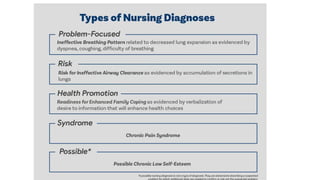
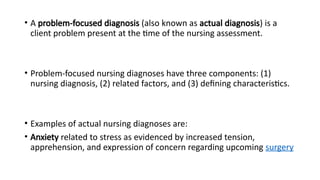
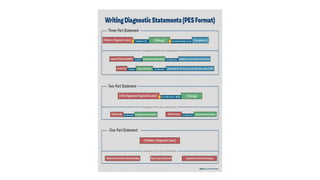
• A problem-focused diagnosis (also known as actual diagnosis) is a
client problem present at the time of the nursing assessment.
• Problem-focused nursing diagnoses have three components: (1)
nursing diagnosis, (2) related factors, and (3) defining characteristics.
• Examples of actual nursing diagnoses are:
• Anxiety related to stress as evidenced by increased tension,
apprehension, and expression of concern regarding upcoming surgery
Risk diagnosis
• These are clinical judgments that a problem does not exist, but the
presence of risk factors indicates that a problem is likely to develop
unless nurses intervene.
• Components of a risk nursing diagnosis include (1) risk diagnostic
label, and (2) risk factors.
• Examples of risk nursing diagnosis are:
• Risk for injury
Health promotion
• clinical judgment about motivation and desire to increase well-being.
• It is a statement that identifies the patient’s readiness for engaging in
activities that promote health and well-being.
• For example, if a first-time mother shows interest on how to properly
breastfeed her baby, a nurse make a health promotion diagnosis of
“Readiness for Enhanced Breastfeeding.”
• Components of a health promotion diagnosis generally include only
the diagnostic label or a one-part statement.
• Examples of health promotion diagnosis:
• Readiness for enhanced health literacy
syndrome diagnosis
• A syndrome diagnosis is a clinical judgment concerning a cluster of
problem or risk nursing diagnoses that are predicted to present
because of a certain situation or event.
• They, too, are written as a one-part statement requiring only the
diagnostic label.
• Examples of a syndrome nursing diagnosis are:
• Chronic Pain Syndrome
Possible nursing diagnoses
• Possible nursing diagnoses are statements describing a suspected
problem for which additional data are needed to confirm or rule out the
suspected problem.
• It provides the nurse with the ability to communicate with other nurses
that a diagnosis may be present but additional data collection is indicated
to rule out or confirm the diagnosis.
• Examples include:
• Possible chronic low self-esteem
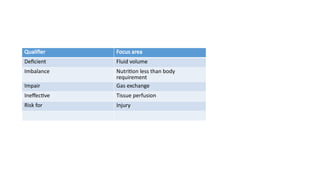
Components of diagnosis
• Qualifier/ modifier
• Etiology/ relate factor
• Risk factors
• Defining characteristics
Qualifier Focus area
Deficient Fluid volume
Imbalance Nutrition less than body
requirement
Impair Gas exchange
Ineffective Tissue perfusion
Risk for Injury
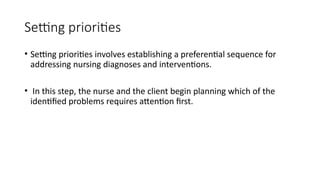
Setting priorities
• Setting priorities involves establishing a preferential sequence for
addressing nursing diagnoses and interventions.
• In this step, the nurse and the client begin planning which of the
identified problems requires attention first.
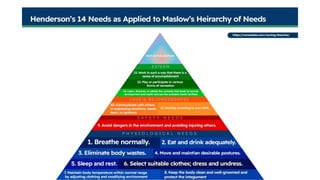
• A nursing diagnosis encompasses Maslow’s Hierarchy of Needs and
helps to prioritize and plan care based on patient-centered outcomes.
• In 1943, Abraham Maslow developed a hierarchy based on basic
fundamental needs innate to all individuals.
Maslow’s Hierarchy of Needs
• Basic Physiological Needs: Nutrition (water and food), elimination
(Toileting), airway (suction)-breathing (oxygen)-circulation (pulse,
cardiac monitor, blood pressure) (ABCs), sleep, sex, shelter, and
exercise.
• Safety and Security: Injury prevention (side rails, call lights,
hand hygiene, isolation, suicide precautions, fall precautions, car
seats, helmets, seat belts), fostering a climate of trust and safety (
therapeutic relationship), patient education (modifiable risk factors
for stroke, heart disease).
• Love and Belonging: Foster supportive relationships, methods to avoid
social isolation (bullying), employ active listening techniques,
therapeutic communication, and sexual intimacy.
• Self-Esteem: Acceptance in the community, workforce, personal
achievement, sense of control or empowerment, accepting one’s
physical appearance or body habitus.
• Self-Actualization: Empowering environment, spiritual growth, ability
to recognize the point of view of others, reaching one’s maximum
potential.
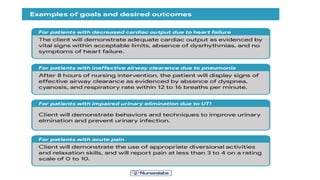
Establishing Client Goals and Desired Outcomes
• Goals or desired outcomes describe what the nurse hopes to achieve
by implementing the nursing interventions derived from the client’s
nursing diagnoses.
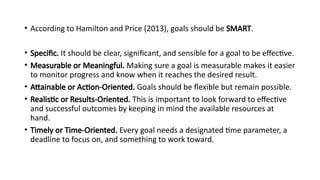
• According to Hamilton and Price (2013), goals should be SMART.
• Specific. It should be clear, significant, and sensible for a goal to be effective.
• Measurable or Meaningful. Making sure a goal is measurable makes it easier
to monitor progress and know when it reaches the desired result.
• Attainable or Action-Oriented. Goals should be flexible but remain possible.
• Realistic or Results-Oriented. This is important to look forward to effective
and successful outcomes by keeping in mind the available resources at
hand.
• Timely or Time-Oriented. Every goal needs a designated time parameter, a
deadline to focus on, and something to work toward.
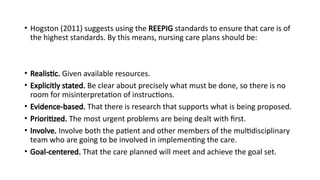
• Hogston (2011) suggests using the REEPIG standards to ensure that care is of
the highest standards. By this means, nursing care plans should be:
• Realistic. Given available resources.
• Explicitly stated. Be clear about precisely what must be done, so there is no
room for misinterpretation of instructions.
• Evidence-based. That there is research that supports what is being proposed.
• Prioritized. The most urgent problems are being dealt with first.
• Involve. Involve both the patient and other members of the multidisciplinary
team who are going to be involved in implementing the care.
• Goal-centered. That the care planned will meet and achieve the goal set.
Short-Term and Long-Term Goals
• Goals and expected outcomes must be measurable and client-centered.
• Goals are constructed by focusing on problem prevention, resolution,
and rehabilitation.
• Short-term goal. A statement distinguishing a shift in behavior that can
be completed immediately, usually within a few hours or days.
• Long-term goal. Indicates an objective to be completed over a longer
period, usually weeks or months.
• Discharge planning. Involves naming long-term goals, therefore
promoting continued restorative care and problem resolution through
home health, physical therapy, or various other referral sources.
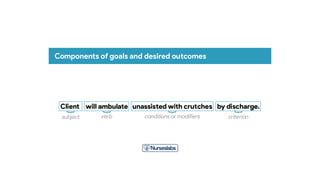
•Conditions or modifiers. These are the “what, when, where, or how” that are added to the verb
•to explain the circumstances under which the behavior is to be performed.
•Criterion of desired performance. The criterion indicates the standard by which a performance is
evaluated
Planning
• Planning is the third step of the nursing process. It provides direction
for nursing interventions.
• When the nurse, any supervising medical staff, and the patient agree
on the diagnosis, the nurse will plan a course of treatment that takes
into account short and long-term goals.
• The planning phase is where goals and outcomes are formulated that
directly impact patient care based on evidence-based practice (EBP)
guidelines.
• These patient-specific goals and the attainment of such assist in
ensuring a positive outcome.
Types of planning
• Initial Planning
• Initial planning is done by the nurse who conducts the admission
assessment.
• Ongoing Planning
• As a nurse obtain new information and evaluate the client’s responses
to care, they can individualize the initial care plan further.
• Ongoing planning allows the nurse to: determine if the client’s health
status has changed
• Discharge Planning
• To provide continuity of care, nurses need to accomplish the
following:
• Start discharge planning for all clients when they are admitted to any
health care setting.
• Involve the client and the client’s family or support persons in the
planning process.
Selecting Nursing Interventions
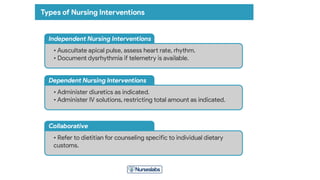
• Nursing interventions are activities or actions that a nurse performs to
achieve client goals.
• Interventions chosen should focus on eliminating or reducing the
etiology of the priority nursing problem or diagnosis.
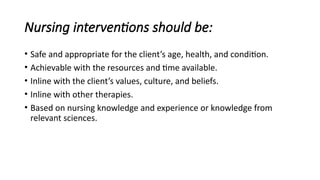
Nursing interventions should be:
• Safe and appropriate for the client’s age, health, and condition.
• Achievable with the resources and time available.
• Inline with the client’s values, culture, and beliefs.
• Inline with other therapies.
• Based on nursing knowledge and experience or knowledge from
relevant sciences.
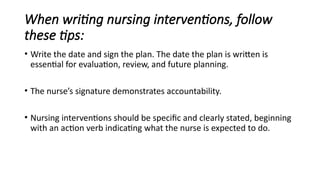
When writing nursing interventions, follow
these tips:
• Write the date and sign the plan. The date the plan is written is
essential for evaluation, review, and future planning.
• The nurse’s signature demonstrates accountability.
• Nursing interventions should be specific and clearly stated, beginning
with an action verb indicating what the nurse is expected to do.
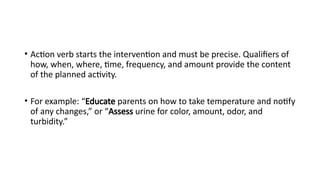
• Action verb starts the intervention and must be precise. Qualifiers of
how, when, where, time, frequency, and amount provide the content
of the planned activity.
• For example: “Educate parents on how to take temperature and notify
of any changes,” or “Assess urine for color, amount, odor, and
turbidity.”
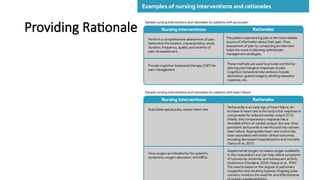
Providing Rationale
Evaluation
• Evaluation is a planned, ongoing, purposeful activity in which the
client’s progress towards achieving goals or desired outcomes is
assessed, and the effectiveness of the nursing care plan (NCP).
• Evaluation is an essential aspect of the nursing process because the
conclusions drawn from this step determine whether the nursing
intervention should be terminated, continued, or changed.
THANK YOU

critical thinking and Nursing care plan

  • 1.
    NURSING PROCESS and CRITICAL THINKING BY Ms.SAPNA PAL, TUTOR, CON, KANPUR
  • 9.
    Purpose •To identify theclient’s health status and actual or potential health care problems or needs (through assessment). •To establish plans to meet the identified needs. •To deliver specific nursing interventions to meet those needs.
  • 10.
    •To apply thebest available caregiving evidence and promote human functions and responses to health and illness (ANA, 2010). •To protect nurses against legal problems related to nursing care when the standards of the nursing process are followed correctly. •To establish a database about the client’s health status, health concerns, response to illness, and the ability to manage health care needs.
  • 11.
  • 12.
    Assessment • collecting, organizing,validating, and documenting the clients’ health status. • This data can be obtained in a variety of ways. • Usually, when the nurse first encounters a patient, the nurse is expected to assess to identify the patient’s health problems as well as the physiological, psychological, and emotional state
  • 13.
    Collecting data • Typesof data 1. Subjective : covert information, such as feelings, perceptions, thoughts, sensations, or concerns that are shared by the patient 2. Objective : overt, measurable, tangible data 3. Verbal data : spoken or written data 4. Non verbal data : body language, general appearance, facial expressions, gestures
  • 14.
    Source of data •Primary : client is the only primary source of data • Secondary : provided from someone else other than the client but within the client’s frame of reference. • Tertiary : Sources from outside the client’s frame of reference e.g. textbooks, medical and nursing journals, drug handbooks, surveys, and policy and procedural manuals.
  • 15.
    Method of datacollection • Health interview • Physical examination • Observation
  • 16.
    Validating data 1. Ensuresthat assessment information is double-checked, verified, and complete. 2. Ensure that objective and related subjective data are valid and accurate. 3. Ensure that the nurse does not come to a conclusion without adequate data to support the conclusion 4. Ensure that any ambiguous or vague statements are clarified. 5. Acquire additional details that may have been overlooked. For example, the nurse is asking a 32-year-old client if he is allergic to any prescription or non-prescription medic 6. Distinguish between cues and inferences.
  • 17.
  • 19.
    Diagnosis • The nursewill analyze all the gathered information and diagnose the client’s condition and needs. • Diagnosing involves analyzing data, identifying health problems, risks, and strengths, and formulating diagnostic statements about a patient’s potential or actual health problem. • More than one diagnosis is sometimes made for a single patient. Formulating a nursing diagnosis by employing clinical judgment assists in the planning and implementation of patient care.
  • 23.
    • A problem-focuseddiagnosis (also known as actual diagnosis) is a client problem present at the time of the nursing assessment. • Problem-focused nursing diagnoses have three components: (1) nursing diagnosis, (2) related factors, and (3) defining characteristics. • Examples of actual nursing diagnoses are: • Anxiety related to stress as evidenced by increased tension, apprehension, and expression of concern regarding upcoming surgery
  • 24.
    Risk diagnosis • Theseare clinical judgments that a problem does not exist, but the presence of risk factors indicates that a problem is likely to develop unless nurses intervene. • Components of a risk nursing diagnosis include (1) risk diagnostic label, and (2) risk factors. • Examples of risk nursing diagnosis are: • Risk for injury
  • 25.
    Health promotion • clinicaljudgment about motivation and desire to increase well-being. • It is a statement that identifies the patient’s readiness for engaging in activities that promote health and well-being. • For example, if a first-time mother shows interest on how to properly breastfeed her baby, a nurse make a health promotion diagnosis of “Readiness for Enhanced Breastfeeding.”
  • 26.
    • Components ofa health promotion diagnosis generally include only the diagnostic label or a one-part statement. • Examples of health promotion diagnosis: • Readiness for enhanced health literacy
  • 27.
    syndrome diagnosis • Asyndrome diagnosis is a clinical judgment concerning a cluster of problem or risk nursing diagnoses that are predicted to present because of a certain situation or event. • They, too, are written as a one-part statement requiring only the diagnostic label. • Examples of a syndrome nursing diagnosis are: • Chronic Pain Syndrome
  • 28.
    Possible nursing diagnoses •Possible nursing diagnoses are statements describing a suspected problem for which additional data are needed to confirm or rule out the suspected problem. • It provides the nurse with the ability to communicate with other nurses that a diagnosis may be present but additional data collection is indicated to rule out or confirm the diagnosis. • Examples include: • Possible chronic low self-esteem
  • 29.
    Components of diagnosis •Qualifier/ modifier • Etiology/ relate factor • Risk factors • Defining characteristics
  • 30.
    Qualifier Focus area DeficientFluid volume Imbalance Nutrition less than body requirement Impair Gas exchange Ineffective Tissue perfusion Risk for Injury
  • 33.
    Setting priorities • Settingpriorities involves establishing a preferential sequence for addressing nursing diagnoses and interventions. • In this step, the nurse and the client begin planning which of the identified problems requires attention first.
  • 34.
    • A nursingdiagnosis encompasses Maslow’s Hierarchy of Needs and helps to prioritize and plan care based on patient-centered outcomes. • In 1943, Abraham Maslow developed a hierarchy based on basic fundamental needs innate to all individuals.
  • 36.
    Maslow’s Hierarchy ofNeeds • Basic Physiological Needs: Nutrition (water and food), elimination (Toileting), airway (suction)-breathing (oxygen)-circulation (pulse, cardiac monitor, blood pressure) (ABCs), sleep, sex, shelter, and exercise. • Safety and Security: Injury prevention (side rails, call lights, hand hygiene, isolation, suicide precautions, fall precautions, car seats, helmets, seat belts), fostering a climate of trust and safety ( therapeutic relationship), patient education (modifiable risk factors for stroke, heart disease).
  • 37.
    • Love andBelonging: Foster supportive relationships, methods to avoid social isolation (bullying), employ active listening techniques, therapeutic communication, and sexual intimacy. • Self-Esteem: Acceptance in the community, workforce, personal achievement, sense of control or empowerment, accepting one’s physical appearance or body habitus. • Self-Actualization: Empowering environment, spiritual growth, ability to recognize the point of view of others, reaching one’s maximum potential.
  • 38.
    Establishing Client Goalsand Desired Outcomes • Goals or desired outcomes describe what the nurse hopes to achieve by implementing the nursing interventions derived from the client’s nursing diagnoses.
  • 40.
    • According toHamilton and Price (2013), goals should be SMART. • Specific. It should be clear, significant, and sensible for a goal to be effective. • Measurable or Meaningful. Making sure a goal is measurable makes it easier to monitor progress and know when it reaches the desired result. • Attainable or Action-Oriented. Goals should be flexible but remain possible. • Realistic or Results-Oriented. This is important to look forward to effective and successful outcomes by keeping in mind the available resources at hand. • Timely or Time-Oriented. Every goal needs a designated time parameter, a deadline to focus on, and something to work toward.
  • 41.
    • Hogston (2011)suggests using the REEPIG standards to ensure that care is of the highest standards. By this means, nursing care plans should be: • Realistic. Given available resources. • Explicitly stated. Be clear about precisely what must be done, so there is no room for misinterpretation of instructions. • Evidence-based. That there is research that supports what is being proposed. • Prioritized. The most urgent problems are being dealt with first. • Involve. Involve both the patient and other members of the multidisciplinary team who are going to be involved in implementing the care. • Goal-centered. That the care planned will meet and achieve the goal set.
  • 42.
    Short-Term and Long-TermGoals • Goals and expected outcomes must be measurable and client-centered. • Goals are constructed by focusing on problem prevention, resolution, and rehabilitation. • Short-term goal. A statement distinguishing a shift in behavior that can be completed immediately, usually within a few hours or days. • Long-term goal. Indicates an objective to be completed over a longer period, usually weeks or months. • Discharge planning. Involves naming long-term goals, therefore promoting continued restorative care and problem resolution through home health, physical therapy, or various other referral sources.
  • 44.
    •Conditions or modifiers.These are the “what, when, where, or how” that are added to the verb •to explain the circumstances under which the behavior is to be performed. •Criterion of desired performance. The criterion indicates the standard by which a performance is evaluated
  • 45.
    Planning • Planning isthe third step of the nursing process. It provides direction for nursing interventions. • When the nurse, any supervising medical staff, and the patient agree on the diagnosis, the nurse will plan a course of treatment that takes into account short and long-term goals.
  • 46.
    • The planningphase is where goals and outcomes are formulated that directly impact patient care based on evidence-based practice (EBP) guidelines. • These patient-specific goals and the attainment of such assist in ensuring a positive outcome.
  • 47.
    Types of planning •Initial Planning • Initial planning is done by the nurse who conducts the admission assessment. • Ongoing Planning • As a nurse obtain new information and evaluate the client’s responses to care, they can individualize the initial care plan further. • Ongoing planning allows the nurse to: determine if the client’s health status has changed
  • 48.
    • Discharge Planning •To provide continuity of care, nurses need to accomplish the following: • Start discharge planning for all clients when they are admitted to any health care setting. • Involve the client and the client’s family or support persons in the planning process.
  • 49.
    Selecting Nursing Interventions •Nursing interventions are activities or actions that a nurse performs to achieve client goals. • Interventions chosen should focus on eliminating or reducing the etiology of the priority nursing problem or diagnosis.
  • 51.
    Nursing interventions shouldbe: • Safe and appropriate for the client’s age, health, and condition. • Achievable with the resources and time available. • Inline with the client’s values, culture, and beliefs. • Inline with other therapies. • Based on nursing knowledge and experience or knowledge from relevant sciences.
  • 52.
    When writing nursinginterventions, follow these tips: • Write the date and sign the plan. The date the plan is written is essential for evaluation, review, and future planning. • The nurse’s signature demonstrates accountability. • Nursing interventions should be specific and clearly stated, beginning with an action verb indicating what the nurse is expected to do.
  • 53.
    • Action verbstarts the intervention and must be precise. Qualifiers of how, when, where, time, frequency, and amount provide the content of the planned activity. • For example: “Educate parents on how to take temperature and notify of any changes,” or “Assess urine for color, amount, odor, and turbidity.”
  • 54.
  • 55.
    Evaluation • Evaluation isa planned, ongoing, purposeful activity in which the client’s progress towards achieving goals or desired outcomes is assessed, and the effectiveness of the nursing care plan (NCP). • Evaluation is an essential aspect of the nursing process because the conclusions drawn from this step determine whether the nursing intervention should be terminated, continued, or changed.
  • 57.