ICFAI UNIVERSITY TRIPURA
TOPIC :- Newton’s Divided Difference
Presented by
Pralay sarkar
WHAT IS INTERPOLATION?
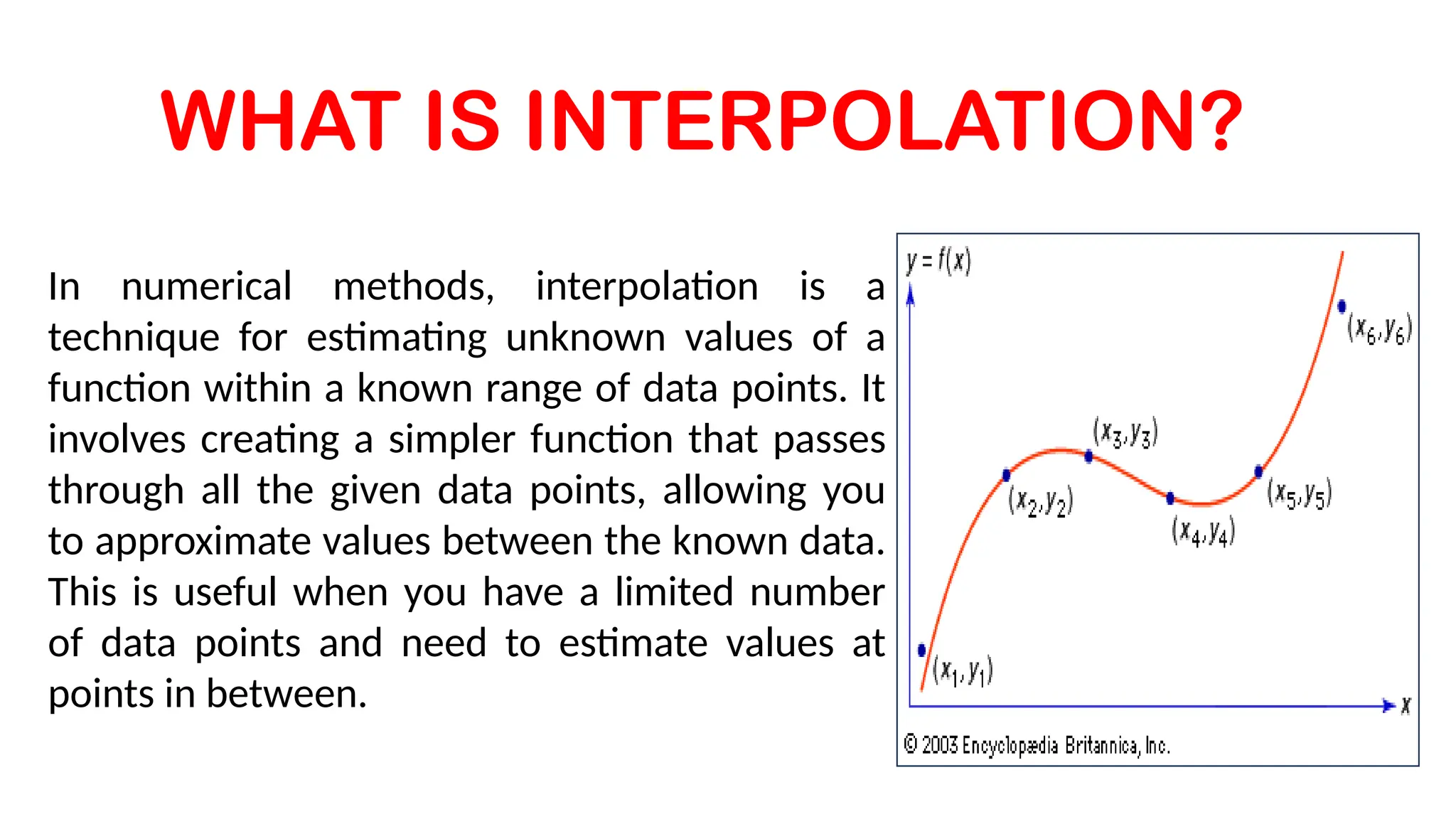
In numerical methods, interpolation is a
technique for estimating unknown values of a
function within a known range of data points. It
involves creating a simpler function that passes
through all the given data points, allowing you
to approximate values between the known data.
This is useful when you have a limited number
of data points and need to estimate values at
points in between.
GEOMETRIC REPRESENTATION OF NEWTON’S
DIVIDED DIFFERENCE INTERPOLATION
Newton's divided difference method
provides a geometric interpretation of
polynomial interpolation by constructing a
polynomial that passes through a given set
of points. This method uses divided
differences to find the coefficients of the
interpolating polynomial, essentially
fitting a curve to the data points.
WHAT IS NEWTON’S DIVIDED
DIFFERENCE INTERPOLATION?
Newton's divided difference is a
method for constructing an
interpolating polynomial, which
approximates a function's behavior
between known data points, using
a recursive process involving
divided differences. It's named
after Sir Isaac Newton and is often
used when the data points are not
equally spaced.
ADVANTAGE OF NEWTON’S DIVIDED
DIFFERENCE INTERPOLATION
Newton's divided difference interpolation offers
several advantages over other interpolation
methods, particularly Lagrange interpolation. It's
easier to add more data points without
recalculating the entire polynomial, and it utilizes
nested multiplication for efficiency. This method
is also well-suited for scenarios where you need
to find values of a function between known x-
values where the function values are given.
DISADVANTAGE OF NEWTON’S DIVIDED
DIFFERENCE INTERPOLATION
Newton's divided difference interpolation, while
powerful, has some drawbacks. For higher-degree
polynomials, the coefficients can become large,
leading to numerical instability. While Newton's
method is more flexible than Lagrange
interpolation, adding or removing data points
requires less computation, it can still be
computationally intensive for a large number of
data points. Additionally, it can struggle with noisy
data or data with large errors, as the interpolation
polynomial can amplify these errors.
PROPERTIES OF NEWTON’S DIVIDED
DIFFERENCE
1.The divided difference are symmetric with respect to their arguments.
2.The divided difference of f(x)+-g(x) is the sum of the corresponding divided
difference of f(x) and g(x) , i.e, the divided difference is linear.
3.The divided difference of a constant is zero.
4. The divided difference of kf(x),where k is a constant , is k times the divided
difference of f(x).
5. The nth order divided difference of a polynomial is constant.
ALGORITHM FOR NEWTON’S DIVIDED
DIFFERENCE
APPLICATION OF NEWTON’S DIVIDED
DIFFERENCE
Construct the Newton Divided Difference Table for generating
Newton interpolation polynomial with the following data set:
i 0 1 2 3 4
Xi 0 1 2 3 4
Yi=f(Xi) 0 1 8 27 64
SOLUTION:
Here n = 5. One can fit a fourth order
Newton Divided Difference interpolation
polynomial to the given data. Let us
generate Newton Divided Difference
Table; as requested.
THANK YOU

newton divided difference PPT.pptx presented by Mr. Pralay Sarkar for newton's devide difference topic.

  • 1.
    ICFAI UNIVERSITY TRIPURA TOPIC:- Newton’s Divided Difference Presented by Pralay sarkar
  • 2.
    WHAT IS INTERPOLATION? Innumerical methods, interpolation is a technique for estimating unknown values of a function within a known range of data points. It involves creating a simpler function that passes through all the given data points, allowing you to approximate values between the known data. This is useful when you have a limited number of data points and need to estimate values at points in between.
  • 3.
    GEOMETRIC REPRESENTATION OFNEWTON’S DIVIDED DIFFERENCE INTERPOLATION Newton's divided difference method provides a geometric interpretation of polynomial interpolation by constructing a polynomial that passes through a given set of points. This method uses divided differences to find the coefficients of the interpolating polynomial, essentially fitting a curve to the data points.
  • 4.
    WHAT IS NEWTON’SDIVIDED DIFFERENCE INTERPOLATION? Newton's divided difference is a method for constructing an interpolating polynomial, which approximates a function's behavior between known data points, using a recursive process involving divided differences. It's named after Sir Isaac Newton and is often used when the data points are not equally spaced.
  • 6.
    ADVANTAGE OF NEWTON’SDIVIDED DIFFERENCE INTERPOLATION Newton's divided difference interpolation offers several advantages over other interpolation methods, particularly Lagrange interpolation. It's easier to add more data points without recalculating the entire polynomial, and it utilizes nested multiplication for efficiency. This method is also well-suited for scenarios where you need to find values of a function between known x- values where the function values are given.
  • 7.
    DISADVANTAGE OF NEWTON’SDIVIDED DIFFERENCE INTERPOLATION Newton's divided difference interpolation, while powerful, has some drawbacks. For higher-degree polynomials, the coefficients can become large, leading to numerical instability. While Newton's method is more flexible than Lagrange interpolation, adding or removing data points requires less computation, it can still be computationally intensive for a large number of data points. Additionally, it can struggle with noisy data or data with large errors, as the interpolation polynomial can amplify these errors.
  • 8.
    PROPERTIES OF NEWTON’SDIVIDED DIFFERENCE 1.The divided difference are symmetric with respect to their arguments. 2.The divided difference of f(x)+-g(x) is the sum of the corresponding divided difference of f(x) and g(x) , i.e, the divided difference is linear. 3.The divided difference of a constant is zero. 4. The divided difference of kf(x),where k is a constant , is k times the divided difference of f(x). 5. The nth order divided difference of a polynomial is constant.
  • 9.
    ALGORITHM FOR NEWTON’SDIVIDED DIFFERENCE
  • 10.
    APPLICATION OF NEWTON’SDIVIDED DIFFERENCE Construct the Newton Divided Difference Table for generating Newton interpolation polynomial with the following data set: i 0 1 2 3 4 Xi 0 1 2 3 4 Yi=f(Xi) 0 1 8 27 64 SOLUTION: Here n = 5. One can fit a fourth order Newton Divided Difference interpolation polynomial to the given data. Let us generate Newton Divided Difference Table; as requested.
  • 11.