NUMERICAL ABILITY
Prof. Samruddhi Chepe
SOME AREAS-
 Number Series
 Height & Distance
 Average
 Percentage
 Square Root
 Chain Rule
 Arithmetic Aptitude
 Simple Interest
 Numerical Reasoning
 Numerical Aptitude
 Probability
 Numerical Ability
 Compound Interest
 Multiplication Quiz
 Metric Unit Conversion
 Square and Cubic
Conversion
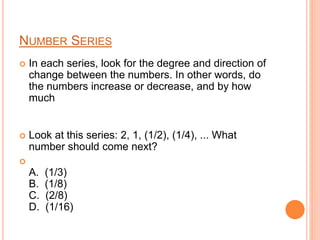
NUMBER SERIES
 In each series, look for the degree and direction of
change between the numbers. In other words, do
the numbers increase or decrease, and by how
much
 Look at this series: 2, 1, (1/2), (1/4), ... What
number should come next?

A. (1/3)
B. (1/8)
C. (2/8)
D. (1/16)
 Answer & Explanation:
 Answer: Option B
 Explanation: This is a simple division series; each
number is one-half of the previous number. In other
terms to say, the number is divided by 2
successively to get the next result.
 4/2 = 2
 2/2 = 1
 1/2 = 1/2
 (1/2)/2 = 1/4
 (1/4)/2 = 1/8 and so on.
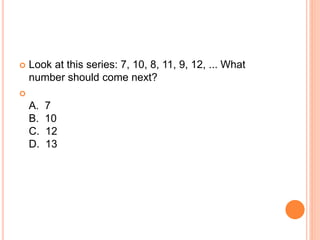
 Look at this series: 7, 10, 8, 11, 9, 12, ... What
number should come next?

A. 7
B. 10
C. 12
D. 13
 Answer & Explanation:
 Answer: Option B
 Explanation: This is a simple alternating addition
and subtraction series. In the first pattern, 3 is
added; in the second, 2 is subtracted.
 Look at this series: 36, 34, 30, 28, 24, ... What
number should come next?

A. 20
B. 22
C. 23
D. 26
 Answer & Explanation:
 Answer: Option B
 Explanation: This is an alternating number
subtraction series. First, 2 is subtracted, then 4,
then 2, and so on.
 Look at this series: 22, 21, 23, 22, 24, 23, ... What
number should come next?

A. 22
B. 24
C. 25
D. 26
 Answer & Explanation:
 Answer: Option C
 Explanation: In this simple alternating subtraction
and addition series; 1 is subtracted, then 2 is
added, and so on.
 Look at this series: 53, 53, 40, 40, 27, 27, ... What
number should come next?

A. 12
B. 14
C. 27
D. 53
 Answer: Option B Explanation:
 In this series, each number is repeated, then 13 is
subtracted to arrive at the next number.

HEIGHT & DISTANCE
AVERAGE
 A grocer has a sales of Euro 6435, Euro 6927, Euro
6855, Euro 7230 and Euro 6562 for 5 consecutive
months. How much sale must he have in the sixth
month so that he gets an average sale of Euro
6500?

A. Euro 4991
B. Euro 5991
C. Euro 6001
D. Euro 6991
 Answer & Explanation:
 Answer: Option A
 Explanation: Total sale for 5 months = Euro (6435 +
6927 + 6855 + 7230 + 6562) = Euro 34009.
 Required sale = Euro [ (6500 x 6) - 34009 ]
 = Euro (39000 - 34009)
 = Euro 4991.
 The average monthly income of P and Q is Dollar
5050. The average monthly income of Q and R is
Dollar 6250 and the average monthly income of P
and R is Dollar 5200. The monthly income of P is:

A. Dollar 3500
B. Dollar 4000
C. Dollar 4050
D. Dollar 5000
 Answer & Explanation:
 Answer: Option B
 Explanation: Let P, Q and R represent their respective
monthly incomes. Then, we have:
 P + Q = (5050 x 2) = 10100 .... (i)
 Q + R = (6250 x 2) = 12500 .... (ii)
 P + R = (5200 x 2) = 10400 .... (iii)
 Adding (i), (ii) and (iii), we get: 2(P + Q + R) = 33000 or
P + Q + R = 16500 .... (iv)
 Subtracting (ii) from (iv), we get P = 4000. P's monthly
income = Dollar 4000.

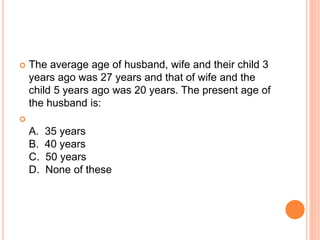
 The average age of husband, wife and their child 3
years ago was 27 years and that of wife and the
child 5 years ago was 20 years. The present age of
the husband is:

A. 35 years
B. 40 years
C. 50 years
D. None of these
 Answer & Explanation:
 Answer: Option B
 Explanation: Sum of the present ages of husband,
wife and child = (27 x 3 + 3 x 3) years = 90 years.
 Sum of the present ages of wife and child = (20 x 2
+ 5 x 2) years = 50 years.
 Husband's present age = (90 - 50) years = 40
years.

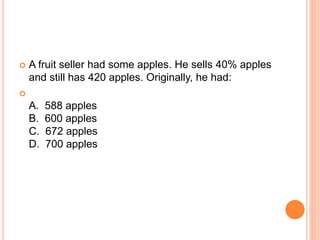
 A fruit seller had some apples. He sells 40% apples
and still has 420 apples. Originally, he had:

A. 588 apples
B. 600 apples
C. 672 apples
D. 700 apples
 Answer & Explanation:
 Answer: Option D
 Explanation: Suppose originally he had x apples.
 Then, (100 - 40)% of x = 420.
 60/100 x x = 420
 x = (420 x 100)/60 = 700.
 A sum of money at simple interest amounts to 815
in 3 years and to 854 in 4 years. The sum is:

A. 650
B. 690
C. 698
D. 700
 Answer & Explanation:
 Answer: Option C
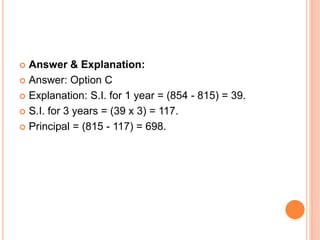
 Explanation: S.I. for 1 year = (854 - 815) = 39.
 S.I. for 3 years = (39 x 3) = 117.
 Principal = (815 - 117) = 698.
93296 - 45874 + 20382 - 56817 = ?
 A. 10387
 B. 10587
 C. 10787
 D. 10987
 Answer & Explanation
 Answer : Option D
 Explanation :? = 113678 - 102691 = 109887
DISTANCE, SPEED AND TIME EQUATION
 All the calculations in
this section will be
worked out using
the distance, speed
and time equation. An
easy way to remember
the distance, speed
and time equations is
to put the letters into a
triangle.
SPEED, DISTANCE AND TIME
 A boat can travel with a speed of 13 km/hr in still
water. If the speed of the stream is 4 km/hr, find the
time taken by the boat to go 68 km downstream.
A. 2 hours
B. 3 hours
C. 4 hours
D. 5 hours
 Answer & Explanation:
 Answer: Option C
 Explanation: Speed downstream = (13 + 4) km/hr =
17 km/hr.
 Time taken to travel 68 km downstream = 68/17 hrs
= 4 hrs.
 A man's speed with the current is 15 km/hr and the
speed of the current is 2.5 km/hr. The man's speed
against the current is:

A. 8.5 km/hr
B. 9 km/hr
C. 10 km/hr
D. 12.5 km/hr
 Answer & Explanation:
 Answer: Option C
 Explanation: Man's rate in still water = (15 - 2.5)
km/hr = 12.5 km/hr.
 Man's rate against the current = (12.5 - 2.5) km/hr =
10 km/hr.
METRIC UNIT CONVERSION
 Which is larger: 15 square metres or 15 000 square
millimetres?

A. 15 square metres
B. 15 000 square millimetres
C. they are the same
 Answer & Explanation:
 Answer: Option C
 Explanation:
 6 square metres is equal to how many square
kilometres?

A. 60 square kilometres
B. 0,0006 square kilometres
C. 0,000006 square kilometres
 Answer & Explanation:
 Answer: Option C
 Explanation:
 5 square kilometres is what compared to 50 000
000 square metres?

A. smaller
B. larger
C. they are the same
D. can not be said from data
 Answer & Explanation:
 Answer: Option A
 Which word does NOT belong with the others?

A. inch
B. ounce
C. centimeter
D. yard
 Answer & Explanation:
 Answer: Option B
 Explanation: An ounce measures weight; the other
choices measure length.
Thank You!!!!

Numerical Ability.pptx

  • 1.
  • 2.
    SOME AREAS-  NumberSeries  Height & Distance  Average  Percentage  Square Root  Chain Rule  Arithmetic Aptitude  Simple Interest  Numerical Reasoning  Numerical Aptitude  Probability  Numerical Ability  Compound Interest  Multiplication Quiz  Metric Unit Conversion  Square and Cubic Conversion
  • 3.
    NUMBER SERIES  Ineach series, look for the degree and direction of change between the numbers. In other words, do the numbers increase or decrease, and by how much  Look at this series: 2, 1, (1/2), (1/4), ... What number should come next?  A. (1/3) B. (1/8) C. (2/8) D. (1/16)
  • 4.
     Answer &Explanation:  Answer: Option B  Explanation: This is a simple division series; each number is one-half of the previous number. In other terms to say, the number is divided by 2 successively to get the next result.  4/2 = 2  2/2 = 1  1/2 = 1/2  (1/2)/2 = 1/4  (1/4)/2 = 1/8 and so on.
  • 5.
     Look atthis series: 7, 10, 8, 11, 9, 12, ... What number should come next?  A. 7 B. 10 C. 12 D. 13
  • 6.
     Answer &Explanation:  Answer: Option B  Explanation: This is a simple alternating addition and subtraction series. In the first pattern, 3 is added; in the second, 2 is subtracted.
  • 7.
     Look atthis series: 36, 34, 30, 28, 24, ... What number should come next?  A. 20 B. 22 C. 23 D. 26
  • 8.
     Answer &Explanation:  Answer: Option B  Explanation: This is an alternating number subtraction series. First, 2 is subtracted, then 4, then 2, and so on.
  • 9.
     Look atthis series: 22, 21, 23, 22, 24, 23, ... What number should come next?  A. 22 B. 24 C. 25 D. 26
  • 10.
     Answer &Explanation:  Answer: Option C  Explanation: In this simple alternating subtraction and addition series; 1 is subtracted, then 2 is added, and so on.
  • 11.
     Look atthis series: 53, 53, 40, 40, 27, 27, ... What number should come next?  A. 12 B. 14 C. 27 D. 53
  • 12.
     Answer: OptionB Explanation:  In this series, each number is repeated, then 13 is subtracted to arrive at the next number. 
  • 13.
  • 14.
    AVERAGE  A grocerhas a sales of Euro 6435, Euro 6927, Euro 6855, Euro 7230 and Euro 6562 for 5 consecutive months. How much sale must he have in the sixth month so that he gets an average sale of Euro 6500?  A. Euro 4991 B. Euro 5991 C. Euro 6001 D. Euro 6991
  • 15.
     Answer &Explanation:  Answer: Option A  Explanation: Total sale for 5 months = Euro (6435 + 6927 + 6855 + 7230 + 6562) = Euro 34009.  Required sale = Euro [ (6500 x 6) - 34009 ]  = Euro (39000 - 34009)  = Euro 4991.
  • 16.
     The averagemonthly income of P and Q is Dollar 5050. The average monthly income of Q and R is Dollar 6250 and the average monthly income of P and R is Dollar 5200. The monthly income of P is:  A. Dollar 3500 B. Dollar 4000 C. Dollar 4050 D. Dollar 5000
  • 17.
     Answer &Explanation:  Answer: Option B  Explanation: Let P, Q and R represent their respective monthly incomes. Then, we have:  P + Q = (5050 x 2) = 10100 .... (i)  Q + R = (6250 x 2) = 12500 .... (ii)  P + R = (5200 x 2) = 10400 .... (iii)  Adding (i), (ii) and (iii), we get: 2(P + Q + R) = 33000 or P + Q + R = 16500 .... (iv)  Subtracting (ii) from (iv), we get P = 4000. P's monthly income = Dollar 4000. 
  • 18.
     The averageage of husband, wife and their child 3 years ago was 27 years and that of wife and the child 5 years ago was 20 years. The present age of the husband is:  A. 35 years B. 40 years C. 50 years D. None of these
  • 19.
     Answer &Explanation:  Answer: Option B  Explanation: Sum of the present ages of husband, wife and child = (27 x 3 + 3 x 3) years = 90 years.  Sum of the present ages of wife and child = (20 x 2 + 5 x 2) years = 50 years.  Husband's present age = (90 - 50) years = 40 years. 
  • 20.
     A fruitseller had some apples. He sells 40% apples and still has 420 apples. Originally, he had:  A. 588 apples B. 600 apples C. 672 apples D. 700 apples
  • 21.
     Answer &Explanation:  Answer: Option D  Explanation: Suppose originally he had x apples.  Then, (100 - 40)% of x = 420.  60/100 x x = 420  x = (420 x 100)/60 = 700.
  • 22.
     A sumof money at simple interest amounts to 815 in 3 years and to 854 in 4 years. The sum is:  A. 650 B. 690 C. 698 D. 700
  • 23.
     Answer &Explanation:  Answer: Option C  Explanation: S.I. for 1 year = (854 - 815) = 39.  S.I. for 3 years = (39 x 3) = 117.  Principal = (815 - 117) = 698.
  • 24.
    93296 - 45874+ 20382 - 56817 = ?  A. 10387  B. 10587  C. 10787  D. 10987  Answer & Explanation  Answer : Option D  Explanation :? = 113678 - 102691 = 109887
  • 25.
    DISTANCE, SPEED ANDTIME EQUATION  All the calculations in this section will be worked out using the distance, speed and time equation. An easy way to remember the distance, speed and time equations is to put the letters into a triangle.
  • 26.
    SPEED, DISTANCE ANDTIME  A boat can travel with a speed of 13 km/hr in still water. If the speed of the stream is 4 km/hr, find the time taken by the boat to go 68 km downstream. A. 2 hours B. 3 hours C. 4 hours D. 5 hours
  • 27.
     Answer &Explanation:  Answer: Option C  Explanation: Speed downstream = (13 + 4) km/hr = 17 km/hr.  Time taken to travel 68 km downstream = 68/17 hrs = 4 hrs.
  • 28.
     A man'sspeed with the current is 15 km/hr and the speed of the current is 2.5 km/hr. The man's speed against the current is:  A. 8.5 km/hr B. 9 km/hr C. 10 km/hr D. 12.5 km/hr
  • 29.
     Answer &Explanation:  Answer: Option C  Explanation: Man's rate in still water = (15 - 2.5) km/hr = 12.5 km/hr.  Man's rate against the current = (12.5 - 2.5) km/hr = 10 km/hr.
  • 30.
    METRIC UNIT CONVERSION Which is larger: 15 square metres or 15 000 square millimetres?  A. 15 square metres B. 15 000 square millimetres C. they are the same
  • 31.
     Answer &Explanation:  Answer: Option C  Explanation:
  • 32.
     6 squaremetres is equal to how many square kilometres?  A. 60 square kilometres B. 0,0006 square kilometres C. 0,000006 square kilometres
  • 33.
     Answer &Explanation:  Answer: Option C  Explanation:
  • 34.
     5 squarekilometres is what compared to 50 000 000 square metres?  A. smaller B. larger C. they are the same D. can not be said from data
  • 35.
     Answer &Explanation:  Answer: Option A
  • 36.
     Which worddoes NOT belong with the others?  A. inch B. ounce C. centimeter D. yard
  • 37.
     Answer &Explanation:  Answer: Option B  Explanation: An ounce measures weight; the other choices measure length.
  • 38.