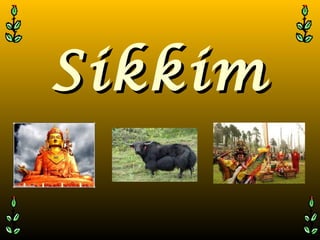
SikkimSikkim
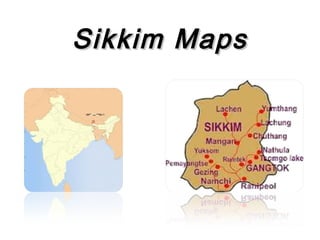
Sikkim MapsSikkim Maps
SikkimSikkim
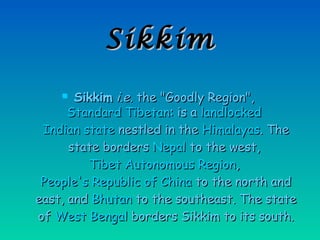
 SikkimSikkim i.e.i.e. the "Goodly Region",the "Goodly Region",
Standard TibetanStandard Tibetan: is a: is a landlockedlandlocked
Indian stateIndian state nestled in thenestled in the HimalayasHimalayas. The. The
state bordersstate borders NepalNepal to the west,to the west,
Tibet Autonomous RegionTibet Autonomous Region,,
People's Republic of ChinaPeople's Republic of China to the north andto the north and
east, andeast, and BhutanBhutan to the southeast. The stateto the southeast. The state
ofof West BengalWest Bengal borders Sikkim to its south.borders Sikkim to its south.
People Of SikkimPeople Of Sikkim
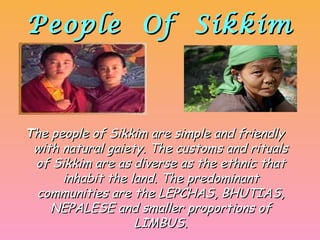
TThe people of Sikkim are simple and friendlyhe people of Sikkim are simple and friendly
with natural gaiety. The customs and ritualswith natural gaiety. The customs and rituals
of Sikkim are as diverse as the ethnic thatof Sikkim are as diverse as the ethnic that
inhabit the land. The predominantinhabit the land. The predominant
communities are the LEPCHAS, BHUTIAS,communities are the LEPCHAS, BHUTIAS,
NEPALESE and smaller proportions ofNEPALESE and smaller proportions of
LIMBUS.LIMBUS.
USP Of SikkimUSP Of Sikkim
 With around 600,000 permanent residents,With around 600,000 permanent residents,
Sikkim is the least populous state in India andSikkim is the least populous state in India and
the second-smallest state afterthe second-smallest state after GoaGoa in totalin total
area.area. KangchenjungaKangchenjunga, the world's third-, the world's third-
highest peak, is located on Sikkim's borderhighest peak, is located on Sikkim's border
withwith NepalNepal..[6][6]
Sikkim is a popular touristSikkim is a popular tourist
destination, owing to its culture, scenery anddestination, owing to its culture, scenery and
biodiversitybiodiversity. It also has the only. It also has the only open borderopen border
betweenbetween IndiaIndia andand ChinaChina..
LEGEND OF SIKKIMLEGEND OF SIKKIM
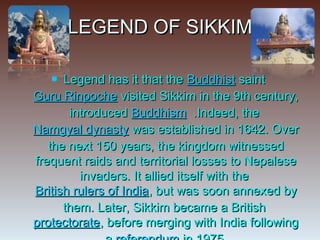
 Legend has it that theLegend has it that the BuddhistBuddhist saintsaint
Guru RinpocheGuru Rinpoche visited Sikkim in the 9th century,visited Sikkim in the 9th century,
introducedintroduced BuddhismBuddhism .Indeed, the.Indeed, the
Namgyal dynastyNamgyal dynasty was established in 1642. Overwas established in 1642. Over
the next 150 years, the kingdom witnessedthe next 150 years, the kingdom witnessed
frequent raids and territorial losses to Nepalesefrequent raids and territorial losses to Nepalese
invaders. It allied itself with theinvaders. It allied itself with the
British rulers of IndiaBritish rulers of India, but was soon annexed by, but was soon annexed by
them. Later, Sikkim became a Britishthem. Later, Sikkim became a British
protectorateprotectorate, before merging with India following, before merging with India following
Languages Of SikkimLanguages Of Sikkim
 Sikkim has 11Sikkim has 11 official languagesofficial languages:: NepaliNepali,, BhutiaBhutia,, LepchaLepcha
(since 1977),(since 1977), LimbuLimbu (since 1981),(since 1981), NewariNewari,, RaiRai,, GurungGurung,,
MangarMangar,, SherpaSherpa,, TamangTamang (since 1995) and(since 1995) and SunwarSunwar
(since 1996).(since 1996).[7][7]
EnglishEnglish is taught in schools and used inis taught in schools and used in
government documents. Sikkim is the only state in Indiagovernment documents. Sikkim is the only state in India
with an ethnicwith an ethnic NepaleseNepalese majority.majority.[8][8]
The predominantThe predominant
religions arereligions are HinduismHinduism andand Vajrayana BuddhismVajrayana Buddhism..
GangtokGangtok is theis the capitalcapital and largest city. Sikkim's economyand largest city. Sikkim's economy
is largely dependent on agriculture and tourism, and theis largely dependent on agriculture and tourism, and the
state hasstate has the fourth-smallest GDP among Indian statesthe fourth-smallest GDP among Indian states,,[9][9]
although it is also among the fastest-growing.although it is also among the fastest-growing.
ClimateClimate
 Sikkim's climate ranges fromSikkim's climate ranges from sub-tropicalsub-tropical in the south toin the south to tundratundra in thein the
northern parts. The tundra-type region in the north is clad by snow fornorthern parts. The tundra-type region in the north is clad by snow for
four months a year though the temperature drops below 0 °C (32 °F)four months a year though the temperature drops below 0 °C (32 °F)
almost every night.almost every night.[31][31]
The peaks of north-western Sikkim are perpetuallyThe peaks of north-western Sikkim are perpetually
frozen.frozen.[35][35]
Most of the inhabited regions of Sikkim, however, witness aMost of the inhabited regions of Sikkim, however, witness a
temperatetemperate climate, with the temperatures seldom exceeding 28 °climate, with the temperatures seldom exceeding 28 °CC (82 °(82 °
FF) in summer or dropping below 0 °C (32 °F) in winter. The mean monthly) in summer or dropping below 0 °C (32 °F) in winter. The mean monthly
temperature in summer is 15 °C.temperature in summer is 15 °C.[36][36]
The state has five seasons: winter,The state has five seasons: winter,
summer, spring, and autumn, and asummer, spring, and autumn, and a monsoonmonsoon season between June andseason between June and
September. The average annual temperature for most of Sikkim isSeptember. The average annual temperature for most of Sikkim is
around 18 °C (64 °F). Sikkim is one of the few states in India to receivearound 18 °C (64 °F). Sikkim is one of the few states in India to receive
regular snowfall. Theregular snowfall. The snow linesnow line ranges from 20,000 feet in the north toranges from 20,000 feet in the north to
16,000 feet in the south.16,000 feet in the south.[37][37]
During the monsoon, heavy rains increaseDuring the monsoon, heavy rains increase
the possibility of landslides. The record for the longest period ofthe possibility of landslides. The record for the longest period of
continuous rain is 11 days. In the northern region, because of highcontinuous rain is 11 days. In the northern region, because of high
altitude, temperatures drop below −40 °C (−40 °F) in winter.altitude, temperatures drop below −40 °C (−40 °F) in winter.
CultureCulture
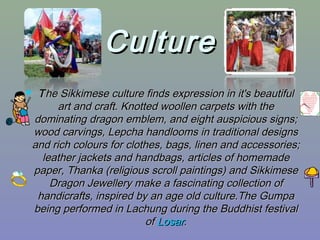
 TThe Sikkimese culture finds expression in it's beautifulhe Sikkimese culture finds expression in it's beautiful
art and craft. Knotted woollen carpets with theart and craft. Knotted woollen carpets with the
dominating dragon emblem, and eight auspicious signs;dominating dragon emblem, and eight auspicious signs;
wood carvings, Lepcha handlooms in traditional designswood carvings, Lepcha handlooms in traditional designs
and rich colours for clothes, bags, linen and accessories;and rich colours for clothes, bags, linen and accessories;
leather jackets and handbags, articles of homemadeleather jackets and handbags, articles of homemade
paper, Thanka (religious scroll paintings) and Sikkimesepaper, Thanka (religious scroll paintings) and Sikkimese
Dragon Jewellery make a fascinating collection ofDragon Jewellery make a fascinating collection of
handicrafts, inspired by an age old culture.The Gumpahandicrafts, inspired by an age old culture.The Gumpa
being performed in Lachung during the Buddhist festivalbeing performed in Lachung during the Buddhist festival
ofof LosarLosar..
Festivals Celebrated InFestivals Celebrated In
SikkimSikkim
 The SikkimeseThe Sikkimese NepaleseNepalese celebrate all major Hinducelebrate all major Hindu
festivals such asfestivals such as DiwaliDiwali andand DusseraDussera. Local festivals. Local festivals
likelike Maghe SankrantiMaghe Sankranti and Bhimsen Puja areand Bhimsen Puja are
common.common.[75][75]
LosarLosar,, LoosongLoosong,, Saga DawaSaga Dawa,,
Lhabab DuechenLhabab Duechen,, Drupka TeshiDrupka Teshi andand BhumchuBhumchu areare
Buddhist festivals. During the Losar (Tibetan NewBuddhist festivals. During the Losar (Tibetan New
Year) most offices and educational institutions areYear) most offices and educational institutions are
closed for a week.closed for a week.[76][76]
Muslims celebrate Id-ul-fitr andMuslims celebrate Id-ul-fitr and
Muharram.Muharram.[77][77]
ChristmasChristmas has also been promoted inhas also been promoted in
MusicMusic
 WesternWestern rock musicrock music and Hindiand Hindi
songs have gained widesongs have gained wide
acceptance among theacceptance among the
Sikkimese. Indigenous NepaliSikkimese. Indigenous Nepali
rock and Lepcha music are alsorock and Lepcha music are also
popular.popular.
Sports Of SikkimSports Of Sikkim
 Common sports in Sikkim areCommon sports in Sikkim are
Football and cricket. HangFootball and cricket. Hang
gliding and river rafting havegliding and river rafting have
also been introduced in orderalso been introduced in order
to promote tourism.to promote tourism.
EducationEducation
 Literacy in Sikkim is 69.68%, which breaks down into 76.73% forLiteracy in Sikkim is 69.68%, which breaks down into 76.73% for
males and 61.46% for females. There are a total of 1157males and 61.46% for females. There are a total of 1157
schools, including 765 schools run by the State government, 7schools, including 765 schools run by the State government, 7
central government schools and 385 private schools.central government schools and 385 private schools.[93][93]
TwelveTwelve
colleges and other institutions in Sikkim offer higher education.colleges and other institutions in Sikkim offer higher education.
The largest institution is theThe largest institution is the Sikkim Manipal UniversitySikkim Manipal University ofof
Technological Sciences, which offers higher education inTechnological Sciences, which offers higher education in
engineering, medicine and management. It also runs a host ofengineering, medicine and management. It also runs a host of
distance education programs in diverse fields. There are twodistance education programs in diverse fields. There are two
state-run polytechnical schools, Advanced Technical Trainingstate-run polytechnical schools, Advanced Technical Training
Centre (ATTC) and Centre for Computers and CommunicationCentre (ATTC) and Centre for Computers and Communication
Technology (CCCT) in Sikkim which offer diploma courses inTechnology (CCCT) in Sikkim which offer diploma courses in
various branches of engineering.various branches of engineering.
MADE BYMADE BY
Shivam GuptaShivam Gupta
Class :- vi OrionClass :- vi Orion
Topic :- SikkimTopic :- Sikkim

Sikkim ppt Art integrated project

  • 1.
  • 2.
  • 3.
    SikkimSikkim  SikkimSikkim i.e.i.e.the "Goodly Region",the "Goodly Region", Standard TibetanStandard Tibetan: is a: is a landlockedlandlocked Indian stateIndian state nestled in thenestled in the HimalayasHimalayas. The. The state bordersstate borders NepalNepal to the west,to the west, Tibet Autonomous RegionTibet Autonomous Region,, People's Republic of ChinaPeople's Republic of China to the north andto the north and east, andeast, and BhutanBhutan to the southeast. The stateto the southeast. The state ofof West BengalWest Bengal borders Sikkim to its south.borders Sikkim to its south.
  • 4.
    People Of SikkimPeopleOf Sikkim TThe people of Sikkim are simple and friendlyhe people of Sikkim are simple and friendly with natural gaiety. The customs and ritualswith natural gaiety. The customs and rituals of Sikkim are as diverse as the ethnic thatof Sikkim are as diverse as the ethnic that inhabit the land. The predominantinhabit the land. The predominant communities are the LEPCHAS, BHUTIAS,communities are the LEPCHAS, BHUTIAS, NEPALESE and smaller proportions ofNEPALESE and smaller proportions of LIMBUS.LIMBUS.
  • 5.
    USP Of SikkimUSPOf Sikkim  With around 600,000 permanent residents,With around 600,000 permanent residents, Sikkim is the least populous state in India andSikkim is the least populous state in India and the second-smallest state afterthe second-smallest state after GoaGoa in totalin total area.area. KangchenjungaKangchenjunga, the world's third-, the world's third- highest peak, is located on Sikkim's borderhighest peak, is located on Sikkim's border withwith NepalNepal..[6][6] Sikkim is a popular touristSikkim is a popular tourist destination, owing to its culture, scenery anddestination, owing to its culture, scenery and biodiversitybiodiversity. It also has the only. It also has the only open borderopen border betweenbetween IndiaIndia andand ChinaChina..
  • 6.
    LEGEND OF SIKKIMLEGENDOF SIKKIM  Legend has it that theLegend has it that the BuddhistBuddhist saintsaint Guru RinpocheGuru Rinpoche visited Sikkim in the 9th century,visited Sikkim in the 9th century, introducedintroduced BuddhismBuddhism .Indeed, the.Indeed, the Namgyal dynastyNamgyal dynasty was established in 1642. Overwas established in 1642. Over the next 150 years, the kingdom witnessedthe next 150 years, the kingdom witnessed frequent raids and territorial losses to Nepalesefrequent raids and territorial losses to Nepalese invaders. It allied itself with theinvaders. It allied itself with the British rulers of IndiaBritish rulers of India, but was soon annexed by, but was soon annexed by them. Later, Sikkim became a Britishthem. Later, Sikkim became a British protectorateprotectorate, before merging with India following, before merging with India following
  • 7.
    Languages Of SikkimLanguagesOf Sikkim  Sikkim has 11Sikkim has 11 official languagesofficial languages:: NepaliNepali,, BhutiaBhutia,, LepchaLepcha (since 1977),(since 1977), LimbuLimbu (since 1981),(since 1981), NewariNewari,, RaiRai,, GurungGurung,, MangarMangar,, SherpaSherpa,, TamangTamang (since 1995) and(since 1995) and SunwarSunwar (since 1996).(since 1996).[7][7] EnglishEnglish is taught in schools and used inis taught in schools and used in government documents. Sikkim is the only state in Indiagovernment documents. Sikkim is the only state in India with an ethnicwith an ethnic NepaleseNepalese majority.majority.[8][8] The predominantThe predominant religions arereligions are HinduismHinduism andand Vajrayana BuddhismVajrayana Buddhism.. GangtokGangtok is theis the capitalcapital and largest city. Sikkim's economyand largest city. Sikkim's economy is largely dependent on agriculture and tourism, and theis largely dependent on agriculture and tourism, and the state hasstate has the fourth-smallest GDP among Indian statesthe fourth-smallest GDP among Indian states,,[9][9] although it is also among the fastest-growing.although it is also among the fastest-growing.
  • 8.
    ClimateClimate  Sikkim's climateranges fromSikkim's climate ranges from sub-tropicalsub-tropical in the south toin the south to tundratundra in thein the northern parts. The tundra-type region in the north is clad by snow fornorthern parts. The tundra-type region in the north is clad by snow for four months a year though the temperature drops below 0 °C (32 °F)four months a year though the temperature drops below 0 °C (32 °F) almost every night.almost every night.[31][31] The peaks of north-western Sikkim are perpetuallyThe peaks of north-western Sikkim are perpetually frozen.frozen.[35][35] Most of the inhabited regions of Sikkim, however, witness aMost of the inhabited regions of Sikkim, however, witness a temperatetemperate climate, with the temperatures seldom exceeding 28 °climate, with the temperatures seldom exceeding 28 °CC (82 °(82 ° FF) in summer or dropping below 0 °C (32 °F) in winter. The mean monthly) in summer or dropping below 0 °C (32 °F) in winter. The mean monthly temperature in summer is 15 °C.temperature in summer is 15 °C.[36][36] The state has five seasons: winter,The state has five seasons: winter, summer, spring, and autumn, and asummer, spring, and autumn, and a monsoonmonsoon season between June andseason between June and September. The average annual temperature for most of Sikkim isSeptember. The average annual temperature for most of Sikkim is around 18 °C (64 °F). Sikkim is one of the few states in India to receivearound 18 °C (64 °F). Sikkim is one of the few states in India to receive regular snowfall. Theregular snowfall. The snow linesnow line ranges from 20,000 feet in the north toranges from 20,000 feet in the north to 16,000 feet in the south.16,000 feet in the south.[37][37] During the monsoon, heavy rains increaseDuring the monsoon, heavy rains increase the possibility of landslides. The record for the longest period ofthe possibility of landslides. The record for the longest period of continuous rain is 11 days. In the northern region, because of highcontinuous rain is 11 days. In the northern region, because of high altitude, temperatures drop below −40 °C (−40 °F) in winter.altitude, temperatures drop below −40 °C (−40 °F) in winter.
  • 9.
    CultureCulture  TThe Sikkimeseculture finds expression in it's beautifulhe Sikkimese culture finds expression in it's beautiful art and craft. Knotted woollen carpets with theart and craft. Knotted woollen carpets with the dominating dragon emblem, and eight auspicious signs;dominating dragon emblem, and eight auspicious signs; wood carvings, Lepcha handlooms in traditional designswood carvings, Lepcha handlooms in traditional designs and rich colours for clothes, bags, linen and accessories;and rich colours for clothes, bags, linen and accessories; leather jackets and handbags, articles of homemadeleather jackets and handbags, articles of homemade paper, Thanka (religious scroll paintings) and Sikkimesepaper, Thanka (religious scroll paintings) and Sikkimese Dragon Jewellery make a fascinating collection ofDragon Jewellery make a fascinating collection of handicrafts, inspired by an age old culture.The Gumpahandicrafts, inspired by an age old culture.The Gumpa being performed in Lachung during the Buddhist festivalbeing performed in Lachung during the Buddhist festival ofof LosarLosar..
  • 10.
    Festivals Celebrated InFestivalsCelebrated In SikkimSikkim  The SikkimeseThe Sikkimese NepaleseNepalese celebrate all major Hinducelebrate all major Hindu festivals such asfestivals such as DiwaliDiwali andand DusseraDussera. Local festivals. Local festivals likelike Maghe SankrantiMaghe Sankranti and Bhimsen Puja areand Bhimsen Puja are common.common.[75][75] LosarLosar,, LoosongLoosong,, Saga DawaSaga Dawa,, Lhabab DuechenLhabab Duechen,, Drupka TeshiDrupka Teshi andand BhumchuBhumchu areare Buddhist festivals. During the Losar (Tibetan NewBuddhist festivals. During the Losar (Tibetan New Year) most offices and educational institutions areYear) most offices and educational institutions are closed for a week.closed for a week.[76][76] Muslims celebrate Id-ul-fitr andMuslims celebrate Id-ul-fitr and Muharram.Muharram.[77][77] ChristmasChristmas has also been promoted inhas also been promoted in
  • 11.
    MusicMusic  WesternWestern rockmusicrock music and Hindiand Hindi songs have gained widesongs have gained wide acceptance among theacceptance among the Sikkimese. Indigenous NepaliSikkimese. Indigenous Nepali rock and Lepcha music are alsorock and Lepcha music are also popular.popular.
  • 12.
    Sports Of SikkimSportsOf Sikkim  Common sports in Sikkim areCommon sports in Sikkim are Football and cricket. HangFootball and cricket. Hang gliding and river rafting havegliding and river rafting have also been introduced in orderalso been introduced in order to promote tourism.to promote tourism.
  • 13.
    EducationEducation  Literacy inSikkim is 69.68%, which breaks down into 76.73% forLiteracy in Sikkim is 69.68%, which breaks down into 76.73% for males and 61.46% for females. There are a total of 1157males and 61.46% for females. There are a total of 1157 schools, including 765 schools run by the State government, 7schools, including 765 schools run by the State government, 7 central government schools and 385 private schools.central government schools and 385 private schools.[93][93] TwelveTwelve colleges and other institutions in Sikkim offer higher education.colleges and other institutions in Sikkim offer higher education. The largest institution is theThe largest institution is the Sikkim Manipal UniversitySikkim Manipal University ofof Technological Sciences, which offers higher education inTechnological Sciences, which offers higher education in engineering, medicine and management. It also runs a host ofengineering, medicine and management. It also runs a host of distance education programs in diverse fields. There are twodistance education programs in diverse fields. There are two state-run polytechnical schools, Advanced Technical Trainingstate-run polytechnical schools, Advanced Technical Training Centre (ATTC) and Centre for Computers and CommunicationCentre (ATTC) and Centre for Computers and Communication Technology (CCCT) in Sikkim which offer diploma courses inTechnology (CCCT) in Sikkim which offer diploma courses in various branches of engineering.various branches of engineering.
  • 14.
    MADE BYMADE BY ShivamGuptaShivam Gupta Class :- vi OrionClass :- vi Orion Topic :- SikkimTopic :- Sikkim