NUCLEOSIDE REVERSE TRANSCRIPTASE INHIBITORS
(NRTIS)
OBIN DERRICK VU-BPC-2307-0315-DAY
KIBERU COLLINE VU-BPC-2301-0798-DAY
NAKIYINJI MERINA VU-BPC-2307-1031-DAY
OROMA FRANCIS VU-BPC-2307-0226-DAY
CLASSIFICATION OF NRTIS
NRTIS are classified based on their nucleoside
or nucleotide analog structure:
Adenosine analogs:
Didanosine(ddI)
Tenofovir disoproxil
fumarate (TDF)
Cytidine analogs:
Zalcitabine (ddC)
Lamivudine (3TC),
Emtricitabine (FTC)
Thymidine analogs:
Zidovudine (AZT),
Stavudine (d4T)
Guanosine analogs:
Abacavir (ABC)
MECHANISM OF ACTION OF NRTIS
• NRTIs are prodrugs that undergo intracellular
phosphorylation to their active triphosphate forms.
• They mimic natural nucleotides and compete for
incorporation into the viral DNA by reverse transcriptase.
• Once incorporated, they act as chain terminators due to the
absence of a 3’-hydroxyl group which normally forms the 5´-
to 3´- phosphoester bond with the next nucleic acid blocking
further extension of the DNA by Reverse transcriptase
THERAPEUTIC INDICATIONS OF NRTIS
• 1. HIV Treatment
Combination Antiretroviral Therapy (cART):
NRTIs are cornerstone drugs in cART regimens for managing HIV-1 and HIV-2
infections.
Typically used in combination with other antiretroviral classes (e.g., integrase
inhibitors, protease inhibitors) to suppress viral replication, reduce viral load, and
improve CD4+ T-cell counts.)
2. HIV Prophylaxis
Pre-Exposure Prophylaxis (PrEP):
Tenofovir disoproxil fumarate (TDF) and Emtricitabine (FTC) are commonly used
as a fixed-dose combination for preventing HIV infection in high-risk individuals.
Post-Exposure Prophylaxis (PEP):
NRTIs like TDF and FTC are included in PEP regimens to prevent HIV infection
after potential exposure (e.g., needlestick injuries, sexual exposure).
THERAPEUTIC INDICATIONS OF NRTIS
3. Mother-to-Child Transmission of HIV
NRTIs such as Zidovudine (AZT) are used during pregnancy, labor, and
delivery to prevent vertical transmission of HIV from mother to child.
Neonatal prophylaxis with NRTIs is often administered to newborns of
HIV-positive mothers.
4. Chronic Hepatitis B (HBV) Infection
Tenofovir disoproxil fumarate (TDF) and Tenofovir alafenamide (TAF)
are effective in treating chronic HBV by suppressing viral replication.
They are particularly useful in individuals with co-infection of HIV and
HBV.
THYMIDINE DERIVATIVES
Zidovudine
3'-azido-3'-
deoxythymidine
Stavudine
2',3'-didehydro-
3'-deoxythymidine
Parent
thymidine
ADENOSINE
ANALOGS
Parent adenosine
DIDANOSINE
Tenofovir
CYTIDINE ANALOGS
Parent
cystidine
Lamivudine(2 ,3 -dideoxy-3 -
′ ′ ′
thiacytidine)
Emtricitabine (5-fluoro-1-[(2R,5S)-2-
(hydroxymethyl)-1,3-oxathiolan-5-
yl]cytosine)
GUANOSINE ANALOGS
Parent
Guanosine
Abacavir(ABC)
(4R)-4-[6-(cyclopropylamino)-2-
aminoguanin-9-yl]-2-cyclopentene-
1-methanol)
STRUCTURAL ELUCIDATION OF NRTIS
• Nuclear Magnetic Resonance (NMR) Spectroscopy
Purpose: Determines the molecular structure by identifying the
chemical environment of hydrogen (¹H NMR) and carbon (¹³C
NMR) atoms.
Key Findings for NRTIs:
Sugar moiety: Identifies the oxathiolane or deoxyribose-like sugar
rings.
Base structure: Differentiates between purines (e.g., adenine,
guanine) and pyrimidines (e.g., cytosine, thymine).
Phosphonate groups (in tenofovir): Confirmed via characteristic
chemical shifts.
CONT.
2. Mass Spectrometry (MS)
Purpose: Determines the molecular weight and
fragmentation patterns of the molecule.
Key Findings for NRTIs:
Confirms the molecular mass of parent compounds (e.g.,
Tenofovir, Emtricitabine).
Identifies fragmentation patterns corresponding to the
sugar ring, base, and phosphate groups.
CONT.
• 3.Infrared (IR) Spectroscopy
Purpose: Identifies functional groups through their
vibrational frequencies.
Key Findings for NRTIs:
Phosphonate or phosphate groups (Tenofovir): Strong
absorbance near 1000–1200 cm⁻¹.
Hydroxyl groups (sugar moiety): Broad absorbance
around 3200–3500 cm⁻¹.
Azido group (Zidovudine): Characteristic absorbance
around 2100 cm⁻¹.
CONT.
• 4. Ultraviolet-Visible (UV-Vis) Spectroscopy
Purpose: Verifies the presence of conjugated systems in
the nitrogenous bases.
Key Findings for NRTIs:
Absorbance in the UV range (250–280 nm), confirming
the purine or pyrimidine base structure.
CONT.
• 5. X-Ray Crystallography
Purpose: Provides a three-dimensional representation of the
molecule, including bond lengths and angles.
Key Findings for NRTIs:
Confirms stereochemistry of sugar rings (e.g., Lamivudine’s
oxathiolane ring).
Visualizes base-sugar connectivity and phosphate/salt
arrangemen
CONT.
• 6. Elemental Analysis and High-Resolution MS
Purpose: Confirms the empirical formula by analyzing
the ratio of elements like C, H, N, O, P, F, or S.
Key Findings for NRTIs:
Ensures the calculated molecular formula matches the
theoretical structure.
CONT.
• 7. Chromatographic Techniques
High-Performance Liquid Chromatography (HPLC):
Confirms purity and identifies any degradation products
or isomers.
Thin-Layer Chromatography (TLC):
Provides a quick check of compound mobility and
separation.
STRUCTURAL ELUCIDATION OF ABC
(GUANOSINE ANALOG)
• 1. ¹H NMR:
Identifies the protons on the
cyclopentene ring and purine base.
Distinct signals for the
hydroxymethyl group and the
cyclopropylamino substitution.
• 2. ¹³C NMR:
Detects carbons in the
cyclopentene ring and purine base,
with deshielding observed near the
amino groups.
• 3. IR Spectroscopy:
STRUCTURAL ELUCIDATION OF AZT
(THYMIDINE ANALOG)
• 1. ¹H NMR:
Identifies the hydrogen atoms in the thymine base and the
deoxyribose sugar.
• Key signals:
Doublet from the methyl group on the thymine base.
Sugar protons, with one showing a distinct chemical shift due
to the azido (-N3) group.
• 2. ¹³C NMR:
Confirms the carbons in the sugar and thymine ring, with
deshielding at the carbon connected to the azido group.
CONT.
• 3. IR Spectroscopy:
Strong absorption at ~2100 cm⁻¹ from the azido group.
Hydroxyl and carbonyl stretches confirm the sugar and thymine
functional groups.
• 4. MS:
Molecular ion peak at 267 g/mol confirms molecular weight.
Fragmentation shows loss of the azido group, providing additional
confirmation.
• 5. X-Ray Crystallography:
Validates the 3D arrangement of the thymine base, sugar, and
azido group.
STRUCTURAL ELUCIDATION OF D4T (THYMIDINE
ANALOG)
• 1. ¹H NMR:
Identifies the hydrogens on the
thymine ring and the sugar moiety.
Unique signals due to the 2',3'-
unsaturation in the sugar.
• 2. ¹³C NMR:
Detects the absence of hydroxyl
carbons at 2' and 3' positions,
characteristic of
dideoxynucleosides.
• 3. IR Spectroscopy:
Carbonyl stretch at ~1700 cm⁻¹ from
the thymine base.
Hydroxyl group stretch from the
sugar moiety at ~3200–3500
cm ¹.
⁻
4. MS:
Molecular ion peak at 224 g/mol
confirms molecular weight.
Fragmentation reveals the base
and sugar components.
5. X-Ray Crystallography:
Confirms the planar geometry of
the thymine base and the 2',3'-
unsaturation in the sugar.
STRUCTURAL ELUCIDATION OF FTC (CYTIDINE ANALOG)
• 1. ¹H NMR:
Identifies the oxathiolane ring
protons and the fluorine-
substituted cytosine base.
Proton signals indicate the
asymmetric environment of the
oxathiolane ring.
• 2. ¹³C NMR:
Detects the carbon-fluorine bond
with a characteristic chemical shift.
• 3. IR Spectroscopy:
C-F stretch at ~1100 cm⁻¹.Broad OH
stretch from the
sugar moiety at ~3400 cm ¹.
⁻
4. MS:
Molecular ion peak at 247
g/mol confirms molecular
weight.
Fragmentation shows loss of
the sulfur or fluorine-
containing groups.
5. X-Ray Crystallography:
Confirms stereochemistry of
the oxathiolane ring and the
fluorine-substituted cytosine
base.
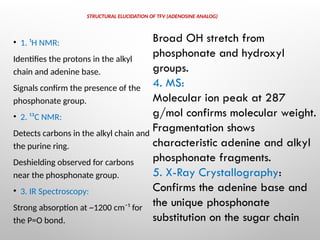
STRUCTURAL ELUCIDATION OF TFV (ADENOSINE ANALOG)
• 1. ¹H NMR:
Identifies the protons in the alkyl
chain and adenine base.
Signals confirm the presence of
the phosphonate group.
• 2. ¹³C NMR:
Detects carbons in the alkyl chain
and the purine ring.
Deshielding observed for carbons
near the phosphonate group.
• 3. IR Spectroscopy:
Strong absorption at ~1200 cm⁻¹
for the P=O bond.
Broad OH stretch from
phosphonate and hydroxyl
groups.
4. MS:
Molecular ion peak at 287
g/mol confirms molecular weight.
Fragmentation shows
characteristic adenine and alkyl
phosphonate fragments.
5. X-Ray Crystallography:
Confirms the adenine base and
the unique phosphonate
substitution on the sugar chain
STRUCTURAL ELUCIDATION OF TFV (ADENOSINE ANALOG)
• 1. ¹H NMR:
Identifies the protons in the alkyl
chain and adenine base.
Signals confirm the presence of the
phosphonate group.
• 2. ¹³C NMR:
Detects carbons in the alkyl chain and
the purine ring.
Deshielding observed for carbons
near the phosphonate group.
• 3. IR Spectroscopy:
Strong absorption at ~1200 cm⁻¹ for
the P=O bond.
Broad OH stretch from
phosphonate and hydroxyl
groups.
4. MS:
Molecular ion peak at 287
g/mol confirms molecular weight.
Fragmentation shows
characteristic adenine and alkyl
phosphonate fragments.
5. X-Ray Crystallography:
Confirms the adenine base and
the unique phosphonate
substitution on the sugar chain
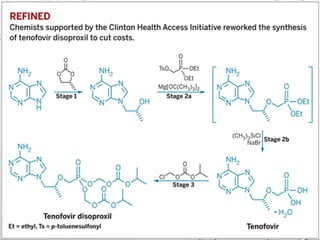
CHEMICAL SYNTHESIS OF TFV
• 1. Preparation of the Intermediate: (R)-PMPA
Starting Material: Adenine
Adenine is reacted with an appropriate alkylating agent, such as (R)-propylene carbonate, to
introduce the (R)-hydroxypropyl group at the 9-position of the purine base.
• Reaction Type: Alkylation
Intermediate: (R)-9-(2-hydroxypropyl)adenine
• 2. Phosphorylation
The hydroxyl group of the intermediate is reacted with chloromethylphosphonic dichloride (or
similar phosphonating agents) to introduce a phosphonate group.
Reaction Type: Phosphonation
Product: Tenofovir (free acid form)
• 3. Purification
The crude product is purified through recrystallization or column chromatography to isolate
the pure Tenofovir.
CONT.
• 4. Conversion to Prodrugs (Optional)
• Tenofovir can be further processed into prodrugs for clinical use, such
as:
• Tenofovir Disoproxil Fumarate (TDF): Esterification with isopropyl
groups and subsequent salt formation.
• Tenofovir Alafenamide (TAF): Modified amidation to improve
bioavailability and cellular targeting.
• Overall Reaction Summary:
• Adenine → Alkylated Adenine → Phosphonated Product (Tenofovir)
• This synthetic route allows for large-scale production of Tenofovir
with high yield and purity, suitable for antiviral applications.
SAR OF AZT
Base: Thymine (pyrimidine derivative).
Sugar: Deoxyribose analog with an azido (-N₃) group at the 3'-position.
SAR Insights:
Replacement of the hydroxyl group at the 3'-position with an azido group
prevents DNA chain elongation by inhibiting phosphodiester bond formation.
Modifications to the base significantly reduce activity, as thymine is essential
for recognition by RT.
The azido group enhances specificity for viral RT over host DNA polymerase.
Structural Variations:
Substitution of the azido group (e.g., amino or alkyl groups) reduces antiviral
activity.
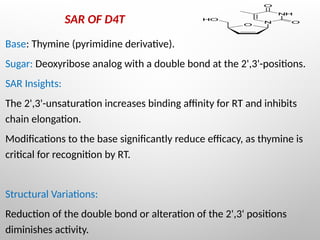
SAR OF D4T
Base: Thymine (pyrimidine derivative).
Sugar: Deoxyribose analog with a double bond at the 2',3'-positions.
SAR Insights:
The 2',3'-unsaturation increases binding affinity for RT and inhibits
chain elongation.
Modifications to the base significantly reduce efficacy, as thymine is
critical for recognition by RT.
Structural Variations:
Reduction of the double bond or alteration of the 2',3' positions
diminishes activity.
SAR OF 3TC
• 3. Lamivudine (3TC)
Base: Cytosine (pyrimidine derivative).
Sugar: Oxathiolane ring replacing deoxyribose.
SAR Insights:
The oxathiolane ring with (2R,5S) stereochemistry is crucial for activity. The
enantiomer (2S,5R) is significantly less effective.
The cytosine base is essential for binding to RT. Substitutions here reduce
efficacy.
Structural Variations:
Substitution of sulfur in the oxathiolane ring with oxygen reduces activity.
Replacement of the cytosine base disrupts RT binding.
SAR OF FTC
• 4. Emtricitabine (FTC)
Base: Fluorinated cytosine (pyrimidine derivative).
Sugar: Oxathiolane ring similar to 3TC.
SAR Insights:
The fluorine atom at the 5-position of cytosine enhances potency and
metabolic stability.
The (2R,5S) configuration of the oxathiolane ring is critical for activity.
Structural Variations:
Altering the fluorine position or removing it reduces potency.
Modifying the oxathiolane stereochemistry decreases RT selectivity.
SAR OF TFV
• Tenofovir (TFV)
Base: Adenine (purine derivative).
Sugar: Alkyl chain (phosphonate group replaces the sugar).
SAR Insights:
The phosphonate group is essential for chain termination and bypasses the need for
initial phosphorylation.
The alkyl chain connecting the phosphonate to adenine provides stability and
ensures selective uptake.
Structural Variations:
Esterification of the phosphonate group (e.g., in TDF or TAF) improves oral
bioavailability.
Modifications to the alkyl chain length alter pharmacokinetics.
SAR OF TFV
• Tenofovir (TFV)
Base: Adenine (purine derivative).
Sugar: Alkyl chain (phosphonate group replaces the sugar).
SAR Insights:
The phosphonate group is essential for chain termination and bypasses the
need for initial phosphorylation.
The alkyl chain connecting the phosphonate to adenine provides stability and
ensures selective uptake.
Structural Variations:
Esterification of the phosphonate group (e.g., in TDF or TAF) improves oral
bioavailability.
Modifications to the alkyl chain length alter pharmacokinetics.

Nucleoside Reverse transcriptase inhibitors.pptx

  • 1.
    NUCLEOSIDE REVERSE TRANSCRIPTASEINHIBITORS (NRTIS) OBIN DERRICK VU-BPC-2307-0315-DAY KIBERU COLLINE VU-BPC-2301-0798-DAY NAKIYINJI MERINA VU-BPC-2307-1031-DAY OROMA FRANCIS VU-BPC-2307-0226-DAY
  • 2.
    CLASSIFICATION OF NRTIS NRTISare classified based on their nucleoside or nucleotide analog structure: Adenosine analogs: Didanosine(ddI) Tenofovir disoproxil fumarate (TDF) Cytidine analogs: Zalcitabine (ddC) Lamivudine (3TC), Emtricitabine (FTC) Thymidine analogs: Zidovudine (AZT), Stavudine (d4T) Guanosine analogs: Abacavir (ABC)
  • 3.
    MECHANISM OF ACTIONOF NRTIS • NRTIs are prodrugs that undergo intracellular phosphorylation to their active triphosphate forms. • They mimic natural nucleotides and compete for incorporation into the viral DNA by reverse transcriptase. • Once incorporated, they act as chain terminators due to the absence of a 3’-hydroxyl group which normally forms the 5´- to 3´- phosphoester bond with the next nucleic acid blocking further extension of the DNA by Reverse transcriptase
  • 6.
    THERAPEUTIC INDICATIONS OFNRTIS • 1. HIV Treatment Combination Antiretroviral Therapy (cART): NRTIs are cornerstone drugs in cART regimens for managing HIV-1 and HIV-2 infections. Typically used in combination with other antiretroviral classes (e.g., integrase inhibitors, protease inhibitors) to suppress viral replication, reduce viral load, and improve CD4+ T-cell counts.) 2. HIV Prophylaxis Pre-Exposure Prophylaxis (PrEP): Tenofovir disoproxil fumarate (TDF) and Emtricitabine (FTC) are commonly used as a fixed-dose combination for preventing HIV infection in high-risk individuals. Post-Exposure Prophylaxis (PEP): NRTIs like TDF and FTC are included in PEP regimens to prevent HIV infection after potential exposure (e.g., needlestick injuries, sexual exposure).
  • 7.
    THERAPEUTIC INDICATIONS OFNRTIS 3. Mother-to-Child Transmission of HIV NRTIs such as Zidovudine (AZT) are used during pregnancy, labor, and delivery to prevent vertical transmission of HIV from mother to child. Neonatal prophylaxis with NRTIs is often administered to newborns of HIV-positive mothers. 4. Chronic Hepatitis B (HBV) Infection Tenofovir disoproxil fumarate (TDF) and Tenofovir alafenamide (TAF) are effective in treating chronic HBV by suppressing viral replication. They are particularly useful in individuals with co-infection of HIV and HBV.
  • 8.
  • 9.
  • 10.
    CYTIDINE ANALOGS Parent cystidine Lamivudine(2 ,3-dideoxy-3 - ′ ′ ′ thiacytidine) Emtricitabine (5-fluoro-1-[(2R,5S)-2- (hydroxymethyl)-1,3-oxathiolan-5- yl]cytosine)
  • 11.
  • 12.
    STRUCTURAL ELUCIDATION OFNRTIS • Nuclear Magnetic Resonance (NMR) Spectroscopy Purpose: Determines the molecular structure by identifying the chemical environment of hydrogen (¹H NMR) and carbon (¹³C NMR) atoms. Key Findings for NRTIs: Sugar moiety: Identifies the oxathiolane or deoxyribose-like sugar rings. Base structure: Differentiates between purines (e.g., adenine, guanine) and pyrimidines (e.g., cytosine, thymine). Phosphonate groups (in tenofovir): Confirmed via characteristic chemical shifts.
  • 13.
    CONT. 2. Mass Spectrometry(MS) Purpose: Determines the molecular weight and fragmentation patterns of the molecule. Key Findings for NRTIs: Confirms the molecular mass of parent compounds (e.g., Tenofovir, Emtricitabine). Identifies fragmentation patterns corresponding to the sugar ring, base, and phosphate groups.
  • 14.
    CONT. • 3.Infrared (IR)Spectroscopy Purpose: Identifies functional groups through their vibrational frequencies. Key Findings for NRTIs: Phosphonate or phosphate groups (Tenofovir): Strong absorbance near 1000–1200 cm⁻¹. Hydroxyl groups (sugar moiety): Broad absorbance around 3200–3500 cm⁻¹. Azido group (Zidovudine): Characteristic absorbance around 2100 cm⁻¹.
  • 15.
    CONT. • 4. Ultraviolet-Visible(UV-Vis) Spectroscopy Purpose: Verifies the presence of conjugated systems in the nitrogenous bases. Key Findings for NRTIs: Absorbance in the UV range (250–280 nm), confirming the purine or pyrimidine base structure.
  • 16.
    CONT. • 5. X-RayCrystallography Purpose: Provides a three-dimensional representation of the molecule, including bond lengths and angles. Key Findings for NRTIs: Confirms stereochemistry of sugar rings (e.g., Lamivudine’s oxathiolane ring). Visualizes base-sugar connectivity and phosphate/salt arrangemen
  • 17.
    CONT. • 6. ElementalAnalysis and High-Resolution MS Purpose: Confirms the empirical formula by analyzing the ratio of elements like C, H, N, O, P, F, or S. Key Findings for NRTIs: Ensures the calculated molecular formula matches the theoretical structure.
  • 18.
    CONT. • 7. ChromatographicTechniques High-Performance Liquid Chromatography (HPLC): Confirms purity and identifies any degradation products or isomers. Thin-Layer Chromatography (TLC): Provides a quick check of compound mobility and separation.
  • 19.
    STRUCTURAL ELUCIDATION OFABC (GUANOSINE ANALOG) • 1. ¹H NMR: Identifies the protons on the cyclopentene ring and purine base. Distinct signals for the hydroxymethyl group and the cyclopropylamino substitution. • 2. ¹³C NMR: Detects carbons in the cyclopentene ring and purine base, with deshielding observed near the amino groups. • 3. IR Spectroscopy:
  • 20.
    STRUCTURAL ELUCIDATION OFAZT (THYMIDINE ANALOG) • 1. ¹H NMR: Identifies the hydrogen atoms in the thymine base and the deoxyribose sugar. • Key signals: Doublet from the methyl group on the thymine base. Sugar protons, with one showing a distinct chemical shift due to the azido (-N3) group. • 2. ¹³C NMR: Confirms the carbons in the sugar and thymine ring, with deshielding at the carbon connected to the azido group.
  • 21.
    CONT. • 3. IRSpectroscopy: Strong absorption at ~2100 cm⁻¹ from the azido group. Hydroxyl and carbonyl stretches confirm the sugar and thymine functional groups. • 4. MS: Molecular ion peak at 267 g/mol confirms molecular weight. Fragmentation shows loss of the azido group, providing additional confirmation. • 5. X-Ray Crystallography: Validates the 3D arrangement of the thymine base, sugar, and azido group.
  • 22.
    STRUCTURAL ELUCIDATION OFD4T (THYMIDINE ANALOG) • 1. ¹H NMR: Identifies the hydrogens on the thymine ring and the sugar moiety. Unique signals due to the 2',3'- unsaturation in the sugar. • 2. ¹³C NMR: Detects the absence of hydroxyl carbons at 2' and 3' positions, characteristic of dideoxynucleosides. • 3. IR Spectroscopy: Carbonyl stretch at ~1700 cm⁻¹ from the thymine base. Hydroxyl group stretch from the sugar moiety at ~3200–3500 cm ¹. ⁻ 4. MS: Molecular ion peak at 224 g/mol confirms molecular weight. Fragmentation reveals the base and sugar components. 5. X-Ray Crystallography: Confirms the planar geometry of the thymine base and the 2',3'- unsaturation in the sugar.
  • 23.
    STRUCTURAL ELUCIDATION OFFTC (CYTIDINE ANALOG) • 1. ¹H NMR: Identifies the oxathiolane ring protons and the fluorine- substituted cytosine base. Proton signals indicate the asymmetric environment of the oxathiolane ring. • 2. ¹³C NMR: Detects the carbon-fluorine bond with a characteristic chemical shift. • 3. IR Spectroscopy: C-F stretch at ~1100 cm⁻¹.Broad OH stretch from the sugar moiety at ~3400 cm ¹. ⁻ 4. MS: Molecular ion peak at 247 g/mol confirms molecular weight. Fragmentation shows loss of the sulfur or fluorine- containing groups. 5. X-Ray Crystallography: Confirms stereochemistry of the oxathiolane ring and the fluorine-substituted cytosine base.
  • 24.
    STRUCTURAL ELUCIDATION OFTFV (ADENOSINE ANALOG) • 1. ¹H NMR: Identifies the protons in the alkyl chain and adenine base. Signals confirm the presence of the phosphonate group. • 2. ¹³C NMR: Detects carbons in the alkyl chain and the purine ring. Deshielding observed for carbons near the phosphonate group. • 3. IR Spectroscopy: Strong absorption at ~1200 cm⁻¹ for the P=O bond. Broad OH stretch from phosphonate and hydroxyl groups. 4. MS: Molecular ion peak at 287 g/mol confirms molecular weight. Fragmentation shows characteristic adenine and alkyl phosphonate fragments. 5. X-Ray Crystallography: Confirms the adenine base and the unique phosphonate substitution on the sugar chain
  • 25.
    STRUCTURAL ELUCIDATION OFTFV (ADENOSINE ANALOG) • 1. ¹H NMR: Identifies the protons in the alkyl chain and adenine base. Signals confirm the presence of the phosphonate group. • 2. ¹³C NMR: Detects carbons in the alkyl chain and the purine ring. Deshielding observed for carbons near the phosphonate group. • 3. IR Spectroscopy: Strong absorption at ~1200 cm⁻¹ for the P=O bond. Broad OH stretch from phosphonate and hydroxyl groups. 4. MS: Molecular ion peak at 287 g/mol confirms molecular weight. Fragmentation shows characteristic adenine and alkyl phosphonate fragments. 5. X-Ray Crystallography: Confirms the adenine base and the unique phosphonate substitution on the sugar chain
  • 26.
    CHEMICAL SYNTHESIS OFTFV • 1. Preparation of the Intermediate: (R)-PMPA Starting Material: Adenine Adenine is reacted with an appropriate alkylating agent, such as (R)-propylene carbonate, to introduce the (R)-hydroxypropyl group at the 9-position of the purine base. • Reaction Type: Alkylation Intermediate: (R)-9-(2-hydroxypropyl)adenine • 2. Phosphorylation The hydroxyl group of the intermediate is reacted with chloromethylphosphonic dichloride (or similar phosphonating agents) to introduce a phosphonate group. Reaction Type: Phosphonation Product: Tenofovir (free acid form) • 3. Purification The crude product is purified through recrystallization or column chromatography to isolate the pure Tenofovir.
  • 27.
    CONT. • 4. Conversionto Prodrugs (Optional) • Tenofovir can be further processed into prodrugs for clinical use, such as: • Tenofovir Disoproxil Fumarate (TDF): Esterification with isopropyl groups and subsequent salt formation. • Tenofovir Alafenamide (TAF): Modified amidation to improve bioavailability and cellular targeting. • Overall Reaction Summary: • Adenine → Alkylated Adenine → Phosphonated Product (Tenofovir) • This synthetic route allows for large-scale production of Tenofovir with high yield and purity, suitable for antiviral applications.
  • 29.
    SAR OF AZT Base:Thymine (pyrimidine derivative). Sugar: Deoxyribose analog with an azido (-N₃) group at the 3'-position. SAR Insights: Replacement of the hydroxyl group at the 3'-position with an azido group prevents DNA chain elongation by inhibiting phosphodiester bond formation. Modifications to the base significantly reduce activity, as thymine is essential for recognition by RT. The azido group enhances specificity for viral RT over host DNA polymerase. Structural Variations: Substitution of the azido group (e.g., amino or alkyl groups) reduces antiviral activity.
  • 30.
    SAR OF D4T Base:Thymine (pyrimidine derivative). Sugar: Deoxyribose analog with a double bond at the 2',3'-positions. SAR Insights: The 2',3'-unsaturation increases binding affinity for RT and inhibits chain elongation. Modifications to the base significantly reduce efficacy, as thymine is critical for recognition by RT. Structural Variations: Reduction of the double bond or alteration of the 2',3' positions diminishes activity.
  • 31.
    SAR OF 3TC •3. Lamivudine (3TC) Base: Cytosine (pyrimidine derivative). Sugar: Oxathiolane ring replacing deoxyribose. SAR Insights: The oxathiolane ring with (2R,5S) stereochemistry is crucial for activity. The enantiomer (2S,5R) is significantly less effective. The cytosine base is essential for binding to RT. Substitutions here reduce efficacy. Structural Variations: Substitution of sulfur in the oxathiolane ring with oxygen reduces activity. Replacement of the cytosine base disrupts RT binding.
  • 32.
    SAR OF FTC •4. Emtricitabine (FTC) Base: Fluorinated cytosine (pyrimidine derivative). Sugar: Oxathiolane ring similar to 3TC. SAR Insights: The fluorine atom at the 5-position of cytosine enhances potency and metabolic stability. The (2R,5S) configuration of the oxathiolane ring is critical for activity. Structural Variations: Altering the fluorine position or removing it reduces potency. Modifying the oxathiolane stereochemistry decreases RT selectivity.
  • 33.
    SAR OF TFV •Tenofovir (TFV) Base: Adenine (purine derivative). Sugar: Alkyl chain (phosphonate group replaces the sugar). SAR Insights: The phosphonate group is essential for chain termination and bypasses the need for initial phosphorylation. The alkyl chain connecting the phosphonate to adenine provides stability and ensures selective uptake. Structural Variations: Esterification of the phosphonate group (e.g., in TDF or TAF) improves oral bioavailability. Modifications to the alkyl chain length alter pharmacokinetics.
  • 34.
    SAR OF TFV •Tenofovir (TFV) Base: Adenine (purine derivative). Sugar: Alkyl chain (phosphonate group replaces the sugar). SAR Insights: The phosphonate group is essential for chain termination and bypasses the need for initial phosphorylation. The alkyl chain connecting the phosphonate to adenine provides stability and ensures selective uptake. Structural Variations: Esterification of the phosphonate group (e.g., in TDF or TAF) improves oral bioavailability. Modifications to the alkyl chain length alter pharmacokinetics.