NUCLEIC ACID: Structures and Chemistry
Watch the video for more explanation 
https://oke.io/JiqNrM
Objectives
By the end of this topic, students are should be able:
1. State the functions of nucleic acids
2. identify the differences between nucleosides and nucleotides
3. states the corresponding base pair for nitrogenous bases
4. state the existing bond in DNA and RNA backbone
5. name nucleotides and nucleosides
6. account for the clinical significance of nucleotide derivatives
Clinic Waiting Room
Watch the video for more
explanation 
https://oke.io/JiqNrM
Ivy Sharer is a 26-year-old intravenous (IV) drug abuser who admitted to sharing
unsterile needles with another addict for several years. Five months before presenting
to the hospital emergency department with soaking night sweats, she experienced a 3-
week course of a flu-like syndrome with fever, malaise, and muscle aches. Four months
ago, she noted generalized lymph node enlargement associated with chills, anorexia,
and diarrhea, which led to a 22-lb weight loss. Tests were positive for human
immunodeficiency virus (HIV). Because her symptoms indicated that she now had the
acquired immunodeficiency syndrome (AIDS), a multidrug regimen including
zidovudine (ZDV), formerly called azidothymidine (AZT), was initiated.
Colin Tuma had intestinal polyps at age 45, which were removed via a colonoscope.
However, he did not return for annual colonoscopic examinations as instructed. At age
56, he reappeared, complaining of tar-colored stools (melena), which are caused by
intestinal bleeding. The source of the blood loss was an adenocarcinoma growing from
a colonic polyp of the large intestine. At surgery, it was found that the tumor had
invaded the gut wall and perforated the visceral peritoneum. Several pericolic lymph
nodes contained cancer cells, and several small nodules of metastatic cancer were
found in the liver. After resection of the tumor, the oncologist began treatment with 5-
fluorouracil (5-FU) combined with other chemotherapeutic agents.
Agneu (“neu”) Moania complains to his physician of a fever and cough. His
cough produces thick yellow-brown sputum. A stain of his sputum shows many
Gram-positive, bullet-shaped diplococci. A sputum culture confirms that he
has pneumonia, a respiratory infection caused by Streptococcus pneumoniae,
which is sensitive to penicillin, erythromycin, tetracycline, and other
antibiotics. Because of a history of penicillin allergy, he is started on oral
erythromycin therapy.
CELLULAR PROCESSES
Watch the video for more
explanation  https://oke.io/JiqNrM
Cellular Processes
DNA
RNA (mRNA)
Proteins
Lipids Carbohydrates
replication
transcription
translation
The following are the functions of nucleic acids
1. serves as energy stores (i.e., adenosine triphosphate)
2. Forms portions of several coenzymes (e.g NAD+, NADP+, FAD and coenzyme A )
3. Serving as mediators of numerous important cellular processes such as second
messengers in signal transduction events (cyclic-AMP (cAMP)).
4. an allosteric modifier of certain regulated enzymes
5. Conveys genetic information (DNA and RNA)
6. Serving as activated intermediates in numerous biosynthetic reactions. These activated
intermediates include S-adenosylmethionine (S-AdoMet or SAM) involved in methyl
transfer reactions as well as the many sugar coupled nucleotides involved in glycogen
and glycoprotein synthesis.
Structures & nomenclature of nucleosides & nucleotides
Watch the video for more explanation 
https://oke.io/JiqNrM
Structure of Nucleotides
Purine
Adenine Guanine
Pyrimidine
Cytosine Thymine (DNA) Uracil (RNA)
Synthetic Nucleotide Analogs
➢ Many nucleotide analogues are chemically synthesized and used for their therapeutic
potential.
➢ They are used to inhibit specific enzymatic activities.
➢ A large family of analogues are used as anti-tumor agents, for instance, because they
interfere with the synthesis of DNA and thereby preferentially kill rapidly dividing cells
such as tumor cells.
➢ Some of the nucleotide analogues commonly used in chemotherapy are 6-
mercaptopurine, 5-fluorouracil, 5-iodo-2'-deoxyuridine and 6-thioguanine.
➢ Each of these compounds disrupts the normal replication process by interfering with the
formation of correct Watson-Crick base-pairing.
➢ Nucleotide analogs also have been targeted for use as antiviral agents. Several analogs
are used to interfere with the replication of HIV, such as AZT (azidothymidine) and ddI
(dideoxyinosine).
➢ Several purine analogs are used to treat gout, one of the most common being allopurinol,
which resembles hypoxanthine.
➢ Allopurinol inhibits the activity of xanthine oxidase, an enzyme involved in purine
nucleotide catabolism.
➢ Additionally, several nucleotide analogues are used after organ transplantation in order
to suppress the immune system and reduce the likelihood of transplant rejection by the
recipient.
Phosphodiester
linkages in the
covalent backbone
of DNA and RNA
Hydrolysis of RNA under alkaline conditions
Absorption
spectra of the
common
nucleotides
Hydrogen bonding between
complementary DNA strands
Watson – Crick model for the structure of DNA
Certain DNA sequences adopt unusual structures
A single DNA strand with self complementary sequences
can form a hairpin structure
Double stranded DNA
with self complementary
sequences can form a
cruciform structure
Hoogsteen base pairs form in triplex DNA
A single strand of DNA, typically a string of pyrimidines, hydrogen bonds in the
major groove of a double-stranded DNA
Red strand is in the major
groove
Four DNA strands containing a high proportion of
guanosines can form a G tetraplex
Nucleotides
found in
biomolecules
Biochemical comments
Watch the video for more
explanation 
https://oke.io/JiqNrM
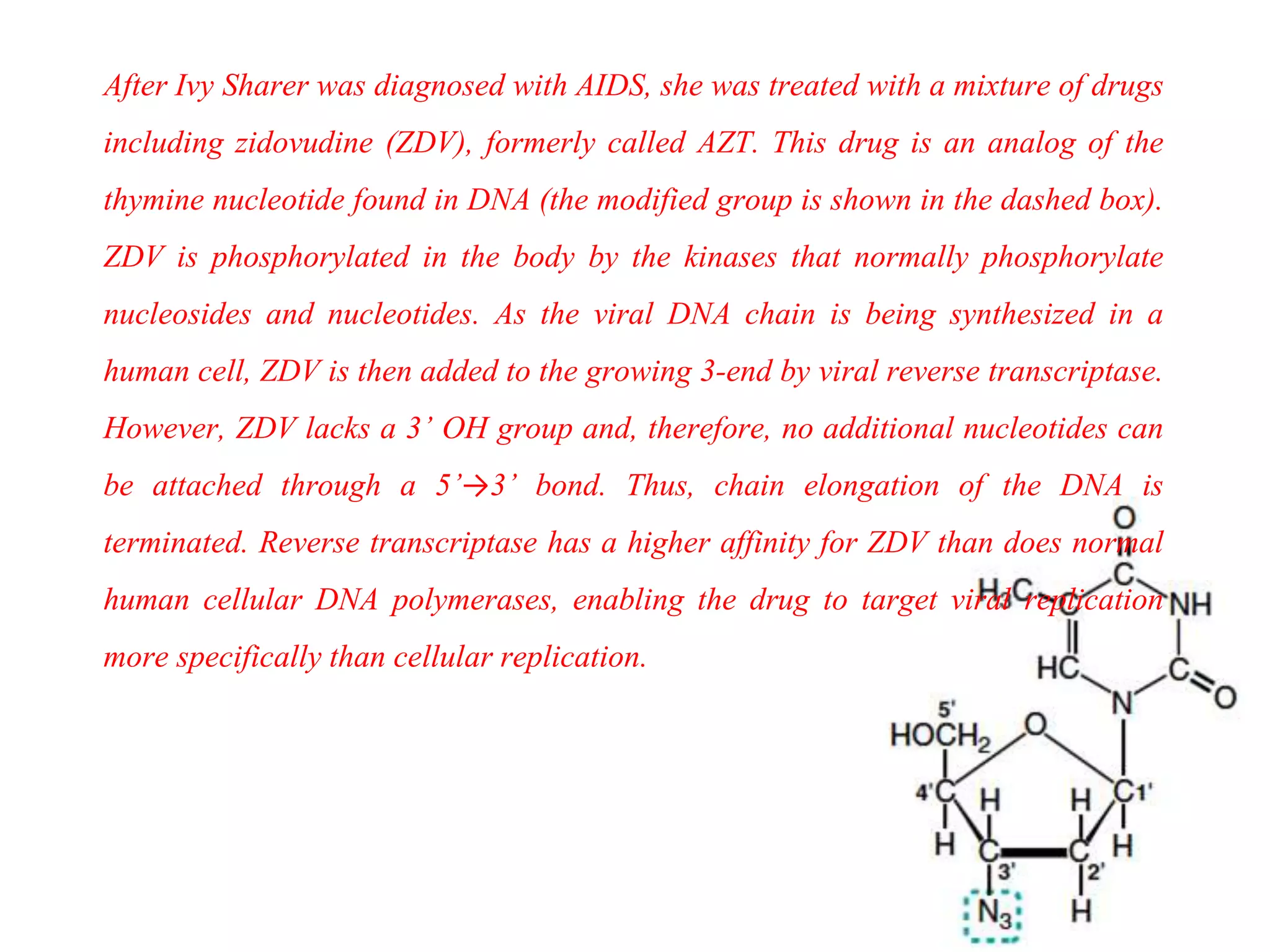
After Ivy Sharer was diagnosed with AIDS, she was treated with a mixture of drugs
including zidovudine (ZDV), formerly called AZT. This drug is an analog of the
thymine nucleotide found in DNA (the modified group is shown in the dashed box).
ZDV is phosphorylated in the body by the kinases that normally phosphorylate
nucleosides and nucleotides. As the viral DNA chain is being synthesized in a
human cell, ZDV is then added to the growing 3-end by viral reverse transcriptase.
However, ZDV lacks a 3’ OH group and, therefore, no additional nucleotides can
be attached through a 5’→3’ bond. Thus, chain elongation of the DNA is
terminated. Reverse transcriptase has a higher affinity for ZDV than does normal
human cellular DNA polymerases, enabling the drug to target viral replication
more specifically than cellular replication.
Colin Tuma is being treated with 5- fluorouracil (5-FU), a pyrimidine
base similar to uracil and thymine. 5-FU inhibits the synthesis of the
thymine nucleotides required for DNA replication. Thymine is normally
produced by a reaction catalyzed by thymidylate synthase, an enzyme that
converts deoxyuridine monophosphate (dUMP) to deoxythymidine
monophosphate (dTMP). 5-FU is converted in the body to F-dUMP, which
binds tightly to thymidylate synthase in a transition state complex and
inhibits the reaction (recall that thymine is 5-methyl uracil). Thus, thymine
nucleotides cannot be generated for DNA synthesis, and the rate of cell
proliferation decreases.

11.nucleic acid

  • 1.
    NUCLEIC ACID: Structuresand Chemistry Watch the video for more explanation  https://oke.io/JiqNrM
  • 2.
    Objectives By the endof this topic, students are should be able: 1. State the functions of nucleic acids 2. identify the differences between nucleosides and nucleotides 3. states the corresponding base pair for nitrogenous bases 4. state the existing bond in DNA and RNA backbone 5. name nucleotides and nucleosides 6. account for the clinical significance of nucleotide derivatives
  • 3.
    Clinic Waiting Room Watchthe video for more explanation  https://oke.io/JiqNrM
  • 4.
    Ivy Sharer isa 26-year-old intravenous (IV) drug abuser who admitted to sharing unsterile needles with another addict for several years. Five months before presenting to the hospital emergency department with soaking night sweats, she experienced a 3- week course of a flu-like syndrome with fever, malaise, and muscle aches. Four months ago, she noted generalized lymph node enlargement associated with chills, anorexia, and diarrhea, which led to a 22-lb weight loss. Tests were positive for human immunodeficiency virus (HIV). Because her symptoms indicated that she now had the acquired immunodeficiency syndrome (AIDS), a multidrug regimen including zidovudine (ZDV), formerly called azidothymidine (AZT), was initiated.
  • 5.
    Colin Tuma hadintestinal polyps at age 45, which were removed via a colonoscope. However, he did not return for annual colonoscopic examinations as instructed. At age 56, he reappeared, complaining of tar-colored stools (melena), which are caused by intestinal bleeding. The source of the blood loss was an adenocarcinoma growing from a colonic polyp of the large intestine. At surgery, it was found that the tumor had invaded the gut wall and perforated the visceral peritoneum. Several pericolic lymph nodes contained cancer cells, and several small nodules of metastatic cancer were found in the liver. After resection of the tumor, the oncologist began treatment with 5- fluorouracil (5-FU) combined with other chemotherapeutic agents.
  • 6.
    Agneu (“neu”) Moaniacomplains to his physician of a fever and cough. His cough produces thick yellow-brown sputum. A stain of his sputum shows many Gram-positive, bullet-shaped diplococci. A sputum culture confirms that he has pneumonia, a respiratory infection caused by Streptococcus pneumoniae, which is sensitive to penicillin, erythromycin, tetracycline, and other antibiotics. Because of a history of penicillin allergy, he is started on oral erythromycin therapy.
  • 7.
    CELLULAR PROCESSES Watch thevideo for more explanation  https://oke.io/JiqNrM
  • 8.
    Cellular Processes DNA RNA (mRNA) Proteins LipidsCarbohydrates replication transcription translation
  • 9.
    The following arethe functions of nucleic acids 1. serves as energy stores (i.e., adenosine triphosphate) 2. Forms portions of several coenzymes (e.g NAD+, NADP+, FAD and coenzyme A ) 3. Serving as mediators of numerous important cellular processes such as second messengers in signal transduction events (cyclic-AMP (cAMP)). 4. an allosteric modifier of certain regulated enzymes 5. Conveys genetic information (DNA and RNA) 6. Serving as activated intermediates in numerous biosynthetic reactions. These activated intermediates include S-adenosylmethionine (S-AdoMet or SAM) involved in methyl transfer reactions as well as the many sugar coupled nucleotides involved in glycogen and glycoprotein synthesis.
  • 10.
    Structures & nomenclatureof nucleosides & nucleotides Watch the video for more explanation  https://oke.io/JiqNrM
  • 11.
  • 12.
  • 13.
  • 14.
  • 15.
  • 19.
    Synthetic Nucleotide Analogs ➢Many nucleotide analogues are chemically synthesized and used for their therapeutic potential. ➢ They are used to inhibit specific enzymatic activities. ➢ A large family of analogues are used as anti-tumor agents, for instance, because they interfere with the synthesis of DNA and thereby preferentially kill rapidly dividing cells such as tumor cells. ➢ Some of the nucleotide analogues commonly used in chemotherapy are 6- mercaptopurine, 5-fluorouracil, 5-iodo-2'-deoxyuridine and 6-thioguanine. ➢ Each of these compounds disrupts the normal replication process by interfering with the formation of correct Watson-Crick base-pairing. ➢ Nucleotide analogs also have been targeted for use as antiviral agents. Several analogs are used to interfere with the replication of HIV, such as AZT (azidothymidine) and ddI (dideoxyinosine).
  • 20.
    ➢ Several purineanalogs are used to treat gout, one of the most common being allopurinol, which resembles hypoxanthine. ➢ Allopurinol inhibits the activity of xanthine oxidase, an enzyme involved in purine nucleotide catabolism. ➢ Additionally, several nucleotide analogues are used after organ transplantation in order to suppress the immune system and reduce the likelihood of transplant rejection by the recipient.
  • 21.
  • 22.
    Hydrolysis of RNAunder alkaline conditions
  • 23.
  • 24.
  • 25.
    Watson – Crickmodel for the structure of DNA
  • 26.
    Certain DNA sequencesadopt unusual structures
  • 27.
    A single DNAstrand with self complementary sequences can form a hairpin structure
  • 28.
    Double stranded DNA withself complementary sequences can form a cruciform structure
  • 29.
    Hoogsteen base pairsform in triplex DNA A single strand of DNA, typically a string of pyrimidines, hydrogen bonds in the major groove of a double-stranded DNA Red strand is in the major groove
  • 30.
    Four DNA strandscontaining a high proportion of guanosines can form a G tetraplex
  • 31.
  • 34.
    Biochemical comments Watch thevideo for more explanation  https://oke.io/JiqNrM
  • 35.
    After Ivy Sharerwas diagnosed with AIDS, she was treated with a mixture of drugs including zidovudine (ZDV), formerly called AZT. This drug is an analog of the thymine nucleotide found in DNA (the modified group is shown in the dashed box). ZDV is phosphorylated in the body by the kinases that normally phosphorylate nucleosides and nucleotides. As the viral DNA chain is being synthesized in a human cell, ZDV is then added to the growing 3-end by viral reverse transcriptase. However, ZDV lacks a 3’ OH group and, therefore, no additional nucleotides can be attached through a 5’→3’ bond. Thus, chain elongation of the DNA is terminated. Reverse transcriptase has a higher affinity for ZDV than does normal human cellular DNA polymerases, enabling the drug to target viral replication more specifically than cellular replication.
  • 36.
    Colin Tuma isbeing treated with 5- fluorouracil (5-FU), a pyrimidine base similar to uracil and thymine. 5-FU inhibits the synthesis of the thymine nucleotides required for DNA replication. Thymine is normally produced by a reaction catalyzed by thymidylate synthase, an enzyme that converts deoxyuridine monophosphate (dUMP) to deoxythymidine monophosphate (dTMP). 5-FU is converted in the body to F-dUMP, which binds tightly to thymidylate synthase in a transition state complex and inhibits the reaction (recall that thymine is 5-methyl uracil). Thus, thymine nucleotides cannot be generated for DNA synthesis, and the rate of cell proliferation decreases.