Ceyhun Ekrem. Kirimli, PhD.
Advisors: Dr. Wan Y. Shih1
Dr. Wei-Heng Shih2
1
Circulating DNA
• Existence of nucleic acids in blood is first
discovered in 1948 by Mandel and Métais1
• In 1994, association of circulating DNA with
cancer was discovered.2,3
• Circulating DNA  diagnostic and even
prognostic association with different cancer types
• Total number of estimated deaths in US related
to the cancer types which may be diagnosed
using circulating DNA is 400.000.
1.Mandel P. CR Acad Sci Paris.
2.Sorenson Gd Fau - Pribish DM, Pribish Dm Fau - Valone FH, Valone Fh Fau - Memoli VA, Memoli Va Fau - Bzik DJ, Bzik Dj Fau - Yao SL, Yao SL.
3.Vasioukhin V Fau - Anker P, Anker P Fau - Maurice P, Maurice P Fau - Lyautey J, Lyautey J Fau - Lederrey C, Lederrey C Fau - Stroun M, Stroun M.
Adopted from http://www.inostics.com/?page_id=39
2
Trans-renal DNA
• It was later found out
that low molecular
weight DNA fragments
can actually pass
through kidneys
1)Image adopted from: Green C, Huggett JF, Talbot E, Mwaba P, Reither K, Zumla AI. 2009;9(8):505-11.
2) Su YH, Wang M, Brenner DE, Ng A, Melkonyan H, Umansky S, Syngal S, Block TM, Journal of Molecular Diagnostics. 2004 May;6(2):101-7.
3
Why Tr-DNA?
• Non-invasive
• Cleaner than most body fluids (almost no
proteins etc.)
• Enrichment of low molecular weight DNA
• Large Volume
4
Clinical Applications
• Prenatal diagnostics
 Trisomies, disomies, gender detection etc…
• Tumor detection & monitoring (almost all markers are
applicable to cf-DNA is also applicable to tr-DNA)
• Transplantation monitoring
 >10 biopsies in first year after surgery
• Infectious Diseases
5
Objective
• To develop a method that can be applied to detection of transrenal
DNA Mutation
• With attomolar (10-18
M) detection sensitivity1
• With specificity enough to detect mutant DNA in a background with
abundant Wild Type DNA
• Can be Multiplexed
• Most clinical conditions require detections from multiple loci for diagnosis
• Time requirement
• Labeling, isolation, amplification can be time consuming
6
2) Ying-Hsiu Su, Mengjun Wang,Dean E. Brenner, Alan Ng, Hovsep Melkonyan, Samuil Umansky, Sapna Syngal, and Timothy M. Block, Journal of Molecular Diagnostics,
Vol. 6, No. 2, May 2004
1) Frank Caruso, Elke Rodda, and D. Neil Furlong, Anal. Chem. 1997, 69, 2043-2049
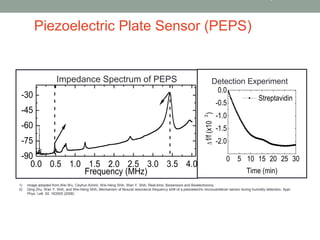
Piezoelectric Plate Sensor (PEPS)
MPS= 3-mercaptopropyl trimethoxysilane
1) Image adopted from,Wei Wu, Ceyhun Kirimli, Wei-Heng Shih, Wan Y. Shih, Real-time, Biosensors and Bioelectronics,
2) Qing Zhu, Wan Y. Shih, and Wei-Heng Shih, Mechanism of flexural resonance frequency shift of a piezoelectric microcantilever sensor during humidity detection, Appl.
Phys. Lett. 92, 183505 (2008)
1
Schematic of PEPS
Micrograph of PEPS
Highly sensitive piezoelectric
sensor due to piezoelectric Layer’s
Young’s modulus change1
due to
binding
Flexural resonance frequency shift was more than 300 times
larger than could be accounted for by mass loading.2
7
Piezoelectric Plate Sensor (PEPS)
0.0 0.5 1.0 1.5 2.0 2.5 3.0 3.5 4.0
-90
-75
-60
-45
-30
PhaseAngle
Frequency (MHz)
1) Image adopted from,Wei Wu, Ceyhun Kirimli, Wei-Heng Shih, Wan Y. Shih, Real-time, Biosensors and Bioelectronics,
2) Qing Zhu, Wan Y. Shih, and Wei-Heng Shih, Mechanism of flexural resonance frequency shift of a piezoelectric microcantilever sensor during humidity detection, Appl.
Phys. Lett. 92, 183505 (2008)
0 5 10 15 20 25 30
-2.0
-1.5
-1.0
-0.5
0.0
∆f/f(x103
)
Time (min)
Streptavidin
Impedance Spectrum of PEPS Detection Experiment
8
Accomplishments
1. Development of a signal processing algorithm to increase the sensitivity
by reducing noise in the resonance spectrum to achieve 10-19
M LOD
2. Initial optimization of flow speed and temperature for in situ mutation
detection using glass slides with fluorescent microspheres
3. Validation of specific mutation detection with reporter fluorescent
microspheres
9
Accomplishments
4.In situ mutation detection with optimal temperature and flow speed with
better than 1:250 MT/WT specificity in detecting both single mutation and
double mutation
• DoubleSingle mutation
4.Development of in situ double-stranded target DNA mutation detection
• Target DNA can be detected without the need for DNA isolation, concentration, and
amplification.
10
Sensitivity : Noise problem in data
processing
• Inability to detect low concentrations of analytes due to
noise in data.
Reason
1.Imprecise peak
finding algorithm.
2.Stationary window
losing important data
while peak shifts.
0 5 10 15 20 25 30
-2
-1
0
1
2
FrequencyChange(kHz)
Time (min)
[tDNA]=10
-19
M
Control
11
More accurate peak finding
algorithm
3.41 3.42 3.43
-11.5
-11.0
-10.5
-10.0
-9.5
PhaseAngle
Frequency (MHz)
Raw data
Smoothed raw data
Max. of raw data
Max. of smoothed data
Window Size (kHz)
3.41 3.42 3.43
-11.5
-11.0
-10.5
-10.0
-9.5
PhaseAngle
Frequency (MHz)
Smoothed raw data
Peak of fitted parabola
Neighbourhood
Fitted parabola
 Polynomial fitting on data around the maximum of Raw Data
can be misleading
Solution: Polynomial fitting on data around maximum of smoothed
raw data.
 Statistical analysis on ≅35±10 polynomials per spectrum.
12
Moving window peak monitoring
3.43 3.44 3.45
-34
-33
-32
-31
-30
-29
-28
PhaseAngle
Frequency (MHz)
Scan @ t=0 min
Scan @ t=30 min
3.40 3.41 3.42 3.43 3.44 3.45 3.46
-29.4
-29.2
-29.0
-28.8
-28.6
-28.4
-28.2
-28.0
-27.8
PhaseAngle
Frequency (MHz)
Scan @ t=0 min
Scan @ t=30 min
 Real peak position will not be lost
 Important data to determine the real peak position will remain in
the spectrum
13
Battery Powered Impedance Analyzer
14
Model Study: Specificity
15
Effect of Laminar Flow and
Temperature on Specificity
0 2 4 6
0
5
10
15
20
25
30
35
SMT
/SWT
Flow Rate (ml/min)
Room Temp.
30
o
C
35
o
C
 Increasing the temperature alone, SMT/SWT, 11 12 at 35°C.
 With flow, SMT/SWT increased dramatically.
16
Effect of Laminar Flow and
Temperature on Specificity
• SMT/SWT 24 at 4 ml/min > SMT/SWT at any flow rate at
35°C,
• Optimal detection conditions MT occurred at 30°C and
a flow rate of 4 ml/min. (Hepatitis B Virus 1762T/1764A
double mutation)
0 2 4 6
0
5
10
15
20
25
30
35
SMT
/SWT
Flow Rate (ml/min)
RT
30
o
C
35
o
C
17
Validation: 2 color FRM hybridization
Scheme
18
DNA Marker (Double Mutation)
19
Detection of Mixture of MT and WT
tDNA
0 10 20 30 40 50 60
-1.2
-1.0
-0.8
-0.6
-0.4
-0.2
0.0
100 zM
1 aM
10 aM
100 aM
∆f/f(10
-3
)
Time (min)
tDNA FRM
0.15 0.30 0.45 0.60 0.75
0
10
20
30
40
50
60
70
10 aM
#FRMs
∆f/f (10
-3
)
1 aM
100 aM
100 zM
100 zM 1 aM
10 aM 100 aM
MT
FRM
WT
FRM
20
Switching from Double Mutation to
Single Mutation
Problem : Melting Temperature (Tm) difference between
perfect and mismatch decreases making it more difficult to
distinguish MT and WT tDNA hybridizations.
30 40 50
0
25
50
75
100
∆tm1
%ofDenaturedDNA
Temperature (
o
C)
Perfect Match Single Mismatch Double Mismatch
∆tm2
21
Locked Nucleic Acids
Locked Nucleic Acids increase the melting temperature
difference between perfectly matching and mismatching target
DNA sequences
DNA
22
Detection of Mixture of MT and WT
tDNA
0 10 20 30 40 50 60
-1.8
-1.5
-1.2
-0.9
-0.6
-0.3
0.0
∆f/f(10
-3
)
Time (min)
100 zM
1 aM
10 aM
100 aM
tDNAmix. FRM
0.0 0.2 0.4 0.6 0.8 1.0 1.2
0
15
30
45
60
75
90
#FRMs
∆f/f(10
-3
)
100 zM
1 aM
10 aM
100 aM
MT
FRM
WT
FRM
100 zM 1 aM
10 aM 100 aM
23
Denaturation of dsDNA
• Problem
• Most of tr-DNA is in double stranded form
• PEPS detection depends on hybridization requiring
ssDNA
• Solution
Flow Cell
with
PEPS
Incubator
Water
Bath
Boiled
Sample
T1=95o
C
T2=21o
C-63o
C
L
Flow Cell
with capture
DNA
24
Capture Probe
• Capture probes hybridize to complementary tDNA
sequences
Heat
ssDNA
Capture DNA
Immobilized on
Gold coated Glass
Slides
Probe DNA
immobilized
PEPS
Complementary tDNA
tDNA
25
Detection of Double Stranded DNA
0 10 20 30 40 50 60
-1.5
-1.2
-0.9
-0.6
-0.3
0.0
∆f/f(10
-3
)
Time (min)
100 zM
1 aM
10 aM
100 aM
MT tDNA FRM
0 10 20 30 40 50 60
-0.20
-0.15
-0.10
-0.05
0.00
∆f/f(10
-3
)
Time (min)
10 aM
100 aM
10 fM
100 fM
1 pM
WT tDNA FRM
26
Detection of Cell Culture Extracted
DNA
0 10 20 30 40 50 60
-1.5
-1.2
-0.9
-0.6
-0.3
0.0
Time (min)
100 zM
1 aM
10 aM
100 aM
∆f/f(10
-3
)
tDNA FRM
0.0 0.2 0.4 0.6 0.8
0.0
0.3
0.6
0.9
1.2
1.5
1.8
∆f/fFRM
(10
-3
)
∆f/ftDNA
(10
-3
)
100zM
1 aM
10 aM
100 aM
10
-19
10
-18
10
-17
10
-16
10
20
30
40
#FRMs
tDNA Concentration (M)
100 zM 1 aM
10 aM 100 aM
27
Conclusions
• Peak Determination method developed allowed detection of <60
copies/ml tDNA hybridization by reducing the noise in the
resonance spectrum
• Laminar flow and Temperature is optimized to increase the
specificity to allow hybridization of 15 fold more FRMs after tDNA
hybridization with a MTtDNA:WTtDNA 1:107
• By introducing flow, with minimal need to increase the temperature, specificity is maximized
• Detection of 60 copies/ml of single stranded Mutant tDNA is
achieved using DNA probes on a background of 250 and 1000
fold more WT DNA in double/single mismatch mixture
experiments
• More importantly, unambigous confirmation of detection is achieved by 2 color FRM hybridization
method with a 80% MT FRMs in mixture experiments.
28
Conclusions
• Fast cooling method is developed to detect ds-tDNA
• 87% of efficiency in detecting tDNA from ds-DNA is achieved using
capture DNA
• Double stranded DNA of double/single mutations are detected with
a limit of detection of 60 copies/ml.
• Cell line extracted DNA detected at 60 copies/ml LOD
• It has been shown that probes can be designed to allow for
multiplexed detections of very similar tDNA fragments
simultaneously with no cross hybridization.
29
Potentiostat Assisted FTIR
30
Potentiostat Assisted FTIR
31
Wave Number (cm
-1
)
1000 1500 2000 2500 3000 3500 4000
∆R/R
-0.10
-0.08
-0.06
-0.04
-0.02
0.00
Experiment 4 Normalized Spectra
-200 mV
900 mV
-100 mV
32
DNA marker
33
Effect of Cooling Rate and Capture
Probes on Recovery of ssDNA
87 % recovery with respect to ssDNA
77% recovery without capture DNA
0 5 10 15 20 25 30
-0.6
-0.4
-0.2
0.0
Slow, Capture (-) Slow, Capture (+)
Moderate, Capture (-) Fast, Capture (-)
Moderate, Capture (+) Fast, Capture(+)
ssDNA
∆f/f(10
-3
)
Time (min)
Slow Moderate Fast
0
25
50
75
100 Capture DNA (+)
Capture DNA (-)
(∆f/f)dsDNA
/(∆f/f)ssDNA
Cooling Rate
34
Detection of Mixture of MT and WT
tDNA
MT
FRM
WT
FRM
0.0 0.2 0.4 0.6 0.8
0.0
0.3
0.6
0.9
1.2
1.5
1.8
2.1
100 aM
∆f/fFRM
(10
-3
)
∆f/ftDNA
(10
-3
)
100 zM
1 aM
10 aM
10
-19
10
-18
10
-17
10
-16
0
20
40
60
80
100
%#MTFRM
MT tDNA Concentration (M)
100 zM 1 aM
10 aM 100 aM
35
Detection of Double Stranded DNA
10
-18
10
-16
10
-14
10
-12
0.0
0.2
0.4
0.6
0.8
MT tDNA
WT tDNA
∆f/f(10
-3
)
tDNA Concentration (M)
0
50
100
150
200
250
300
(∆f/f)MT
/(∆f/f)WT tDNA Concentration (M)
10
-17
10
-16
36
Standard method of Tr-DNA Detection
• Polymerase Chain Reaction
PROS CONS
Unmatched in sensitivity
Single
molecule/reaction
Requires right method of
nucleic acid isolation
Loss of low molecular
weight fragments
PCR amplicon size
Potential PCR inhibition by
co-isolated factors.
37
Detection of Mixture of MT and WT
tDNA
100 zM 1 aM
10 aM 100 aM
MT
FRM
WT
FRM
0.0 0.1 0.2 0.3 0.4 0.5 0.6
0.2
0.4
0.6
0.8
1.0
1.2
∆f/fFRM
(10
-3
)
∆f/ftDNA
(10
-3
)
10
-19
10
-18
10
-17
10
-16
10
-15
0
20
40
60
80
100
%#MTFRM
MT tDNA Concentration (M)
MT:WT = 1:250
38
Blocking of non-specific binding in urine
• Use of Bovine Serum Albumin (BSA) before detection
• Non-specific binding was not observed only when PEPS is pre-
treated with at least 3% BSA before being immersed in urine
0 10 20 30 40 50 60
-1.6
-1.2
-0.8
-0.4
0.0
Washing
No BSA
1% BSA
2% BSA
3% BSA
FrequencyShift(kHz)
Time (min)
Urine
• Urine contains urea, chloride, sodium, potassium, creatinine,
very low amounts of peptides and proteins and other organic
molecules
39
Other Platforms
• No other platform on direct detection from urine.
Method Sensitivity Disadvantages Advantages
Quartz Crystal
Microbalance
.1 fM1,2
Low Sensitivity
Time consuming (4
Hrs.)1,2
Low cost3
Surface Plasmon
Resonance
1 fM4
Expensive, Low
sensitivity5
Can be
multiplexed,5
9.5 min-1.5 Hrs.6
Carbon Nanotubes 35 fM7
Low Sensitivity Low cost8
Piezoelectric
Microcantilevers
10pM9
Low Sensitivity Inexpensive
Atomic Force
Microscopy
Attomolar10
Expensive
Equipment
High Sensitivity
Electrochemical Attomolar11
Time consuming (4
Hrs.)6
High Sensitivity
1) Liu T, Tang J, Jiang L (2002) Biochem Biophys Res Commun 295:14–16 2) Liu T, Tang J, Jiang L (2004) Biochem Biophys Res Commun 313:3–7
3) Sung-Rok Hong, Hyun-Do Jeong, Suhee Hong, Talanta 82 (2010) 899–903 4) D’Agata R, Corradini R, Grasso G, Marchelli R, Spoto G (2008) ChemBioChem 9:2067–2070
5) S. Paul P. Vadgama A.K. Ray, IET Nanobiotechnol., 2009, Vol. 3, Iss. 3, pp. 71–80 6) Laura Maria Zanoli, Roberta D’Agata, Giuseppe Spoto, Anal Bioanal Chem (2012) 402:1759–1771
7) S. Niu, M. Zhao, R. Ren, S. Zhang, J. Inorg. Biochem. 103 (2009) 43. 8) Alexander Star, Eugene Tu, Joseph Niemann, Jean-Christophe P. Gabriel, C. Steve Joiner, and Christian Valcke, PNAS January 24, 2006 vol. 103 no. 4 921–926
9) Su M, Li SU, Dravid VP. Appl Phys Lett. 2003;82(20):3562-4. doi: Doi 10.1063/1.1576915. PubMed PMID: ISI:000182823300062. 10) Husale S, Persson HHJ, Sahin O. DNA nanomechanics allows direct digital detection of complementary DNA and microRNA
targets.
11) Hu K, Lan D, Li X, Zhang S (2008) Anal Chem 80:9124–9130
40
• Attomolar (10-18
M) level detection sensitivity
• Real Time Detection of 1.6x10⁻¹⁸
M target DNA sequences in
PBS by monitoring the first longitudinal extension mode
(LEM) resonance frequency shift of the PEPS1
• Multiplexed Detections
• Array PEPS are used for in situ, real-time, all-electrical
detection of Bacillus anthracis (BA) spores in an aqueous
suspension using the first longitudinal extension mode of
resonance.2
• Label-free detection in complex body fluids
• Highly sensitive detection of HER2 extracellular domain in
the serum of breast cancer patients by piezoelectric
microcantilevers.3
41
1) Wei Wu, Ceyhun Kirimli, Wei-Heng Shih, Wan Y. Shih, Real-time, Biosensors and Bioelectronics,
2) McGovern JP, Shih WH, Rest RF, Purohit M, Mattiucci M, Pourrezaei K, Onaral B, Shih WY. The review of scientific instruments
3) Loo L, Capobianco JA, Wu W, Gao X, Shih WY, Shih WH, Pourrezaei K, Robinson MK, Adams GP.
PEPS
Conclusions
• Detection of < 60
copies/ml is possible
(SNR >3)
• SNR ratio increased
at least 5 fold
0 5 10 15 20 25 30 35
-2
-1
0
1
2
FrequencyShift(kHz)
Time (min)
Control
10
-19
MtDNA
0 5 10 15 20 25 30
-0.10
-0.08
-0.06
-0.04
-0.02
0.00
0.02
Control
10
-19
M tDNA
FrequencyShift(kHz)
∆f=100 Hz
Single Parabola Peak Determination
10
-18
10
-16
10
-14
10
-12
10
-10
10
-8
10
0
10
1
10
2
SNR
tDNA Concentration (M)
Peak Determination
Single Parabola
Raw
Threshold for Detection (SNR = 3)
42
Conclusions (Simulations)
0.3 0.6 0.9 1.2 1.5 1.8
-2
0
2
4
6
8
10
12
|∆fs
-∆fa
|/∆fa
(%)
∆fa
/f(10
-3
)
50zM
0 5 10 15 20 25 30
3.456
3.459
3.462
3.465
Frequency(MHz)
Time (min)
Peak positions determined
by data analysis
Real peak positions
∆fReal
∆fcalculated
At most 12% error in the lowest concentration is
estimated by simulations
43
Preliminaries
• Multiplexed Simultaneous Detection of kRas 6 different
codon 12 mutations using Array PEPS
44
Probes and Tms
• Detections done at 63 o
C
• Tms calculated using salt adjusted values and nearest
neighbor algorithm for the mismatch types1,2
Mutation Tm (Mt, Perfect Match) o
C Tm (WT, Mismatch), o
C Difference, o
C
GGTAGT 68 52.7 15.3
GGTCGT 71 50.1 20.9
GGTTGT 69 53.3 15.7
GGTGAT 70 54.7 15.3
GGTGCT 72 51.1 20.9
GGTGTT 70 54.3 15.7
1) J. SantaLucia, Jr., Proceedings of the National Academy of Sciences of the United States of America, 1998, 95, 1460-1465.
2) Yong You, Bernardo G. Moreira, Mark A. Behlke and Richard Owczarzy, Design of LNA probes that improve mismatch discrimination, Nucleic Acids Research, 2006,
Vol. 34, No. 8
45
Results
• No cross hybridization is observed at 63 o
C, tDNA
(10-15
M) concentration
• Multiplexed single mismatch tDNA detection in urine
at 10-15
M
T1= Target DNA Complementary to Probe 1
46
Challenges
• Urine contains urea, chloride, sodium, potassium,
creatinine, very low amounts of peptides and proteins
and other organic molecules
• Non-specific binding in urine decreases the sensitivity of
any detection scheme in this complex environment
• Specificity enabling
separation of single
base difference in
hybridization is
required.
Probe DNA
Target DNA
Non-specifically binding
molecules, ions, proteins, etc…
1) Ying-Hsiu Su, Mengjun Wang,Dean E. Brenner, Alan Ng, Hovsep Melkonyan, Samuil Umansky, Sapna Syngal, and Timothy M. Block, Journal of Molecular Diagnostics,
Vol. 6, No. 2, May 2004
47
Challenges
• DNA in urine is double stranded
• Detection based on hybridization, requires single stranded DNA.
• Denatured DNA can renature to form dsDNA
48

Piezoelectric Plate Sensor

  • 1.
    Ceyhun Ekrem. Kirimli,PhD. Advisors: Dr. Wan Y. Shih1 Dr. Wei-Heng Shih2 1
  • 2.
    Circulating DNA • Existenceof nucleic acids in blood is first discovered in 1948 by Mandel and Métais1 • In 1994, association of circulating DNA with cancer was discovered.2,3 • Circulating DNA  diagnostic and even prognostic association with different cancer types • Total number of estimated deaths in US related to the cancer types which may be diagnosed using circulating DNA is 400.000. 1.Mandel P. CR Acad Sci Paris. 2.Sorenson Gd Fau - Pribish DM, Pribish Dm Fau - Valone FH, Valone Fh Fau - Memoli VA, Memoli Va Fau - Bzik DJ, Bzik Dj Fau - Yao SL, Yao SL. 3.Vasioukhin V Fau - Anker P, Anker P Fau - Maurice P, Maurice P Fau - Lyautey J, Lyautey J Fau - Lederrey C, Lederrey C Fau - Stroun M, Stroun M. Adopted from http://www.inostics.com/?page_id=39 2
  • 3.
    Trans-renal DNA • Itwas later found out that low molecular weight DNA fragments can actually pass through kidneys 1)Image adopted from: Green C, Huggett JF, Talbot E, Mwaba P, Reither K, Zumla AI. 2009;9(8):505-11. 2) Su YH, Wang M, Brenner DE, Ng A, Melkonyan H, Umansky S, Syngal S, Block TM, Journal of Molecular Diagnostics. 2004 May;6(2):101-7. 3
  • 4.
    Why Tr-DNA? • Non-invasive •Cleaner than most body fluids (almost no proteins etc.) • Enrichment of low molecular weight DNA • Large Volume 4
  • 5.
    Clinical Applications • Prenataldiagnostics  Trisomies, disomies, gender detection etc… • Tumor detection & monitoring (almost all markers are applicable to cf-DNA is also applicable to tr-DNA) • Transplantation monitoring  >10 biopsies in first year after surgery • Infectious Diseases 5
  • 6.
    Objective • To developa method that can be applied to detection of transrenal DNA Mutation • With attomolar (10-18 M) detection sensitivity1 • With specificity enough to detect mutant DNA in a background with abundant Wild Type DNA • Can be Multiplexed • Most clinical conditions require detections from multiple loci for diagnosis • Time requirement • Labeling, isolation, amplification can be time consuming 6 2) Ying-Hsiu Su, Mengjun Wang,Dean E. Brenner, Alan Ng, Hovsep Melkonyan, Samuil Umansky, Sapna Syngal, and Timothy M. Block, Journal of Molecular Diagnostics, Vol. 6, No. 2, May 2004 1) Frank Caruso, Elke Rodda, and D. Neil Furlong, Anal. Chem. 1997, 69, 2043-2049
  • 7.
    Piezoelectric Plate Sensor(PEPS) MPS= 3-mercaptopropyl trimethoxysilane 1) Image adopted from,Wei Wu, Ceyhun Kirimli, Wei-Heng Shih, Wan Y. Shih, Real-time, Biosensors and Bioelectronics, 2) Qing Zhu, Wan Y. Shih, and Wei-Heng Shih, Mechanism of flexural resonance frequency shift of a piezoelectric microcantilever sensor during humidity detection, Appl. Phys. Lett. 92, 183505 (2008) 1 Schematic of PEPS Micrograph of PEPS Highly sensitive piezoelectric sensor due to piezoelectric Layer’s Young’s modulus change1 due to binding Flexural resonance frequency shift was more than 300 times larger than could be accounted for by mass loading.2 7
  • 8.
    Piezoelectric Plate Sensor(PEPS) 0.0 0.5 1.0 1.5 2.0 2.5 3.0 3.5 4.0 -90 -75 -60 -45 -30 PhaseAngle Frequency (MHz) 1) Image adopted from,Wei Wu, Ceyhun Kirimli, Wei-Heng Shih, Wan Y. Shih, Real-time, Biosensors and Bioelectronics, 2) Qing Zhu, Wan Y. Shih, and Wei-Heng Shih, Mechanism of flexural resonance frequency shift of a piezoelectric microcantilever sensor during humidity detection, Appl. Phys. Lett. 92, 183505 (2008) 0 5 10 15 20 25 30 -2.0 -1.5 -1.0 -0.5 0.0 ∆f/f(x103 ) Time (min) Streptavidin Impedance Spectrum of PEPS Detection Experiment 8
  • 9.
    Accomplishments 1. Development ofa signal processing algorithm to increase the sensitivity by reducing noise in the resonance spectrum to achieve 10-19 M LOD 2. Initial optimization of flow speed and temperature for in situ mutation detection using glass slides with fluorescent microspheres 3. Validation of specific mutation detection with reporter fluorescent microspheres 9
  • 10.
    Accomplishments 4.In situ mutationdetection with optimal temperature and flow speed with better than 1:250 MT/WT specificity in detecting both single mutation and double mutation • DoubleSingle mutation 4.Development of in situ double-stranded target DNA mutation detection • Target DNA can be detected without the need for DNA isolation, concentration, and amplification. 10
  • 11.
    Sensitivity : Noiseproblem in data processing • Inability to detect low concentrations of analytes due to noise in data. Reason 1.Imprecise peak finding algorithm. 2.Stationary window losing important data while peak shifts. 0 5 10 15 20 25 30 -2 -1 0 1 2 FrequencyChange(kHz) Time (min) [tDNA]=10 -19 M Control 11
  • 12.
    More accurate peakfinding algorithm 3.41 3.42 3.43 -11.5 -11.0 -10.5 -10.0 -9.5 PhaseAngle Frequency (MHz) Raw data Smoothed raw data Max. of raw data Max. of smoothed data Window Size (kHz) 3.41 3.42 3.43 -11.5 -11.0 -10.5 -10.0 -9.5 PhaseAngle Frequency (MHz) Smoothed raw data Peak of fitted parabola Neighbourhood Fitted parabola  Polynomial fitting on data around the maximum of Raw Data can be misleading Solution: Polynomial fitting on data around maximum of smoothed raw data.  Statistical analysis on ≅35±10 polynomials per spectrum. 12
  • 13.
    Moving window peakmonitoring 3.43 3.44 3.45 -34 -33 -32 -31 -30 -29 -28 PhaseAngle Frequency (MHz) Scan @ t=0 min Scan @ t=30 min 3.40 3.41 3.42 3.43 3.44 3.45 3.46 -29.4 -29.2 -29.0 -28.8 -28.6 -28.4 -28.2 -28.0 -27.8 PhaseAngle Frequency (MHz) Scan @ t=0 min Scan @ t=30 min  Real peak position will not be lost  Important data to determine the real peak position will remain in the spectrum 13
  • 14.
  • 15.
  • 16.
    Effect of LaminarFlow and Temperature on Specificity 0 2 4 6 0 5 10 15 20 25 30 35 SMT /SWT Flow Rate (ml/min) Room Temp. 30 o C 35 o C  Increasing the temperature alone, SMT/SWT, 11 12 at 35°C.  With flow, SMT/SWT increased dramatically. 16
  • 17.
    Effect of LaminarFlow and Temperature on Specificity • SMT/SWT 24 at 4 ml/min > SMT/SWT at any flow rate at 35°C, • Optimal detection conditions MT occurred at 30°C and a flow rate of 4 ml/min. (Hepatitis B Virus 1762T/1764A double mutation) 0 2 4 6 0 5 10 15 20 25 30 35 SMT /SWT Flow Rate (ml/min) RT 30 o C 35 o C 17
  • 18.
    Validation: 2 colorFRM hybridization Scheme 18
  • 19.
    DNA Marker (DoubleMutation) 19
  • 20.
    Detection of Mixtureof MT and WT tDNA 0 10 20 30 40 50 60 -1.2 -1.0 -0.8 -0.6 -0.4 -0.2 0.0 100 zM 1 aM 10 aM 100 aM ∆f/f(10 -3 ) Time (min) tDNA FRM 0.15 0.30 0.45 0.60 0.75 0 10 20 30 40 50 60 70 10 aM #FRMs ∆f/f (10 -3 ) 1 aM 100 aM 100 zM 100 zM 1 aM 10 aM 100 aM MT FRM WT FRM 20
  • 21.
    Switching from DoubleMutation to Single Mutation Problem : Melting Temperature (Tm) difference between perfect and mismatch decreases making it more difficult to distinguish MT and WT tDNA hybridizations. 30 40 50 0 25 50 75 100 ∆tm1 %ofDenaturedDNA Temperature ( o C) Perfect Match Single Mismatch Double Mismatch ∆tm2 21
  • 22.
    Locked Nucleic Acids LockedNucleic Acids increase the melting temperature difference between perfectly matching and mismatching target DNA sequences DNA 22
  • 23.
    Detection of Mixtureof MT and WT tDNA 0 10 20 30 40 50 60 -1.8 -1.5 -1.2 -0.9 -0.6 -0.3 0.0 ∆f/f(10 -3 ) Time (min) 100 zM 1 aM 10 aM 100 aM tDNAmix. FRM 0.0 0.2 0.4 0.6 0.8 1.0 1.2 0 15 30 45 60 75 90 #FRMs ∆f/f(10 -3 ) 100 zM 1 aM 10 aM 100 aM MT FRM WT FRM 100 zM 1 aM 10 aM 100 aM 23
  • 24.
    Denaturation of dsDNA •Problem • Most of tr-DNA is in double stranded form • PEPS detection depends on hybridization requiring ssDNA • Solution Flow Cell with PEPS Incubator Water Bath Boiled Sample T1=95o C T2=21o C-63o C L Flow Cell with capture DNA 24
  • 25.
    Capture Probe • Captureprobes hybridize to complementary tDNA sequences Heat ssDNA Capture DNA Immobilized on Gold coated Glass Slides Probe DNA immobilized PEPS Complementary tDNA tDNA 25
  • 26.
    Detection of DoubleStranded DNA 0 10 20 30 40 50 60 -1.5 -1.2 -0.9 -0.6 -0.3 0.0 ∆f/f(10 -3 ) Time (min) 100 zM 1 aM 10 aM 100 aM MT tDNA FRM 0 10 20 30 40 50 60 -0.20 -0.15 -0.10 -0.05 0.00 ∆f/f(10 -3 ) Time (min) 10 aM 100 aM 10 fM 100 fM 1 pM WT tDNA FRM 26
  • 27.
    Detection of CellCulture Extracted DNA 0 10 20 30 40 50 60 -1.5 -1.2 -0.9 -0.6 -0.3 0.0 Time (min) 100 zM 1 aM 10 aM 100 aM ∆f/f(10 -3 ) tDNA FRM 0.0 0.2 0.4 0.6 0.8 0.0 0.3 0.6 0.9 1.2 1.5 1.8 ∆f/fFRM (10 -3 ) ∆f/ftDNA (10 -3 ) 100zM 1 aM 10 aM 100 aM 10 -19 10 -18 10 -17 10 -16 10 20 30 40 #FRMs tDNA Concentration (M) 100 zM 1 aM 10 aM 100 aM 27
  • 28.
    Conclusions • Peak Determinationmethod developed allowed detection of <60 copies/ml tDNA hybridization by reducing the noise in the resonance spectrum • Laminar flow and Temperature is optimized to increase the specificity to allow hybridization of 15 fold more FRMs after tDNA hybridization with a MTtDNA:WTtDNA 1:107 • By introducing flow, with minimal need to increase the temperature, specificity is maximized • Detection of 60 copies/ml of single stranded Mutant tDNA is achieved using DNA probes on a background of 250 and 1000 fold more WT DNA in double/single mismatch mixture experiments • More importantly, unambigous confirmation of detection is achieved by 2 color FRM hybridization method with a 80% MT FRMs in mixture experiments. 28
  • 29.
    Conclusions • Fast coolingmethod is developed to detect ds-tDNA • 87% of efficiency in detecting tDNA from ds-DNA is achieved using capture DNA • Double stranded DNA of double/single mutations are detected with a limit of detection of 60 copies/ml. • Cell line extracted DNA detected at 60 copies/ml LOD • It has been shown that probes can be designed to allow for multiplexed detections of very similar tDNA fragments simultaneously with no cross hybridization. 29
  • 30.
  • 31.
    Potentiostat Assisted FTIR 31 WaveNumber (cm -1 ) 1000 1500 2000 2500 3000 3500 4000 ∆R/R -0.10 -0.08 -0.06 -0.04 -0.02 0.00 Experiment 4 Normalized Spectra -200 mV 900 mV -100 mV
  • 32.
  • 33.
  • 34.
    Effect of CoolingRate and Capture Probes on Recovery of ssDNA 87 % recovery with respect to ssDNA 77% recovery without capture DNA 0 5 10 15 20 25 30 -0.6 -0.4 -0.2 0.0 Slow, Capture (-) Slow, Capture (+) Moderate, Capture (-) Fast, Capture (-) Moderate, Capture (+) Fast, Capture(+) ssDNA ∆f/f(10 -3 ) Time (min) Slow Moderate Fast 0 25 50 75 100 Capture DNA (+) Capture DNA (-) (∆f/f)dsDNA /(∆f/f)ssDNA Cooling Rate 34
  • 35.
    Detection of Mixtureof MT and WT tDNA MT FRM WT FRM 0.0 0.2 0.4 0.6 0.8 0.0 0.3 0.6 0.9 1.2 1.5 1.8 2.1 100 aM ∆f/fFRM (10 -3 ) ∆f/ftDNA (10 -3 ) 100 zM 1 aM 10 aM 10 -19 10 -18 10 -17 10 -16 0 20 40 60 80 100 %#MTFRM MT tDNA Concentration (M) 100 zM 1 aM 10 aM 100 aM 35
  • 36.
    Detection of DoubleStranded DNA 10 -18 10 -16 10 -14 10 -12 0.0 0.2 0.4 0.6 0.8 MT tDNA WT tDNA ∆f/f(10 -3 ) tDNA Concentration (M) 0 50 100 150 200 250 300 (∆f/f)MT /(∆f/f)WT tDNA Concentration (M) 10 -17 10 -16 36
  • 37.
    Standard method ofTr-DNA Detection • Polymerase Chain Reaction PROS CONS Unmatched in sensitivity Single molecule/reaction Requires right method of nucleic acid isolation Loss of low molecular weight fragments PCR amplicon size Potential PCR inhibition by co-isolated factors. 37
  • 38.
    Detection of Mixtureof MT and WT tDNA 100 zM 1 aM 10 aM 100 aM MT FRM WT FRM 0.0 0.1 0.2 0.3 0.4 0.5 0.6 0.2 0.4 0.6 0.8 1.0 1.2 ∆f/fFRM (10 -3 ) ∆f/ftDNA (10 -3 ) 10 -19 10 -18 10 -17 10 -16 10 -15 0 20 40 60 80 100 %#MTFRM MT tDNA Concentration (M) MT:WT = 1:250 38
  • 39.
    Blocking of non-specificbinding in urine • Use of Bovine Serum Albumin (BSA) before detection • Non-specific binding was not observed only when PEPS is pre- treated with at least 3% BSA before being immersed in urine 0 10 20 30 40 50 60 -1.6 -1.2 -0.8 -0.4 0.0 Washing No BSA 1% BSA 2% BSA 3% BSA FrequencyShift(kHz) Time (min) Urine • Urine contains urea, chloride, sodium, potassium, creatinine, very low amounts of peptides and proteins and other organic molecules 39
  • 40.
    Other Platforms • Noother platform on direct detection from urine. Method Sensitivity Disadvantages Advantages Quartz Crystal Microbalance .1 fM1,2 Low Sensitivity Time consuming (4 Hrs.)1,2 Low cost3 Surface Plasmon Resonance 1 fM4 Expensive, Low sensitivity5 Can be multiplexed,5 9.5 min-1.5 Hrs.6 Carbon Nanotubes 35 fM7 Low Sensitivity Low cost8 Piezoelectric Microcantilevers 10pM9 Low Sensitivity Inexpensive Atomic Force Microscopy Attomolar10 Expensive Equipment High Sensitivity Electrochemical Attomolar11 Time consuming (4 Hrs.)6 High Sensitivity 1) Liu T, Tang J, Jiang L (2002) Biochem Biophys Res Commun 295:14–16 2) Liu T, Tang J, Jiang L (2004) Biochem Biophys Res Commun 313:3–7 3) Sung-Rok Hong, Hyun-Do Jeong, Suhee Hong, Talanta 82 (2010) 899–903 4) D’Agata R, Corradini R, Grasso G, Marchelli R, Spoto G (2008) ChemBioChem 9:2067–2070 5) S. Paul P. Vadgama A.K. Ray, IET Nanobiotechnol., 2009, Vol. 3, Iss. 3, pp. 71–80 6) Laura Maria Zanoli, Roberta D’Agata, Giuseppe Spoto, Anal Bioanal Chem (2012) 402:1759–1771 7) S. Niu, M. Zhao, R. Ren, S. Zhang, J. Inorg. Biochem. 103 (2009) 43. 8) Alexander Star, Eugene Tu, Joseph Niemann, Jean-Christophe P. Gabriel, C. Steve Joiner, and Christian Valcke, PNAS January 24, 2006 vol. 103 no. 4 921–926 9) Su M, Li SU, Dravid VP. Appl Phys Lett. 2003;82(20):3562-4. doi: Doi 10.1063/1.1576915. PubMed PMID: ISI:000182823300062. 10) Husale S, Persson HHJ, Sahin O. DNA nanomechanics allows direct digital detection of complementary DNA and microRNA targets. 11) Hu K, Lan D, Li X, Zhang S (2008) Anal Chem 80:9124–9130 40
  • 41.
    • Attomolar (10-18 M)level detection sensitivity • Real Time Detection of 1.6x10⁻¹⁸ M target DNA sequences in PBS by monitoring the first longitudinal extension mode (LEM) resonance frequency shift of the PEPS1 • Multiplexed Detections • Array PEPS are used for in situ, real-time, all-electrical detection of Bacillus anthracis (BA) spores in an aqueous suspension using the first longitudinal extension mode of resonance.2 • Label-free detection in complex body fluids • Highly sensitive detection of HER2 extracellular domain in the serum of breast cancer patients by piezoelectric microcantilevers.3 41 1) Wei Wu, Ceyhun Kirimli, Wei-Heng Shih, Wan Y. Shih, Real-time, Biosensors and Bioelectronics, 2) McGovern JP, Shih WH, Rest RF, Purohit M, Mattiucci M, Pourrezaei K, Onaral B, Shih WY. The review of scientific instruments 3) Loo L, Capobianco JA, Wu W, Gao X, Shih WY, Shih WH, Pourrezaei K, Robinson MK, Adams GP. PEPS
  • 42.
    Conclusions • Detection of< 60 copies/ml is possible (SNR >3) • SNR ratio increased at least 5 fold 0 5 10 15 20 25 30 35 -2 -1 0 1 2 FrequencyShift(kHz) Time (min) Control 10 -19 MtDNA 0 5 10 15 20 25 30 -0.10 -0.08 -0.06 -0.04 -0.02 0.00 0.02 Control 10 -19 M tDNA FrequencyShift(kHz) ∆f=100 Hz Single Parabola Peak Determination 10 -18 10 -16 10 -14 10 -12 10 -10 10 -8 10 0 10 1 10 2 SNR tDNA Concentration (M) Peak Determination Single Parabola Raw Threshold for Detection (SNR = 3) 42
  • 43.
    Conclusions (Simulations) 0.3 0.60.9 1.2 1.5 1.8 -2 0 2 4 6 8 10 12 |∆fs -∆fa |/∆fa (%) ∆fa /f(10 -3 ) 50zM 0 5 10 15 20 25 30 3.456 3.459 3.462 3.465 Frequency(MHz) Time (min) Peak positions determined by data analysis Real peak positions ∆fReal ∆fcalculated At most 12% error in the lowest concentration is estimated by simulations 43
  • 44.
    Preliminaries • Multiplexed SimultaneousDetection of kRas 6 different codon 12 mutations using Array PEPS 44
  • 45.
    Probes and Tms •Detections done at 63 o C • Tms calculated using salt adjusted values and nearest neighbor algorithm for the mismatch types1,2 Mutation Tm (Mt, Perfect Match) o C Tm (WT, Mismatch), o C Difference, o C GGTAGT 68 52.7 15.3 GGTCGT 71 50.1 20.9 GGTTGT 69 53.3 15.7 GGTGAT 70 54.7 15.3 GGTGCT 72 51.1 20.9 GGTGTT 70 54.3 15.7 1) J. SantaLucia, Jr., Proceedings of the National Academy of Sciences of the United States of America, 1998, 95, 1460-1465. 2) Yong You, Bernardo G. Moreira, Mark A. Behlke and Richard Owczarzy, Design of LNA probes that improve mismatch discrimination, Nucleic Acids Research, 2006, Vol. 34, No. 8 45
  • 46.
    Results • No crosshybridization is observed at 63 o C, tDNA (10-15 M) concentration • Multiplexed single mismatch tDNA detection in urine at 10-15 M T1= Target DNA Complementary to Probe 1 46
  • 47.
    Challenges • Urine containsurea, chloride, sodium, potassium, creatinine, very low amounts of peptides and proteins and other organic molecules • Non-specific binding in urine decreases the sensitivity of any detection scheme in this complex environment • Specificity enabling separation of single base difference in hybridization is required. Probe DNA Target DNA Non-specifically binding molecules, ions, proteins, etc… 1) Ying-Hsiu Su, Mengjun Wang,Dean E. Brenner, Alan Ng, Hovsep Melkonyan, Samuil Umansky, Sapna Syngal, and Timothy M. Block, Journal of Molecular Diagnostics, Vol. 6, No. 2, May 2004 47
  • 48.
    Challenges • DNA inurine is double stranded • Detection based on hybridization, requires single stranded DNA. • Denatured DNA can renature to form dsDNA 48

Editor's Notes

  • #3 Make total more obvious, erase the cancer types
  • #4 Put reference for the low molecular weigth dna, make citation smaller in size
  • #7 I can talk about mutation and methylation before this slide
  • #10 Before specific aims I need a problems associated with peps. Real sample reduce sensitivity detection requires more sensitivity. Talk about ingridients of urine. Wild type and mutant differentiation, non specific binding interference. Turn the dsdna into single stranded without extraction. Put slides about methylation and mutation Put smaller bullet statement in 2
  • #11 Before specific aims I need a problems associated with peps. Real sample reduce sensitivity detection requires more sensitivity. Talk about ingridients of urine. Wild type and mutant differentiation, non specific binding interference. Turn the dsdna into single stranded without extraction. Put slides about methylation and mutation Put smaller bullet statement in 2
  • #12 Wording should be in one line, do not divide it.
  • #13 Why do we have the problem in the previous slide, 2 bullet statements
  • #14 Change the title into explanation, change the bullet statements into conclusion
  • #16 Legend for the right pic.
  • #29 Look at aims in the abstract
  • #33 Add more pictures and schematics.
  • #35 Dehybridization efficiency for the y axis,bar chart, cooling and cooling with capturing, do the ss DNA using heating and cooling, add standard deviation using last 5-10 points of the detection, blue legend should be black, put the percentage value without capture
  • #38 pros AND cons, explanatory
  • #41 See if this is complete, weiwu’s reviewer
  • #42 Due to binding in the first statement, picture of the device and spectrum, PEPS continues,what is unique for DNA detection? With respect to pcr amplicon size is not important. Demonstrates 10-18 m in PBS Explanation: Material enhanced sensitivity 2) Multiplexed, Explanation: Electrical, use of relay 3) Unlabeled detection Paper on serum detection
  • #46 Show them on a line? With 63 in the middle???