NUCLEIC ACIDS
- a historical perspective
BUDDHI POKHREL
This presentation has its
roots on the book
“MAN MADE LIFE”
by
Jeremy Cherfas
It all begins with a thin soup of
bacterial cells
- Millions of bacterial cells are suspended in a broth of nutrient
chemicals, doubling their number in about every half an hour.
- Let‟s concentrate these cells a bit.
- The test tube full of cloudy soup is whirled round at about
8000 revolutions per minute in a centrifuge.
[ The soup is cloudy because it reflects light]
- The cells are then forced down to the bottom of the test tube.
- After 30 minutes or so, the broth has separated into an
absolutely clear liquid above a small pellet, dingy and greyish
yellow.
- The clear liquid can be poured away.
- The pellet, which consists of compacted mass of cells, need to
be broken up again.
- The cells are again resuspended in a small amount of liquid
and vibrated using a mechanical shaker.
- We have a cloudy broth once again, but much thicker than
before.
- We now need to break the cell wall to reach the content
within.
- Ethylenediamine tetra acetate (EDTA) removes magnesium
ions from the cell walls, without which it becomes weak.
- SDS (Sodium Dodecyl Sulphate) is a detergent to dissolve
grease.
Its an effective mixture, EDTA and SDS
- The mixture when added, cell wall is opened up and are
dissolved. The dissolved cells are transparent as they no
longer reflect light.
- So, the test tube is clear again after half an hour.
- Not only clear…but viscous too. Its almost like egg white
viscosity whereas the before one was more like water.
The confined DNA has been released.
There are more to cells besides DNA
- The SDS has dealt with fats.
- The major remaining impurity is now protein.
- To deal with it let‟s add phenol (carbolic acid).
Carbolic acid was among the first antiseptics, precisely
because it attacks protein.
- The phenol causes protein to precipitate out of the
solution, and sinks to the bottom (as it is heavier than the
liquid), taking proteins away with it.
- Rock the test tube gently (shaking heavily at this point
would break delicate DNAs) to mix the phenol with the
broth.
- The mixture now is even thicker, and grey.
- Centrifuge the mixture
- At the very bottom is a clear layer of phenol, on top of which is
a thick and faintly repellant white band of coagulated proteins.
- And above the protein is another clear layer….
This is the layer of our interest
- However, any attempt to suck out the DNA rich layer is
thwarted by the viscosity of the liquid , and pulls itself back out
of the pipette.
- The problem is solved by using a pipette with a bent tip, and
removing one sticky drop at a time.
Finally, we have a DNA rich solution…We are yet to lay our
hands into the fiber, though.
ALCOHOL COMES TO THE RESCUE
- Even an ordinary alcohol (but absolutely pure) does the trick.
- Pour the alcohol into the tube…It floats, unlike phenol, above
the DNA.
- Dip a glass rod through the alcohol … into the DNA .
- It shall pick up some fibers…and as the rod is pulled back
from alcohol layer, fiber precipitates.
A long glistening filament of almost pure DNA now awaits for the
magic …
… that extends as far as our imagination let’s us to
Note : the techniques might have been modified, yet the
basic principle is the same
ONCE UPON A TIME:
- It was 1869.
- Johann Friedrich Miescher, a young Swiss of 25, was
interested in the chemistry of the nucleus of the cell.
- Discarded dressings from the local surgical clinic was his
source of nuclei ( as they contained WBCs which have
relatively large nuclei, which he diligently separated from
the surrounding cytoplasm).
- His analysis revealed an unknown compound which was
acidic and was rich in phosphorus.
- He called it nuclein.
- Richard Altman , his student, later coined the term nucleic
acid.
The chemistry was then thoroughly worked out
within few years :
- Sugar
- Bases ( A, C, T, G, U)
- Phosphate
- By1920s, two different nucleic acids had been
distinguished…DNA and RNA.
Miescher was also interested in…
- 3 years before he died (55, of Tb), he wrote a letter to his
uncle where he talked of large biomolecules containing
repitition of similar, but not identical, subunits; which gave
these molecules the potential to harbour the hereditary
message. He wrote :
“ just as the words and concepts of all languages can find
expression in twenty-four to thirty letters of the alphabet”
First, the discovery…and such foresighted notion!!
This certainly hints of beginning of something very big and rapid
…
But, alas, as it was pointed out by Horace Freeland Judson
, “ Miescher’s notion was fatally imprecise. The molecules he offered
as examples were albumin and hemoglobin, both proteins.”
It took a while :
- In 1928, Frederick Griffith , injected mice with 2 different
preparations of the disease causing bacteria
Streptococcus pneumonae (Pneumococcus).
- One of the preparation contained a mutant which, alone,
was harmless. The other was virulent and lethal (but had
been killed by heating the culture, and hence was
ineffective when injected alone).
- The mice receiving the double injection died… And from
the blood, Griffith collected virulent pneumococci
identical to the second preparations.
- This “bacterial transformation”, was quickly and
successfully repeated in laboratories around the world.
- Nobody knew what to think of this strange phenomenon.
- Oswald T. Avery found that they could do the experiment
without the mice.
- In the culture media the 2 forms of pneumococci look
very different.
- The virulent one forms a smooth glistening colony and
the non virulent mutant grows into rough crinkled
colonies.
- Cultures of rough pneumococci, grown in the presence
of heat killed smooth pneumococci, gave rise to smooth
colonies.
- In 1931, James Alloway ( also the member of Avery‟s
lab), ground up the virulent smooth bacteria and passed
the mixture through a sieve so fine that the empty cell
walls, unbroken cells and other debris couldn‟t pass
through.
- AND, even such filtered extracts had the power to
transform the mutants.
At first, like everyone else, they thought of protein
“ Transforming factor”, it was called.
- The first guess was obviously protein.
- 20 gallons (75 litres) of pneumococcus culture and a
hundredth of an ounce (25 mg) of the stuff later ( obviously it
took many years) they were convinced it was nucleic acid.
Because it behaved like nucleic acid and not a bit like
protein in every respect. Enzymes digesting protein didn’t
affect it. No protein tests were positive. And then,
enzymes known to attack DNA completely destroyed the
“transformation”. It wasn’t even touched by the enzymes
that attacked only RNAs.
It had to be DNA…
ANOTHER CLASSIC PHENOMENON: THE
WARING BLENDER EXPERIMENT1
- 1952 it was.
- Alfred Hershey and Martha Chase, at the cold spring harbour laboratory on Long
Island.
“. . . Al Hershey had sent me a long letter summarizing the recently
completed experiments by which he and Martha Chase established
that a key feature of the infection of a bacterium by a phage was
the injection of the viral DNA into the host bacterium. Their
experiment was thus a powerful new proof that DNA is the
primary genetic material.”
- James Watson
1. AD Hershey, M Chase. Independent functions of viral protein and nucleic acid in growth of bacteriophage.
Journal of General Physiology 1952; 36: 39-56
THE EXPERIMENT : Using E. coli and T- group
bacteriophage
-CulturesofE.coliweregrowninmediathatcontainedastheonlysource
ofsulfur,radioactiveS-35sulfurinsulfateform.
- CulturesofE.coliweregrowninmediathatcontainedastheonlysource
ofphosphorus,radioactiveP-32phosphorousinphosphate form.
-Suchbacterialcellswillhavealltheirsulfurandphosphate,respectively,
radioactive.
- Infecttheseradioactivebacteriawithphages.
- Progenyphageswillberadioactive.
- PhagesradioactivewithS-35willhavealltheradioactivityconfinedto
proteins,sincesulfuroccursintwoaminoacids(cysteineand
methionine)butnotinDNA.
- PhagesradioactivewithP-32willhavealltheradioactivityconfinedto
DNA,sincephosphorusoccursinDNAbutnotinprotein.
- Now, new cultures of E. coli are infected with S-35 and P-32
phages,respectively
- Allow a few minutes post-infection for phages to attach to
bacteriaandbegintheinfectionprocess
- Do low-speed centrifugation to separate any unattached
phagesanddiscardthesupernatant
- Whirrforseveralminutesinblender
- The shearing forces of whirring in the blender break the virus
particlesawayfromthebacterialsurface
- Centrifuge to separate virus into supernatant and bacteria into
pellet
Result:
- for S-35 radioactive preparation, the radioactivity is in
the supernatant
- for P-32 radioactive preparation, the radioactivity is in
the pellet
conclusions:
- viral DNA enters the bacterial cell during infection
- viral protein does not enter the bacterial cell during
infection
- therefore, DNA must be the viral genetic material.
TWO GLOVED HAND : THE SENSATIONAL
DOUBLE HELIX :
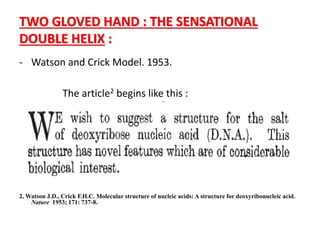
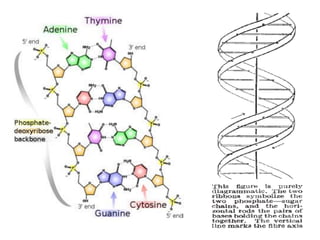
- Watson and Crick Model. 1953.
The article2 begins like this :
2. Watson J.D., Crick F.H.C. Molecular structure of nucleic acids: A structure for deoxyribonucleic acid.
Nature 1953; 171: 737-8.
ERWIN CHARGAFF:
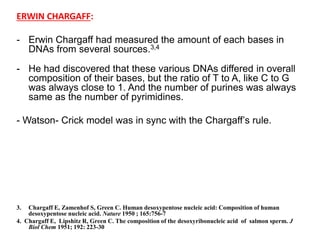
- Erwin Chargaff had measured the amount of each bases in
DNAs from several sources.3,4
- He had discovered that these various DNAs differed in overall
composition of their bases, but the ratio of T to A, like C to G
was always close to 1. And the number of purines was always
same as the number of pyrimidines.
- Watson- Crick model was in sync with the Chargaff‟s rule.
3. Chargaff E, Zamenhof S, Green C. Human desoxypentose nucleic acid: Composition of human
desoxypentose nucleic acid. Nature 1950 ; 165:756-7
4. Chargaff E, Lipshitz R, Green C. The composition of the desoxyribonucleic acid of salmon sperm. J
Biol Chem 1951; 192: 223-30
- This model also predicted the measurements
later confirmed by other precise methods.
- Bases 3.4 A0 apart, complete turn every 10th
time and the entire molecule 20 A0 across.
The weight of the molecule is obviously
proportional to its length , but DNA is so thin
that a molecule stretching the 150 million km
between the earth and the sun would weigh
less than half a gram.
KORNBERG’s EXPERIMENT:
Arthur Kornberg…. Washington University in St Louis
- His group extracted a complex of bacterial enzymes that
would synthesize DNA from raw materials.
- The synthesis would work only if all 4 nucleotides were
present at the same time, and also required the
presence of small amount of DNA (as Primer).
- So, they suggested that the enzyme system made the
new DNA by replicating the primer strands , and not by
assembling nucleotides from scratch.
- DNA synthesized in this way was every bit active as the
natural original.
So, it sort of hinted that Watson- Crick’s prediction of
semiconservative replication might be true…
THE MOST BEAUTIFUL EXPERIMENT IN BIOLOGY
- Matthew Meselson and Franklin Stahl at the California institute of
technology performed an experiment that James Watson called
“CLASSIC” , and Watson‟s predecessor as director of Cold Spring
Harbor, John Cairns, called, without qualification, “the most beautiful
experiment in biology”.
- There were 3 hypothesis of DNA structure, floating around, one of
them being Watson and Crick‟s SEMICONSERVATIVE hypothesis.
- They published their report in 19585, and this was the experiment
that consolidated Watson- Crick model .
- It is also famous for the invention of new technique called
DENSITY GRADIENT CENTRIFUGATION.
5. Messleson M, Stahl FW. The replication of DNA in Escherechia coli. Proc Natl Acad Sci 1958; 44: 671-82.
THE EXPERIMENT
The fact : DNAs with different densities will settle down differently
during centrifugation.
- They grew billions of bacteria (E. coli) in a broth that
contained a heavy isotope of nitrogen in the form of
ammoniuum chloride.
- After 14 generations they were confident that all the
nitrogen in the bacteria’s DNA was of heavy variety.
- These E. coli cells were then transferred to the broth
containing ordinary ammonium chloride {i.e. N14 isotope
of Nitrogen }.
EXPERIMENT CONTD…
- Meanwhile, they took a reference sample of cells that
had been growing on N14 containing broth.
- They broke open the cells with detergent and
extracted the DNA.
- Then they added each lot of DNA into a solution
containing Caesium chloride and spun the tubes at
44,700 r.p.m. for 24 hours.
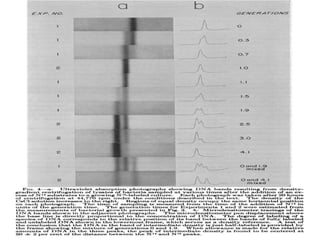
- A photograph taken by ultraviolet light as the tubes
spun round revealed the bands of DNA.
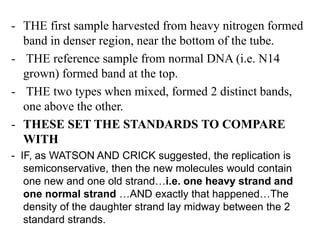
- THE first sample harvested from heavy nitrogen formed
band in denser region, near the bottom of the tube.
- THE reference sample from normal DNA (i.e. N14
grown) formed band at the top.
- THE two types when mixed, formed 2 distinct bands,
one above the other.
- THESE SET THE STANDARDS TO COMPARE
WITH
- IF, as WATSON AND CRICK suggested, the replication is
semiconservative, then the new molecules would contain
one new and one old strand…i.e. one heavy strand and
one normal strand …AND exactly that happened…The
density of the daughter strand lay midway between the 2
standard strands.
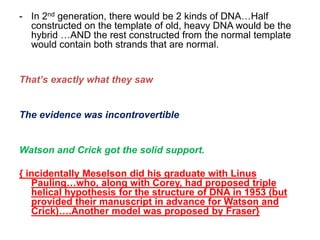
- In 2nd generation, there would be 2 kinds of DNA…Half
constructed on the template of old, heavy DNA would be the
hybrid …AND the rest constructed from the normal template
would contain both strands that are normal.
That’s exactly what they saw
The evidence was incontrovertible
Watson and Crick got the solid support.
{ incidentally Meselson did his graduate with Linus
Pauling…who, along with Corey, had proposed triple
helical hypothesis for the structure of DNA in 1953 (but
provided their manuscript in advance for Watson and
Crick)….Another model was proposed by Fraser}
THE NEXT OBVIOUS QUESTION:
- So, DNA has in it to preserve itself by reproducing
faithfully and making new copies of itself.
- But what information does it possess regarding life that
it has to be preserved ?
- And how does it execute its stored set of plans ?
If DNA is the manager, the workers are proteins…
- In 1945, this guy called Fred Sanger began a mammoth
attempt to determine the primary structure of a protein
called insulin…
It was too bold a decision for that time because no one was
certain during those days that proteins had a fixed
structure.
10 years and 10 grams of insulin later, Sanger was able
to determine the structure of insulin…a 51 amino acid
containing protein arranged in 2 separate chains joined
by disulfide linkages.
It might be interesting to know that , to produce 10
grams of insulin as Sanger did, it requires about 125
cows (average wt 500kg, and its pancreas weighing
about 400 grams).
So, it was quite obvious to draw parallels between the
sequence of bases along DNA and the sequence of
amino acids along the protein.
- First they thought the connection might be a direct
one…that different amino acids would fit into the wide
groove along the double helix at specific places determined
by nucleotide sequence.
- Later when it became clear that it could not be, then they
began to search for the intermediary between the nucleotide
sequence and amino acid sequence specified that gene…
- The major goal of major laboratories at that time was to
crack that genetic code.
- Crick thought that if they knew the amino acid sequence of
a protein and the base sequence of the piece of nucleic acid
that codes it, they could simply match it and identify the
code.
- The problem was, it took 10 years for Sanger to identify the
sequence of a small protein insulin…and yet nobody knew
even how to begin the search for the insulin gene, let alone
other proteins and genes.
Now it can be easily done is another story
- Turning back now we can also realize that it would be quite
impossible to determine the genetic code the way Crick had
thought. As we now know that there are vast stretches of
DNA within many genes that never show up in the protein
products…Also the post translational modification could
hinder the determination of sequence.
Any would be genetic cryptologist’s life would have
become hell!!!
THE CENTRAL DOGMA
- It was pretty clear by that time (as Crick postulated in 1958)
that the information could be transferred only from nucleic
acids to protein and not the other way round.
- Then there was a postulation, and subsequent discovery,
of an intermediary made of RNA that acted as a go-
between from the gene on the DNA and the ribosome…
This became known as messenger RNA (mRNA)
- Then another hypothetical molecule was postulated by
Sydney Brenner, which he called „adaptor‟ that had the job
of reading the coded message and converting the
sequence of bases into specific amino acids.
- Later the molecule was discovered. It too turned out to be
made of RNA. They called it transfer RNA (tRNA).
- THUS the central dogma now became “ DNA makes RNA
makes protein”.
SOME MORE EXPERIMENTS
- Charles Yanofsky, with his colleagues at Stanford collected
variants of E. coli that had mutations in a particular enzyme.
- They found the position in the protein chain of each altered
amino acid, and compared them with the maps of the
mutations in the gene {GENE MAPPING}
- The order of the different amino acid changes along the
protein matched exactly the order of the mutations along the
gene.
- Sydney Brenner at Cambridge was working on a class of
“amber mutants‟, which had the peculiar property of stopping
protein manufacture too soon.
- He compared the size of the fragment made by each amber
mutant with the distance of mutation at the end of DNA (by
Gene Mapping). THE ORDERS MATCHED. { It was clear
later that one of the misplaced code was actually a stop
sign}
CRICK and BRENNER, from these evidences, and their other
works deduced 3 fundamental properties of the code:
1. The code is made of triplets (called a ‘codon’) i.e. 1
amino acid is represented by 3 nucleotides in the
mRNA.
2. Because there are now 64 codons, and only 20
amino acids, the code is degenerate i.e. any amino
acid can correspond to more than one codon.
3. The code is sequential and non overlapping.
[ Later, exceptions to the third point was found…one being
the bacteriophage φX174 which had overlapping
genes]
DECODING THE CODES:
- Marshall Nirenberg and J.H. Mattheaei, just like
Kornberg‟s DNA synthesizing system, devised a cell free
system that would make proteins (in vitro synthesis).
- To monitor protein synthesis they added 14C labeled
amino acids.
- They added Poly U (a synthetic mRNA) to a fresh
disrupted cell suspension (cell free extract).
- Most importantly, they noticed that only 14C
Phenylalanine was incorporated into protein.
- That meant UUU code in mRNA was for Phe.
- Similarly, they noticed…AAA = Lys, and CCC = Pro
ADDITIONAL FACT ON PREVIOUS SLIDE
• Actually, Nirenberg and Matthaei had added RNA(rRNA)
to the in vitro protein synthesis system to prolong the
synthesis of protein (because they knew preparation of
disrupted cells would soon cease to make proteins).
• They had then used synthetic RNA just as a control hoping
that artificial RNA would cause rapid decay of in vitro
protein synthesis…
• But, amazingly, the synthetic RNA turned out to be more
fruitful…
• To produce synthetic RNA they used enzyme
polynucleotide phosphorylase , which synthesized RNA
randomly from available precursors…
• They made synthetic RNA polyuridylic acid(Poly U) by this
method from precursor UDP.
- Then they tried to synthesize more complex RNA
molecules.
- Let‟s imagine a mix of 3:1 U to G. So, the synthetic RNA
would be a poly UG [ which might have UUU, UUG and
other codons…and was guessed on the basis of
probability].
- The protein thus synthesized from poly UG, 3:1 in vitro
were found to be Valine, Leucine and Cysteine present
about 1-3rd as often as Phenylalanine.
{ Phe was present 2-3rd because the amount of U to G
was 3:1, hence more chance of forming UUU codon}.
- It also suggested that Val, Leu and Cys must have
codon that have 2 Us and 1 G…
BUT …
IN WHICH ORDER?
AND WHICH WAS WHICH?
So, his method had major drawback that,
though he could know the compositions of
the codon, but still couldn‟t confirm the
actual order of the bases.
Nevertheless, 35 of the 40 codons that he
had cracked came out to be true
TRIPLET BINDING ASSAY :
- Nirenberg and Philip Leder also took a different look at the
code…They invented a technique which is now famous as
Triplet binding assay.
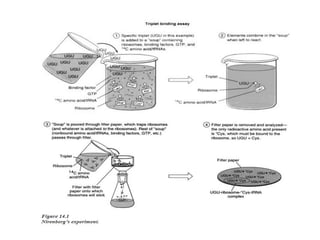
- Let’s take an example of a specific triplet UGU.
- This triplet mRNA was added to a mixture of ribosomes,
binding factors, GTP and a variety of 14C labeled aminoacid
charged tRNAs.
- Then they passed the whole lot through a filter made of
nitrocellulose.
- The ribosomes, with the single triplet mRNA and 14C amino
acid- tRNA (that recognized UGU) stuck to the paper.
- All the other amino acids and their tRNAs passed right
through….
CONTD…
- When the filter was analyzed, it contained 14C-Cysteine
Hence, UGU = Cys
-20 sets of amino acids for each mRNA triplet, each
with a different one made artificially radioactive ,
provided almost the entire code….50 of 64.
the remaining ones gave rather ambiguous results
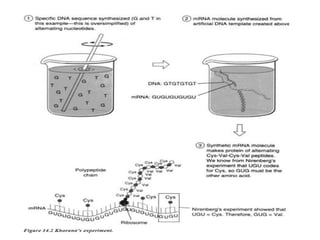
HAR GOBIND KHORANA
- He first constructed short defined sequences of DNA.
- Suppose a sequence of oligonucleotide GTGTGTGT…. on one of
the strand is produced.
- These sequences are then used as templates for RNA polymerase,
and produced RNA molecules…like GUGUGUGU…….
- Here, we can clearly see 2 alternating codons, GUG and UGU.
- During in vitro protein synthesis this mRNA yielded a polypeptide
of alternating Cys-Val-Cys-Val
- He knew from triplet binding assay that UGU=Cys
- Therefore, GUG = Val
NOTE: He knew the sequences of DNA he synthesized
because he made DNA from special chemical groups blocked
such that only certain base combinations were possible
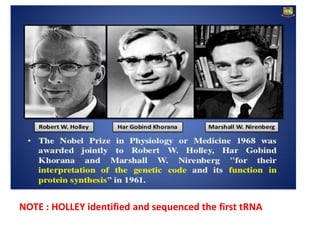
NOTE : HOLLEY identified and sequenced the first tRNA
- By the end of 1966, the decoding of the DNA was
complete.
- And to their surprise, the code was same for all
organisms. Man, microbe, marigold…everything has
a same code.
- This universal nature of the code was a powerful
evidence that all life had descended from a single
successful ancestor with one working code.
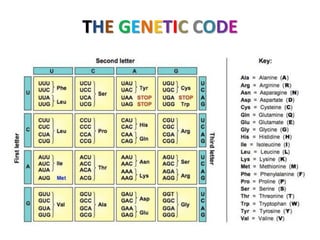
THE GENETIC CODE
THE LULL BEFORE THE STORM
- THE THEN BIG PROBLEMS HAD BEEN SOLVED BY
THE END OF 1960s.
- The broad outlines had been delineated…Only small
details needed to be filled.
- The excitement seemed to take a rest for now.
- This was even reflected in the published papers.
However, the calm was waiting around the corner to be
shattered.
The entire face of molecular biology was about to change.
The slow relay had begun to accelerate…
As if they were merely waiting for the cleaving tools to be discovered.
THE ERA OF GENETIC ENGINEERING WAS ABOUT TO BEGIN…
THANK YOU

Nucleic acids - a historical pesrpective

  • 1.
    NUCLEIC ACIDS - ahistorical perspective BUDDHI POKHREL
  • 2.
    This presentation hasits roots on the book “MAN MADE LIFE” by Jeremy Cherfas
  • 3.
    It all beginswith a thin soup of bacterial cells - Millions of bacterial cells are suspended in a broth of nutrient chemicals, doubling their number in about every half an hour. - Let‟s concentrate these cells a bit. - The test tube full of cloudy soup is whirled round at about 8000 revolutions per minute in a centrifuge. [ The soup is cloudy because it reflects light] - The cells are then forced down to the bottom of the test tube. - After 30 minutes or so, the broth has separated into an absolutely clear liquid above a small pellet, dingy and greyish yellow.
  • 4.
    - The clearliquid can be poured away. - The pellet, which consists of compacted mass of cells, need to be broken up again. - The cells are again resuspended in a small amount of liquid and vibrated using a mechanical shaker. - We have a cloudy broth once again, but much thicker than before. - We now need to break the cell wall to reach the content within. - Ethylenediamine tetra acetate (EDTA) removes magnesium ions from the cell walls, without which it becomes weak. - SDS (Sodium Dodecyl Sulphate) is a detergent to dissolve grease.
  • 5.
    Its an effectivemixture, EDTA and SDS - The mixture when added, cell wall is opened up and are dissolved. The dissolved cells are transparent as they no longer reflect light. - So, the test tube is clear again after half an hour. - Not only clear…but viscous too. Its almost like egg white viscosity whereas the before one was more like water. The confined DNA has been released.
  • 6.
    There are moreto cells besides DNA - The SDS has dealt with fats. - The major remaining impurity is now protein. - To deal with it let‟s add phenol (carbolic acid). Carbolic acid was among the first antiseptics, precisely because it attacks protein. - The phenol causes protein to precipitate out of the solution, and sinks to the bottom (as it is heavier than the liquid), taking proteins away with it. - Rock the test tube gently (shaking heavily at this point would break delicate DNAs) to mix the phenol with the broth. - The mixture now is even thicker, and grey.
  • 7.
    - Centrifuge themixture - At the very bottom is a clear layer of phenol, on top of which is a thick and faintly repellant white band of coagulated proteins. - And above the protein is another clear layer…. This is the layer of our interest - However, any attempt to suck out the DNA rich layer is thwarted by the viscosity of the liquid , and pulls itself back out of the pipette. - The problem is solved by using a pipette with a bent tip, and removing one sticky drop at a time. Finally, we have a DNA rich solution…We are yet to lay our hands into the fiber, though.
  • 8.
    ALCOHOL COMES TOTHE RESCUE - Even an ordinary alcohol (but absolutely pure) does the trick. - Pour the alcohol into the tube…It floats, unlike phenol, above the DNA. - Dip a glass rod through the alcohol … into the DNA . - It shall pick up some fibers…and as the rod is pulled back from alcohol layer, fiber precipitates. A long glistening filament of almost pure DNA now awaits for the magic … … that extends as far as our imagination let’s us to Note : the techniques might have been modified, yet the basic principle is the same
  • 9.
    ONCE UPON ATIME: - It was 1869. - Johann Friedrich Miescher, a young Swiss of 25, was interested in the chemistry of the nucleus of the cell. - Discarded dressings from the local surgical clinic was his source of nuclei ( as they contained WBCs which have relatively large nuclei, which he diligently separated from the surrounding cytoplasm). - His analysis revealed an unknown compound which was acidic and was rich in phosphorus. - He called it nuclein. - Richard Altman , his student, later coined the term nucleic acid.
  • 10.
    The chemistry wasthen thoroughly worked out within few years : - Sugar - Bases ( A, C, T, G, U) - Phosphate - By1920s, two different nucleic acids had been distinguished…DNA and RNA.
  • 12.
    Miescher was alsointerested in… - 3 years before he died (55, of Tb), he wrote a letter to his uncle where he talked of large biomolecules containing repitition of similar, but not identical, subunits; which gave these molecules the potential to harbour the hereditary message. He wrote : “ just as the words and concepts of all languages can find expression in twenty-four to thirty letters of the alphabet” First, the discovery…and such foresighted notion!! This certainly hints of beginning of something very big and rapid … But, alas, as it was pointed out by Horace Freeland Judson , “ Miescher’s notion was fatally imprecise. The molecules he offered as examples were albumin and hemoglobin, both proteins.”
  • 13.
    It took awhile : - In 1928, Frederick Griffith , injected mice with 2 different preparations of the disease causing bacteria Streptococcus pneumonae (Pneumococcus). - One of the preparation contained a mutant which, alone, was harmless. The other was virulent and lethal (but had been killed by heating the culture, and hence was ineffective when injected alone). - The mice receiving the double injection died… And from the blood, Griffith collected virulent pneumococci identical to the second preparations. - This “bacterial transformation”, was quickly and successfully repeated in laboratories around the world. - Nobody knew what to think of this strange phenomenon.
  • 14.
    - Oswald T.Avery found that they could do the experiment without the mice. - In the culture media the 2 forms of pneumococci look very different. - The virulent one forms a smooth glistening colony and the non virulent mutant grows into rough crinkled colonies. - Cultures of rough pneumococci, grown in the presence of heat killed smooth pneumococci, gave rise to smooth colonies. - In 1931, James Alloway ( also the member of Avery‟s lab), ground up the virulent smooth bacteria and passed the mixture through a sieve so fine that the empty cell walls, unbroken cells and other debris couldn‟t pass through. - AND, even such filtered extracts had the power to transform the mutants.
  • 15.
    At first, likeeveryone else, they thought of protein “ Transforming factor”, it was called. - The first guess was obviously protein. - 20 gallons (75 litres) of pneumococcus culture and a hundredth of an ounce (25 mg) of the stuff later ( obviously it took many years) they were convinced it was nucleic acid. Because it behaved like nucleic acid and not a bit like protein in every respect. Enzymes digesting protein didn’t affect it. No protein tests were positive. And then, enzymes known to attack DNA completely destroyed the “transformation”. It wasn’t even touched by the enzymes that attacked only RNAs. It had to be DNA…
  • 16.
    ANOTHER CLASSIC PHENOMENON:THE WARING BLENDER EXPERIMENT1 - 1952 it was. - Alfred Hershey and Martha Chase, at the cold spring harbour laboratory on Long Island. “. . . Al Hershey had sent me a long letter summarizing the recently completed experiments by which he and Martha Chase established that a key feature of the infection of a bacterium by a phage was the injection of the viral DNA into the host bacterium. Their experiment was thus a powerful new proof that DNA is the primary genetic material.” - James Watson 1. AD Hershey, M Chase. Independent functions of viral protein and nucleic acid in growth of bacteriophage. Journal of General Physiology 1952; 36: 39-56
  • 17.
    THE EXPERIMENT :Using E. coli and T- group bacteriophage -CulturesofE.coliweregrowninmediathatcontainedastheonlysource ofsulfur,radioactiveS-35sulfurinsulfateform. - CulturesofE.coliweregrowninmediathatcontainedastheonlysource ofphosphorus,radioactiveP-32phosphorousinphosphate form. -Suchbacterialcellswillhavealltheirsulfurandphosphate,respectively, radioactive. - Infecttheseradioactivebacteriawithphages. - Progenyphageswillberadioactive. - PhagesradioactivewithS-35willhavealltheradioactivityconfinedto proteins,sincesulfuroccursintwoaminoacids(cysteineand methionine)butnotinDNA. - PhagesradioactivewithP-32willhavealltheradioactivityconfinedto DNA,sincephosphorusoccursinDNAbutnotinprotein.
  • 18.
    - Now, newcultures of E. coli are infected with S-35 and P-32 phages,respectively - Allow a few minutes post-infection for phages to attach to bacteriaandbegintheinfectionprocess - Do low-speed centrifugation to separate any unattached phagesanddiscardthesupernatant - Whirrforseveralminutesinblender - The shearing forces of whirring in the blender break the virus particlesawayfromthebacterialsurface - Centrifuge to separate virus into supernatant and bacteria into pellet
  • 19.
    Result: - for S-35radioactive preparation, the radioactivity is in the supernatant - for P-32 radioactive preparation, the radioactivity is in the pellet conclusions: - viral DNA enters the bacterial cell during infection - viral protein does not enter the bacterial cell during infection - therefore, DNA must be the viral genetic material.
  • 20.
    TWO GLOVED HAND: THE SENSATIONAL DOUBLE HELIX : - Watson and Crick Model. 1953. The article2 begins like this : 2. Watson J.D., Crick F.H.C. Molecular structure of nucleic acids: A structure for deoxyribonucleic acid. Nature 1953; 171: 737-8.
  • 22.
    ERWIN CHARGAFF: - ErwinChargaff had measured the amount of each bases in DNAs from several sources.3,4 - He had discovered that these various DNAs differed in overall composition of their bases, but the ratio of T to A, like C to G was always close to 1. And the number of purines was always same as the number of pyrimidines. - Watson- Crick model was in sync with the Chargaff‟s rule. 3. Chargaff E, Zamenhof S, Green C. Human desoxypentose nucleic acid: Composition of human desoxypentose nucleic acid. Nature 1950 ; 165:756-7 4. Chargaff E, Lipshitz R, Green C. The composition of the desoxyribonucleic acid of salmon sperm. J Biol Chem 1951; 192: 223-30
  • 23.
    - This modelalso predicted the measurements later confirmed by other precise methods. - Bases 3.4 A0 apart, complete turn every 10th time and the entire molecule 20 A0 across. The weight of the molecule is obviously proportional to its length , but DNA is so thin that a molecule stretching the 150 million km between the earth and the sun would weigh less than half a gram.
  • 24.
    KORNBERG’s EXPERIMENT: Arthur Kornberg….Washington University in St Louis - His group extracted a complex of bacterial enzymes that would synthesize DNA from raw materials. - The synthesis would work only if all 4 nucleotides were present at the same time, and also required the presence of small amount of DNA (as Primer). - So, they suggested that the enzyme system made the new DNA by replicating the primer strands , and not by assembling nucleotides from scratch. - DNA synthesized in this way was every bit active as the natural original. So, it sort of hinted that Watson- Crick’s prediction of semiconservative replication might be true…
  • 25.
    THE MOST BEAUTIFULEXPERIMENT IN BIOLOGY - Matthew Meselson and Franklin Stahl at the California institute of technology performed an experiment that James Watson called “CLASSIC” , and Watson‟s predecessor as director of Cold Spring Harbor, John Cairns, called, without qualification, “the most beautiful experiment in biology”. - There were 3 hypothesis of DNA structure, floating around, one of them being Watson and Crick‟s SEMICONSERVATIVE hypothesis. - They published their report in 19585, and this was the experiment that consolidated Watson- Crick model . - It is also famous for the invention of new technique called DENSITY GRADIENT CENTRIFUGATION. 5. Messleson M, Stahl FW. The replication of DNA in Escherechia coli. Proc Natl Acad Sci 1958; 44: 671-82.
  • 26.
    THE EXPERIMENT The fact: DNAs with different densities will settle down differently during centrifugation. - They grew billions of bacteria (E. coli) in a broth that contained a heavy isotope of nitrogen in the form of ammoniuum chloride. - After 14 generations they were confident that all the nitrogen in the bacteria’s DNA was of heavy variety. - These E. coli cells were then transferred to the broth containing ordinary ammonium chloride {i.e. N14 isotope of Nitrogen }.
  • 27.
    EXPERIMENT CONTD… - Meanwhile,they took a reference sample of cells that had been growing on N14 containing broth. - They broke open the cells with detergent and extracted the DNA. - Then they added each lot of DNA into a solution containing Caesium chloride and spun the tubes at 44,700 r.p.m. for 24 hours. - A photograph taken by ultraviolet light as the tubes spun round revealed the bands of DNA.
  • 29.
    - THE firstsample harvested from heavy nitrogen formed band in denser region, near the bottom of the tube. - THE reference sample from normal DNA (i.e. N14 grown) formed band at the top. - THE two types when mixed, formed 2 distinct bands, one above the other. - THESE SET THE STANDARDS TO COMPARE WITH - IF, as WATSON AND CRICK suggested, the replication is semiconservative, then the new molecules would contain one new and one old strand…i.e. one heavy strand and one normal strand …AND exactly that happened…The density of the daughter strand lay midway between the 2 standard strands.
  • 30.
    - In 2ndgeneration, there would be 2 kinds of DNA…Half constructed on the template of old, heavy DNA would be the hybrid …AND the rest constructed from the normal template would contain both strands that are normal. That’s exactly what they saw The evidence was incontrovertible Watson and Crick got the solid support. { incidentally Meselson did his graduate with Linus Pauling…who, along with Corey, had proposed triple helical hypothesis for the structure of DNA in 1953 (but provided their manuscript in advance for Watson and Crick)….Another model was proposed by Fraser}
  • 31.
    THE NEXT OBVIOUSQUESTION: - So, DNA has in it to preserve itself by reproducing faithfully and making new copies of itself. - But what information does it possess regarding life that it has to be preserved ? - And how does it execute its stored set of plans ? If DNA is the manager, the workers are proteins… - In 1945, this guy called Fred Sanger began a mammoth attempt to determine the primary structure of a protein called insulin… It was too bold a decision for that time because no one was certain during those days that proteins had a fixed structure.
  • 32.
    10 years and10 grams of insulin later, Sanger was able to determine the structure of insulin…a 51 amino acid containing protein arranged in 2 separate chains joined by disulfide linkages. It might be interesting to know that , to produce 10 grams of insulin as Sanger did, it requires about 125 cows (average wt 500kg, and its pancreas weighing about 400 grams). So, it was quite obvious to draw parallels between the sequence of bases along DNA and the sequence of amino acids along the protein.
  • 33.
    - First theythought the connection might be a direct one…that different amino acids would fit into the wide groove along the double helix at specific places determined by nucleotide sequence. - Later when it became clear that it could not be, then they began to search for the intermediary between the nucleotide sequence and amino acid sequence specified that gene… - The major goal of major laboratories at that time was to crack that genetic code. - Crick thought that if they knew the amino acid sequence of a protein and the base sequence of the piece of nucleic acid that codes it, they could simply match it and identify the code.
  • 34.
    - The problemwas, it took 10 years for Sanger to identify the sequence of a small protein insulin…and yet nobody knew even how to begin the search for the insulin gene, let alone other proteins and genes. Now it can be easily done is another story - Turning back now we can also realize that it would be quite impossible to determine the genetic code the way Crick had thought. As we now know that there are vast stretches of DNA within many genes that never show up in the protein products…Also the post translational modification could hinder the determination of sequence. Any would be genetic cryptologist’s life would have become hell!!!
  • 35.
    THE CENTRAL DOGMA -It was pretty clear by that time (as Crick postulated in 1958) that the information could be transferred only from nucleic acids to protein and not the other way round. - Then there was a postulation, and subsequent discovery, of an intermediary made of RNA that acted as a go- between from the gene on the DNA and the ribosome… This became known as messenger RNA (mRNA) - Then another hypothetical molecule was postulated by Sydney Brenner, which he called „adaptor‟ that had the job of reading the coded message and converting the sequence of bases into specific amino acids. - Later the molecule was discovered. It too turned out to be made of RNA. They called it transfer RNA (tRNA). - THUS the central dogma now became “ DNA makes RNA makes protein”.
  • 36.
    SOME MORE EXPERIMENTS -Charles Yanofsky, with his colleagues at Stanford collected variants of E. coli that had mutations in a particular enzyme. - They found the position in the protein chain of each altered amino acid, and compared them with the maps of the mutations in the gene {GENE MAPPING} - The order of the different amino acid changes along the protein matched exactly the order of the mutations along the gene. - Sydney Brenner at Cambridge was working on a class of “amber mutants‟, which had the peculiar property of stopping protein manufacture too soon. - He compared the size of the fragment made by each amber mutant with the distance of mutation at the end of DNA (by Gene Mapping). THE ORDERS MATCHED. { It was clear later that one of the misplaced code was actually a stop sign}
  • 37.
    CRICK and BRENNER,from these evidences, and their other works deduced 3 fundamental properties of the code: 1. The code is made of triplets (called a ‘codon’) i.e. 1 amino acid is represented by 3 nucleotides in the mRNA. 2. Because there are now 64 codons, and only 20 amino acids, the code is degenerate i.e. any amino acid can correspond to more than one codon. 3. The code is sequential and non overlapping. [ Later, exceptions to the third point was found…one being the bacteriophage φX174 which had overlapping genes]
  • 38.
    DECODING THE CODES: -Marshall Nirenberg and J.H. Mattheaei, just like Kornberg‟s DNA synthesizing system, devised a cell free system that would make proteins (in vitro synthesis). - To monitor protein synthesis they added 14C labeled amino acids. - They added Poly U (a synthetic mRNA) to a fresh disrupted cell suspension (cell free extract). - Most importantly, they noticed that only 14C Phenylalanine was incorporated into protein. - That meant UUU code in mRNA was for Phe. - Similarly, they noticed…AAA = Lys, and CCC = Pro
  • 39.
    ADDITIONAL FACT ONPREVIOUS SLIDE • Actually, Nirenberg and Matthaei had added RNA(rRNA) to the in vitro protein synthesis system to prolong the synthesis of protein (because they knew preparation of disrupted cells would soon cease to make proteins). • They had then used synthetic RNA just as a control hoping that artificial RNA would cause rapid decay of in vitro protein synthesis… • But, amazingly, the synthetic RNA turned out to be more fruitful… • To produce synthetic RNA they used enzyme polynucleotide phosphorylase , which synthesized RNA randomly from available precursors… • They made synthetic RNA polyuridylic acid(Poly U) by this method from precursor UDP.
  • 40.
    - Then theytried to synthesize more complex RNA molecules. - Let‟s imagine a mix of 3:1 U to G. So, the synthetic RNA would be a poly UG [ which might have UUU, UUG and other codons…and was guessed on the basis of probability]. - The protein thus synthesized from poly UG, 3:1 in vitro were found to be Valine, Leucine and Cysteine present about 1-3rd as often as Phenylalanine. { Phe was present 2-3rd because the amount of U to G was 3:1, hence more chance of forming UUU codon}. - It also suggested that Val, Leu and Cys must have codon that have 2 Us and 1 G…
  • 41.
    BUT … IN WHICHORDER? AND WHICH WAS WHICH? So, his method had major drawback that, though he could know the compositions of the codon, but still couldn‟t confirm the actual order of the bases. Nevertheless, 35 of the 40 codons that he had cracked came out to be true
  • 42.
    TRIPLET BINDING ASSAY: - Nirenberg and Philip Leder also took a different look at the code…They invented a technique which is now famous as Triplet binding assay. - Let’s take an example of a specific triplet UGU. - This triplet mRNA was added to a mixture of ribosomes, binding factors, GTP and a variety of 14C labeled aminoacid charged tRNAs. - Then they passed the whole lot through a filter made of nitrocellulose. - The ribosomes, with the single triplet mRNA and 14C amino acid- tRNA (that recognized UGU) stuck to the paper. - All the other amino acids and their tRNAs passed right through….
  • 43.
    CONTD… - When thefilter was analyzed, it contained 14C-Cysteine Hence, UGU = Cys -20 sets of amino acids for each mRNA triplet, each with a different one made artificially radioactive , provided almost the entire code….50 of 64. the remaining ones gave rather ambiguous results
  • 45.
    HAR GOBIND KHORANA -He first constructed short defined sequences of DNA. - Suppose a sequence of oligonucleotide GTGTGTGT…. on one of the strand is produced. - These sequences are then used as templates for RNA polymerase, and produced RNA molecules…like GUGUGUGU……. - Here, we can clearly see 2 alternating codons, GUG and UGU. - During in vitro protein synthesis this mRNA yielded a polypeptide of alternating Cys-Val-Cys-Val - He knew from triplet binding assay that UGU=Cys - Therefore, GUG = Val NOTE: He knew the sequences of DNA he synthesized because he made DNA from special chemical groups blocked such that only certain base combinations were possible
  • 47.
    NOTE : HOLLEYidentified and sequenced the first tRNA
  • 48.
    - By theend of 1966, the decoding of the DNA was complete. - And to their surprise, the code was same for all organisms. Man, microbe, marigold…everything has a same code. - This universal nature of the code was a powerful evidence that all life had descended from a single successful ancestor with one working code.
  • 49.
  • 50.
    THE LULL BEFORETHE STORM - THE THEN BIG PROBLEMS HAD BEEN SOLVED BY THE END OF 1960s. - The broad outlines had been delineated…Only small details needed to be filled. - The excitement seemed to take a rest for now. - This was even reflected in the published papers.
  • 51.
    However, the calmwas waiting around the corner to be shattered. The entire face of molecular biology was about to change. The slow relay had begun to accelerate… As if they were merely waiting for the cleaving tools to be discovered. THE ERA OF GENETIC ENGINEERING WAS ABOUT TO BEGIN…
  • 52.