Name Qaisar Maqbool
Class BS (H)
Roll No 5714
Semester 8th
Seminar Topic
Advancement in solar cells
GC, university Faisalabad
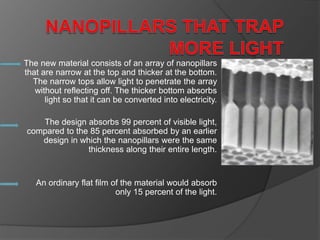
The new material consists of an array of nanopillars
that are narrow at the top and thicker at the bottom.
The narrow tops allow light to penetrate the array
without reflecting off. The thicker bottom absorbs
light so that it can be converted into electricity.
The design absorbs 99 percent of visible light,
compared to the 85 percent absorbed by an earlier
design in which the nanopillars were the same
thickness along their entire length.
An ordinary flat film of the material would absorb
only 15 percent of the light.
Car-Mounted Solar
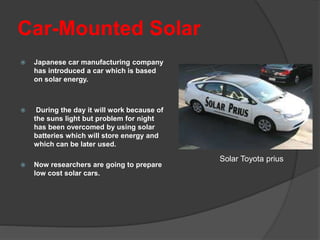
 Japanese car manufacturing company
has introduced a car which is based
on solar energy.
 During the day it will work because of
the suns light but problem for night
has been overcomed by using solar
batteries which will store energy and
which can be later used.
 Now researchers are going to prepare
low cost solar cars.
Solar Toyota prius
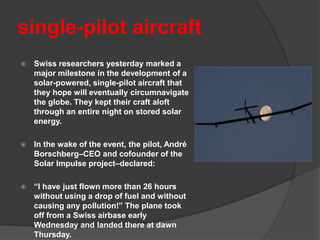
single-pilot aircraft
 Swiss researchers yesterday marked a
major milestone in the development of a
solar-powered, single-pilot aircraft that
they hope will eventually circumnavigate
the globe. They kept their craft aloft
through an entire night on stored solar
energy.
 In the wake of the event, the pilot, André
Borschberg–CEO and cofounder of the
Solar Impulse project–declared:
 “I have just flown more than 26 hours
without using a drop of fuel and without
causing any pollution!” The plane took
off from a Swiss airbase early
Wednesday and landed there at dawn
Thursday.
A Sticker Makes Solar Panels Work
Better
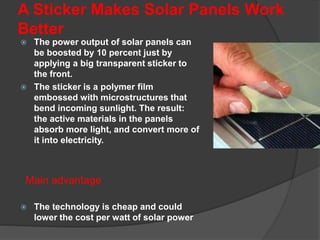
 The power output of solar panels can
be boosted by 10 percent just by
applying a big transparent sticker to
the front.
 The sticker is a polymer film
embossed with microstructures that
bend incoming sunlight. The result:
the active materials in the panels
absorb more light, and convert more of
it into electricity.
Main advantage
 The technology is cheap and could
lower the cost per watt of solar power
Space Based Solar
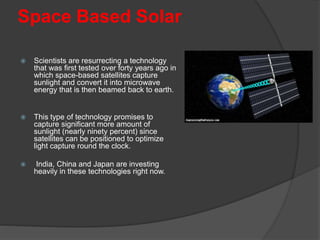
 Scientists are resurrecting a technology
that was first tested over forty years ago in
which space-based satellites capture
sunlight and convert it into microwave
energy that is then beamed back to earth.
 This type of technology promises to
capture significant more amount of
sunlight (nearly ninety percent) since
satellites can be positioned to optimize
light capture round the clock.
 India, China and Japan are investing
heavily in these technologies right now.
Advances in Solar Cell
Manufacturing
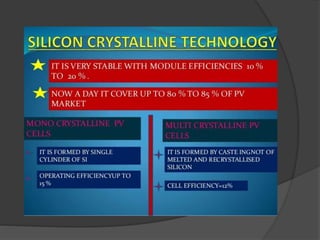
 Magnesium Chloride. While over ninety
percent of solar panels on the market today
are comprised of silicon semiconductors,
the key ingredient to converting sunlight
into electricity
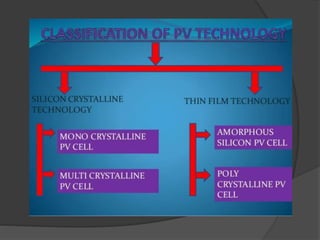
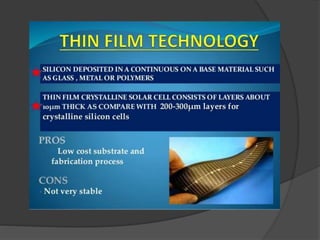
 Many believe the next generation of solar
panels will be made of a thin film
technology that uses narrow coatings of
cadmium telluride in solar cells - this
technology promises to be a much cheaper
and more efficient way to engage the
photovoltaic process.
 One major obstacle for cadmium telluride thin film cells is
that they become highly unstable during the manufacturing
process, which currently uses cadmium chloride.
 Magnesium chloride in replace of cadmium chloride.
Magnesium chloride is recovered from seawater, an
abundant resource, which makes the resource very low
cost, as well as non-toxic.
 Replacing the manufacturing process with this material
promises to increase the efficiency of these solar cells
from two percent to up to fifteen percent
Low-Cost Solar
 Solar cells can produce 10 times more electricity per
gram of silicon thanks to this system, which
concentrates sunlight on the cells with the help of
parabolic troughs and a tracking system that keeps
them pointed at the sun.
 Concentrated sunlight ordinarily causes solar cells to
overheat, impairing their performance, but this
system uses heat sinks and convection to prevent
that problem. The reflective troughs, a type already
used in solar thermal plants that concentrate sunlight
to make steam and drive turbines, can be made in
high volume at low prices.
Installations in Megawatts In
Pakistan
YEAR CUMULATIVELY
CAPACITY
ADDED
CAPACITY
2015 400 ---
2016 1000 600
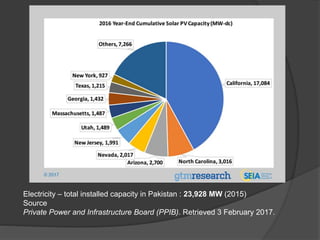
Electricity – total installed capacity in Pakistan : 23,928 MW (2015)
Source
Private Power and Infrastructure Board (PPIB). Retrieved 3 February 2017.

Advancement in solar cell

  • 1.
    Name Qaisar Maqbool ClassBS (H) Roll No 5714 Semester 8th Seminar Topic Advancement in solar cells GC, university Faisalabad
  • 7.
    The new materialconsists of an array of nanopillars that are narrow at the top and thicker at the bottom. The narrow tops allow light to penetrate the array without reflecting off. The thicker bottom absorbs light so that it can be converted into electricity. The design absorbs 99 percent of visible light, compared to the 85 percent absorbed by an earlier design in which the nanopillars were the same thickness along their entire length. An ordinary flat film of the material would absorb only 15 percent of the light.
  • 8.
    Car-Mounted Solar  Japanesecar manufacturing company has introduced a car which is based on solar energy.  During the day it will work because of the suns light but problem for night has been overcomed by using solar batteries which will store energy and which can be later used.  Now researchers are going to prepare low cost solar cars. Solar Toyota prius
  • 9.
    single-pilot aircraft  Swissresearchers yesterday marked a major milestone in the development of a solar-powered, single-pilot aircraft that they hope will eventually circumnavigate the globe. They kept their craft aloft through an entire night on stored solar energy.  In the wake of the event, the pilot, André Borschberg–CEO and cofounder of the Solar Impulse project–declared:  “I have just flown more than 26 hours without using a drop of fuel and without causing any pollution!” The plane took off from a Swiss airbase early Wednesday and landed there at dawn Thursday.
  • 10.
    A Sticker MakesSolar Panels Work Better  The power output of solar panels can be boosted by 10 percent just by applying a big transparent sticker to the front.  The sticker is a polymer film embossed with microstructures that bend incoming sunlight. The result: the active materials in the panels absorb more light, and convert more of it into electricity. Main advantage  The technology is cheap and could lower the cost per watt of solar power
  • 12.
    Space Based Solar Scientists are resurrecting a technology that was first tested over forty years ago in which space-based satellites capture sunlight and convert it into microwave energy that is then beamed back to earth.  This type of technology promises to capture significant more amount of sunlight (nearly ninety percent) since satellites can be positioned to optimize light capture round the clock.  India, China and Japan are investing heavily in these technologies right now.
  • 13.
    Advances in SolarCell Manufacturing  Magnesium Chloride. While over ninety percent of solar panels on the market today are comprised of silicon semiconductors, the key ingredient to converting sunlight into electricity  Many believe the next generation of solar panels will be made of a thin film technology that uses narrow coatings of cadmium telluride in solar cells - this technology promises to be a much cheaper and more efficient way to engage the photovoltaic process.
  • 14.
     One majorobstacle for cadmium telluride thin film cells is that they become highly unstable during the manufacturing process, which currently uses cadmium chloride.  Magnesium chloride in replace of cadmium chloride. Magnesium chloride is recovered from seawater, an abundant resource, which makes the resource very low cost, as well as non-toxic.  Replacing the manufacturing process with this material promises to increase the efficiency of these solar cells from two percent to up to fifteen percent
  • 15.
    Low-Cost Solar  Solarcells can produce 10 times more electricity per gram of silicon thanks to this system, which concentrates sunlight on the cells with the help of parabolic troughs and a tracking system that keeps them pointed at the sun.  Concentrated sunlight ordinarily causes solar cells to overheat, impairing their performance, but this system uses heat sinks and convection to prevent that problem. The reflective troughs, a type already used in solar thermal plants that concentrate sunlight to make steam and drive turbines, can be made in high volume at low prices.
  • 16.
    Installations in MegawattsIn Pakistan YEAR CUMULATIVELY CAPACITY ADDED CAPACITY 2015 400 --- 2016 1000 600
  • 18.
    Electricity – totalinstalled capacity in Pakistan : 23,928 MW (2015) Source Private Power and Infrastructure Board (PPIB). Retrieved 3 February 2017.