



Indian Stock Market
PLAIN AND SIMPLE, STOCK IS A SHARE IN
THE
OWNERSHIP OF A COMPANY. STOCK REPRESENTS A
CLAIM ON THE COMPANY'S ASSETS AND EARNINGS.
AS YOU ACQUIRE MORE STOCK, YOUR OWNERSHIP STAKE IN THE COMPANY
BECOMES GREATER.
WHETHER YOU SAY SHARE, EQUITY, OR STOCK, IT ALL MEANS THE SAME
THING.
What is Stock ?
Classification of stocks
Stocks are classified as
1. Common Stock:- Common shares represent ownership
in a company and a claim (dividends) on a portion of
profits. Investors get one vote per share to elect the
board members, who oversee the major decisions
made by management
2. Preferential Stocks:- Preferred stock represents some
degree of ownership in a company but usually doesn't
come with the same voting rights.
What is Stock Market ?
A stock market is a market for the trading of
publicly held company stock and associated
financial instruments (including stock options,
convertibles and stock index futures).
What is Indian Stock Exchange ?
Formal organizations, approved and
regulated by the Securities and Exchange
Board of India (SEBI), that are made up of
members who use the facilities to
exchange certain common stocks.
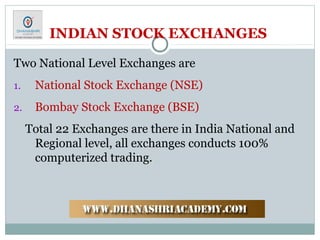
INDIAN STOCK EXCHANGES
Two National Level Exchanges are
1. National Stock Exchange (NSE)
2. Bombay Stock Exchange (BSE)
Total 22 Exchanges are there in India National and
Regional level, all exchanges conducts 100%
computerized trading.
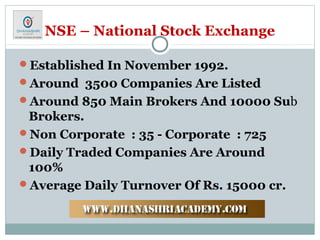
NSE – National Stock Exchange
Established In November 1992.
Around 3500 Companies Are Listed
Around 850 Main Brokers And 10000 Sub
Brokers.
Non Corporate : 35 - Corporate : 725
Daily Traded Companies Are Around
100%
Average Daily Turnover Of Rs. 15000 cr.
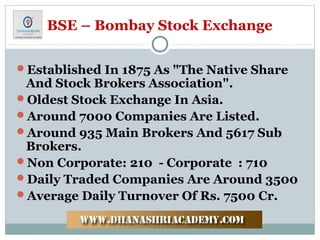
BSE – Bombay Stock Exchange
Established In 1875 As "The Native Share
And Stock Brokers Association".
Oldest Stock Exchange In Asia.
Around 7000 Companies Are Listed.
Around 935 Main Brokers And 5617 Sub
Brokers.
Non Corporate: 210 - Corporate : 710
Daily Traded Companies Are Around 3500
Average Daily Turnover Of Rs. 7500 Cr.
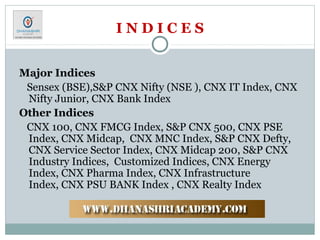
I N D I C E S
Major Indices
Sensex (BSE),S&P CNX Nifty (NSE ), CNX IT Index, CNX
Nifty Junior, CNX Bank Index
Other Indices
CNX 100, CNX FMCG Index, S&P CNX 500, CNX PSE
Index, CNX Midcap, CNX MNC Index, S&P CNX Defty,
CNX Service Sector Index, CNX Midcap 200, S&P CNX
Industry Indices, Customized Indices, CNX Energy
Index, CNX Pharma Index, CNX Infrastructure
Index, CNX PSU BANK Index , CNX Realty Index
REGULATERY BODY
SEBI – Securities & Exchange Board of India
 Established In 1992, As Per Securities &
Exchange Board Of India , Act.
 To Protect The Interests Of Investors
 To Regulate The Securities Market.
 To Promote The Development Of The
Securities Market
Basic requirement for Investing in stocks
 D-Mat Account:-
 Saving Bank Account:-
 Permanent Account Number (PAN):-
 Trading Account with Recognized Stock
Broker:-
D-Mat Account and its Benefits
A Dmat account is like a Bank Account, with the
difference being that instead of cash, a Dmat
account holds shares.
 Safe & convenient way to hold securities.
 Immediate Transfer of Securities.
 No Stamp Duty on Transfer of Securities.
 Auto. Credit Of Shares Into Dmat Account,
Arising Out of Bonus, Right Issue ,Split,
Merger, De-merger.
Trading Account
A Trading account is required if an individual
wishes to trade, i.e. buy and sell shares in the
stock exchange. A Trading account can also be
opened with most banks and financial
institutions, after filling up the required forms
and providing identity and address proofs.
Trading Process
Once the Dmat account, Trading account and
Bank account are in place, an individual is ready
to start trading. While it is not necessary to have
the Dmat account, Trading account and Bank
account with the same organization.
THREE WAYS TO INVEST IN SHARES
PRIMARY MARKET:-
Where Company Directly Allots His Equity
Shares To Investors.
SECONDARY MARKET:- Where Allotted Share
in Public Issue Are Bought And Sold
by Investors With The Help Of Stock Brokers
at Various Stock Exchanges.
Future & Options:- It’s a derivative segment
of Underlying securities.
PRIMARY MARKET
The primary market is where securities are
created (by means of an IPO).
Initial Public Offering (IPO) is the first sale of
stock by a company to the public. A company can
raise money by issuing either debt or equity. If
the company has never issued equity to the
public, it's known as an IPO. This market is
known as primary Market
SECONDARY MARKET
A market on which an investor purchases an asset
from another investor rather than an issuing
corporation.
In this market Brokers becomes intermediate body
between buyer and seller.
FUTURES & OPTIONS
In finance, a security whose price is dependent
upon or derived from one or more underlying
assets.
The derivative itself is merely a contract between
two or more parties.
Its value is determined by fluctuations in the
underlying asset. The most common underlying
assets include stocks,
bonds, commodities, currencies.
DIFFERENCE IN EQUITY & DERIVATIVES
SEGMENTS IN EQUITY MARKET
A) DELIVERY TRADING OR CASH MARKET
B) INTRADY TRADING OR MARGINE MARKET
F&O MARKET IS COMBINES FEATURES OF DELIVERY AND
INTRADAY TRADING
PARAMETERS:-
A) TIME
B) NUMBER OF SHARE
C) INVESTMENT
D) BROKERAGE
E) BILATERAL RETURNS
TYPES OF ORDERS
ON MARKET ORDER
LIMIT ORDER
IMMEDIATE OR CANCEL (IOC) ORDER
STOP LOSS ORDER
TRAILING STOP LOSS ORDER
FACTORS INFLUENCING CHANGE IN STOCK PRICE
DEMAND & SUPPLY, PROFITS, P.H , P/E
RATIO, DIVIDENDS, BONUS SHARES,
ECONOMIC NEWS, POLITICAL NEWS,
COMPANY NEWS.
SOME COMMON TERMS IN STOCK
MARKET
BULL MARKET, BEAR MARKET, BROKERAGE,
MARGINE, OPEN, CLOSE, DAY HIGH, DAY
LOW, PREVIOUS CLOSE, % CHANGE, 52
WEEK HIGH LOW, RESISTANCE & SUPPORT,
STT,
TOT, OTLVT, STAMP DUTY.
Indian Stock Market Tutorial

Indian Stock Market Tutorial

  • 1.
  • 2.
    PLAIN AND SIMPLE,STOCK IS A SHARE IN THE OWNERSHIP OF A COMPANY. STOCK REPRESENTS A CLAIM ON THE COMPANY'S ASSETS AND EARNINGS. AS YOU ACQUIRE MORE STOCK, YOUR OWNERSHIP STAKE IN THE COMPANY BECOMES GREATER. WHETHER YOU SAY SHARE, EQUITY, OR STOCK, IT ALL MEANS THE SAME THING. What is Stock ?
  • 3.
    Classification of stocks Stocksare classified as 1. Common Stock:- Common shares represent ownership in a company and a claim (dividends) on a portion of profits. Investors get one vote per share to elect the board members, who oversee the major decisions made by management 2. Preferential Stocks:- Preferred stock represents some degree of ownership in a company but usually doesn't come with the same voting rights.
  • 4.
    What is StockMarket ? A stock market is a market for the trading of publicly held company stock and associated financial instruments (including stock options, convertibles and stock index futures).
  • 5.
    What is IndianStock Exchange ? Formal organizations, approved and regulated by the Securities and Exchange Board of India (SEBI), that are made up of members who use the facilities to exchange certain common stocks.
  • 6.
    INDIAN STOCK EXCHANGES TwoNational Level Exchanges are 1. National Stock Exchange (NSE) 2. Bombay Stock Exchange (BSE) Total 22 Exchanges are there in India National and Regional level, all exchanges conducts 100% computerized trading.
  • 7.
    NSE – NationalStock Exchange Established In November 1992. Around 3500 Companies Are Listed Around 850 Main Brokers And 10000 Sub Brokers. Non Corporate : 35 - Corporate : 725 Daily Traded Companies Are Around 100% Average Daily Turnover Of Rs. 15000 cr.
  • 8.
    BSE – BombayStock Exchange Established In 1875 As "The Native Share And Stock Brokers Association". Oldest Stock Exchange In Asia. Around 7000 Companies Are Listed. Around 935 Main Brokers And 5617 Sub Brokers. Non Corporate: 210 - Corporate : 710 Daily Traded Companies Are Around 3500 Average Daily Turnover Of Rs. 7500 Cr.
  • 9.
    I N DI C E S Major Indices Sensex (BSE),S&P CNX Nifty (NSE ), CNX IT Index, CNX Nifty Junior, CNX Bank Index Other Indices CNX 100, CNX FMCG Index, S&P CNX 500, CNX PSE Index, CNX Midcap, CNX MNC Index, S&P CNX Defty, CNX Service Sector Index, CNX Midcap 200, S&P CNX Industry Indices, Customized Indices, CNX Energy Index, CNX Pharma Index, CNX Infrastructure Index, CNX PSU BANK Index , CNX Realty Index
  • 10.
    REGULATERY BODY SEBI –Securities & Exchange Board of India  Established In 1992, As Per Securities & Exchange Board Of India , Act.  To Protect The Interests Of Investors  To Regulate The Securities Market.  To Promote The Development Of The Securities Market
  • 11.
    Basic requirement forInvesting in stocks  D-Mat Account:-  Saving Bank Account:-  Permanent Account Number (PAN):-  Trading Account with Recognized Stock Broker:-
  • 12.
    D-Mat Account andits Benefits A Dmat account is like a Bank Account, with the difference being that instead of cash, a Dmat account holds shares.  Safe & convenient way to hold securities.  Immediate Transfer of Securities.  No Stamp Duty on Transfer of Securities.  Auto. Credit Of Shares Into Dmat Account, Arising Out of Bonus, Right Issue ,Split, Merger, De-merger.
  • 13.
    Trading Account A Tradingaccount is required if an individual wishes to trade, i.e. buy and sell shares in the stock exchange. A Trading account can also be opened with most banks and financial institutions, after filling up the required forms and providing identity and address proofs.
  • 14.
    Trading Process Once theDmat account, Trading account and Bank account are in place, an individual is ready to start trading. While it is not necessary to have the Dmat account, Trading account and Bank account with the same organization.
  • 15.
    THREE WAYS TOINVEST IN SHARES PRIMARY MARKET:- Where Company Directly Allots His Equity Shares To Investors. SECONDARY MARKET:- Where Allotted Share in Public Issue Are Bought And Sold by Investors With The Help Of Stock Brokers at Various Stock Exchanges. Future & Options:- It’s a derivative segment of Underlying securities.
  • 16.
    PRIMARY MARKET The primarymarket is where securities are created (by means of an IPO). Initial Public Offering (IPO) is the first sale of stock by a company to the public. A company can raise money by issuing either debt or equity. If the company has never issued equity to the public, it's known as an IPO. This market is known as primary Market
  • 17.
    SECONDARY MARKET A marketon which an investor purchases an asset from another investor rather than an issuing corporation. In this market Brokers becomes intermediate body between buyer and seller.
  • 18.
    FUTURES & OPTIONS Infinance, a security whose price is dependent upon or derived from one or more underlying assets. The derivative itself is merely a contract between two or more parties. Its value is determined by fluctuations in the underlying asset. The most common underlying assets include stocks, bonds, commodities, currencies.
  • 19.
    DIFFERENCE IN EQUITY& DERIVATIVES SEGMENTS IN EQUITY MARKET A) DELIVERY TRADING OR CASH MARKET B) INTRADY TRADING OR MARGINE MARKET F&O MARKET IS COMBINES FEATURES OF DELIVERY AND INTRADAY TRADING PARAMETERS:- A) TIME B) NUMBER OF SHARE C) INVESTMENT D) BROKERAGE E) BILATERAL RETURNS
  • 20.
    TYPES OF ORDERS ONMARKET ORDER LIMIT ORDER IMMEDIATE OR CANCEL (IOC) ORDER STOP LOSS ORDER TRAILING STOP LOSS ORDER
  • 21.
    FACTORS INFLUENCING CHANGEIN STOCK PRICE DEMAND & SUPPLY, PROFITS, P.H , P/E RATIO, DIVIDENDS, BONUS SHARES, ECONOMIC NEWS, POLITICAL NEWS, COMPANY NEWS.
  • 22.
    SOME COMMON TERMSIN STOCK MARKET BULL MARKET, BEAR MARKET, BROKERAGE, MARGINE, OPEN, CLOSE, DAY HIGH, DAY LOW, PREVIOUS CLOSE, % CHANGE, 52 WEEK HIGH LOW, RESISTANCE & SUPPORT, STT, TOT, OTLVT, STAMP DUTY.