NS3 Overview
Components
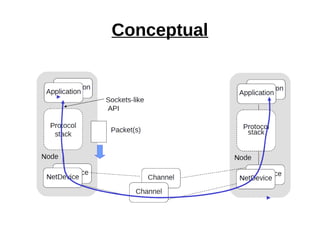
● Basic Components
– Nodes
– Net Device
– Channels
– Application
– Protocol Stack
Conceptual
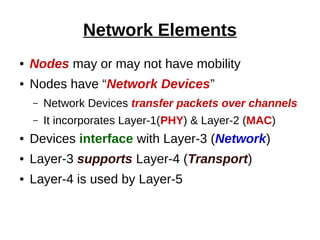
Network Elements
● Nodes may or may not have mobility
● Nodes have “Network Devices”
– Network Devices transfer packets over channels
– It incorporates Layer-1(PHY) & Layer-2 (MAC)
● Devices interface with Layer-3 (Network)
● Layer-3 supports Layer-4 (Transport)
● Layer-4 is used by Layer-5
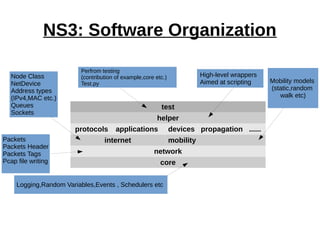
NS3: Software Organization
test
helper
protocols applications devices propagation ......
internet mobility
network
core
High-level wrappers
Aimed at scripting Mobility models
(static,random
walk etc)
Node Class
NetDevice
Address types
(IPv4,MAC etc.)
Queues
Sockets
Logging,Random Variables,Events , Schedulers etc
Perfrom testing
(contribution of example,core etc.)
Test.py
Packets
Packets Header
Packets Tags
Pcap file writing
Interface:NS3
● Folder sturture
– model/ - contains source code for main part of
mudule
– helper/ - contains code for helper classes
– examples/ - contains topology example related to
module
– bindings/ - files related to phython
– wscript – the “Makefile” equivalent
– doc/ - document API of the module
NS3-Implementation
Node
Protocol
Stack
NODE
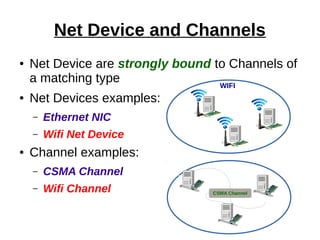
Net Device and Channels
● Net Device are strongly bound to Channels of
a matching type
● Net Devices examples:
– Ethernet NIC
– Wifi Net Device
● Channel examples:
– CSMA Channel
– Wifi Channel
`
`
`
WIFI
CSMA Channel
Net Device and Channel
● Point-to-point – PPP link
● CSMA – Ethernet link
● Wifi – 802.11 link
– Infrastructure and Ad-hoc
● and , many more
Routing
● Optimized Link State Routing (OLSR)
● Ad hoc On Demand Distance Vector (AODV)
● Destination Sequenced Distance Vector (DSDV)
● Dynamic Source Routing (DSR)
● Ipv4GlobalRouting – used to store routes
computed by the global route manager
● and , few more
Application(Traffic Generator)
● Bulk-Send – Send data as fast as possible
– BulkSendApplication
● On-Off – On off pattern
– OnOffApplication
● Udp-Server – Receive UDP packets
– UdpServer , UdpServerHelper
● UDP-Client – UDP packet with seq no and time stamp
– UdpClient , UdpClientHelper
● V4ping – Sends one ICMP ECHO request , report the RTT
ping6
– V4ping , V4pingHelper
Helper Classes
● It provides a set of classes and methods that
make common operations easier than using the
low-level API
● Absence of Helper:Simulation program will be
quite long and tedious
● Contains :
– Container classes
– Helper classes
● It is implemented using the low-level API
Main Program Structure
● Include HEADER files
● Include NAMESPACE
● Enable /disable LOGGING
● Create NODE
● Configure TOPOLOGY for Nodes
● Set up INTERNET STACK
● Set up APPLICATION
● Run SIMULATION
Example Script-1
/* -*- Mode:C++; c-file-style:"gnu"; indent-tabs-mode:nil; -*- */
// GPLv2 Licence …
#include "ns3/core-module.h"
#include "ns3/network-module.h"
#include "ns3/internet-module.h"
#include "ns3/point-to-point-module.h"
#include "ns3/applications-module.h"
using namespace ns3;
NS_LOG_COMPONENT_DEFINE ("FirstScriptExample");
int main (int argc, char *argv[])
{
LogComponentEnable ("UdpEchoClientApplication", LOG_LEVEL_INFO);
LogComponentEnable ("UdpEchoServerApplication", LOG_LEVEL_INFO);
NodeContainer nodes;
nodes.Create (2);
PointToPointHelper pointToPoint;
pointToPoint.SetDeviceAttribute ("DataRate", StringValue ("5Mbps"));
pointToPoint.SetChannelAttribute ("Delay", StringValue ("2ms"));
NetDeviceContainer devices;
devices = pointToPoint.Install (nodes);
include modules that
will be used
ns-3 project namespace
enable and disable console message
logging by reference to the name
Topology Configuration
Create Node
1
2
3
4
5
Example Script-1
InternetStackHelper stack;
stack.Install (nodes);
Ipv4AddressHelper address;
address.SetBase ("10.1.1.0", "255.255.255.0");
Ipv4InterfaceContainer interfaces = address.Assign (devices);
UdpEchoServerHelper echoServer (9);
ApplicationContainer serverApps = echoServer.Install (nodes.Get (1));
serverApps.Start (Seconds (1.0));
serverApps.Stop (Seconds (10.0));
UdpEchoClientHelper echoClient (interfaces.GetAddress (1), 9);
echoClient.SetAttribute ("MaxPackets", UintegerValue (1));
echoClient.SetAttribute ("Interval", TimeValue (Seconds (1.0)));
echoClient.SetAttribute ("PacketSize", UintegerValue (1024));
ApplicationContainer clientApps = echoClient.Install (nodes.Get (0));
clientApps.Start (Seconds (2.0));
clientApps.Stop (Seconds (10.0));
Simulator::Run ();
Simulator::Destroy ();
return 0;
}
Set up internet stack
Set up applications
Run the simulation
6
8
9
Running Example
● Copy program from example to scratch
folder
● And run using following commands
● ./waf –run /scratch/first
To be Continued...

NS3 Overview

  • 1.
  • 2.
    Components ● Basic Components –Nodes – Net Device – Channels – Application – Protocol Stack
  • 3.
  • 4.
    Network Elements ● Nodesmay or may not have mobility ● Nodes have “Network Devices” – Network Devices transfer packets over channels – It incorporates Layer-1(PHY) & Layer-2 (MAC) ● Devices interface with Layer-3 (Network) ● Layer-3 supports Layer-4 (Transport) ● Layer-4 is used by Layer-5
  • 5.
    NS3: Software Organization test helper protocolsapplications devices propagation ...... internet mobility network core High-level wrappers Aimed at scripting Mobility models (static,random walk etc) Node Class NetDevice Address types (IPv4,MAC etc.) Queues Sockets Logging,Random Variables,Events , Schedulers etc Perfrom testing (contribution of example,core etc.) Test.py Packets Packets Header Packets Tags Pcap file writing
  • 6.
    Interface:NS3 ● Folder sturture –model/ - contains source code for main part of mudule – helper/ - contains code for helper classes – examples/ - contains topology example related to module – bindings/ - files related to phython – wscript – the “Makefile” equivalent – doc/ - document API of the module
  • 7.
  • 8.
    Net Device andChannels ● Net Device are strongly bound to Channels of a matching type ● Net Devices examples: – Ethernet NIC – Wifi Net Device ● Channel examples: – CSMA Channel – Wifi Channel ` ` ` WIFI CSMA Channel
  • 9.
    Net Device andChannel ● Point-to-point – PPP link ● CSMA – Ethernet link ● Wifi – 802.11 link – Infrastructure and Ad-hoc ● and , many more
  • 10.
    Routing ● Optimized LinkState Routing (OLSR) ● Ad hoc On Demand Distance Vector (AODV) ● Destination Sequenced Distance Vector (DSDV) ● Dynamic Source Routing (DSR) ● Ipv4GlobalRouting – used to store routes computed by the global route manager ● and , few more
  • 11.
    Application(Traffic Generator) ● Bulk-Send– Send data as fast as possible – BulkSendApplication ● On-Off – On off pattern – OnOffApplication ● Udp-Server – Receive UDP packets – UdpServer , UdpServerHelper ● UDP-Client – UDP packet with seq no and time stamp – UdpClient , UdpClientHelper ● V4ping – Sends one ICMP ECHO request , report the RTT ping6 – V4ping , V4pingHelper
  • 12.
    Helper Classes ● Itprovides a set of classes and methods that make common operations easier than using the low-level API ● Absence of Helper:Simulation program will be quite long and tedious ● Contains : – Container classes – Helper classes ● It is implemented using the low-level API
  • 13.
    Main Program Structure ●Include HEADER files ● Include NAMESPACE ● Enable /disable LOGGING ● Create NODE ● Configure TOPOLOGY for Nodes ● Set up INTERNET STACK ● Set up APPLICATION ● Run SIMULATION
  • 14.
    Example Script-1 /* -*-Mode:C++; c-file-style:"gnu"; indent-tabs-mode:nil; -*- */ // GPLv2 Licence … #include "ns3/core-module.h" #include "ns3/network-module.h" #include "ns3/internet-module.h" #include "ns3/point-to-point-module.h" #include "ns3/applications-module.h" using namespace ns3; NS_LOG_COMPONENT_DEFINE ("FirstScriptExample"); int main (int argc, char *argv[]) { LogComponentEnable ("UdpEchoClientApplication", LOG_LEVEL_INFO); LogComponentEnable ("UdpEchoServerApplication", LOG_LEVEL_INFO); NodeContainer nodes; nodes.Create (2); PointToPointHelper pointToPoint; pointToPoint.SetDeviceAttribute ("DataRate", StringValue ("5Mbps")); pointToPoint.SetChannelAttribute ("Delay", StringValue ("2ms")); NetDeviceContainer devices; devices = pointToPoint.Install (nodes); include modules that will be used ns-3 project namespace enable and disable console message logging by reference to the name Topology Configuration Create Node 1 2 3 4 5
  • 15.
    Example Script-1 InternetStackHelper stack; stack.Install(nodes); Ipv4AddressHelper address; address.SetBase ("10.1.1.0", "255.255.255.0"); Ipv4InterfaceContainer interfaces = address.Assign (devices); UdpEchoServerHelper echoServer (9); ApplicationContainer serverApps = echoServer.Install (nodes.Get (1)); serverApps.Start (Seconds (1.0)); serverApps.Stop (Seconds (10.0)); UdpEchoClientHelper echoClient (interfaces.GetAddress (1), 9); echoClient.SetAttribute ("MaxPackets", UintegerValue (1)); echoClient.SetAttribute ("Interval", TimeValue (Seconds (1.0))); echoClient.SetAttribute ("PacketSize", UintegerValue (1024)); ApplicationContainer clientApps = echoClient.Install (nodes.Get (0)); clientApps.Start (Seconds (2.0)); clientApps.Stop (Seconds (10.0)); Simulator::Run (); Simulator::Destroy (); return 0; } Set up internet stack Set up applications Run the simulation 6 8 9
  • 16.
    Running Example ● Copyprogram from example to scratch folder ● And run using following commands ● ./waf –run /scratch/first
  • 17.