Communication Skills – An Introduction
Basic Questionnaire
1. Why are you here?
2. What are your goals?
3. How do you plan to achieve them?
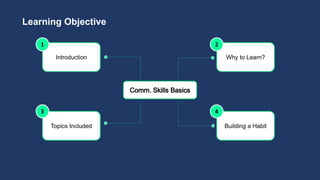
Introduction Why to Learn?
Building a Habit
Topics Included
Learning Objective
Introduction
 One of the most common or widely used training programs or workshops is often based on Effective
Communication Skills.
 Communication Skill is the art and technique of communicating by using Oral and Body Language to persuade
someone or simply express some kind of information.
 We think of Comm Skills as art of speaking, but remember that following skills are included into it, they are–
 Listening Skills
 Body Language
 Emotional Intelligence
 Writing Skills, and many more.
 The act of communicating verbally is the basis of how we relate with others, using a language media.
 Effective communication does not mean that how proficient you are with a language, but it means, how
proficient you are in conveying the right intention or right information to other person.
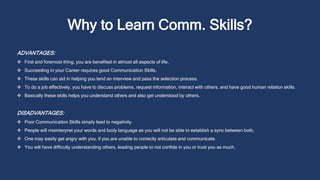
Why to Learn Comm. Skills?
ADVANTAGES:
 First and foremost thing, you are benefited in almost all aspects of life.
 Succeeding in your Career requires good Communication Skills.
 These skills can aid in helping you land an interview and pass the selection process.
 To do a job effectively, you have to discuss problems, request information, interact with others, and have good human relation skills.
 Basically these skills helps you understand others and also get understood by others.
DISADVANTAGES:
 Poor Communication Skills simply lead to negativity.
 People will misinterpret your words and body language as you will not be able to establish a sync between both.
 One may easily get angry with you, if you are unable to correctly articulate and communicate.
 You will have difficulty understanding others, leading people to not confide in you or trust you as much.
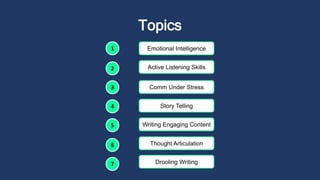
Topics
Emotional Intelligence
Active Listening Skills
Comm Under Stress
Story Telling
Writing Engaging Content
Thought Articulation
Drooling Writing
Building Habit
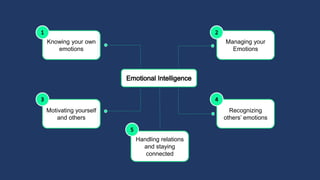
Emotional Intelligence
 Taking information from your own emotions and the
emotions of others and then applying that knowledge
in order to be successful.
 By doing this, we can get the most out of ourselves
and others.
Knowing your own
emotions
Managing your
Emotions
Recognizing
others’ emotions
Motivating yourself
and others
Handling relations
and staying
connected
Knowing your own Emotions – Self Awareness
Previous emotional experiences influence our
decision making so it is important to be aware
of all our emotions if we want to avoid any
negative cycles and, instead, make better
decisions.
Managing your Emotions
Once we can recognize these emotions, we
can use this knowledge and develop
strategies and responses to manage our
emotions. This is true of the three main
triggers to potentially negative outcomes:
anger, anxiety and sadness.
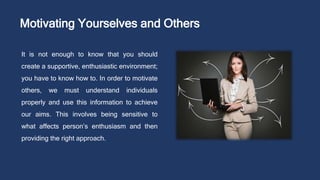
Motivating Yourselves and Others
It is not enough to know that you should
create a supportive, enthusiastic environment;
you have to know how to. In order to motivate
others, we must understand individuals
properly and use this information to achieve
our aims. This involves being sensitive to
what affects person’s enthusiasm and then
providing the right approach.
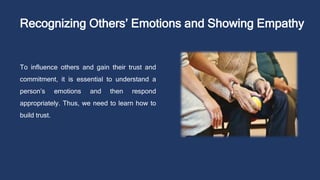
Recognizing Others’ Emotions and Showing Empathy
To influence others and gain their trust and
commitment, it is essential to understand a
person’s emotions and then respond
appropriately. Thus, we need to learn how to
build trust.
Handling Relations and Staying Connected
Whenever we relate to someone, there is an
emotional transaction that passes between
individuals. These interactions have an effect:
they make us feel better or worse. This
creates a secret economy that is a key to
motivate people – a key that we can use to
develop better relations.
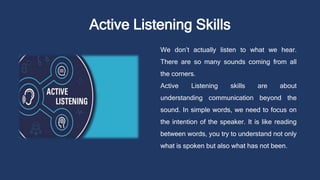
Active Listening Skills
We don’t actually listen to what we hear.
There are so many sounds coming from all
the corners.
Active Listening skills are about
understanding communication beyond the
sound. In simple words, we need to focus on
the intention of the speaker. It is like reading
between words, you try to understand not only
what is spoken but also what has not been.
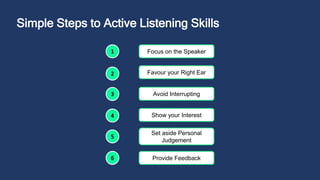
Simple Steps to Active Listening Skills
Focus on the Speaker
Favour your Right Ear
Avoid Interrupting
Show your Interest
Set aside Personal
Judgement
Provide Feedback
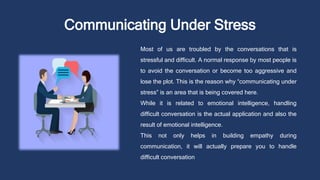
Communicating Under Stress
Most of us are troubled by the conversations that is
stressful and difficult. A normal response by most people is
to avoid the conversation or become too aggressive and
lose the plot. This is the reason why “communicating under
stress” is an area that is being covered here.
While it is related to emotional intelligence, handling
difficult conversation is the actual application and also the
result of emotional intelligence.
This not only helps in building empathy during
communication, it will actually prepare you to handle
difficult conversation
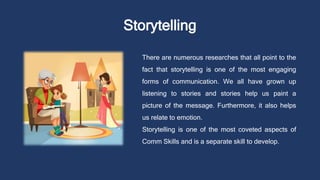
Storytelling
There are numerous researches that all point to the
fact that storytelling is one of the most engaging
forms of communication. We all have grown up
listening to stories and stories help us paint a
picture of the message. Furthermore, it also helps
us relate to emotion.
Storytelling is one of the most coveted aspects of
Comm Skills and is a separate skill to develop.
How to tell a Story Effectively?
Choose a CLEAR Central Message:
A great story usually progresses towards a central moral or
message. When crafting a story, you should have a definite idea of
what you’re building toward. If you are telling a story with strong
moral, you’ll need to guide listeners or readers to that message. If
you’re telling a funny story, then simply you need to add twists and
funny components to your story.
Embrace Conflict:
As a Storyteller, you can’t shy away from the conflict. Great
storytellers craft narratives that have all sorts of obstacles and
hardships strewn in the path of their protagonists. In order to be
satisfied with a happy ending, audiences have to watch the main
characters struggle to achieve their goals. It’s ok to be cruel to your
main characters – in fact, it’s necessary.
Have a CLEAR Structure:
There are many different ways to structure a story, but the three
ingredients a story must have are a beginning, middle and an end.
On a more granular level, a successful story will start with an
inciting incident, lead into a rising action, build to a climax and
ultimately settle into a satisfying resolution. Additional insights into
story structure can be gleaned by exposing yourself to great
storytellers in literature and practicing laying out your own stories
on paper so you can observe its shape and structure.
Mine your Personal Experiences:
Whether or not you are telling a real story directly based on
personal experience, you can always look to your life for
inspiration when coming up with new stories. Think about
important experiences in your real life and how you might be able
to craft them into narratives.
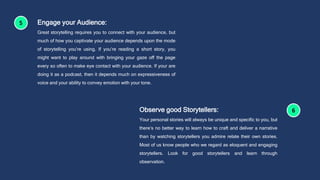
Engage your Audience:
Great storytelling requires you to connect with your audience, but
much of how you captivate your audience depends upon the mode
of storytelling you’re using. If you’re reading a short story, you
might want to play around with bringing your gaze off the page
every so often to make eye contact with your audience. If your are
doing it as a podcast, then it depends much on expressiveness of
voice and your ability to convey emotion with your tone.
Observe good Storytellers:
Your personal stories will always be unique and specific to you, but
there’s no better way to learn how to craft and deliver a narrative
than by watching storytellers you admire relate their own stories.
Most of us know people who we regard as eloquent and engaging
storytellers. Look for good storytellers and learn through
observation.
Narrow the Scope of your story:
If you’re telling a true story from your own life, it can be hard to
choose the important main points that you should include. Many
people have a tendency to include every detail and end up
inundating their audience with facts that dilute the central story arc.
Choose a clear beginning and end to your story, then write the key
plot events as bullet points between them. Trust that your audience
will be able to follow your story, and don’t overwhelm them with
unnecessary backstory or tangential plot points.
Writing Engaging Content
Most often we ignore the importance of writing
great content in communication skills. The
content that you create should always make
readers want to read it, and your content
should be designed with this question in mind:
“Does this content connect with people and
encourage then to engage?”
There are various tips and tricks using which
we can achieve the desired goal.
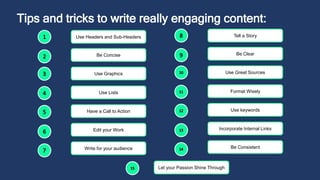
Tips and tricks to write really engaging content:
Use Headers and Sub-Headers
Be Concise
Use Graphics
Use Lists
Have a Call to Action
Edit your Work
Write for your audience
Tell a Story
Be Clear
Use Great Sources
Format Wisely
Use keywords
Incorporate Internal Links
Be Consistent
Let your Passion Shine Through
Thought Articulation
Literal meaning of “Articulation” is that, how efficiently one is
able to express his/her thoughts and ideas easily and well.
Being articulate is nothing more than being able to express
your ideas and thoughts in a way that people understand
exactly what you’re trying to say.
The problem we face here is, thoughts are often complex as
a result of having spend years going thorough unique life
experiences and refine them. So, while thoughts are clear
inside your heads, it is common to have trouble putting
those well-aged thoughts into words.
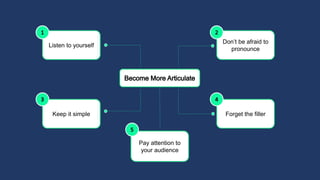
Listen to yourself
Don’t be afraid to
pronounce
Forget the filler
Keep it simple
Pay attention to
your audience
Listen to yourself:
Even if you hate the sound of your own voice, one way to become
a better communicator is to record how you participate in
conversations. Do you speak in many run-on sentences? Go off on
a lot of tangents? Are you hard to understand? Identify your
problem areas by listening to yourself so you can fix them.
Don’t be afraid to pronounce:
One bad habit that can get in the way of powerful speech is
mumbling. Fully pronounce each syllable to prevent trailing off
when speaking; doing so also slows you down and gives
audiences more time to understand your thoughts.
Keep it simple:
If you have a lot to say, it’s OK to use simple sentence structures
when speaking. Speaking in long, winding sentences will lose the
attention of your audience, and can even make you forget what
you wanted to say in first place.
Forget the filler:
One sure way to sound less articulate is to overuse filler words
such as “um”, “uh”, and “like”. These words indicate to your
audience that you are unsure of your direction. As leadership
experts believe, rather than these filler words, consider using “Let’s
move on to…” or “Another important consideration is…” or “Let’s
transition to talking about…” as replacements.
Pay attention to your audience:
Here’s a tip not many know: Your audience will play a consistent
role in how you speak. Keep listeners interested in what you have
to say by studying their attention levels. Speed up your speech if
your audience already understands what you’re saying, or speak at
the same vocabulary level as listeners. You can even vary how
high or low your voice is in order to keep audiences interested.
Writing Winning Proposals
Winning a proposal is a simple matter of figuring out or
guessing what the customer wants, presenting it as their
best alternative, knowing what needs to happen for the
customer to move forward, and earning enough of their
trust that they do as you suggest.
A strong business proposal is a great opportunity to win
a new business. It is the ultimate sales document, a
condensed version of all the value your solution brings
to a client’s problem.
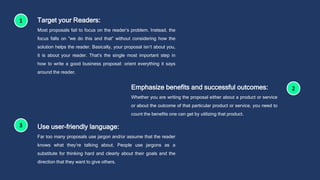
Target your Readers:
Most proposals fail to focus on the reader’s problem. Instead, the
focus falls on “we do this and that” without considering how the
solution helps the reader. Basically, your proposal isn’t about you,
it is about your reader. That’s the single most important step in
how to write a good business proposal: orient everything it says
around the reader.
Emphasize benefits and successful outcomes:
Whether you are writing the proposal either about a product or service
or about the outcome of that particular product or service, you need to
count the benefits one can get by utilizing that product.
Use user-friendly language:
Far too many proposals use jargon and/or assume that the reader
knows what they’re talking about. People use jargons as a
substitute for thinking hard and clearly about their goals and the
direction that they want to give others.
Take steps to improve your writing skills:
Proposals don’t have to be hard to write and, fortunately, proposal
writers have ample options to improve their skills. Start by reading
and analyzing other proposals both successful or not. Another
option is to get editing from a third-party specialist. You can also
take a course to get first-hand experience in honing your proposal
writing skills.

Communication Skills - An Introduction

  • 1.
    Communication Skills –An Introduction
  • 2.
    Basic Questionnaire 1. Whyare you here? 2. What are your goals? 3. How do you plan to achieve them?
  • 3.
    Introduction Why toLearn? Building a Habit Topics Included Learning Objective
  • 4.
    Introduction  One ofthe most common or widely used training programs or workshops is often based on Effective Communication Skills.  Communication Skill is the art and technique of communicating by using Oral and Body Language to persuade someone or simply express some kind of information.  We think of Comm Skills as art of speaking, but remember that following skills are included into it, they are–  Listening Skills  Body Language  Emotional Intelligence  Writing Skills, and many more.  The act of communicating verbally is the basis of how we relate with others, using a language media.  Effective communication does not mean that how proficient you are with a language, but it means, how proficient you are in conveying the right intention or right information to other person.
  • 5.
    Why to LearnComm. Skills? ADVANTAGES:  First and foremost thing, you are benefited in almost all aspects of life.  Succeeding in your Career requires good Communication Skills.  These skills can aid in helping you land an interview and pass the selection process.  To do a job effectively, you have to discuss problems, request information, interact with others, and have good human relation skills.  Basically these skills helps you understand others and also get understood by others. DISADVANTAGES:  Poor Communication Skills simply lead to negativity.  People will misinterpret your words and body language as you will not be able to establish a sync between both.  One may easily get angry with you, if you are unable to correctly articulate and communicate.  You will have difficulty understanding others, leading people to not confide in you or trust you as much.
  • 6.
    Topics Emotional Intelligence Active ListeningSkills Comm Under Stress Story Telling Writing Engaging Content Thought Articulation Drooling Writing
  • 7.
  • 8.
    Emotional Intelligence  Takinginformation from your own emotions and the emotions of others and then applying that knowledge in order to be successful.  By doing this, we can get the most out of ourselves and others.
  • 9.
    Knowing your own emotions Managingyour Emotions Recognizing others’ emotions Motivating yourself and others Handling relations and staying connected
  • 10.
    Knowing your ownEmotions – Self Awareness Previous emotional experiences influence our decision making so it is important to be aware of all our emotions if we want to avoid any negative cycles and, instead, make better decisions.
  • 11.
    Managing your Emotions Oncewe can recognize these emotions, we can use this knowledge and develop strategies and responses to manage our emotions. This is true of the three main triggers to potentially negative outcomes: anger, anxiety and sadness.
  • 12.
    Motivating Yourselves andOthers It is not enough to know that you should create a supportive, enthusiastic environment; you have to know how to. In order to motivate others, we must understand individuals properly and use this information to achieve our aims. This involves being sensitive to what affects person’s enthusiasm and then providing the right approach.
  • 13.
    Recognizing Others’ Emotionsand Showing Empathy To influence others and gain their trust and commitment, it is essential to understand a person’s emotions and then respond appropriately. Thus, we need to learn how to build trust.
  • 14.
    Handling Relations andStaying Connected Whenever we relate to someone, there is an emotional transaction that passes between individuals. These interactions have an effect: they make us feel better or worse. This creates a secret economy that is a key to motivate people – a key that we can use to develop better relations.
  • 15.
    Active Listening Skills Wedon’t actually listen to what we hear. There are so many sounds coming from all the corners. Active Listening skills are about understanding communication beyond the sound. In simple words, we need to focus on the intention of the speaker. It is like reading between words, you try to understand not only what is spoken but also what has not been.
  • 16.
    Simple Steps toActive Listening Skills Focus on the Speaker Favour your Right Ear Avoid Interrupting Show your Interest Set aside Personal Judgement Provide Feedback
  • 17.
    Communicating Under Stress Mostof us are troubled by the conversations that is stressful and difficult. A normal response by most people is to avoid the conversation or become too aggressive and lose the plot. This is the reason why “communicating under stress” is an area that is being covered here. While it is related to emotional intelligence, handling difficult conversation is the actual application and also the result of emotional intelligence. This not only helps in building empathy during communication, it will actually prepare you to handle difficult conversation
  • 18.
    Storytelling There are numerousresearches that all point to the fact that storytelling is one of the most engaging forms of communication. We all have grown up listening to stories and stories help us paint a picture of the message. Furthermore, it also helps us relate to emotion. Storytelling is one of the most coveted aspects of Comm Skills and is a separate skill to develop.
  • 19.
    How to tella Story Effectively? Choose a CLEAR Central Message: A great story usually progresses towards a central moral or message. When crafting a story, you should have a definite idea of what you’re building toward. If you are telling a story with strong moral, you’ll need to guide listeners or readers to that message. If you’re telling a funny story, then simply you need to add twists and funny components to your story. Embrace Conflict: As a Storyteller, you can’t shy away from the conflict. Great storytellers craft narratives that have all sorts of obstacles and hardships strewn in the path of their protagonists. In order to be satisfied with a happy ending, audiences have to watch the main characters struggle to achieve their goals. It’s ok to be cruel to your main characters – in fact, it’s necessary.
  • 20.
    Have a CLEARStructure: There are many different ways to structure a story, but the three ingredients a story must have are a beginning, middle and an end. On a more granular level, a successful story will start with an inciting incident, lead into a rising action, build to a climax and ultimately settle into a satisfying resolution. Additional insights into story structure can be gleaned by exposing yourself to great storytellers in literature and practicing laying out your own stories on paper so you can observe its shape and structure. Mine your Personal Experiences: Whether or not you are telling a real story directly based on personal experience, you can always look to your life for inspiration when coming up with new stories. Think about important experiences in your real life and how you might be able to craft them into narratives.
  • 21.
    Engage your Audience: Greatstorytelling requires you to connect with your audience, but much of how you captivate your audience depends upon the mode of storytelling you’re using. If you’re reading a short story, you might want to play around with bringing your gaze off the page every so often to make eye contact with your audience. If your are doing it as a podcast, then it depends much on expressiveness of voice and your ability to convey emotion with your tone. Observe good Storytellers: Your personal stories will always be unique and specific to you, but there’s no better way to learn how to craft and deliver a narrative than by watching storytellers you admire relate their own stories. Most of us know people who we regard as eloquent and engaging storytellers. Look for good storytellers and learn through observation.
  • 22.
    Narrow the Scopeof your story: If you’re telling a true story from your own life, it can be hard to choose the important main points that you should include. Many people have a tendency to include every detail and end up inundating their audience with facts that dilute the central story arc. Choose a clear beginning and end to your story, then write the key plot events as bullet points between them. Trust that your audience will be able to follow your story, and don’t overwhelm them with unnecessary backstory or tangential plot points.
  • 23.
    Writing Engaging Content Mostoften we ignore the importance of writing great content in communication skills. The content that you create should always make readers want to read it, and your content should be designed with this question in mind: “Does this content connect with people and encourage then to engage?” There are various tips and tricks using which we can achieve the desired goal.
  • 24.
    Tips and tricksto write really engaging content: Use Headers and Sub-Headers Be Concise Use Graphics Use Lists Have a Call to Action Edit your Work Write for your audience Tell a Story Be Clear Use Great Sources Format Wisely Use keywords Incorporate Internal Links Be Consistent Let your Passion Shine Through
  • 25.
    Thought Articulation Literal meaningof “Articulation” is that, how efficiently one is able to express his/her thoughts and ideas easily and well. Being articulate is nothing more than being able to express your ideas and thoughts in a way that people understand exactly what you’re trying to say. The problem we face here is, thoughts are often complex as a result of having spend years going thorough unique life experiences and refine them. So, while thoughts are clear inside your heads, it is common to have trouble putting those well-aged thoughts into words.
  • 26.
    Listen to yourself Don’tbe afraid to pronounce Forget the filler Keep it simple Pay attention to your audience
  • 27.
    Listen to yourself: Evenif you hate the sound of your own voice, one way to become a better communicator is to record how you participate in conversations. Do you speak in many run-on sentences? Go off on a lot of tangents? Are you hard to understand? Identify your problem areas by listening to yourself so you can fix them. Don’t be afraid to pronounce: One bad habit that can get in the way of powerful speech is mumbling. Fully pronounce each syllable to prevent trailing off when speaking; doing so also slows you down and gives audiences more time to understand your thoughts. Keep it simple: If you have a lot to say, it’s OK to use simple sentence structures when speaking. Speaking in long, winding sentences will lose the attention of your audience, and can even make you forget what you wanted to say in first place.
  • 28.
    Forget the filler: Onesure way to sound less articulate is to overuse filler words such as “um”, “uh”, and “like”. These words indicate to your audience that you are unsure of your direction. As leadership experts believe, rather than these filler words, consider using “Let’s move on to…” or “Another important consideration is…” or “Let’s transition to talking about…” as replacements. Pay attention to your audience: Here’s a tip not many know: Your audience will play a consistent role in how you speak. Keep listeners interested in what you have to say by studying their attention levels. Speed up your speech if your audience already understands what you’re saying, or speak at the same vocabulary level as listeners. You can even vary how high or low your voice is in order to keep audiences interested.
  • 29.
    Writing Winning Proposals Winninga proposal is a simple matter of figuring out or guessing what the customer wants, presenting it as their best alternative, knowing what needs to happen for the customer to move forward, and earning enough of their trust that they do as you suggest. A strong business proposal is a great opportunity to win a new business. It is the ultimate sales document, a condensed version of all the value your solution brings to a client’s problem.
  • 30.
    Target your Readers: Mostproposals fail to focus on the reader’s problem. Instead, the focus falls on “we do this and that” without considering how the solution helps the reader. Basically, your proposal isn’t about you, it is about your reader. That’s the single most important step in how to write a good business proposal: orient everything it says around the reader. Emphasize benefits and successful outcomes: Whether you are writing the proposal either about a product or service or about the outcome of that particular product or service, you need to count the benefits one can get by utilizing that product. Use user-friendly language: Far too many proposals use jargon and/or assume that the reader knows what they’re talking about. People use jargons as a substitute for thinking hard and clearly about their goals and the direction that they want to give others.
  • 31.
    Take steps toimprove your writing skills: Proposals don’t have to be hard to write and, fortunately, proposal writers have ample options to improve their skills. Start by reading and analyzing other proposals both successful or not. Another option is to get editing from a third-party specialist. You can also take a course to get first-hand experience in honing your proposal writing skills.