



THE ART OF DEBATING
GAVIN SUSS
What is Debating?
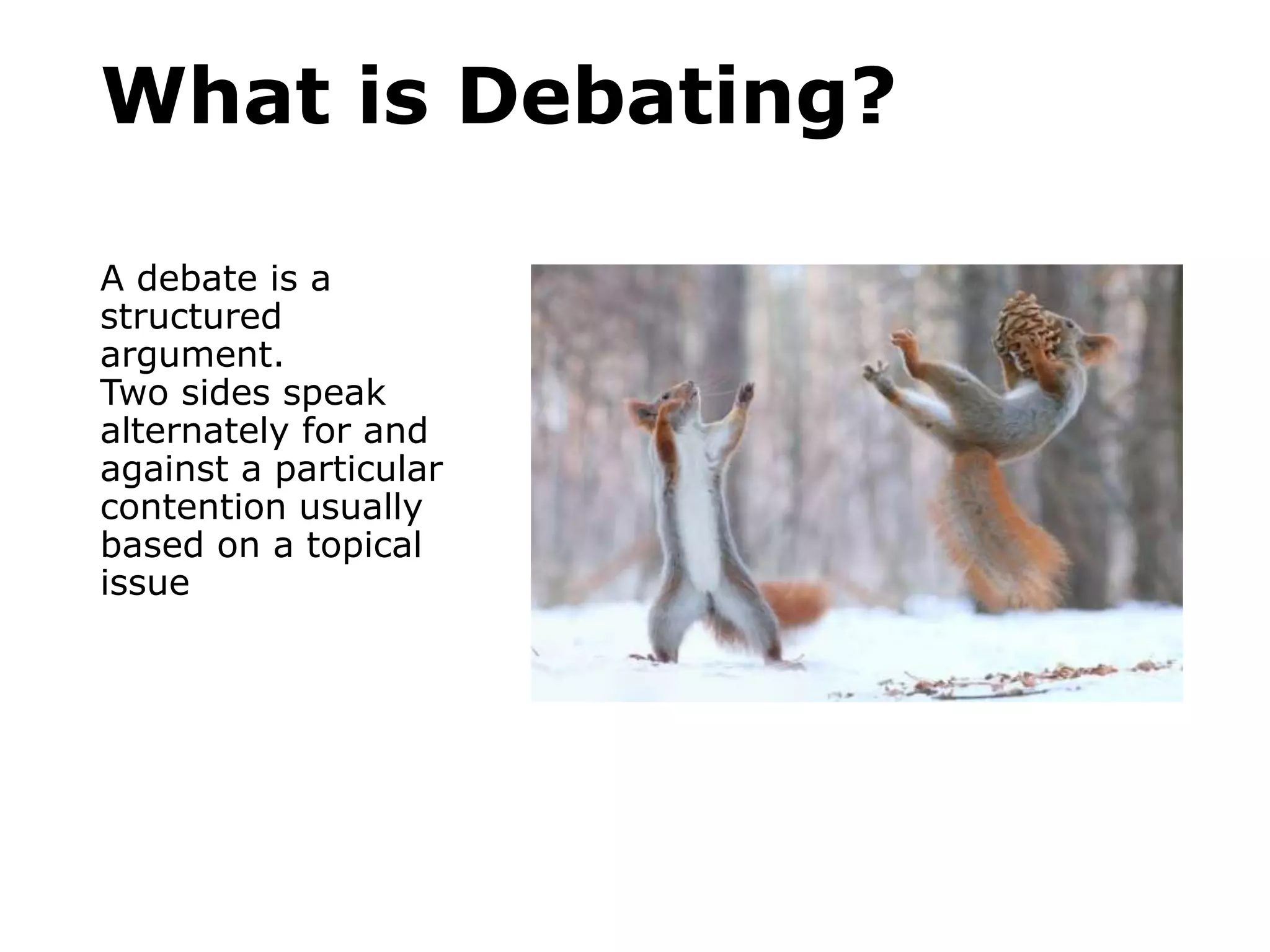
A debate is a
structured
argument.
Two sides speak
alternately for and
against a particular
contention usually
based on a topical
issue
Debate is, above all, a way for
those who hold opposing views
to discuss controversial issues
without descending to insult,
emotional appeals or personal
bias
Why debate?
It is an excellent way of
improving speaking skills and
is particularly helpful in
providing experience in
developing a convincing
argument. Those of you who
are forced to argue against
your natural point of view
realize that arguments, like
coins, always have at least
two sides.
2016 Best
Moments
Rabbi Shmuley Boteach
Prof’ Alan
Dershowitz
https://www.youtube.co
m/watch?v=5jqXEzplxeo
The Basic Debating Skills
Research all
information
around "the
point"
Style is the manner in which
you communicate your
arguments. This is the most
basic part of debating to
master. Content and strategy
are worth little unless you
deliver your material in a
confident and persuasive way
Speed
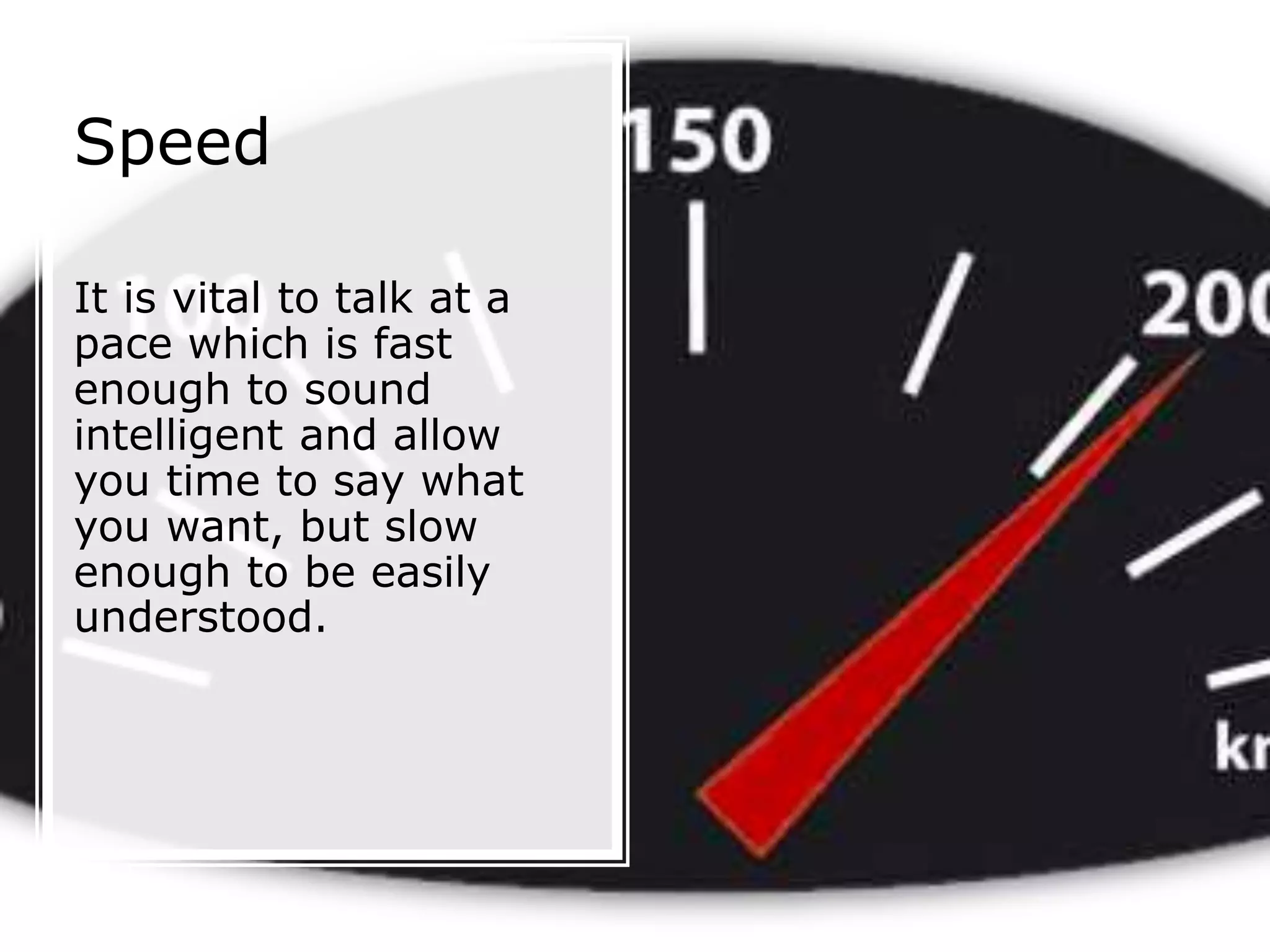
It is vital to talk at a
pace which is fast
enough to sound
intelligent and allow
you time to say what
you want, but slow
enough to be easily
understood.
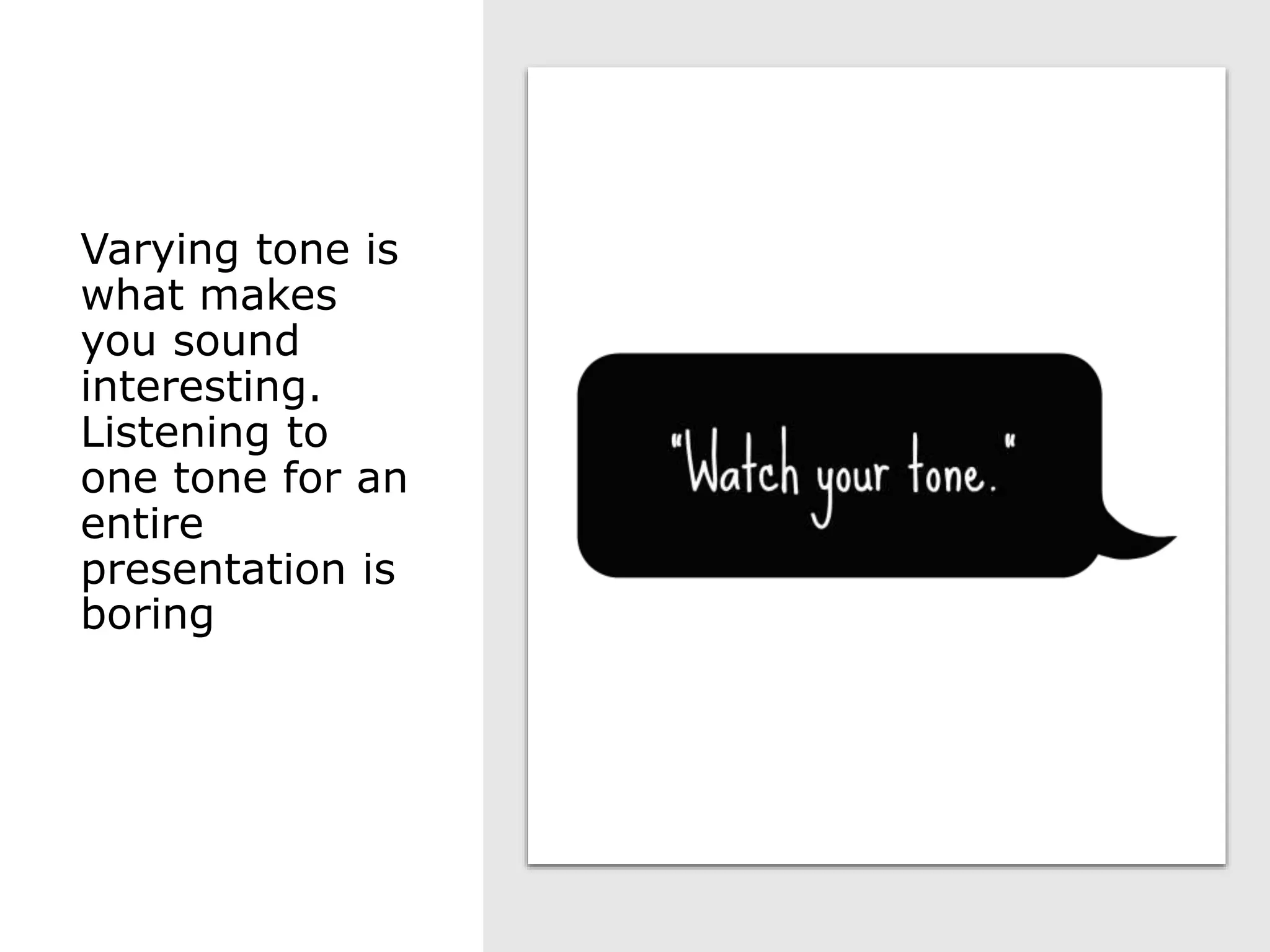
Varying tone is
what makes
you sound
interesting.
Listening to
one tone for an
entire
presentation is
boring
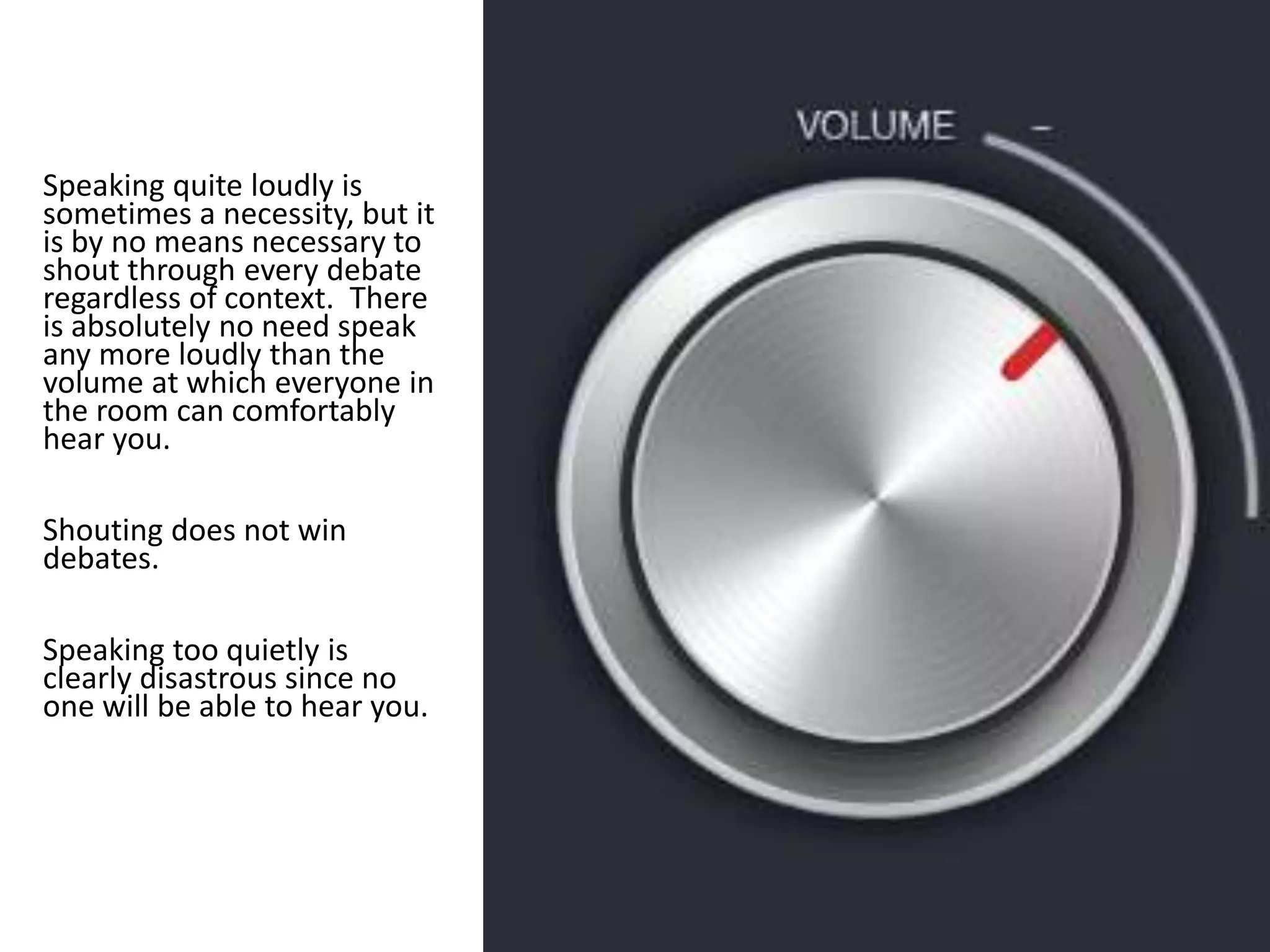
Speaking quite loudly is
sometimes a necessity, but it
is by no means necessary to
shout through every debate
regardless of context. There
is absolutely no need speak
any more loudly than the
volume at which everyone in
the room can comfortably
hear you.
Shouting does not win
debates.
Speaking too quietly is
clearly disastrous since no
one will be able to hear you.
The ability to concisely and
clearly express complex
issues is what debating is
all about. The main reason
people begin to sound
unclear is usually because
they lose the “stream of
thought” which is keeping
them going. It is also
important to keep it simple.
While long words may
make you sound clever,
they may also make you
incomprehensible.
Use of notes and
eye contact
Notes are essential, but
they must be brief and
well organized to be
effective. There is
absolutely no point in
trying to speak without
notes.
Eye contact with the
audience is very
important, but keep
shifting your gaze. No one
likes to be stared at.
It’s like a formula
Like an essay, a debate point
is a formulaic. It has an
introduction, evidence, and a
conclusion. The main
difference is that most
debates are oral
Content
Content is what you
actually say in the
debate. The arguments
used to develop your
own side’s case and
rebut the opposite side’s
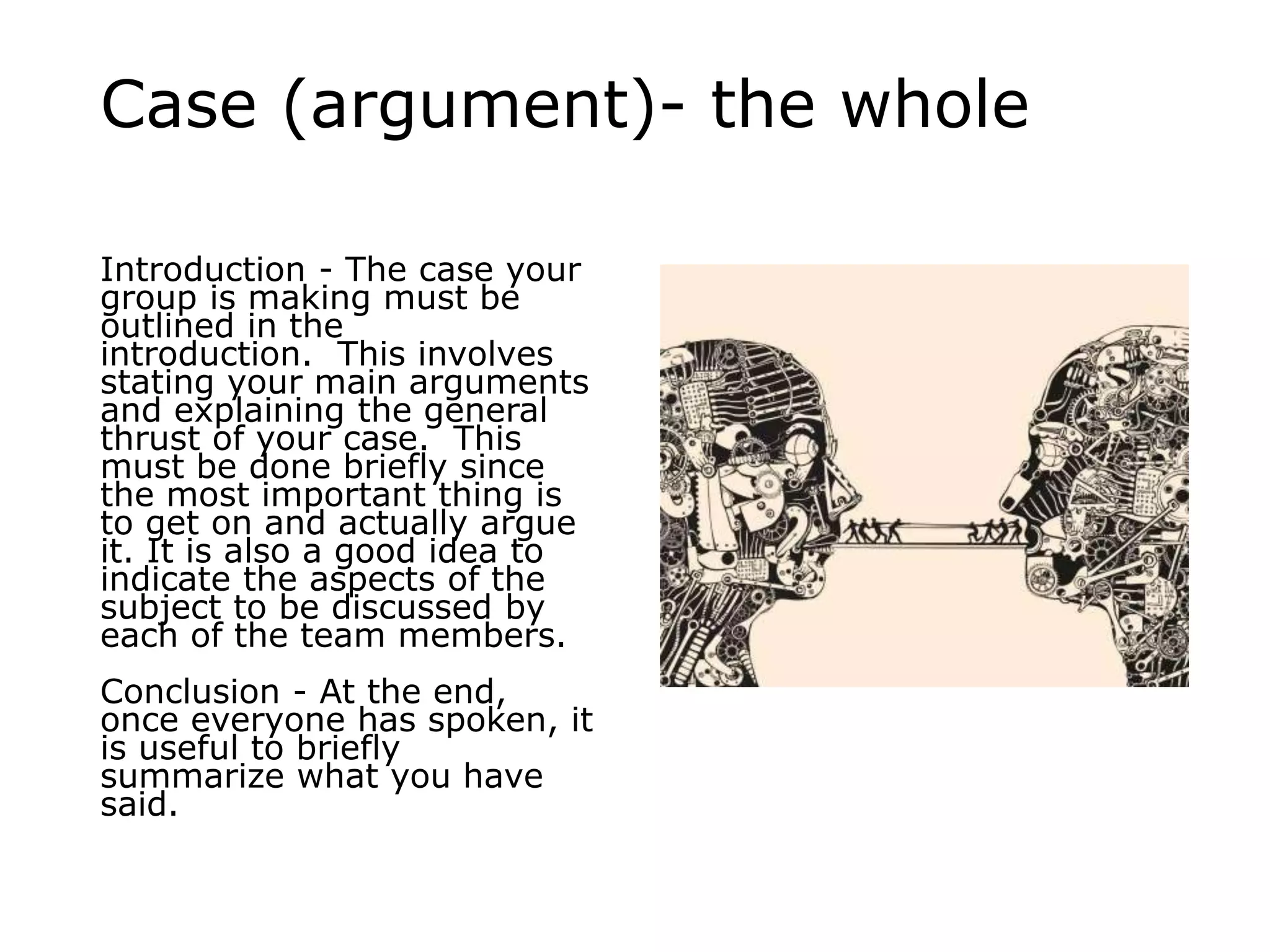
Case (argument)- the whole
Introduction - The case your
group is making must be
outlined in the
introduction. This involves
stating your main arguments
and explaining the general
thrust of your case. This
must be done briefly since
the most important thing is
to get on and actually argue
it. It is also a good idea to
indicate the aspects of the
subject to be discussed by
each of the team members.
Conclusion - At the end,
once everyone has spoken, it
is useful to briefly
summarize what you have
said.
Strategy
The best way to do this is to
divide your case into between
two and four arguments (or
divide your case based on the
number of people in your
group). You must justify your
arguments with basic logic,
worked examples, statistics, and
quotes. Debating is all about
the strategy of “proof”. Proof,
or evidence, supporting your
assertion is what makes it an
argument.
Understand the other
person's position
Ask them to clarify any
confusing areas. If you're not
sure about what their argument
is, help them out in a non-
threatening way: "So, if I
understand what you're saying,
you mean that the penny should
be abolished because it costs
more than a penny to produce a
penny?
Spot logical fallacies
When someone makes an argument that isn't
sound in structure, catch it and gently correct it.
Common logical fallacies include slippery slope
arguments, circular reasoning, and ad hominem
attacks.
Say your interlocutor says, "If we let war refugees
into our country then pretty soon we'll have to let
anyone suffering a manmade disaster into our
country and then we'll have to let in anyone
suffering a natural disaster and then we'll have to
let in anyone who is suffering in any way at all and
then our country will be completely
overwhelmed!"
You might respond, "I understand that concern,
but I think there's a flaw in your logic. One thing
doesn't necessarily lead to another—saying so is a
slippery slope fallacy."
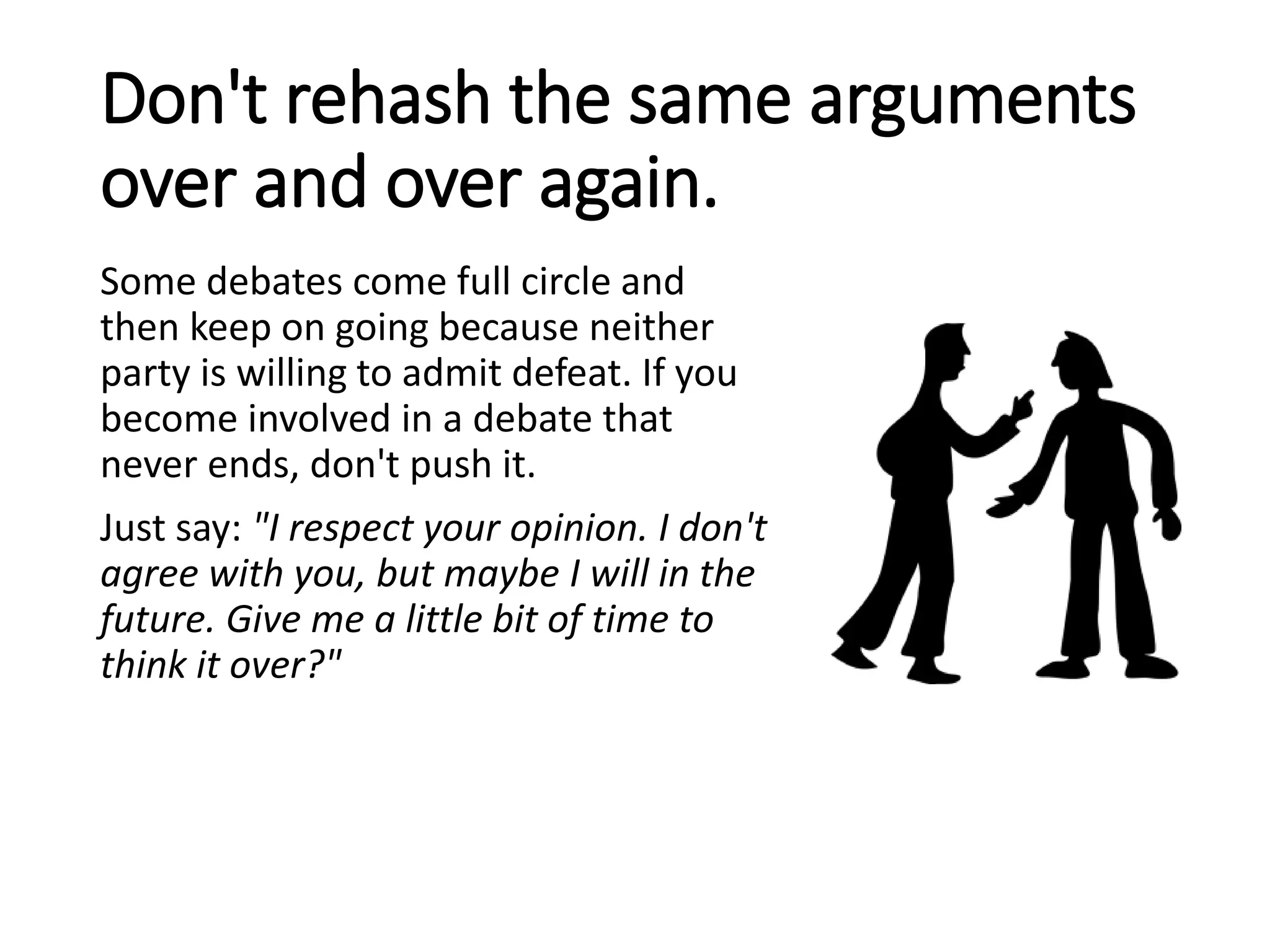
Don't rehash the same arguments
over and over again.
Some debates come full circle and
then keep on going because neither
party is willing to admit defeat. If you
become involved in a debate that
never ends, don't push it.
Just say: "I respect your opinion. I don't
agree with you, but maybe I will in the
future. Give me a little bit of time to
think it over?"
Wrap things up
amicably.
No one will want to debate
you if you're a sore loser or if
you refuse to treat your
sparring partner with respect.
However heated the debate
might have been, try to be
friendly as you wrap things up.
You may disagree with
someone, but that doesn't
mean you can't be friends
Present your argument with
feeling.
Be passionate in your
speech—a monotone
voice will cause people to
drift off, and they may
miss the point of what
you're trying to say.
Speak clearly, slowly, and
loudly. Make eye contact
with whomever decides
the winners of the
debate. (While it's okay
to look at your
opponents every once in
a while, try to direct your
argument at the judge.)
Use up all your time (or most of it).
The more you talk, the more
you'll convince (the judge).
Note that this means you
should come up with many
examples, not that you
should ramble. The more
the judge/audience hears
about why you are correct,
the more inclined s/he will
be to believe you
Dress
appropriately
Have notes prepared. You do
not want your debate to be
an oral presentation of a
written essay.
Practice speaking
aloud in front of a
mirror and then in
front of other
people
Understand both sides of the
debate so that you are
prepared to contradict the
other side.
Be ready to
concede small
points. It does
not matter if
you lose many
little battles, so
long as you win
the war.
You do this by appearing
confident, disproving the
opponent's point, and
overpowering your points
The Art of Debating?

The Art of Debating?

  • 1.
    THE ART OFDEBATING GAVIN SUSS
  • 2.
    What is Debating? Adebate is a structured argument. Two sides speak alternately for and against a particular contention usually based on a topical issue
  • 3.
    Debate is, aboveall, a way for those who hold opposing views to discuss controversial issues without descending to insult, emotional appeals or personal bias
  • 4.
    Why debate? It isan excellent way of improving speaking skills and is particularly helpful in providing experience in developing a convincing argument. Those of you who are forced to argue against your natural point of view realize that arguments, like coins, always have at least two sides.
  • 5.
  • 6.
  • 8.
  • 9.
  • 10.
  • 11.
    Style is themanner in which you communicate your arguments. This is the most basic part of debating to master. Content and strategy are worth little unless you deliver your material in a confident and persuasive way
  • 12.
    Speed It is vitalto talk at a pace which is fast enough to sound intelligent and allow you time to say what you want, but slow enough to be easily understood.
  • 13.
    Varying tone is whatmakes you sound interesting. Listening to one tone for an entire presentation is boring
  • 14.
    Speaking quite loudlyis sometimes a necessity, but it is by no means necessary to shout through every debate regardless of context. There is absolutely no need speak any more loudly than the volume at which everyone in the room can comfortably hear you. Shouting does not win debates. Speaking too quietly is clearly disastrous since no one will be able to hear you.
  • 15.
    The ability toconcisely and clearly express complex issues is what debating is all about. The main reason people begin to sound unclear is usually because they lose the “stream of thought” which is keeping them going. It is also important to keep it simple. While long words may make you sound clever, they may also make you incomprehensible.
  • 16.
    Use of notesand eye contact Notes are essential, but they must be brief and well organized to be effective. There is absolutely no point in trying to speak without notes. Eye contact with the audience is very important, but keep shifting your gaze. No one likes to be stared at.
  • 17.
    It’s like aformula Like an essay, a debate point is a formulaic. It has an introduction, evidence, and a conclusion. The main difference is that most debates are oral
  • 18.
    Content Content is whatyou actually say in the debate. The arguments used to develop your own side’s case and rebut the opposite side’s
  • 19.
    Case (argument)- thewhole Introduction - The case your group is making must be outlined in the introduction. This involves stating your main arguments and explaining the general thrust of your case. This must be done briefly since the most important thing is to get on and actually argue it. It is also a good idea to indicate the aspects of the subject to be discussed by each of the team members. Conclusion - At the end, once everyone has spoken, it is useful to briefly summarize what you have said.
  • 20.
    Strategy The best wayto do this is to divide your case into between two and four arguments (or divide your case based on the number of people in your group). You must justify your arguments with basic logic, worked examples, statistics, and quotes. Debating is all about the strategy of “proof”. Proof, or evidence, supporting your assertion is what makes it an argument.
  • 21.
    Understand the other person'sposition Ask them to clarify any confusing areas. If you're not sure about what their argument is, help them out in a non- threatening way: "So, if I understand what you're saying, you mean that the penny should be abolished because it costs more than a penny to produce a penny?
  • 22.
    Spot logical fallacies Whensomeone makes an argument that isn't sound in structure, catch it and gently correct it. Common logical fallacies include slippery slope arguments, circular reasoning, and ad hominem attacks. Say your interlocutor says, "If we let war refugees into our country then pretty soon we'll have to let anyone suffering a manmade disaster into our country and then we'll have to let in anyone suffering a natural disaster and then we'll have to let in anyone who is suffering in any way at all and then our country will be completely overwhelmed!" You might respond, "I understand that concern, but I think there's a flaw in your logic. One thing doesn't necessarily lead to another—saying so is a slippery slope fallacy."
  • 23.
    Don't rehash thesame arguments over and over again. Some debates come full circle and then keep on going because neither party is willing to admit defeat. If you become involved in a debate that never ends, don't push it. Just say: "I respect your opinion. I don't agree with you, but maybe I will in the future. Give me a little bit of time to think it over?"
  • 24.
    Wrap things up amicably. Noone will want to debate you if you're a sore loser or if you refuse to treat your sparring partner with respect. However heated the debate might have been, try to be friendly as you wrap things up. You may disagree with someone, but that doesn't mean you can't be friends
  • 25.
    Present your argumentwith feeling. Be passionate in your speech—a monotone voice will cause people to drift off, and they may miss the point of what you're trying to say. Speak clearly, slowly, and loudly. Make eye contact with whomever decides the winners of the debate. (While it's okay to look at your opponents every once in a while, try to direct your argument at the judge.)
  • 26.
    Use up allyour time (or most of it). The more you talk, the more you'll convince (the judge). Note that this means you should come up with many examples, not that you should ramble. The more the judge/audience hears about why you are correct, the more inclined s/he will be to believe you
  • 27.
  • 28.
    Have notes prepared.You do not want your debate to be an oral presentation of a written essay.
  • 29.
    Practice speaking aloud infront of a mirror and then in front of other people
  • 30.
    Understand both sidesof the debate so that you are prepared to contradict the other side.
  • 31.
    Be ready to concedesmall points. It does not matter if you lose many little battles, so long as you win the war.
  • 32.
    You do thisby appearing confident, disproving the opponent's point, and overpowering your points