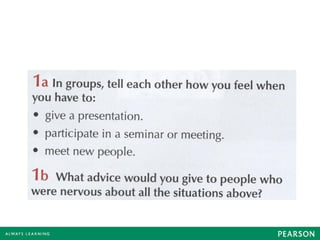
Who do youcommunicate with
every day? Do you
communicate well with them?
Why? / Why not?
Who is the best communicator
you know? Why?
5.
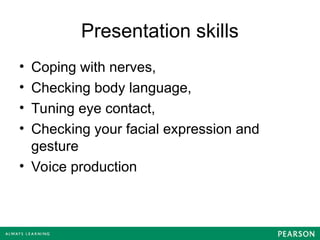
Presentation skills
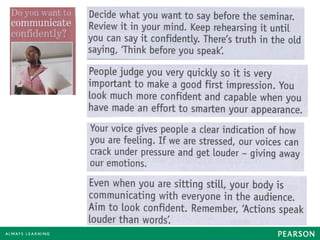
• Copingwith nerves,
• Checking body language,
• Tuning eye contact,
• Checking your facial expression and
gesture
• Voice production
7.
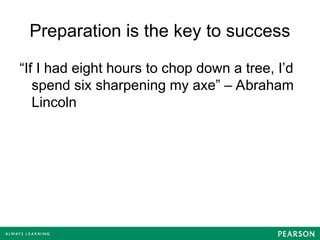
Preparation is thekey to success
“If I had eight hours to chop down a tree, I’d
spend six sharpening my axe” – Abraham
Lincoln
8.
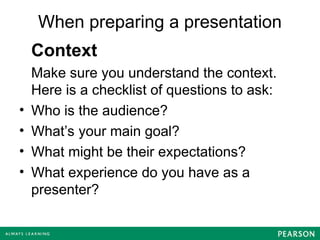
When preparing apresentation
Context
Make sure you understand the context.
Here is a checklist of questions to ask:
• Who is the audience?
• What’s your main goal?
• What might be their expectations?
• What experience do you have as a
presenter?
9.
When preparing apresentation
context
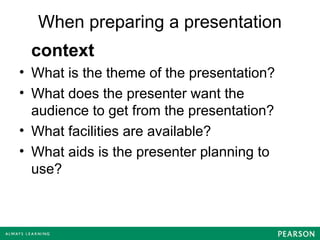
• What is the theme of the presentation?
• What does the presenter want the
audience to get from the presentation?
• What facilities are available?
• What aids is the presenter planning to
use?
10.
Presentation structure
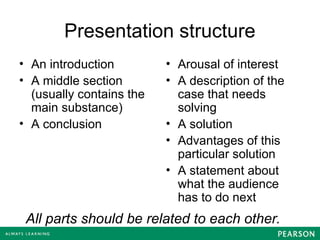
• Anintroduction
• A middle section
(usually contains the
main substance)
• A conclusion
• Arousal of interest
• A description of the
case that needs
solving
• A solution
• Advantages of this
particular solution
• A statement about
what the audience
has to do next
All parts should be related to each other.
When preparing apresentation:
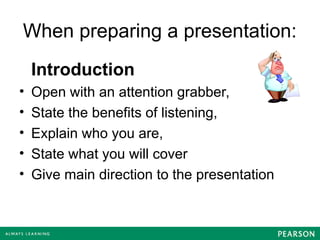
Introduction
• Open with an attention grabber,
• State the benefits of listening,
• Explain who you are,
• State what you will cover
• Give main direction to the presentation
13.
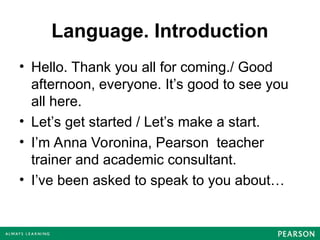
Language. Introduction
• Hello.Thank you all for coming./ Good
afternoon, everyone. It’s good to see you
all here.
• Let’s get started / Let’s make a start.
• I’m Anna Voronina, Pearson teacher
trainer and academic consultant.
• I’ve been asked to speak to you about…
14.
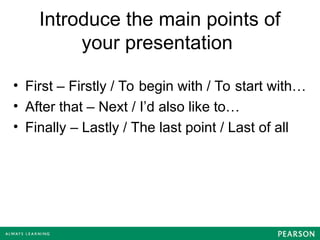
Introduce the mainpoints of
your presentation
• First – Firstly / To begin with / To start with…
• After that – Next / I’d also like to…
• Finally – Lastly / The last point / Last of all
15.
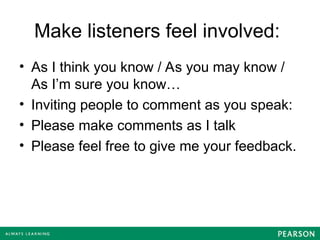
Make listeners feelinvolved:
• As I think you know / As you may know /
As I’m sure you know…
• Inviting people to comment as you speak:
• Please make comments as I talk
• Please feel free to give me your feedback.
16.
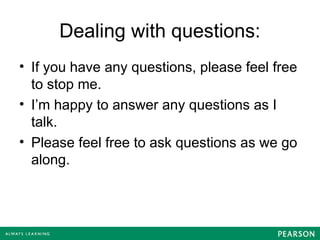
Dealing with questions:
•If you have any questions, please feel free
to stop me.
• I’m happy to answer any questions as I
talk.
• Please feel free to ask questions as we go
along.
17.
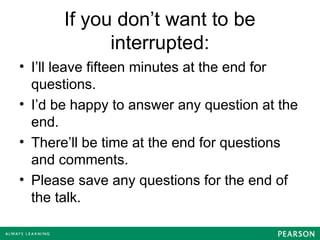
If you don’twant to be
interrupted:
• I’ll leave fifteen minutes at the end for
questions.
• I’d be happy to answer any question at the
end.
• There’ll be time at the end for questions
and comments.
• Please save any questions for the end of
the talk.
18.
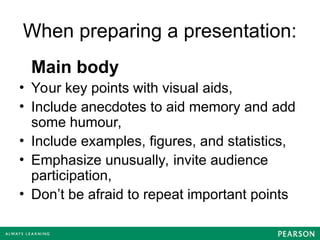
When preparing apresentation:
Main body
• Your key points with visual aids,
• Include anecdotes to aid memory and add
some humour,
• Include examples, figures, and statistics,
• Emphasize unusually, invite audience
participation,
• Don’t be afraid to repeat important points
19.
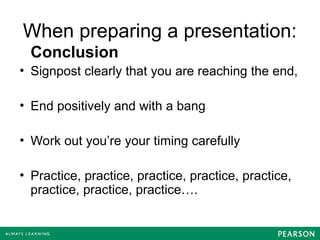
When preparing apresentation:
Conclusion
• Signpost clearly that you are reaching the end,
• End positively and with a bang
• Work out you’re your timing carefully
• Practice, practice, practice, practice, practice,
practice, practice, practice….
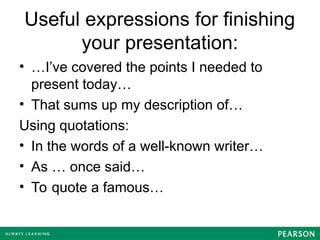
Useful expressions forfinishing
your presentation:
• …I’ve covered the points I needed to
present today…
• That sums up my description of…
Using quotations:
• In the words of a well-known writer…
• As … once said…
• To quote a famous…
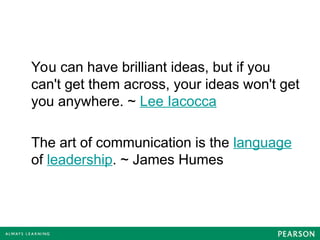
You can havebrilliant ideas, but if you
can't get them across, your ideas won't get
you anywhere. ~ Lee Iacocca
The art of communication is the language
of leadership. ~ James Humes
25.
…I’d like tothank you all for taking out
of your busy day to listen to my
presentation…
• Thank you for listening.
• Thank you for your attention.
• It was good to see you all here.
• Many thanks for coming.
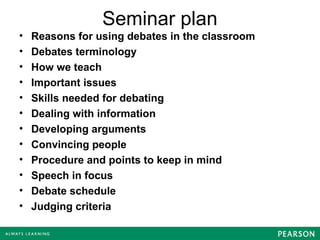
Seminar plan
• Reasonsfor using debates in the classroom
• Debates terminology
• How we teach
• Important issues
• Skills needed for debating
• Dealing with information
• Developing arguments
• Convincing people
• Procedure and points to keep in mind
• Speech in focus
• Debate schedule
• Judging criteria
28.
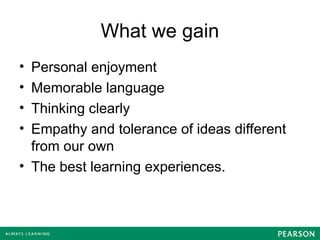
What we gain
•Personal enjoyment
• Memorable language
• Thinking clearly
• Empathy and tolerance of ideas different
from our own
• The best learning experiences.
Why teach debate?
•Debating ability is a valuable skill;
• Debate utilizes useful English;
• Develops critical thinking skills, ability to
evaluate what we read and hear;
• Develops cooperative efforts and improves
social skills;
• Develops research skills and ability to select and
assess information.
31.
How we teach
Opinions:
•What is an opinion
• How do you express your opinion
• How do you express agreement or
disagreement
• Resolutions: fact, policy, value
• Debate in the news
32.
How we teach
Expressingyour opinion:
• Giving reasons
• Strong reasons: logical, specific,
convincing
• Types of reasons: comparison, contrast,
cause-and-effect
• Brainstorming
33.
How we teach
Supportingyour opinion:
• Opinion – Reason – Support
• Types of support: explanation, example,
statistic, expert
• Intro to research
34.
How we teach
:Challengingsupports
• Testing supports: no source, not enough
explanation, out-of-date, questionable
statistic, questionable source biased
• Stating refutation of a source
The Main Skills
Thethree most important skills in debating
are (in order of importance):
• The ability to listen.
• Analysing what you hear.
• The ability to speak in front of people.
37.
Quick reference ofdebate
• Research your motion
• Develop your arguments
• Write your speech
• Deliver your speech
38.
Teaching tips:
• Pre-teachingactivities:
• Ask the students to choose a topic of interest
• Encourage them to bring in their personal
experience on the topic chosen
• Collect information on that topic
• Get them to work in small groups of 3 – 4.
• Discuss with the students WHERE and HOW
they have obtained the information
39.
Teaching tips:
• Pre-teachingactivities:
• Ask them what difficulties they have
encountered in the process of doing so?
• Which ways do they find convenient and useful?
• What are the limitations of getting information
from the Internet?
• Does library research enable the students to find
more information that is not available on the
Internet?
40.
More tips forworking with
information
Organizing information:
• Recording information (ice-cream effect)
• Grouping information
• Leaving irrelevant information out:
Irrelevant details
Boring details
Any information you can’t verify
Be a goodlistener
• Listen carefully to all the opposing
arguments
• Try to grasp your opponents’ arguments
• Make convincing and persuasive
responses to their attacks.
• Differentiate between major and minor
issues raised by your opponents.
44.
Be a goodlistener
• Concentrate on points relating to the main
line of argument.
• Remember, if you don’t listen carefully,
you won’t be able to make sensible
rebuttals that are essential to winning a
debate.
45.
Dealing with floorquestions:
• From another team or from the audience;
• Short and to the point;
• Address one point only;
• The questioner can also specify a certain
debater to answer his question;
• Not one and the same debater to deal with all
the floor questions;
• The floor question should be phrased as a
question, not in form of a statement or a speech.
46.
Write Your Speech
Thenever-fail formula:
• Tell the audience what you’re going to tell
them
• Tell them
• Tell them what you’ve told them
47.
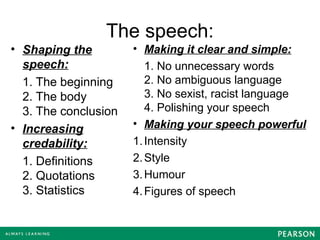
The speech:
• Shapingthe
speech:
1. The beginning
2. The body
3. The conclusion
• Increasing
credability:
1. Definitions
2. Quotations
3. Statistics
• Making it clear and simple:
1. No unnecessary words
2. No ambiguous language
3. No sexist, racist language
4. Polishing your speech
• Making your speech powerful
1.Intensity
2.Style
3.Humour
4.Figures of speech
48.
Speech delivery
• Deliverytechniques
• Voice
• Pace
• Rhythm
• Emphasis
• Body language
• Style
• Practice
• Speak to yourself
• Practice in front of a
mirror
• Ask your friends’
opinion
• The Voice Checklist
49.
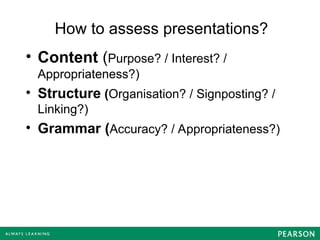
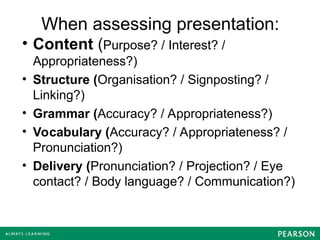
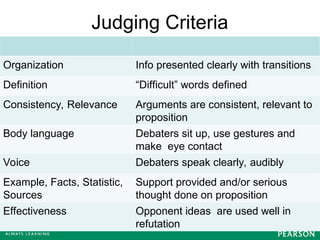
Judging Criteria
Organization Infopresented clearly with transitions
Definition “Difficult” words defined
Consistency, Relevance Arguments are consistent, relevant to
proposition
Body language Debaters sit up, use gestures and
make eye contact
Voice Debaters speak clearly, audibly
Example, Facts, Statistic,
Sources
Support provided and/or serious
thought done on proposition
Effectiveness Opponent ideas are used well in
refutation
50.
Debate basics (easier)
•- A debate is a discussion between sides
with different views. Persons speak for or
against something before making a
decision.
51.
Debate basics (harder)
•Debates are a means of encouraging
critical thinking, personal expression, and
tolerance of others' opinions.
Editor's Notes
#26 Everyone has engaged in debating at some point, from childish squabbles to barroom discussions of philosophical import.
Debate is about argument and persuasion. You try to prove that your arguments on your side of the proposition are more convincing.
Debate is a battle of verbal skill. Yet, it is not simply a case in which participants hurl at each other whatever missiles come their way.
Debate is a process of advocacy and inquiry which involves reasoning, logic, common sense. It gives debaters an opportunity for critical thinking, decision making and problem solving.
Debating allows us to develop poise and confidence in expressing our attitudes and opinions about a subject. We are, in fact, developing skills in the use of language that will serve us well throughout our lives.
Through debates, we learn how to think for ourselves, and how to think on our feet to respond immediately when challenged in a fair-minded discussion. In addition, we use evidence to prove our point of view. We deal with facts and evidence, not emotions.
#28 Personal enjoyment
Competitive debating is stimulating and thrilling. Debaters have great fun matching wits with their opponents
Memorable language
Due to the time limit, debaters need to use as few words as possible to express their ideas. As a result, debating can inspire us to use clear, concise and memorable language
Thinking clearly
Thorough preparation is one factor which leads to successful debating. Debaters need to examine a question critically from both affirmative and negative points of view. Debaters need to sift the relevant arguments from the irrelevant. This gives them superb training and experience in judging the reasonableness and relative importance of arguments and evidence
Most important of all, debating makes us more empathetic and tolerant of ideas different from our own. We learn to respect the opinions of our opponents.
Moreover, in competitive debates, there are only two end results—we either win or we lose. However, it is precisely the losses that provide us with the best learning experiences. In order to improve, debaters never view losses as humiliation or a bad decision made by a crazy judge, but rather, as a new lesson.
#36 The three most important skills in debating are (in order of importance):
The ability to listen.
This is because debating is about listening to and responding to you opponents.
Analysing what you hear.
This is because you need to be able to understand and find mistakes and flaws in your opponents' speeches.
The ability to speak in front of people.
This is the most obvious skill - if you can't talk in front of people, you can't convince them. But it is also the third most important skill. There are lots of people who are very good at speaking in front of people but who aren't good at debating.
#37 The motion is a statement that can be agreed with or disagreed with. It can be referred as a proposition or resolution. It can be fun, interesting or important.
#38 Pre-teaching activities:
Ask the students to choose a topic of interest and collect information on that topic. Get them to work in small groups of 3 – 4.
In class, discuss with the students WHERE and HOW they have obtained the information – from the library, the Internet, newspapers, magazines, journals? Ask them what difficulties they have encountered in the process of doing so? Which ways do they find convenient and useful, e.g. is it more convenient to download information on the Internet? What are the limitations of getting information from the Internet? Does library research enable the students to find more information that is not available on the Internet?
#39 Pre-teaching activities:
Ask the students to choose a topic of interest and collect information on that topic. Get them to work in small groups of 3 – 4.
In class, discuss with the students WHERE and HOW they have obtained the information – from the library, the Internet, newspapers, magazines, journals? Ask them what difficulties they have encountered in the process of doing so? Which ways do they find convenient and useful, e.g. is it more convenient to download information on the Internet? What are the limitations of getting information from the Internet? Does library research enable the students to find more information that is not available on the Internet?
#40 1. Recording information
Gathering information is like holding an ice-cream bar. You know you’ve got it while it’s there, but as soon as it melts it disappears. You must record the results from your research. Your notes are your deep freeze, and remember to make them legible and sensible. Don’t just copy phrases; try to use your own words after comprehending the text.
2. Grouping information
You’ve gathered your information and you’ve got your notes. Now all that’s left is to write your speech, right? WRONG! You must organize the material in order to understand it. When debaters approach a harder or unfamiliar motion, they tend to ‘cut and paste’ large pieces of data without trying to understand how they fit together.
Instead, group your supporting points under main points, and then research for more specific information such as quotations, statistics, definitions, comparisons and contrasts.
3. Leaving out irrelevant information
Decide which information stays and which information goes. Leave out:
Irrelevant details
Boring details
Any information you can’t verify
However, remember to keep information containing points for the other side that will later be helpful when thinking of rebuttals.
#41 Methods of argument
1. Argument by generalization
I’m sure you have heard of statistics like 10% of the people in Hong Kong are Christians. Do the people who take the poll ask every single individual in Hong Kong about their religion? Obviously, the answer is ‘no’. By asking a certain number of people, the organization that took the poll reasoned that they could generalize about all the people in Hong Kong from that group. In this way, they are making a generalization.
Generalizations can be very useful in debates and arguments. By providing a valid example or reliable statistics, you can draw a generalization of whether your proposition stands or not.
2. Argument by cause
Causal reasoning has always been very important. Whenever anything goes wrong, we say who or what caused it. We are aware if the cause-and-effect relationships every day in our daily lives. In debates, there are two things to note about causes:
In establishing arguments, think of what causes what to happen. What are the disadvantages? What are the advantages? What are the points that support your stance?
In attacking arguments, think of what other causes might there be instead of the ones your opponents say. Or how these effects may not be significant or relevant.
3. Argument by analogy
Argument by analogy compares two situations that have the same essential characteristics. The following are the two types commonly used:
The first type is comparing your argument to real-life examples. For example, a speaker can argue that because by constructing wider roads, the traffic jams in Singapore were greatly relieved, in the same way, constructing wider roads will greatly improve Hong Kong’s traffic conditions.
The second type is comparing your argument to a made-up example. For example, you can say that judging a public figure by just his/her public life is like judging a Mars Bar by only the outer chocolate coating, and neglecting the fact that the toffee inside may taste of cabbage or be laden with arsenic.
#42 How You Convince People
In a debate you use speeches to tell your audience about reasons and examples that support your side.
Speeches:
The way you convince people in a debate is by giving a speech. When it is your turn to speak, you are the only one allowed to speak. Everyone else has to listen to you.
When it is someone else's turn to speak you can't say anything, you have to write down anything that you might want to say and wait your turn to say it (or get your partner to say it if they are going next).
Reasons:
When you give a speech, you present reasons (arguments) for why the audience should agree with you. Generally you want to think in terms of the word "because". You want to say things like "You should agree with me because..." and then give the reason. When you are responding to your opponents you want to attack their reasons.
Examples:
Examples are facts or ideas that you can use to illustrate and back up your reasons. They aren't reasons on their own but they help make reasons more convincing.
#43 Debate is not a one-way process. It is a circular process as it involves both speaking and listening. To be a successful debater you must listen carefully to all the opposing arguments, especially those that question your credibility and threaten your position on the proposition.
Try to grasp your opponents’ arguments, and make convincing and persuasive responses to their attacks.
Listening carefully also enables you to differentiate between major and minor issues raised by your opponents. Some of your opponents’ points may be concerned with minor issues, and therefore not worth arguing. You should concentrate on points relating to the main line of argument.
Remember, if you don’t listen carefully, you won’t be able to make sensible rebuttals that are essential to winning a debate.
#44 You should concentrate on points relating to the main line of argument.
Remember, if you don’t listen carefully, you won’t be able to make sensible rebuttals that are essential to winning a debate.
#45 Floor questions should be short and to the point. Each floor question should address one point only, as the debater is given a very short time to deal with it. The questioner can also specify a certain debater to answer his question, but that debater should have touched on the particular point asked. One mistake that many floor speakers make is that they often want one debater to deal with all the floor questions (especially the one whose argument is relatively weak) but it is not fair to the whole team. The debater can be asked to clarify a point, or to give a concrete example to illustrate an abstract point he has made. Remember, the floor question should be phrased as a question, not in form of a statement. We often hear floor speakers making speeches of their own. In fact, the purpose of asking floor questions is not for the questioners to express their own views, but rather to seek clarification, to contradict or challenge the debaters.
#46 Enough thinking. Enough researching. Enough organizing. Finally, the time to write, but you may as well find yourself having to do more thinking, more researching, more organizing. It is not easy to write a successful debate speech, but you will find it much easier if you keep the following three points in mind:
Tell the audience what you’re going to tell them
Tell them
Tell them what you’ve told them
#51 Two thousand years ago, citizens of Athens held regularly scheduled public assemblies. Peoples' votes determined the policies and actions of the state. Citizens decided whether Athens went to war and how it fought. They created the laws that impacted their daily life. But the votes were always preceded by debates where citizens and leaders argued about the right choices, what was morally and legally right, the best way to achieve a desired outcome, and what was possible and prudent.
Debates are a means of encouraging critical thinking, personal expression, and tolerance of others' opinions. Today, debate still remains essential to democracy. Debates are conducted in governing assemblies, held in lecture halls and public arenas, presented in schools and universities, written in newspaper and magazine columns, heard on radio, or seen on the television. Like our predecessors in ancient Greece, people argue about what is best for their societies and shape the course of law, policy, and action.


![CHAPTER 5 [Autosaved].pptx](https://cdn.slidesharecdn.com/ss_thumbnails/chapter5autosaved-230218034729-cee31ba9-thumbnail.jpg?width=640&height=640&fit=bounds)


