1) The document discusses different types of intruders including masqueraders, misfeasors, and clandestine users. Masqueraders are outsiders who penetrate access controls, misfeasors are legitimate users who access unauthorized data, and clandestine users seize control to evade detection.
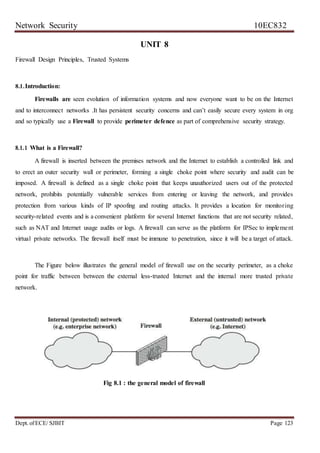
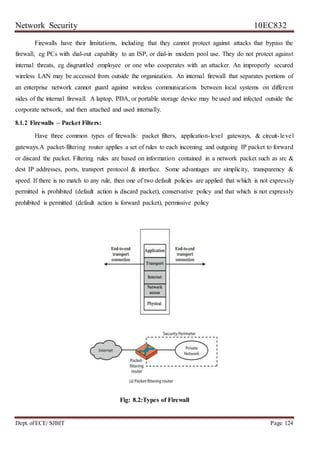
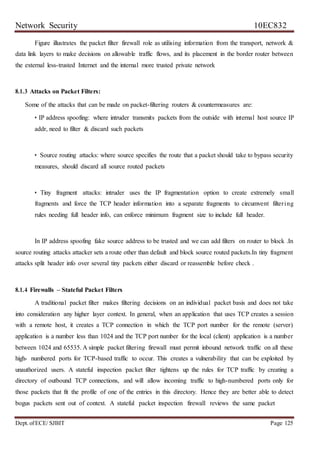
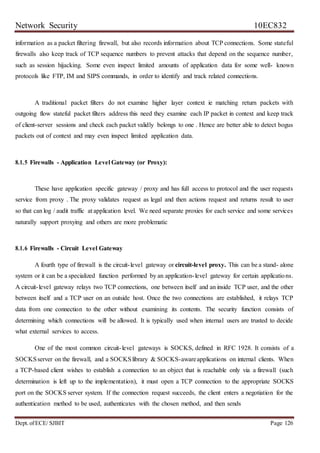
2) Intruder attacks range from benign curiosity to serious attempts to access privileged data or disrupt systems. Common intrusion examples include password cracking, unauthorized data access, and packet sniffing.
3) Intrusion detection is important as a secondary line of defense when prevention fails. It can help identify intruders, collect information on techniques, and act as a deterrent. Behavior-based detection looks for
![Network Security 10EC832
UNIT 6
Intruders, Intrusion Detection, Password Management.
6.1. INTRUDERS
One of the two most publicized threats to security is the intruder (the other isviruses), often referred
to as a hacker or cracker. In an important early study ofintrusion, Anderson[ANDE80] identified three
classes of intruders:
Masquerader: An individual who is not authorized to use the computer andwhopenetrates a
system’s access controls to exploit a legitimate user’s account
Misfeasor: A legitimate user who accesses data, programs, or resources for which such access
is not authorized, or who is authorized for such access but misuses his or her privileges .
Clandestine user: An individual who seizes supervisory control of the system and uses this
control to evade auditing and access controls or to suppress audit collection
The masquerader is likely to be an outsider; the misfeasor generally is an insider;and theclandestine
user can be either an outsider or an insider.
Intruder attacks range from the benign to the serious. At the benign end of thescale, there are many
people who simply wish to explore internets and see what isout there. At the serious end are individuals
who are attempting to read privilegeddata, perform unauthorized modifications to data, or disrupt the
system. the following are examples of intrusion:
Performing a remote root compromise of an e-mail server
Defacing a Web server
Guessing and cracking passwords
Copying a database containing credit card numbers
Viewing sensitive data, including payroll records and medical information,
without authorization
Running a packet sniffer on a workstation to capture usernames and passwords
Using a permission error on an anonymous FTP server to distribute pirated](https://image.slidesharecdn.com/nsunit678-200817095649/85/Ns-unit-6-7-8-1-320.jpg)
![Network Security 10EC832
software and music files
Dialing into an unsecured modem and gaining internal network access
Posing as an executive, calling the help desk, resetting the executive’s e-mail
password, and learning the new password
Using an unattended, logged-in workstation without permission
Intruder BehaviorPatterns
The techniques and behavior patterns of intruders are constantly shifting, to discovered weaknesses
and to evade detection and countermeasures. Even so, intruders typically follow one of a number of
recognizable behavior patterns, and these patterns typically differ from those of ordinary users. In the
following, we look at three broad examples of intruder behavior patterns, to give the reader some feel for
the challenge facing the security administrator. Table 20.1, based on [RADC04],summarizes the
behavior.
HACKERS Traditionally, those who hack into computers do so for the thrill of it or for status. The
hacking community is a strong meritocracy in which status is determined by level of competence. Thus,
attackers often look for targets of opportunity and then share the information with others. A typical
example is a break-in at a large financial institution reported in [RADC04]. The intruder took advantage
of the fact that the corporate network was running unprotected services, some of which were not even
needed. In this case, the key to the break-in was the pc Anywhere application. The manufacturer,
Symantec, advertises this program as a remote control solution that enables secure connection to remote
devices. But the attacker had an easy time gaining access to pc Anywhere; the administrator used the
same three-letter username and password for the program. In this case, there was no intrusion detection
system on the 700-node corporate network. The intruder was only discovered when a vice president
walked into her office and saw the cursor moving files around on her Windows workstation.
Some Examples of Intruder Patterns of Behavior
(a) Hacker
Select the target using IP lookup tools such as NS Lookup, Dig, and others.
Map network for accessible services using tools such as NMAP.
Identify potentially vulnerable services (in this case, pcAnywhere).
Brute force (guess) pc Anywhere password.
Install remote administration tool called Dame Ware.
Wait for administrator to log on and capture his password.](https://image.slidesharecdn.com/nsunit678-200817095649/85/Ns-unit-6-7-8-2-320.jpg)
![Network Security 10EC832
Use that password to access remainder of network.
Intrusion Techniques
The objective of the intruder is to gain access to a system or to increase the range of privileges
accessible on a system. Most initial attacks use system or software vulnerabilities that allow a user to
execute code that opens a back door into the system. Alternatively, the intruder attempts to acquire
information that should have been protected. In some cases, this information is in the form of a user
password. With knowledge of some other user’s password, an intruder can log in to a system and exercise
all the privileges accorded to the legitimate user.
Typically, a system must maintain a file that associates a password with each authorized user. If such
a file is stored with no protection, then it is an easy matter to gain access to it and learn passwords. The
password file can be protected in one of two ways:
One-way function: The system stores only the value of a function based on the user’s
password. When the user presents a password, the system transforms that password and
compares it with the stored value. In practice, the system usually performs a one- way
transformation (not reversible) in which the password is used to generate a key for the one-ay
function and in which a fixed-length output is produced.
Access control: Access to the password file is limited to one or a very few accounts.
If one or both of these countermeasures are in place, some effort is needed fora potential intruder to
learn passwords. On the basis of a survey of the literature and interviews with a number of password
crackers, [ALVA90] reports the following techniques for learning passwords:
Try default passwords used with standard accounts that are shipped with the system. Many
administrators do not bother to change these defaults.](https://image.slidesharecdn.com/nsunit678-200817095649/85/Ns-unit-6-7-8-3-320.jpg)
![Network Security 10EC832
authorized users identified as intruders. On the other hand, an attempt to limit false positives by a tight
interpretation of intruder behavior will lead to an increase in false negatives, or intruders not identified
as intruders. Thus, there is an element of compromise and art in the practice of intrusion detection.
In Anderson’s study [ANDE80], it was postulated that one could, with reasonable confidence,
distinguish between a masquerader and a legitimate user. Patterns of legitimate user behavior can be
established by observing past history, and significant deviation from such patterns can be detected.
Anderson suggests that the task of detecting a misfeasor(legitimate user performing in an unauthorized
fashion) is more difficult, in that the distinction between abnormal and normal behavior maybe small.
Anderson concluded that such violations would be undetectable solely through the search for anomalous
behavior. However, misfeasor behavior might nevertheless be detectable by intelligent definition of the
class of conditions that suggest unauthorized use. Finally, the detection of the clandestine user was felt
to be beyond the scope of purely automated techniques. These observations, which were made in 1980,
remain true today.
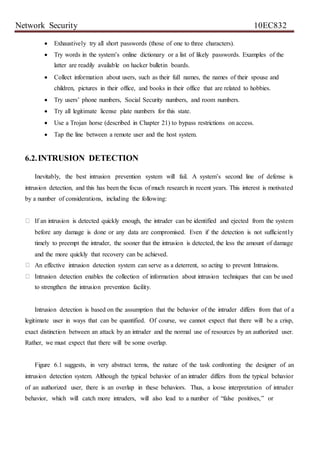
Figure 6.1: Profiles of Behavior of Intruders and Authorized Users
Identifies the following approaches to intrusion detection:
1. Statistical anomaly detection: Involves the collection of data relating to the behavior of
legitimate users over a period of time. Then statistical tests are applied to observed](https://image.slidesharecdn.com/nsunit678-200817095649/85/Ns-unit-6-7-8-5-320.jpg)
![Network Security 10EC832
given command is executed during a single user session, and the number of password failures
during a minute.
Gauge: A nonnegative integer that may be incremented or decremented. Typically, a gauge is used
to measure the current value of some entity. Examples include the number of logical connections
assigned to a user application and the number of outgoing messages queued for a user process.
Interval timer: The length of time between two related events. An example is the length of time
between successive logins to an account.
Resource utilization: Quantity of resources consumed during a specified period. Examples include
the number of pages printed during a user session and total time consumed by a program execution.
Given these general metrics, various tests can be performed to determine whether current activity fits
within acceptable limits. [DENN87] lists the following approaches that may be taken:
Mean and standard deviation
Multivariate
Markov process
Time series
Operational
The simplest statistical test is to measure the mean and standard deviation of a parameter over some
historical period. This gives a reflection of the average behavior and its variability. The use of mean and
standard deviation is applicable to a wide variety of counters ,timers, and resource measures. But these
measures, by themselves ,are typically too crude for intrusion detection purposes.
A multivariate model is based on correlations between two or more variables. Intruder behavior may
be characterized with greater confidence by considering such correlations (for example, processor time
and resource usage, or login frequency and session elapsed time).
A Markov process model is used to establish transition probabilities among various states. As an
example, this model might be used to look at transitions between certain commands.
A time series model focuses on time intervals, looking for sequences of events that happen too rapidly
or too slowly. A variety of statistical tests can be applied to characterize abnormal timing.](https://image.slidesharecdn.com/nsunit678-200817095649/85/Ns-unit-6-7-8-9-320.jpg)
![Network Security 10EC832
Finally, an operational model is based on a judgment of what is considered abnormal, rather than an
automated analysis of past audit records. Typically, fixed limits are defined and intrusion is suspected for
an observation that is outside the limits. This type of approach works best where intruder behavior can
be deduced from certain types of activities. For example, a large number of login attempts over a short
period suggests an attempted intrusion.
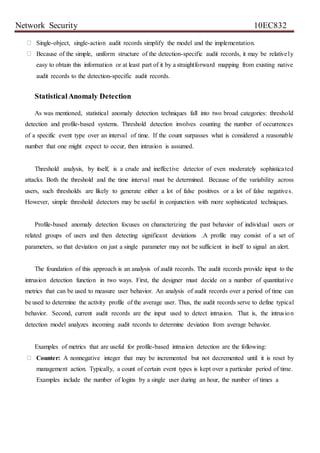
As an example of the use of these various metrics and models, Table, shows various measures
considered or tested for the Stanford Research Institute(SRI) intrusion detection system (IDES)
[DENN87, JAVI91, LUNT88].The main advantage of the use of statistical profiles is that a prior
knowledge of security flaws is not required. The detector program learns what is “normal” behavior and
then looks for deviations. The approach is not based on system-dependent characteristics and
vulnerabilities. Thus, it should be readily portable among a variety of systems.](https://image.slidesharecdn.com/nsunit678-200817095649/85/Ns-unit-6-7-8-10-320.jpg)
![Network Security 10EC832
Table 7.1: Measures That May Be Used for Intrusion Detection
System administrators and security analysts to collect a suite of known penetration scenarios and key
events that threaten the security of the target system. A simple example of the type of rules that can be
used is found in NIDX, a nearly system that used heuristic rules that can be used to assign degrees of
suspicion to activities [BAUE88]. Example heuristics are the following:
Users should not read files in other users’ personal directories.
Users must not write other users’ files.
Users who log in after hours often access the same files they used earlier.](https://image.slidesharecdn.com/nsunit678-200817095649/85/Ns-unit-6-7-8-11-320.jpg)
![Network Security 10EC832
Users do not generally open disk devices directly but rely on higher-level operating system utilities.
Users should not be logged in more than once to the same system.
Users do not make copies of system programs.
The Base-Rate Fallacy
To be of practical use, an intrusion detection system should detect a substantial percentage of
intrusions while keeping the false alarm rate at an acceptable level .If only a modest percentage of actual
intrusions are detected, the system provides a false sense of security. On the other hand, if the system
frequently triggers an alert when there is no intrusion (a false alarm), then either system managers will
begin to ignore the alarms, or much time will be wasted analyzing the false alarms.
Unfortunately, because of the nature of the probabilities involved, it is very difficult to meet the
standard of high rate of detections with a low rate of false alarms. In general, if the actual numbers of
intrusions is low compared to the number of legitimate uses of a system, then the false alarm rate will be
high unless the test is extremely discriminating. A study of existing intrusion detection systems, reported
in [AXEL00], indicated that current systems have not overcome the problem of the base-rate fallacy. See
Appendix 20A for a brief background on the mathematics of this problem.
Distributed Intrusion Detection
Until recently, work on intrusion detection systems focused on single-system standalone facilities.
The typical organization, however, needs to defend a distributed collection of hosts supported by a LAN
or internetwork. Although it is possible to mount a defense by using stand-alone intrusion detection
systems on each host, amore effective defense can be achieved by coordination and cooperation among
intrusion detection systems across the network .Porras points out the following major issues in the design
of a distributed intrusion detection system [PORR92]:
A distributed intrusion detection system may need to deal with different audit record formats. In a
heterogeneous environment, different systems will employ different native audit collection systems
and, if using intrusion detection, may employ different formats for security-related audit records.
One or more nodes in the network will serve as collection and analysis points for the data from the
systems on the network. Thus, either raw audit data or summary data must be transmitted across the
network. Therefore, there is a requirement to assure the integrity and confidentiality of these data.
Integrity is required to prevent an intruder from masking his or her activities by altering the](https://image.slidesharecdn.com/nsunit678-200817095649/85/Ns-unit-6-7-8-12-320.jpg)
![Network Security 10EC832
transmitted audit information. Confidentiality is required because the transmitted audit information
could be valuable.
Either a centralized or decentralized architecture can be used. With a centralized architecture, there
is a single central point of collection and analysis of all audit data. This eases the task of correlating
incoming reports but creates a potential bottleneck and single point of failure. With a decentralized
architecture, there are more than one analysis centers, but these must coordinate their activities and
exchange information.
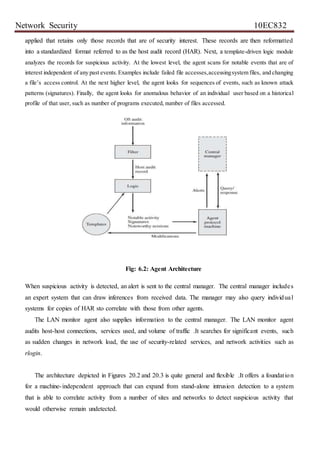
Fig: 6.2: Architecture for Distributed Intrusion Detection
A good example of a distributed intrusion detection system is one developed at the university of
California at Davis [HEBE92, SNAP91]. Figure 20.2 shows the over all architecture, which consists of
three main components:
• Host agent module: An audit collection module operating as a background process on a monitored
system. Its purpose is to collect data on security related events on the host and transmit these to the central
manager.
• LAN monitor agent module: Operates in the same fashion as a host agent module except that it
analyzes LAN traffic and reports the results to the central manager.
• Central manager module: Receives reports from LAN monitor and host agents and processes and
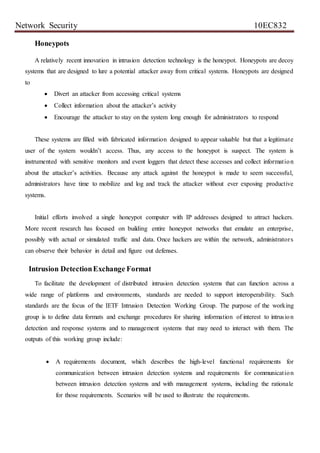
correlates these reports to detect intrusion. The scheme is designed to be independent of any operating
system or system auditing implementation. Figure 20.3 [SNAP91] shows the general approach that is
taken. The agent captures each audit record produced by the native audit collection system .A filter is](https://image.slidesharecdn.com/nsunit678-200817095649/85/Ns-unit-6-7-8-13-320.jpg)
![Network Security 10EC832
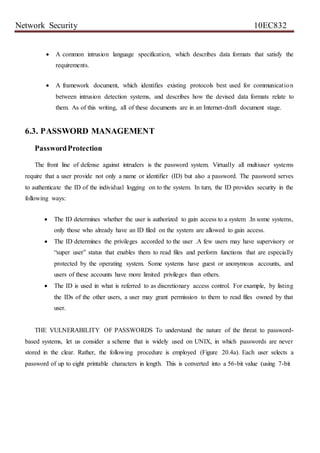
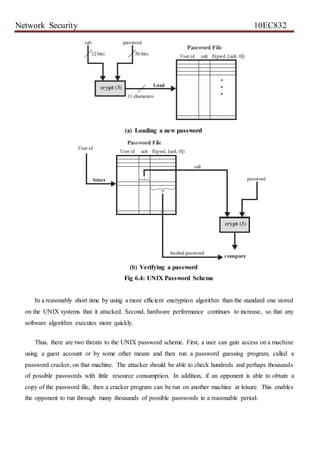
ASCII) that serves as the key input to an encryption routine. The encryption routine, known as crypt, is
based on DES. The DES algorithm is modified using a 12-bit “salt” value. Typically, this value is related
to the time at which the password is assigned to the user. The modified DES algorithm is exercised with
a data input consisting of a 64-bit block of zeros. The output of the algorithm then serves as input for a
second encryption. This process is repeated for a total of 25 encryptions. The resulting 64-bit output is
then translated into an 11-character sequence. The hashed password is then stored, together with a
plaintext copy of the salt, in the password file for the corresponding user ID. This method has been shown
to be secure against a variety of cryptanalytic attacks [WAGN00].
The salt serves three purposes:
It prevents duplicate passwords from being visible in the password file. Even if two users
choose the same password, those passwords will be assigned at different times. Hence, the
“extended” passwords of the two users will differ.
It effectively increases the length of the password without requiring the user to remember two
additional characters. Hence, the number of possible passwords is increased by a factor of
4096, increasing the difficulty of guessing a password.
It prevents the use of a hardware implementation of DES, which would ease the difficulty of
a brute-force guessing attack.
When a user attempts to log on to a UNIX system, the user provides an ID and a password. The
operating system uses the ID to index into the password file and retrieve the plaintext salt and the
encrypted password. The salt and user-supplied password are used as input to the encryption routine. If
the result matches the stored value, the password is accepted.
The encryption routine is designed to discourage guessing attacks. Software implementations of DES
are slow compared to hardware versions, and the use of25 iterations multiplies the time required by 25.
However, since the original design of this algorithm, two changes have occurred. First, newer
implementations of the algorithm itself have resulted in speedups.](https://image.slidesharecdn.com/nsunit678-200817095649/85/Ns-unit-6-7-8-17-320.jpg)
![Network Security 10EC832
As an example, a password cracker was reported on the Internet in August 1993 [MADS93]. Using a
Thinking Machines Corporation parallel computer, a performance of 1560 encryptions per second per
vector unit was achieved. With four vector units per processing node (a standard configuration), this
works out to 800,000 encryptions per second on a 128-node machine (which is a modest size) and 6.4
million encryptions per second on a 1024-node machine. Even these stupendous guessing rates do not
yet make it feasible for an attacker to use a dumb brute-force technique of trying all possible combinations
of characters to discover a password. Instead, password crackers rely on the fact that some people choose
easily guessable passwords.
Some users, when permitted to choose their own password, pick one that is absurdly short. The results
of one study at Purdue University are shown in Table 20.4. The study observed password change choices
on 54 machines, representing approximately 7000 user accounts. Almost 3% of the passwords were three
characters or fewer in length. An attacker could begin the attack by exhaustively testing all possible
passwords of length 3 or fewer .A simple remedy is for the system to reject any password choice of fewer
than, say, six characters or even to require that all passwords be exactly eight characters in length. Most
users would not complain about such a restriction.
Password length is only part of the problem. Many people, when permitted to choose their own
password, pick a password that is guessable, such as their own name, their street name, a common
dictionary word, and so forth. This makes the job of password cracking straightforward. The cracker
simply has to test the password file against lists of likely passwords. Because many people use guessable
passwords, such a strategy should succeed on virtually all systems.
One demonstration of the effectiveness of guessing is reported in [KLEI90]. From a variety of
sources, the author collected UNIX password files, containing nearly 14,000 encrypted passwords. The
result, which the author rightly characterizes .
Try various permutations on the words from step 2. This included making the first letter uppercase
or a control character, making the entire word uppercase, reversing the word, changing the letter “o”
to the digit “zero,” and so on. These permutations added another 1 million words to the list.
Try various capitalization permutations on the words from step 2 that were not considered in step3.
This added almost 2 million additional words to the list. Thus, the test involved in the neighborhood
of 3 million words. Using the fastest Thinking Machines implementation listed earlier, the time to](https://image.slidesharecdn.com/nsunit678-200817095649/85/Ns-unit-6-7-8-19-320.jpg)
![Network Security 10EC832
encrypt all these words for all possible salt values is under an hour. Keep in mind that such a thorough
search could produce a success rate of about 25%, whereas even a single hit may be enough to gain
a wide range of privileges on a system.
ACCESS CONTROL: One way to thwart a password attack is to deny the opponent access to the
password file. If the encrypted password portion of the file is accessible only by a privileged user, then
the opponent cannot read it without already knowing the password of a privileged user. [SPAF92a] points
out several flaws in this strategy:• Many systems, including most UNIX systems, are susceptible to
unanticipated break-ins. Once an attacker has gained access by some means, he or she may wish to obtain
a collection of passwords in order to use different accounts for different logon sessions to decrease the
risk of detection. Or a user with an account may desire another user’s account to access privileged data
An accident of protection might render the password file readable, thus compromising all the accounts.
Some of the users have accounts on other machines in other protection domains, and they use the
same password. Thus, if the passwords could be read by anyone on one machine, a machine in another
location might be compromised. Thus, a more effective strategy would be to force users to select
passwords that are difficult to guess.
PasswordSelectionStrategies
The lesson from the two experiments just described (Tables 20.4 and 20.5) is that ,left to their own
devices, many users choose a password that is too short or too easy to guess. At the other extreme, if
users are assigned passwords consisting of eight randomly selected printable characters, password
cracking is effectively impossible. But it would be almost as impossible for most users to remember their
passwords. Fortunately, even if we limit the password universe to strings of characters that are reasonably
memorable, the size of the universe is still too large to permit practical cracking. Our goal, then, is to
eliminate guessable passwords while allowing the user to select a password that is memorable. Four basic
techniques are in use:
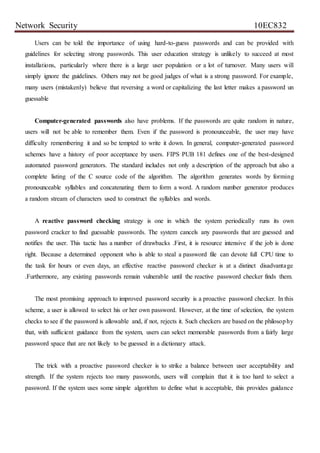
User education
Computer-generated passwords
Reactive password checking
Proactive password checking](https://image.slidesharecdn.com/nsunit678-200817095649/85/Ns-unit-6-7-8-20-320.jpg)
![Network Security 10EC832
to password crackers to refine their guessing technique. In the remainder of this subsection, we look at
possible approaches to proactive password checking.
The first approach is a simple system for rule enforcement. For example, the following rules could
be enforced:
All passwords must be at least eight characters long.
In the first eight characters, the passwords must include at least one each of uppercase,
lowercase, numeric digits, and punctuation marks.
These rules could be coupled with advice to the user. Although this approach is superior to simply
educating users, it may not be sufficient to thwart password crackers. This scheme alerts crackers as to
which passwords not to try but may still make it possible to do password cracking.
Another possible procedure is simply to compile a large dictionary of possible“ bad” passwords.
When a user selects a password, the system checks to make sure that it is not on the disapproved list.
There are two problems with this approach:
Space: The dictionary must be very large to be effective. For example, the dictionary used in
the Purdue study [SPAF92a] occupies more than 30 megabytes of storage.
Time: The time required to search a large dictionary may itself be large. In addition, to check
for likely permutations of dictionary words, either those words most be included in the dictionary, making
it truly huge, or each search must also involve considerable processing.](https://image.slidesharecdn.com/nsunit678-200817095649/85/Ns-unit-6-7-8-22-320.jpg)
![Network Security 10EC832
user’s file permissions so that the files are readable by any user. The author could then induce users
to run the program by placing it in a common directory and naming it such that it appears to be a
useful utility program or application. An example is a program that ostensibly produces a listing of
the user’s files in a desirable format. After another user has run the program, the author of the program
can then access the information in the user’s files. An example of a Trojan horse program that would
be difficult to detect is a compiler that has been modified to insert additional code into certain
programs as they are compiled, such as a system login program [THOM84]. The code creates a
backdoor in the login program that permits the author to log on to the system using a special
password.This Trojan horse can never be discovered by reading the source code of the login program.
Trojan horses fit into one of three models:
• Continuing to perform the function of the original program and additionally performing a separate
malicious activity
• Continuing to perform the function of the original program but modifying the function to perform
malicious activity (e.g., a Trojan horse version of a login program that collects passwords) or to
disguise other malicious activity (e.g., a Trojan horse version of a process listing program that does
not display certain processes that are malicious)
• Performing a malicious function that completely replaces the function of the original program
Mobile Code
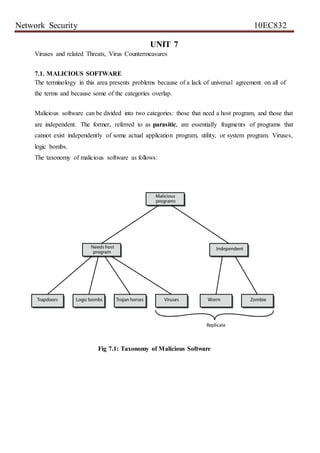
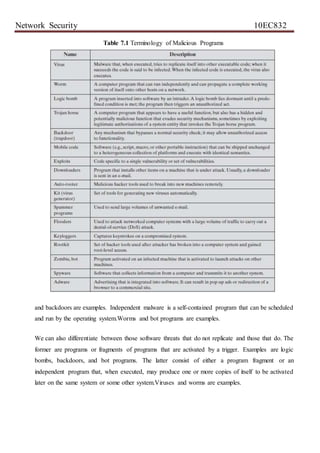
Mobile code refers to programs (e.g., script, macro, or other portable instruction) that can be shipped
unchanged to a heterogeneous collection of platforms and execute with identical semantics
[JANS01]. The term also applies to situations involving a large homogeneous collection of platforms
(e.g., Microsoft Windows). Mobile code is transmitted from a remote system to a local system and
then executed on the local system without the user’s explicit instruction. Mobile code often acts as a
mechanism for a virus, worm, or Trojan horse to be transmitted to the user’s workstation. In other
cases, mobile code takes advantage of vulnerabilities to perform its own exploits, such as
unauthorized data access or root compromise. Popular vehicles for mobile code include Java applets,
ActiveX, JavaScript, and VBScript.The most common ways of using mobile code for malicious
operations on local system are cross-site scripting, interactive and dynamic Web sites, e-mail
attachments, and downloads from untrusted sites or of untrusted software.](https://image.slidesharecdn.com/nsunit678-200817095649/85/Ns-unit-6-7-8-26-320.jpg)
![Network Security 10EC832
A virus such as the one just described is easily detected because an infected version of a program is
longer than the corresponding uninfected one. A way to thwart such a simple means of detecting a
virus is to compress the executable file so that both the infected and uninfected versions are of
identical length. Figure 7.2 shows in general terms the logic required.The key lines in this virus are
numbered, and Figure 21.3 [COHE94] illustrates the operation.We assume that program P1 is
infected with the virus CV.When this program is invoked, control passes to its virus, which performs
the following steps:
1. For each uninfected file P2 that is found, the virus first compresses that file to produce , which is
shorter than the original program by the size of the virus.
2. A copy of the virus is prepended to the compressed program.
3. The compressed version of the original infected program, , is uncompressed.
4. The uncompressed original program is executed.
Figure 7.2 Logic for a Compression Virus](https://image.slidesharecdn.com/nsunit678-200817095649/85/Ns-unit-6-7-8-30-320.jpg)