Traditional Banking Vs E-Banking
Dr.N.RAMESHKUMAR
Assistant Professor
Department of Commerce with
Compute Applications
PSG College of Arts & Science
Coimbatore 614 014
TamilNadu, India
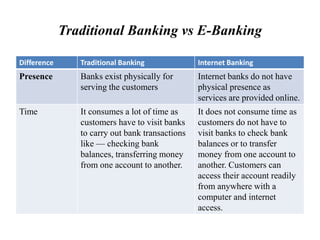
Traditional Banking vs E-Banking
Difference Traditional Banking Internet Banking
Presence Banks exist physically for
serving the customers
Internet banks do not have
physical presence as
services are provided online.
Time It consumes a lot of time as
customers have to visit banks
to carry out bank transactions
like — checking bank
balances, transferring money
from one account to another.
It does not consume time as
customers do not have to
visit banks to check bank
balances or to transfer
money from one account to
another. Customers can
access their account readily
from anywhere with a
computer and internet
access.
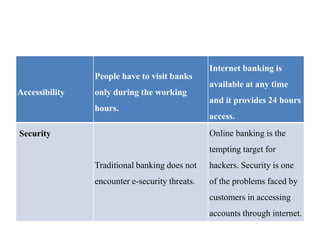
Accessibility
People have to visit banks
only during the working
hours.
Internet banking is
available at any time
and it provides 24 hours
access.
Security
Traditional banking does not
encounter e-security threats.
Online banking is the
tempting target for
hackers. Security is one
of the problems faced by
customers in accessing
accounts through internet.
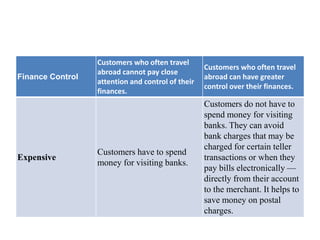
Finance Control
Customers who often travel
abroad cannot pay close
attention and control of their
finances.
Customers who often travel
abroad can have greater
control over their finances.
Expensive
Customers have to spend
money for visiting banks.
Customers do not have to
spend money for visiting
banks. They can avoid
bank charges that may be
charged for certain teller
transactions or when they
pay bills electronically —
directly from their account
to the merchant. It helps to
save money on postal
charges.
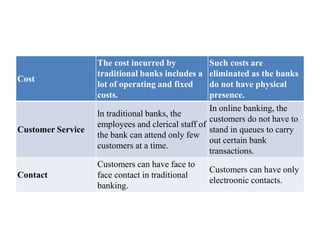
Cost
The cost incurred by
traditional banks includes a
lot of operating and fixed
costs.
Such costs are
eliminated as the banks
do not have physical
presence.
Customer Service
ln traditional banks, the
employees and clerical staff of
the bank can attend only few
customers at a time.
In online banking, the
customers do not have to
stand in queues to carry
out certain bank
transactions.
Contact
Customers can have face to
face contact in traditional
banking.
Customers can have only
electroonic contacts.

NR traditional banking vs e-banking.pptx

  • 1.
    Traditional Banking VsE-Banking Dr.N.RAMESHKUMAR Assistant Professor Department of Commerce with Compute Applications PSG College of Arts & Science Coimbatore 614 014 TamilNadu, India
  • 2.
    Traditional Banking vsE-Banking Difference Traditional Banking Internet Banking Presence Banks exist physically for serving the customers Internet banks do not have physical presence as services are provided online. Time It consumes a lot of time as customers have to visit banks to carry out bank transactions like — checking bank balances, transferring money from one account to another. It does not consume time as customers do not have to visit banks to check bank balances or to transfer money from one account to another. Customers can access their account readily from anywhere with a computer and internet access.
  • 3.
    Accessibility People have tovisit banks only during the working hours. Internet banking is available at any time and it provides 24 hours access. Security Traditional banking does not encounter e-security threats. Online banking is the tempting target for hackers. Security is one of the problems faced by customers in accessing accounts through internet.
  • 4.
    Finance Control Customers whooften travel abroad cannot pay close attention and control of their finances. Customers who often travel abroad can have greater control over their finances. Expensive Customers have to spend money for visiting banks. Customers do not have to spend money for visiting banks. They can avoid bank charges that may be charged for certain teller transactions or when they pay bills electronically — directly from their account to the merchant. It helps to save money on postal charges.
  • 5.
    Cost The cost incurredby traditional banks includes a lot of operating and fixed costs. Such costs are eliminated as the banks do not have physical presence. Customer Service ln traditional banks, the employees and clerical staff of the bank can attend only few customers at a time. In online banking, the customers do not have to stand in queues to carry out certain bank transactions. Contact Customers can have face to face contact in traditional banking. Customers can have only electroonic contacts.