Electronics Clearing Services
ECS
•
•

•
•
•

Objectives
At the end of the session the Students should
be able to:
Define what is ECS (Credits) ECS (Debits)
Explain the procedure of ECS
List the Advantages of ECS systems

2
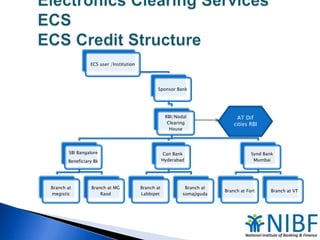
ECS user /Institution

Sponsor Bank

RBI/Nodal
Clearing
House

SBI Bangalore

Can Bank
Hyderabad

Beneficiary Bk

Branch at
megistic

Branch at MG
Raod

Branch at
Labbipet

Branch at
somajiguda

AT Dif
cities RBI

Synd Bank
Mumbai

Branch at Fort

Branch at VT
•

What is Electronic Clearing Service (ECS)?
It is a mode of electronic funds transfer from
one bank account to another bank account
using the services of a Clearing House.
Bulk transfers from one account to many
accounts (ECS Credits).
Collection of amounts from many accounts to
one account. (ECS Debits).

4
•
•
•

•

•

Types of ECS
ECS (Credit)

Dividend, Pension,
Interest , Salary

payment,
Sponsor Bank, Beneficiary Bank
ECS (Debits)
House tax, Water tax
Telephone, Electricity





Who can initiate an ECS (Credit) transaction?
ECS payments can be initiated by any institution
(called ECS user) who have to make bulk or
repetitive payments to a number of beneficiaries.
They can initiate the transactions after registering
themselves with an approved clearing house
Consent of beneficiary is required, and Account
details have to be obtained










Can the Account Details be Changed?
YES
Who will communicate the beneficiaries' about the
credit?
It is the responsibility of the ECS user to communicate to
the beneficiary the details of credit that is being afforded to
his account,
What are the advantages to the ultimate beneficiary?
No depositing the physical paper instruments.
No risk of loss of instrument and fraudulent encashment.
No delay in realisation of proceeds.





How does the ECS Credit system work?
The ECS users intending to effect payments have to
submit the data in a specified format to one of the
approved clearing houses.
The clearing house would debit the account of the
ECS user through the account of the sponsor bank
on the appointed day and credit the accounts of the
recipient banks, for onward credit to the accounts of
the ultimate beneficiaries.
•
•

•
•

At which of the centres ECS facility is available?
At present ECS facility is available at more than 60
centres. The beneficiaries need to maintain an account
with one of the banks at these centres in order to avail of
the benefit of ECS.
How does a beneficiary participate in ECS (Credit )
scheme?
The beneficiary has to furnish a mandate giving his
consent to avail of the ECS facility. He should also
communicate to the ECS user the details of his bank
branch and account particulars. Such authorisation
form is called a mandate.
•
•
•
•
•

How does the scheme benefit the ECS user-like
corporate bodies/ institutions?
Saves on administrative machinery for
printing, dispatch and reconciliation.
No loss of instruments in postal transit.
Avoids fraudulent encashment.
Ensuring credit on the designated date to
beneficiaries' account.
•
•
•

•

•

What are the advantages to the banks?
Get freed of paper handling.
Paper handling also creates lot of pressure on banks
as they have to encode the instruments, present
them in clearing, monitor their return and follow up
with the concerned bank and customers.
In ECS banks simply get the payment particulars
relating to their customers. All they need to do is to
match the account particulars like name, a/c number
and credit the proceeds
Wherever the details do not match, they have to
return it back, as per the procedure
•

•

•
•

Is there any limit on the amount of Individual
transactions?
No value limit on the amount of individual
transactions has been prescribed under the scheme.
Who can Avail this Facility?
Any ECS (Debit)user desirous of participating in the
scheme has to register with an approved clearing
house and submit the data in specified form through
the sponsor bank to the clearing house. Banks will
treat the electronic instructions received through the
clearing system on par with the physical cheques.
•

•

•
•
•
•

•

What are the advantages to the ultimate
beneficiary?
No need going to the collection centres/banks
No need to stand in long ‘Q’s for payment
No tracking down of payments by last dates.
The debits would be monitored by the ECS users
How can the customer track-down these
payments?
Pass-books/statements given to the customers
reflect the particulars of the transaction. Customers
can match these entries with the advice received by
them from the payment institution.









How does the scheme benefit the ECS user-like
corporate bodies/ institutions?
Saves on administrative machinery for collecting the
cheques,
monitoring
their
realisation
and
reconciliation
Better cash management.
Avoids chances of frauds due to fraudulent access to
the paper instruments and encashment.
Realise the payments on a single date instead of
fractured receipt of payments.







Can the customer stipulate any maximum
debit, purpose or validity period for the mandate?
Yes. It is left to the choice of the individual customer and
the ECS user to finalise these aspects. The mandate
can contain a maximum ceiling; it can also specify the
purpose as also a validity period.
What is the current coverage of the scheme?
At present the scheme is in operation at 15 RBI centres
(ie centres where RBI manages the Clearing House
operations) and at other centres where Public Sector
Banks manage the clearing operations. The list of
centres is available at the RBI web-site under the
procedural guidelines.




Which are the institutions eligible to participate in
the ECS Debit scheme?
Utility
service
providers
such
as
telephone
companies, electricity supplying companies, electricity
boards, credit card collections, collection of loan
installments by banks and financial institutions, and
investment schemes of Mutual funds, etc.









What are the Processing charges/Service
charges on individual transactions (ECS Debit)
Is there any ceiling on the amount
What is the current coverage of the scheme ECS
(credits), ECS (Debits)?
Who has introduced this ECS Scheme
EFT is a result of Which committee report?
Home work
•
•

•

Day-0
1.Submission of encrypted Input
Tape/Floppy fully validated by NCC
earlier with a mandate from the
Sponsor Bank in the morning.
2.Processing at NCC- Generating out put
data in magnetic media and their
encryption for onward transmission to
Destination banks




3. NCC making available out put data in
magnetic media duly encrypted to
Destination Banks in the morning hours
along with MICR Clearing Reports
4. Destination Banks (Service Branches)
generating the clearing reports from
the output tape/floppy supplied by NCC
after
decrypting the same.


5. Service Branches of Destination Banks
ensuring accounting of the transactions
either centrally or at the destination
branches either by giving soft copy of
the transaction details or delivering the
hard copy of the Destination Branch
Reports and Destination Ledger Reports
(in
duplicate) to the respective branches.





6. NCC making available Sponsor Bank
Settlement Report to the Sponsor Bank.
Day-1
1. Sponsor Bank’s account debited and
Destination Banks’ accounts credited
at Deposit Accounts Department of RBI




2. Destination Bank branches crediting the
accounts of the beneficiaries (i.e. the
Destination Account Holders) and
Sponsor
Bank debiting the account of the User.
3. Destination Bank branches reporting the
un credited items to the Service Branch
on
the duplicate of the Destination Ledger
Reports.
•

4. Service Branches of Destination Banks
preparing floppy file for reporting to NCC, the
particulars of credited /un credited items,
preparing two hard copies of the Destination
Banks Final Report in Form Appendix XVII
and submitting the output tape/floppy to the
NCC together with the return memos and a
hard copy of the Destination Bank Final
Report to the NCC-while presenting the day’s
MICR instruments for clearing.





5. NCC to arrive at the settlement based
on the tapes/floppies received from all
the Destination Banks.
6. NCC to generate all the relevant reports
7. Destination Bank’s accounts debited
and consolidated credit given to
Sponsor Bank for un credited items.




8. NCC to supply clearing reportsi) Sponsor Bank Final Report ----- To
Sponsor Bank
ii) Combined list of un credited item------- iii) Two copies of the final output
tape/floppy ----iv) Destination Bank Final Report--------





DAY-0
1. Submission of encrypted Input
Tape/Floppy fully validated by the CH
earlier with a mandate from the Sponsor
Bank in the morning.
2. Processing and generating output data at
the CH in magnetic media and their
encryption, for onward transmission to
Destination Banks




3. The CH making available output data in
magnetic media duly encrypted to
Destination banks with MICR Clearing
Reports.
4. Destination Banks (Service branches)
generating the clearing reports from the User
Status File/floppy supplied by the CH, after
decrypting the same.




5. Service branches of Destination Banks
delivering the hard copy of the Destination
Branch Reports and Destination Ledger
Reports (in duplicate) or the same in
electronic form to the respective branches.
6. The CH making available Sponsor Bank
settlement Report to the Sponsor Bank.







DAY-1
1.Destination banks' accounts debited and Sponsor
Bank's account credited at Deposit Accounts
Department of RBI/ the Settlement Bank.
2.Destination bank branches debiting the accounts of
the beneficiaries (i.e. the Destination Account
Holders) and Sponsor Bank crediting the account of
the User
3.Destination Bank Branches reporting the un debited
items to the Service branch on the duplicate copy of
the Destination Ledger Reports.


4. Service branches of Destination Banks
preparing floppy file for reporting to the CH
the particulars of the debited/un debited items,
preparing two hard copies of the Destination
Banks Final report in the From Appendix XVII
and submitting the User Status File/floppy to
the CH together with the return memos and a
hard copy of the Destination Bank final report
to the CH - while presenting the day's MICR
instruments for clearing




5. The CH to arrive at the settlement,
based on the tapes/floppies received
from all the Destination Banks; and
generate all the relevant reports.
6. Destination Bank's accounts credited
& consolidated debit given to Sponsor
Bank for un debited items.









7. The CH to supply clearing reports
i) Sponsor Bank Final Report- To
Sponsor Bank
ii) Combined list of un debited item- do iii) Two Copies of the final User Status File/
- do –
floppy (one to be forwarded to User)
iv) Destination Bank Final Report- To
Destination Bank

ECS

  • 1.
  • 2.
    • • • • • Objectives At the endof the session the Students should be able to: Define what is ECS (Credits) ECS (Debits) Explain the procedure of ECS List the Advantages of ECS systems 2
  • 3.
    ECS user /Institution SponsorBank RBI/Nodal Clearing House SBI Bangalore Can Bank Hyderabad Beneficiary Bk Branch at megistic Branch at MG Raod Branch at Labbipet Branch at somajiguda AT Dif cities RBI Synd Bank Mumbai Branch at Fort Branch at VT
  • 4.
    • What is ElectronicClearing Service (ECS)? It is a mode of electronic funds transfer from one bank account to another bank account using the services of a Clearing House. Bulk transfers from one account to many accounts (ECS Credits). Collection of amounts from many accounts to one account. (ECS Debits). 4
  • 5.
    • • • • • Types of ECS ECS(Credit) Dividend, Pension, Interest , Salary payment, Sponsor Bank, Beneficiary Bank ECS (Debits) House tax, Water tax Telephone, Electricity
  • 6.
       Who can initiatean ECS (Credit) transaction? ECS payments can be initiated by any institution (called ECS user) who have to make bulk or repetitive payments to a number of beneficiaries. They can initiate the transactions after registering themselves with an approved clearing house Consent of beneficiary is required, and Account details have to be obtained
  • 7.
            Can the AccountDetails be Changed? YES Who will communicate the beneficiaries' about the credit? It is the responsibility of the ECS user to communicate to the beneficiary the details of credit that is being afforded to his account, What are the advantages to the ultimate beneficiary? No depositing the physical paper instruments. No risk of loss of instrument and fraudulent encashment. No delay in realisation of proceeds.
  • 8.
       How does theECS Credit system work? The ECS users intending to effect payments have to submit the data in a specified format to one of the approved clearing houses. The clearing house would debit the account of the ECS user through the account of the sponsor bank on the appointed day and credit the accounts of the recipient banks, for onward credit to the accounts of the ultimate beneficiaries.
  • 9.
    • • • • At which ofthe centres ECS facility is available? At present ECS facility is available at more than 60 centres. The beneficiaries need to maintain an account with one of the banks at these centres in order to avail of the benefit of ECS. How does a beneficiary participate in ECS (Credit ) scheme? The beneficiary has to furnish a mandate giving his consent to avail of the ECS facility. He should also communicate to the ECS user the details of his bank branch and account particulars. Such authorisation form is called a mandate.
  • 10.
    • • • • • How does thescheme benefit the ECS user-like corporate bodies/ institutions? Saves on administrative machinery for printing, dispatch and reconciliation. No loss of instruments in postal transit. Avoids fraudulent encashment. Ensuring credit on the designated date to beneficiaries' account.
  • 11.
    • • • • • What are theadvantages to the banks? Get freed of paper handling. Paper handling also creates lot of pressure on banks as they have to encode the instruments, present them in clearing, monitor their return and follow up with the concerned bank and customers. In ECS banks simply get the payment particulars relating to their customers. All they need to do is to match the account particulars like name, a/c number and credit the proceeds Wherever the details do not match, they have to return it back, as per the procedure
  • 12.
    • • • • Is there anylimit on the amount of Individual transactions? No value limit on the amount of individual transactions has been prescribed under the scheme. Who can Avail this Facility? Any ECS (Debit)user desirous of participating in the scheme has to register with an approved clearing house and submit the data in specified form through the sponsor bank to the clearing house. Banks will treat the electronic instructions received through the clearing system on par with the physical cheques.
  • 13.
    • • • • • • • What are theadvantages to the ultimate beneficiary? No need going to the collection centres/banks No need to stand in long ‘Q’s for payment No tracking down of payments by last dates. The debits would be monitored by the ECS users How can the customer track-down these payments? Pass-books/statements given to the customers reflect the particulars of the transaction. Customers can match these entries with the advice received by them from the payment institution.
  • 14.
         How does thescheme benefit the ECS user-like corporate bodies/ institutions? Saves on administrative machinery for collecting the cheques, monitoring their realisation and reconciliation Better cash management. Avoids chances of frauds due to fraudulent access to the paper instruments and encashment. Realise the payments on a single date instead of fractured receipt of payments.
  • 15.
        Can the customerstipulate any maximum debit, purpose or validity period for the mandate? Yes. It is left to the choice of the individual customer and the ECS user to finalise these aspects. The mandate can contain a maximum ceiling; it can also specify the purpose as also a validity period. What is the current coverage of the scheme? At present the scheme is in operation at 15 RBI centres (ie centres where RBI manages the Clearing House operations) and at other centres where Public Sector Banks manage the clearing operations. The list of centres is available at the RBI web-site under the procedural guidelines.
  • 16.
      Which are theinstitutions eligible to participate in the ECS Debit scheme? Utility service providers such as telephone companies, electricity supplying companies, electricity boards, credit card collections, collection of loan installments by banks and financial institutions, and investment schemes of Mutual funds, etc.
  • 17.
          What are theProcessing charges/Service charges on individual transactions (ECS Debit) Is there any ceiling on the amount What is the current coverage of the scheme ECS (credits), ECS (Debits)? Who has introduced this ECS Scheme EFT is a result of Which committee report? Home work
  • 18.
    • • • Day-0 1.Submission of encryptedInput Tape/Floppy fully validated by NCC earlier with a mandate from the Sponsor Bank in the morning. 2.Processing at NCC- Generating out put data in magnetic media and their encryption for onward transmission to Destination banks
  • 19.
      3. NCC makingavailable out put data in magnetic media duly encrypted to Destination Banks in the morning hours along with MICR Clearing Reports 4. Destination Banks (Service Branches) generating the clearing reports from the output tape/floppy supplied by NCC after decrypting the same.
  • 20.
     5. Service Branchesof Destination Banks ensuring accounting of the transactions either centrally or at the destination branches either by giving soft copy of the transaction details or delivering the hard copy of the Destination Branch Reports and Destination Ledger Reports (in duplicate) to the respective branches.
  • 21.
       6. NCC makingavailable Sponsor Bank Settlement Report to the Sponsor Bank. Day-1 1. Sponsor Bank’s account debited and Destination Banks’ accounts credited at Deposit Accounts Department of RBI
  • 22.
      2. Destination Bankbranches crediting the accounts of the beneficiaries (i.e. the Destination Account Holders) and Sponsor Bank debiting the account of the User. 3. Destination Bank branches reporting the un credited items to the Service Branch on the duplicate of the Destination Ledger Reports.
  • 23.
    • 4. Service Branchesof Destination Banks preparing floppy file for reporting to NCC, the particulars of credited /un credited items, preparing two hard copies of the Destination Banks Final Report in Form Appendix XVII and submitting the output tape/floppy to the NCC together with the return memos and a hard copy of the Destination Bank Final Report to the NCC-while presenting the day’s MICR instruments for clearing.
  • 24.
       5. NCC toarrive at the settlement based on the tapes/floppies received from all the Destination Banks. 6. NCC to generate all the relevant reports 7. Destination Bank’s accounts debited and consolidated credit given to Sponsor Bank for un credited items.
  • 25.
      8. NCC tosupply clearing reportsi) Sponsor Bank Final Report ----- To Sponsor Bank ii) Combined list of un credited item------- iii) Two copies of the final output tape/floppy ----iv) Destination Bank Final Report--------
  • 26.
       DAY-0 1. Submission ofencrypted Input Tape/Floppy fully validated by the CH earlier with a mandate from the Sponsor Bank in the morning. 2. Processing and generating output data at the CH in magnetic media and their encryption, for onward transmission to Destination Banks
  • 27.
      3. The CHmaking available output data in magnetic media duly encrypted to Destination banks with MICR Clearing Reports. 4. Destination Banks (Service branches) generating the clearing reports from the User Status File/floppy supplied by the CH, after decrypting the same.
  • 28.
      5. Service branchesof Destination Banks delivering the hard copy of the Destination Branch Reports and Destination Ledger Reports (in duplicate) or the same in electronic form to the respective branches. 6. The CH making available Sponsor Bank settlement Report to the Sponsor Bank.
  • 29.
        DAY-1 1.Destination banks' accountsdebited and Sponsor Bank's account credited at Deposit Accounts Department of RBI/ the Settlement Bank. 2.Destination bank branches debiting the accounts of the beneficiaries (i.e. the Destination Account Holders) and Sponsor Bank crediting the account of the User 3.Destination Bank Branches reporting the un debited items to the Service branch on the duplicate copy of the Destination Ledger Reports.
  • 30.
     4. Service branchesof Destination Banks preparing floppy file for reporting to the CH the particulars of the debited/un debited items, preparing two hard copies of the Destination Banks Final report in the From Appendix XVII and submitting the User Status File/floppy to the CH together with the return memos and a hard copy of the Destination Bank final report to the CH - while presenting the day's MICR instruments for clearing
  • 31.
      5. The CHto arrive at the settlement, based on the tapes/floppies received from all the Destination Banks; and generate all the relevant reports. 6. Destination Bank's accounts credited & consolidated debit given to Sponsor Bank for un debited items.
  • 32.
          7. The CHto supply clearing reports i) Sponsor Bank Final Report- To Sponsor Bank ii) Combined list of un debited item- do iii) Two Copies of the final User Status File/ - do – floppy (one to be forwarded to User) iv) Destination Bank Final Report- To Destination Bank