Notes from Gary Hamel @profhamel
Amcham Conference,
Melbourne 8 Dec 2014
CharterMason perspective by John Phillips
au.linkedin.com/in/johnphillips11kps
What Matters Now?
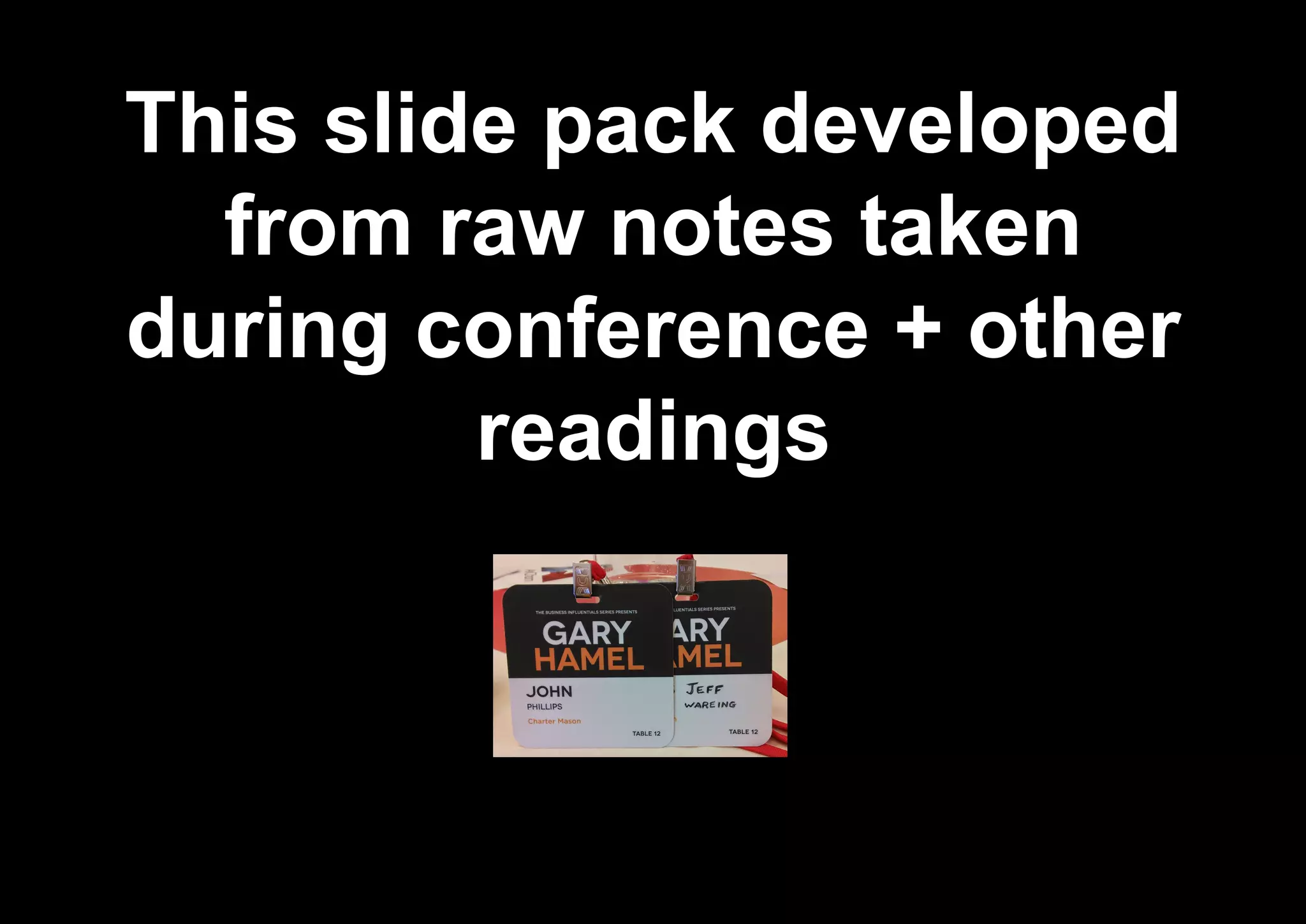
This slide pack developed
from raw notes taken
during conference + other
readings
Who is Gary Hamel?
core competencies
international cross-subsidization
strategic intent
collaborative competition
expeditionary marketing
Hamel (with Prahalad)
originated concepts such
as ...
He is visiting Professor of
Strategic Management at
the London Business
School.
He was Visiting Professor
of International Business
at the University of
Michigan and at Harvard
Business School.
What has Gary Hamel
written?
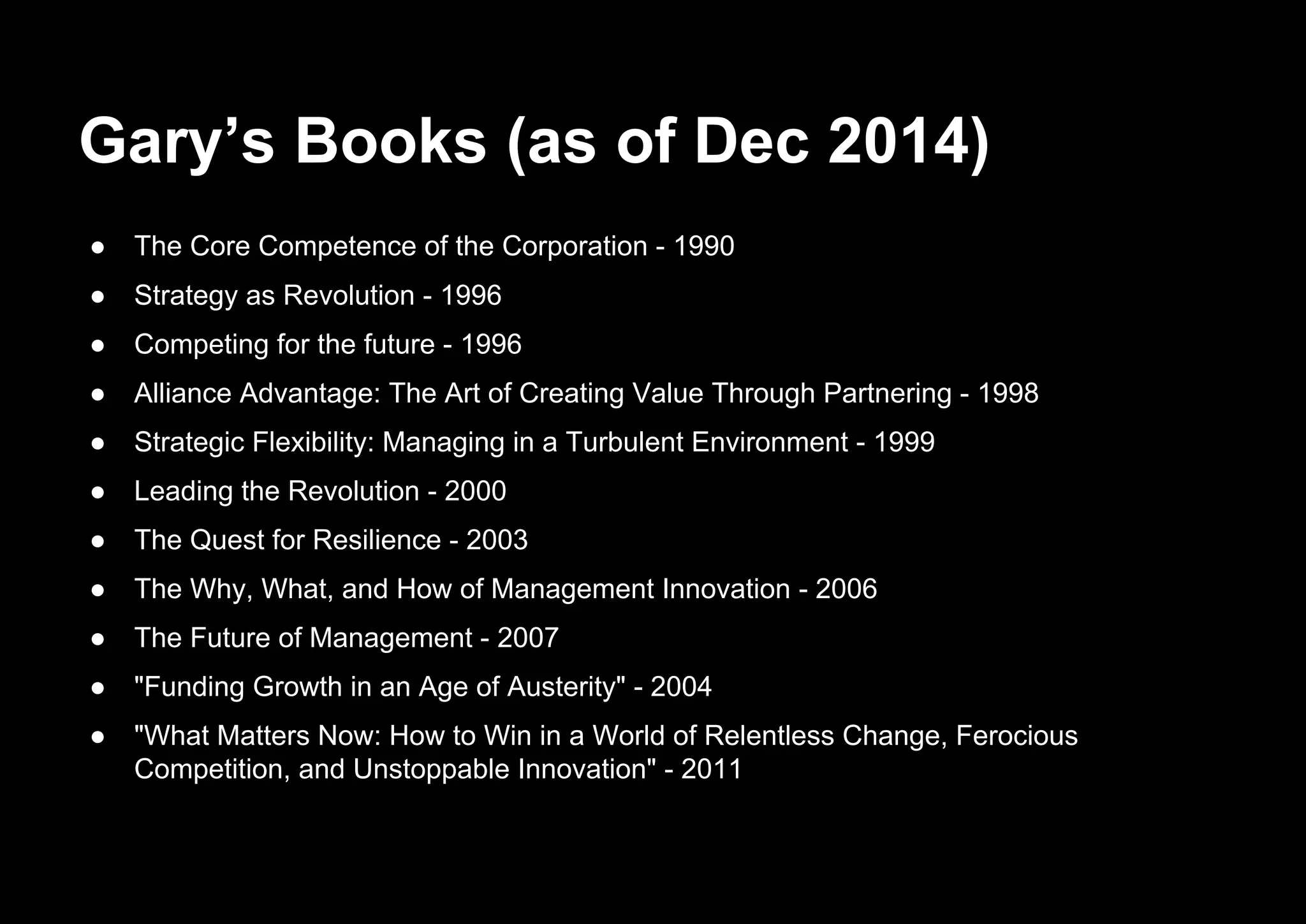
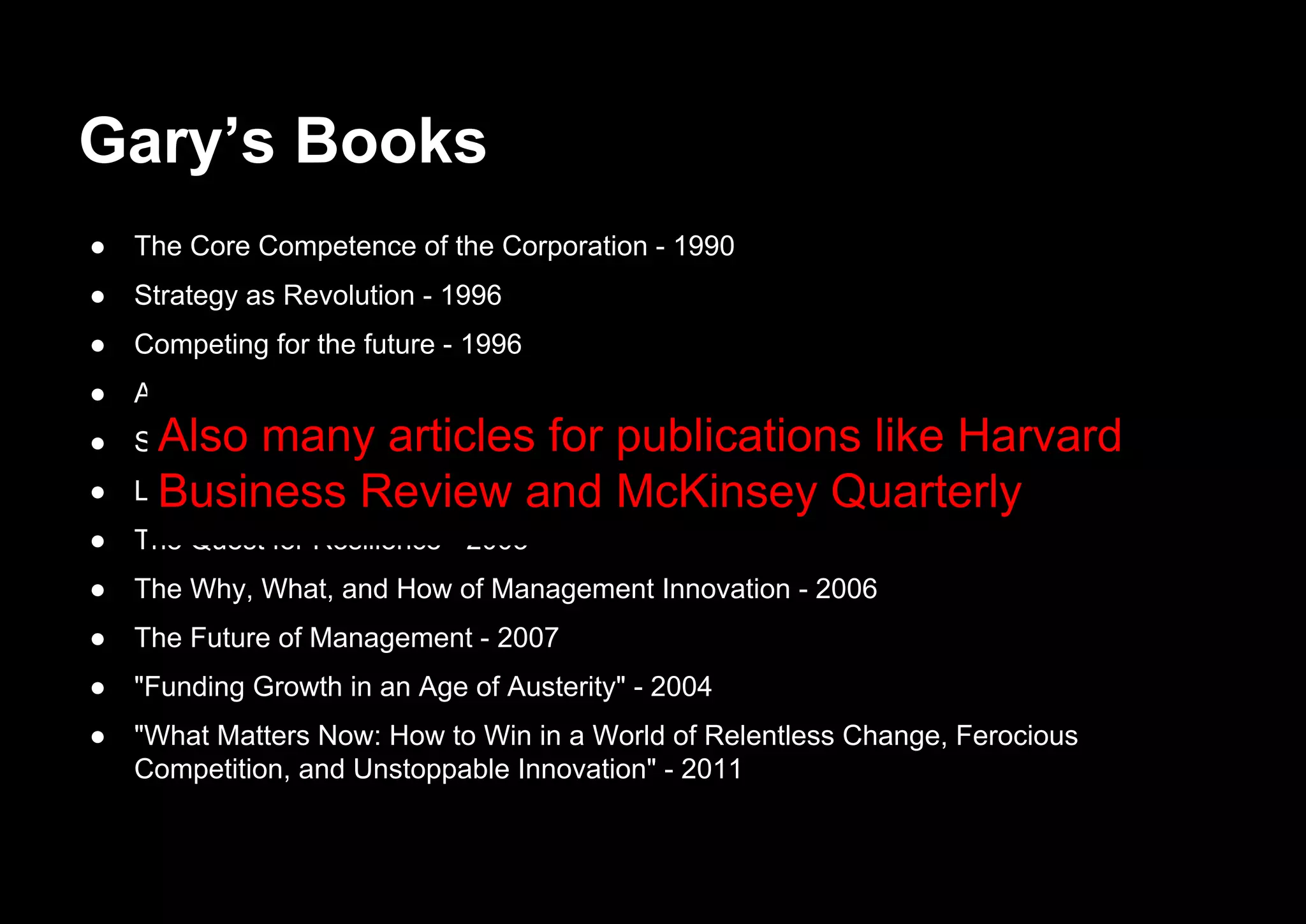
Gary’s Books (as of Dec 2014)
● The Core Competence of the Corporation - 1990
● Strategy as Revolution - 1996
● Competing for the future - 1996
● Alliance Advantage: The Art of Creating Value Through Partnering - 1998
● Strategic Flexibility: Managing in a Turbulent Environment - 1999
● Leading the Revolution - 2000
● The Quest for Resilience - 2003
● The Why, What, and How of Management Innovation - 2006
● The Future of Management - 2007
● "Funding Growth in an Age of Austerity" - 2004
● "What Matters Now: How to Win in a World of Relentless Change, Ferocious
Competition, and Unstoppable Innovation" - 2011
Gary’s Books
● The Core Competence of the Corporation - 1990
● Strategy as Revolution - 1996
● Competing for the future - 1996
● Alliance Advantage: The Art of Creating Value Through Partnering - 1998
● Strategic Flexibility: Managing in a Turbulent Environment - 1999
● Leading the Revolution - 2000
● The Quest for Resilience - 2003
● The Why, What, and How of Management Innovation - 2006
● The Future of Management - 2007
● "Funding Growth in an Age of Austerity" - 2004
● "What Matters Now: How to Win in a World of Relentless Change, Ferocious
Competition, and Unstoppable Innovation" - 2011
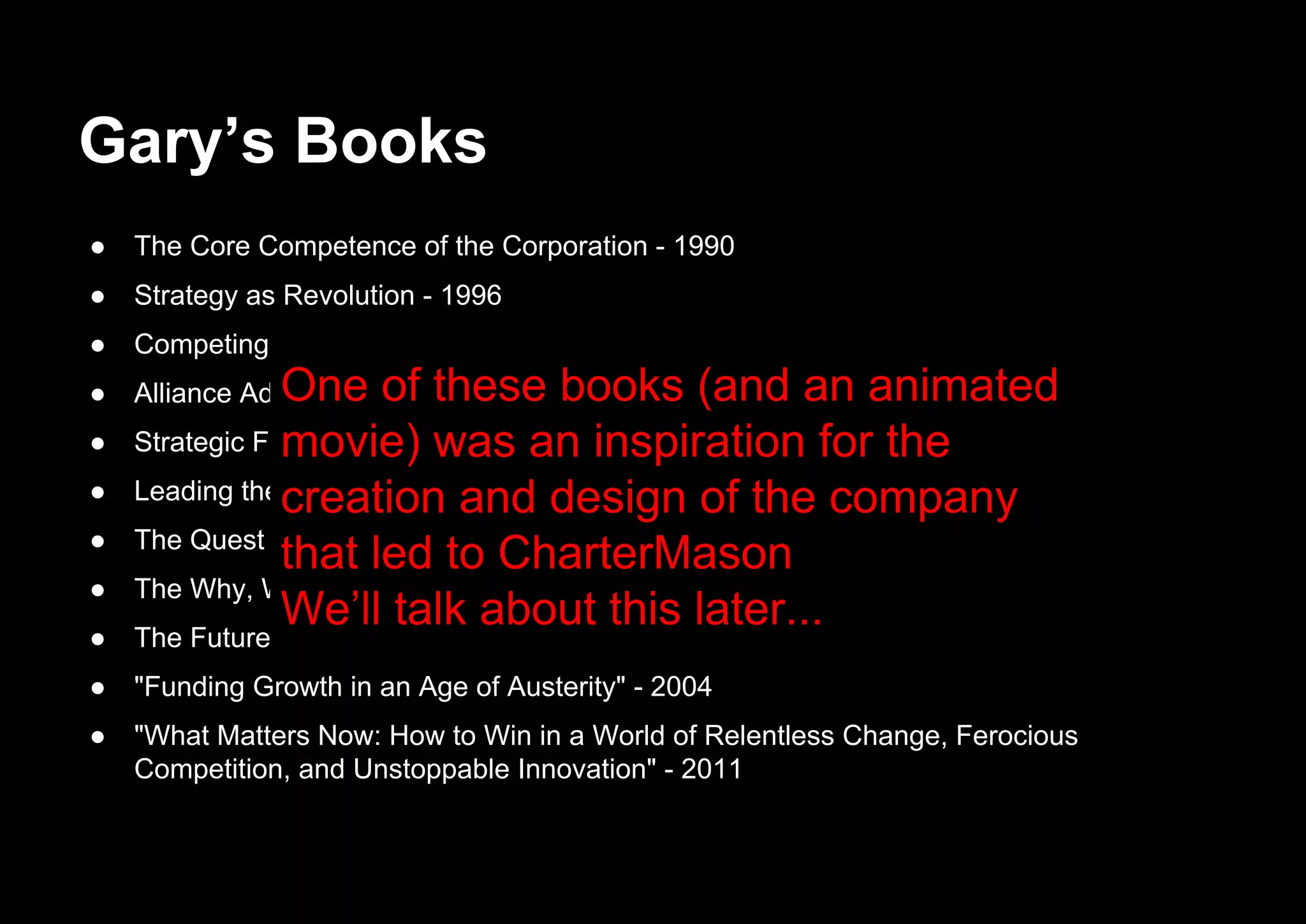
Also many articles for publications like Harvard
Business Review and McKinsey Quarterly
Gary’s Books
● The Core Competence of the Corporation - 1990
● Strategy as Revolution - 1996
● Competing for the future - 1996
● Alliance Advantage: The Art of Creating Value Through Partnering - 1998
● Strategic Flexibility: Managing in a Turbulent Environment - 1999
● Leading the Revolution - 2000
● The Quest for Resilience - 2003
● The Why, What, and How of Management Innovation - 2006
● The Future of Management - 2007
● "Funding Growth in an Age of Austerity" - 2004
● "What Matters Now: How to Win in a World of Relentless Change, Ferocious
Competition, and Unstoppable Innovation" - 2011
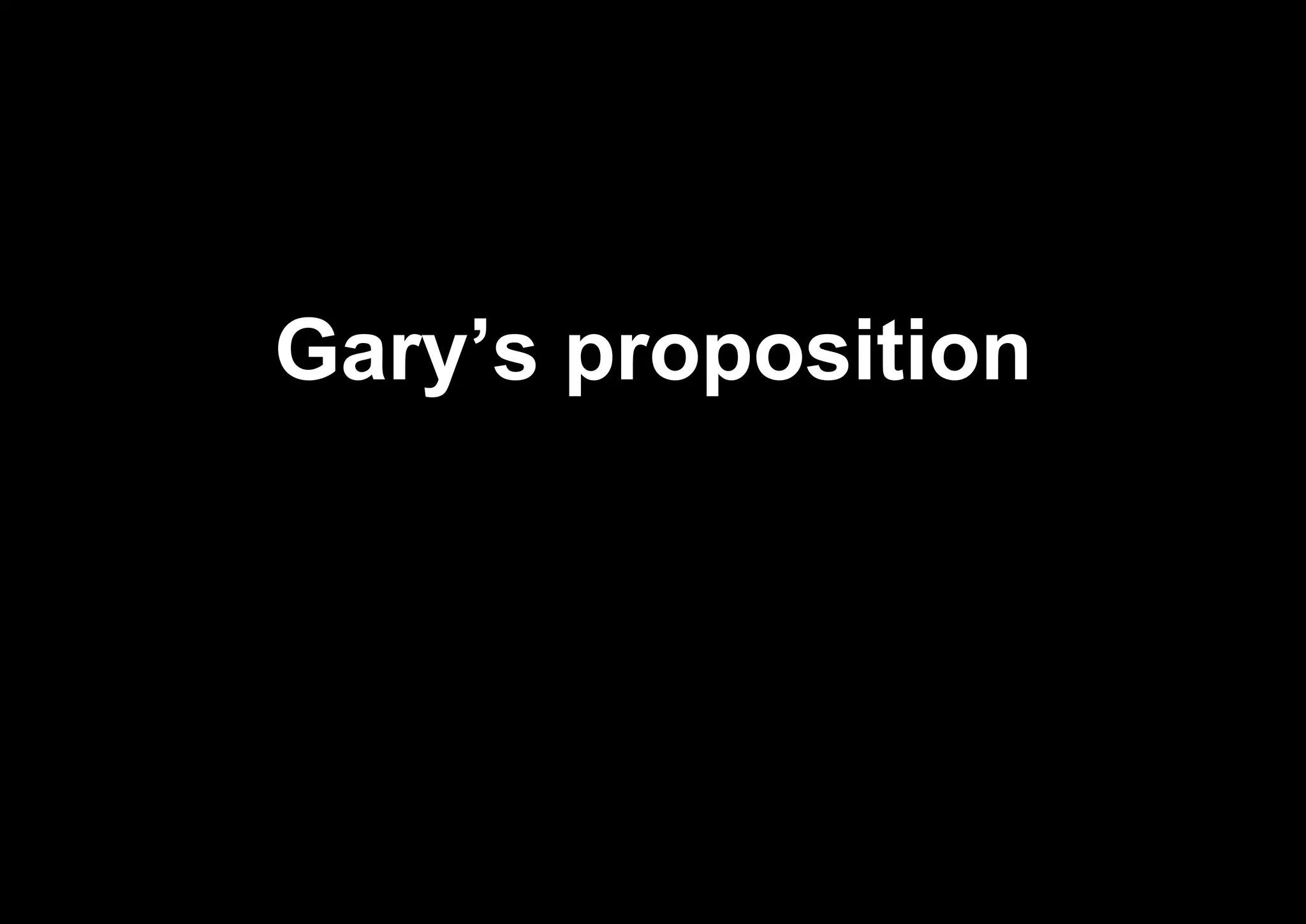
One of these books (and an animated
movie) was an inspiration for the
creation and design of the company
that led to CharterMason
We’ll talk about this later...
Gary’s proposition
Management is now seriously out of
date…
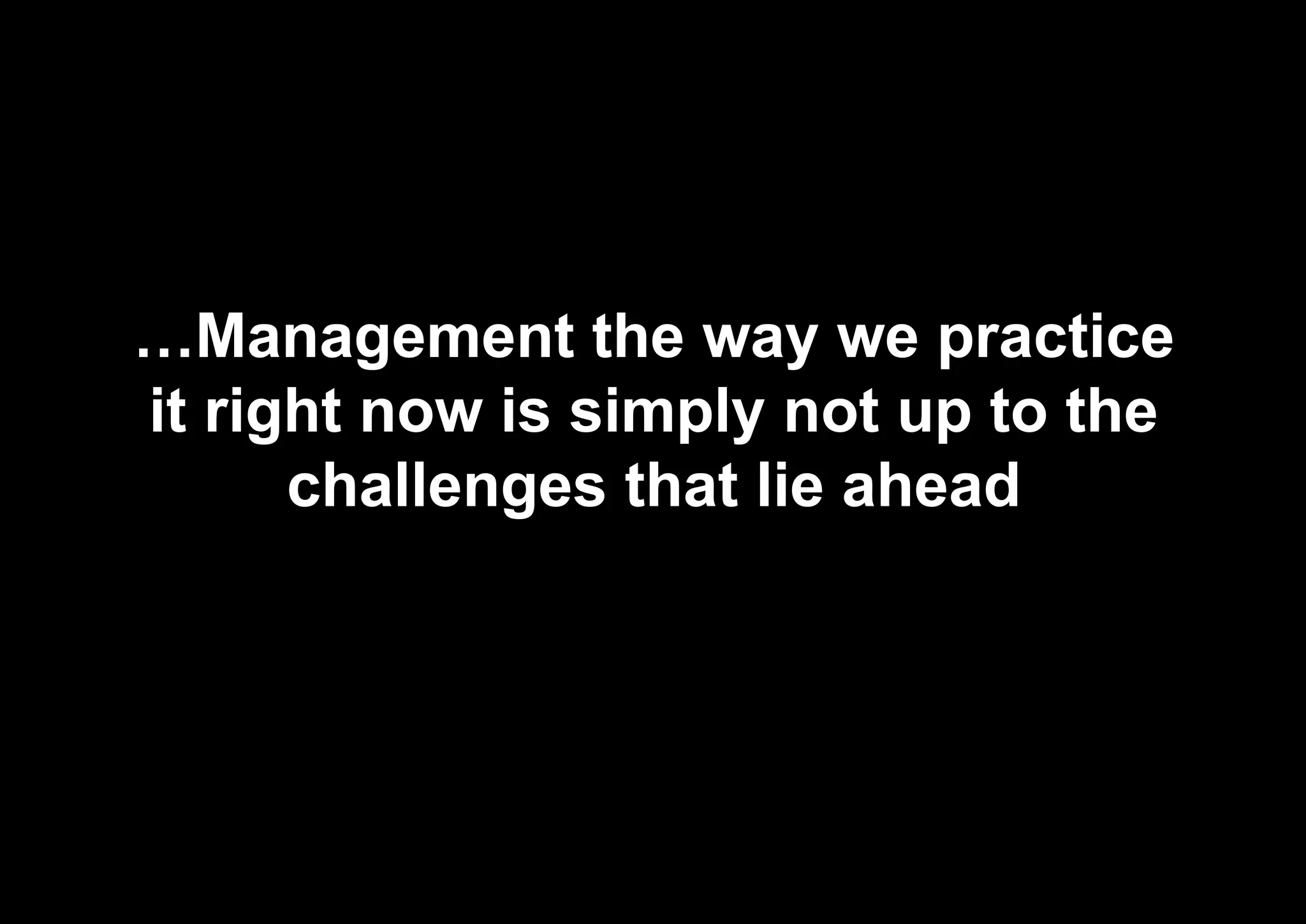
…Management the way we practice
it right now is simply not up to the
challenges that lie ahead
… unless we can reinvent
management, every bit as
dramatically as we have reinvented
our products or our operating
model, companies are not going to
succeed in the years ahead.
Gary’s objectives for life
"Rousing the human heart
at work"
Gary’s objectives for the
seminar
of what's possible
Raising aspirations
of the influence you can have
Raising aspirations
Gary’s Agenda for the Day
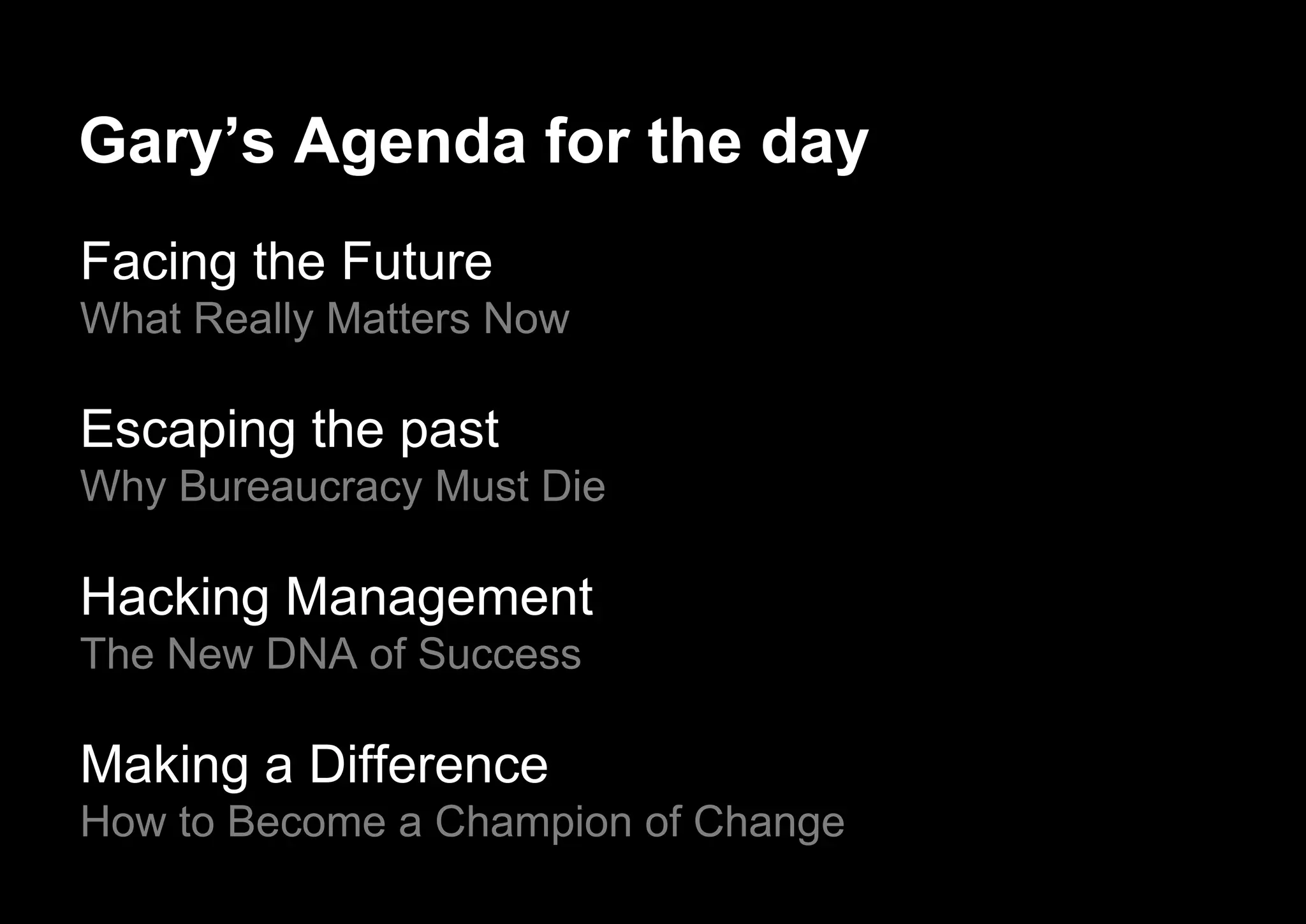
Gary’s Agenda for the day
Facing the Future
What Really Matters Now
Escaping the past
Why Bureaucracy Must Die
Hacking Management
The New DNA of Success
Making a Difference
How to Become a Champion of Change
What Really Matters Now
Facing the future
The depressing state of engagement
Gallup survey of employee engagement: [ONLY!]
13% of employees across 142 countries
worldwide are engaged in their jobs — that is,
they are emotionally invested in and focused on
creating value for their organizations every day.
The depressing state of engagement
In Australia and New Zealand we’re doing a little
better, 24% of adults who work for an employer
are engaged, while 60% are not engaged and
16% are actively disengaged.
So a quarter of your team want to play for you,
most don’t really care and a sixth don’t even
want to be on the pitch.
Who wants to be runner-up “least worst”?
[My] favourite Hamel’isms
“Change Management is an oxymoron”
“What matters now is not resources but resourcefulness”
“In 1987 60% of computing powerwas in hand held calculators”
“More of the same isn't
going to get us there”Management 1.0 was designed to
excise irregularity
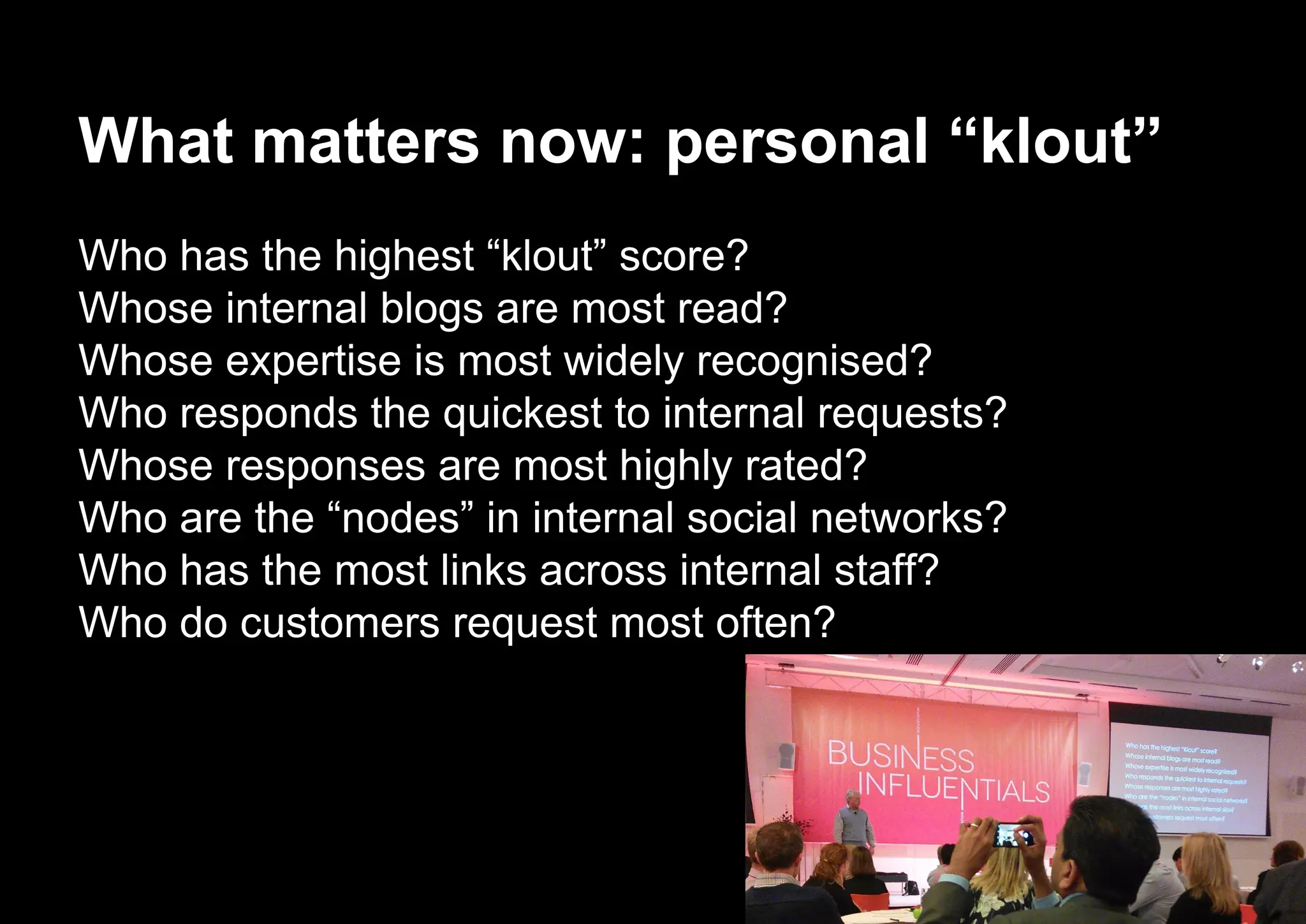
What matters now: personal “klout”
Who has the highest “klout” score?
Whose internal blogs are most read?
Whose expertise is most widely recognised?
Who responds the quickest to internal requests?
Whose responses are most highly rated?
Who are the “nodes” in internal social networks?
Who has the most links across internal staff?
Who do customers request most often?
Why Bureaucracy Must Die
Escaping the past
The German sociologist Max Weber argued that bureaucracy
constitutes the most efficient and rational way in which human activity
can be organized, and that systematic processes and organized
hierarchies were necessary to maintain order, maximize efficiency
and eliminate favoritism. But even Weber saw unfettered bureaucracy
as a threat to individual freedom, in which an increase in the
bureaucratization of human life can trap individuals in an "iron cage"
of rule-based, rational control - Wikipedia
Innovation is irregularity
What made us successful in the past will kill us in the future - Jeff
Wareing (CharterMason)
Bureaucracy was designed to excise
irregularity
What’s wrong with
organisations?
What’s wrong with organisations
Inertia - too slow
Incremental - too short-sighted
Sterile - no (really different) ideas
“We are captives of a paradigm that places the
pursuit of efficiency ahead of every other goal”
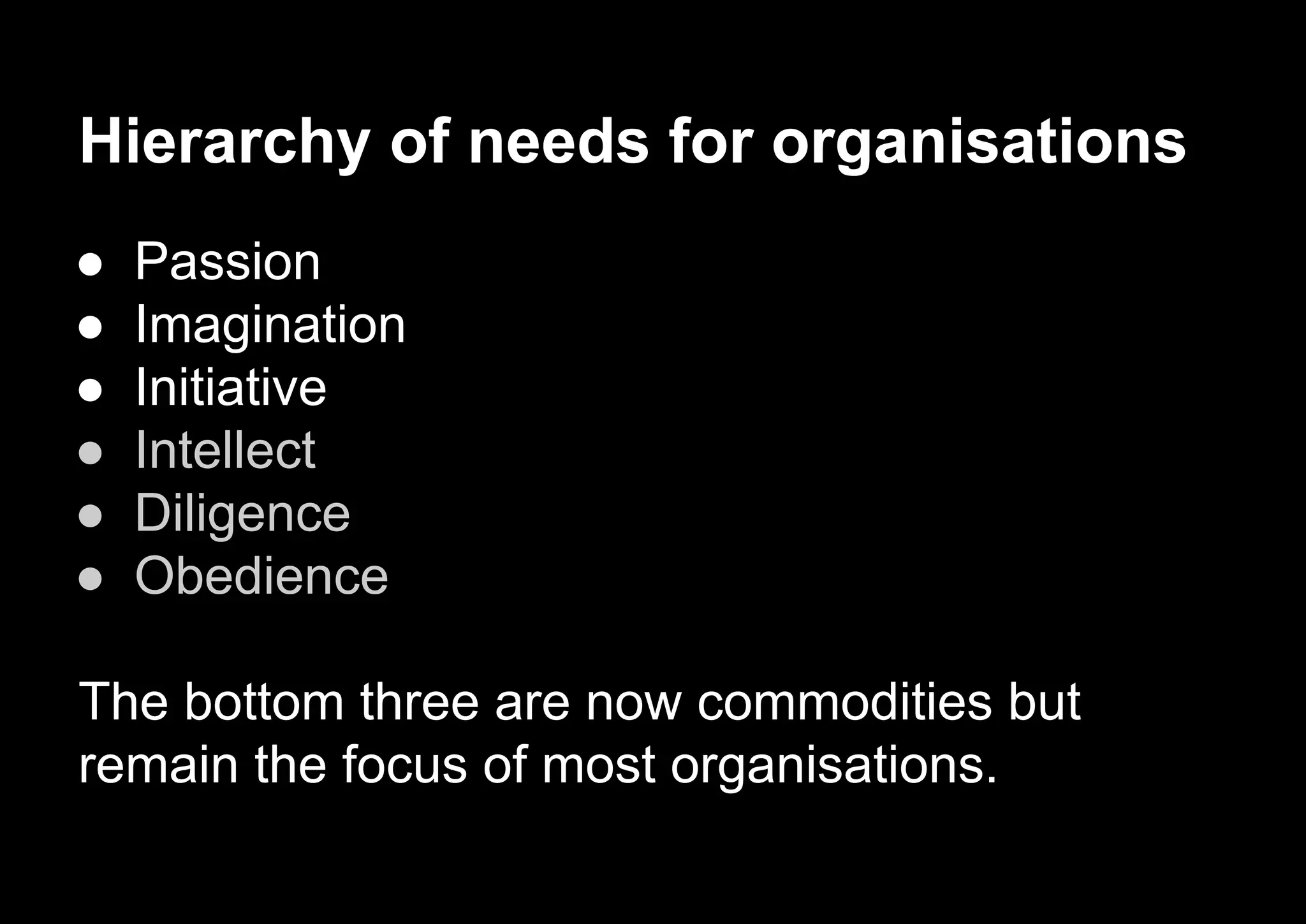
Hierarchy of needs for organisations
● Passion
● Imagination
● Initiative
● Intellect
● Diligence
● Obedience
The bottom three are now commodities but
remain the focus of most organisations.
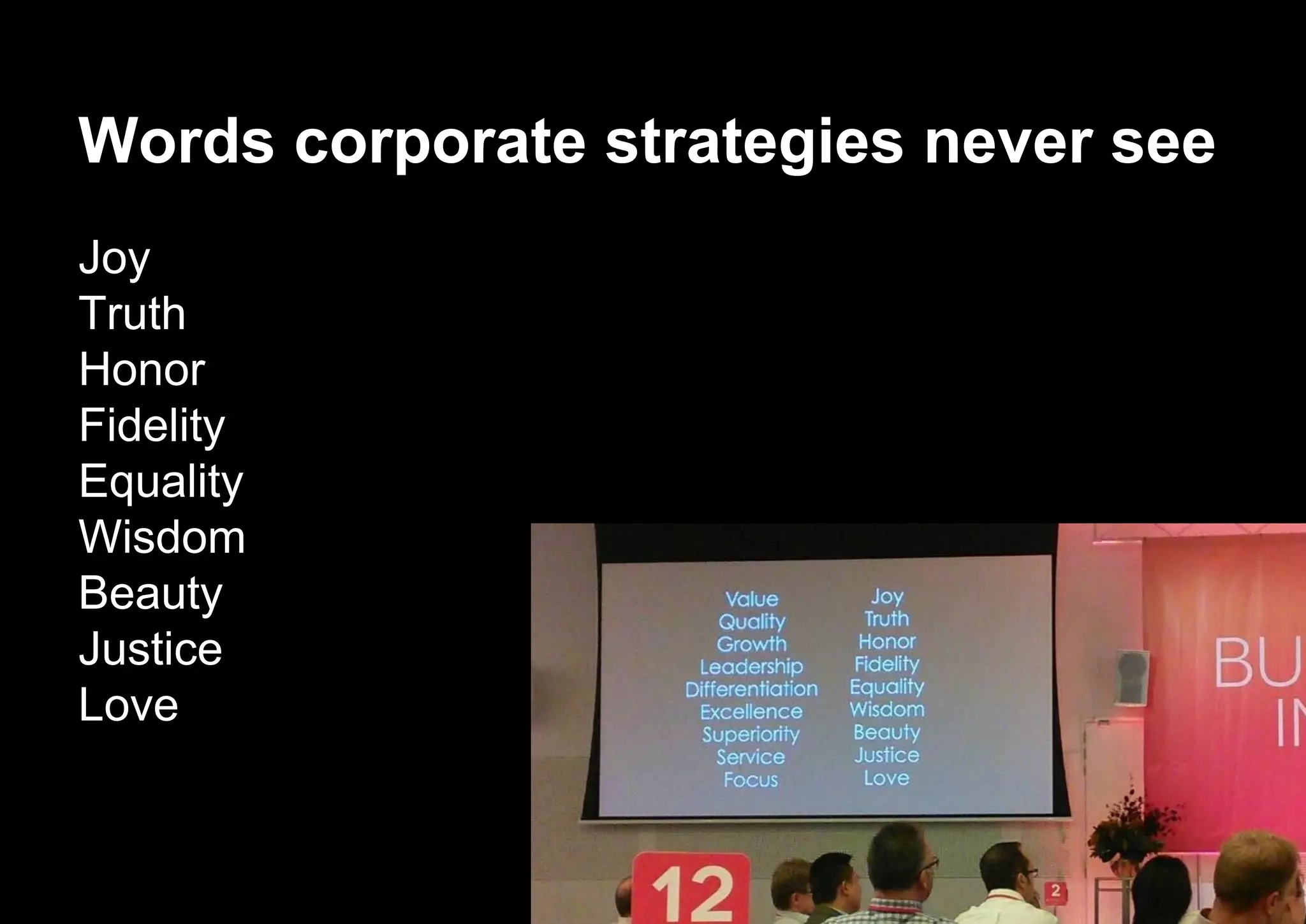
Words corporate strategies never see
Joy
Truth
Honor
Fidelity
Equality
Wisdom
Beauty
Justice
Love
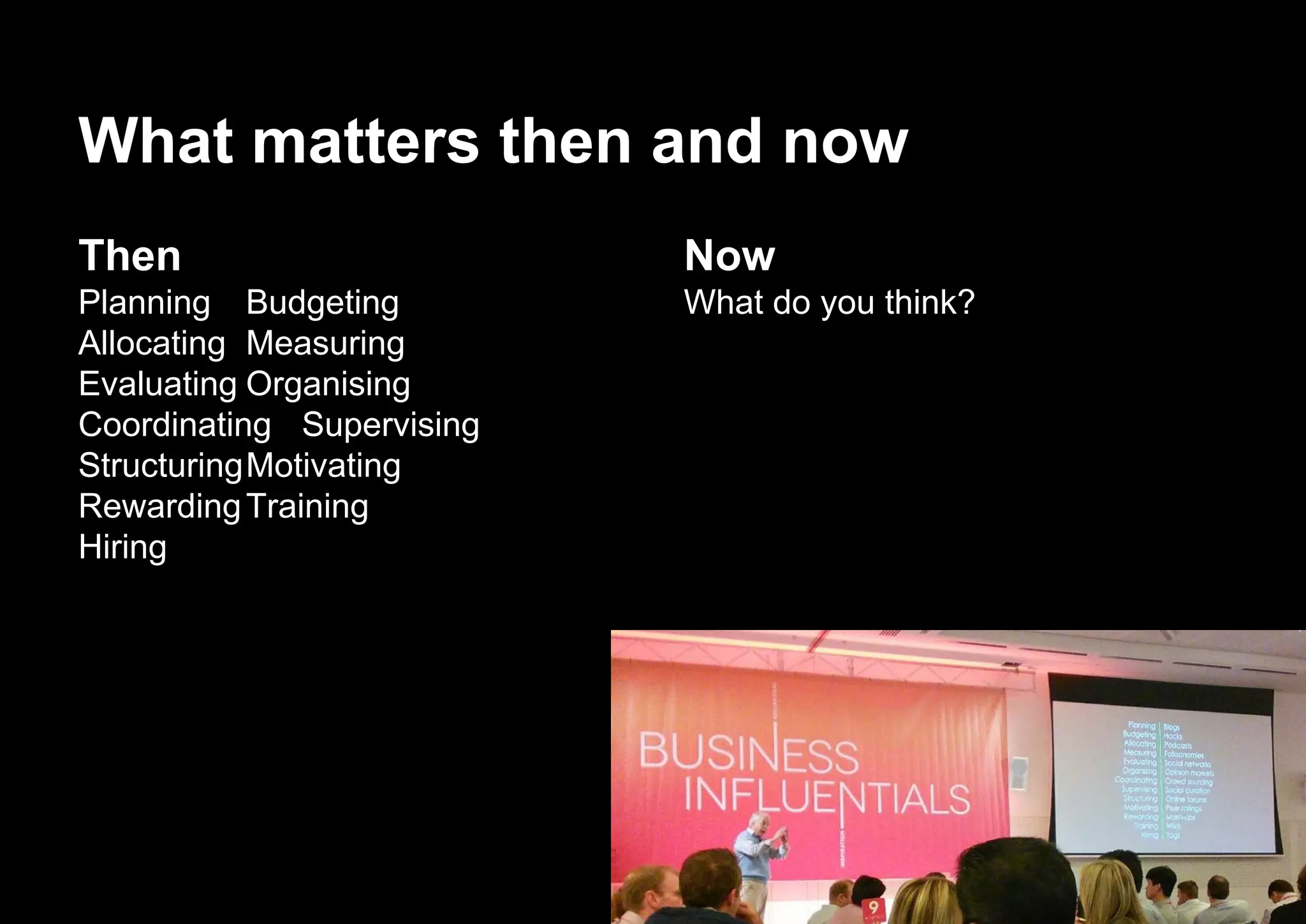
What matters then and now
Then
Planning Budgeting
Allocating Measuring
Evaluating Organising
Coordinating Supervising
StructuringMotivating
RewardingTraining
Hiring
Now
What do you think?
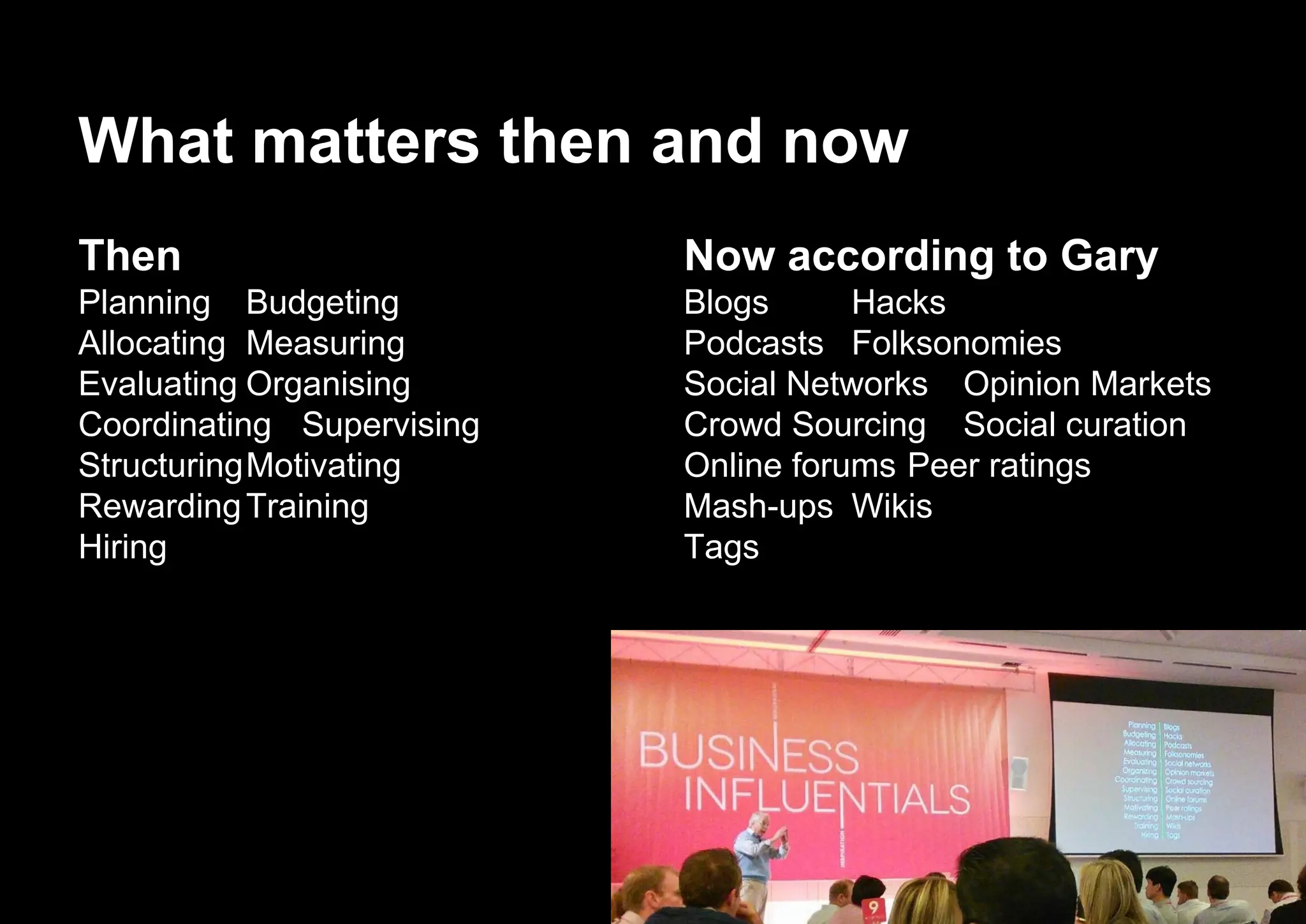
What matters then and now
Then
Planning Budgeting
Allocating Measuring
Evaluating Organising
Coordinating Supervising
StructuringMotivating
RewardingTraining
Hiring
Now according to Gary
Blogs Hacks
Podcasts Folksonomies
Social Networks Opinion Markets
Crowd Sourcing Social curation
Online forums Peer ratings
Mash-ups Wikis
Tags
The New DNA of Success
Hacking Management
The New DNA of Success
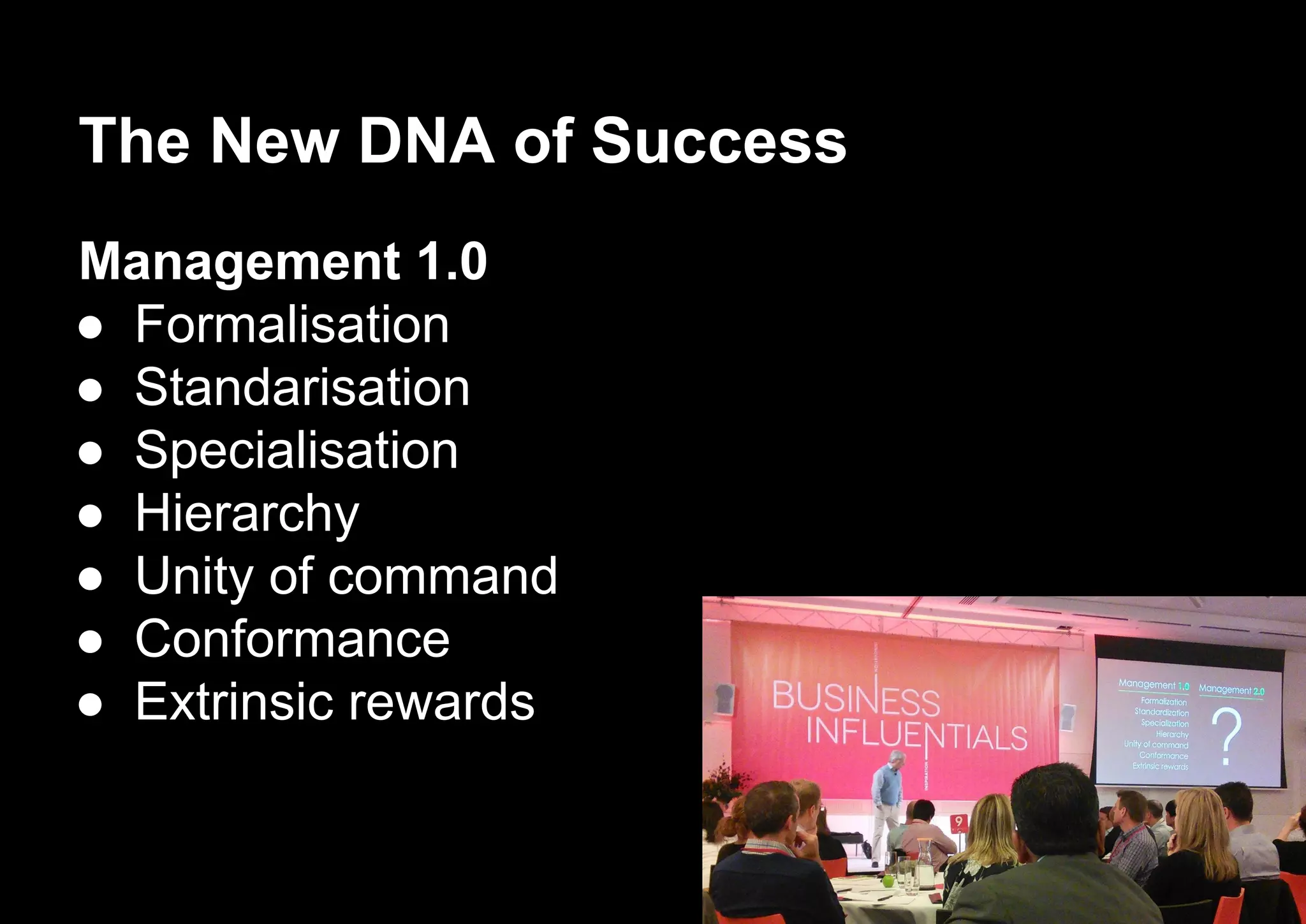
Management 1.0
● Formalisation
● Standarisation
● Specialisation
● Hierarchy
● Unity of command
● Conformance
● Extrinsic rewards
The New DNA of Success
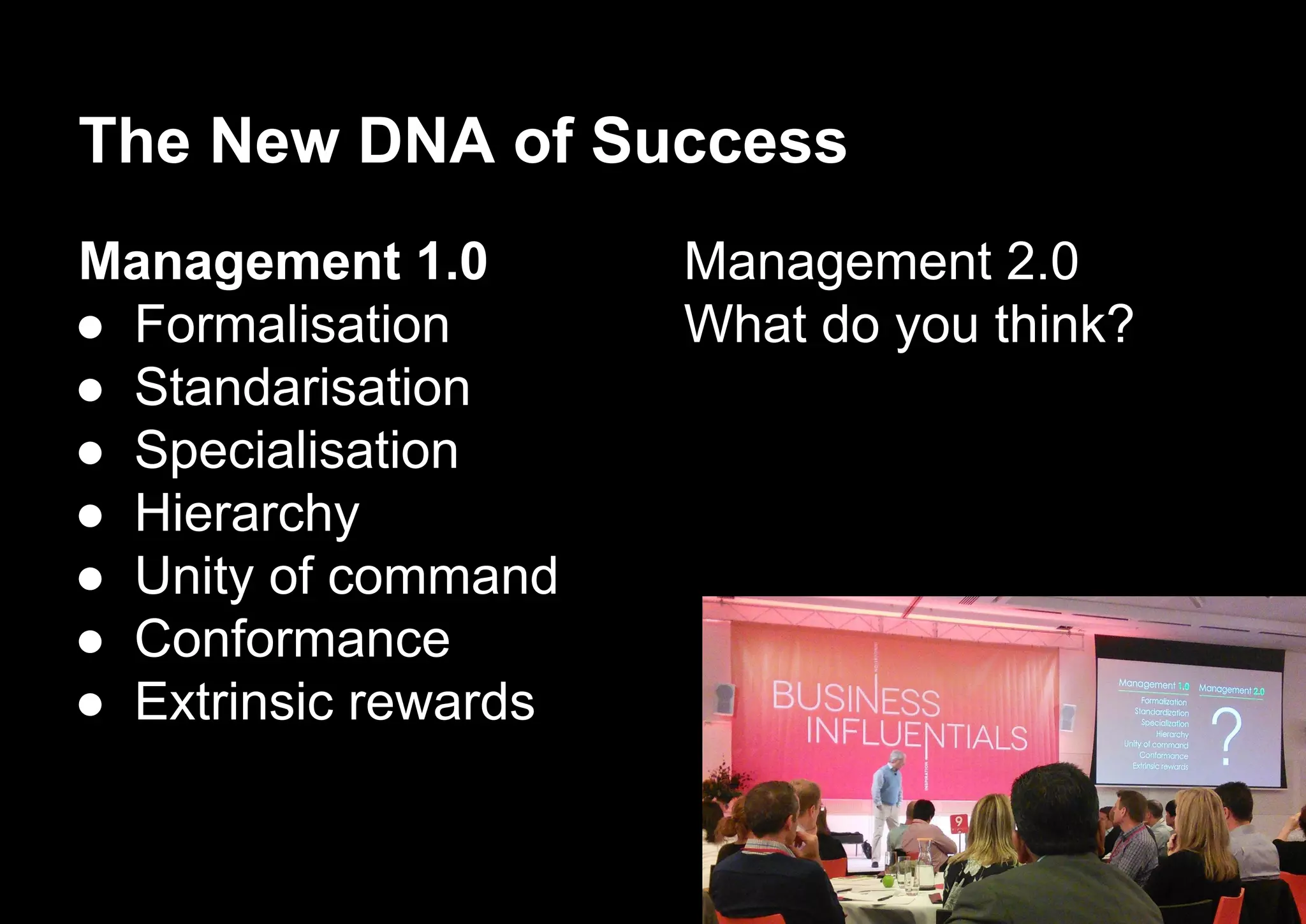
Management 1.0
● Formalisation
● Standarisation
● Specialisation
● Hierarchy
● Unity of command
● Conformance
● Extrinsic rewards
Management 2.0
What do you think?
Management 1.0 vs 2.0
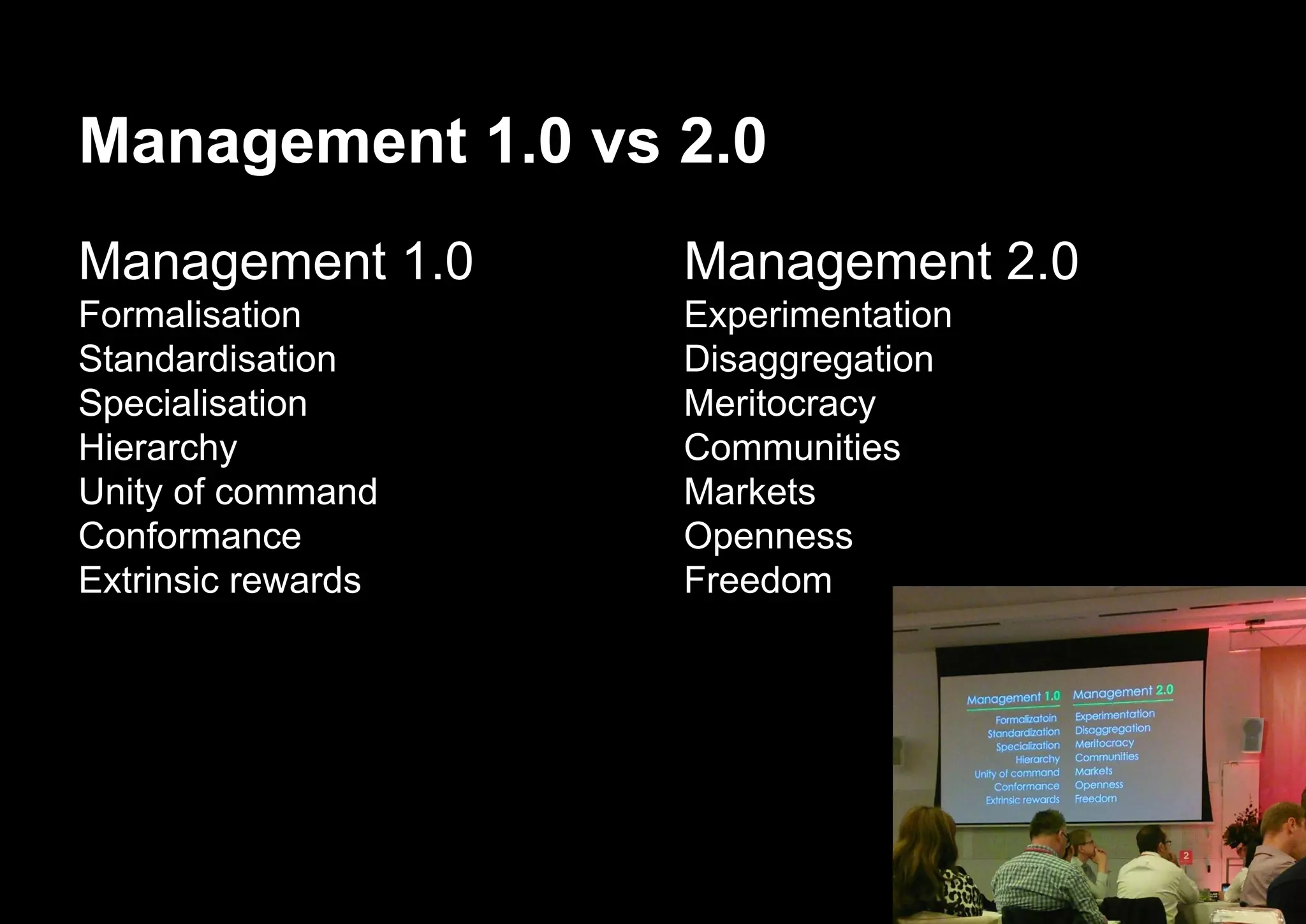
Management 1.0
Formalisation
Standardisation
Specialisation
Hierarchy
Unity of command
Conformance
Extrinsic rewards
Management 2.0
Experimentation
Disaggregation
Meritocracy
Communities
Markets
Openness
Freedom
Gary’s stories about the company’s that he
admires most right now
Companies that Gary
admires
“Create useful products people lust after”
Atlassian
Atlassian
12 Year Old Australian Software Company
2010 USD 60m Investment by Accel Partners
valued the company at ~ USD 3.5bn
2014 revenues ~ USD150m
800+ employees
Makes software tools to plan, collaborate, code
and service
Offices in Australia, US, Netherlands
Atlassian’s Values
Open Company, No Bullshit
Atlassian embraces transparency wherever
practical, and sometimes where impractical. All
information, both internal and external, is public
by default. We are not afraid of being honest with
ourselves, our staff, and our customers.
Build with Heart and Balance
Every day we try to build useful products that
people lust after. Building with heart means really
caring about what we're making and doing–it's a
mission, not just a job. When we build with
balance we take into account how initiatives and
decisions will affect our colleagues, customers,
and stakeholders.
Don't #@!% the Customer
When we make decisions we ask ourselves,
"How will this affect our customers?" If the
answer is that it would screw them over, or make
life more difficult, then we need to find a better
way. We want the customer to respect us in the
morning.
Play as a team
We want all Atlassians to feel like they work with
Atlassian, not for Atlassian. We think it's
important to have fun with your workmates while
working and contributing to the Atlassian team.
Be the change you seek
We think Gandhi had it right when he said, "We
need to be the change we wish to see in the
world". At Atlassian we encourage everyone to
create positive change. We're constantly looking
for ways to improve our company, our products,
and our environment.
Atlassian Structure
Based on an extended Agile model where all
offices in all locations are organised as small
teams.
Performance Reviews turned into weekly
coaching sessions with a simple 2 dimensional
scale (no grid) with assessment of performance
every 6 months.
“The coolest company in Australia”? BRW
Morning Star
Morning Star is serious company
Largest US Grower and Processor of tomatoes
(40% of US market in paste and diced
tomatoes).
Processes 1100 tons+ of tomatoes per hour.
Several processing plants and farms
400 full-time plus 2400 harvest time employees
Operating in an industry renowned for poor
industrial relations and worker conditions
Yet this is a company where...
● No one has a boss
● Employees negotiate responsibilities with their
peers
● Everyone can spend the company’s money
without limits
● Each individual is responsible for acquiring the
tools needed to do his or her work
● There are no titles and no promotions
● Compensation decisions are peer-based
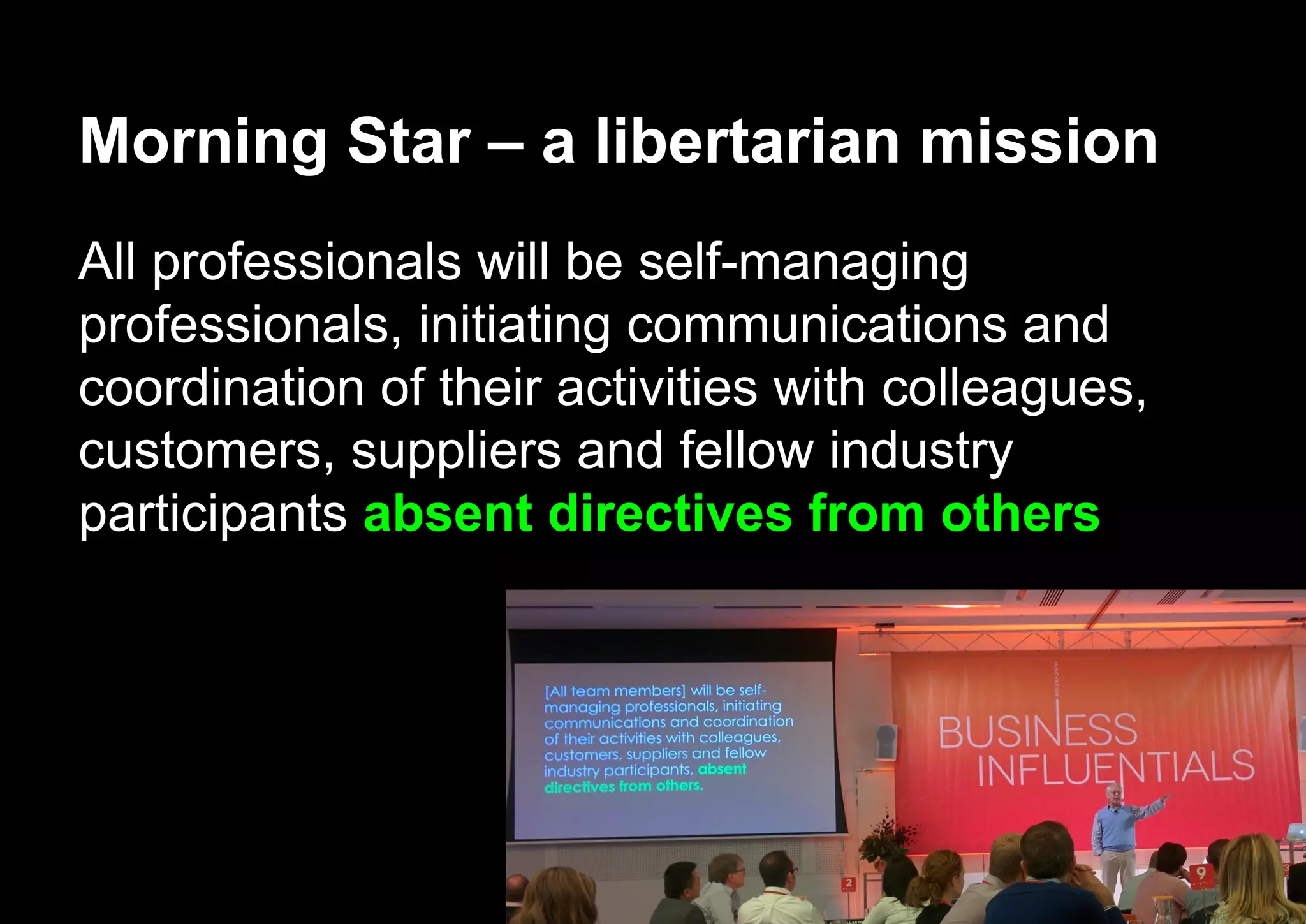
Morning Star – a libertarian mission
All professionals will be self-managing
professionals, initiating communications and
coordination of their activities with colleagues,
customers, suppliers and fellow industry
participants absent directives from others
The Morning Star Model
• Make the mission the boss - at a personal level
• Let employees forge agreements
Colleague Letter Of Understanding (CLOU). Every Year. Also
between Units (processing plants, logistics, farms etc)
• Empower Everyone - Truly. Not trickled down but built in
• Don’t force people into boxes
• Encourage competition for impact, not promotions
• Freedom to succeed [this is libertarianism, not communism]
• Conflict resolution and due process
• Peer review and the challenge process
W.L. Gore & Associates
Gore
Gore is significant global force
Makes innovative, technology-driven solutions,
from medical devices that treat aneurysms to
high-performance GORE‑TEX® fabrics.
Privately held, annual USD 3 billion+ annual
sales.
10,000 employees, called associates, with
manufacturing facilities in the United States,
Germany, the United Kingdom, Japan and
China, and sales offices around the world.
Four principles for Associates
1. Fairness to each other and everyone with whom we
come in contact
2. Freedom to encourage, help, and allow other associates
to grow in knowledge, skill, and scope of responsibility
3. The ability to make one's own commitments and keep
them
4. Consultation with other associates before undertaking
actions that could impact the reputation of the company
How does Gore make it work
Associates are hired for general work areas.
With the guidance of their sponsors (not bosses)
and a growing understanding of opportunities
and team objectives, Associates commit to
projects that match their skills.
All of this takes place in an environment that
combines freedom with cooperation and
autonomy with synergy.
How does leadership work?
Everyone can earn the credibility to define and
drive projects. Leaders may be appointed, but
are defined by 'followership.' More often, leaders
emerge naturally by demonstrating special
knowledge, skill, or experience that advances a
business objective.
Choosing the new Gore CEO
When Chuck Carroll retired in 2005, the board
polled a wide cross-section of Gore employees
asking who they’d be willing to follow, they could
nominate anyone in the company.
One of those employees was Terri Kelly, who
had joined Gore as a graduate in Engineering in
‘83.
To Terri’s surprise, the new CEO turned out to
be her.
Followership in action.
Gary’s stories on how to become a Champion
of Change
Making a Difference
Example: UK Health Service
5th largest employer in the world (after the US DoD,
Red Army, Walmart, and McDonalds)
A million patients use its services every day.
Not known for its agility
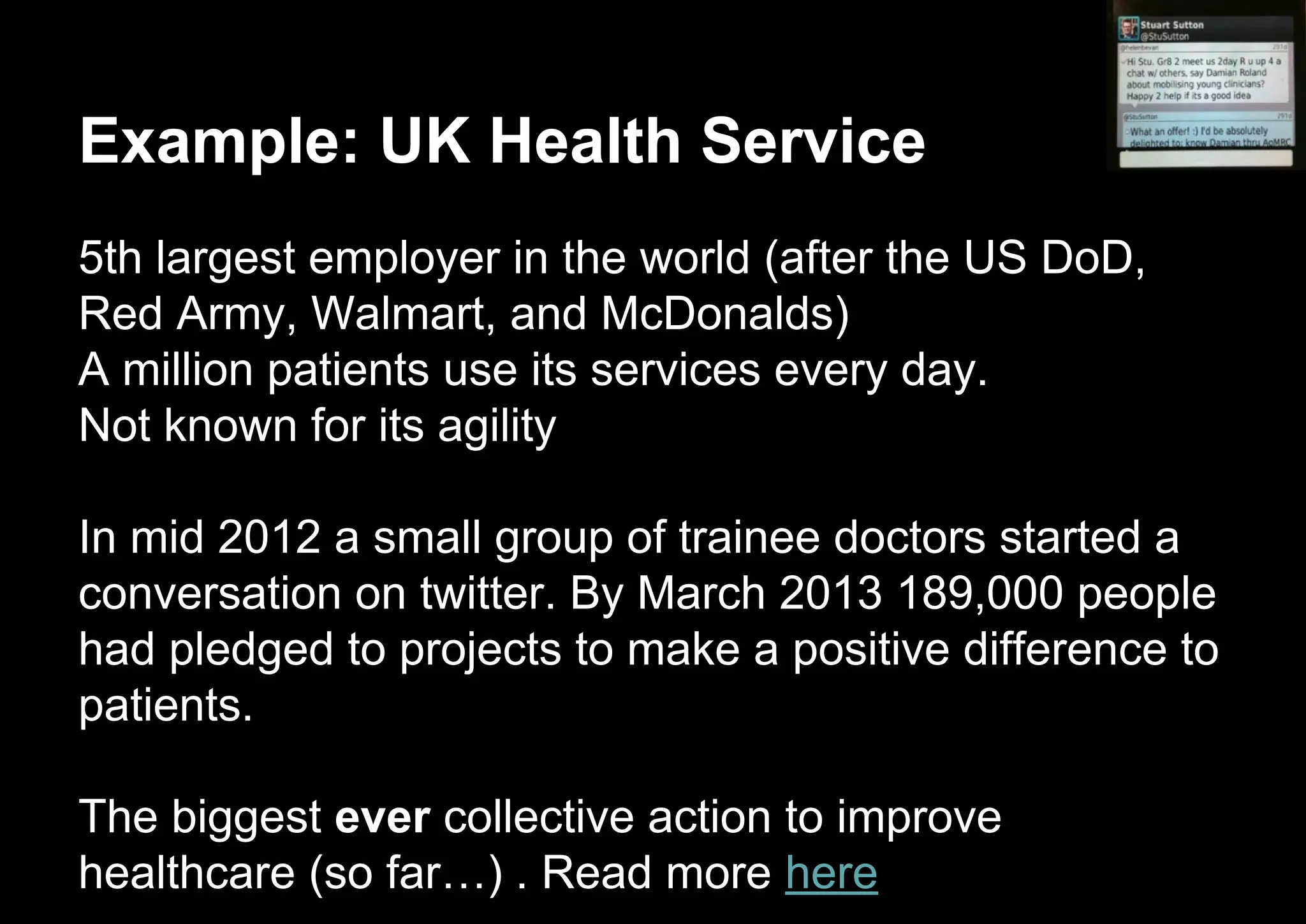
In mid 2012 a small group of trainee doctors started a
conversation on twitter. By March 2013 189,000 people
had pledged to projects to make a positive difference to
patients.
The biggest ever collective action to improve
healthcare (so far…) . Read more here
Some tools of the
revolutionaries trade
How to run an innovation market
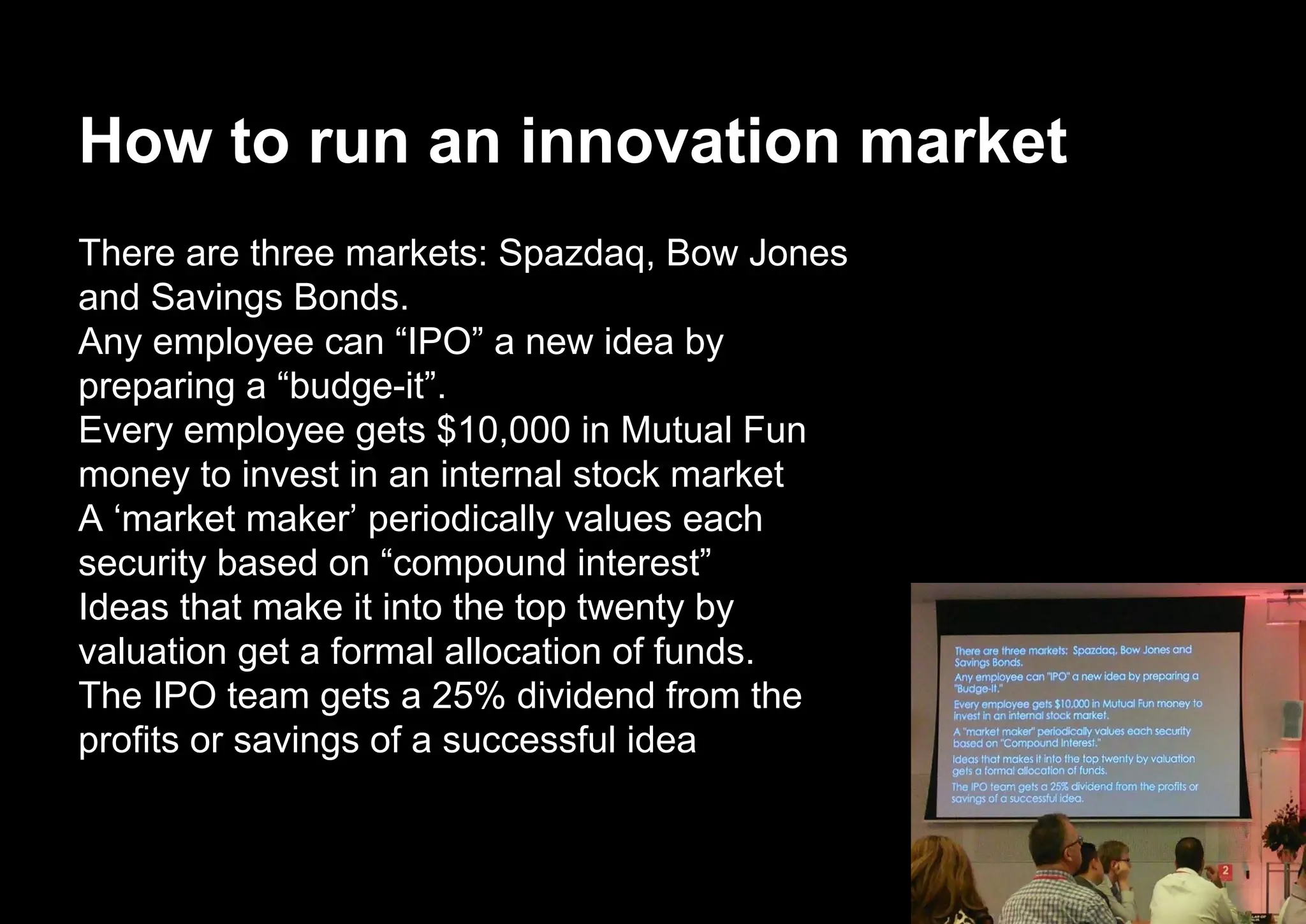
There are three markets: Spazdaq, Bow Jones
and Savings Bonds.
Any employee can “IPO” a new idea by
preparing a “budge-it”.
Every employee gets $10,000 in Mutual Fun
money to invest in an internal stock market
A ‘market maker’ periodically values each
security based on “compound interest”
Ideas that make it into the top twenty by
valuation get a formal allocation of funds.
The IPO team gets a 25% dividend from the
profits or savings of a successful idea
A call to arms
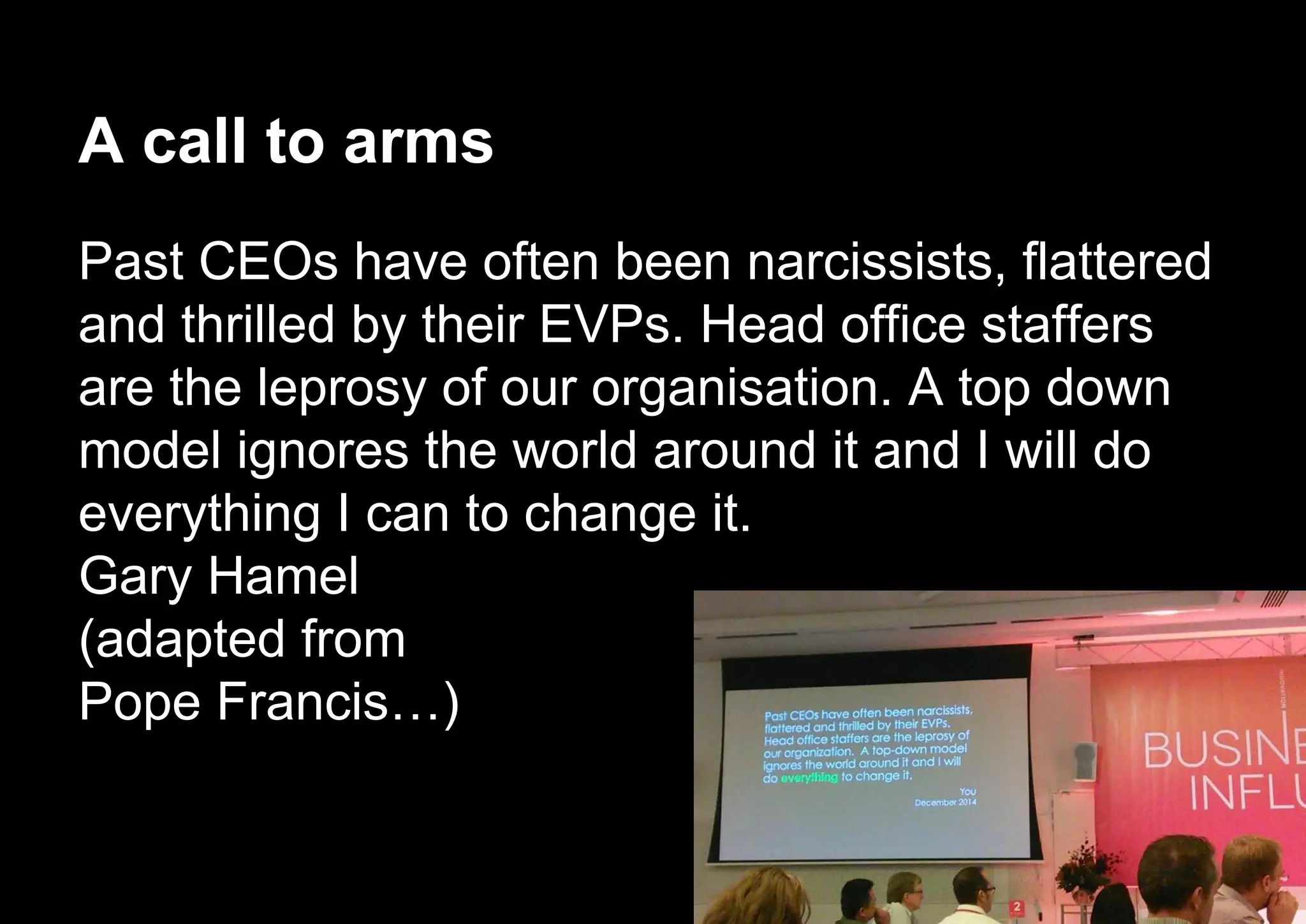
Past CEOs have often been narcissists, flattered
and thrilled by their EVPs. Head office staffers
are the leprosy of our organisation. A top down
model ignores the world around it and I will do
everything I can to change it.
Gary Hamel
(adapted from
Pope Francis…)
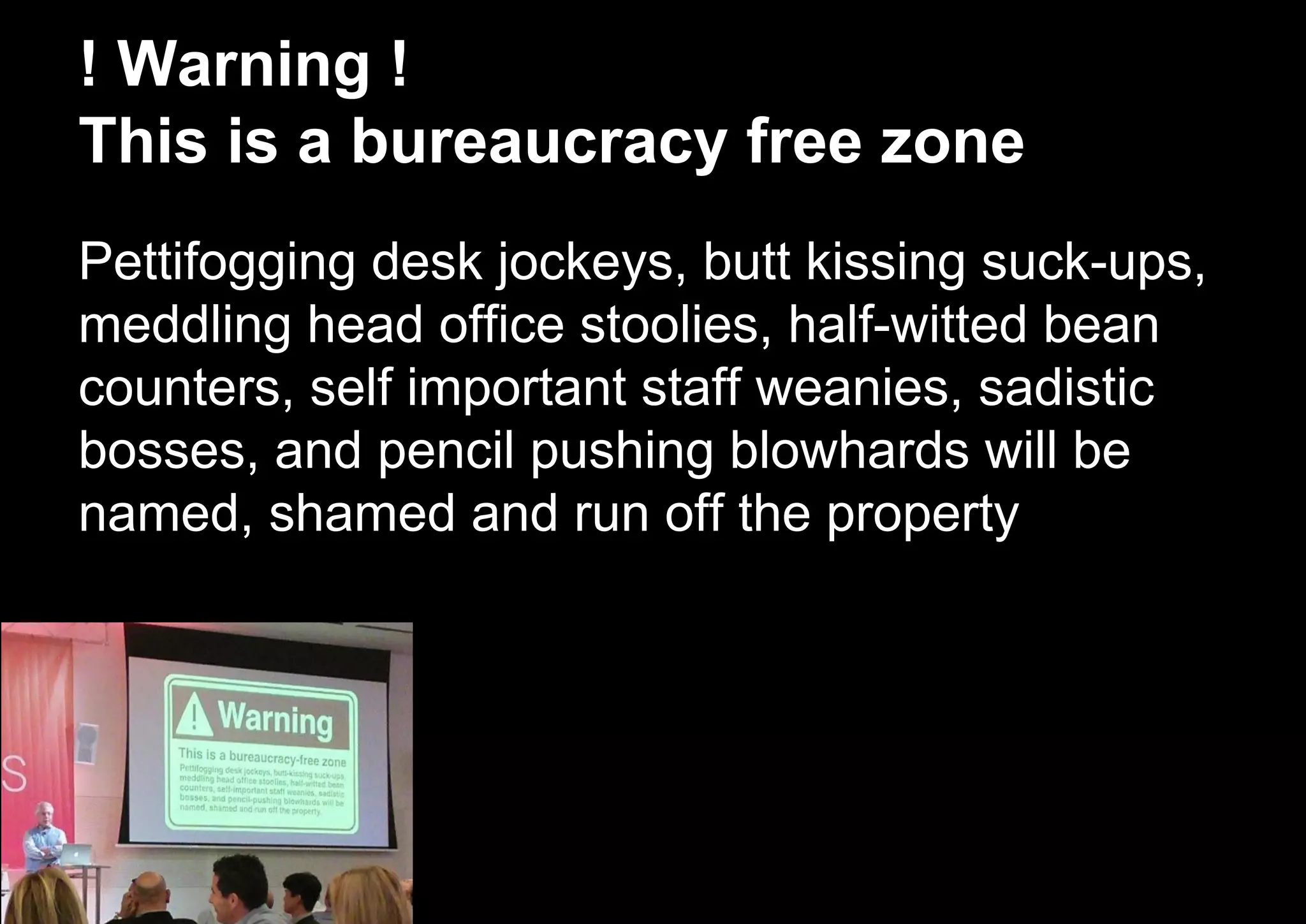
! Warning !
This is a bureaucracy free zone
Pettifogging desk jockeys, butt kissing suck-ups,
meddling head office stoolies, half-witted bean
counters, self important staff weanies, sadistic
bosses, and pencil pushing blowhards will be
named, shamed and run off the property
Which book inspired the
creation of the company
that led to CharterMason?
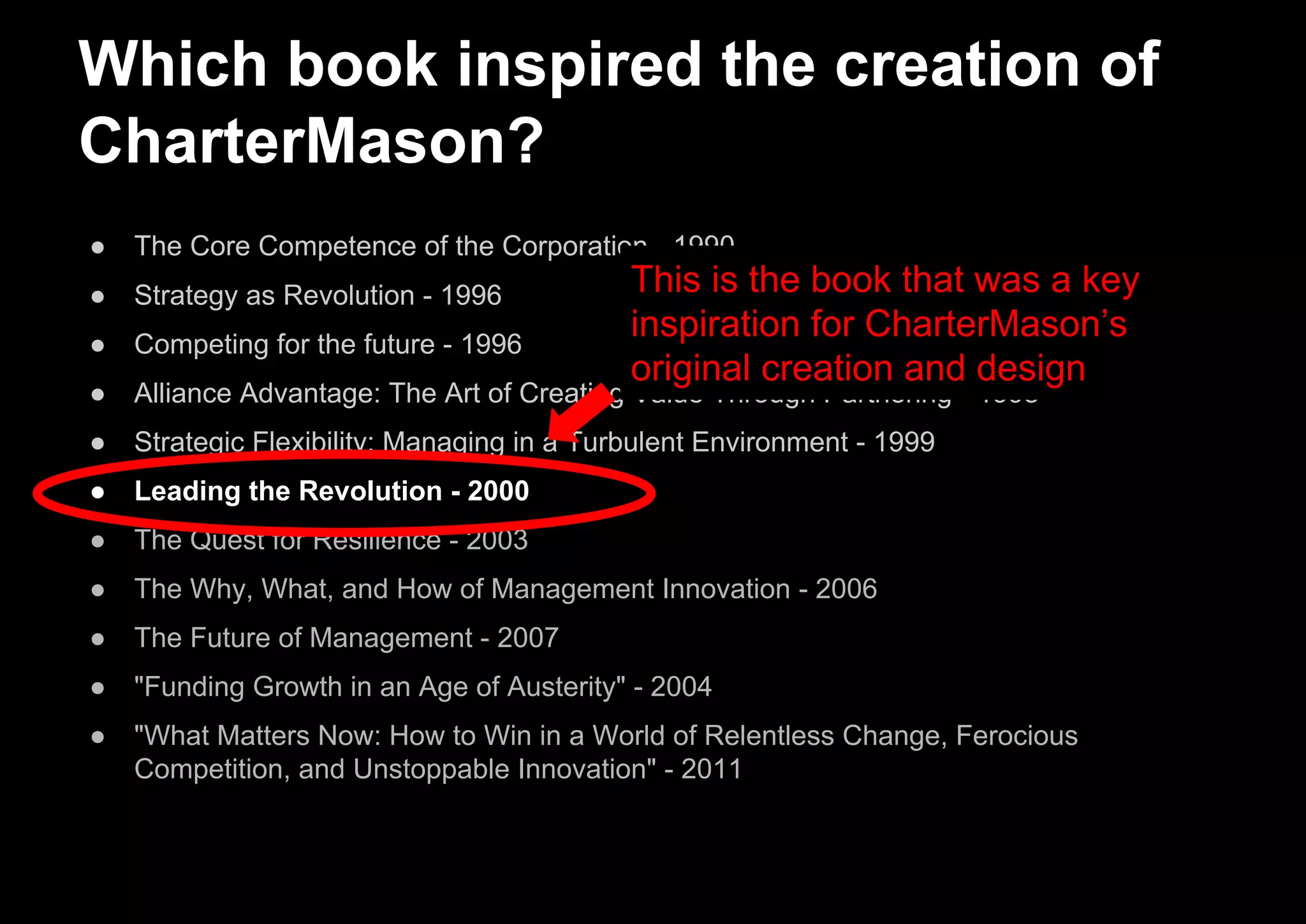
Which book inspired the creation of
CharterMason?
● The Core Competence of the Corporation - 1990
● Strategy as Revolution - 1996
● Competing for the future - 1996
● Alliance Advantage: The Art of Creating Value Through Partnering - 1998
● Strategic Flexibility: Managing in a Turbulent Environment - 1999
● Leading the Revolution - 2000
● The Quest for Resilience - 2003
● The Why, What, and How of Management Innovation - 2006
● The Future of Management - 2007
● "Funding Growth in an Age of Austerity" - 2004
● "What Matters Now: How to Win in a World of Relentless Change, Ferocious
Competition, and Unstoppable Innovation" - 2011
This is the book that was a key
inspiration for CharterMason’s
original creation and design
Which film character
inspired the initial
company name?
In the 1998 film by Dreamworks, Ant ‘Z’ voiced by Woody Allen was the freedom
seeking individual who dared to challenge convention
The lead character ‘Z’
from Dreamworks’ “Antz”
What’s Gary’s latest
endeavour?
Management Innovation Exchange
“MIX”
http://www.managementexchange.com/
Website designed to allow management
“hackers” to share ideas, content, stories, and
recognise award winning hacks.
Lots of good content, including the stories told
today, in full, from their original authors.
Worth checking out.
What do you think?
What do you think?
Do you agree with Gary about what matters
now?
Is CharterMason ready for what matters now?
Are our clients ready for what matters now?
Are you ready for what matters now?
Could we be a poster company for Gary?
What would Gary do?
What will you do?
End
Extra material
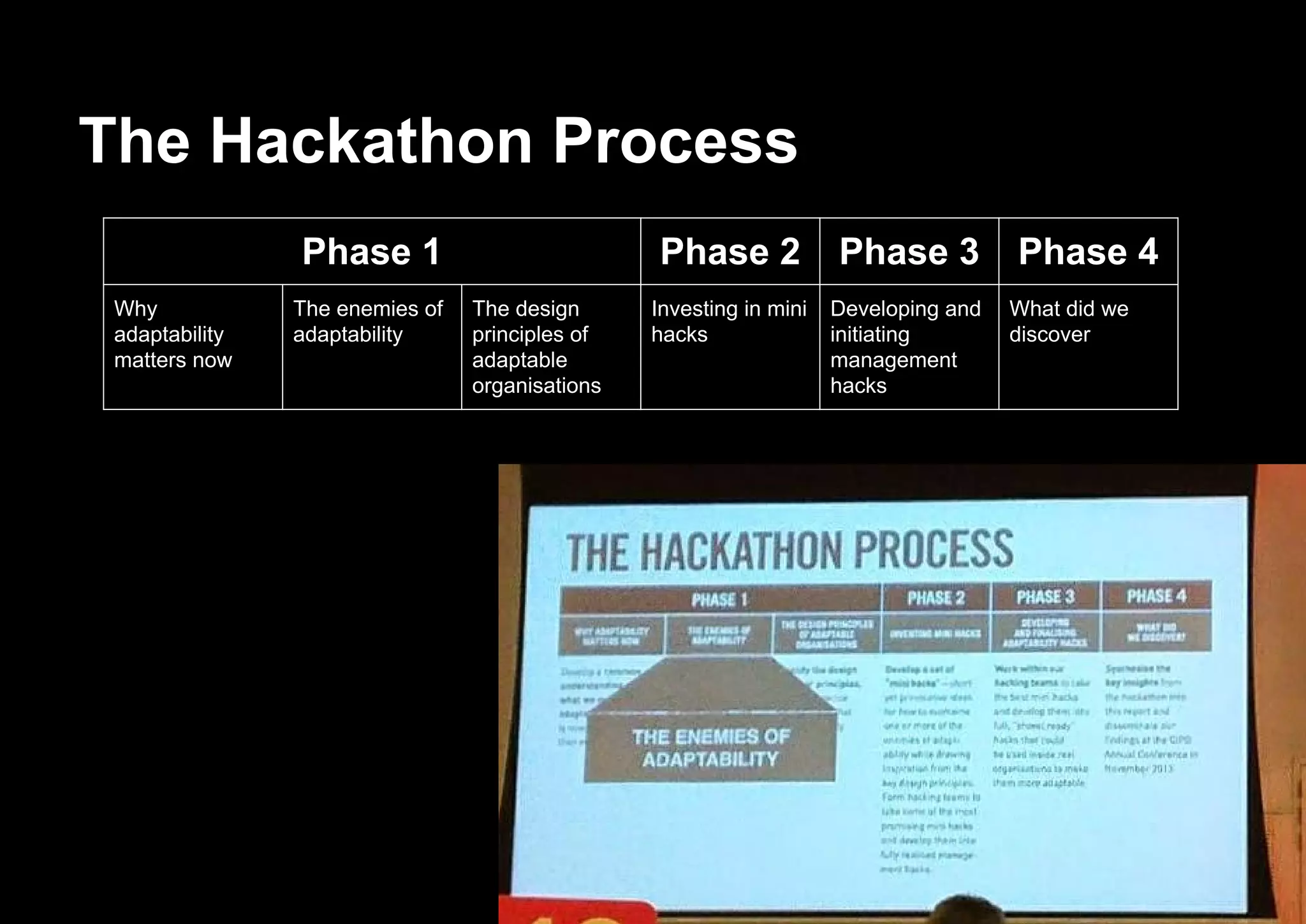
The Hackathon Process
Phase 1 Phase 2 Phase 3 Phase 4
Why
adaptability
matters now
The enemies of
adaptability
The design
principles of
adaptable
organisations
Investing in mini
hacks
Developing and
initiating
management
hacks
What did we
discover
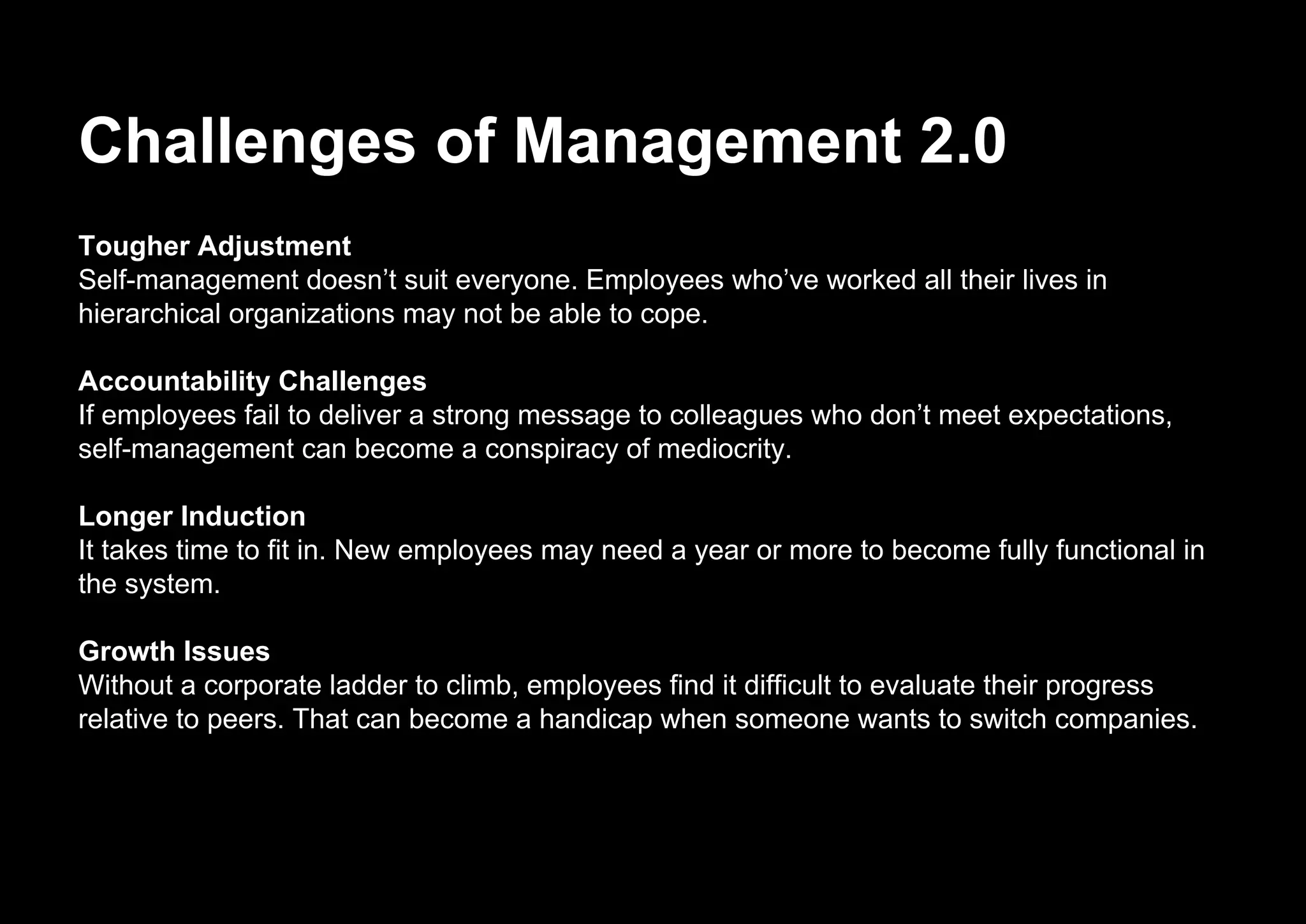
Challenges of Management 2.0
Tougher Adjustment
Self-management doesn’t suit everyone. Employees who’ve worked all their lives in
hierarchical organizations may not be able to cope.
Accountability Challenges
If employees fail to deliver a strong message to colleagues who don’t meet expectations,
self-management can become a conspiracy of mediocrity.
Longer Induction
It takes time to fit in. New employees may need a year or more to become fully functional in
the system.
Growth Issues
Without a corporate ladder to climb, employees find it difficult to evaluate their progress
relative to peers. That can become a handicap when someone wants to switch companies.
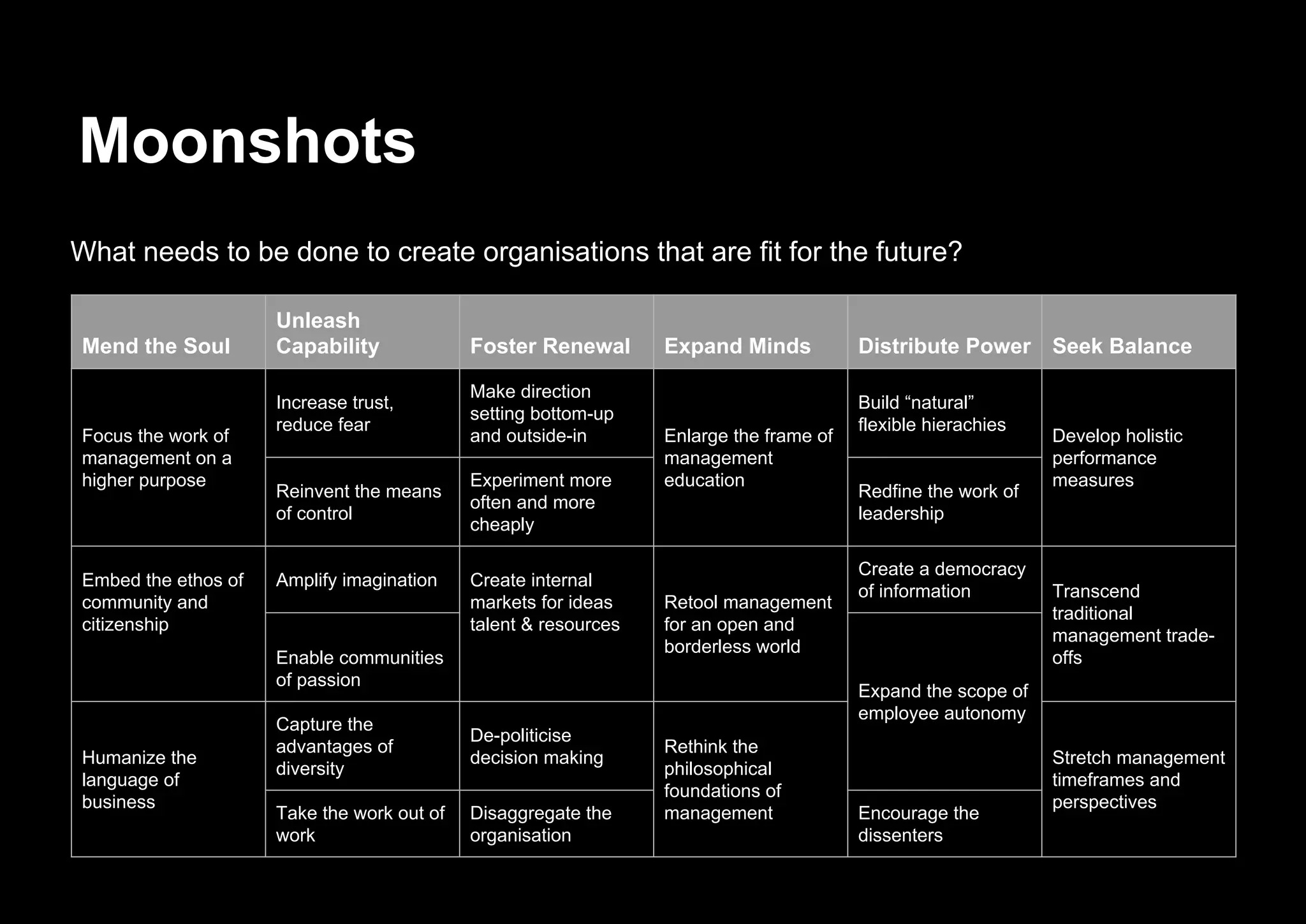
Moonshots
Mend the Soul
Unleash
Capability Foster Renewal Expand Minds Distribute Power Seek Balance
Focus the work of
management on a
higher purpose
Increase trust,
reduce fear
Make direction
setting bottom-up
and outside-in Enlarge the frame of
management
education
Build “natural”
flexible hierachies
Develop holistic
performance
measures
Reinvent the means
of control
Experiment more
often and more
cheaply
Redfine the work of
leadership
Embed the ethos of
community and
citizenship
Amplify imagination Create internal
markets for ideas
talent & resources
Retool management
for an open and
borderless world
Create a democracy
of information Transcend
traditional
management trade-
offsEnable communities
of passion
Expand the scope of
employee autonomy
Humanize the
language of
business
Capture the
advantages of
diversity
De-politicise
decision making
Rethink the
philosophical
foundations of
management
Stretch management
timeframes and
perspectives
Take the work out of
work
Disaggregate the
organisation
Encourage the
dissenters
What needs to be done to create organisations that are fit for the future?

What Matters Now? Gary Hamel on how to win in a world of relentless change

  • 1.
    Notes from GaryHamel @profhamel Amcham Conference, Melbourne 8 Dec 2014 CharterMason perspective by John Phillips au.linkedin.com/in/johnphillips11kps What Matters Now?
  • 2.
    This slide packdeveloped from raw notes taken during conference + other readings
  • 3.
  • 4.
    core competencies international cross-subsidization strategicintent collaborative competition expeditionary marketing Hamel (with Prahalad) originated concepts such as ...
  • 5.
    He is visitingProfessor of Strategic Management at the London Business School.
  • 6.
    He was VisitingProfessor of International Business at the University of Michigan and at Harvard Business School.
  • 7.
    What has GaryHamel written?
  • 8.
    Gary’s Books (asof Dec 2014) ● The Core Competence of the Corporation - 1990 ● Strategy as Revolution - 1996 ● Competing for the future - 1996 ● Alliance Advantage: The Art of Creating Value Through Partnering - 1998 ● Strategic Flexibility: Managing in a Turbulent Environment - 1999 ● Leading the Revolution - 2000 ● The Quest for Resilience - 2003 ● The Why, What, and How of Management Innovation - 2006 ● The Future of Management - 2007 ● "Funding Growth in an Age of Austerity" - 2004 ● "What Matters Now: How to Win in a World of Relentless Change, Ferocious Competition, and Unstoppable Innovation" - 2011
  • 9.
    Gary’s Books ● TheCore Competence of the Corporation - 1990 ● Strategy as Revolution - 1996 ● Competing for the future - 1996 ● Alliance Advantage: The Art of Creating Value Through Partnering - 1998 ● Strategic Flexibility: Managing in a Turbulent Environment - 1999 ● Leading the Revolution - 2000 ● The Quest for Resilience - 2003 ● The Why, What, and How of Management Innovation - 2006 ● The Future of Management - 2007 ● "Funding Growth in an Age of Austerity" - 2004 ● "What Matters Now: How to Win in a World of Relentless Change, Ferocious Competition, and Unstoppable Innovation" - 2011 Also many articles for publications like Harvard Business Review and McKinsey Quarterly
  • 10.
    Gary’s Books ● TheCore Competence of the Corporation - 1990 ● Strategy as Revolution - 1996 ● Competing for the future - 1996 ● Alliance Advantage: The Art of Creating Value Through Partnering - 1998 ● Strategic Flexibility: Managing in a Turbulent Environment - 1999 ● Leading the Revolution - 2000 ● The Quest for Resilience - 2003 ● The Why, What, and How of Management Innovation - 2006 ● The Future of Management - 2007 ● "Funding Growth in an Age of Austerity" - 2004 ● "What Matters Now: How to Win in a World of Relentless Change, Ferocious Competition, and Unstoppable Innovation" - 2011 One of these books (and an animated movie) was an inspiration for the creation and design of the company that led to CharterMason We’ll talk about this later...
  • 11.
  • 12.
    Management is nowseriously out of date…
  • 13.
    …Management the waywe practice it right now is simply not up to the challenges that lie ahead
  • 14.
    … unless wecan reinvent management, every bit as dramatically as we have reinvented our products or our operating model, companies are not going to succeed in the years ahead.
  • 15.
  • 16.
    "Rousing the humanheart at work"
  • 17.
  • 18.
  • 19.
    of the influenceyou can have Raising aspirations
  • 20.
  • 21.
    Gary’s Agenda forthe day Facing the Future What Really Matters Now Escaping the past Why Bureaucracy Must Die Hacking Management The New DNA of Success Making a Difference How to Become a Champion of Change
  • 22.
    What Really MattersNow Facing the future
  • 23.
    The depressing stateof engagement Gallup survey of employee engagement: [ONLY!] 13% of employees across 142 countries worldwide are engaged in their jobs — that is, they are emotionally invested in and focused on creating value for their organizations every day.
  • 24.
    The depressing stateof engagement In Australia and New Zealand we’re doing a little better, 24% of adults who work for an employer are engaged, while 60% are not engaged and 16% are actively disengaged. So a quarter of your team want to play for you, most don’t really care and a sixth don’t even want to be on the pitch. Who wants to be runner-up “least worst”?
  • 25.
    [My] favourite Hamel’isms “ChangeManagement is an oxymoron” “What matters now is not resources but resourcefulness” “In 1987 60% of computing powerwas in hand held calculators” “More of the same isn't going to get us there”Management 1.0 was designed to excise irregularity
  • 26.
    What matters now:personal “klout” Who has the highest “klout” score? Whose internal blogs are most read? Whose expertise is most widely recognised? Who responds the quickest to internal requests? Whose responses are most highly rated? Who are the “nodes” in internal social networks? Who has the most links across internal staff? Who do customers request most often?
  • 27.
    Why Bureaucracy MustDie Escaping the past
  • 28.
    The German sociologistMax Weber argued that bureaucracy constitutes the most efficient and rational way in which human activity can be organized, and that systematic processes and organized hierarchies were necessary to maintain order, maximize efficiency and eliminate favoritism. But even Weber saw unfettered bureaucracy as a threat to individual freedom, in which an increase in the bureaucratization of human life can trap individuals in an "iron cage" of rule-based, rational control - Wikipedia Innovation is irregularity What made us successful in the past will kill us in the future - Jeff Wareing (CharterMason) Bureaucracy was designed to excise irregularity
  • 29.
  • 30.
    What’s wrong withorganisations Inertia - too slow Incremental - too short-sighted Sterile - no (really different) ideas “We are captives of a paradigm that places the pursuit of efficiency ahead of every other goal”
  • 31.
    Hierarchy of needsfor organisations ● Passion ● Imagination ● Initiative ● Intellect ● Diligence ● Obedience The bottom three are now commodities but remain the focus of most organisations.
  • 32.
    Words corporate strategiesnever see Joy Truth Honor Fidelity Equality Wisdom Beauty Justice Love
  • 33.
    What matters thenand now Then Planning Budgeting Allocating Measuring Evaluating Organising Coordinating Supervising StructuringMotivating RewardingTraining Hiring Now What do you think?
  • 34.
    What matters thenand now Then Planning Budgeting Allocating Measuring Evaluating Organising Coordinating Supervising StructuringMotivating RewardingTraining Hiring Now according to Gary Blogs Hacks Podcasts Folksonomies Social Networks Opinion Markets Crowd Sourcing Social curation Online forums Peer ratings Mash-ups Wikis Tags
  • 35.
    The New DNAof Success Hacking Management
  • 36.
    The New DNAof Success Management 1.0 ● Formalisation ● Standarisation ● Specialisation ● Hierarchy ● Unity of command ● Conformance ● Extrinsic rewards
  • 37.
    The New DNAof Success Management 1.0 ● Formalisation ● Standarisation ● Specialisation ● Hierarchy ● Unity of command ● Conformance ● Extrinsic rewards Management 2.0 What do you think?
  • 38.
    Management 1.0 vs2.0 Management 1.0 Formalisation Standardisation Specialisation Hierarchy Unity of command Conformance Extrinsic rewards Management 2.0 Experimentation Disaggregation Meritocracy Communities Markets Openness Freedom
  • 39.
    Gary’s stories aboutthe company’s that he admires most right now Companies that Gary admires
  • 40.
    “Create useful productspeople lust after” Atlassian
  • 41.
    Atlassian 12 Year OldAustralian Software Company 2010 USD 60m Investment by Accel Partners valued the company at ~ USD 3.5bn 2014 revenues ~ USD150m 800+ employees Makes software tools to plan, collaborate, code and service Offices in Australia, US, Netherlands
  • 42.
  • 43.
    Open Company, NoBullshit Atlassian embraces transparency wherever practical, and sometimes where impractical. All information, both internal and external, is public by default. We are not afraid of being honest with ourselves, our staff, and our customers.
  • 44.
    Build with Heartand Balance Every day we try to build useful products that people lust after. Building with heart means really caring about what we're making and doing–it's a mission, not just a job. When we build with balance we take into account how initiatives and decisions will affect our colleagues, customers, and stakeholders.
  • 45.
    Don't #@!% theCustomer When we make decisions we ask ourselves, "How will this affect our customers?" If the answer is that it would screw them over, or make life more difficult, then we need to find a better way. We want the customer to respect us in the morning.
  • 46.
    Play as ateam We want all Atlassians to feel like they work with Atlassian, not for Atlassian. We think it's important to have fun with your workmates while working and contributing to the Atlassian team.
  • 47.
    Be the changeyou seek We think Gandhi had it right when he said, "We need to be the change we wish to see in the world". At Atlassian we encourage everyone to create positive change. We're constantly looking for ways to improve our company, our products, and our environment.
  • 48.
    Atlassian Structure Based onan extended Agile model where all offices in all locations are organised as small teams. Performance Reviews turned into weekly coaching sessions with a simple 2 dimensional scale (no grid) with assessment of performance every 6 months. “The coolest company in Australia”? BRW
  • 49.
  • 50.
    Morning Star isserious company Largest US Grower and Processor of tomatoes (40% of US market in paste and diced tomatoes). Processes 1100 tons+ of tomatoes per hour. Several processing plants and farms 400 full-time plus 2400 harvest time employees Operating in an industry renowned for poor industrial relations and worker conditions
  • 51.
    Yet this isa company where... ● No one has a boss ● Employees negotiate responsibilities with their peers ● Everyone can spend the company’s money without limits ● Each individual is responsible for acquiring the tools needed to do his or her work ● There are no titles and no promotions ● Compensation decisions are peer-based
  • 52.
    Morning Star –a libertarian mission All professionals will be self-managing professionals, initiating communications and coordination of their activities with colleagues, customers, suppliers and fellow industry participants absent directives from others
  • 53.
    The Morning StarModel • Make the mission the boss - at a personal level • Let employees forge agreements Colleague Letter Of Understanding (CLOU). Every Year. Also between Units (processing plants, logistics, farms etc) • Empower Everyone - Truly. Not trickled down but built in • Don’t force people into boxes • Encourage competition for impact, not promotions • Freedom to succeed [this is libertarianism, not communism] • Conflict resolution and due process • Peer review and the challenge process
  • 54.
    W.L. Gore &Associates Gore
  • 55.
    Gore is significantglobal force Makes innovative, technology-driven solutions, from medical devices that treat aneurysms to high-performance GORE‑TEX® fabrics. Privately held, annual USD 3 billion+ annual sales. 10,000 employees, called associates, with manufacturing facilities in the United States, Germany, the United Kingdom, Japan and China, and sales offices around the world.
  • 56.
    Four principles forAssociates 1. Fairness to each other and everyone with whom we come in contact 2. Freedom to encourage, help, and allow other associates to grow in knowledge, skill, and scope of responsibility 3. The ability to make one's own commitments and keep them 4. Consultation with other associates before undertaking actions that could impact the reputation of the company
  • 57.
    How does Goremake it work Associates are hired for general work areas. With the guidance of their sponsors (not bosses) and a growing understanding of opportunities and team objectives, Associates commit to projects that match their skills. All of this takes place in an environment that combines freedom with cooperation and autonomy with synergy.
  • 58.
    How does leadershipwork? Everyone can earn the credibility to define and drive projects. Leaders may be appointed, but are defined by 'followership.' More often, leaders emerge naturally by demonstrating special knowledge, skill, or experience that advances a business objective.
  • 59.
    Choosing the newGore CEO When Chuck Carroll retired in 2005, the board polled a wide cross-section of Gore employees asking who they’d be willing to follow, they could nominate anyone in the company. One of those employees was Terri Kelly, who had joined Gore as a graduate in Engineering in ‘83. To Terri’s surprise, the new CEO turned out to be her. Followership in action.
  • 60.
    Gary’s stories onhow to become a Champion of Change Making a Difference
  • 61.
    Example: UK HealthService 5th largest employer in the world (after the US DoD, Red Army, Walmart, and McDonalds) A million patients use its services every day. Not known for its agility In mid 2012 a small group of trainee doctors started a conversation on twitter. By March 2013 189,000 people had pledged to projects to make a positive difference to patients. The biggest ever collective action to improve healthcare (so far…) . Read more here
  • 62.
    Some tools ofthe revolutionaries trade
  • 63.
    How to runan innovation market There are three markets: Spazdaq, Bow Jones and Savings Bonds. Any employee can “IPO” a new idea by preparing a “budge-it”. Every employee gets $10,000 in Mutual Fun money to invest in an internal stock market A ‘market maker’ periodically values each security based on “compound interest” Ideas that make it into the top twenty by valuation get a formal allocation of funds. The IPO team gets a 25% dividend from the profits or savings of a successful idea
  • 64.
    A call toarms Past CEOs have often been narcissists, flattered and thrilled by their EVPs. Head office staffers are the leprosy of our organisation. A top down model ignores the world around it and I will do everything I can to change it. Gary Hamel (adapted from Pope Francis…)
  • 65.
    ! Warning ! Thisis a bureaucracy free zone Pettifogging desk jockeys, butt kissing suck-ups, meddling head office stoolies, half-witted bean counters, self important staff weanies, sadistic bosses, and pencil pushing blowhards will be named, shamed and run off the property
  • 66.
    Which book inspiredthe creation of the company that led to CharterMason?
  • 67.
    Which book inspiredthe creation of CharterMason? ● The Core Competence of the Corporation - 1990 ● Strategy as Revolution - 1996 ● Competing for the future - 1996 ● Alliance Advantage: The Art of Creating Value Through Partnering - 1998 ● Strategic Flexibility: Managing in a Turbulent Environment - 1999 ● Leading the Revolution - 2000 ● The Quest for Resilience - 2003 ● The Why, What, and How of Management Innovation - 2006 ● The Future of Management - 2007 ● "Funding Growth in an Age of Austerity" - 2004 ● "What Matters Now: How to Win in a World of Relentless Change, Ferocious Competition, and Unstoppable Innovation" - 2011 This is the book that was a key inspiration for CharterMason’s original creation and design
  • 68.
    Which film character inspiredthe initial company name?
  • 69.
    In the 1998film by Dreamworks, Ant ‘Z’ voiced by Woody Allen was the freedom seeking individual who dared to challenge convention The lead character ‘Z’ from Dreamworks’ “Antz”
  • 70.
  • 71.
    Management Innovation Exchange “MIX” http://www.managementexchange.com/ Websitedesigned to allow management “hackers” to share ideas, content, stories, and recognise award winning hacks. Lots of good content, including the stories told today, in full, from their original authors. Worth checking out.
  • 72.
  • 73.
    What do youthink? Do you agree with Gary about what matters now? Is CharterMason ready for what matters now? Are our clients ready for what matters now? Are you ready for what matters now? Could we be a poster company for Gary? What would Gary do? What will you do?
  • 74.
  • 75.
  • 76.
    The Hackathon Process Phase1 Phase 2 Phase 3 Phase 4 Why adaptability matters now The enemies of adaptability The design principles of adaptable organisations Investing in mini hacks Developing and initiating management hacks What did we discover
  • 77.
    Challenges of Management2.0 Tougher Adjustment Self-management doesn’t suit everyone. Employees who’ve worked all their lives in hierarchical organizations may not be able to cope. Accountability Challenges If employees fail to deliver a strong message to colleagues who don’t meet expectations, self-management can become a conspiracy of mediocrity. Longer Induction It takes time to fit in. New employees may need a year or more to become fully functional in the system. Growth Issues Without a corporate ladder to climb, employees find it difficult to evaluate their progress relative to peers. That can become a handicap when someone wants to switch companies.
  • 78.
    Moonshots Mend the Soul Unleash CapabilityFoster Renewal Expand Minds Distribute Power Seek Balance Focus the work of management on a higher purpose Increase trust, reduce fear Make direction setting bottom-up and outside-in Enlarge the frame of management education Build “natural” flexible hierachies Develop holistic performance measures Reinvent the means of control Experiment more often and more cheaply Redfine the work of leadership Embed the ethos of community and citizenship Amplify imagination Create internal markets for ideas talent & resources Retool management for an open and borderless world Create a democracy of information Transcend traditional management trade- offsEnable communities of passion Expand the scope of employee autonomy Humanize the language of business Capture the advantages of diversity De-politicise decision making Rethink the philosophical foundations of management Stretch management timeframes and perspectives Take the work out of work Disaggregate the organisation Encourage the dissenters What needs to be done to create organisations that are fit for the future?