BULLWHIP EFFECT
DR. SHAILAJA
B
WHAT IS BULLWHIP?
 Bullwhip effect is a phenomenon in forecast
driven distribution channels detected by supply
chain.
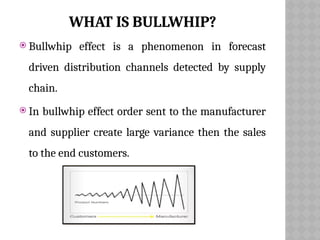
 In bullwhip effect order sent to the manufacturer
and supplier create large variance then the sales
to the end customers.
BULLWHIP EFFECT
WHAT DO YOU MEAN BY
BULLWHIP EFFECT?
 The order that the manufacturer receives is often
much longer than what the actual customer’s
demand is at the point of sale.
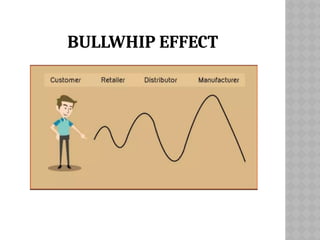
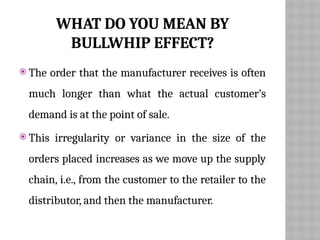
 This irregularity or variance in the size of the
orders placed increases as we move up the supply
chain, i.e., from the customer to the retailer to the
distributor, and then the manufacturer.
EXAMPLE
EXPLANATION
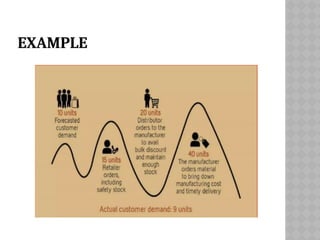
So eventually, 40 units were produced against a
demand of 9 units, and now the inventory will be
pushed to the customer through offers and
discounts and more investment will be made for
the product’s marketing and advertising efforts.
EFFECTS OF BULLWHIP
 In a supply chain plagued with bullwhip effect,
the distortion in information is escalated as it
moves up in the chain.
 This variance can interrupt the smoothness of the
supply chain process as each link in the supply
chain will over or underestimate the product
demand i.e., exaggerated fluctuations.
CONTRIBUTION TOWARDS BULLWHIP
EFFECT
There are many factors to cause bullwhip effect:
1. DISORGANIZATION: between each supply chain link if it occurs then due to
non uniformity in ordering leads to over or under reaction to the supply
chain beforehand.
2. LACK OF COMMUNICATION: between each link in the supply chain makes
it difficult for the process to run smoothly and therefore order different
quantities.
3. FREE RETURN POLICIES: customers order more demands intentionally to
meet there inventory but cancel in between when supply becomes adequate.
4. ORDER BATCHING: creates variability in the demand as there may be surge
in demand at some stage followed by no demand.
SYMPTOMS OF BULLWHIP
Some symptoms of Bullwhip are:
 Excessive Inventory
 Poor product forecast
 Insufficient capacities
 Long backlogs
 Uncertain product planning
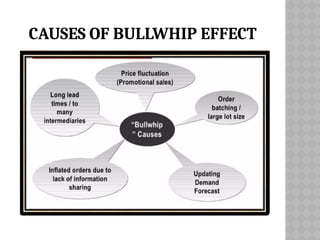
CAUSES OF BULLWHIP EFFECT
EXPLANATION
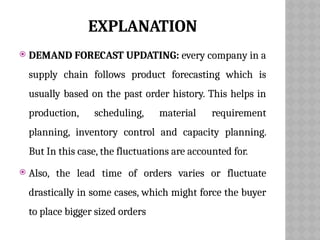
 DEMAND FORECAST UPDATING: every company in a
supply chain follows product forecasting which is
usually based on the past order history. This helps in
production, scheduling, material requirement
planning, inventory control and capacity planning.
But In this case, the fluctuations are accounted for.
 Also, the lead time of orders varies or fluctuate
drastically in some cases, which might force the buyer
to place bigger sized orders
CONTD…
 ORDER BATCHING PRACTICE: larger order sizes
often offer discounts and lower cost advantages to the
buyer, or at times suppliers don’t entertain smaller
order sizes. Hence, companies tend to accumulate the
demand to reach a respectable order size and develop
the practice to order monthly or weekly, which creates
demand variability as the average demand is not
stable across the time-period.
CONTD…
 PRICING FLUCTUATIONS & TRADE
PROMOTIONS: Specific period discounts , or cost
fluctuations, can lead the buyers to order in bulk
to avail the discounts which cause demand
variability in the supply chain.
CONTD….
 RATIONING AND SHORT GAMING: When product
demand exceeds supply, a manufacturer often
rations its product to customers. For example, the
manufacturer then allocates its products in
proportion to the amount ordered by the different
retailers. Retailers often anticipate on potential
shortages by exaggerating their real needs when
they order. If demand drops later, this will lead to
small orders and cancellations.
CONTROLLING MEASURES
 The only way to counter bullwhip effect is to have
the accurate, real-time demand information.
 To achieve that, we need to shift from a forecast-
driven ordering system to measures that allow
information sharing with the supply chain
partners and hence complete visibility of the
actual customer demand.

SUPPLY CHAIN MANAGEMENT BULLWHIP EFFECT. pptx

  • 1.
  • 2.
    WHAT IS BULLWHIP? Bullwhip effect is a phenomenon in forecast driven distribution channels detected by supply chain.  In bullwhip effect order sent to the manufacturer and supplier create large variance then the sales to the end customers.
  • 3.
  • 4.
    WHAT DO YOUMEAN BY BULLWHIP EFFECT?  The order that the manufacturer receives is often much longer than what the actual customer’s demand is at the point of sale.  This irregularity or variance in the size of the orders placed increases as we move up the supply chain, i.e., from the customer to the retailer to the distributor, and then the manufacturer.
  • 5.
  • 6.
    EXPLANATION So eventually, 40units were produced against a demand of 9 units, and now the inventory will be pushed to the customer through offers and discounts and more investment will be made for the product’s marketing and advertising efforts.
  • 7.
    EFFECTS OF BULLWHIP In a supply chain plagued with bullwhip effect, the distortion in information is escalated as it moves up in the chain.  This variance can interrupt the smoothness of the supply chain process as each link in the supply chain will over or underestimate the product demand i.e., exaggerated fluctuations.
  • 8.
    CONTRIBUTION TOWARDS BULLWHIP EFFECT Thereare many factors to cause bullwhip effect: 1. DISORGANIZATION: between each supply chain link if it occurs then due to non uniformity in ordering leads to over or under reaction to the supply chain beforehand. 2. LACK OF COMMUNICATION: between each link in the supply chain makes it difficult for the process to run smoothly and therefore order different quantities. 3. FREE RETURN POLICIES: customers order more demands intentionally to meet there inventory but cancel in between when supply becomes adequate. 4. ORDER BATCHING: creates variability in the demand as there may be surge in demand at some stage followed by no demand.
  • 9.
    SYMPTOMS OF BULLWHIP Somesymptoms of Bullwhip are:  Excessive Inventory  Poor product forecast  Insufficient capacities  Long backlogs  Uncertain product planning
  • 11.
  • 12.
    EXPLANATION  DEMAND FORECASTUPDATING: every company in a supply chain follows product forecasting which is usually based on the past order history. This helps in production, scheduling, material requirement planning, inventory control and capacity planning. But In this case, the fluctuations are accounted for.  Also, the lead time of orders varies or fluctuate drastically in some cases, which might force the buyer to place bigger sized orders
  • 13.
    CONTD…  ORDER BATCHINGPRACTICE: larger order sizes often offer discounts and lower cost advantages to the buyer, or at times suppliers don’t entertain smaller order sizes. Hence, companies tend to accumulate the demand to reach a respectable order size and develop the practice to order monthly or weekly, which creates demand variability as the average demand is not stable across the time-period.
  • 14.
    CONTD…  PRICING FLUCTUATIONS& TRADE PROMOTIONS: Specific period discounts , or cost fluctuations, can lead the buyers to order in bulk to avail the discounts which cause demand variability in the supply chain.
  • 15.
    CONTD….  RATIONING ANDSHORT GAMING: When product demand exceeds supply, a manufacturer often rations its product to customers. For example, the manufacturer then allocates its products in proportion to the amount ordered by the different retailers. Retailers often anticipate on potential shortages by exaggerating their real needs when they order. If demand drops later, this will lead to small orders and cancellations.
  • 16.
    CONTROLLING MEASURES  Theonly way to counter bullwhip effect is to have the accurate, real-time demand information.  To achieve that, we need to shift from a forecast- driven ordering system to measures that allow information sharing with the supply chain partners and hence complete visibility of the actual customer demand.