www.mun.ca
HAZARDOUS WASTE DRILLING
MUD MANAGEMENT – A CASE
STUDY ON REMEDIATION
TECHNOLOGIES
Presented at:
Oil Industry and the Environment Seminar
(NOTES 2015)
April 27, 2015
Hesam Hassan Nejad
Ph.D. Candidate, Oil & Gas Engineering
Supervisors: Dr. Kelly Hawboldt and Dr. Lesley James
www.mun.ca2
Outline
 Drilling Mud Fundamentals
 Regulations on Waste Drilling Mud
 Remediation Technologies
• Chemical techniques
• Biological techniques
• Thermal techniques
• Physical techniques
 Technical Comparison of Individual Technologies
www.mun.ca3
Waste Drilling Mud Production
Purpose of Drilling Mud:
• Prevent blowouts
• Balance & control pressure
• Minimize corrosion
• Lubricate and cool
• Remove drill cuttings
[1]
www.mun.ca4
Drilling Mud Composition
Drilling mud:
• A solid-liquid slurry
• Very high viscosity
• High content of oil and heavy metals
• Bentonite, barite, and other polymers
The composition of the drilling mud depends on the:
• Type of drilling fluid in use
• Composition of the formation
www.mun.ca5
Non-Aqueous vs Water Based
Drilling Fluids
5
Non-Aqueous Based Drilling Fluids
Diesel-based fluids
Aromatic content 25%, 2% ≤ PAH ≤ 4 %)
Low toxicity mineral oil-based fluids
0.001% ≤ PAH ≤ 0.35%
Synthetic-based fluids (SBFs)
PAH ≤ 0.001%
[2]
Water Based
Drilling Fluids
www.mun.ca6
Waste Drilling Mud Disposal
 Depending on the regulation, the treatment may vary
 Local authorities may have their own regulations
 Inject waste drilling mud into a formation with high porosity
and high permeability
 In the absence of overboard disposal, another option is to
bring it to shore for land disposal
EPA Regulations
 Environmental Protection Agency (EPA) and Oslo and Paris
Commission (OSPAR) regulations [3]:
• Oil on solid particles should not exceed 1% (wt./wt.)
 Hazardous metal concentrations should be less than specific
amounts
• Toxicity characteristics leaching procedure (TCLP)
www.mun.ca7
Waste Drilling Mud Disposal -
Newfoundland Regulations
Oil Based Drilling Fluids
• At no time can be discharged to sea
Synthetic Based Drilling Fluids
• Required to have a PAH concentration of < 10 mg/kg and be
able to biodegrade under aerobic conditions
• Oil on cuttings retention limit of 6.9% wet weight
Water Based Drilling Fluids
• Discharge of drill cuttings associated with water based
drilling muds is permitted
[4]
www.mun.ca8
Current Treatment Technologies
 Waste drilling mud treatment technologies are categorized
into four main groups:
• Chemical treatment
• Biological Treatment
• Thermal Treatment
• Physical Treatment
www.mun.ca9
Current Technologies
Chemical Treatment
 Destroys the contaminants or converts them to harmless
compounds.
 The most common chemical methods involve oxidants such as
hydrogen peroxide and ozone
 Disadvantages:
• High cost
• Ineffective at higher pH
[5]
www.mun.ca10
 Another chemical treatment option is to solidify/stabilize the
hazardous waste to convert them into less toxic materials.
 Many reports have been published regarding adding some
chemicals for drilling mud solidification such as lime, cement,
and aluminum sulphate
 Advantages:
• Relatively short processing time
• Effective
 Disadvantages:
• Increase in waste volume
• Difficult to implement
• Need for other chemical compounds increases cost
Current Technologies
Chemical Treatment
www.mun.ca11
 Biotechnologies involve the use of micro–organisms to
degrade or mineralize the organic components of drill waste
 Advantages:
• Cost effective
• Green process
Current Technologies
Biological Treatment
 Disadvantages:
• Slow reaction times
• Long processing times
• Temperature sensitivity
[6]
www.mun.ca12
 Removes or destroys hydrocarbon pollutants in the drilling
waste by desorption, incineration, gasification, volatilization,
and pyrolysis (or a combination thereof)
 Advantages:
• Very effective
• High volume reduction
Current Technologies
Thermal Treatment
 Disadvantages:
• Toxic gas production
• High energy requirement
• Very expensive
• No oil recovery
[7]
www.mun.ca13
 Surfactants (detergent) reduce the interfacial tension (IFT)
between the water and oil phases
 Surfactants liberate the oil from the solid surface
 Surfactants can be used in mixtures with/without additives [8]
[9]
Current Technologies
Physical Treatment:
Surfactant Enhanced Washing
www.mun.ca14
 Advantages:
• Cost-effective
• Easy to implement
 Disadvantages:
• Usually ineffective in hydrocarbon removal
• May increase waste volume
Current Technologies
Physical Treatment:
Surfactant Enhanced Washing
www.mun.ca15
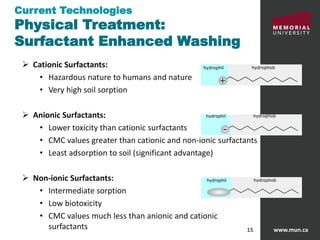
 Cationic Surfactants:
• Hazardous nature to humans and nature
• Very high soil sorption
 Anionic Surfactants:
• Lower toxicity than cationic surfactants
• CMC values greater than cationic and non-ionic surfactants
• Least adsorption to soil (significant advantage)
 Non-ionic Surfactants:
• Intermediate sorption
• Low biotoxicity
• CMC values much less than anionic and cationic
surfactants
Current Technologies
Physical Treatment:
Surfactant Enhanced Washing
www.mun.ca16
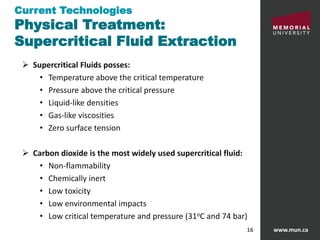
 Supercritical Fluids posses:
• Temperature above the critical temperature
• Pressure above the critical pressure
• Liquid-like densities
• Gas-like viscosities
• Zero surface tension
 Carbon dioxide is the most widely used supercritical fluid:
• Non-flammability
• Chemically inert
• Low toxicity
• Low environmental impacts
• Low critical temperature and pressure (31oC and 74 bar)
Current Technologies
Physical Treatment:
Supercritical Fluid Extraction
www.mun.ca17
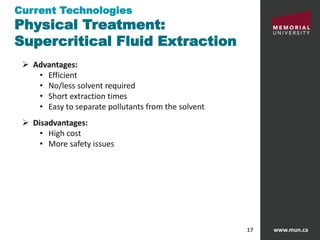
 Advantages:
• Efficient
• No/less solvent required
• Short extraction times
• Easy to separate pollutants from the solvent
 Disadvantages:
• High cost
• More safety issues
Current Technologies
Physical Treatment:
Supercritical Fluid Extraction
www.mun.ca18
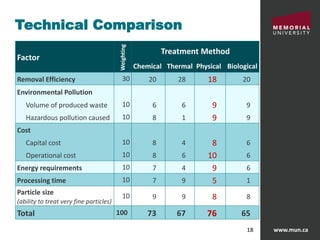
Technical Comparison
Factor
Weighting
Treatment Method
Chemical Thermal Physical Biological
Removal Efficiency 30 20 28 18 20
Environmental Pollution
Volume of produced waste 10 6 6 9 9
Hazardous pollution caused 10 8 1 9 9
Cost
Capital cost 10 8 4 8 6
Operational cost 10 8 6 10 6
Energy requirements 10 7 4 9 6
Processing time 10 7 9 5 1
Particle size
(ability to treat very fine particles)
10 9 9 8 8
Total 100 73 67 76 65
www.mun.ca19
Recommendations
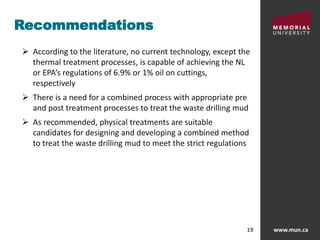
 According to the literature, no current technology, except the
thermal treatment processes, is capable of achieving the NL
or EPA’s regulations of 6.9% or 1% oil on cuttings,
respectively
 There is a need for a combined process with appropriate pre
and post treatment processes to treat the waste drilling mud
 As recommended, physical treatments are suitable
candidates for designing and developing a combined method
to treat the waste drilling mud to meet the strict regulations
www.mun.ca20
Future Work
 There is no sole technology, except thermal treatment,
capable of reaching disposal regulations, there is a need to
find alternative solutions including combination physical
technologies to treat the drilling mud for land disposal.
 Research is currently being conducted at Memorial
University to test the optimal removal efficiency using
• surfactant enhanced washing and
• supercritical fluid extraction processes.
www.mun.ca21
References
[1]. Growcock, F. and T. Harvey (2005). Drilling fluids. Drilling Fluids Processing Handbook.
ASME Shale Shaker Committee. Burlington, MA, Gulf Professional Publishing.
[2]. A. M. Shaikh, Environmental Management of Drilling Mud, Master’s thesis, Delft
University of Technology, January 2010
[3]. OSPAR convention for the protection of the marine environment of the north east
Atlantic, OSPAR Commission summary record OIC 2002, ANNEX 12, 2002
[4]. J. Whitford, Stantec Limited, Cuttings Treatment Technology, Evaluation Environmental
Studies Research Funds Report No. 166. St. John’s, NL, July 2009, ISBN 0-921652-85-2
[5]. Ozone secondary disinfection system, Public swimming venues under MAHC compiliance,
January 1st, 2013
[6]. Available at: https://www.sintef.no/projectweb/nomremove/water-treatment-
processes/biological-treatment/
[7]. Available at: http://www.eisenmann.com/en/products-and-services/environmental-
technology/waste-disposal/rotary-kiln.html
[8] P. Yan et al., Remediation of oil-based drill cuttings through a biosurfactant-based
washing followed by a biodegradation treatment, Bioresource Technology 102 (2011)
10252–10259
[9]. Thomkatt, Understanding Basic Chemicals, Available at:
http://www.janitorkatt.com/understanding-basic-chemicals
www.mun.ca22
Acknowledgements
 Dr. Lesley James and Dr. Kelly Hawboldt for developing this
project and their kindest help and support throughout the
whole project
 Leslie Harris Centre of Regional and Policy Development
for partially funding this project through their 2014-15
MMSB Waste Management Applied Research Fund
Supportedby
www.mun.ca23
Thank You for Your Attention

Hazardous waste drilling mud management – A case study on remediation technologies

  • 1.
    www.mun.ca HAZARDOUS WASTE DRILLING MUDMANAGEMENT – A CASE STUDY ON REMEDIATION TECHNOLOGIES Presented at: Oil Industry and the Environment Seminar (NOTES 2015) April 27, 2015 Hesam Hassan Nejad Ph.D. Candidate, Oil & Gas Engineering Supervisors: Dr. Kelly Hawboldt and Dr. Lesley James
  • 2.
    www.mun.ca2 Outline  Drilling MudFundamentals  Regulations on Waste Drilling Mud  Remediation Technologies • Chemical techniques • Biological techniques • Thermal techniques • Physical techniques  Technical Comparison of Individual Technologies
  • 3.
    www.mun.ca3 Waste Drilling MudProduction Purpose of Drilling Mud: • Prevent blowouts • Balance & control pressure • Minimize corrosion • Lubricate and cool • Remove drill cuttings [1]
  • 4.
    www.mun.ca4 Drilling Mud Composition Drillingmud: • A solid-liquid slurry • Very high viscosity • High content of oil and heavy metals • Bentonite, barite, and other polymers The composition of the drilling mud depends on the: • Type of drilling fluid in use • Composition of the formation
  • 5.
    www.mun.ca5 Non-Aqueous vs WaterBased Drilling Fluids 5 Non-Aqueous Based Drilling Fluids Diesel-based fluids Aromatic content 25%, 2% ≤ PAH ≤ 4 %) Low toxicity mineral oil-based fluids 0.001% ≤ PAH ≤ 0.35% Synthetic-based fluids (SBFs) PAH ≤ 0.001% [2] Water Based Drilling Fluids
  • 6.
    www.mun.ca6 Waste Drilling MudDisposal  Depending on the regulation, the treatment may vary  Local authorities may have their own regulations  Inject waste drilling mud into a formation with high porosity and high permeability  In the absence of overboard disposal, another option is to bring it to shore for land disposal EPA Regulations  Environmental Protection Agency (EPA) and Oslo and Paris Commission (OSPAR) regulations [3]: • Oil on solid particles should not exceed 1% (wt./wt.)  Hazardous metal concentrations should be less than specific amounts • Toxicity characteristics leaching procedure (TCLP)
  • 7.
    www.mun.ca7 Waste Drilling MudDisposal - Newfoundland Regulations Oil Based Drilling Fluids • At no time can be discharged to sea Synthetic Based Drilling Fluids • Required to have a PAH concentration of < 10 mg/kg and be able to biodegrade under aerobic conditions • Oil on cuttings retention limit of 6.9% wet weight Water Based Drilling Fluids • Discharge of drill cuttings associated with water based drilling muds is permitted [4]
  • 8.
    www.mun.ca8 Current Treatment Technologies Waste drilling mud treatment technologies are categorized into four main groups: • Chemical treatment • Biological Treatment • Thermal Treatment • Physical Treatment
  • 9.
    www.mun.ca9 Current Technologies Chemical Treatment Destroys the contaminants or converts them to harmless compounds.  The most common chemical methods involve oxidants such as hydrogen peroxide and ozone  Disadvantages: • High cost • Ineffective at higher pH [5]
  • 10.
    www.mun.ca10  Another chemicaltreatment option is to solidify/stabilize the hazardous waste to convert them into less toxic materials.  Many reports have been published regarding adding some chemicals for drilling mud solidification such as lime, cement, and aluminum sulphate  Advantages: • Relatively short processing time • Effective  Disadvantages: • Increase in waste volume • Difficult to implement • Need for other chemical compounds increases cost Current Technologies Chemical Treatment
  • 11.
    www.mun.ca11  Biotechnologies involvethe use of micro–organisms to degrade or mineralize the organic components of drill waste  Advantages: • Cost effective • Green process Current Technologies Biological Treatment  Disadvantages: • Slow reaction times • Long processing times • Temperature sensitivity [6]
  • 12.
    www.mun.ca12  Removes ordestroys hydrocarbon pollutants in the drilling waste by desorption, incineration, gasification, volatilization, and pyrolysis (or a combination thereof)  Advantages: • Very effective • High volume reduction Current Technologies Thermal Treatment  Disadvantages: • Toxic gas production • High energy requirement • Very expensive • No oil recovery [7]
  • 13.
    www.mun.ca13  Surfactants (detergent)reduce the interfacial tension (IFT) between the water and oil phases  Surfactants liberate the oil from the solid surface  Surfactants can be used in mixtures with/without additives [8] [9] Current Technologies Physical Treatment: Surfactant Enhanced Washing
  • 14.
    www.mun.ca14  Advantages: • Cost-effective •Easy to implement  Disadvantages: • Usually ineffective in hydrocarbon removal • May increase waste volume Current Technologies Physical Treatment: Surfactant Enhanced Washing
  • 15.
    www.mun.ca15  Cationic Surfactants: •Hazardous nature to humans and nature • Very high soil sorption  Anionic Surfactants: • Lower toxicity than cationic surfactants • CMC values greater than cationic and non-ionic surfactants • Least adsorption to soil (significant advantage)  Non-ionic Surfactants: • Intermediate sorption • Low biotoxicity • CMC values much less than anionic and cationic surfactants Current Technologies Physical Treatment: Surfactant Enhanced Washing
  • 16.
    www.mun.ca16  Supercritical Fluidsposses: • Temperature above the critical temperature • Pressure above the critical pressure • Liquid-like densities • Gas-like viscosities • Zero surface tension  Carbon dioxide is the most widely used supercritical fluid: • Non-flammability • Chemically inert • Low toxicity • Low environmental impacts • Low critical temperature and pressure (31oC and 74 bar) Current Technologies Physical Treatment: Supercritical Fluid Extraction
  • 17.
    www.mun.ca17  Advantages: • Efficient •No/less solvent required • Short extraction times • Easy to separate pollutants from the solvent  Disadvantages: • High cost • More safety issues Current Technologies Physical Treatment: Supercritical Fluid Extraction
  • 18.
    www.mun.ca18 Technical Comparison Factor Weighting Treatment Method ChemicalThermal Physical Biological Removal Efficiency 30 20 28 18 20 Environmental Pollution Volume of produced waste 10 6 6 9 9 Hazardous pollution caused 10 8 1 9 9 Cost Capital cost 10 8 4 8 6 Operational cost 10 8 6 10 6 Energy requirements 10 7 4 9 6 Processing time 10 7 9 5 1 Particle size (ability to treat very fine particles) 10 9 9 8 8 Total 100 73 67 76 65
  • 19.
    www.mun.ca19 Recommendations  According tothe literature, no current technology, except the thermal treatment processes, is capable of achieving the NL or EPA’s regulations of 6.9% or 1% oil on cuttings, respectively  There is a need for a combined process with appropriate pre and post treatment processes to treat the waste drilling mud  As recommended, physical treatments are suitable candidates for designing and developing a combined method to treat the waste drilling mud to meet the strict regulations
  • 20.
    www.mun.ca20 Future Work  Thereis no sole technology, except thermal treatment, capable of reaching disposal regulations, there is a need to find alternative solutions including combination physical technologies to treat the drilling mud for land disposal.  Research is currently being conducted at Memorial University to test the optimal removal efficiency using • surfactant enhanced washing and • supercritical fluid extraction processes.
  • 21.
    www.mun.ca21 References [1]. Growcock, F.and T. Harvey (2005). Drilling fluids. Drilling Fluids Processing Handbook. ASME Shale Shaker Committee. Burlington, MA, Gulf Professional Publishing. [2]. A. M. Shaikh, Environmental Management of Drilling Mud, Master’s thesis, Delft University of Technology, January 2010 [3]. OSPAR convention for the protection of the marine environment of the north east Atlantic, OSPAR Commission summary record OIC 2002, ANNEX 12, 2002 [4]. J. Whitford, Stantec Limited, Cuttings Treatment Technology, Evaluation Environmental Studies Research Funds Report No. 166. St. John’s, NL, July 2009, ISBN 0-921652-85-2 [5]. Ozone secondary disinfection system, Public swimming venues under MAHC compiliance, January 1st, 2013 [6]. Available at: https://www.sintef.no/projectweb/nomremove/water-treatment- processes/biological-treatment/ [7]. Available at: http://www.eisenmann.com/en/products-and-services/environmental- technology/waste-disposal/rotary-kiln.html [8] P. Yan et al., Remediation of oil-based drill cuttings through a biosurfactant-based washing followed by a biodegradation treatment, Bioresource Technology 102 (2011) 10252–10259 [9]. Thomkatt, Understanding Basic Chemicals, Available at: http://www.janitorkatt.com/understanding-basic-chemicals
  • 22.
    www.mun.ca22 Acknowledgements  Dr. LesleyJames and Dr. Kelly Hawboldt for developing this project and their kindest help and support throughout the whole project  Leslie Harris Centre of Regional and Policy Development for partially funding this project through their 2014-15 MMSB Waste Management Applied Research Fund Supportedby
  • 23.

Editor's Notes

  • #4  Schematic of how drilling mud is produced How the shale shaker works
  • #5  What affects the composition? Types of drilling mud
  • #6  What affects the composition? Types of drilling mud
  • #7 - What are EPA and OSPAR regulations ? - Hydrocarbon and hazardous metal concentrations should be simultaneously considered before landfilling
  • #8 - What are EPA and OSPAR regulations ? - Hydrocarbon and hazardous metal concentrations should be simultaneously considered before landfilling
  • #9 - Brief intro for the next section
  • #10 What are chemical treatments? How they work and disadvantages
  • #11 - How solidifying works and may increase the waste volume
  • #12 How the biological technologies work for organic matter removal?
  • #13 Thermal treatments are the sole treatment technologies capable of reaching EPA’s 1% limit Advantages and diosadvantages
  • #14 How surfactants work in principle Difference between cationic, anionic and non-ionic surfactants
  • #15 Advantages and disadvantages of surfactant-enhanced washing
  • #16 How surfactants work in principle Difference between cationic, anionic and non-ionic surfactants
  • #17 Why supercritical can be very efficient? Why Supercritical CO2?
  • #18 Advantages and disadvantages of SFE?
  • #19 These technologies have been ranked according to their capability considering each factor
  • #20 These technologies have been ranked according to their capability considering each factor
  • #21 These technologies have been ranked according to their capability considering each factor