NORM in Waste Derived From Oil and
Gas Production
Prof. Dr M.F. Abdel-Sabour
E-mail:wise2007egy@yahoo.com
‫الغاز‬ ‫و‬ ‫البترول‬ ‫انتاج‬ ‫من‬ ‫الناتجة‬ ‫النورم‬ ‫نفايات‬
‫الصبور‬ ‫عبد‬ ‫فتحى‬ ‫ممدوح‬ ‫أد‬
‫النووية‬ ‫البحوث‬ ‫مركز‬
Soil and water Research Department
Nuclear Research Center
Atomic Energy Authority
INTRODUCTION
 In the process of oil and gas extraction, the
oil/gas/water mixture is brought to the
surface through well tubing. The mixture
then passes through a separator, which
removes the gas. With further processing
the gas is transported to a gas purification
plant where the various gas fractions are
separated and purified.
 The oil stream is further treated to remove
the geological formation water that is
extracted with the oil and gas. After
separation from the oil, the formation
water, also termed production water at this
stage, is usually treated and discharged to
the sea/ocean.
 Sand and oily sludge from the reservoir are
also removed during this treatment.
 Solids deposit on the internal surfaces of
the oil field extraction and production
equipment, such as tubulars, other pipes,
heat exchangers and pumps
(Kvasnicka,1996).
INTRODUCTION
Each year the petroleum industry generates several
thousand tons of waste including produced water,
scales, sludges, and contaminated equipment.
The amount produced at any oil reserve varies and
depends on several factors:
 Geological location
 Formation conditions
 Type of production operation
 Age of the production well.
INTRODUCTION
 NORM encountered in oil and gas
exploration, development, and
production operations originates in
subsurface formations may contain
radioactive materials such as uranium
and thorium and their products, radium
226 and radium 228. These materials are
brought to the surface in the formation
water that is produced in the extraction
of oil and gas (Cooper,2005).
Formation water contains the radium isotopes
226Ra from the 238U series, and 228Ra and
224Ra from the 232Th series. All three radium
isotopes; but not their parents; thus appear in
the water co-produced with the oil or gas.
MAJOR FACTORS INFLUENCING THE OCCURRENCE OF
NORM IN OIL/GAS PRODUCTION
Solid arrows indicate a radio active decay or series of radioactive decays. Dashed arrows
indicate a physical or chemical partitioning process.
Radon gas is highly mobile. It
originates in underground
formations and dissolves in the
organic petroleum areas of the gas
plant. It concentrates mainly in the
more volatile propane and ethane
fractions of the gas.
 NORM precipitate as sulphate and
carbonate scales.
 NORM generally occurs as radon
gas in the natural gas stream. Radon
decays to Lead-210, then to
Bismuth-210, Polonium-210, and
finally to stable Lead-206.
 Radon decay elements occur as a
film on the inner surface of inlet lines,
treating units, pumps, and valves
principally associated with propylene,
ethane, and propane processing
streams.
Generally, the activity concentrations of
radium isotopes are lower in sludge
than in scales, the opposite applies to
210Pb (Zaidan,2010).
TYPE OF GENERATED WASTE
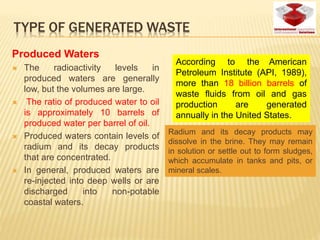
Produced Waters
 The radioactivity levels in
produced waters are generally
low, but the volumes are large.
 The ratio of produced water to oil
is approximately 10 barrels of
produced water per barrel of oil.
 Produced waters contain levels of
radium and its decay products
that are concentrated.
 In general, produced waters are
re-injected into deep wells or are
discharged into non-potable
coastal waters.
According to the American
Petroleum Institute (API, 1989),
more than 18 billion barrels of
waste fluids from oil and gas
production are generated
annually in the United States.
Radium and its decay products may
dissolve in the brine. They may remain
in solution or settle out to form sludges,
which accumulate in tanks and pits, or
mineral scales.
TYPE OF GENERATED WASTE:-
SCALE
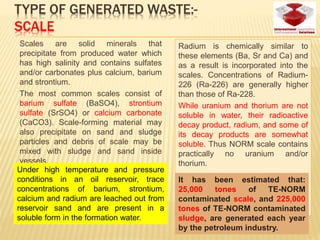
Scales are solid minerals that
precipitate from produced water which
has high salinity and contains sulfates
and/or carbonates plus calcium, barium
and strontium.
The most common scales consist of
barium sulfate (BaSO4), strontium
sulfate (SrSO4) or calcium carbonate
(CaCO3). Scale-forming material may
also precipitate on sand and sludge
particles and debris of scale may be
mixed with sludge and sand inside
vessels.
Radium is chemically similar to
these elements (Ba, Sr and Ca) and
as a result is incorporated into the
scales. Concentrations of Radium-
226 (Ra-226) are generally higher
than those of Ra-228.
While uranium and thorium are not
soluble in water, their radioactive
decay product, radium, and some of
its decay products are somewhat
soluble. Thus NORM scale contains
practically no uranium and/or
thorium.
Under high temperature and pressure
conditions in an oil reservoir, trace
concentrations of barium, strontium,
calcium and radium are leached out from
reservoir sand and are present in a
soluble form in the formation water.
It has been estimated that:
25,000 tones of TE-NORM
contaminated scale, and 225,000
tones of TE-NORM contaminated
sludge, are generated each year
by the petroleum industry.
TYPE OF GENERATED WASTE:-
SCALE
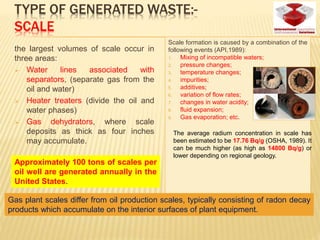
the largest volumes of scale occur in
three areas:
 Water lines associated with
separators, (separate gas from the
oil and water)
 Heater treaters (divide the oil and
water phases)
 Gas dehydrators, where scale
deposits as thick as four inches
may accumulate.
Scale formation is caused by a combination of the
following events (API,1989):
1. Mixing of incompatible waters;
2. pressure changes;
3. temperature changes;
4. impurities;
5. additives;
6. variation of flow rates;
7. changes in water acidity;
8. fluid expansion;
9. Gas evaporation; etc.
Approximately 100 tons of scales per
oil well are generated annually in the
United States.
Gas plant scales differ from oil production scales, typically consisting of radon decay
products which accumulate on the interior surfaces of plant equipment.
The average radium concentration in scale has
been estimated to be 17.76 Bq/g (OSHA, 1989). It
can be much higher (as high as 14800 Bq/g) or
lower depending on regional geology.
TYPE OF GENERATED WASTE:-
SLUDGE
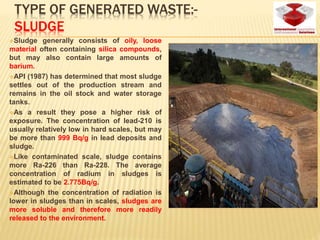
Sludge generally consists of oily, loose
material often containing silica compounds,
but may also contain large amounts of
barium.
API (1987) has determined that most sludge
settles out of the production stream and
remains in the oil stock and water storage
tanks.
As a result they pose a higher risk of
exposure. The concentration of lead-210 is
usually relatively low in hard scales, but may
be more than 999 Bq/g in lead deposits and
sludge.
Like contaminated scale, sludge contains
more Ra-226 than Ra-228. The average
concentration of radium in sludges is
estimated to be 2.775Bq/g.
Although the concentration of radiation is
lower in sludges than in scales, sludges are
more soluble and therefore more readily
released to the environment.
TYPE OF GENERATED WASTE:-
SLUDGE
The results have shown that
scales are 75% barium and
strontium sulfates, with a mean
(226)Ra and (228)Ra content of
106 kBq kg(-1) and 78 kBq kg(-1),
respectively.
The (226)Ra and (228)Ra
content in sludge also varies
much more than the content
observed in the scales samples
and ranged from 0.36 to 367 kBq
kg(-1) and 0.25 to 343 kBq kg(-1),
respectively.
Godoy and da-Cruz (2003
TYPE OF GENERATED WASTE:-
CONTAMINATED EQUIPMENT
Gas plant processing equipment is
generally contaminated on the surface
by 210Pb-. However, TENORM may also
accumulate in gas plant equipment from
radon (222Rn) gas decay.
Equipment from gas treatment and
transport facilities may also accumulate
very thin films of 210-Pb formed by
decay of short-lived radon daughters
plated onto the inner surfaces.
However, the total amount of waste is
much less and the appearance of 210-Pb
in gas production is not a waste problem
to the same extent as radium sulphates
in scales and sludges.
.
NORM REGULATIONS
The Safety Guide on Occupational
Radiation Protection [IAEA, (1999)]
provides general guidance on the
control of occupational exposures.
This guidance is based on the
requirements contained in the
International Basic Safety
Standards for Protection against
Ionizing Radiation and for the
Safety of Radiation Sources [IAEA
series, (1996)].
The objectives, concepts and
principles of radioactive waste
management are presented in the
Safety Fundamentals publication on
The Principles of Radioactive Waste
Management [IAEA, (1995)].
HOW MUCH RADIATION IS IN THE WASTES?
NORM in Egyptian oil field228Ra (Bq/kg)226Ra (Bq/kg)SampleField
1000-950,000ScaleAlgeria [32]
48,000-300.00021,000-250,000Australia [34]
4210-235.00019,100-323,000Brazil [35]
148,000-2.195.000121,000-3.500,000Brazil [36]
101,500-1.550.00077,900-2.110,000Brazil [37]
24,00068,900Egypt [27]
35,460-368.6547541-143,262Egypt [29]
32-50493-519Egypt [30]
200-10.000510-51,000Kazakhstan [39]
130,120-206.630114,300-187,750Malaysia [40]
300-33.500300-32,300Norway [41]
08-1.5Saudi Arabia [42]
30,00025,000SludgeAustralia [34]
49,000-52.00050,000-168,000Brazil [35]
< LLD-117.900< LLD-413,000Brazil [36]
13,25018,000Egypt [29]
1-1.95.27-8.68Egypt [30]
45206-560Malaysia [40]
100-4600100-4700Norway [41]
Environmental Radioactivity of TE-NORM Waste Produced from Petroleum Industry in Egypt: Review on Characterization and Treatment.
M. F. Attallah, N. S. Awwad and H. F. Aly (1999), INTECH, October 31, 2012 ),
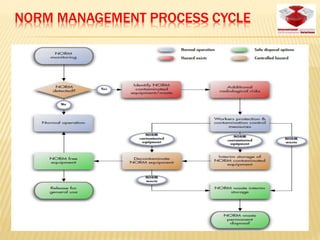
NORM MANAGEMENT PROCESS CYCLE
SCHEMATIC OF NORM SURVEY REQUIREMENTS
DISPOSAL AND REUSE: PAST PRACTICES
 Disposal of Wastes
When sludge fouling in water and
oil storage tanks became a
problem, the tanks were drained
and the sludge disposed of in
waste pits:
 Burn pits
Earthen pits were previously
used for temporary storage a
periodic burning of non-
hazardous oil field wastes
collected from tanks and other
equipment.
Lined and/or earthen pits were
previously used for storing produced
water and other nonhazardous oil field
wastes, hydrocarbon storage brine, or
mining wastes.
In this case, TENORM in the water will
concentrate in the bottom sludges or
residual salts of the ponds. Thus, the
pond sediments pose a potential
radiological health risk. The
radionuclides in these soils have been
reported to be in the range from 9.99 to
40.7Bq/g.
BRINE PITS
DISPOSAL AND REUSE: CURRENT
PRACTICES
Oil recovery from oily waste
(liquied/sludges)
Energy recovery from oily solid
waste
Loads of scrap metal are surveyed
for hidden radioactive sources and
TENORM.
Piping and equipment are cleaned
before release for recycling at
smelters.
Pollution control devices, such as
filters and bubblers, are installed in
smelter stacks to reduce airborne
radiation releases.
Although much of the NORM-
contaminated equipment is
presently stored in controlled areas,
some companies are now cleaning
the equipment and proposing to
store it at designated disposal sites.
DISPOSAL ALTERNATIVES
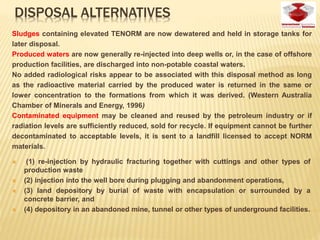
 (1) re-injection by hydraulic fracturing together with cuttings and other types of
production waste
 (2) injection into the well bore during plugging and abandonment operations,
 (3) land depository by burial of waste with encapsulation or surrounded by a
concrete barrier, and
 (4) depository in an abandoned mine, tunnel or other types of underground facilities.
Sludges containing elevated TENORM are now dewatered and held in storage tanks for
later disposal.
Produced waters are now generally re-injected into deep wells or, in the case of offshore
production facilities, are discharged into non-potable coastal waters.
No added radiological risks appear to be associated with this disposal method as long
as the radioactive material carried by the produced water is returned in the same or
lower concentration to the formations from which it was derived. (Western Australia
Chamber of Minerals and Energy, 1996)
Contaminated equipment may be cleaned and reused by the petroleum industry or if
radiation levels are sufficiently reduced, sold for recycle. If equipment cannot be further
decontaminated to acceptable levels, it is sent to a landfill licensed to accept NORM
materials.
DISPOSAL ALTERNATIVES
Currently, in Australia, equipment with NORM scales
is either cleaned for re-use within the industry or
stored awaiting approval for scrap metal smelting,
disposal or other recycling options.
On some off-shore platforms, scale has been
removed from pipes and tubulars and disposed of in
a disused well which is then plugged; another option
is to ground the scale to a fine powder, slurred with
production water and discharged to the ocean. Pipes
contaminated with scale are cleaned at pipe yards
either by sandblasting them with high pressure water
or by scraping out the scale with a rotating drill bit.
The removed scale is then placed in drums and
stored for later disposal.
In some cases contaminated steel may be
reprocessed via smelting. During the smelting
process, molten steel separates from the NORM
which vaporizes and is released as a gas. If the steel
mill has pollution control equipment, most of the
NORM is trapped in the bag-houses and scrubbers. A
typical smelting operation is capable of capturing 99
% of the particulate releases
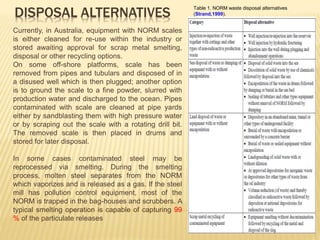
Table 1. NORM waste disposal alternatives
(Strand,1999).
 PW is conventionally treated
through different physical,
chemical, and biological
methods. In offshore platforms,
because of space constraints,
compact physical and chemical
systems are used. However,
major research efforts are being
developed with innovative
technologies for treating PW in
order to comply with reuse and
discharge limits.
 Among them, electrochemical
technologies have been
proposed as a promising
alternative for the treatment of
this kind of wastewaters (Dos
Santos et al., 2014).
The waste generated in oil and gas equipment is due to the precipitation of
alkaline earth metals as sulfate, carbonates and/or silicates. It is clear that
sludge and scale wastes represent one of the major sources of 226-Ra in the
environment.

Norm

  • 1.
    NORM in WasteDerived From Oil and Gas Production Prof. Dr M.F. Abdel-Sabour E-mail:wise2007egy@yahoo.com ‫الغاز‬ ‫و‬ ‫البترول‬ ‫انتاج‬ ‫من‬ ‫الناتجة‬ ‫النورم‬ ‫نفايات‬ ‫الصبور‬ ‫عبد‬ ‫فتحى‬ ‫ممدوح‬ ‫أد‬ ‫النووية‬ ‫البحوث‬ ‫مركز‬ Soil and water Research Department Nuclear Research Center Atomic Energy Authority
  • 2.
    INTRODUCTION  In theprocess of oil and gas extraction, the oil/gas/water mixture is brought to the surface through well tubing. The mixture then passes through a separator, which removes the gas. With further processing the gas is transported to a gas purification plant where the various gas fractions are separated and purified.  The oil stream is further treated to remove the geological formation water that is extracted with the oil and gas. After separation from the oil, the formation water, also termed production water at this stage, is usually treated and discharged to the sea/ocean.  Sand and oily sludge from the reservoir are also removed during this treatment.  Solids deposit on the internal surfaces of the oil field extraction and production equipment, such as tubulars, other pipes, heat exchangers and pumps (Kvasnicka,1996).
  • 3.
    INTRODUCTION Each year thepetroleum industry generates several thousand tons of waste including produced water, scales, sludges, and contaminated equipment. The amount produced at any oil reserve varies and depends on several factors:  Geological location  Formation conditions  Type of production operation  Age of the production well.
  • 4.
    INTRODUCTION  NORM encounteredin oil and gas exploration, development, and production operations originates in subsurface formations may contain radioactive materials such as uranium and thorium and their products, radium 226 and radium 228. These materials are brought to the surface in the formation water that is produced in the extraction of oil and gas (Cooper,2005). Formation water contains the radium isotopes 226Ra from the 238U series, and 228Ra and 224Ra from the 232Th series. All three radium isotopes; but not their parents; thus appear in the water co-produced with the oil or gas.
  • 5.
    MAJOR FACTORS INFLUENCINGTHE OCCURRENCE OF NORM IN OIL/GAS PRODUCTION
  • 6.
    Solid arrows indicatea radio active decay or series of radioactive decays. Dashed arrows indicate a physical or chemical partitioning process. Radon gas is highly mobile. It originates in underground formations and dissolves in the organic petroleum areas of the gas plant. It concentrates mainly in the more volatile propane and ethane fractions of the gas.
  • 7.
     NORM precipitateas sulphate and carbonate scales.  NORM generally occurs as radon gas in the natural gas stream. Radon decays to Lead-210, then to Bismuth-210, Polonium-210, and finally to stable Lead-206.  Radon decay elements occur as a film on the inner surface of inlet lines, treating units, pumps, and valves principally associated with propylene, ethane, and propane processing streams. Generally, the activity concentrations of radium isotopes are lower in sludge than in scales, the opposite applies to 210Pb (Zaidan,2010).
  • 8.
    TYPE OF GENERATEDWASTE Produced Waters  The radioactivity levels in produced waters are generally low, but the volumes are large.  The ratio of produced water to oil is approximately 10 barrels of produced water per barrel of oil.  Produced waters contain levels of radium and its decay products that are concentrated.  In general, produced waters are re-injected into deep wells or are discharged into non-potable coastal waters. According to the American Petroleum Institute (API, 1989), more than 18 billion barrels of waste fluids from oil and gas production are generated annually in the United States. Radium and its decay products may dissolve in the brine. They may remain in solution or settle out to form sludges, which accumulate in tanks and pits, or mineral scales.
  • 9.
    TYPE OF GENERATEDWASTE:- SCALE Scales are solid minerals that precipitate from produced water which has high salinity and contains sulfates and/or carbonates plus calcium, barium and strontium. The most common scales consist of barium sulfate (BaSO4), strontium sulfate (SrSO4) or calcium carbonate (CaCO3). Scale-forming material may also precipitate on sand and sludge particles and debris of scale may be mixed with sludge and sand inside vessels. Radium is chemically similar to these elements (Ba, Sr and Ca) and as a result is incorporated into the scales. Concentrations of Radium- 226 (Ra-226) are generally higher than those of Ra-228. While uranium and thorium are not soluble in water, their radioactive decay product, radium, and some of its decay products are somewhat soluble. Thus NORM scale contains practically no uranium and/or thorium. Under high temperature and pressure conditions in an oil reservoir, trace concentrations of barium, strontium, calcium and radium are leached out from reservoir sand and are present in a soluble form in the formation water. It has been estimated that: 25,000 tones of TE-NORM contaminated scale, and 225,000 tones of TE-NORM contaminated sludge, are generated each year by the petroleum industry.
  • 10.
    TYPE OF GENERATEDWASTE:- SCALE the largest volumes of scale occur in three areas:  Water lines associated with separators, (separate gas from the oil and water)  Heater treaters (divide the oil and water phases)  Gas dehydrators, where scale deposits as thick as four inches may accumulate. Scale formation is caused by a combination of the following events (API,1989): 1. Mixing of incompatible waters; 2. pressure changes; 3. temperature changes; 4. impurities; 5. additives; 6. variation of flow rates; 7. changes in water acidity; 8. fluid expansion; 9. Gas evaporation; etc. Approximately 100 tons of scales per oil well are generated annually in the United States. Gas plant scales differ from oil production scales, typically consisting of radon decay products which accumulate on the interior surfaces of plant equipment. The average radium concentration in scale has been estimated to be 17.76 Bq/g (OSHA, 1989). It can be much higher (as high as 14800 Bq/g) or lower depending on regional geology.
  • 11.
    TYPE OF GENERATEDWASTE:- SLUDGE Sludge generally consists of oily, loose material often containing silica compounds, but may also contain large amounts of barium. API (1987) has determined that most sludge settles out of the production stream and remains in the oil stock and water storage tanks. As a result they pose a higher risk of exposure. The concentration of lead-210 is usually relatively low in hard scales, but may be more than 999 Bq/g in lead deposits and sludge. Like contaminated scale, sludge contains more Ra-226 than Ra-228. The average concentration of radium in sludges is estimated to be 2.775Bq/g. Although the concentration of radiation is lower in sludges than in scales, sludges are more soluble and therefore more readily released to the environment.
  • 12.
    TYPE OF GENERATEDWASTE:- SLUDGE The results have shown that scales are 75% barium and strontium sulfates, with a mean (226)Ra and (228)Ra content of 106 kBq kg(-1) and 78 kBq kg(-1), respectively. The (226)Ra and (228)Ra content in sludge also varies much more than the content observed in the scales samples and ranged from 0.36 to 367 kBq kg(-1) and 0.25 to 343 kBq kg(-1), respectively. Godoy and da-Cruz (2003
  • 13.
    TYPE OF GENERATEDWASTE:- CONTAMINATED EQUIPMENT Gas plant processing equipment is generally contaminated on the surface by 210Pb-. However, TENORM may also accumulate in gas plant equipment from radon (222Rn) gas decay. Equipment from gas treatment and transport facilities may also accumulate very thin films of 210-Pb formed by decay of short-lived radon daughters plated onto the inner surfaces. However, the total amount of waste is much less and the appearance of 210-Pb in gas production is not a waste problem to the same extent as radium sulphates in scales and sludges. .
  • 14.
    NORM REGULATIONS The SafetyGuide on Occupational Radiation Protection [IAEA, (1999)] provides general guidance on the control of occupational exposures. This guidance is based on the requirements contained in the International Basic Safety Standards for Protection against Ionizing Radiation and for the Safety of Radiation Sources [IAEA series, (1996)]. The objectives, concepts and principles of radioactive waste management are presented in the Safety Fundamentals publication on The Principles of Radioactive Waste Management [IAEA, (1995)].
  • 15.
    HOW MUCH RADIATIONIS IN THE WASTES? NORM in Egyptian oil field228Ra (Bq/kg)226Ra (Bq/kg)SampleField 1000-950,000ScaleAlgeria [32] 48,000-300.00021,000-250,000Australia [34] 4210-235.00019,100-323,000Brazil [35] 148,000-2.195.000121,000-3.500,000Brazil [36] 101,500-1.550.00077,900-2.110,000Brazil [37] 24,00068,900Egypt [27] 35,460-368.6547541-143,262Egypt [29] 32-50493-519Egypt [30] 200-10.000510-51,000Kazakhstan [39] 130,120-206.630114,300-187,750Malaysia [40] 300-33.500300-32,300Norway [41] 08-1.5Saudi Arabia [42] 30,00025,000SludgeAustralia [34] 49,000-52.00050,000-168,000Brazil [35] < LLD-117.900< LLD-413,000Brazil [36] 13,25018,000Egypt [29] 1-1.95.27-8.68Egypt [30] 45206-560Malaysia [40] 100-4600100-4700Norway [41] Environmental Radioactivity of TE-NORM Waste Produced from Petroleum Industry in Egypt: Review on Characterization and Treatment. M. F. Attallah, N. S. Awwad and H. F. Aly (1999), INTECH, October 31, 2012 ),
  • 16.
  • 17.
    SCHEMATIC OF NORMSURVEY REQUIREMENTS
  • 18.
    DISPOSAL AND REUSE:PAST PRACTICES  Disposal of Wastes When sludge fouling in water and oil storage tanks became a problem, the tanks were drained and the sludge disposed of in waste pits:  Burn pits Earthen pits were previously used for temporary storage a periodic burning of non- hazardous oil field wastes collected from tanks and other equipment. Lined and/or earthen pits were previously used for storing produced water and other nonhazardous oil field wastes, hydrocarbon storage brine, or mining wastes. In this case, TENORM in the water will concentrate in the bottom sludges or residual salts of the ponds. Thus, the pond sediments pose a potential radiological health risk. The radionuclides in these soils have been reported to be in the range from 9.99 to 40.7Bq/g. BRINE PITS
  • 19.
    DISPOSAL AND REUSE:CURRENT PRACTICES Oil recovery from oily waste (liquied/sludges) Energy recovery from oily solid waste Loads of scrap metal are surveyed for hidden radioactive sources and TENORM. Piping and equipment are cleaned before release for recycling at smelters. Pollution control devices, such as filters and bubblers, are installed in smelter stacks to reduce airborne radiation releases. Although much of the NORM- contaminated equipment is presently stored in controlled areas, some companies are now cleaning the equipment and proposing to store it at designated disposal sites.
  • 21.
    DISPOSAL ALTERNATIVES  (1)re-injection by hydraulic fracturing together with cuttings and other types of production waste  (2) injection into the well bore during plugging and abandonment operations,  (3) land depository by burial of waste with encapsulation or surrounded by a concrete barrier, and  (4) depository in an abandoned mine, tunnel or other types of underground facilities. Sludges containing elevated TENORM are now dewatered and held in storage tanks for later disposal. Produced waters are now generally re-injected into deep wells or, in the case of offshore production facilities, are discharged into non-potable coastal waters. No added radiological risks appear to be associated with this disposal method as long as the radioactive material carried by the produced water is returned in the same or lower concentration to the formations from which it was derived. (Western Australia Chamber of Minerals and Energy, 1996) Contaminated equipment may be cleaned and reused by the petroleum industry or if radiation levels are sufficiently reduced, sold for recycle. If equipment cannot be further decontaminated to acceptable levels, it is sent to a landfill licensed to accept NORM materials.
  • 22.
    DISPOSAL ALTERNATIVES Currently, inAustralia, equipment with NORM scales is either cleaned for re-use within the industry or stored awaiting approval for scrap metal smelting, disposal or other recycling options. On some off-shore platforms, scale has been removed from pipes and tubulars and disposed of in a disused well which is then plugged; another option is to ground the scale to a fine powder, slurred with production water and discharged to the ocean. Pipes contaminated with scale are cleaned at pipe yards either by sandblasting them with high pressure water or by scraping out the scale with a rotating drill bit. The removed scale is then placed in drums and stored for later disposal. In some cases contaminated steel may be reprocessed via smelting. During the smelting process, molten steel separates from the NORM which vaporizes and is released as a gas. If the steel mill has pollution control equipment, most of the NORM is trapped in the bag-houses and scrubbers. A typical smelting operation is capable of capturing 99 % of the particulate releases Table 1. NORM waste disposal alternatives (Strand,1999).
  • 24.
     PW isconventionally treated through different physical, chemical, and biological methods. In offshore platforms, because of space constraints, compact physical and chemical systems are used. However, major research efforts are being developed with innovative technologies for treating PW in order to comply with reuse and discharge limits.  Among them, electrochemical technologies have been proposed as a promising alternative for the treatment of this kind of wastewaters (Dos Santos et al., 2014).
  • 25.
    The waste generatedin oil and gas equipment is due to the precipitation of alkaline earth metals as sulfate, carbonates and/or silicates. It is clear that sludge and scale wastes represent one of the major sources of 226-Ra in the environment.