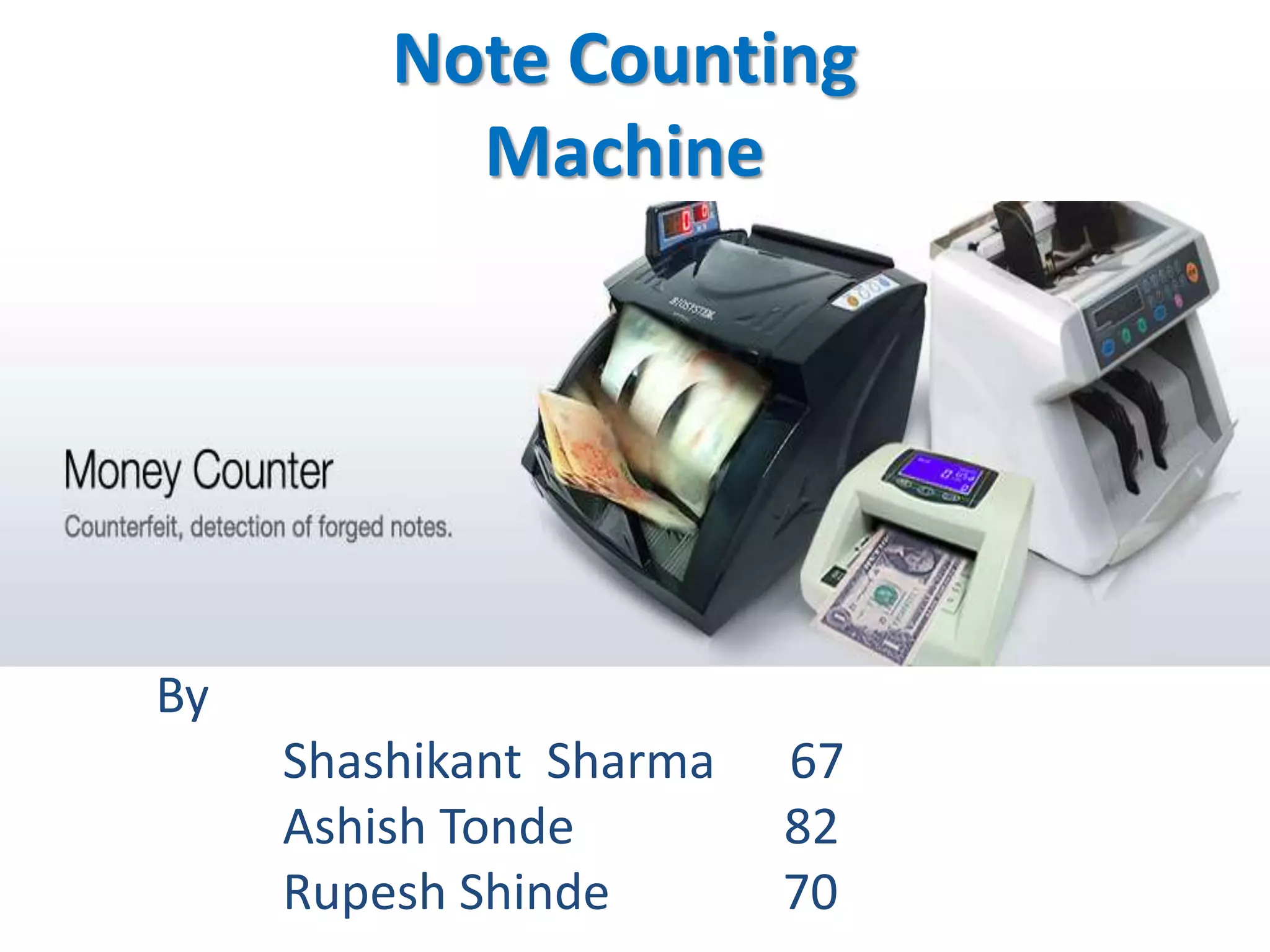
Note Counting 
Machine 
By 
Shashikant Sharma 67 
Ashish Tonde 82 
Rupesh Shinde 70
CONTENT 
• Introduction 
• Invention 
• Hardware 
• I/O Devices 
• Working 
• Types of Machines 
• Features 
• Disadvantages 
• Applications 
• Conclusion
INTRODUCTION 
• A Note-counting machine is a machine that counts 
money—either stacks of banknotes or loose 
collections of notes. 
• Note-counting machine not only counts, they also 
function as a high speed counterfeit banknote 
detector. With the advanced printing, copying and 
electronic scanning technologies available today. 
• The need to validate currency authenticity has 
increased dramatically, increasing the demand for 
continuous improvement of counterfeit detection 
technologies.
INVENTION 
• The first ever recorded currency-counting 
machine was invented in 1958 in China, 
created by a small time banker Zhi Tian 
Sie, who entered it in a contest. He won 
3rd place. 
• Zhi died at the age of 30 and his model 
was lost until recently rediscovered when 
tearing down his home.
HARDWARE 
The hardware, are highly a mixed-signal system driven by a DSP(Digital Signal 
Processing) or MCU(Microcontroller Unit) for system processing, which is surrounded by 
a high performance analog products. 
Ultraviolet, infrared & magnetic sensing are the typical detection techniques used today 
to verify the inherent characteristics of banknotes. More advanced systems, capture the 
banknote images with a CIS or CCD scan, enabling the recognition of denomination, 
serial number and other aspects of each note. 
Fluorescence detection uses UV light to check for missing marks & irradiation 
response of the fake notes. 
Magnetic ink & different patterns of security strip can be detected by using the 
magnetic head with a precision amplification scheme. 
Infrared penetration is used to the thickness detection of the banknote & the absorption 
of infrared signals to identify the genuine banknotes.
HARDWARE 
The response signals of these various transducers are low level 
signals which are very sensitive to system noise. As such a high 
performance signal conditioning design is required. Multiple 
channel input, high resolution data converters help simplify the 
design layout & ensure the accurate measurement. 
For those systems which require banknote imaging, in addition to 
high performance analog signal chains, a system processor such 
as DSP or ARM combined with a CIS/CCD AFE, capable of 
complicated algorithmic calculations would be required. The 
additional processing capability allows the system to perform 
denomination classification, OCR recognition & banknote fitness 
detection, etc.
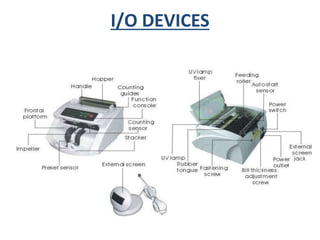
I/O DEVICES
WORKING 
The Note-counting machine works on the principle on the 
breadth of the bundle of currency and there in an roller which 
has rods in an continuous pattern and the roller moves these 
rods with a particular speed. 
The speed remains constant as like in the ATM machine 
counting machine and these rollers moves on the bundle of 
the currency and just move out the single currency one by 
one at a constant and high speed and there is an transducers 
which detect that how many single currency has passed out 
in front of it.
WORKING 
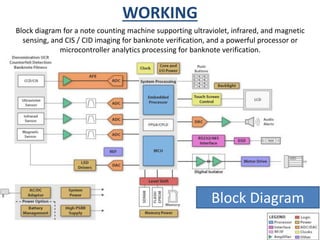
Block diagram for a note counting machine supporting ultraviolet, infrared, and magnetic 
sensing, and CIS / CID imaging for banknote verification, and a powerful processor or 
microcontroller analytics processing for banknote verification. 
Block Diagram
WORKING 
Understandably, there are design trade offs between sheer 
counting speed and amount of banknote validation that can 
be done. However, improved motor control and drive 
designs can help with overall system optimization. 
Especially as many designs are migrating to BLDC & 
Stepper motors, due to their low-maintenance, precision & 
controllability characteristics.
TYPES OF MACHINES 
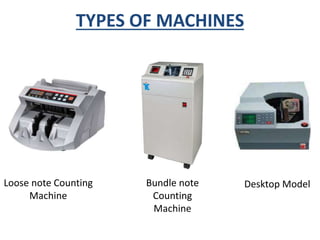
Bundle note 
Counting 
Machine 
Loose note Counting 
Machine 
Desktop Model
TYPES OF MACHINES 
• Loose note Counting Machine is very user friendly and economic loose notes 
counter for worldwide banknotes and all types of currencies. Counting less 
amount of cash and any type currencies in just 4 seconds. The best in terms of 
prices and user friendly with excellent feature of UV detection. 
• Bundle Note Counting Machine type of machines also called as High Speed 
counting machines. HIGH SPEED machine (2/3/4 second) Counts 100 notes in 2 
sec, 3 sec & 4 seconds. Accurate counting ,8-12 hours working for 
HEAVYCASH/CURRENCY COUNTING. Automatic Start/Stop function. Alarm for 
aborted count. Count number verification 
• Desktop model is compact model. Easy to carry any where. Lose note counting 
machine as well as bundled note counting machine also have desktop versions. 
Bundled model desktop version Lose note model desktop version
FEATURES 
• Fully automatic detection of currency, no human 
interference required. 
• Detects Super Fake notes in various denomination 
currencies. 
• Detection and separation of Silver/Green Thread 
notes. 
• Function of fake note detection by UV inspection for 
checking Paper quality of Xerox currencies. 
• Automatic Audible alarm when fake note is detected. 
• Easy to carry any where.
DISADVANTAGES 
• Continuous Power supply needed. 
• Human interpretation is necessary. 
• Always not accurate. 
• Very much Expensive 
• Training Required.
APPLICATIONS 
• Bank & financial Institution 
• Hospitals 
• Schools & colleges 
• Hotels & restaurants 
• Shopping malls 
• Indian railways 
• Airport authority 
• Other transport services 
• Retail outlets & showrooms.
CONCLUSION 
Counting money by hand can take a lot of 
time and isn’t always accurate. Technology 
makes it easier.
Thank You

Note counting machine

  • 1.
    Note Counting Machine By Shashikant Sharma 67 Ashish Tonde 82 Rupesh Shinde 70
  • 2.
    CONTENT • Introduction • Invention • Hardware • I/O Devices • Working • Types of Machines • Features • Disadvantages • Applications • Conclusion
  • 3.
    INTRODUCTION • ANote-counting machine is a machine that counts money—either stacks of banknotes or loose collections of notes. • Note-counting machine not only counts, they also function as a high speed counterfeit banknote detector. With the advanced printing, copying and electronic scanning technologies available today. • The need to validate currency authenticity has increased dramatically, increasing the demand for continuous improvement of counterfeit detection technologies.
  • 4.
    INVENTION • Thefirst ever recorded currency-counting machine was invented in 1958 in China, created by a small time banker Zhi Tian Sie, who entered it in a contest. He won 3rd place. • Zhi died at the age of 30 and his model was lost until recently rediscovered when tearing down his home.
  • 5.
    HARDWARE The hardware,are highly a mixed-signal system driven by a DSP(Digital Signal Processing) or MCU(Microcontroller Unit) for system processing, which is surrounded by a high performance analog products. Ultraviolet, infrared & magnetic sensing are the typical detection techniques used today to verify the inherent characteristics of banknotes. More advanced systems, capture the banknote images with a CIS or CCD scan, enabling the recognition of denomination, serial number and other aspects of each note. Fluorescence detection uses UV light to check for missing marks & irradiation response of the fake notes. Magnetic ink & different patterns of security strip can be detected by using the magnetic head with a precision amplification scheme. Infrared penetration is used to the thickness detection of the banknote & the absorption of infrared signals to identify the genuine banknotes.
  • 6.
    HARDWARE The responsesignals of these various transducers are low level signals which are very sensitive to system noise. As such a high performance signal conditioning design is required. Multiple channel input, high resolution data converters help simplify the design layout & ensure the accurate measurement. For those systems which require banknote imaging, in addition to high performance analog signal chains, a system processor such as DSP or ARM combined with a CIS/CCD AFE, capable of complicated algorithmic calculations would be required. The additional processing capability allows the system to perform denomination classification, OCR recognition & banknote fitness detection, etc.
  • 7.
  • 8.
    WORKING The Note-countingmachine works on the principle on the breadth of the bundle of currency and there in an roller which has rods in an continuous pattern and the roller moves these rods with a particular speed. The speed remains constant as like in the ATM machine counting machine and these rollers moves on the bundle of the currency and just move out the single currency one by one at a constant and high speed and there is an transducers which detect that how many single currency has passed out in front of it.
  • 9.
    WORKING Block diagramfor a note counting machine supporting ultraviolet, infrared, and magnetic sensing, and CIS / CID imaging for banknote verification, and a powerful processor or microcontroller analytics processing for banknote verification. Block Diagram
  • 10.
    WORKING Understandably, thereare design trade offs between sheer counting speed and amount of banknote validation that can be done. However, improved motor control and drive designs can help with overall system optimization. Especially as many designs are migrating to BLDC & Stepper motors, due to their low-maintenance, precision & controllability characteristics.
  • 11.
    TYPES OF MACHINES Bundle note Counting Machine Loose note Counting Machine Desktop Model
  • 12.
    TYPES OF MACHINES • Loose note Counting Machine is very user friendly and economic loose notes counter for worldwide banknotes and all types of currencies. Counting less amount of cash and any type currencies in just 4 seconds. The best in terms of prices and user friendly with excellent feature of UV detection. • Bundle Note Counting Machine type of machines also called as High Speed counting machines. HIGH SPEED machine (2/3/4 second) Counts 100 notes in 2 sec, 3 sec & 4 seconds. Accurate counting ,8-12 hours working for HEAVYCASH/CURRENCY COUNTING. Automatic Start/Stop function. Alarm for aborted count. Count number verification • Desktop model is compact model. Easy to carry any where. Lose note counting machine as well as bundled note counting machine also have desktop versions. Bundled model desktop version Lose note model desktop version
  • 13.
    FEATURES • Fullyautomatic detection of currency, no human interference required. • Detects Super Fake notes in various denomination currencies. • Detection and separation of Silver/Green Thread notes. • Function of fake note detection by UV inspection for checking Paper quality of Xerox currencies. • Automatic Audible alarm when fake note is detected. • Easy to carry any where.
  • 14.
    DISADVANTAGES • ContinuousPower supply needed. • Human interpretation is necessary. • Always not accurate. • Very much Expensive • Training Required.
  • 15.
    APPLICATIONS • Bank& financial Institution • Hospitals • Schools & colleges • Hotels & restaurants • Shopping malls • Indian railways • Airport authority • Other transport services • Retail outlets & showrooms.
  • 16.
    CONCLUSION Counting moneyby hand can take a lot of time and isn’t always accurate. Technology makes it easier.
  • 17.