Implementing Adaptation:
Developing Land Use
Regulations and Infrastructure
Policies
to Implement
Great Lakes Shoreland Area
Management Plans
Supported through a grant from the Michigan Coastal Zone Management
Program, Office of the Great Lakes, Department of Environmental Quality and
the National Oceanic and Atmospheric Administration
Background
• Research team:
– Richard Norton, UM
– Guy Meadows, GLRC MTU
• Collaborator:
– LIAA – Harry Burkholder
• Stakeholders:
– Study localities (City of Grand Haven & Grand
Haven Charter Township)
– Michigan Association of Planning
Project Focus
• Impact Areas
– Infrastructure
– Shoreline communities/economies
– Nearshore and shoreland habitat
• Interdisciplinary topics/drivers
– Planning / policy implementation
– Planning / land use / coastal area law
– Hazard mitigation
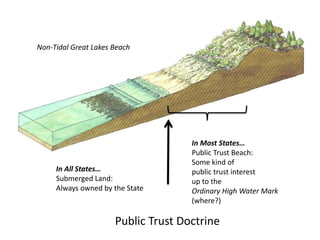
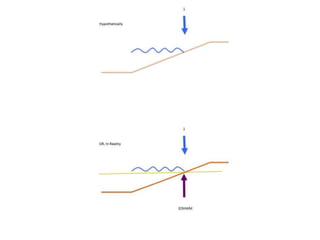
In All States…
Submerged Land:
Always owned by the State
Non-Tidal Great Lakes Beach
In Most States…
Public Trust Beach:
Some kind of
public trust interest
up to the
Ordinary High Water Mark
(where?)
Public Trust Doctrine
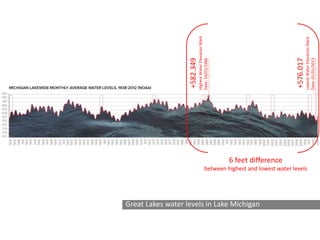
+576.017
LowestWaterElevationMark
Date:01/01/2013
+582.349
HighestWaterElevationMark
Date:10/01/1986Great Lakes water levels in Lake Michigan
6 feet difference
between highest and lowest water levels
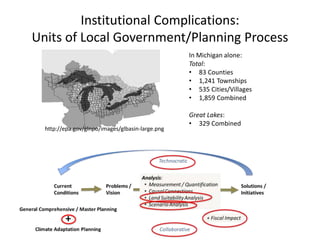
Institutional Complications:
Units of Local Government/Planning Process
http://epa.gov/glnpo/images/glbasin-large.png
In Michigan alone:
Total:
• 83 Counties
• 1,241 Townships
• 535 Cities/Villages
• 1,859 Combined
Great Lakes:
• 329 Combined
Analysis of Options
• Potential regulatory and non-regulatory options
for responding to lake level variability:
– Avoidance BMPs (setbacks from natural features)
– Protection of natural features not included in BMPs, i.e., CDAs
– Sensitive Areas Overlay/Floodplain Overlay
– Performance zoning / contingent zoning (developed in
conjunction with identification of high-risk zones at varying
levels of rigor)
– Coordination with other related policies (e.g., restrictions on
infrastructure redevelopment)
• We’re taking special note of issues that are not strictly related to
coastal area management, but that local citizens and officials believe
should be addressed concurrently with coastal management concerns
as part of a larger regulatory/policy reform effort
Transferability
• The key issues we are addressing are all
transferable to other settings around the
Great Lakes, primarily through local planning
and zoning efforts.
• Key constraints: Local capacity and
commitment to addressing near-shore hazard
avoidance, hazard mitigation, natural resource
conservation.

Implementing Adaptation: Developing Land Use Regulations and Infrastructure Policies to Implement Great Lakes Shoreland Area Management Plans

  • 1.
    Implementing Adaptation: Developing LandUse Regulations and Infrastructure Policies to Implement Great Lakes Shoreland Area Management Plans Supported through a grant from the Michigan Coastal Zone Management Program, Office of the Great Lakes, Department of Environmental Quality and the National Oceanic and Atmospheric Administration
  • 2.
    Background • Research team: –Richard Norton, UM – Guy Meadows, GLRC MTU • Collaborator: – LIAA – Harry Burkholder • Stakeholders: – Study localities (City of Grand Haven & Grand Haven Charter Township) – Michigan Association of Planning
  • 3.
    Project Focus • ImpactAreas – Infrastructure – Shoreline communities/economies – Nearshore and shoreland habitat • Interdisciplinary topics/drivers – Planning / policy implementation – Planning / land use / coastal area law – Hazard mitigation
  • 4.
    In All States… SubmergedLand: Always owned by the State Non-Tidal Great Lakes Beach In Most States… Public Trust Beach: Some kind of public trust interest up to the Ordinary High Water Mark (where?) Public Trust Doctrine
  • 5.
    +576.017 LowestWaterElevationMark Date:01/01/2013 +582.349 HighestWaterElevationMark Date:10/01/1986Great Lakes waterlevels in Lake Michigan 6 feet difference between highest and lowest water levels
  • 8.
    Institutional Complications: Units ofLocal Government/Planning Process http://epa.gov/glnpo/images/glbasin-large.png In Michigan alone: Total: • 83 Counties • 1,241 Townships • 535 Cities/Villages • 1,859 Combined Great Lakes: • 329 Combined
  • 9.
    Analysis of Options •Potential regulatory and non-regulatory options for responding to lake level variability: – Avoidance BMPs (setbacks from natural features) – Protection of natural features not included in BMPs, i.e., CDAs – Sensitive Areas Overlay/Floodplain Overlay – Performance zoning / contingent zoning (developed in conjunction with identification of high-risk zones at varying levels of rigor) – Coordination with other related policies (e.g., restrictions on infrastructure redevelopment) • We’re taking special note of issues that are not strictly related to coastal area management, but that local citizens and officials believe should be addressed concurrently with coastal management concerns as part of a larger regulatory/policy reform effort
  • 10.
    Transferability • The keyissues we are addressing are all transferable to other settings around the Great Lakes, primarily through local planning and zoning efforts. • Key constraints: Local capacity and commitment to addressing near-shore hazard avoidance, hazard mitigation, natural resource conservation.