ACP-EU_CTA
REGIONAL POLICY BRIEFING No. 7
Building Resilience in Small Island Economies:
     from Vulnerabilities to Opportunities


     ENHANCING SUSTAINABLE
  DEVELOPMENT ON SMALL ISLAND
          ECONOMIES


      Hotel Victoria, Pointe aux Piments
       Mauritius; 23rd ~ 24th April 2012
STRENGTHENING
   NATIONAL RESILIENCE
         THROUGH
    IMPLEMENTATION OF
SUSTAINABLE LAND PLANNING
Mr Tarakabu Tofinga
Snr Land Planning Officer
Land Management Division
Ministry of Environment, Lands & Agriculture Dev.
Presentation Overview
• Kiribati ~ A Brief Introduction
• Kiribati ~ Environment & Development Context
• Climate Change & Kiribati
• Land Planning & Climate Change
• Strengthening Resilience through Sustainable
  Land Planning
• Land Planning, Sustainability & Food Security
    – Agricultural Land Uses & Practices
    – Agricultural Activities at Urban & Rural Settings
• Summary & Conclusion
Kiribati ~ A Brief Introduction
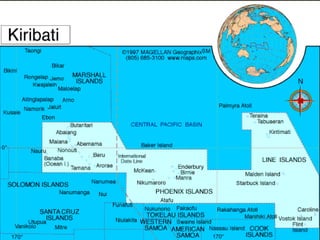
• The Republic of Kiribati (Kiribati) is an island
  nation lies astride the equator in the mid Pacific
  Ocean
• Consists of 33 low-lying coral atoll islands (total
  land area of 800 sq. km) spread across an
  oceanic EEZ of 3.5 million square kilometers
• Part of former British colony (Gilbert & Ellice
  Islands) gained independence in 1979
• Population of 103,000 (2010 pop. Census)
• 50,402 (48%) lives in S.Tarawa – Capital &
  Main Urban Centre of 684 hectare in area
Kiribati ~ Environment &
Development Context
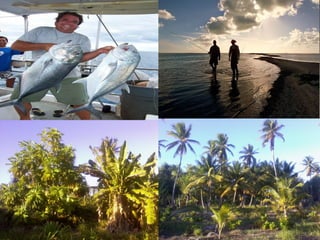
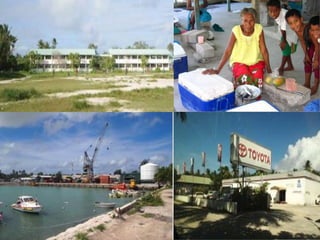
• The islands have diverse marine environ for
  food, transport, traditional practice & recreation
• The atoll terrestrial environment is more limited
  but essential for water, food & shelter
• The people have relied on natural resources for
  livelihood & enjoyed relative high standard of
  living owing generally to favorable resources for
  subsistence living
• Poverty, starvation & severe malnutrition are
  generally non-existent with basic food & shelter
  readily available for modest efforts
Environment & Dev. Context – cont’d
• Dominant transition from traditional subsistence
  lifestyle to contemporary market-based
  economy has posed key challenges
• Development performance has been poor with
  ‘stagnating & low economic growth rate’
  – Low productivity of investments, inefficient public
    enterprises, low return from resource exploitation &
    public expenditure forms the bulk of all expenses
• Constraints to sustainable economic growth;
  – Isolation & vulnerability, high reservation prices of
    labor, land & capital, low standard of workforce
    skills…etc. Land tenure is often an issue...
Climate Change
• C/Change is complicated by tremendous no. of
  variables linked with climate and complex
  interaction of atmosphere, ecosystems, ocean
  & land forms.
• There’s always level of uncertainty associated
  with C/Change predictions
• Often anticipated C/Change impacts on the
  natural & built environments includes;
  Droughts, flooding, thawing permafrost, storm surge,
  sea-level rise, heat waves and other
• IPCC however states that impacts will mostly
  manifest themselves in regional/land variables
Kiribati & Climate Change
• The fragile physical environment of Kiribati
  makes it one of the most vulnerable to the
  adverse impacts of C/Change
• The atolls rise 3-4 meters above mean sea
  level & a few hundred meters wide
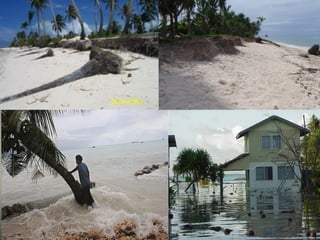
• Inundation, storm surge & erosion will destroy
  land areas of the already small islands &
  contaminates fresh groundwater lens vital for all
  living organisms/farm land – Challenges!!!
• Addressing the predictable impacts dominate
  the national environment and development
  agenda.
Kiribati & Climate Change
• Government has embarked in process of
  mainstreaming C/Change adaptation & disaster
  risk reduction in its development plan by
  implementing series of initiatives such as:
  – launch of the Kiribati Adaptation Program (KAP) in
    2003 and ongoing phases
  – Adoption of Climate Change Adaptation Policy
    Note
  – Climate Change Adaptation Strategy (‘05)
  – Consultation process and consequent adoption of a
    National Adaptation Program of Action (NAPA-’07)
  – Adoption of a 10 years National Integrated
    Environment Policy (NIEP: 2012 ~ 2022)
Land Planning & Climate Change
• Planning can play an important role in
  influencing societal actions that can ‘mitigate’
  effects that do occur & allow ‘adaptation’ to
  impacts.
• Planner’s role is significant as it deals with
  basic issues as community design, land use
  and development guidelines
• Planners can play a key role in enhancing
  resilience through improved adaptive land uses,
  efficient use of climate-sensitive resources ~
  (water), promote sustainable land activities
  …etc.
Strengthening Resilience through
Sustainable Land Planning
• Regulate land uses through zoning considerate
  of mitigate/adaptive measures
  – Open/Green Space, Environmental Significance
   Sites, Sanctuary, Protected Areas & Reserves
• Promote land uses that support sustainability
  – Mixed/Compact Uses (commercial/residential/civic),
  Agricultural/Farm Land Uses
• Encourage Green Development Standards
  – Urban Land Development Guideline & Policies
    (solar powers, gardening, natural lights/ventilations
    & setbacks from hazard areas…etc.)
Land Use, Sustainability & Food
Security ~ Agricultural Land Uses &
Practices
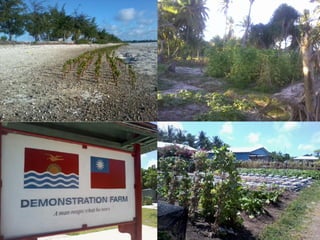
• Agriculture is mainstay of most Pacific Is.
  including Kiribati & subsistence farming
  continues to be significant/efficient component
  of subsistence living & income earning
• Designating land for agricultural initiatives is a
  testimony to the efficiency of subsistence
  production & improve opportunity for cash
  earning in domestic & outside markets
• Agricultural land uses support local food
  production & stimulate agro-market system
Land Use & Sustainable Agriculture
Dev. ~ Urban Setting
• High population density & competitive demand
  for land thus promoting ‘Mixed Land Uses’
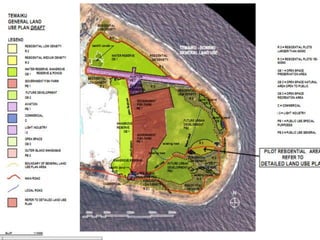
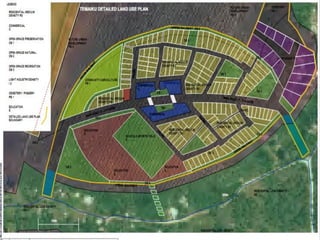
  – Water Reserve + (Organic) Farming Area
  – Urban Development Project & Temaiku Subdivision
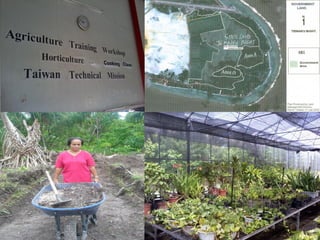
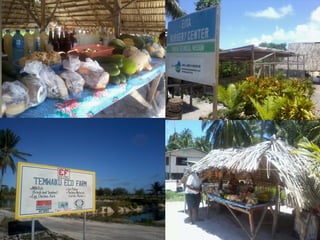
• Well established farmers’ associations with
  formal setups/nursery, products markets &
  readily available land
  – Eita Community Farmers Coop, KOFA, Eco-farm…
• Easy access to collaborative technical support
  with favorable number of customers
  – Agriculture Division & Taiwan Technical Mission
Land Use & Sustainable Agriculture
Dev. ~ Rural Setting
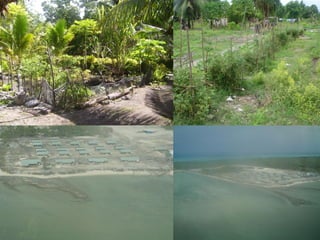
• Less population density = non competitive land
  use thus easy access to agricultural land
• Informal setups vs. urban but higher yields
• ‘Growth Center Concept’ that will stimulate
  more productive agricultural activities & market
  system & also aims to decentralize urban
  center & promote utilization of idle rural lands &
  boost productivity
• Establishment of public services &
  infrastructures + easier access to technical
  assistances
Summary
• Land use planning offers significant C/Change
  mitigation & adaptation opportunity
• Land planning has a significant role in the
  attainment of sustainability through initiation of
  land uses that are conductive to land
  productivity especially one that considers food
  security & economic development.
• Through commitment & well implemented plans
  is realization of opportunities & attainment of
  sustainability
Conclusion
• Kiribati being a Least developed country (LDC)
  & Small Island Developing State (SIDS) it’s
  among countries most vulnerable to C/C
• Their special circumstances being LDCs make
  them unable to meet costs of adaptation &
  SIDS physical susceptibility to effects of C/C.
• Always welcome assistances (technical &
  financial) from interested development partners
  to effectively/efficiently formulate & implement
  relevant programs
THANK YOU!!
Reference & sources:
•   Land Management Division, 2011, Urban Planning & Development Policy,
    MELAD-Government of Kiribati, Kiribati
•   Environment & Conservation Division, 2011, National Integrated
    Environment Policy, Draft Report, MELAD-Government of Kiribati, Kiribati
•   Asian Development Bank, 1995, Strategy for the Pacific; Policies & Program
    for Sustainable Growth, Manila, Philippines.

23. Tofinga

  • 1.
    ACP-EU_CTA REGIONAL POLICY BRIEFINGNo. 7 Building Resilience in Small Island Economies: from Vulnerabilities to Opportunities ENHANCING SUSTAINABLE DEVELOPMENT ON SMALL ISLAND ECONOMIES Hotel Victoria, Pointe aux Piments Mauritius; 23rd ~ 24th April 2012
  • 2.
    STRENGTHENING NATIONAL RESILIENCE THROUGH IMPLEMENTATION OF SUSTAINABLE LAND PLANNING Mr Tarakabu Tofinga Snr Land Planning Officer Land Management Division Ministry of Environment, Lands & Agriculture Dev.
  • 3.
    Presentation Overview • Kiribati~ A Brief Introduction • Kiribati ~ Environment & Development Context • Climate Change & Kiribati • Land Planning & Climate Change • Strengthening Resilience through Sustainable Land Planning • Land Planning, Sustainability & Food Security – Agricultural Land Uses & Practices – Agricultural Activities at Urban & Rural Settings • Summary & Conclusion
  • 4.
    Kiribati ~ ABrief Introduction • The Republic of Kiribati (Kiribati) is an island nation lies astride the equator in the mid Pacific Ocean • Consists of 33 low-lying coral atoll islands (total land area of 800 sq. km) spread across an oceanic EEZ of 3.5 million square kilometers • Part of former British colony (Gilbert & Ellice Islands) gained independence in 1979 • Population of 103,000 (2010 pop. Census) • 50,402 (48%) lives in S.Tarawa – Capital & Main Urban Centre of 684 hectare in area
  • 7.
    Kiribati ~ Environment& Development Context • The islands have diverse marine environ for food, transport, traditional practice & recreation • The atoll terrestrial environment is more limited but essential for water, food & shelter • The people have relied on natural resources for livelihood & enjoyed relative high standard of living owing generally to favorable resources for subsistence living • Poverty, starvation & severe malnutrition are generally non-existent with basic food & shelter readily available for modest efforts
  • 9.
    Environment & Dev.Context – cont’d • Dominant transition from traditional subsistence lifestyle to contemporary market-based economy has posed key challenges • Development performance has been poor with ‘stagnating & low economic growth rate’ – Low productivity of investments, inefficient public enterprises, low return from resource exploitation & public expenditure forms the bulk of all expenses • Constraints to sustainable economic growth; – Isolation & vulnerability, high reservation prices of labor, land & capital, low standard of workforce skills…etc. Land tenure is often an issue...
  • 11.
    Climate Change • C/Changeis complicated by tremendous no. of variables linked with climate and complex interaction of atmosphere, ecosystems, ocean & land forms. • There’s always level of uncertainty associated with C/Change predictions • Often anticipated C/Change impacts on the natural & built environments includes; Droughts, flooding, thawing permafrost, storm surge, sea-level rise, heat waves and other • IPCC however states that impacts will mostly manifest themselves in regional/land variables
  • 12.
    Kiribati & ClimateChange • The fragile physical environment of Kiribati makes it one of the most vulnerable to the adverse impacts of C/Change • The atolls rise 3-4 meters above mean sea level & a few hundred meters wide • Inundation, storm surge & erosion will destroy land areas of the already small islands & contaminates fresh groundwater lens vital for all living organisms/farm land – Challenges!!! • Addressing the predictable impacts dominate the national environment and development agenda.
  • 14.
    Kiribati & ClimateChange • Government has embarked in process of mainstreaming C/Change adaptation & disaster risk reduction in its development plan by implementing series of initiatives such as: – launch of the Kiribati Adaptation Program (KAP) in 2003 and ongoing phases – Adoption of Climate Change Adaptation Policy Note – Climate Change Adaptation Strategy (‘05) – Consultation process and consequent adoption of a National Adaptation Program of Action (NAPA-’07) – Adoption of a 10 years National Integrated Environment Policy (NIEP: 2012 ~ 2022)
  • 15.
    Land Planning &Climate Change • Planning can play an important role in influencing societal actions that can ‘mitigate’ effects that do occur & allow ‘adaptation’ to impacts. • Planner’s role is significant as it deals with basic issues as community design, land use and development guidelines • Planners can play a key role in enhancing resilience through improved adaptive land uses, efficient use of climate-sensitive resources ~ (water), promote sustainable land activities …etc.
  • 16.
    Strengthening Resilience through SustainableLand Planning • Regulate land uses through zoning considerate of mitigate/adaptive measures – Open/Green Space, Environmental Significance Sites, Sanctuary, Protected Areas & Reserves • Promote land uses that support sustainability – Mixed/Compact Uses (commercial/residential/civic), Agricultural/Farm Land Uses • Encourage Green Development Standards – Urban Land Development Guideline & Policies (solar powers, gardening, natural lights/ventilations & setbacks from hazard areas…etc.)
  • 20.
    Land Use, Sustainability& Food Security ~ Agricultural Land Uses & Practices • Agriculture is mainstay of most Pacific Is. including Kiribati & subsistence farming continues to be significant/efficient component of subsistence living & income earning • Designating land for agricultural initiatives is a testimony to the efficiency of subsistence production & improve opportunity for cash earning in domestic & outside markets • Agricultural land uses support local food production & stimulate agro-market system
  • 21.
    Land Use &Sustainable Agriculture Dev. ~ Urban Setting • High population density & competitive demand for land thus promoting ‘Mixed Land Uses’ – Water Reserve + (Organic) Farming Area – Urban Development Project & Temaiku Subdivision • Well established farmers’ associations with formal setups/nursery, products markets & readily available land – Eita Community Farmers Coop, KOFA, Eco-farm… • Easy access to collaborative technical support with favorable number of customers – Agriculture Division & Taiwan Technical Mission
  • 24.
    Land Use &Sustainable Agriculture Dev. ~ Rural Setting • Less population density = non competitive land use thus easy access to agricultural land • Informal setups vs. urban but higher yields • ‘Growth Center Concept’ that will stimulate more productive agricultural activities & market system & also aims to decentralize urban center & promote utilization of idle rural lands & boost productivity • Establishment of public services & infrastructures + easier access to technical assistances
  • 26.
    Summary • Land useplanning offers significant C/Change mitigation & adaptation opportunity • Land planning has a significant role in the attainment of sustainability through initiation of land uses that are conductive to land productivity especially one that considers food security & economic development. • Through commitment & well implemented plans is realization of opportunities & attainment of sustainability
  • 27.
    Conclusion • Kiribati beinga Least developed country (LDC) & Small Island Developing State (SIDS) it’s among countries most vulnerable to C/C • Their special circumstances being LDCs make them unable to meet costs of adaptation & SIDS physical susceptibility to effects of C/C. • Always welcome assistances (technical & financial) from interested development partners to effectively/efficiently formulate & implement relevant programs
  • 28.
  • 29.
    Reference & sources: • Land Management Division, 2011, Urban Planning & Development Policy, MELAD-Government of Kiribati, Kiribati • Environment & Conservation Division, 2011, National Integrated Environment Policy, Draft Report, MELAD-Government of Kiribati, Kiribati • Asian Development Bank, 1995, Strategy for the Pacific; Policies & Program for Sustainable Growth, Manila, Philippines.