1
2
Objectives
• In this chapter, students will learn:
– What normalization is and what role it plays in
the database design process
– About the normal forms 1NF, 2NF, 3NF, BCNF,
and 4NF
– How normal forms can be transformed from
lower normal forms to higher normal forms
– That normalization and ER modeling are used
concurrently to produce a good database design
– That some situations require denormalization to
generate information efficiently
Database Tables and Normalization
• Normalization
– Process for evaluating and correcting table
structures to minimize data redundancies
• Reduces data anomalies
– Series of stages called normal forms:
• First normal form (1NF)
• Second normal form (2NF)
• Third normal form (3NF)
3
Database Tables and Normalization
• Normalization (continued)
– 2NF is better than 1NF; 3NF is better than 2NF
– For most business database design purposes,
3NF is as high as needed in normalization
– Highest level of normalization is not always most
desirable
• Denormalization produces a lower normal form
– Increased performance but greater data
redundancy
4
The Need for Normalization
• Example: company that manages building projects
(Figure 6.1)
– Each project has its own project number, name,
assigned employees, etc.
– Each employee has an employee number, name, job
class
– Charges its clients by billing hours spent on each
contract
– Hourly billing rate is dependent on employee’s
position
– Total charge is a derived attribute and not stored in
the table
– Periodically, report is generated that contains
information such as displayed in Table 6.1
5
6
7
The Need for Normalization
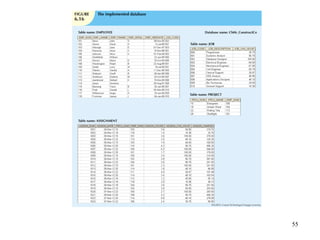
• Structure of data set in Figure 6.1 does not
handle data very well
• Table structure appears to work; report is
generated with ease
• Report may yield different results depending on
what data anomaly has occurred
– Employee can be assigned to more than one
project but each project includes only a single
occurrence of any one employee
• Relational database environment is suited to
help designer avoid data integrity problems
8
The Need for Normalization
• PROJECT_NUM, either a PK or part of a PK, contains
NULLS
• JOB_CLASS values could be abbreviated differently
• Each time an employee is assigned to a project, all
employee information is duplicated
• Update anomalies – Modifying JOB_CLASS for employee
105 requires alterations in two records
• Insertion anomalies – to insert a new employee who has not
been assigned to a project requires a phantom project
• Deletion anomalies – If a project has only one employee
associated with it and that employee leaves, a phantom
employee must be created
9
The Normalization Process
• Each table represents a single subject
• No data item will be unnecessarily stored in more
than one table
• All nonprime attributes in a table are dependent
on the primary key
• Each table is void of insertion, update, and
deletion anomalies
10
11
The Normalization Process (cont’d.)
• Objective of normalization is to ensure that all
tables are in at least 3NF
• Higher forms are not likely to be encountered in
business environment
• Normalization works one relation at a time
• Progressively breaks table into new set of
relations based on identified dependencies
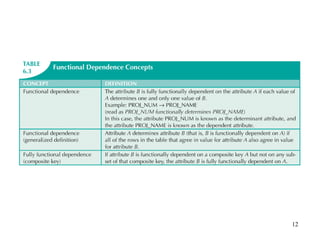
12
The Normalization Process (cont’d.)
• Partial dependency
– Exists when there is a functional dependence in
which the determinant is only part of the primary key
– If (A,B)(C,D); BC and (A,B) is the PK
• BC is a partial dependency because only part of the
PK, B, is needed to determine the value of C
• Transitive dependency
– Exists when there are functional dependencies such
that X → Y, Y → Z, and X is the primary key
• XZ is a transitive dependency because X determines
the value of Z via Y
• The existence of a functional dependence among non-
prime attributes is a sign of transitive dependency
13
Conversion to First Normal Form
• Repeating group
– Group of multiple entries of same type can exist
for any single key attribute occurrence
• Relational table must not contain repeating
groups
• Normalizing table structure will reduce data
redundancies
• Normalization is three-step procedure
14
Conversion to First Normal Form
(cont’d.)
• Step 1: Eliminate the Repeating Groups
– Eliminate nulls: each repeating group attribute
contains an appropriate data value
• Step 2: Identify the Primary Key
– Must uniquely identify attribute value
– New key must be composed
• Step 3: Identify All Dependencies
– Dependencies are depicted with a diagram
15
16
17
Conversion to First Normal Form
(cont’d.)
• Dependency diagram:
– Depicts all dependencies found within given
table structure
– Helpful in getting bird’s-eye view of all
relationships among table’s attributes
– Makes it less likely that you will overlook an
important dependency
– The arrows above the attributes indicate
desirable dependencies (i.e., based on the PK)
– The arrows below the attributes indicate less
desirable dependencies (partial and transitive)
18
19
as neither attribute is a prime attribute
Conversion to First Normal Form
• First normal form describes tabular format:
– All key attributes are defined
– No repeating groups in the table
– All attributes are dependent on primary key
• All relational tables satisfy 1NF requirements
• Some tables contain partial dependencies
– Dependencies are based on part of the primary
key
– Should be used with caution
20
Conversion to Second Normal Form
• Conversion to 2NF occurs only when the 1NF has a composite
key
– If the 1NF key is a single attribute, then the table is automatically
in 2NF
• Step 1: Make New Tables to Eliminate Partial Dependencies
– For each component of the PK that acts as a determinant in a
partial dependency, create a new table with a copy of that
component as the PK
– These components also remain in the original table in order to
serve as FKs to the original table
– Write each key component on a separate line; then write the
original composite key on the last line. Each component will
become the key in a new table
PROJ_NUM
EMP_NUM
PROJ_NUM EMP_NUM 21
Conversion to Second Normal Form
• Step 2: Reassign Corresponding Dependent Attributes
– The dependencies for the original key components are found
by examining the arrows below the dependency diagram in
Fig 6.3
– The attributes in a partial dependency are removed from the
original table and placed in the new table with the
dependency’s determinant
– Any attributes that are not dependent in a partial
dependency remain in the original table
– At this point, most anomalies have been eliminated
PROJECT(PROJ_NUM, PROJ_NAME)
EMPLOYEE(EMP_NUM, EMP_NAME, JOB_CLASS, CHG_HOUR)
ASSIGNMENT(PROJ_NUM , EMP_NUM, ASSIGN_HOURS)
22
23
Conversion to Second Normal Form
• Table is in second normal form (2NF) when:
– It is in 1NF and
– It includes no partial dependencies:
• No attribute is dependent on only portion of
primary key
24
Conversion to Third Normal Form
• Step 1: Make New Tables to Eliminate
Transitive Dependencies
– For every transitive dependency, write its
determinant as PK for new table (JOB_CLASS)
• Determinant: any attribute whose value
determines other values within a row
– The determinant should remain in the original
table to serve as a FK
25
Conversion to Third Normal Form
• Step 2: Reassign Corresponding Dependent
Attributes
– Identify attributes dependent on each determinant
identified in Step 1
• Identify dependency
– Name table to reflect its contents and function
PROJECT(PROJ_NUM, PROJ_NAME)
ASSIGNMENT(PROJ_NUM , EMP_NUM, ASSIGN_HOURS)
EMPLOYEE(EMP_NUM, EMP_NAME, JOB_CLASS)
JOB(JOB_CLASS, CHG_HOUR)
26
27
Conversion to Third Normal Form
• A table is in third normal form (3NF)
when both of the following are true:
– It is in 2NF
– It contains no transitive dependencies
28
Conversion to Third Normal Form
1NF->2NF – remove partial dependencies
2NF->3NF – remove transitive dependencies
• In both cases, the answer is create a new
table
– The determinant of the problem dependency
remains in the original table and is placed as
the PK of the new table
– The dependents of the problem dependency
are removed from the original table and
placed as nonprime attributes in the new table
29
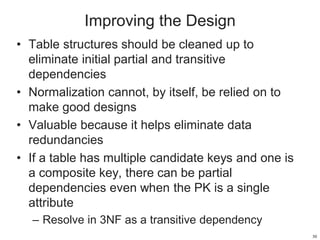
Improving the Design
• Table structures should be cleaned up to
eliminate initial partial and transitive
dependencies
• Normalization cannot, by itself, be relied on to
make good designs
• Valuable because it helps eliminate data
redundancies
• If a table has multiple candidate keys and one is
a composite key, there can be partial
dependencies even when the PK is a single
attribute
– Resolve in 3NF as a transitive dependency
30
Improving the Design (cont’d.)
• Issues to address, in order, to produce a good
normalized set of tables:
– Evaluate PK Assignments
• Use JOB_CODE as PK for JOB table rather than
JOB_CLASS to avoid data-entry errors when
used as a FK in EMPLOYEE (DB Designer
/Database Designer)
• JOB (JOB_CODE, JOB_CLASS,CHG_HOUR)
• Why is JOB_CLASS-->CHG_HOUR not a
transitive dependency? (Because JOB_CLASS is
a candidate key)
31
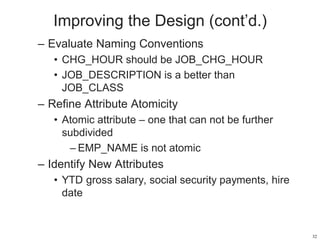
Improving the Design (cont’d.)
– Evaluate Naming Conventions
• CHG_HOUR should be JOB_CHG_HOUR
• JOB_DESCRIPTION is a better than
JOB_CLASS
– Refine Attribute Atomicity
• Atomic attribute – one that can not be further
subdivided
– EMP_NAME is not atomic
– Identify New Attributes
• YTD gross salary, social security payments, hire
date
32
Improving the Design (cont’d.)
– Identify New Relationships
• To track the manager of each project, put
EMP_NUM as a FK in PROJECT
– Refine Primary Keys as Required for Data
Granularity
• What does ASSIGN_HOURS represent ? Yearly
total hours, weekly, daily?
• If need multiple daily entries for project and emp
number, then use a surrogate key ASSIGN_NUM to
avoid duplication of the PK key EMP_NUM,
PROJ_NUM, ASSIGN_DATE
33
Improving the Design (cont’d.)
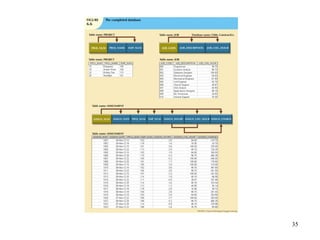
– Maintain Historical Accuracy
• An employee’s job charge could change over the
lifetime of a project. In order to reconstruct the
charges to a project, another field with the job
charge and date active is required
– Evaluate Using Derived Attributes
• Store rather than derive the charge if it will speed up
reporting
34
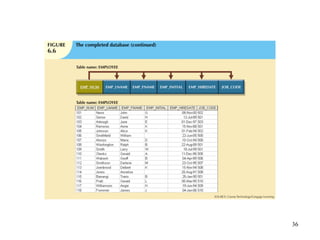
35
36
Surrogate Key Considerations
• When primary key is considered to be
unsuitable, designers use surrogate keys
• Data entries in Table 6.4 are inappropriate
because they duplicate existing records
– No violation of entity or referential integrity
37
Higher-Level Normal Forms
• Tables in 3NF perform suitably in business
transactional databases
• Higher-order normal forms are useful on
occasion
• Two special cases of 3NF:
– Boyce-Codd normal form (BCNF)
– Fourth normal form (4NF)
38
The Boyce-Codd Normal Form
• Every determinant in table is a candidate key
– Has same characteristics as primary key, but for
some reason, not chosen to be primary key
• When table contains only one candidate key,
the 3NF and the BCNF are equivalent
• BCNF can be violated only when table contains
more than one candidate key
39
The Boyce-Codd Normal Form
• Most designers consider the BCNF as a special
case of 3NF
• Table is in 3NF when it is in 2NF and there are
no transitive dependencies
• Table can be in 3NF and fail to meet BCNF
– No partial dependencies, nor does it contain
transitive dependencies
– A nonkey attribute is the determinant of a key
attribute
40
41
42
43
Fourth Normal Form (4NF)
• Table is in fourth normal form (4NF) when both
of the following are true:
– It is in 3NF
– No multiple sets of multivalued dependencies
• 4NF is largely academic if tables conform to
following two rules:
– All attributes dependent on primary key,
independent of each other
– No row contains two or more multivalued facts
about an entity
44
45
46
Normalization and Database Design
• Normalization should be part of the design
process
• Make sure that proposed entities meet required
normal form before table structures are created
• Many real-world databases have been
improperly designed or burdened with
anomalies
• You may be asked to redesign and modify
existing databases
47
Normalization and Database Design
• ER diagram
– Identify relevant entities, their attributes, and
their relationships
– Identify additional entities and attributes
• Normalization procedures
– Focus on characteristics of specific entities
– Micro view of entities within ER diagram
• Difficult to separate normalization process from
ER modeling process
48
49
Normalization and Database Design
• Given the following business rules:
– The company manages many projects
– Each project requires the services of many employees
– An employee may be assigned to several projects
– Some employees are not assigned to a project and perform
non-project related duties. Some employees are part of a
labor pool and shared by all project teams
– Each employee has a single primary job classification which
determines the hourly billing rate]
– Many employees can have the same job classification.
50
Normalization and Database Design
• We initially define the following entities
PROJECT(PROJ_NUM, PROJ_NAME)
EMPLOYEE(EMP_NUM,EMP_LNAME, EMP_FNAME, EMP_INITIAL,
JOB_DESCRIPTION, JOB_CHG_HOUR)
• PROJECT is in 3NF and needs no modification
• EMPLOYEE contains a transitive dependency so we now have
PROJECT(PROJ_NUM, PROJ_NAME)
EMPLOYEE(EMP_NUM,EMP_LNAME, EMP_FNAME, EMP_INITIAL,
JOB_CODE)
JOB(JOB_CODE, JOB_DESCRIPTION, JOB_CHG_HOUR)
51
• EMPLOYEE contains a transitive dependency so we now have
PROJECT(PROJ_NUM, PROJ_NAME)
EMPLOYEE(EMP_NUM,EMP_LNAME, EMP_FNAME, EMP_INITIAL,
JOB_CODE)
JOB(JOB_CODE, JOB_DESCRIPTION, JOB_CHG_HOUR)
Normalization and Database Design
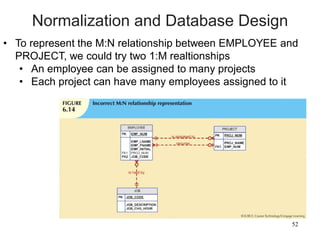
52
• To represent the M:N relationship between EMPLOYEE and
PROJECT, we could try two 1:M realtionships
• An employee can be assigned to many projects
• Each project can have many employees assigned to it
Normalization and Database Design
53
• As this M:N can not be implemented, we include the ASSIGNMENT
entity to track the assignment of employees in projects
Normalization and Database Design
54
• ASSIGN_HOURS is assigned to ASSIGNMENT
• A “manages” relationship is added to in order to keep detailed
information about each project’s manager
• Some additional attributes are added to maintain additional
information
PROJECT(PROJ_NUM, PROJ_NAME,EMP_NUM)
EMPLOYEE(EMP_NUM,EMP_LNAME, EMP_FNAME, EMP_INITIAL,
EMP_HIREDATE, JOB_CODE)
JOB(JOB_CODE, JOB_DESCRIPTION, JOB_CHG_HOUR)
ASSIGNMENT(ASSIGN_NUM, ASSIGN_DATE, PROJ_NUM, EMP_NUM,
ASSIGN_HOURS, ASSIGN_CHG_HOUR, ASSIGN_CHARGE)
Normalization and Database Design
55
Denormalization
• Creation of normalized relations is important
database design goal
• Processing requirements should also be a goal
• If tables are decomposed to conform to
normalization requirements:
– Number of database tables expands
56
Denormalization (cont’d.)
• Joining the larger number of tables reduces
system speed
• Conflicts are often resolved through
compromises that may include denormalization
• Defects of unnormalized tables:
– Data updates are less efficient because tables
are larger
– Indexing is more cumbersome as there are more
fields per table
– No simple strategies for creating virtual tables
known as views
57
Denormalization
58
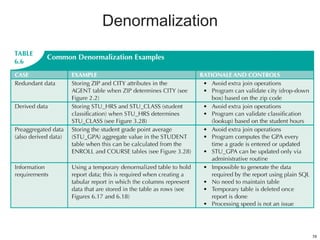
Denormalization
• In order to generate the report below, a temporary
denormalized table is used since the last four
semesters of each faculty member could be
different due to sabbatical, leave, start date, etc
59
Denormalization
• EVALDATA is the master data table which is normalized
• FACHIST is created via a series of queries in order to
produce the desired report
60
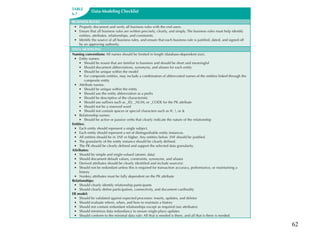
Data-Modeling Checklist
• Data modeling translates specific real-world
environment into data model
– Represents real-world data, users, processes,
interactions
• Data-modeling checklist helps ensure that data-
modeling tasks are successfully performed
• Based on concepts and tools learned in Part II
61
62

Ch06-Normalization SDHVFDDGNMFBVMBNCVMNMV

  • 1.
  • 2.
    2 Objectives • In thischapter, students will learn: – What normalization is and what role it plays in the database design process – About the normal forms 1NF, 2NF, 3NF, BCNF, and 4NF – How normal forms can be transformed from lower normal forms to higher normal forms – That normalization and ER modeling are used concurrently to produce a good database design – That some situations require denormalization to generate information efficiently
  • 3.
    Database Tables andNormalization • Normalization – Process for evaluating and correcting table structures to minimize data redundancies • Reduces data anomalies – Series of stages called normal forms: • First normal form (1NF) • Second normal form (2NF) • Third normal form (3NF) 3
  • 4.
    Database Tables andNormalization • Normalization (continued) – 2NF is better than 1NF; 3NF is better than 2NF – For most business database design purposes, 3NF is as high as needed in normalization – Highest level of normalization is not always most desirable • Denormalization produces a lower normal form – Increased performance but greater data redundancy 4
  • 5.
    The Need forNormalization • Example: company that manages building projects (Figure 6.1) – Each project has its own project number, name, assigned employees, etc. – Each employee has an employee number, name, job class – Charges its clients by billing hours spent on each contract – Hourly billing rate is dependent on employee’s position – Total charge is a derived attribute and not stored in the table – Periodically, report is generated that contains information such as displayed in Table 6.1 5
  • 6.
  • 7.
  • 8.
    The Need forNormalization • Structure of data set in Figure 6.1 does not handle data very well • Table structure appears to work; report is generated with ease • Report may yield different results depending on what data anomaly has occurred – Employee can be assigned to more than one project but each project includes only a single occurrence of any one employee • Relational database environment is suited to help designer avoid data integrity problems 8
  • 9.
    The Need forNormalization • PROJECT_NUM, either a PK or part of a PK, contains NULLS • JOB_CLASS values could be abbreviated differently • Each time an employee is assigned to a project, all employee information is duplicated • Update anomalies – Modifying JOB_CLASS for employee 105 requires alterations in two records • Insertion anomalies – to insert a new employee who has not been assigned to a project requires a phantom project • Deletion anomalies – If a project has only one employee associated with it and that employee leaves, a phantom employee must be created 9
  • 10.
    The Normalization Process •Each table represents a single subject • No data item will be unnecessarily stored in more than one table • All nonprime attributes in a table are dependent on the primary key • Each table is void of insertion, update, and deletion anomalies 10
  • 11.
    11 The Normalization Process(cont’d.) • Objective of normalization is to ensure that all tables are in at least 3NF • Higher forms are not likely to be encountered in business environment • Normalization works one relation at a time • Progressively breaks table into new set of relations based on identified dependencies
  • 12.
  • 13.
    The Normalization Process(cont’d.) • Partial dependency – Exists when there is a functional dependence in which the determinant is only part of the primary key – If (A,B)(C,D); BC and (A,B) is the PK • BC is a partial dependency because only part of the PK, B, is needed to determine the value of C • Transitive dependency – Exists when there are functional dependencies such that X → Y, Y → Z, and X is the primary key • XZ is a transitive dependency because X determines the value of Z via Y • The existence of a functional dependence among non- prime attributes is a sign of transitive dependency 13
  • 14.
    Conversion to FirstNormal Form • Repeating group – Group of multiple entries of same type can exist for any single key attribute occurrence • Relational table must not contain repeating groups • Normalizing table structure will reduce data redundancies • Normalization is three-step procedure 14
  • 15.
    Conversion to FirstNormal Form (cont’d.) • Step 1: Eliminate the Repeating Groups – Eliminate nulls: each repeating group attribute contains an appropriate data value • Step 2: Identify the Primary Key – Must uniquely identify attribute value – New key must be composed • Step 3: Identify All Dependencies – Dependencies are depicted with a diagram 15
  • 16.
  • 17.
  • 18.
    Conversion to FirstNormal Form (cont’d.) • Dependency diagram: – Depicts all dependencies found within given table structure – Helpful in getting bird’s-eye view of all relationships among table’s attributes – Makes it less likely that you will overlook an important dependency – The arrows above the attributes indicate desirable dependencies (i.e., based on the PK) – The arrows below the attributes indicate less desirable dependencies (partial and transitive) 18
  • 19.
    19 as neither attributeis a prime attribute
  • 20.
    Conversion to FirstNormal Form • First normal form describes tabular format: – All key attributes are defined – No repeating groups in the table – All attributes are dependent on primary key • All relational tables satisfy 1NF requirements • Some tables contain partial dependencies – Dependencies are based on part of the primary key – Should be used with caution 20
  • 21.
    Conversion to SecondNormal Form • Conversion to 2NF occurs only when the 1NF has a composite key – If the 1NF key is a single attribute, then the table is automatically in 2NF • Step 1: Make New Tables to Eliminate Partial Dependencies – For each component of the PK that acts as a determinant in a partial dependency, create a new table with a copy of that component as the PK – These components also remain in the original table in order to serve as FKs to the original table – Write each key component on a separate line; then write the original composite key on the last line. Each component will become the key in a new table PROJ_NUM EMP_NUM PROJ_NUM EMP_NUM 21
  • 22.
    Conversion to SecondNormal Form • Step 2: Reassign Corresponding Dependent Attributes – The dependencies for the original key components are found by examining the arrows below the dependency diagram in Fig 6.3 – The attributes in a partial dependency are removed from the original table and placed in the new table with the dependency’s determinant – Any attributes that are not dependent in a partial dependency remain in the original table – At this point, most anomalies have been eliminated PROJECT(PROJ_NUM, PROJ_NAME) EMPLOYEE(EMP_NUM, EMP_NAME, JOB_CLASS, CHG_HOUR) ASSIGNMENT(PROJ_NUM , EMP_NUM, ASSIGN_HOURS) 22
  • 23.
  • 24.
    Conversion to SecondNormal Form • Table is in second normal form (2NF) when: – It is in 1NF and – It includes no partial dependencies: • No attribute is dependent on only portion of primary key 24
  • 25.
    Conversion to ThirdNormal Form • Step 1: Make New Tables to Eliminate Transitive Dependencies – For every transitive dependency, write its determinant as PK for new table (JOB_CLASS) • Determinant: any attribute whose value determines other values within a row – The determinant should remain in the original table to serve as a FK 25
  • 26.
    Conversion to ThirdNormal Form • Step 2: Reassign Corresponding Dependent Attributes – Identify attributes dependent on each determinant identified in Step 1 • Identify dependency – Name table to reflect its contents and function PROJECT(PROJ_NUM, PROJ_NAME) ASSIGNMENT(PROJ_NUM , EMP_NUM, ASSIGN_HOURS) EMPLOYEE(EMP_NUM, EMP_NAME, JOB_CLASS) JOB(JOB_CLASS, CHG_HOUR) 26
  • 27.
  • 28.
    Conversion to ThirdNormal Form • A table is in third normal form (3NF) when both of the following are true: – It is in 2NF – It contains no transitive dependencies 28
  • 29.
    Conversion to ThirdNormal Form 1NF->2NF – remove partial dependencies 2NF->3NF – remove transitive dependencies • In both cases, the answer is create a new table – The determinant of the problem dependency remains in the original table and is placed as the PK of the new table – The dependents of the problem dependency are removed from the original table and placed as nonprime attributes in the new table 29
  • 30.
    Improving the Design •Table structures should be cleaned up to eliminate initial partial and transitive dependencies • Normalization cannot, by itself, be relied on to make good designs • Valuable because it helps eliminate data redundancies • If a table has multiple candidate keys and one is a composite key, there can be partial dependencies even when the PK is a single attribute – Resolve in 3NF as a transitive dependency 30
  • 31.
    Improving the Design(cont’d.) • Issues to address, in order, to produce a good normalized set of tables: – Evaluate PK Assignments • Use JOB_CODE as PK for JOB table rather than JOB_CLASS to avoid data-entry errors when used as a FK in EMPLOYEE (DB Designer /Database Designer) • JOB (JOB_CODE, JOB_CLASS,CHG_HOUR) • Why is JOB_CLASS-->CHG_HOUR not a transitive dependency? (Because JOB_CLASS is a candidate key) 31
  • 32.
    Improving the Design(cont’d.) – Evaluate Naming Conventions • CHG_HOUR should be JOB_CHG_HOUR • JOB_DESCRIPTION is a better than JOB_CLASS – Refine Attribute Atomicity • Atomic attribute – one that can not be further subdivided – EMP_NAME is not atomic – Identify New Attributes • YTD gross salary, social security payments, hire date 32
  • 33.
    Improving the Design(cont’d.) – Identify New Relationships • To track the manager of each project, put EMP_NUM as a FK in PROJECT – Refine Primary Keys as Required for Data Granularity • What does ASSIGN_HOURS represent ? Yearly total hours, weekly, daily? • If need multiple daily entries for project and emp number, then use a surrogate key ASSIGN_NUM to avoid duplication of the PK key EMP_NUM, PROJ_NUM, ASSIGN_DATE 33
  • 34.
    Improving the Design(cont’d.) – Maintain Historical Accuracy • An employee’s job charge could change over the lifetime of a project. In order to reconstruct the charges to a project, another field with the job charge and date active is required – Evaluate Using Derived Attributes • Store rather than derive the charge if it will speed up reporting 34
  • 35.
  • 36.
  • 37.
    Surrogate Key Considerations •When primary key is considered to be unsuitable, designers use surrogate keys • Data entries in Table 6.4 are inappropriate because they duplicate existing records – No violation of entity or referential integrity 37
  • 38.
    Higher-Level Normal Forms •Tables in 3NF perform suitably in business transactional databases • Higher-order normal forms are useful on occasion • Two special cases of 3NF: – Boyce-Codd normal form (BCNF) – Fourth normal form (4NF) 38
  • 39.
    The Boyce-Codd NormalForm • Every determinant in table is a candidate key – Has same characteristics as primary key, but for some reason, not chosen to be primary key • When table contains only one candidate key, the 3NF and the BCNF are equivalent • BCNF can be violated only when table contains more than one candidate key 39
  • 40.
    The Boyce-Codd NormalForm • Most designers consider the BCNF as a special case of 3NF • Table is in 3NF when it is in 2NF and there are no transitive dependencies • Table can be in 3NF and fail to meet BCNF – No partial dependencies, nor does it contain transitive dependencies – A nonkey attribute is the determinant of a key attribute 40
  • 41.
  • 42.
  • 43.
  • 44.
    Fourth Normal Form(4NF) • Table is in fourth normal form (4NF) when both of the following are true: – It is in 3NF – No multiple sets of multivalued dependencies • 4NF is largely academic if tables conform to following two rules: – All attributes dependent on primary key, independent of each other – No row contains two or more multivalued facts about an entity 44
  • 45.
  • 46.
  • 47.
    Normalization and DatabaseDesign • Normalization should be part of the design process • Make sure that proposed entities meet required normal form before table structures are created • Many real-world databases have been improperly designed or burdened with anomalies • You may be asked to redesign and modify existing databases 47
  • 48.
    Normalization and DatabaseDesign • ER diagram – Identify relevant entities, their attributes, and their relationships – Identify additional entities and attributes • Normalization procedures – Focus on characteristics of specific entities – Micro view of entities within ER diagram • Difficult to separate normalization process from ER modeling process 48
  • 49.
    49 Normalization and DatabaseDesign • Given the following business rules: – The company manages many projects – Each project requires the services of many employees – An employee may be assigned to several projects – Some employees are not assigned to a project and perform non-project related duties. Some employees are part of a labor pool and shared by all project teams – Each employee has a single primary job classification which determines the hourly billing rate] – Many employees can have the same job classification.
  • 50.
    50 Normalization and DatabaseDesign • We initially define the following entities PROJECT(PROJ_NUM, PROJ_NAME) EMPLOYEE(EMP_NUM,EMP_LNAME, EMP_FNAME, EMP_INITIAL, JOB_DESCRIPTION, JOB_CHG_HOUR) • PROJECT is in 3NF and needs no modification • EMPLOYEE contains a transitive dependency so we now have PROJECT(PROJ_NUM, PROJ_NAME) EMPLOYEE(EMP_NUM,EMP_LNAME, EMP_FNAME, EMP_INITIAL, JOB_CODE) JOB(JOB_CODE, JOB_DESCRIPTION, JOB_CHG_HOUR)
  • 51.
    51 • EMPLOYEE containsa transitive dependency so we now have PROJECT(PROJ_NUM, PROJ_NAME) EMPLOYEE(EMP_NUM,EMP_LNAME, EMP_FNAME, EMP_INITIAL, JOB_CODE) JOB(JOB_CODE, JOB_DESCRIPTION, JOB_CHG_HOUR) Normalization and Database Design
  • 52.
    52 • To representthe M:N relationship between EMPLOYEE and PROJECT, we could try two 1:M realtionships • An employee can be assigned to many projects • Each project can have many employees assigned to it Normalization and Database Design
  • 53.
    53 • As thisM:N can not be implemented, we include the ASSIGNMENT entity to track the assignment of employees in projects Normalization and Database Design
  • 54.
    54 • ASSIGN_HOURS isassigned to ASSIGNMENT • A “manages” relationship is added to in order to keep detailed information about each project’s manager • Some additional attributes are added to maintain additional information PROJECT(PROJ_NUM, PROJ_NAME,EMP_NUM) EMPLOYEE(EMP_NUM,EMP_LNAME, EMP_FNAME, EMP_INITIAL, EMP_HIREDATE, JOB_CODE) JOB(JOB_CODE, JOB_DESCRIPTION, JOB_CHG_HOUR) ASSIGNMENT(ASSIGN_NUM, ASSIGN_DATE, PROJ_NUM, EMP_NUM, ASSIGN_HOURS, ASSIGN_CHG_HOUR, ASSIGN_CHARGE) Normalization and Database Design
  • 55.
  • 56.
    Denormalization • Creation ofnormalized relations is important database design goal • Processing requirements should also be a goal • If tables are decomposed to conform to normalization requirements: – Number of database tables expands 56
  • 57.
    Denormalization (cont’d.) • Joiningthe larger number of tables reduces system speed • Conflicts are often resolved through compromises that may include denormalization • Defects of unnormalized tables: – Data updates are less efficient because tables are larger – Indexing is more cumbersome as there are more fields per table – No simple strategies for creating virtual tables known as views 57
  • 58.
  • 59.
    Denormalization • In orderto generate the report below, a temporary denormalized table is used since the last four semesters of each faculty member could be different due to sabbatical, leave, start date, etc 59
  • 60.
    Denormalization • EVALDATA isthe master data table which is normalized • FACHIST is created via a series of queries in order to produce the desired report 60
  • 61.
    Data-Modeling Checklist • Datamodeling translates specific real-world environment into data model – Represents real-world data, users, processes, interactions • Data-modeling checklist helps ensure that data- modeling tasks are successfully performed • Based on concepts and tools learned in Part II 61
  • 62.