NGO’s
-By
Dr. D. Sreenivasa Reddy
Dept. of Rural Development & Social Work
Introduction
• NGOs may be funded by governments,
foundations, schools, businesses or private
people.
• Some may have charitable status, while
others may be registered for tax exemption
based on recognition of social purposes.
Others may be fronts for political, religious,
or other interests.
Definition
• A non-governmental organization (NGO) is any non-
profit, voluntary citizens' group which is organized on a
local, national or international level.
• A non-governmental organization (NGO) is a citizen-
based association that operates independently of
government, usually to deliver resources or serve some
social or political purpose.
• NGO is defined as an independent voluntary association
of people acting together on a continuous basis, for some
common purpose, other than achieving government
office, making money or illegal activities.
History
• The term "non-governmental organization" was first
coined in 1945, when the United Nations (UN) was
created and there were 1083 NGOs.
• According to the UN any kind of private
organization that is independent from government
control can be termed as ‘NGO’.
• In some countries the term NGO is applied to an
organization that in another country would be called
as NPO (non profit organization).
• International NGOs were important in the anti-
slavery movement and the movement for
women's suffrage.
• Based on Societies Registration Act (SRA) NGO
was approved in 1860.
• India is estimated to had around 3 million
NGOs in 2020.
• Acc to the 202 govt. figures, there a total of
49,859 registered NGOs with FCRA.
Alternative Terms
Apart from "NGO", there are many alternative
terms in use, including:
• 1.Third Sector Organization (TSO),
• 2.Non-profit Organization (NPO),
• 3.Voluntary Organization (VO),
• 4.Civil Society Organization (CSO),
• 5.Grassroots Organization (GO),
• 6.Social Movement Organization (SMO),
• 7.Private Voluntary Organization (PVO) and
• 8.Self-help Organization (SHO).
Advantages
 Innovative approaches and, if necessary, to take
risks.
 Flexible in adapting to local situations and
responding to local needs
 Good rapport with people and can render
micro-assistance to very poor people
 Ability to communicate at all levels, from the
neighborhood to the top levels of government.
 Recruit both experts and highly motivated staff
Disadvantages
• The degree of participation in programme
/project design.
• Restricted/constrained ways of approach to a
problem or area.
• Dependence on outside financial resources
• Reduces cooperation between agencies, seen as
threatening or competitive.
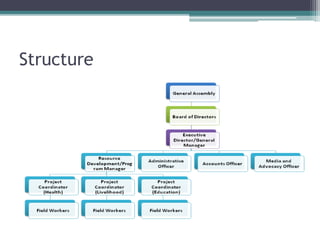
Structure
Functions:
• The functions of NGO deem to have a legal
status as they are registered under the Societies
Registration Act, which is a Central Act for
registering not for profit registration.
• Thus, because of the functions of NGO in India it
signifies broad range of organisations which may
be non-governmental, quasi or semi
governmental and includes both voluntary and
non-voluntary organisation, etc.
• NGO acts as a mediator between government and
citizen. When few issues that the does not reach to
government or are not solved by the government
then functions of NGO play a significant role in
assigning these issues to the government and few
issues are intentionally looked by the NGO.
• Their main aim is to make the earth a better place
for every human being who is suffering.
• The function of NGO is to focus on all the issues
concerning human rights, social, environmental
and advocacy. They work to promote and
improve the social and political conditions of the
society on a broad scale. Some of the functions
of NGO are:
• Human rights and child rights
• Poverty eradication
• Animal Rights
• Prevent Social Injustice
• Conservation of Environment
• Aged people care routine
• Empowerment of women
• Disease Control and others
• Health and Nutrition plans
• Conservation of Wildlife
• Hygiene and Sanitation conditions
• Humanitarian Relief
• Education plans and literacy
• Refugee Crisis
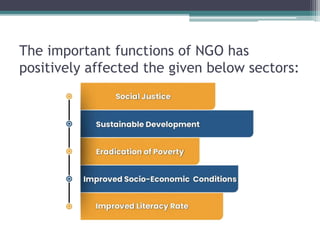
The important functions of NGO has
positively affected the given below sectors:
• The functions of NGO play a major role and have
brought social change for promotion and
development of the society.
• It has proved that these organisations are working
for various parts of the world and are doing their
work in serving the humanity and other good cause.
• It is important that the members of the NGO are
educated, inspired, enthusiastic and working in the
interest and properly carrying out the functions of
NGO. Few of the roles of NGO are given below:
• Social Safety-Valve Role
• NGO plays a crucial role in organising the public
inconvenience and becomes an advocate to the societal
problems and needs. They play a significant role in lending
voice to the poor and needy.
• Improve Government Performance
• It is one of the functions of NGO to ensure that the
government is responsive and are solving the problems of the
citizens thus making the governments work accountable. NGO
is also authorised to give suggestions and encourage
improvement and flexibility in the government’s
policymaking by giving their own research teams and
expertise.
• The Service Role
• The non-profit organisation works as a mechanism through
which people worried about any social or economic difficulty
which can respond and lend their helping hands. NGO help in
beneficial conflict resolution and creates the environment of
trust and confidence.
• Building Community Participation
• The non-profit organisation proposes substitute perspective
that includes the capability to carry out a meaningful dialogue
with disadvantaged communities. Many NGO are working to
conserve and encourage India’s diverse culture. They have
different communities all across the world who is
participating to serve the same interest of NGO.
• Women Empowerment
• The performance of major functions of NGO has come a long
way in working for women empowerment. Few of the
examples like fighting against sati, dowry, cruelty, other social
menaces to educating women, lowering the female foeticide
rate, employment to female, etc.
• It is still giving their best in removing gender inequality
.There are many foundations working for such causes like
Sewa, Agrani foundation, Eklavya, and Environmental Action
Group etc.
• Sustainable Development
• This area needs the maximum attention because
nobody is compromising their present needs and
is destroying natural resources to achieve their
selfish goals.
• Therefore, NGO is keeping an eye to all of this
and coming up with control measures to prevent
an overutilization of natural resources which is
the reason to environmental threats which later
cause health problems and natural calamities.
Activities Undertaken By NGO
• Advocacy and Raising Awareness
• NGO is a voice for every individual. Researching, analysing and to
inform the public about the prevalent issues and to organise citizen
action by conducting media campaigns and other kinds of activism.
• Brokerage
• NGO acts as an agent between various sectors and groups.
• Conflict Resolution
• NGO works as a mediator and facilitator in solving resolution.
• Building Capacity
• NGO provides free education, training programs and other
information.
• Service Delivery
• It functions the delivery of essential humanitarian and other social
services.
• Monitoring and Evaluation
• NGO acts as a ‘watchdog’ or independent ‘auditor ‘of government
and corporate performance and accountability.
Types of NGOs: by orientation & Level
of Operation
• Charitable Orientation-Needs of the poor -
distribution of food, clothing or medicine; provision
of housing, transport, schools etc.
• Service Orientation- Provision of health, family
planning or education services in which the
programs are designed by the NGO
• Service Orientation- Self-help projects where
local people are involved particularly in the
implementation of a project by contributing cash,
tools, land, materials, labour etc.
• Empowering Orientation- The aim is to
help poor people develop a clearer
understanding of the social, political and
economic factors affecting their lives, and to
strengthen their awareness of their own
potential power to control their lives.
NGO Types: By level of Operation
• Community-based Organizations- These
can include sports clubs, women's organizations,
and neighborhood organizations, religious or
educational organizations.
• Citywide Organizations- Its Include
organizations such as the Rotary or lion's Club,
chambers of commerce and industry, coalitions
of business, ethnic or educational groups and
associations of community organizations.
• National NGOs- Its Include organizations such
as the Red Cross, YMCAs/YWCAs, professional
organizations etc. Some of these have state and
city branches and assist local NGOs.
• International NGOs- Redda Barna and Save the
Children organizations, OXFAM, CARE, Ford
and Rockefeller Foundations to religiously
motivated groups.

Ngo’s

  • 1.
    NGO’s -By Dr. D. SreenivasaReddy Dept. of Rural Development & Social Work
  • 2.
    Introduction • NGOs maybe funded by governments, foundations, schools, businesses or private people. • Some may have charitable status, while others may be registered for tax exemption based on recognition of social purposes. Others may be fronts for political, religious, or other interests.
  • 3.
    Definition • A non-governmentalorganization (NGO) is any non- profit, voluntary citizens' group which is organized on a local, national or international level. • A non-governmental organization (NGO) is a citizen- based association that operates independently of government, usually to deliver resources or serve some social or political purpose. • NGO is defined as an independent voluntary association of people acting together on a continuous basis, for some common purpose, other than achieving government office, making money or illegal activities.
  • 4.
    History • The term"non-governmental organization" was first coined in 1945, when the United Nations (UN) was created and there were 1083 NGOs. • According to the UN any kind of private organization that is independent from government control can be termed as ‘NGO’. • In some countries the term NGO is applied to an organization that in another country would be called as NPO (non profit organization).
  • 5.
    • International NGOswere important in the anti- slavery movement and the movement for women's suffrage. • Based on Societies Registration Act (SRA) NGO was approved in 1860. • India is estimated to had around 3 million NGOs in 2020. • Acc to the 202 govt. figures, there a total of 49,859 registered NGOs with FCRA.
  • 6.
    Alternative Terms Apart from"NGO", there are many alternative terms in use, including: • 1.Third Sector Organization (TSO), • 2.Non-profit Organization (NPO), • 3.Voluntary Organization (VO), • 4.Civil Society Organization (CSO), • 5.Grassroots Organization (GO), • 6.Social Movement Organization (SMO), • 7.Private Voluntary Organization (PVO) and • 8.Self-help Organization (SHO).
  • 7.
    Advantages  Innovative approachesand, if necessary, to take risks.  Flexible in adapting to local situations and responding to local needs  Good rapport with people and can render micro-assistance to very poor people  Ability to communicate at all levels, from the neighborhood to the top levels of government.  Recruit both experts and highly motivated staff
  • 8.
    Disadvantages • The degreeof participation in programme /project design. • Restricted/constrained ways of approach to a problem or area. • Dependence on outside financial resources • Reduces cooperation between agencies, seen as threatening or competitive.
  • 9.
  • 10.
    Functions: • The functionsof NGO deem to have a legal status as they are registered under the Societies Registration Act, which is a Central Act for registering not for profit registration. • Thus, because of the functions of NGO in India it signifies broad range of organisations which may be non-governmental, quasi or semi governmental and includes both voluntary and non-voluntary organisation, etc.
  • 11.
    • NGO actsas a mediator between government and citizen. When few issues that the does not reach to government or are not solved by the government then functions of NGO play a significant role in assigning these issues to the government and few issues are intentionally looked by the NGO. • Their main aim is to make the earth a better place for every human being who is suffering.
  • 12.
    • The functionof NGO is to focus on all the issues concerning human rights, social, environmental and advocacy. They work to promote and improve the social and political conditions of the society on a broad scale. Some of the functions of NGO are:
  • 13.
    • Human rightsand child rights • Poverty eradication • Animal Rights • Prevent Social Injustice • Conservation of Environment • Aged people care routine • Empowerment of women • Disease Control and others • Health and Nutrition plans • Conservation of Wildlife • Hygiene and Sanitation conditions • Humanitarian Relief • Education plans and literacy • Refugee Crisis
  • 14.
    The important functionsof NGO has positively affected the given below sectors:
  • 15.
    • The functionsof NGO play a major role and have brought social change for promotion and development of the society. • It has proved that these organisations are working for various parts of the world and are doing their work in serving the humanity and other good cause. • It is important that the members of the NGO are educated, inspired, enthusiastic and working in the interest and properly carrying out the functions of NGO. Few of the roles of NGO are given below:
  • 16.
    • Social Safety-ValveRole • NGO plays a crucial role in organising the public inconvenience and becomes an advocate to the societal problems and needs. They play a significant role in lending voice to the poor and needy. • Improve Government Performance • It is one of the functions of NGO to ensure that the government is responsive and are solving the problems of the citizens thus making the governments work accountable. NGO is also authorised to give suggestions and encourage improvement and flexibility in the government’s policymaking by giving their own research teams and expertise. • The Service Role • The non-profit organisation works as a mechanism through which people worried about any social or economic difficulty which can respond and lend their helping hands. NGO help in beneficial conflict resolution and creates the environment of trust and confidence.
  • 17.
    • Building CommunityParticipation • The non-profit organisation proposes substitute perspective that includes the capability to carry out a meaningful dialogue with disadvantaged communities. Many NGO are working to conserve and encourage India’s diverse culture. They have different communities all across the world who is participating to serve the same interest of NGO. • Women Empowerment • The performance of major functions of NGO has come a long way in working for women empowerment. Few of the examples like fighting against sati, dowry, cruelty, other social menaces to educating women, lowering the female foeticide rate, employment to female, etc. • It is still giving their best in removing gender inequality .There are many foundations working for such causes like Sewa, Agrani foundation, Eklavya, and Environmental Action Group etc.
  • 18.
    • Sustainable Development •This area needs the maximum attention because nobody is compromising their present needs and is destroying natural resources to achieve their selfish goals. • Therefore, NGO is keeping an eye to all of this and coming up with control measures to prevent an overutilization of natural resources which is the reason to environmental threats which later cause health problems and natural calamities.
  • 19.
    Activities Undertaken ByNGO • Advocacy and Raising Awareness • NGO is a voice for every individual. Researching, analysing and to inform the public about the prevalent issues and to organise citizen action by conducting media campaigns and other kinds of activism. • Brokerage • NGO acts as an agent between various sectors and groups. • Conflict Resolution • NGO works as a mediator and facilitator in solving resolution. • Building Capacity • NGO provides free education, training programs and other information. • Service Delivery • It functions the delivery of essential humanitarian and other social services. • Monitoring and Evaluation • NGO acts as a ‘watchdog’ or independent ‘auditor ‘of government and corporate performance and accountability.
  • 20.
    Types of NGOs:by orientation & Level of Operation • Charitable Orientation-Needs of the poor - distribution of food, clothing or medicine; provision of housing, transport, schools etc. • Service Orientation- Provision of health, family planning or education services in which the programs are designed by the NGO • Service Orientation- Self-help projects where local people are involved particularly in the implementation of a project by contributing cash, tools, land, materials, labour etc.
  • 21.
    • Empowering Orientation-The aim is to help poor people develop a clearer understanding of the social, political and economic factors affecting their lives, and to strengthen their awareness of their own potential power to control their lives.
  • 22.
    NGO Types: Bylevel of Operation • Community-based Organizations- These can include sports clubs, women's organizations, and neighborhood organizations, religious or educational organizations. • Citywide Organizations- Its Include organizations such as the Rotary or lion's Club, chambers of commerce and industry, coalitions of business, ethnic or educational groups and associations of community organizations.
  • 23.
    • National NGOs-Its Include organizations such as the Red Cross, YMCAs/YWCAs, professional organizations etc. Some of these have state and city branches and assist local NGOs. • International NGOs- Redda Barna and Save the Children organizations, OXFAM, CARE, Ford and Rockefeller Foundations to religiously motivated groups.