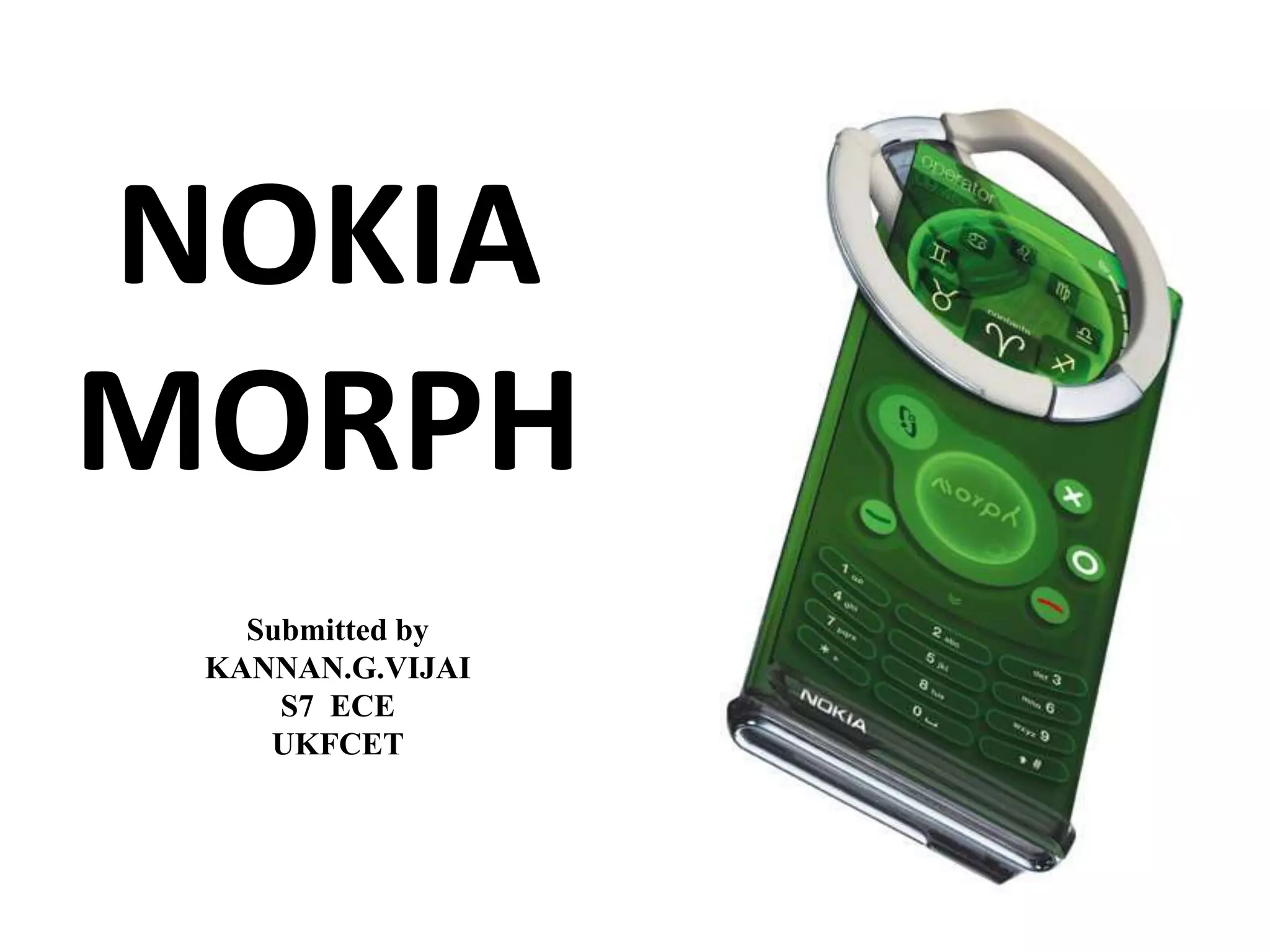
NOKIA
MORPH
Submitted by
KANNAN.G.VIJAI
S7 ECE
UKFCET
INTRODUCTION
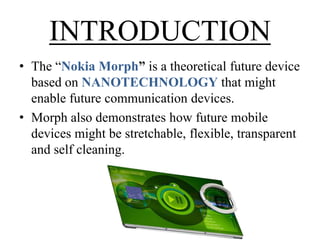
• The ―Nokia Morph” is a theoretical future device
based on NANOTECHNOLOGY that might
enable future communication devices.
• Morph also demonstrates how future mobile
devices might be stretchable, flexible, transparent
and self cleaning.
Points to be discussed
•
•
•
•
•
•
•

What is Morph..?
History of morph
The concept phone
Features of Morph
Specifications of Morph
Advantages
Disadvantages
What is Morph?
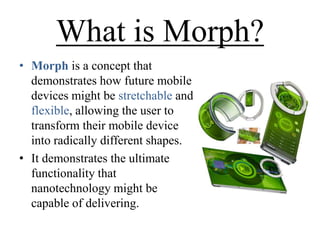
• Morph is a concept that
demonstrates how future mobile
devices might be stretchable and
flexible, allowing the user to
transform their mobile device
into radically different shapes.
• It demonstrates the ultimate
functionality that
nanotechnology might be
capable of delivering.
HISTORY
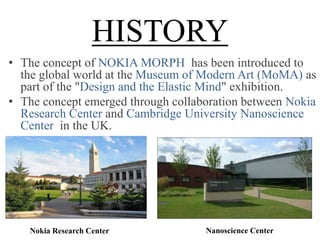
• The concept of NOKIA MORPH has been introduced to
the global world at the Museum of Modern Art (MoMA) as
part of the "Design and the Elastic Mind" exhibition.
• The concept emerged through collaboration between Nokia
Research Center and Cambridge University Nanoscience
Center in the UK.

Nokia Research Center

Nanoscience Center
The concept phone
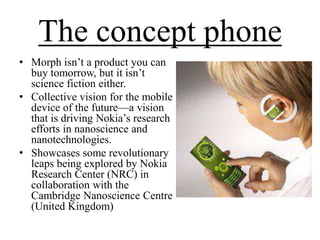
• Morph isn’t a product you can
buy tomorrow, but it isn’t
science fiction either.
• Collective vision for the mobile
device of the future—a vision
that is driving Nokia’s research
efforts in nanoscience and
nanotechnologies.
• Showcases some revolutionary
leaps being explored by Nokia
Research Center (NRC) in
collaboration with the
Cambridge Nanoscience Centre
(United Kingdom)
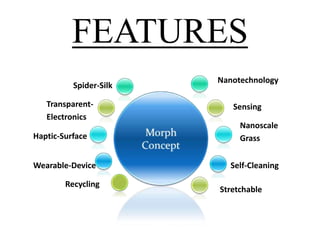
FEATURES
Spider-Silk
TransparentElectronics
Haptic-Surface

Wearable-Device
Recycling

Nanotechnology
Sensing
Nanoscale
Grass

Self-Cleaning
Stretchable
NANOTECHNOLOGY
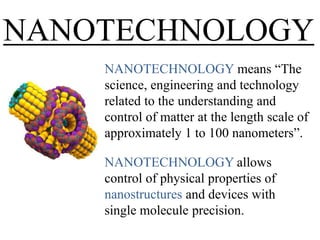
NANOTECHNOLOGY means ―The
science, engineering and technology
related to the understanding and
control of matter at the length scale of
approximately 1 to 100 nanometers‖.
NANOTECHNOLOGY allows
control of physical properties of
nanostructures and devices with
single molecule precision.
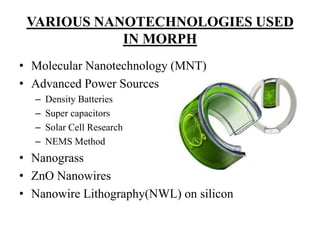
VARIOUS NANOTECHNOLOGIES USED
IN MORPH
• Molecular Nanotechnology (MNT)
• Advanced Power Sources
–
–
–
–

Density Batteries
Super capacitors
Solar Cell Research
NEMS Method

• Nanograss
• ZnO Nanowires
• Nanowire Lithography(NWL) on silicon
SENSING
• Morph can sense its surrounding .
• Empower users to examine the environment around them in completely
new ways, from analyzing air pollution, to gaining insight into biochemical traces and processes
• Nanoscale sensors with improved resolution and the stability forms the
building block.
• In order to improve sensor and signal processing characteristics Nokia
introduced NanoWire Lithography (NWL) process that fabricates a large
area and self aligned 3D architectures.
• It has Nanocomponents having an immense surface area–to-volume ratio,
allowing plenty of space for chemical reactions that enable robust
chemical and biochemical sensing
• Our ability to tune into our environment in these ways can help us make
key decisions that guide our daily actions and ultimately can enhance our
health.
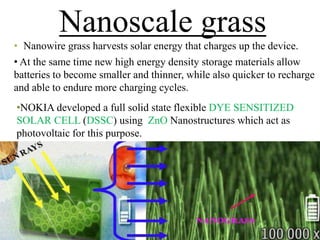
Nanoscale grass
• Nanowire grass harvests solar energy that charges up the device.
• At the same time new high energy density storage materials allow
batteries to become smaller and thinner, while also quicker to recharge
and able to endure more charging cycles.
•NOKIA developed a full solid state flexible DYE SENSITIZED
SOLAR CELL (DSSC) using ZnO Nanostructures which act as
photovoltaic for this purpose.
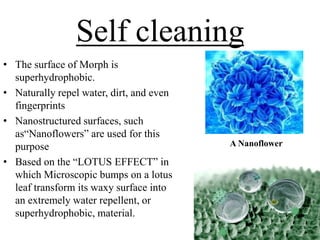
Self cleaning
• The surface of Morph is
superhydrophobic.
• Naturally repel water, dirt, and even
fingerprints
• Nanostructured surfaces, such
as―Nanoflowers‖ are used for this
purpose
• Based on the ―LOTUS EFFECT‖ in
which Microscopic bumps on a lotus
leaf transform its waxy surface into
an extremely water repellent, or
superhydrophobic, material.

A Nanoflower
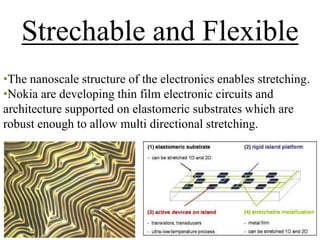
Strechable and Flexible
•The nanoscale structure of the electronics enables stretching.
•Nokia are developing thin film electronic circuits and
architecture supported on elastomeric substrates which are
robust enough to allow multi directional stretching.
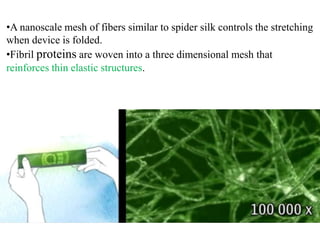
•A nanoscale mesh of fibers similar to spider silk controls the stretching
when device is folded.
•Fibril proteins are woven into a three dimensional mesh that
reinforces thin elastic structures.
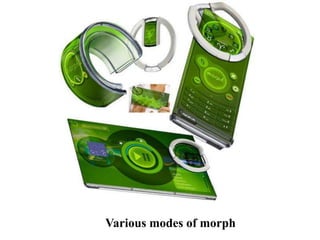
Various modes of morph
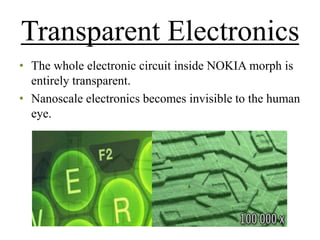
Transparent Electronics
• The whole electronic circuit inside NOKIA morph is
entirely transparent.
• Nanoscale electronics becomes invisible to the human
eye.
Haptic Surface
• Touch sensitive and
responsive [haptic] surface
of NOKIA morph is
provided by large area
sensing surfaces using
piezoelectric nanowire
arrays.
• ―ZnO‖ nanowires are used to
produce the piezoelectric
nanowire arrays.
• Buttons on the device
surface are real 3D forms.
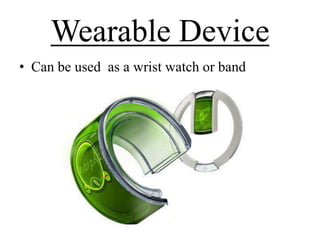
Wearable Device
• Can be used as a wrist watch or band
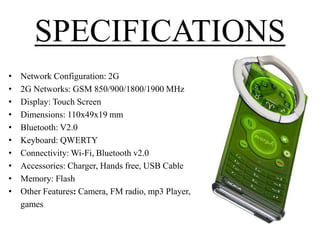
SPECIFICATIONS
•
•
•
•
•
•
•
•
•
•

Network Configuration: 2G
2G Networks: GSM 850/900/1800/1900 MHz
Display: Touch Screen
Dimensions: 110x49x19 mm
Bluetooth: V2.0
Keyboard: QWERTY
Connectivity: Wi-Fi, Bluetooth v2.0
Accessories: Charger, Hands free, USB Cable
Memory: Flash
Other Features: Camera, FM radio, mp3 Player,
games
VIDEO
ADVANTAGES
• Utilization of biodegradable materials might make
production and recycling of devices easier and
ecologically friendly
• Low Power cost due to built-in solar absorption that
might charge the device making batteries smaller,
longer lasting and faster to charge and hence making
the phone less bulky
• Helps to learn more about the environment around us,
empowering us to make better choices
• Stretchable and flexible electronics.
• Transparent electronics.
• Self-cleaning surfaces
DISADVANTAGES
• Due to the granular structure, nano particles can go
unnoticed on a person’s hand, but the risk of inhaling
this could be very dangerous. This can duly be a cause
of death.
• Lack of a reliable power source: Nokia is still searching
new battery materials to power the Morph. This is a
significant technical drawback that Nokia has to
overcome before launching this concept.
• Conventional dsscs provides instability related to
solvent Leakage and evaporation.
• Overpriced
Nokia morph
Nokia morph

Nokia morph

  • 1.
  • 2.
    INTRODUCTION • The ―NokiaMorph” is a theoretical future device based on NANOTECHNOLOGY that might enable future communication devices. • Morph also demonstrates how future mobile devices might be stretchable, flexible, transparent and self cleaning.
  • 3.
    Points to bediscussed • • • • • • • What is Morph..? History of morph The concept phone Features of Morph Specifications of Morph Advantages Disadvantages
  • 4.
    What is Morph? •Morph is a concept that demonstrates how future mobile devices might be stretchable and flexible, allowing the user to transform their mobile device into radically different shapes. • It demonstrates the ultimate functionality that nanotechnology might be capable of delivering.
  • 5.
    HISTORY • The conceptof NOKIA MORPH has been introduced to the global world at the Museum of Modern Art (MoMA) as part of the "Design and the Elastic Mind" exhibition. • The concept emerged through collaboration between Nokia Research Center and Cambridge University Nanoscience Center in the UK. Nokia Research Center Nanoscience Center
  • 6.
    The concept phone •Morph isn’t a product you can buy tomorrow, but it isn’t science fiction either. • Collective vision for the mobile device of the future—a vision that is driving Nokia’s research efforts in nanoscience and nanotechnologies. • Showcases some revolutionary leaps being explored by Nokia Research Center (NRC) in collaboration with the Cambridge Nanoscience Centre (United Kingdom)
  • 7.
  • 8.
    NANOTECHNOLOGY NANOTECHNOLOGY means ―The science,engineering and technology related to the understanding and control of matter at the length scale of approximately 1 to 100 nanometers‖. NANOTECHNOLOGY allows control of physical properties of nanostructures and devices with single molecule precision.
  • 9.
    VARIOUS NANOTECHNOLOGIES USED INMORPH • Molecular Nanotechnology (MNT) • Advanced Power Sources – – – – Density Batteries Super capacitors Solar Cell Research NEMS Method • Nanograss • ZnO Nanowires • Nanowire Lithography(NWL) on silicon
  • 10.
    SENSING • Morph cansense its surrounding . • Empower users to examine the environment around them in completely new ways, from analyzing air pollution, to gaining insight into biochemical traces and processes • Nanoscale sensors with improved resolution and the stability forms the building block. • In order to improve sensor and signal processing characteristics Nokia introduced NanoWire Lithography (NWL) process that fabricates a large area and self aligned 3D architectures. • It has Nanocomponents having an immense surface area–to-volume ratio, allowing plenty of space for chemical reactions that enable robust chemical and biochemical sensing • Our ability to tune into our environment in these ways can help us make key decisions that guide our daily actions and ultimately can enhance our health.
  • 11.
    Nanoscale grass • Nanowiregrass harvests solar energy that charges up the device. • At the same time new high energy density storage materials allow batteries to become smaller and thinner, while also quicker to recharge and able to endure more charging cycles. •NOKIA developed a full solid state flexible DYE SENSITIZED SOLAR CELL (DSSC) using ZnO Nanostructures which act as photovoltaic for this purpose.
  • 12.
    Self cleaning • Thesurface of Morph is superhydrophobic. • Naturally repel water, dirt, and even fingerprints • Nanostructured surfaces, such as―Nanoflowers‖ are used for this purpose • Based on the ―LOTUS EFFECT‖ in which Microscopic bumps on a lotus leaf transform its waxy surface into an extremely water repellent, or superhydrophobic, material. A Nanoflower
  • 13.
    Strechable and Flexible •Thenanoscale structure of the electronics enables stretching. •Nokia are developing thin film electronic circuits and architecture supported on elastomeric substrates which are robust enough to allow multi directional stretching.
  • 14.
    •A nanoscale meshof fibers similar to spider silk controls the stretching when device is folded. •Fibril proteins are woven into a three dimensional mesh that reinforces thin elastic structures.
  • 15.
  • 16.
    Transparent Electronics • Thewhole electronic circuit inside NOKIA morph is entirely transparent. • Nanoscale electronics becomes invisible to the human eye.
  • 17.
    Haptic Surface • Touchsensitive and responsive [haptic] surface of NOKIA morph is provided by large area sensing surfaces using piezoelectric nanowire arrays. • ―ZnO‖ nanowires are used to produce the piezoelectric nanowire arrays. • Buttons on the device surface are real 3D forms.
  • 18.
    Wearable Device • Canbe used as a wrist watch or band
  • 19.
    SPECIFICATIONS • • • • • • • • • • Network Configuration: 2G 2GNetworks: GSM 850/900/1800/1900 MHz Display: Touch Screen Dimensions: 110x49x19 mm Bluetooth: V2.0 Keyboard: QWERTY Connectivity: Wi-Fi, Bluetooth v2.0 Accessories: Charger, Hands free, USB Cable Memory: Flash Other Features: Camera, FM radio, mp3 Player, games
  • 20.
  • 21.
    ADVANTAGES • Utilization ofbiodegradable materials might make production and recycling of devices easier and ecologically friendly • Low Power cost due to built-in solar absorption that might charge the device making batteries smaller, longer lasting and faster to charge and hence making the phone less bulky • Helps to learn more about the environment around us, empowering us to make better choices • Stretchable and flexible electronics. • Transparent electronics. • Self-cleaning surfaces
  • 22.
    DISADVANTAGES • Due tothe granular structure, nano particles can go unnoticed on a person’s hand, but the risk of inhaling this could be very dangerous. This can duly be a cause of death. • Lack of a reliable power source: Nokia is still searching new battery materials to power the Morph. This is a significant technical drawback that Nokia has to overcome before launching this concept. • Conventional dsscs provides instability related to solvent Leakage and evaporation. • Overpriced