Submitted to By Mr. Gunjan Gupta   Rishav Majumdar Lecturer (Electrical)  VIII Sem.(Electrical)
AGENDA An overview on Nanotechnology About Morph Features Sensors Design Power Source Advantages Disadvantages References
NANOTECHNOLOGY The Next BIG thing is Really Small! Also called ‘ molecular manufacturing’ , is a branch of engineering deals with the design and manufacture of extremely small electronic circuits and mechanical devices built at “ultra molecular level” in order to  create materials, devices, and systems with fundamentally new properties and functions because of their small structure  between approximately 1 and 100 nanometers (100,000 times thinner than a strand of human hair) Involves imaging, measuring, modeling, and manipulating matter at this length scale With this one can lower costs, increase functionality and lower power
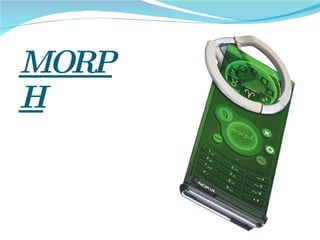
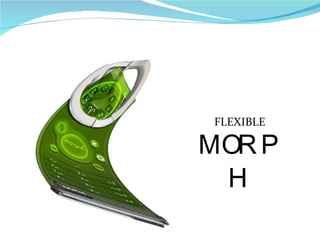
MORPH
“ HOW DO THEY DO IT”? In the ongoing race to make phones smaller, thinner, stronger, and increasingly functional, NANOTECHNOLOGY has been considered as a boon Nokia is already beginning to apply nanotechnologies to deliver product like Morph
THE CONCEPT PHONE Morph isn’t a product you can buy tomorrow, but it isn’t science fiction either.  Collective vision for the mobile device of the future—a vision that is driving Nokia’s research efforts in nanoscience and nanotechnologies. Showcases some revolutionary leaps being explored by Nokia Research Center (NRC) in collaboration with the Cambridge Nanoscience Centre (United Kingdom)
Intelligently bridges local and global information  A self-configuring unit that can learn its context—and adapt instantly by sensing ambient elements, physical objects, and your individual context —presents severe challenges for sensor technologies  Efficient computing solutions to minimize power consumption New materials and advanced fabrication methodologies have been used for making it a robust, self-healing device that can operate for days under rough conditions
WHAT’S NEW IN  MORPH ? Sensing.  Morph enables us to observe our local environment. It can detect specific chemical compounds in the air. Nanoscale grass .  Nanowire grass harvests solar energy that charges up the device. Self-cleaning.  The surface of the Morph is superhydrophobic that makes it extremely dirt repellent. Stretchable.  The nanoscale structure of the electronics enables stretching. Strength of Spider Silk.  A nanoscale mesh of fibers controls the stretching of the device when the device is folded. Transparent Electronics.  Nanoscale electronics becomes invisible to the human eye. Haptic Surface.  Buttons on the device are real 3D forms. The surface forms its context dependent. Wearable Device.  Wearing Morph can be a substitute for  wearing a watch.
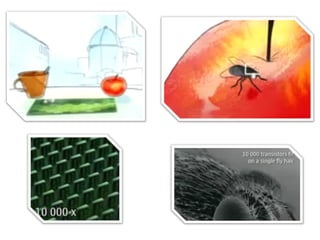
SENSORS AND SENSING EVERYWHERE Empower users to examine the environment around them in completely new ways, from analyzing air pollution, to gaining insight into bio-chemical traces and processes Nanoscale sensors (MICROSENSORS)  with improved resolution and the stability forms the building block. It has Nanocomponents having an immense surface area–to-volume ratio, allowing plenty of space for chemical reactions  that enable robust chemical and biochemical sensing  Nanoscale chemical sensors use principles and materials common to most biological systems
 
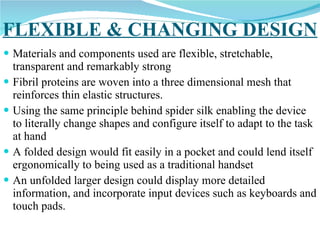
FLEXIBLE & CHANGING DESIGN Materials and components used are flexible, stretchable, transparent and remarkably strong Fibril proteins are woven into a three dimensional mesh that reinforces thin elastic structures.  Using the same principle behind spider silk enabling the device to literally change shapes and configure itself to adapt to the task at hand A folded design would fit easily in a pocket and could lend itself ergonomically to being used as a traditional handset An unfolded larger design could display more detailed information, and incorporate input devices such as keyboards and touch pads.
FLEXIBLE  MORPH
STRETCHABLE & WEARABLE A wearable and distinctly easy-to-use device Low-cost, environmentally friendly, and touch-sensitive  So versatile that the entire surface of device available for user interface  Zinc oxide (ZnO) nanowire arrays emerge as promising building blocks for functional surface structures such as toughness, dirt repellency, antenna integration, optical effects. ZnO exhibits an unusual combination of properties  Nokia is exploiting these qualities to achieve strain-based electromechanical transducers—ideal for touch-sensitive (even direction-sensitive) surfaces
Scale bar = 5 micrometers Scale bar = 1 micrometer Scale bar = 2 micrometers Scale bar = 1 micrometer
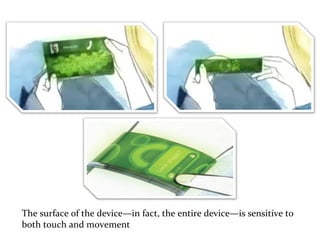
The surface of the device—in fact, the entire device—is sensitive to both touch and movement
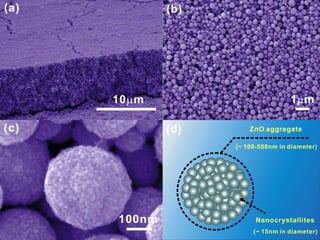
HARVESTING SOLAR ENERGY  Nanowire grass harvests solar energy that charges up the device ZnO nanostructures in it play an important role in low-cost photovoltaics A new method for making a full solid-state, flexible  dye-sensitized solar cell (DSSC) Presents a low-cost alternative to silicon-based photovoltaics because conventional DSSCs posed challenges related to solvent leakage and evaporation A promising photocurrent using a novel ionic liquid gel, organic dye, and a thin film of CNTs.
CNTs serve both as the charge collector and as scaffolds for the growth of ZnO nanoparticles  The flexible and lightweight qualities of this film open up the possibility of a continuous roll-to-roll process for low-cost mass production of DSSCs
 
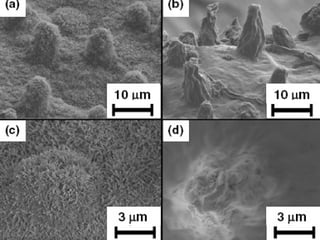
SELF-CLEANING SURFACE Naturally repel water, dirt, and even fingerprints. Reducing corrosion, wear & tear and further improving longevity Nanostructured surfaces, such as “Nanoflowers” for this purpoes Based on the “LOTUS EFFECT” in which Microscopic bumps on a lotus leaf transform its waxy surface into an extremely water repellent, or superhydrophobic, material.  Water drops roll easily across such a surface, removing any dirt.
 
This video will briefly illustrate the power of Nanotechnology in future telecommunication devices like  MORPH
ADVANTAGES Utilization of biodegradable materials might make production and recycling of devices easier and ecologically friendly Low Power cost due to built-in solar absorption that might charge the device making batteries smaller, longer lasting and faster to charge and hence making the phone less bulky Helps to learn more about the environment around us, empowering us to make better choices
DISADVANTAGES Due to the granular structure, nano particles can go unnoticed on a person’s hand, but the risk of inhaling this could be very dangerous. This can duly be a cause of death.  Lack of a reliable power source: Nokia is still searching new battery materials to power the Morph. This is a significant technical drawback that Nokia has to overcome before launching this concept.  Overpriced
REFERENCES http://www.nokia.com/about-nokia/research/demos/the-morph-concept http://en.wikipedia.org/wiki/Nanoflower http://www.youtube.com en.wikipedia.org/wiki/Lotuseffect http://www.crnano.org/whatis.htm
 

Morph ppt

  • 1.
    Submitted to ByMr. Gunjan Gupta Rishav Majumdar Lecturer (Electrical) VIII Sem.(Electrical)
  • 2.
    AGENDA An overviewon Nanotechnology About Morph Features Sensors Design Power Source Advantages Disadvantages References
  • 3.
    NANOTECHNOLOGY The NextBIG thing is Really Small! Also called ‘ molecular manufacturing’ , is a branch of engineering deals with the design and manufacture of extremely small electronic circuits and mechanical devices built at “ultra molecular level” in order to create materials, devices, and systems with fundamentally new properties and functions because of their small structure between approximately 1 and 100 nanometers (100,000 times thinner than a strand of human hair) Involves imaging, measuring, modeling, and manipulating matter at this length scale With this one can lower costs, increase functionality and lower power
  • 4.
  • 5.
    “ HOW DOTHEY DO IT”? In the ongoing race to make phones smaller, thinner, stronger, and increasingly functional, NANOTECHNOLOGY has been considered as a boon Nokia is already beginning to apply nanotechnologies to deliver product like Morph
  • 6.
    THE CONCEPT PHONEMorph isn’t a product you can buy tomorrow, but it isn’t science fiction either. Collective vision for the mobile device of the future—a vision that is driving Nokia’s research efforts in nanoscience and nanotechnologies. Showcases some revolutionary leaps being explored by Nokia Research Center (NRC) in collaboration with the Cambridge Nanoscience Centre (United Kingdom)
  • 7.
    Intelligently bridges localand global information A self-configuring unit that can learn its context—and adapt instantly by sensing ambient elements, physical objects, and your individual context —presents severe challenges for sensor technologies Efficient computing solutions to minimize power consumption New materials and advanced fabrication methodologies have been used for making it a robust, self-healing device that can operate for days under rough conditions
  • 8.
    WHAT’S NEW IN MORPH ? Sensing. Morph enables us to observe our local environment. It can detect specific chemical compounds in the air. Nanoscale grass . Nanowire grass harvests solar energy that charges up the device. Self-cleaning. The surface of the Morph is superhydrophobic that makes it extremely dirt repellent. Stretchable. The nanoscale structure of the electronics enables stretching. Strength of Spider Silk. A nanoscale mesh of fibers controls the stretching of the device when the device is folded. Transparent Electronics. Nanoscale electronics becomes invisible to the human eye. Haptic Surface. Buttons on the device are real 3D forms. The surface forms its context dependent. Wearable Device. Wearing Morph can be a substitute for wearing a watch.
  • 9.
    SENSORS AND SENSINGEVERYWHERE Empower users to examine the environment around them in completely new ways, from analyzing air pollution, to gaining insight into bio-chemical traces and processes Nanoscale sensors (MICROSENSORS) with improved resolution and the stability forms the building block. It has Nanocomponents having an immense surface area–to-volume ratio, allowing plenty of space for chemical reactions that enable robust chemical and biochemical sensing Nanoscale chemical sensors use principles and materials common to most biological systems
  • 10.
  • 11.
    FLEXIBLE & CHANGINGDESIGN Materials and components used are flexible, stretchable, transparent and remarkably strong Fibril proteins are woven into a three dimensional mesh that reinforces thin elastic structures. Using the same principle behind spider silk enabling the device to literally change shapes and configure itself to adapt to the task at hand A folded design would fit easily in a pocket and could lend itself ergonomically to being used as a traditional handset An unfolded larger design could display more detailed information, and incorporate input devices such as keyboards and touch pads.
  • 12.
  • 13.
    STRETCHABLE & WEARABLEA wearable and distinctly easy-to-use device Low-cost, environmentally friendly, and touch-sensitive So versatile that the entire surface of device available for user interface Zinc oxide (ZnO) nanowire arrays emerge as promising building blocks for functional surface structures such as toughness, dirt repellency, antenna integration, optical effects. ZnO exhibits an unusual combination of properties Nokia is exploiting these qualities to achieve strain-based electromechanical transducers—ideal for touch-sensitive (even direction-sensitive) surfaces
  • 14.
    Scale bar =5 micrometers Scale bar = 1 micrometer Scale bar = 2 micrometers Scale bar = 1 micrometer
  • 15.
    The surface ofthe device—in fact, the entire device—is sensitive to both touch and movement
  • 16.
    HARVESTING SOLAR ENERGY Nanowire grass harvests solar energy that charges up the device ZnO nanostructures in it play an important role in low-cost photovoltaics A new method for making a full solid-state, flexible dye-sensitized solar cell (DSSC) Presents a low-cost alternative to silicon-based photovoltaics because conventional DSSCs posed challenges related to solvent leakage and evaporation A promising photocurrent using a novel ionic liquid gel, organic dye, and a thin film of CNTs.
  • 17.
    CNTs serve bothas the charge collector and as scaffolds for the growth of ZnO nanoparticles The flexible and lightweight qualities of this film open up the possibility of a continuous roll-to-roll process for low-cost mass production of DSSCs
  • 18.
  • 19.
    SELF-CLEANING SURFACE Naturallyrepel water, dirt, and even fingerprints. Reducing corrosion, wear & tear and further improving longevity Nanostructured surfaces, such as “Nanoflowers” for this purpoes Based on the “LOTUS EFFECT” in which Microscopic bumps on a lotus leaf transform its waxy surface into an extremely water repellent, or superhydrophobic, material. Water drops roll easily across such a surface, removing any dirt.
  • 20.
  • 21.
    This video willbriefly illustrate the power of Nanotechnology in future telecommunication devices like MORPH
  • 22.
    ADVANTAGES Utilization ofbiodegradable materials might make production and recycling of devices easier and ecologically friendly Low Power cost due to built-in solar absorption that might charge the device making batteries smaller, longer lasting and faster to charge and hence making the phone less bulky Helps to learn more about the environment around us, empowering us to make better choices
  • 23.
    DISADVANTAGES Due tothe granular structure, nano particles can go unnoticed on a person’s hand, but the risk of inhaling this could be very dangerous. This can duly be a cause of death. Lack of a reliable power source: Nokia is still searching new battery materials to power the Morph. This is a significant technical drawback that Nokia has to overcome before launching this concept. Overpriced
  • 24.
    REFERENCES http://www.nokia.com/about-nokia/research/demos/the-morph-concept http://en.wikipedia.org/wiki/Nanoflowerhttp://www.youtube.com en.wikipedia.org/wiki/Lotuseffect http://www.crnano.org/whatis.htm
  • 25.