NOISE POLLUTION DR. AVINASH BHONDWE IMM. PAST PRESIDENT IMA, PUNE
HARSH  SOUNDS
MELODY
 
 
SOUND Vs. NOISE Sound is a form of energy that is transmitted by pressure variations which the human ear can detect.  When one plays a musical instrument, say a guitar, the vibrating chords set air particles into vibration and generate pressure waves in the air. A person nearby may then hear the sound of the guitar when the pressure waves are perceived by the ear.  Sound can also travel through other media, such as water or steel.
SOUND Vs. NOISE Apart from musical instruments,  sound can be produced by many other sources – man's vocal cord,  a running engine,  a vibrating loudspeaker diaphragm,  an operating machine tool, and so on.
Noise is unwanted sound  Sound is the quickly varying pressure wave traveling through a medium. When sound travels through air, the atmospheric pressure varies periodically.  The number of pressure variations per second is called the frequency of sound, and is measured in Hertz (Hz) which is defined as cycles per second
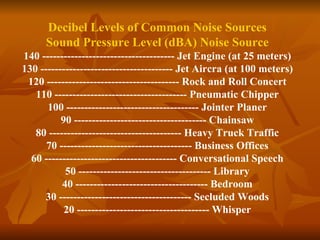
Noise intensity is measured in   decibel  units.  The decibel scale is logarithmic; each 10-decibel increase represents a tenfold increase in noise intensity.  Human perception of loudness also conforms to a logarithmic scale;  a 10-decibel increase is perceived as roughly a doubling of loudness. Thus, 30 decibels is 10 times more intense than 20 decibels and sounds twice as loud; 40 decibels is 100 times more intense than 20 and sounds 4 times as loud; 80 decibels is 1 million times more intense than 20 and sounds 64 times as loud.
Decibel Levels of Common Noise Sources Sound Pressure Level (dBA) Noise Source 140 ------------------------------------- Jet Engine (at 25 meters) 130 ------------------------------------- Jet Aircra (at 100 meters) 120 ------------------------------------- Rock and Roll Concert 110 ------------------------------------- Pneumatic Chipper 100 ------------------------------------- Jointer Planer 90 ------------------------------------- Chainsaw 80 ------------------------------------- Heavy Truck Traffic 70 ------------------------------------- Business Offices 60 ------------------------------------- Conversational Speech 50 ------------------------------------- Library 40 ------------------------------------- Bedroom 30 ------------------------------------- Secluded Woods 20 ------------------------------------- Whisper
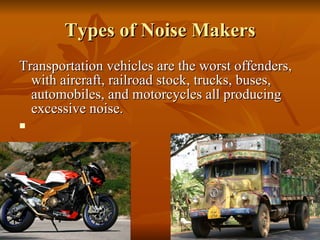
Types of Noise Makers Transportation vehicles are the worst offenders, with aircraft, railroad stock, trucks, buses, automobiles, and motorcycles all producing excessive noise.
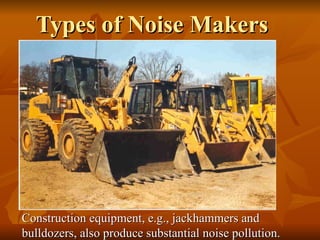
Types of Noise Makers Construction equipment, e.g., jackhammers and bulldozers, also produce substantial noise pollution.
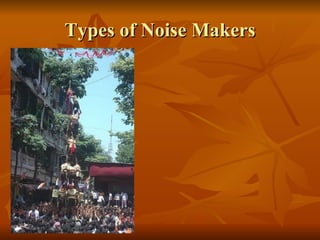
Types of Noise Makers
Ganpati Bappa Moraya
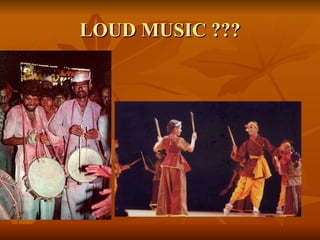
LOUD MUSIC ???
Effects of Noise on Health Noise health effects  are both  Health   and Behavior in nature.  The unwanted sound is called noise. This unwanted sound can damage  Physiological and Psychological  health.
Effects of Noise on Health Noise pollution can cause  Annoyance and Aggression,  Hypertension ,  High Stress Levels,  Tinnitus ,  Hearing loss,  Sleep disturbances,  Forgetfulness,  Severe Depression  Panic Attacks.
Effects of Noise on Health Chronic exposure to noise may cause  noise-induced hearing loss .  Older males exposed to significant  occupational noise  demonstrate  significantly  reduced hearing sensitivity than their non-exposed peers, though differences in hearing sensitivity decrease with time and the two groups are indistinguishable by age 79 A comparison of  Maaban   tribesmen , who were insignificantly exposed to transportation or industrial noise, to a typical U.S. population showed that chronic exposure to moderately high levels of environmental noise contributes to hearing loss
Effects of Noise on Health High noise levels can contribute to  Cardiovascular  effects Exposure to moderately high levels during a single eight hour period causes a statistical rise in  Blood Pressure  of five to ten points and an increase in and  vasoconstriction  leading to the  increased blood pressure  noted above as well as to increased incidence of  Coronary Artery Disease .
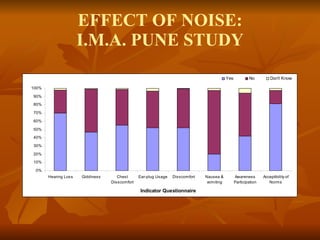
EFFECT OF NOISE: I.M.A. PUNE STUDY
Effects of Noise on Health Noise can have a detrimental effect on animals by causing stress, increasing risk of mortality by changing the delicate balance in predator/prey detection and avoidance,  interferes with their use of sounds in communication especially in relation to reproduction and in navigation.  Acoustic overexposure can lead to temporary or permanent loss of hearing.
Effects of Noise on Health An impact of noise on animal life is the  reduction of usable habitat  that noisy areas may cause, which in the case of endangered species may be part of the path to  extinction . One of the best known cases of damage caused by noise pollution is the death of certain species of  beached whales , brought on by the loud sound of military  sonar .
Effects of Noise on Health Zebra finches  become less faithful to their partners when exposed to traffic noise. This could alter a population's evolutionary trajectory by selecting traits, sapping resources normally devoted to other activities and thus lead to profound genetic and evolutionary consequences.
Remedies GO TO HIMALAYAS USE EAR PLUGS
Remedies There are a variety of strategies for mitigating  roadway noise  including: use of  noise barriers , limitation of vehicle speeds, alteration of roadway surface texture, limitation of  heavy vehicles , use of traffic controls that smooth vehicle flow to reduce braking and acceleration, and tire design.  An important factor in applying these strategies is a  computer model  for  roadway noise , that is capable of addressing local  topography ,  meteorology , traffic operations and hypothetical mitigation.  Costs of building-in mitigation can be modest, provided these solutions are sought in the planning stage of a roadway project.
Remedies Aircraft noise  can be reduced to some extent by design of quieter  jet engines , which was pursued vigorously in the 1970s and 1980s. This strategy has brought limited but noticeable reduction of urban sound levels. Reconsideration of operations, such as altering  flight paths  and time of day runway use, have demonstrated benefits for
Remedies
Remedies
Remedies Exposure of workers to  Industrial noise  has been addressed since the 1930s. Changes include redesign of industrial equipment, shock mounting assemblies and physical barriers in the workplace.  Noise Free America , a national anti-noise pollution organization, regularly lobbies for the enforcement of noise ordinances at all levels of government.
RULES & LAWS Motor Horns Music during Festivals Crackers Marriages & Processions Road near Hospitals & Schools Parties
SELF DISCIPLINE
THANK YOU

Noise pollution

  • 1.
    NOISE POLLUTION DR.AVINASH BHONDWE IMM. PAST PRESIDENT IMA, PUNE
  • 2.
  • 3.
  • 4.
  • 5.
  • 6.
    SOUND Vs. NOISESound is a form of energy that is transmitted by pressure variations which the human ear can detect. When one plays a musical instrument, say a guitar, the vibrating chords set air particles into vibration and generate pressure waves in the air. A person nearby may then hear the sound of the guitar when the pressure waves are perceived by the ear. Sound can also travel through other media, such as water or steel.
  • 7.
    SOUND Vs. NOISEApart from musical instruments, sound can be produced by many other sources – man's vocal cord, a running engine, a vibrating loudspeaker diaphragm, an operating machine tool, and so on.
  • 8.
    Noise is unwantedsound Sound is the quickly varying pressure wave traveling through a medium. When sound travels through air, the atmospheric pressure varies periodically. The number of pressure variations per second is called the frequency of sound, and is measured in Hertz (Hz) which is defined as cycles per second
  • 9.
    Noise intensity ismeasured in decibel units. The decibel scale is logarithmic; each 10-decibel increase represents a tenfold increase in noise intensity. Human perception of loudness also conforms to a logarithmic scale; a 10-decibel increase is perceived as roughly a doubling of loudness. Thus, 30 decibels is 10 times more intense than 20 decibels and sounds twice as loud; 40 decibels is 100 times more intense than 20 and sounds 4 times as loud; 80 decibels is 1 million times more intense than 20 and sounds 64 times as loud.
  • 10.
    Decibel Levels ofCommon Noise Sources Sound Pressure Level (dBA) Noise Source 140 ------------------------------------- Jet Engine (at 25 meters) 130 ------------------------------------- Jet Aircra (at 100 meters) 120 ------------------------------------- Rock and Roll Concert 110 ------------------------------------- Pneumatic Chipper 100 ------------------------------------- Jointer Planer 90 ------------------------------------- Chainsaw 80 ------------------------------------- Heavy Truck Traffic 70 ------------------------------------- Business Offices 60 ------------------------------------- Conversational Speech 50 ------------------------------------- Library 40 ------------------------------------- Bedroom 30 ------------------------------------- Secluded Woods 20 ------------------------------------- Whisper
  • 11.
    Types of NoiseMakers Transportation vehicles are the worst offenders, with aircraft, railroad stock, trucks, buses, automobiles, and motorcycles all producing excessive noise.
  • 12.
    Types of NoiseMakers Construction equipment, e.g., jackhammers and bulldozers, also produce substantial noise pollution.
  • 13.
  • 14.
  • 15.
  • 16.
    Effects of Noiseon Health Noise health effects are both Health and Behavior in nature. The unwanted sound is called noise. This unwanted sound can damage Physiological and Psychological health.
  • 17.
    Effects of Noiseon Health Noise pollution can cause Annoyance and Aggression, Hypertension , High Stress Levels, Tinnitus , Hearing loss, Sleep disturbances, Forgetfulness, Severe Depression Panic Attacks.
  • 18.
    Effects of Noiseon Health Chronic exposure to noise may cause noise-induced hearing loss . Older males exposed to significant occupational noise demonstrate significantly reduced hearing sensitivity than their non-exposed peers, though differences in hearing sensitivity decrease with time and the two groups are indistinguishable by age 79 A comparison of Maaban tribesmen , who were insignificantly exposed to transportation or industrial noise, to a typical U.S. population showed that chronic exposure to moderately high levels of environmental noise contributes to hearing loss
  • 19.
    Effects of Noiseon Health High noise levels can contribute to Cardiovascular effects Exposure to moderately high levels during a single eight hour period causes a statistical rise in Blood Pressure of five to ten points and an increase in and vasoconstriction leading to the increased blood pressure noted above as well as to increased incidence of Coronary Artery Disease .
  • 20.
    EFFECT OF NOISE:I.M.A. PUNE STUDY
  • 21.
    Effects of Noiseon Health Noise can have a detrimental effect on animals by causing stress, increasing risk of mortality by changing the delicate balance in predator/prey detection and avoidance, interferes with their use of sounds in communication especially in relation to reproduction and in navigation. Acoustic overexposure can lead to temporary or permanent loss of hearing.
  • 22.
    Effects of Noiseon Health An impact of noise on animal life is the reduction of usable habitat that noisy areas may cause, which in the case of endangered species may be part of the path to extinction . One of the best known cases of damage caused by noise pollution is the death of certain species of beached whales , brought on by the loud sound of military sonar .
  • 23.
    Effects of Noiseon Health Zebra finches become less faithful to their partners when exposed to traffic noise. This could alter a population's evolutionary trajectory by selecting traits, sapping resources normally devoted to other activities and thus lead to profound genetic and evolutionary consequences.
  • 24.
    Remedies GO TOHIMALAYAS USE EAR PLUGS
  • 25.
    Remedies There area variety of strategies for mitigating roadway noise including: use of noise barriers , limitation of vehicle speeds, alteration of roadway surface texture, limitation of heavy vehicles , use of traffic controls that smooth vehicle flow to reduce braking and acceleration, and tire design. An important factor in applying these strategies is a computer model for roadway noise , that is capable of addressing local topography , meteorology , traffic operations and hypothetical mitigation. Costs of building-in mitigation can be modest, provided these solutions are sought in the planning stage of a roadway project.
  • 26.
    Remedies Aircraft noise can be reduced to some extent by design of quieter jet engines , which was pursued vigorously in the 1970s and 1980s. This strategy has brought limited but noticeable reduction of urban sound levels. Reconsideration of operations, such as altering flight paths and time of day runway use, have demonstrated benefits for
  • 27.
  • 28.
  • 29.
    Remedies Exposure ofworkers to Industrial noise has been addressed since the 1930s. Changes include redesign of industrial equipment, shock mounting assemblies and physical barriers in the workplace. Noise Free America , a national anti-noise pollution organization, regularly lobbies for the enforcement of noise ordinances at all levels of government.
  • 30.
    RULES & LAWSMotor Horns Music during Festivals Crackers Marriages & Processions Road near Hospitals & Schools Parties
  • 31.
  • 32.