



Chapter - 7Chapter - 7
NOISE POLLUTIONNOISE POLLUTION
CONTENT
 INTRODUCTION
 MEASUREMENT OF SOUND
 SOURCES
 EFFECTS OF NOISE POLLUTION
 CONTROL OF NOISE POLLUTION
SOUND VS. NOISE
• Sound is a form of energy that is transmitted by pressure
variations which the human ear can detect.
• When one plays a musical instrument, say a guitar, the
vibrating chords set air particles into vibration and generate
pressure waves in the air.
• A person nearby may then hear the sound of the guitar when
the pressure waves are perceived by the ear.
• Sound can also travel through other media, such as water or
steel.
• Apart from musical instruments,
sound can be produced by many other sources –
• man's vocal cord,
• a running engine,
• a vibrating loudspeaker diaphragm,
• an operating machine tool, and so on.
SOUND VS. NOISE
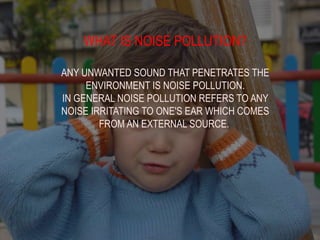
WHAT IS NOISE POLLUTION?
ANY UNWANTED SOUND THAT PENETRATES THE
ENVIRONMENT IS NOISE POLLUTION.
IN GENERAL NOISE POLLUTION REFERS TO ANY
NOISE IRRITATING TO ONE'S EAR WHICH COMES
FROM AN EXTERNAL SOURCE.
INTRODUCTION
• Sound that is unwanted or disrupts one’s quality of life
is called as noise. When there is lot of noise in the
environment, it is termed as noise pollution.
• Sound becomes undesirable when it disturbs the
normal activities such as working, sleeping, and during
conversations.
• It is an underrated environmental problem because of
the fact that we can’t see, smell, or taste it.
• World Health Organization stated that “Noise must be
recognized as a major threat to human well-being”
• Noise intensity is measured in decibel units.
• The decibel scale is logarithmic; each 10-decibel increase
represents a tenfold increase in noise intensity.
• Human perception of loudness also conforms to a logarithmic
scale;
• a 10-decibel increase is perceived as roughly a doubling of
loudness. Thus, 30 decibels is 10 times more intense than 20
decibels and sounds twice as loud; 40 decibels is 100 times more
intense than 20 and sounds 4 times as loud; 80 decibels is 1
million times more intense than 20 and sounds 64 times as loud.
INTRODUCTION
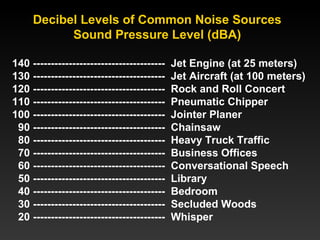
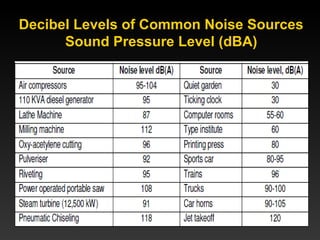
Decibel Levels of Common Noise Sources
Sound Pressure Level (dBA)
140 ------------------------------------- Jet Engine (at 25 meters)
130 ------------------------------------- Jet Aircraft (at 100 meters)
120 ------------------------------------- Rock and Roll Concert
110 ------------------------------------- Pneumatic Chipper
100 ------------------------------------- Jointer Planer
90 ------------------------------------- Chainsaw
80 ------------------------------------- Heavy Truck Traffic
70 ------------------------------------- Business Offices
60 ------------------------------------- Conversational Speech
50 ------------------------------------- Library
40 ------------------------------------- Bedroom
30 ------------------------------------- Secluded Woods
20 ------------------------------------- Whisper
Decibel Levels of Common Noise Sources
Sound Pressure Level (dBA)
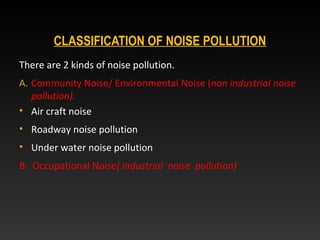
CLASSIFICATION OF NOISE POLLUTION
There are 2 kinds of noise pollution.
A. Community Noise/ Environmental Noise (non industrial noise
pollution).
• Air craft noise
• Roadway noise pollution
• Under water noise pollution
B. Occupational Noise( industrial noise pollution)
COMMUNITY NOISE
Community noise
Also called environmental noise, residential noise or
domestic noise) is defined as noise emitted from all sources,
except at the industrial workplace. Main sources of
community noise include road, rail and air traffic,
construction and public work, and the neighborhood.
Typical neighborhood noise comes from live or recorded
music; from sporting events including motor sports; from
playgrounds and car parks; and from domestic animals such
as barking dogs.
AIR CRAFT NOISE POLLUTION
Noise from planes flying over residential areas impairs
people's ability to work, learn in school and sleep, and
consequently also results in lowered property values in
affected areas.
As passenger volume increases and new and larger airports
are built, noise is becoming even more of a concern.
ROADWAY NOISE POLLUTION
Roadway noise is the collective sound energy emanating
from motor vehicles.
In the USA it contributes more to environmental noise
exposure than any other noise source, and is constituted
chiefly of engine, tire, aerodynamic and braking elements.
In other Western countries as well as Lesser developed
countries, roadway noise is expected to contribute a
proportionately large share of the total societal noise
pollution.
UNDER WATER NOISE POLLUTION
• UNP is intense human-generated noise in the marine
environment. It is caused by use of explosives,
oceanographic experiments, geophysical research,
underwater construction, ship traffic, intense active sonars
and air guns used for seismic surveys for oil and related
activities.
OCCUPATIONAL NOISE
The many and varied sources of noise is industrial machinery
and processes include: rotors, gears, turbulent fluid flow,
impact processes, electrical machines, internal combustion
engines, pneumatic equipment, drilling, crushing, blasting,
pumps and compressors. Furthermore, the emitted sounds
are reflected from floors, ceiling and equipment
SOURCES OF NOISE POLLUTION
• Street traffic
• Rail roads
• Airplanes
• Constructions
• Consumer products
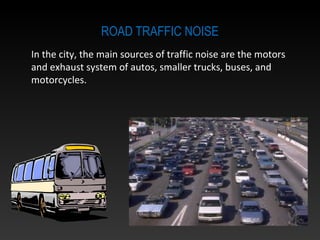
ROAD TRAFFIC NOISE
In the city, the main sources of traffic noise are the motors
and exhaust system of autos, smaller trucks, buses, and
motorcycles.
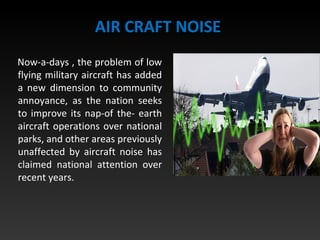
AIR CRAFT NOISE
Now-a-days , the problem of low
flying military aircraft has added
a new dimension to community
annoyance, as the nation seeks
to improve its nap-of the- earth
aircraft operations over national
parks, and other areas previously
unaffected by aircraft noise has
claimed national attention over
recent years.
NOISE FROM RAILROADS
Rail car retarders can produce a high frequency, high level
screech that can reach peak levels of 120 dB at a distance of
100 feet, which translates to levels as high as 138, or 140 dB
at the railroad worker’s ear.
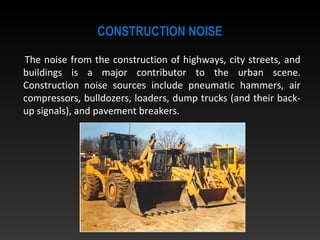
CONSTRUCTION NOISE
The noise from the construction of highways, city streets, and
buildings is a major contributor to the urban scene.
Construction noise sources include pneumatic hammers, air
compressors, bulldozers, loaders, dump trucks (and their back-
up signals), and pavement breakers.
NOISE IN BUILDING
Apartment dwellers are often annoyed by noise in their
homes, especially when the building is not well designed and
constructed. In this case, internal building noise from
plumbing, boilers, generators, air conditioners, and fans, can
be audible and annoying
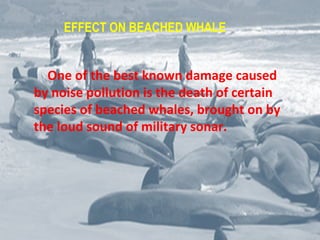
EFFECT ON BEACHED WHALE
One of the best known damage caused
by noise pollution is the death of certain
species of beached whales, brought on by
the loud sound of military sonar.
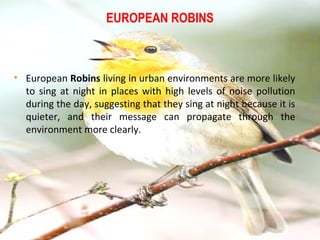
EUROPEAN ROBINS
• European Robins living in urban environments are more likely
to sing at night in places with high levels of noise pollution
during the day, suggesting that they sing at night because it is
quieter, and their message can propagate through the
environment more clearly.
LEVEL OF TOLERANCE
• Normal level of tolerance is 80dbA.
• Sound level below and above this is considered to be as noise
pollution.
EFFECTS OF NOISE ON HEALTH
Noise health effects are both
• Health
• and Behavior in nature.
• The unwanted sound is called noise. This unwanted sound
can damage Physiological and Psychological health.
EFFECTS OF NOISE ON HEALTH
Noise pollution can cause
• Annoyance and Aggression,
• Hypertension,
• High Stress Levels,
• Tinnitus,
• Hearing loss,
• Sleep disturbances,
• Forgetfulness,
• Severe Depression
• Panic Attacks.
• Hearing Impairment
• It Decreases the Efficiency
of A Man
• Lack of concentration
• Abortion is caused
• Pupil Dilation
• Mental Illness
• It Causes Heart Attack
• Digestive problems
• Temporary or permanent Deafness
• Aggressive Behavior
• Effect on Vegetation Poor Quality of
Crops
• Effect on Animal
• Effect on Property
• Sleep interference
• Speech interference
EFFECTS OF NOISE ON HEALTH
• Chronic exposure to noise may cause
noise-induced hearing loss.
• Older males exposed to significant occupational noise
demonstrate significantly reduced hearing sensitivity than
their non-exposed peers, though differences in hearing
sensitivity decrease with time and the two groups are
indistinguishable by age 79
• A comparison of Maaban tribesmen, who were insignificantly
exposed to transportation or industrial noise, to a typical U.S.
population showed that chronic exposure to moderately high
levels of environmental noise contributes to hearing loss
EFFECTS OF NOISE ON HEALTH
• High noise levels can contribute to Cardiovascular effects
• Exposure to moderately high levels during a single eight hour
period causes a statistical rise in Blood Pressure of five to ten
points and an increase in and vasoconstriction leading to the
increased blood pressure noted above as well as to increased
incidence of Coronary Artery Disease.
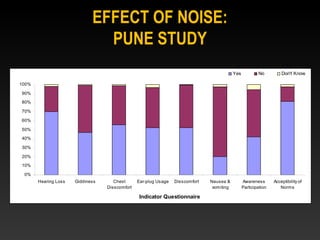
EFFECT OF NOISE:
PUNE STUDY
0%
10%
20%
30%
40%
50%
60%
70%
80%
90%
100%
Hearing Loss Giddiness Chest
Disscomfort
Ear-plug Usage Disscomfort Nausea &
vomiting
Awareness
Participation
Acceptibility of
Norms
Indicator Questionnaire
Yes No Don't Know
EFFECTS OF NOISE ON HEALTH
• Noise can have a detrimental effect on animals by causing
stress, increasing risk of mortality by changing the delicate
balance in predator/prey detection and avoidance,
• interferes with their use of sounds in communication
especially in relation to reproduction and in navigation.
• Acoustic overexposure can lead to temporary or permanent
loss of hearing.
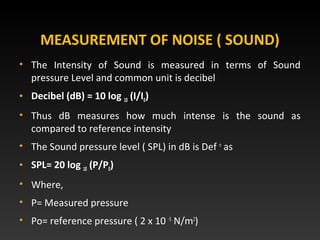
MEASUREMENT OF NOISE ( SOUND)
• The Intensity of Sound is measured in terms of Sound
pressure Level and common unit is decibel
• Decibel (dB) = 10 log 10 (I/I0)
• Thus dB measures how much intense is the sound as
compared to reference intensity
• The Sound pressure level ( SPL) in dB is Def n
as
• SPL= 20 log 10 (P/P0)
• Where,
• P= Measured pressure
• Po= reference pressure ( 2 x 10 -5
N/m2
)
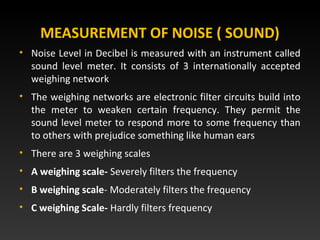
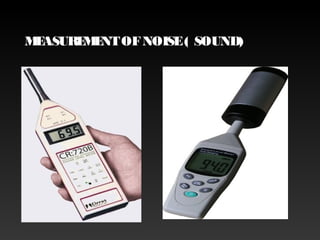
• Noise Level in Decibel is measured with an instrument called
sound level meter. It consists of 3 internationally accepted
weighing network
• The weighing networks are electronic filter circuits build into
the meter to weaken certain frequency. They permit the
sound level meter to respond more to some frequency than
to others with prejudice something like human ears
• There are 3 weighing scales
• A weighing scale- Severely filters the frequency
• B weighing scale- Moderately filters the frequency
• C weighing Scale- Hardly filters frequency
MEASUREMENT OF NOISE ( SOUND)
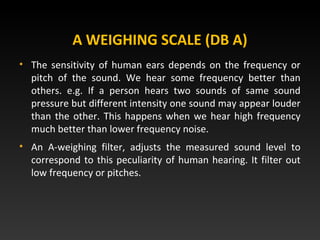
A WEIGHING SCALE (DB A)
• The sensitivity of human ears depends on the frequency or
pitch of the sound. We hear some frequency better than
others. e.g. If a person hears two sounds of same sound
pressure but different intensity one sound may appear louder
than the other. This happens when we hear high frequency
much better than lower frequency noise.
• An A-weighing filter, adjusts the measured sound level to
correspond to this peculiarity of human hearing. It filter out
low frequency or pitches.
MEASUREMENTOFNOISE( SOUND)
EFFECTS OF NOISE ON HEALTH
• An impact of noise on animal life is the reduction of usable
habitat that noisy areas may cause, which in the case of
endangered species may be part of the path to extinction.
• One of the best known cases of damage caused by noise
pollution is the death of certain species of beached whales,
brought on by the loud sound of military sonar.
• Zebra finches become less faithful to their partners when exposed to
traffic noise. This could alter a population's evolutionary trajectory by
selecting traits, sapping resources normally devoted to other activities
and thus lead to profound genetic and evolutionary consequences.
REMEDIES
GO TO HIMALAYAS !!
USE EAR PLUGS !!
CONTROL OF NOISE POLLUTION
• Noise is not only a nuisance but a
serious environmental problem and
a health hazard. Like all other
pollution, noise pollution is needed
to be controlled.
• Noise pollution can be effectively
controlled by taking following
measures.
CONTROL OF NOISE POLLUTION
Control at receivers end
 For people working in noisy areas ear protection aids like
ear plugs, muffs, noise helmets, head phones etc should
be provided it reduces occupational exposure.
Controlling at source
This is only possible if working method is improved.
Design new machines to replace noisy ones. Proper
lubrication and better, maintenance of machines. Installing
noisy machines with sound absorbing materials. Using
Silencer to control noise from automobiles etc.
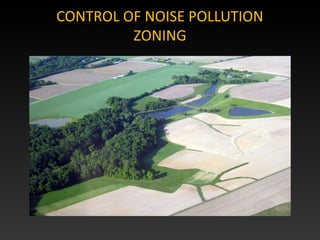
Zoning
 Increased distance between source and receiver by zoning of
noisy industrial areas like bus stand and railway stations
away from silence zones near residential areas, educational
institutions and hospitals.
Sound Insulation
 A) Sound insulations can be done by constructing windows
with more than one panes of glass and filling the gap with
sound absorbing material.
 B) Acoustical tiles, perforated plywood can be fixed on wall,
ceilings, floors to reduce noise.
CONTROL OF NOISE POLLUTION
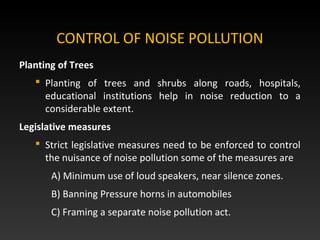
Planting of Trees
 Planting of trees and shrubs along roads, hospitals,
educational institutions help in noise reduction to a
considerable extent.
Legislative measures
 Strict legislative measures need to be enforced to control
the nuisance of noise pollution some of the measures are
A) Minimum use of loud speakers, near silence zones.
B) Banning Pressure horns in automobiles
C) Framing a separate noise pollution act.
CONTROL OF NOISE POLLUTION
ZONING
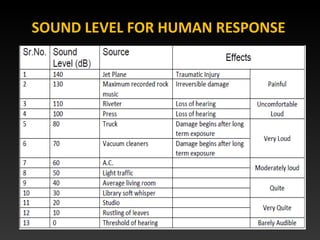
SOUND LEVEL FOR HUMAN RESPONSE
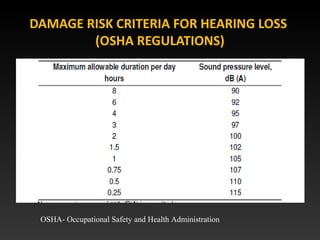
DAMAGE RISK CRITERIA FOR HEARING LOSS
(OSHA REGULATIONS)
OSHA- Occupational Safety and Health Administration
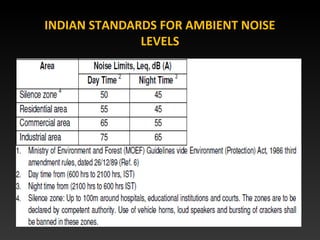
INDIAN STANDARDS FOR AMBIENT NOISE
LEVELS
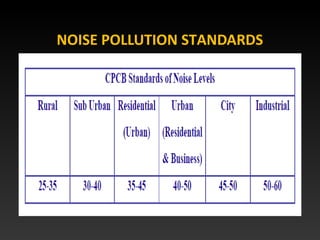
NOISE POLLUTION STANDARDS
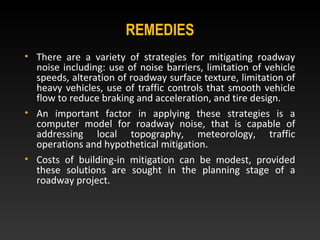
REMEDIES
• There are a variety of strategies for mitigating roadway
noise including: use of noise barriers, limitation of vehicle
speeds, alteration of roadway surface texture, limitation of
heavy vehicles, use of traffic controls that smooth vehicle
flow to reduce braking and acceleration, and tire design.
• An important factor in applying these strategies is a
computer model for roadway noise, that is capable of
addressing local topography, meteorology, traffic
operations and hypothetical mitigation.
• Costs of building-in mitigation can be modest, provided
these solutions are sought in the planning stage of a
roadway project.
REMEDIES
• Aircraft noise can be reduced to some extent by design of
quieter jet engines, which was pursued vigorously in the
1970s and 1980s. This strategy has brought limited but
noticeable reduction of urban sound levels. Reconsideration
of operations, such as altering flight paths and time of day
runway use, have demonstrated benefits for
THANK YOU

Noise pollution

  • 1.
    Chapter - 7Chapter- 7 NOISE POLLUTIONNOISE POLLUTION
  • 2.
    CONTENT  INTRODUCTION  MEASUREMENTOF SOUND  SOURCES  EFFECTS OF NOISE POLLUTION  CONTROL OF NOISE POLLUTION
  • 3.
    SOUND VS. NOISE •Sound is a form of energy that is transmitted by pressure variations which the human ear can detect. • When one plays a musical instrument, say a guitar, the vibrating chords set air particles into vibration and generate pressure waves in the air. • A person nearby may then hear the sound of the guitar when the pressure waves are perceived by the ear. • Sound can also travel through other media, such as water or steel.
  • 4.
    • Apart frommusical instruments, sound can be produced by many other sources – • man's vocal cord, • a running engine, • a vibrating loudspeaker diaphragm, • an operating machine tool, and so on. SOUND VS. NOISE
  • 5.
    WHAT IS NOISEPOLLUTION? ANY UNWANTED SOUND THAT PENETRATES THE ENVIRONMENT IS NOISE POLLUTION. IN GENERAL NOISE POLLUTION REFERS TO ANY NOISE IRRITATING TO ONE'S EAR WHICH COMES FROM AN EXTERNAL SOURCE.
  • 6.
    INTRODUCTION • Sound thatis unwanted or disrupts one’s quality of life is called as noise. When there is lot of noise in the environment, it is termed as noise pollution. • Sound becomes undesirable when it disturbs the normal activities such as working, sleeping, and during conversations. • It is an underrated environmental problem because of the fact that we can’t see, smell, or taste it. • World Health Organization stated that “Noise must be recognized as a major threat to human well-being”
  • 7.
    • Noise intensityis measured in decibel units. • The decibel scale is logarithmic; each 10-decibel increase represents a tenfold increase in noise intensity. • Human perception of loudness also conforms to a logarithmic scale; • a 10-decibel increase is perceived as roughly a doubling of loudness. Thus, 30 decibels is 10 times more intense than 20 decibels and sounds twice as loud; 40 decibels is 100 times more intense than 20 and sounds 4 times as loud; 80 decibels is 1 million times more intense than 20 and sounds 64 times as loud. INTRODUCTION
  • 8.
    Decibel Levels ofCommon Noise Sources Sound Pressure Level (dBA) 140 ------------------------------------- Jet Engine (at 25 meters) 130 ------------------------------------- Jet Aircraft (at 100 meters) 120 ------------------------------------- Rock and Roll Concert 110 ------------------------------------- Pneumatic Chipper 100 ------------------------------------- Jointer Planer 90 ------------------------------------- Chainsaw 80 ------------------------------------- Heavy Truck Traffic 70 ------------------------------------- Business Offices 60 ------------------------------------- Conversational Speech 50 ------------------------------------- Library 40 ------------------------------------- Bedroom 30 ------------------------------------- Secluded Woods 20 ------------------------------------- Whisper
  • 9.
    Decibel Levels ofCommon Noise Sources Sound Pressure Level (dBA)
  • 10.
    CLASSIFICATION OF NOISEPOLLUTION There are 2 kinds of noise pollution. A. Community Noise/ Environmental Noise (non industrial noise pollution). • Air craft noise • Roadway noise pollution • Under water noise pollution B. Occupational Noise( industrial noise pollution)
  • 11.
    COMMUNITY NOISE Community noise Alsocalled environmental noise, residential noise or domestic noise) is defined as noise emitted from all sources, except at the industrial workplace. Main sources of community noise include road, rail and air traffic, construction and public work, and the neighborhood. Typical neighborhood noise comes from live or recorded music; from sporting events including motor sports; from playgrounds and car parks; and from domestic animals such as barking dogs.
  • 15.
    AIR CRAFT NOISEPOLLUTION Noise from planes flying over residential areas impairs people's ability to work, learn in school and sleep, and consequently also results in lowered property values in affected areas. As passenger volume increases and new and larger airports are built, noise is becoming even more of a concern.
  • 16.
    ROADWAY NOISE POLLUTION Roadwaynoise is the collective sound energy emanating from motor vehicles. In the USA it contributes more to environmental noise exposure than any other noise source, and is constituted chiefly of engine, tire, aerodynamic and braking elements. In other Western countries as well as Lesser developed countries, roadway noise is expected to contribute a proportionately large share of the total societal noise pollution.
  • 17.
    UNDER WATER NOISEPOLLUTION • UNP is intense human-generated noise in the marine environment. It is caused by use of explosives, oceanographic experiments, geophysical research, underwater construction, ship traffic, intense active sonars and air guns used for seismic surveys for oil and related activities.
  • 18.
    OCCUPATIONAL NOISE The manyand varied sources of noise is industrial machinery and processes include: rotors, gears, turbulent fluid flow, impact processes, electrical machines, internal combustion engines, pneumatic equipment, drilling, crushing, blasting, pumps and compressors. Furthermore, the emitted sounds are reflected from floors, ceiling and equipment
  • 19.
    SOURCES OF NOISEPOLLUTION • Street traffic • Rail roads • Airplanes • Constructions • Consumer products
  • 20.
    ROAD TRAFFIC NOISE Inthe city, the main sources of traffic noise are the motors and exhaust system of autos, smaller trucks, buses, and motorcycles.
  • 21.
    AIR CRAFT NOISE Now-a-days, the problem of low flying military aircraft has added a new dimension to community annoyance, as the nation seeks to improve its nap-of the- earth aircraft operations over national parks, and other areas previously unaffected by aircraft noise has claimed national attention over recent years.
  • 22.
    NOISE FROM RAILROADS Railcar retarders can produce a high frequency, high level screech that can reach peak levels of 120 dB at a distance of 100 feet, which translates to levels as high as 138, or 140 dB at the railroad worker’s ear.
  • 23.
    CONSTRUCTION NOISE The noisefrom the construction of highways, city streets, and buildings is a major contributor to the urban scene. Construction noise sources include pneumatic hammers, air compressors, bulldozers, loaders, dump trucks (and their back- up signals), and pavement breakers.
  • 24.
    NOISE IN BUILDING Apartmentdwellers are often annoyed by noise in their homes, especially when the building is not well designed and constructed. In this case, internal building noise from plumbing, boilers, generators, air conditioners, and fans, can be audible and annoying
  • 25.
    EFFECT ON BEACHEDWHALE One of the best known damage caused by noise pollution is the death of certain species of beached whales, brought on by the loud sound of military sonar.
  • 26.
    EUROPEAN ROBINS • EuropeanRobins living in urban environments are more likely to sing at night in places with high levels of noise pollution during the day, suggesting that they sing at night because it is quieter, and their message can propagate through the environment more clearly.
  • 27.
    LEVEL OF TOLERANCE •Normal level of tolerance is 80dbA. • Sound level below and above this is considered to be as noise pollution.
  • 28.
    EFFECTS OF NOISEON HEALTH Noise health effects are both • Health • and Behavior in nature. • The unwanted sound is called noise. This unwanted sound can damage Physiological and Psychological health.
  • 29.
    EFFECTS OF NOISEON HEALTH Noise pollution can cause • Annoyance and Aggression, • Hypertension, • High Stress Levels, • Tinnitus, • Hearing loss, • Sleep disturbances, • Forgetfulness, • Severe Depression • Panic Attacks.
  • 30.
    • Hearing Impairment •It Decreases the Efficiency of A Man • Lack of concentration • Abortion is caused • Pupil Dilation • Mental Illness • It Causes Heart Attack • Digestive problems • Temporary or permanent Deafness • Aggressive Behavior • Effect on Vegetation Poor Quality of Crops • Effect on Animal • Effect on Property • Sleep interference • Speech interference EFFECTS OF NOISE ON HEALTH
  • 31.
    EFFECTS OF NOISEON HEALTH • Chronic exposure to noise may cause noise-induced hearing loss. • Older males exposed to significant occupational noise demonstrate significantly reduced hearing sensitivity than their non-exposed peers, though differences in hearing sensitivity decrease with time and the two groups are indistinguishable by age 79 • A comparison of Maaban tribesmen, who were insignificantly exposed to transportation or industrial noise, to a typical U.S. population showed that chronic exposure to moderately high levels of environmental noise contributes to hearing loss
  • 32.
    EFFECTS OF NOISEON HEALTH • High noise levels can contribute to Cardiovascular effects • Exposure to moderately high levels during a single eight hour period causes a statistical rise in Blood Pressure of five to ten points and an increase in and vasoconstriction leading to the increased blood pressure noted above as well as to increased incidence of Coronary Artery Disease.
  • 33.
    EFFECT OF NOISE: PUNESTUDY 0% 10% 20% 30% 40% 50% 60% 70% 80% 90% 100% Hearing Loss Giddiness Chest Disscomfort Ear-plug Usage Disscomfort Nausea & vomiting Awareness Participation Acceptibility of Norms Indicator Questionnaire Yes No Don't Know
  • 34.
    EFFECTS OF NOISEON HEALTH • Noise can have a detrimental effect on animals by causing stress, increasing risk of mortality by changing the delicate balance in predator/prey detection and avoidance, • interferes with their use of sounds in communication especially in relation to reproduction and in navigation. • Acoustic overexposure can lead to temporary or permanent loss of hearing.
  • 35.
    MEASUREMENT OF NOISE( SOUND) • The Intensity of Sound is measured in terms of Sound pressure Level and common unit is decibel • Decibel (dB) = 10 log 10 (I/I0) • Thus dB measures how much intense is the sound as compared to reference intensity • The Sound pressure level ( SPL) in dB is Def n as • SPL= 20 log 10 (P/P0) • Where, • P= Measured pressure • Po= reference pressure ( 2 x 10 -5 N/m2 )
  • 36.
    • Noise Levelin Decibel is measured with an instrument called sound level meter. It consists of 3 internationally accepted weighing network • The weighing networks are electronic filter circuits build into the meter to weaken certain frequency. They permit the sound level meter to respond more to some frequency than to others with prejudice something like human ears • There are 3 weighing scales • A weighing scale- Severely filters the frequency • B weighing scale- Moderately filters the frequency • C weighing Scale- Hardly filters frequency MEASUREMENT OF NOISE ( SOUND)
  • 37.
    A WEIGHING SCALE(DB A) • The sensitivity of human ears depends on the frequency or pitch of the sound. We hear some frequency better than others. e.g. If a person hears two sounds of same sound pressure but different intensity one sound may appear louder than the other. This happens when we hear high frequency much better than lower frequency noise. • An A-weighing filter, adjusts the measured sound level to correspond to this peculiarity of human hearing. It filter out low frequency or pitches.
  • 38.
  • 39.
    EFFECTS OF NOISEON HEALTH • An impact of noise on animal life is the reduction of usable habitat that noisy areas may cause, which in the case of endangered species may be part of the path to extinction. • One of the best known cases of damage caused by noise pollution is the death of certain species of beached whales, brought on by the loud sound of military sonar. • Zebra finches become less faithful to their partners when exposed to traffic noise. This could alter a population's evolutionary trajectory by selecting traits, sapping resources normally devoted to other activities and thus lead to profound genetic and evolutionary consequences.
  • 40.
    REMEDIES GO TO HIMALAYAS!! USE EAR PLUGS !!
  • 41.
    CONTROL OF NOISEPOLLUTION • Noise is not only a nuisance but a serious environmental problem and a health hazard. Like all other pollution, noise pollution is needed to be controlled. • Noise pollution can be effectively controlled by taking following measures.
  • 42.
    CONTROL OF NOISEPOLLUTION Control at receivers end  For people working in noisy areas ear protection aids like ear plugs, muffs, noise helmets, head phones etc should be provided it reduces occupational exposure. Controlling at source This is only possible if working method is improved. Design new machines to replace noisy ones. Proper lubrication and better, maintenance of machines. Installing noisy machines with sound absorbing materials. Using Silencer to control noise from automobiles etc.
  • 43.
    Zoning  Increased distancebetween source and receiver by zoning of noisy industrial areas like bus stand and railway stations away from silence zones near residential areas, educational institutions and hospitals. Sound Insulation  A) Sound insulations can be done by constructing windows with more than one panes of glass and filling the gap with sound absorbing material.  B) Acoustical tiles, perforated plywood can be fixed on wall, ceilings, floors to reduce noise. CONTROL OF NOISE POLLUTION
  • 44.
  • 45.
    CONTROL OF NOISEPOLLUTION Planting of Trees  Planting of trees and shrubs along roads, hospitals, educational institutions help in noise reduction to a considerable extent. Legislative measures  Strict legislative measures need to be enforced to control the nuisance of noise pollution some of the measures are A) Minimum use of loud speakers, near silence zones. B) Banning Pressure horns in automobiles C) Framing a separate noise pollution act.
  • 46.
    CONTROL OF NOISEPOLLUTION ZONING
  • 47.
    SOUND LEVEL FORHUMAN RESPONSE
  • 48.
    DAMAGE RISK CRITERIAFOR HEARING LOSS (OSHA REGULATIONS) OSHA- Occupational Safety and Health Administration
  • 49.
    INDIAN STANDARDS FORAMBIENT NOISE LEVELS
  • 50.
  • 51.
    REMEDIES • There area variety of strategies for mitigating roadway noise including: use of noise barriers, limitation of vehicle speeds, alteration of roadway surface texture, limitation of heavy vehicles, use of traffic controls that smooth vehicle flow to reduce braking and acceleration, and tire design. • An important factor in applying these strategies is a computer model for roadway noise, that is capable of addressing local topography, meteorology, traffic operations and hypothetical mitigation. • Costs of building-in mitigation can be modest, provided these solutions are sought in the planning stage of a roadway project.
  • 52.
    REMEDIES • Aircraft noisecan be reduced to some extent by design of quieter jet engines, which was pursued vigorously in the 1970s and 1980s. This strategy has brought limited but noticeable reduction of urban sound levels. Reconsideration of operations, such as altering flight paths and time of day runway use, have demonstrated benefits for
  • 53.