MGT 2306
MARKETING MANAGEMENT
Lesson 5
LESSON 5 OBJECTIVES
• Define what is marketing research
• Examine the purposes of marketing research
and how market research helps businesses.
• Describe the market research process
WHAT IS MARKET RESEARCH?
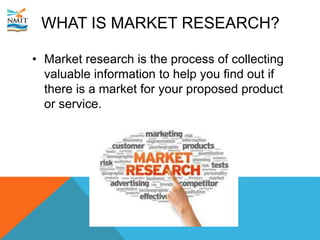
• Market research is the process of collecting
valuable information to help you find out if
there is a market for your proposed product
or service.
WHY DO BUSINESSES REQUIRE
INFORMATION?
Businesses need information about customer wants,
market demand, competition, distribution channels
etc. This information needs to be updated regularly
because businesses operate in a dynamic
environment, characterised by frequent:
- Changes in technology
- Changes in consumer tastes
- Changes in the product ranges of competitors
- Changes in economic conditions
HOW MARKET RESEARCH
HELPS BUSINESSES
• Gain a more detailed understanding of
consumers’ needs
• Reduce the risk of product/business failure
• Forecast future trends
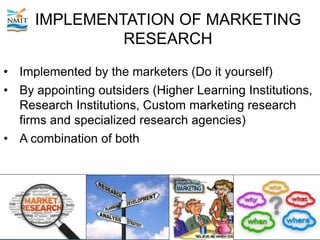
IMPLEMENTATION OF MARKETING
RESEARCH
• Implemented by the marketers (Do it yourself)
• By appointing outsiders (Higher Learning Institutions,
Research Institutions, Custom marketing research
firms and specialized research agencies)
• A combination of both
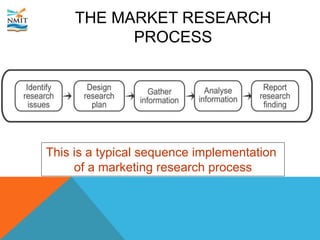
THE MARKET RESEARCH
PROCESS
This is a typical sequence implementation
of a marketing research process
1. IDENTIFY THE RESEARCH ISSUES
• The starting phase is always identifying the reason
or problem for which research is to be conducted.
2. DESIGN THE RESEARCH PLAN
• Now that you know your problem or issue, it is time
to plan out the type of research that will best obtain
the necessary data.
• There are 3 categories of research:
a) Explorative research
b) Descriptive research
c) Causal research
EXPLORATORY RESEARCH
• It is used when you don’t know
what the real problem or issue
is and you need to uncover the
causes
• Example: Why do Muslims
nowadays brave
themselves to travel
to countries where
they would not travel
previously?
DESCRIPTIVE RESEARCH
• Used to describe the market problem or situation
for example:
a) measure market demand
b) develop a profile of the target
market
c) measure the attitudes of
consumers
• The research yields quantitative data
Example : The new generation prefer fuss-free
economical fast-food compared to the older
generation who prefer home-cooked food. How
much of it is true?
CAUSAL RESEARCH
• This research tests hypotheses about
cause and effect relationships,
example, a relationship between two
variables.
Example:
Does advertising bring sales up?
How do price and quantity co-relate?
Are fat people more likely to get diabetes
and hypertension?
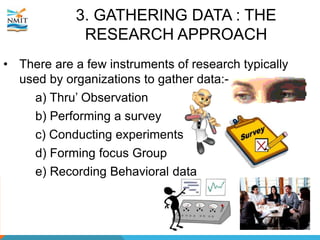
3. GATHERING DATA : THE
RESEARCH APPROACH
• There are a few instruments of research typically
used by organizations to gather data:-
a) Thru’ Observation
b) Performing a survey
c) Conducting experiments
d) Forming focus Group
e) Recording Behavioral data
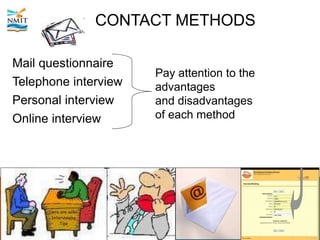
CONTACT METHODS
Mail questionnaire
Telephone interview
Personal interview
Online interview
Pay attention to the
advantages
and disadvantages
of each method
4. ANALYZE YOUR INFORMATION
• Data analysis consists of recording and
summarizing (ringkasan/ kesimpulan) the
responses for each question or observation for
every participant.
5. REPORT YOUR RESEARCH
FINDINGS
• Interpreting the information and drawing conclusion
for use in managerial decision.
CHARACTERISTICS OF GOOD
MARKETING RESEARCH
 Scientific method – be thorough, factual,
with proof
 Research creativity – get response
 Multiple methods – use more than one way
to obtain information
 Interdependence – keep close to research
methodology
 Value and cost of information - minimal
 Overall conclusion (Healthy skepticism)
 Ethical (complying with etiquette)
WHAT IS MARKET
FORECASTING?
A market forecast is a core component of a market
analysis. It projects the future numbers,
characteristics, and trends in your target market.
A standard analysis shows the projected number of
potential customers divided into segments.
MARKET FORECASTING TERMS
Demand measurement :
• Product Stage : Number of orders secured
when production starts
• Space Stage : How the orders are distributed to
wholesalers, retailers & consumers
• Time stage – What is the quantity of orders you
would need to product in the next 3-6 months?
Buyer Groups
• Actual buyers: are those who have heard of our
products, used your products before and that
will definitely buy from you
• Potential Buyers: consumers who have not
heard from you, are hesitant to buy from you or
those who are unsure if they would buy from
you.
• Non buyers: consumers who will not buy from
you
Marketers thus focus on those who are buying and
those who are likely to buy.
Demand forecasting
• Company Demand is the sales volume that a
company wants to achieve in its business
• Company Sales Prediction is the sales volume
estimated by accumulating every single
salesperson’s estimation of sales to be done
• Company potential sales is the sales volume
that may be achieved bearing NO CHANGES in
whatever situation it currently is in.
Current demand estimation
• Total market potential is the sales volume
achievable in every stage, space and time at a
stipulated period.
• Market area potential breaks the sales volume
into segments like LOCATION and TIME
Potential demand estimation
• Survey of Buyers’ Intentions : Ask consumers
what, where, when they would buy
• expert opinion : Ask panel or industry experts
• test market method : Test the market by selling
the product and observe the response.

MGT2306-MARKETING-MANAGEMENT LESSON 5

  • 1.
  • 2.
    LESSON 5 OBJECTIVES •Define what is marketing research • Examine the purposes of marketing research and how market research helps businesses. • Describe the market research process
  • 3.
    WHAT IS MARKETRESEARCH? • Market research is the process of collecting valuable information to help you find out if there is a market for your proposed product or service.
  • 4.
    WHY DO BUSINESSESREQUIRE INFORMATION? Businesses need information about customer wants, market demand, competition, distribution channels etc. This information needs to be updated regularly because businesses operate in a dynamic environment, characterised by frequent: - Changes in technology - Changes in consumer tastes - Changes in the product ranges of competitors - Changes in economic conditions
  • 5.
    HOW MARKET RESEARCH HELPSBUSINESSES • Gain a more detailed understanding of consumers’ needs • Reduce the risk of product/business failure • Forecast future trends
  • 6.
    IMPLEMENTATION OF MARKETING RESEARCH •Implemented by the marketers (Do it yourself) • By appointing outsiders (Higher Learning Institutions, Research Institutions, Custom marketing research firms and specialized research agencies) • A combination of both
  • 7.
    THE MARKET RESEARCH PROCESS Thisis a typical sequence implementation of a marketing research process
  • 8.
    1. IDENTIFY THERESEARCH ISSUES • The starting phase is always identifying the reason or problem for which research is to be conducted.
  • 9.
    2. DESIGN THERESEARCH PLAN • Now that you know your problem or issue, it is time to plan out the type of research that will best obtain the necessary data. • There are 3 categories of research: a) Explorative research b) Descriptive research c) Causal research
  • 10.
    EXPLORATORY RESEARCH • Itis used when you don’t know what the real problem or issue is and you need to uncover the causes • Example: Why do Muslims nowadays brave themselves to travel to countries where they would not travel previously?
  • 11.
    DESCRIPTIVE RESEARCH • Usedto describe the market problem or situation for example: a) measure market demand b) develop a profile of the target market c) measure the attitudes of consumers • The research yields quantitative data Example : The new generation prefer fuss-free economical fast-food compared to the older generation who prefer home-cooked food. How much of it is true?
  • 12.
    CAUSAL RESEARCH • Thisresearch tests hypotheses about cause and effect relationships, example, a relationship between two variables. Example: Does advertising bring sales up? How do price and quantity co-relate? Are fat people more likely to get diabetes and hypertension?
  • 13.
    3. GATHERING DATA: THE RESEARCH APPROACH • There are a few instruments of research typically used by organizations to gather data:- a) Thru’ Observation b) Performing a survey c) Conducting experiments d) Forming focus Group e) Recording Behavioral data
  • 14.
    CONTACT METHODS Mail questionnaire Telephoneinterview Personal interview Online interview Pay attention to the advantages and disadvantages of each method
  • 15.
    4. ANALYZE YOURINFORMATION • Data analysis consists of recording and summarizing (ringkasan/ kesimpulan) the responses for each question or observation for every participant.
  • 16.
    5. REPORT YOURRESEARCH FINDINGS • Interpreting the information and drawing conclusion for use in managerial decision.
  • 17.
    CHARACTERISTICS OF GOOD MARKETINGRESEARCH  Scientific method – be thorough, factual, with proof  Research creativity – get response  Multiple methods – use more than one way to obtain information  Interdependence – keep close to research methodology  Value and cost of information - minimal  Overall conclusion (Healthy skepticism)  Ethical (complying with etiquette)
  • 18.
    WHAT IS MARKET FORECASTING? Amarket forecast is a core component of a market analysis. It projects the future numbers, characteristics, and trends in your target market. A standard analysis shows the projected number of potential customers divided into segments.
  • 19.
    MARKET FORECASTING TERMS Demandmeasurement : • Product Stage : Number of orders secured when production starts • Space Stage : How the orders are distributed to wholesalers, retailers & consumers • Time stage – What is the quantity of orders you would need to product in the next 3-6 months?
  • 20.
    Buyer Groups • Actualbuyers: are those who have heard of our products, used your products before and that will definitely buy from you • Potential Buyers: consumers who have not heard from you, are hesitant to buy from you or those who are unsure if they would buy from you. • Non buyers: consumers who will not buy from you Marketers thus focus on those who are buying and those who are likely to buy.
  • 21.
    Demand forecasting • CompanyDemand is the sales volume that a company wants to achieve in its business • Company Sales Prediction is the sales volume estimated by accumulating every single salesperson’s estimation of sales to be done • Company potential sales is the sales volume that may be achieved bearing NO CHANGES in whatever situation it currently is in.
  • 22.
    Current demand estimation •Total market potential is the sales volume achievable in every stage, space and time at a stipulated period. • Market area potential breaks the sales volume into segments like LOCATION and TIME
  • 23.
    Potential demand estimation •Survey of Buyers’ Intentions : Ask consumers what, where, when they would buy • expert opinion : Ask panel or industry experts • test market method : Test the market by selling the product and observe the response.