


SUSHI Update
Oliver Pesch
SUSHI Standing Committee co-chair
Chief Product Strategist
EBSCO Information Services
opesch@ebsco.com
Overview
• What is SUSHI
• Who is on the committee
• What’s new
• What we are working on
• Future
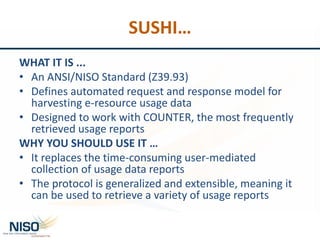
SUSHI…
WHAT IT IS ...
• An ANSI/NISO Standard (Z39.93)
• Defines automated request and response model for
harvesting e-resource usage data
• Designed to work with COUNTER, the most frequently
retrieved usage reports
WHY YOU SHOULD USE IT …
• It replaces the time-consuming user-mediated
collection of usage data reports
• The protocol is generalized and extensible, meaning it
can be used to retrieve a variety of usage reports
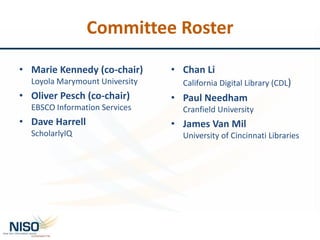
Committee Roster
• Marie Kennedy (co-chair)
Loyola Marymount University
• Oliver Pesch (co-chair)
EBSCO Information Services
• Dave Harrell
ScholarlyIQ
• Chan Li
California Digital Library (CDL)
• Paul Needham
Cranfield University
• James Van Mil
University of Cincinnati Libraries
SUSHI standard updated
Z39.93-2014 released in September…
SUSHI version 1.7 introduces new Filters
and Report Attributes
SUSHI standard updated
New Filters and Report Attributes
• Allows for more precise specification of report
requests, e.g.
– Filter results to return usage only for a specific department
– Ask to have zero usage excluded from the report
• Backwards compatible
• The new elements are optional
• Current implementations of SUSHI for COUNTER R4
should NOT be affected
COUNTER schema updated
COUNTER schema 4.1…
• Expanded to support new COUNTER “Article” reports
• Backward compatible
– New elements are options
– Standard COUNTER reports (JR1, BR1, BR2, etc.) did not
change since they do not use the new elements
COUNTER SUSHI Implementation Profile
Updated
Minor update to address some issues
• PubYr attribute value to represent “unknown” should
be “0001” and not “0000”
• Fixed COUNTER report names in tables for
consistency
• Updated schema versions as necessary to match
current standard
SUSHI-Lite
A technical report – not a new standard
• A Light-weight approach to delivering SUSHI reports
• Using up-to-date web service approaches that uses
HTTP/REST for communication and JSON for the
contents
• Ideal for delivering snippets of usage but also useful
for full reports
SUSHI-Lite
Sample use cases…
• Serials management system pulling use for a
particular journal for in-workflow usage display
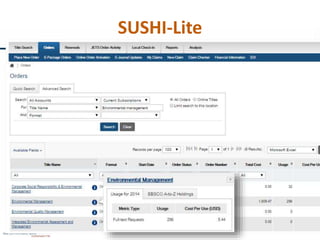
SUSHI-Lite
Sample use cases…
• Serials management system pulling use for a
particular journal for in-workflow usage display
SUSHI-Lite
Sample use cases…
• Institutional repository exchanging article-level usage
with publisher
• Usage Factor: Journal processing pulling article level
usage from institutional repositories and other
content sites
SUSHI-Lite
Sample use cases…
• Alternative metrics system retrieving article-level
usage from publishers, institutional repositories and
other content sites for…
– Presenting overall impact numbers
– Offering real-time access to stats
SUSHI-Lite
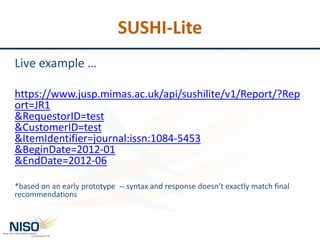
Live example …
https://www.jusp.mimas.ac.uk/api/sushilite/v1/Report/?Rep
ort=JR1
&RequestorID=test
&CustomerID=test
&ItemIdentifier=journal:issn:1084-5453
&BeginDate=2012-01
&EndDate=2012-06
*based on an early prototype -- syntax and response doesn’t exactly match final
recommendations
SUSHI-Lite
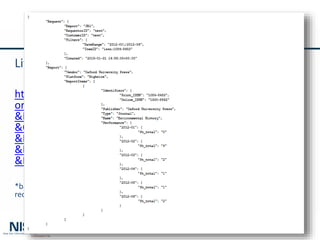
Live example …
https://www.jusp.mimas.ac.uk/api/sushilite/v1/Report/?Rep
ort=JR1
&RequestorID=test
&CustomerID=test
&ItemIdentifier=journal:issn:1084-5453
&BeginDate=2012-01
&EndDate=2012-06
*based on an early prototype -- syntax and response doesn’t exactly match final
recommendations
SUSHI-Lite
Proof-of-concept implementations…
• JUSP (Journal Usage Statistics Portal)
– Supply journal level COUNTER usage statistics
– Contributed by: Paul Needham, Cranfield
University
SUSHI-Lite
Proof-of-concept implementations…
• IRUS-UK (a JISC-funded repository service)
– For consolidating article-level COUNTER usage
statistics from multiple repositories
– Paul Needham, Cranfied University
SUSHI-Lite
Proof-of-concept implementations…
• Open Journal System (OJS)
– Supply COUNTER JR1 reports
– Exchange article-level usage with alternative
metrics organizations
– Contributed by: Clinton Graham & Brian Gregg,
University of Pittsburg
SUSHI-Lite Working Group Roster
• Paul Needham (co-chair)
– Cranfield University
• Oliver Pesch (co-chair)
– EBSCO Information Services
• Clinton Graham
– University of Pittsburg
• Brian Gregg
– University of Pittsburg
• Miriam Lorenz
– Cologne University of Applied
Science
• Guy Marjew
– Reed Elsevier
• Mike Showalter
– Plum Analytics
• Alan Stiles
– Open University
• James van Mil
– University of Cincinnati Libraries
Areas of focus going forward…
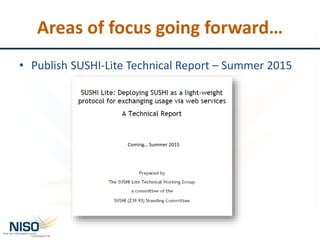
• Publish SUSHI-Lite Technical Report – Summer 2015
Coming… Summer 2015
Areas of focus going forward…
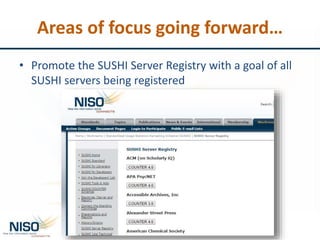
• Promote the SUSHI Server Registry with a goal of all
SUSHI servers being registered
Areas of focus going forward…
• Continued collaboration with COUNTER to manage
COUNTER schemas and provide input
Areas of focus going forward…
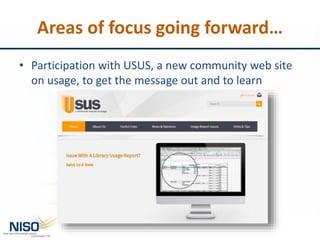
• Participation with USUS, a new community web site
on usage, to get the message out and to learn
Areas of focus going forward…
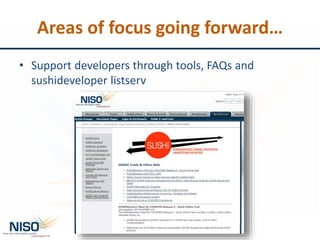
• Support developers through tools, FAQs and
sushideveloper listserv
Areas of focus going forward…
…. and consider and implement changes to
SUSHI standard and related schemas and
registries as needed
References
• NISO SUSHI Website:
http://www.niso.org/workrooms/sushi/
• SUSHI Release 1.7:
http://www.niso.org/standards/z39-93-2014/
• COUNTER_SUSHI Implementation Profile:
http://www.niso.org/publications/rp/rp-14-2014/
• COUNTER Schema 4.1:
http://www.niso.org/schemas/sushi/#counter
• JUSP: http://jusp.mimas.ac.uk/
• IRUS-UK: http://www.irus.mimas.ac.uk/
• USUS: http://www.usus.org.uk

NISO SUSHI update, ALA Midwinter 2015

  • 1.
    SUSHI Update Oliver Pesch SUSHIStanding Committee co-chair Chief Product Strategist EBSCO Information Services opesch@ebsco.com
  • 2.
    Overview • What isSUSHI • Who is on the committee • What’s new • What we are working on • Future
  • 3.
    SUSHI… WHAT IT IS... • An ANSI/NISO Standard (Z39.93) • Defines automated request and response model for harvesting e-resource usage data • Designed to work with COUNTER, the most frequently retrieved usage reports WHY YOU SHOULD USE IT … • It replaces the time-consuming user-mediated collection of usage data reports • The protocol is generalized and extensible, meaning it can be used to retrieve a variety of usage reports
  • 4.
    Committee Roster • MarieKennedy (co-chair) Loyola Marymount University • Oliver Pesch (co-chair) EBSCO Information Services • Dave Harrell ScholarlyIQ • Chan Li California Digital Library (CDL) • Paul Needham Cranfield University • James Van Mil University of Cincinnati Libraries
  • 6.
    SUSHI standard updated Z39.93-2014released in September… SUSHI version 1.7 introduces new Filters and Report Attributes
  • 7.
    SUSHI standard updated NewFilters and Report Attributes • Allows for more precise specification of report requests, e.g. – Filter results to return usage only for a specific department – Ask to have zero usage excluded from the report • Backwards compatible • The new elements are optional • Current implementations of SUSHI for COUNTER R4 should NOT be affected
  • 8.
    COUNTER schema updated COUNTERschema 4.1… • Expanded to support new COUNTER “Article” reports • Backward compatible – New elements are options – Standard COUNTER reports (JR1, BR1, BR2, etc.) did not change since they do not use the new elements
  • 9.
    COUNTER SUSHI ImplementationProfile Updated Minor update to address some issues • PubYr attribute value to represent “unknown” should be “0001” and not “0000” • Fixed COUNTER report names in tables for consistency • Updated schema versions as necessary to match current standard
  • 11.
    SUSHI-Lite A technical report– not a new standard • A Light-weight approach to delivering SUSHI reports • Using up-to-date web service approaches that uses HTTP/REST for communication and JSON for the contents • Ideal for delivering snippets of usage but also useful for full reports
  • 12.
    SUSHI-Lite Sample use cases… •Serials management system pulling use for a particular journal for in-workflow usage display
  • 13.
    SUSHI-Lite Sample use cases… •Serials management system pulling use for a particular journal for in-workflow usage display
  • 14.
    SUSHI-Lite Sample use cases… •Institutional repository exchanging article-level usage with publisher • Usage Factor: Journal processing pulling article level usage from institutional repositories and other content sites
  • 15.
    SUSHI-Lite Sample use cases… •Alternative metrics system retrieving article-level usage from publishers, institutional repositories and other content sites for… – Presenting overall impact numbers – Offering real-time access to stats
  • 16.
  • 17.
  • 18.
    SUSHI-Lite Proof-of-concept implementations… • JUSP(Journal Usage Statistics Portal) – Supply journal level COUNTER usage statistics – Contributed by: Paul Needham, Cranfield University
  • 19.
    SUSHI-Lite Proof-of-concept implementations… • IRUS-UK(a JISC-funded repository service) – For consolidating article-level COUNTER usage statistics from multiple repositories – Paul Needham, Cranfied University
  • 20.
    SUSHI-Lite Proof-of-concept implementations… • OpenJournal System (OJS) – Supply COUNTER JR1 reports – Exchange article-level usage with alternative metrics organizations – Contributed by: Clinton Graham & Brian Gregg, University of Pittsburg
  • 21.
    SUSHI-Lite Working GroupRoster • Paul Needham (co-chair) – Cranfield University • Oliver Pesch (co-chair) – EBSCO Information Services • Clinton Graham – University of Pittsburg • Brian Gregg – University of Pittsburg • Miriam Lorenz – Cologne University of Applied Science • Guy Marjew – Reed Elsevier • Mike Showalter – Plum Analytics • Alan Stiles – Open University • James van Mil – University of Cincinnati Libraries
  • 23.
    Areas of focusgoing forward… • Publish SUSHI-Lite Technical Report – Summer 2015 Coming… Summer 2015
  • 24.
    Areas of focusgoing forward… • Promote the SUSHI Server Registry with a goal of all SUSHI servers being registered
  • 25.
    Areas of focusgoing forward… • Continued collaboration with COUNTER to manage COUNTER schemas and provide input
  • 26.
    Areas of focusgoing forward… • Participation with USUS, a new community web site on usage, to get the message out and to learn
  • 27.
    Areas of focusgoing forward… • Support developers through tools, FAQs and sushideveloper listserv
  • 28.
    Areas of focusgoing forward… …. and consider and implement changes to SUSHI standard and related schemas and registries as needed
  • 29.
    References • NISO SUSHIWebsite: http://www.niso.org/workrooms/sushi/ • SUSHI Release 1.7: http://www.niso.org/standards/z39-93-2014/ • COUNTER_SUSHI Implementation Profile: http://www.niso.org/publications/rp/rp-14-2014/ • COUNTER Schema 4.1: http://www.niso.org/schemas/sushi/#counter • JUSP: http://jusp.mimas.ac.uk/ • IRUS-UK: http://www.irus.mimas.ac.uk/ • USUS: http://www.usus.org.uk