1
Lesson 1. Amino acid and Protein
1.1. Experiment 1 : Ninhydrin reaction
• Principle
- α-amino acids can be qualitatively and quantitatively estimated by their
reaction with ninhydrin.
- The reaction produces hydrindantin, ammonia, aldehyde, and carbon
dioxide
- Then hydrindantin react with ammonia and ninhydrin to make
Ruhemann's Purple.
Ninhydrin reaction
2
1.1. Experiment 1 : Ninhydrin
reaction
Reagants:
- Amino acid solution
- Ninhydrin solution, 0.1%
- CuSO4 (copper II sulfate) solution, 5%
Equipment:
- Filter papers
- Oven
3
4
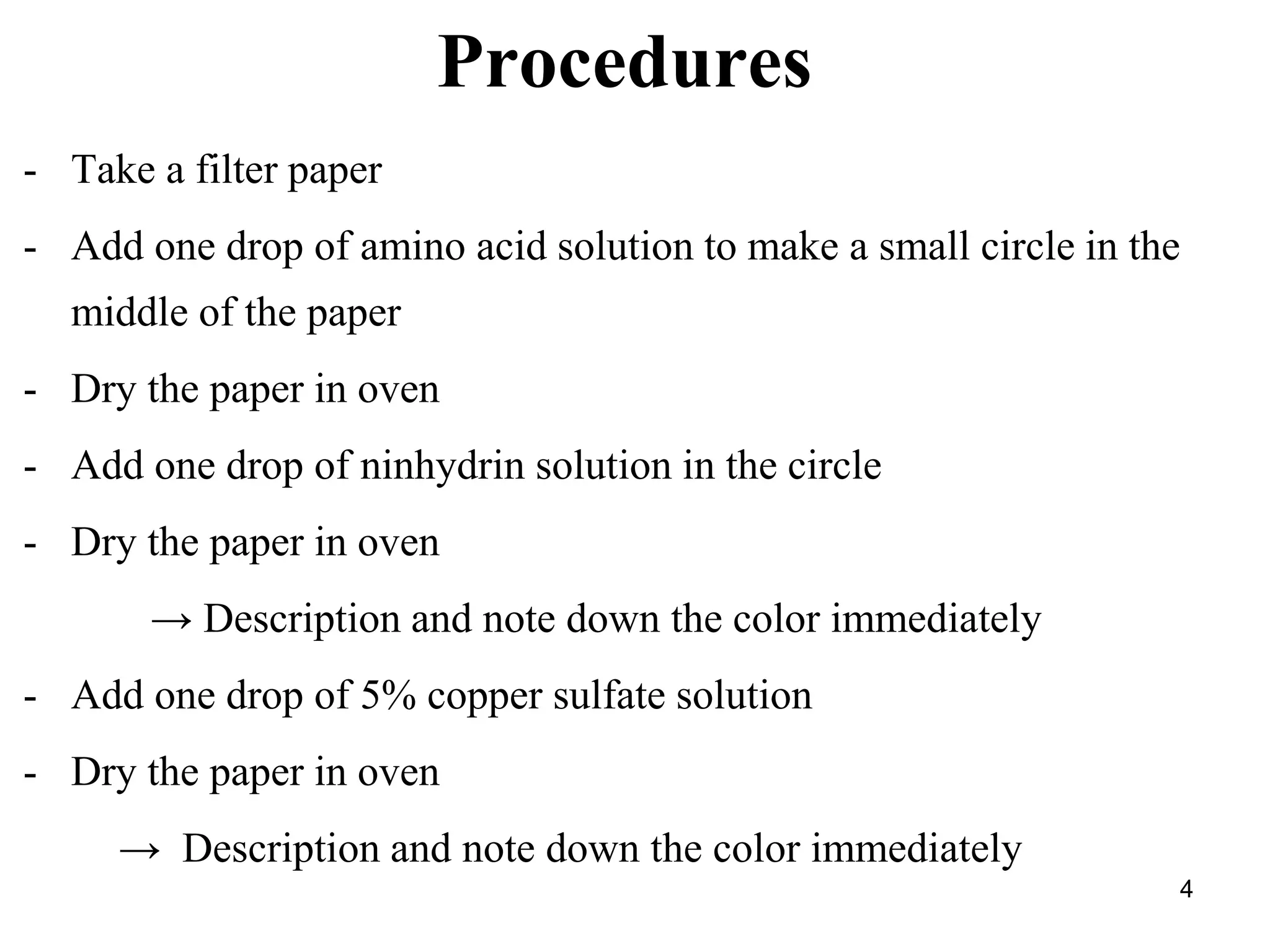
Procedures
- Take a filter paper
- Add one drop of amino acid solution to make a small circle in the
middle of the paper
- Dry the paper in oven
- Add one drop of ninhydrin solution in the circle
- Dry the paper in oven
→ Description and note down the color immediately
- Add one drop of 5% copper sulfate solution
- Dry the paper in oven
→ Description and note down the color immediately
1.2. Experiment 2: Xanthoproteic
reaction
Principle:
- This reaction tests for the presence of aromatic amino acid
(benzene rings - Phe, Tyr, Trp) in proteins.
- Aromatic amino acids react with the concentrated nitric acid leads
to the nitration of the aromatic ring and formation of yellow nitro-
products (nitro derivatives) (This reaction need heating time)
When the strong alkali solution (NaOH) is added the colour of
obtained products turns from yellow to orange.
5
6
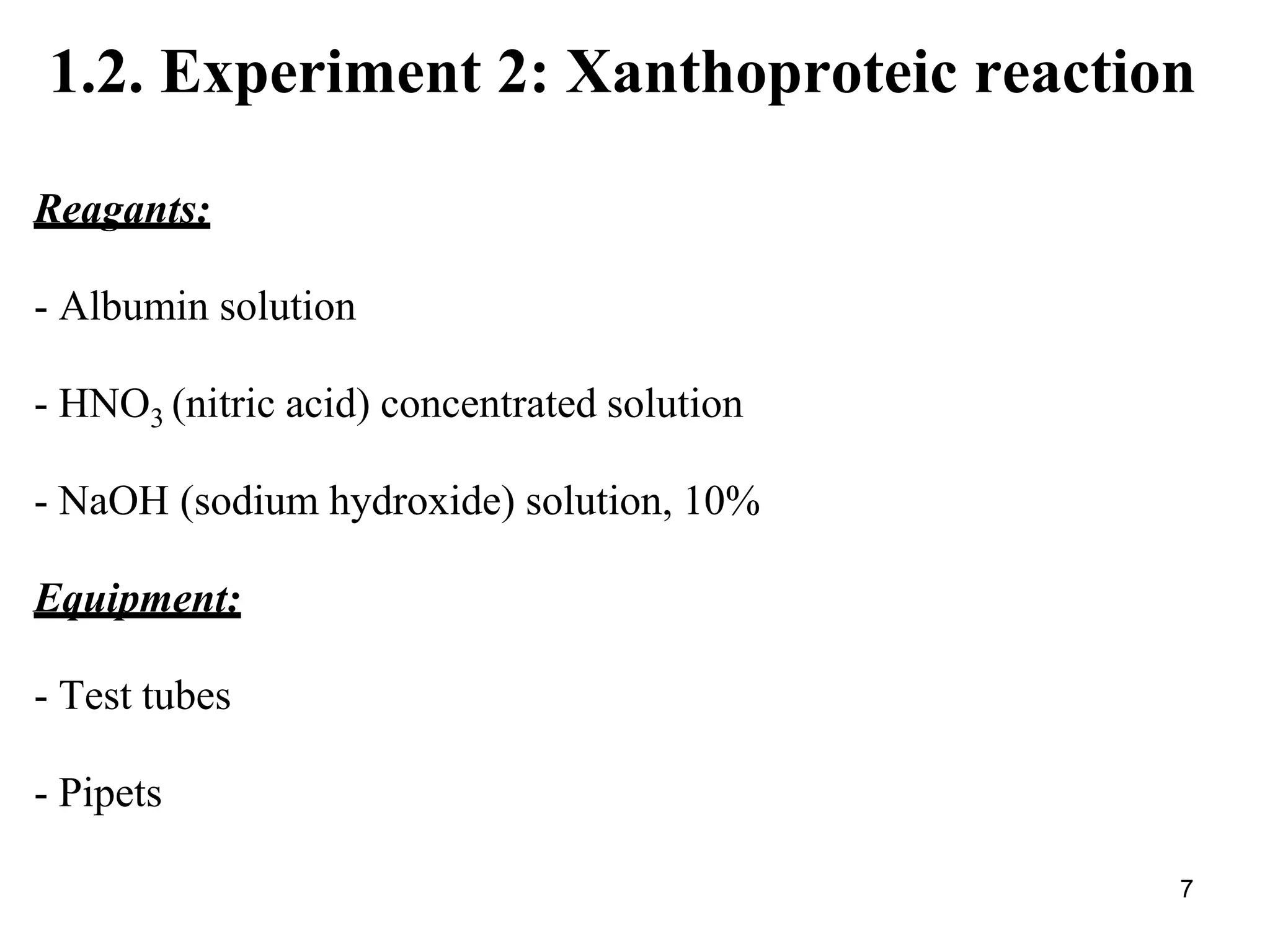
1.2. Experiment 2: Xanthoproteic reaction
Reagants:
- Albumin solution
- HNO3 (nitric acid) concentrated solution
- NaOH (sodium hydroxide) solution, 10%
Equipment:
- Test tubes
- Pipets
7
1.2. Experiment 2: Xanthoproteic reaction
Procedures:
- Take 5 drops albumin solution in a test tube
- Add 5 drops of concentrated nitric acid
- Mix, put thermostat, see the change color, take out
- Observe the change of color (yellow)
- Add slowly 10% sodium hydroxide drop by drop and mixing. The
color will change in the alakine medium
- Note down the changes
8
1.3. Experiment 3: Biuret reaction
Principle
• The reaction takes place with compounds containing two or more
peptide bonds,
• It can be used for both qualitative and quantitative analysis of
peptides and protein.
• The blue-violet color of the Biuret reaction is due to the complexion
of copper (Cu2+) in alkaline solution with the peptide bonds in the
protein.
NaOH
Protein (Peptide bond) ------------------->
CuSO4
9
10
1.3. Experiment 3: Biuret reaction
Reagants:
- Albumin solution, 1%
- CuSO4 solution, 1%
- NaOH solution, 10%
Equipment:
- Test tubes
- Pipets
11
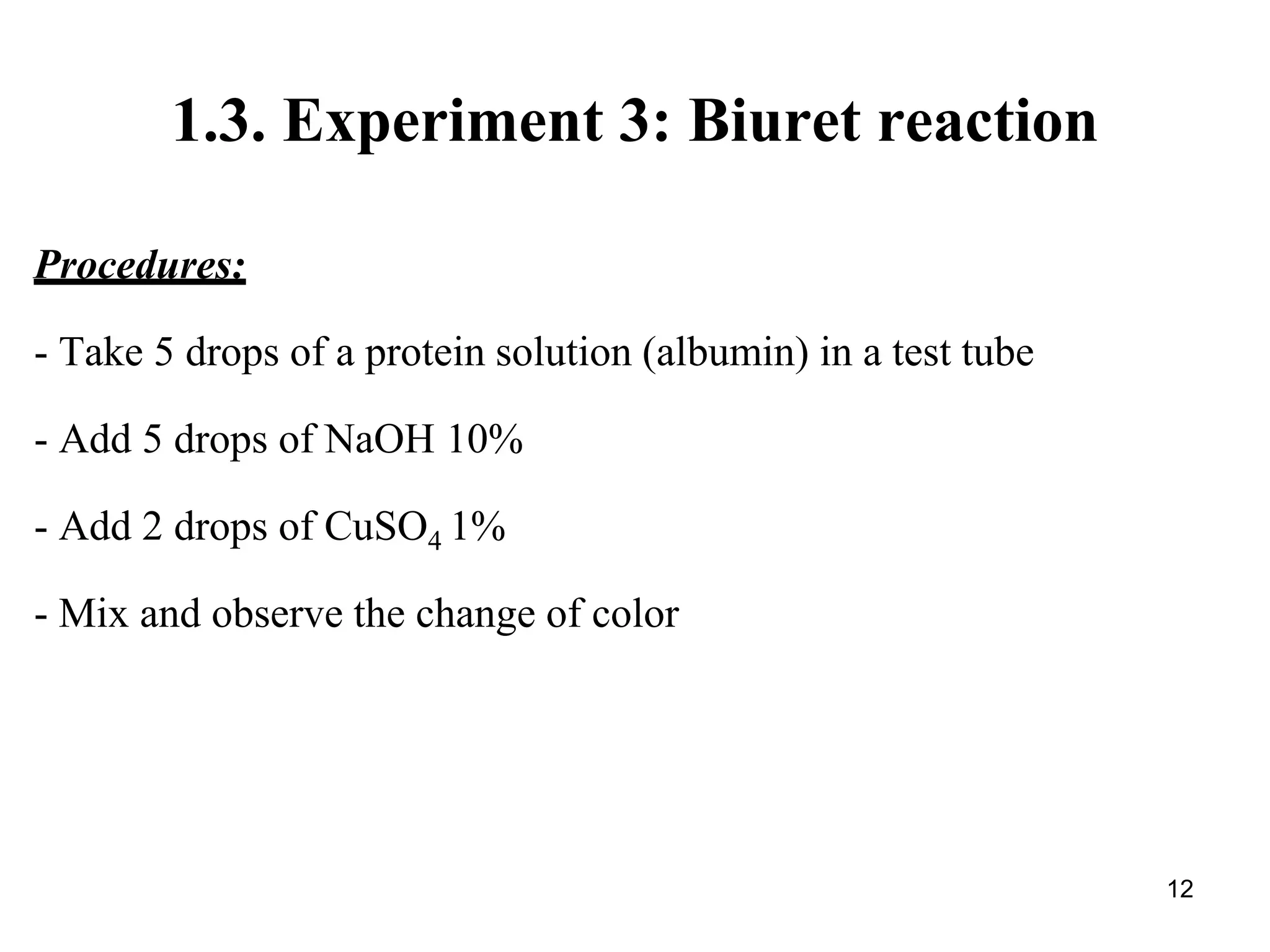
1.3. Experiment 3: Biuret reaction
Procedures:
- Take 5 drops of a protein solution (albumin) in a test tube
- Add 5 drops of NaOH 10%
- Add 2 drops of CuSO4 1%
- Mix and observe the change of color
12
Experiment 4: Quantitative determination of
protein content by Biuret method
Principle: The Biuret complex can be quantitatively measured by
spectrophotometer (maximum absorbance at 540 nm)
Reagants:
Albumin solution 0.1%
Albumin solution (unknown concentration):
Distilled water
Biure reagant solution:
Equipment:
Test tubes
Spectrophotometer 13
Experiment 4: Quantitative determination
of protein content by Biuret method
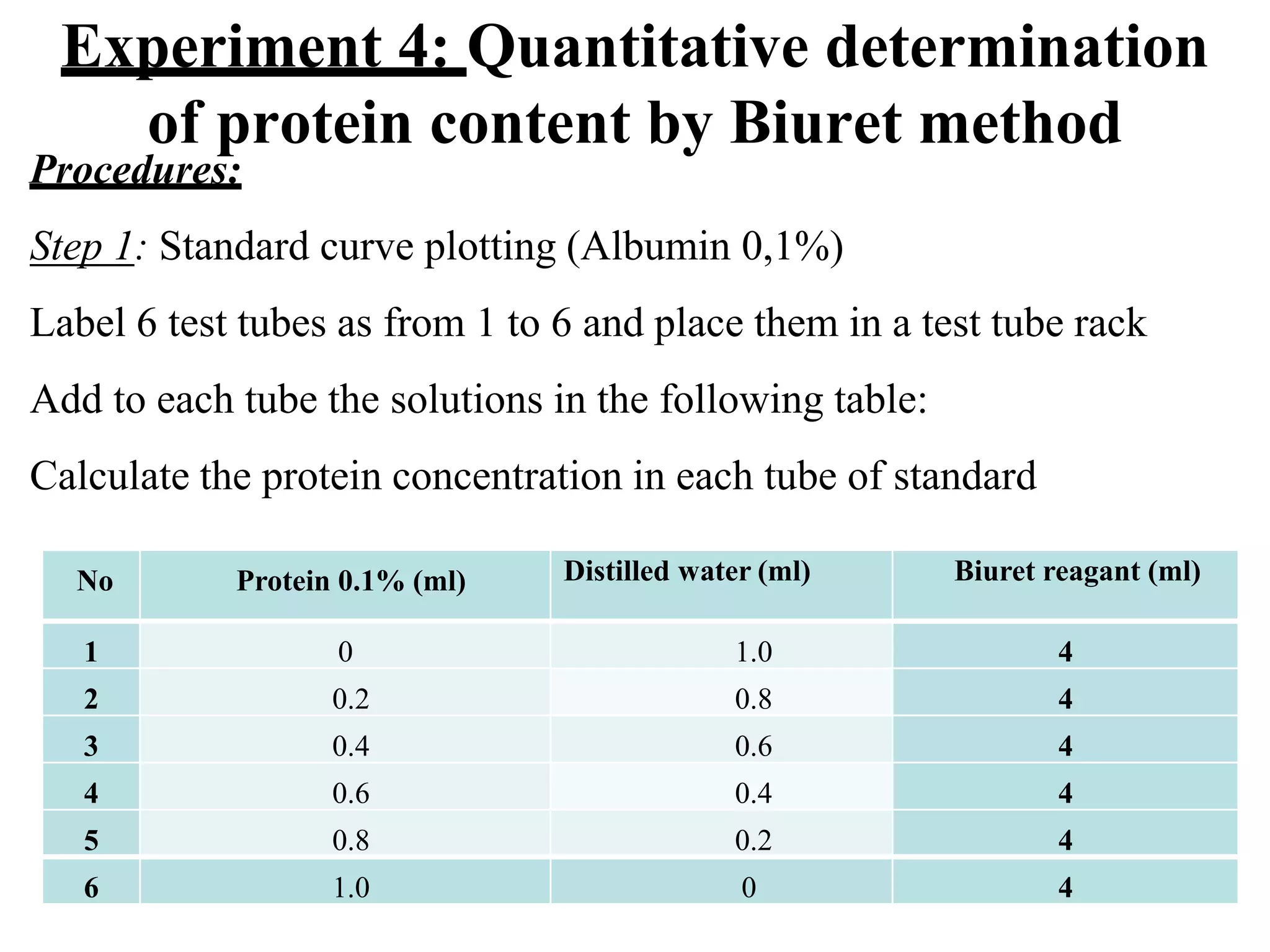
Procedures:
Step 1: Standard curve plotting (Albumin 0,1%)
Label 6 test tubes as from 1 to 6 and place them in a test tube rack
Add to each tube the solutions in the following table:
Calculate the protein concentration in each tube of standard
14
No Protein 0.1% (ml) Distilled water (ml) Biuret reagant (ml)
1 0 1.0 4
2 0.2 0.8 4
3 0.4 0.6 4
4 0.6 0.4 4
5 0.8 0.2 4
6 1.0 0 4
Experiment 4: Quantitative determination of
protein content by Biuret method
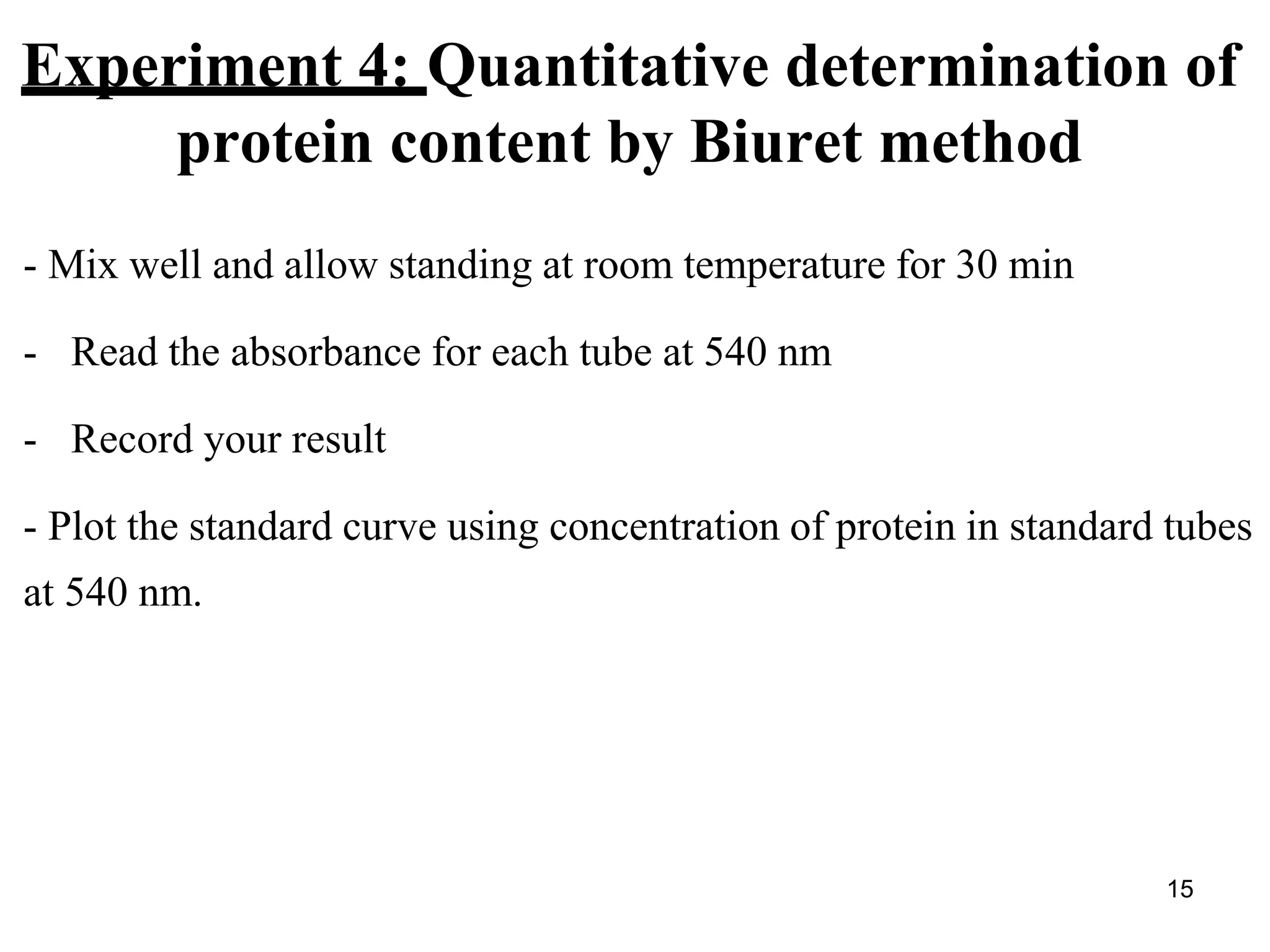
- Mix well and allow standing at room temperature for 30 min
- Read the absorbance for each tube at 540 nm
- Record your result
- Plot the standard curve using concentration of protein in standard tubes
at 540 nm.
15
Experiment 4: Quantitative determination of
protein content by Biuret method
Step 2: Determination of protein content in a given sample
- Take 1 test tube and label it as 7
- Add 1 mL of a protein solution (albumin ?) with unknown protein
content
- Add 4 mL of Biuret reagant
- Allow standing at room temperature for 30 min
- Read the absorbance for the tube at 540 nm.
- Record your result
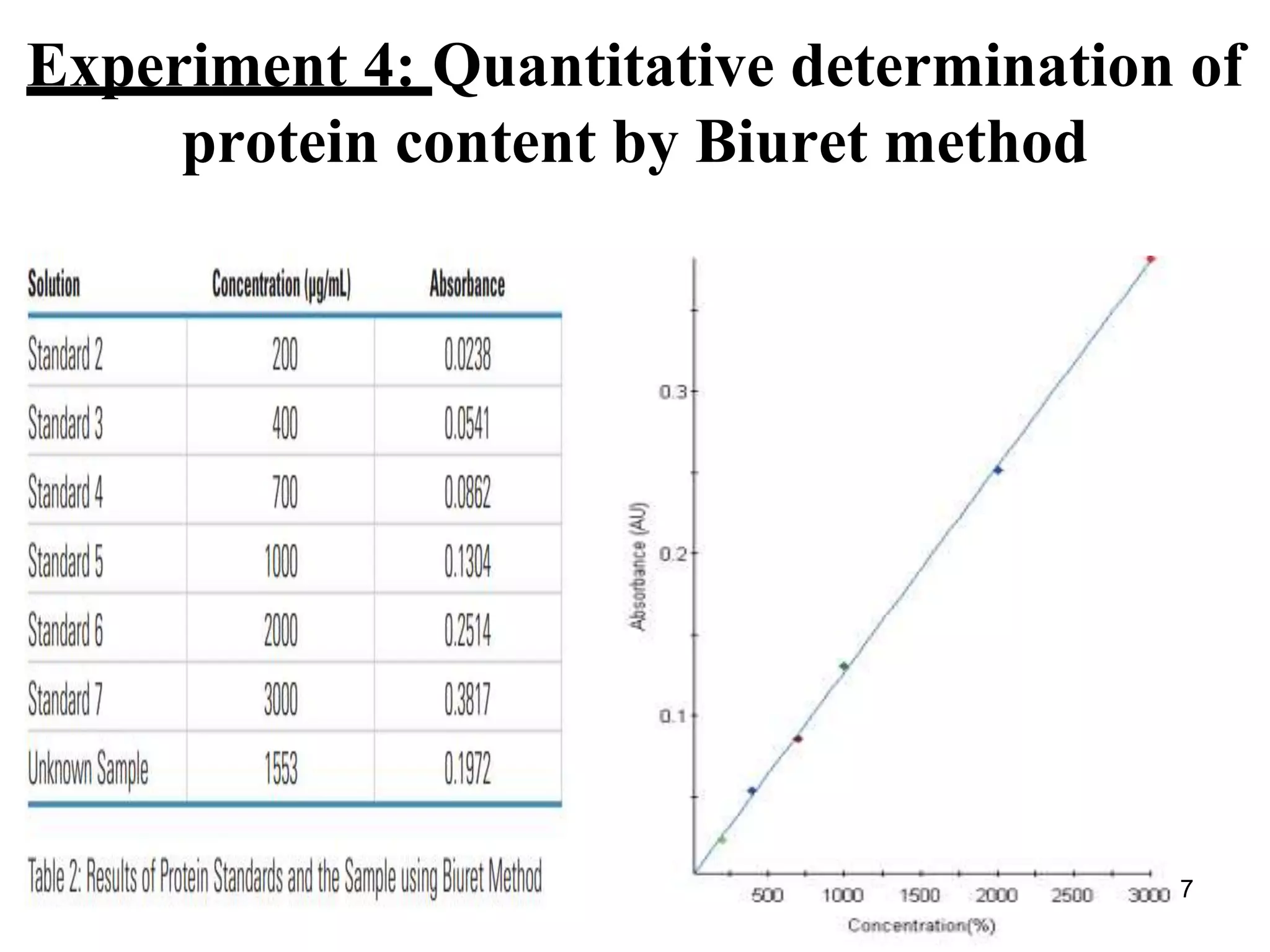
- Determine protein content based on the standard curve
16
Experiment 4: Quantitative determination of
protein content by Biuret method
17

Ninhydrin.ppt

  • 1.
    1 Lesson 1. Aminoacid and Protein 1.1. Experiment 1 : Ninhydrin reaction • Principle - α-amino acids can be qualitatively and quantitatively estimated by their reaction with ninhydrin. - The reaction produces hydrindantin, ammonia, aldehyde, and carbon dioxide - Then hydrindantin react with ammonia and ninhydrin to make Ruhemann's Purple.
  • 2.
  • 3.
    1.1. Experiment 1: Ninhydrin reaction Reagants: - Amino acid solution - Ninhydrin solution, 0.1% - CuSO4 (copper II sulfate) solution, 5% Equipment: - Filter papers - Oven 3
  • 4.
    4 Procedures - Take afilter paper - Add one drop of amino acid solution to make a small circle in the middle of the paper - Dry the paper in oven - Add one drop of ninhydrin solution in the circle - Dry the paper in oven → Description and note down the color immediately - Add one drop of 5% copper sulfate solution - Dry the paper in oven → Description and note down the color immediately
  • 5.
    1.2. Experiment 2:Xanthoproteic reaction Principle: - This reaction tests for the presence of aromatic amino acid (benzene rings - Phe, Tyr, Trp) in proteins. - Aromatic amino acids react with the concentrated nitric acid leads to the nitration of the aromatic ring and formation of yellow nitro- products (nitro derivatives) (This reaction need heating time) When the strong alkali solution (NaOH) is added the colour of obtained products turns from yellow to orange. 5
  • 6.
  • 7.
    1.2. Experiment 2:Xanthoproteic reaction Reagants: - Albumin solution - HNO3 (nitric acid) concentrated solution - NaOH (sodium hydroxide) solution, 10% Equipment: - Test tubes - Pipets 7
  • 8.
    1.2. Experiment 2:Xanthoproteic reaction Procedures: - Take 5 drops albumin solution in a test tube - Add 5 drops of concentrated nitric acid - Mix, put thermostat, see the change color, take out - Observe the change of color (yellow) - Add slowly 10% sodium hydroxide drop by drop and mixing. The color will change in the alakine medium - Note down the changes 8
  • 9.
    1.3. Experiment 3:Biuret reaction Principle • The reaction takes place with compounds containing two or more peptide bonds, • It can be used for both qualitative and quantitative analysis of peptides and protein. • The blue-violet color of the Biuret reaction is due to the complexion of copper (Cu2+) in alkaline solution with the peptide bonds in the protein. NaOH Protein (Peptide bond) -------------------> CuSO4 9
  • 10.
  • 11.
    1.3. Experiment 3:Biuret reaction Reagants: - Albumin solution, 1% - CuSO4 solution, 1% - NaOH solution, 10% Equipment: - Test tubes - Pipets 11
  • 12.
    1.3. Experiment 3:Biuret reaction Procedures: - Take 5 drops of a protein solution (albumin) in a test tube - Add 5 drops of NaOH 10% - Add 2 drops of CuSO4 1% - Mix and observe the change of color 12
  • 13.
    Experiment 4: Quantitativedetermination of protein content by Biuret method Principle: The Biuret complex can be quantitatively measured by spectrophotometer (maximum absorbance at 540 nm) Reagants: Albumin solution 0.1% Albumin solution (unknown concentration): Distilled water Biure reagant solution: Equipment: Test tubes Spectrophotometer 13
  • 14.
    Experiment 4: Quantitativedetermination of protein content by Biuret method Procedures: Step 1: Standard curve plotting (Albumin 0,1%) Label 6 test tubes as from 1 to 6 and place them in a test tube rack Add to each tube the solutions in the following table: Calculate the protein concentration in each tube of standard 14 No Protein 0.1% (ml) Distilled water (ml) Biuret reagant (ml) 1 0 1.0 4 2 0.2 0.8 4 3 0.4 0.6 4 4 0.6 0.4 4 5 0.8 0.2 4 6 1.0 0 4
  • 15.
    Experiment 4: Quantitativedetermination of protein content by Biuret method - Mix well and allow standing at room temperature for 30 min - Read the absorbance for each tube at 540 nm - Record your result - Plot the standard curve using concentration of protein in standard tubes at 540 nm. 15
  • 16.
    Experiment 4: Quantitativedetermination of protein content by Biuret method Step 2: Determination of protein content in a given sample - Take 1 test tube and label it as 7 - Add 1 mL of a protein solution (albumin ?) with unknown protein content - Add 4 mL of Biuret reagant - Allow standing at room temperature for 30 min - Read the absorbance for the tube at 540 nm. - Record your result - Determine protein content based on the standard curve 16
  • 17.
    Experiment 4: Quantitativedetermination of protein content by Biuret method 17