Seven Myths of the Spanish Conquest Andrew Elsey HIST 140 Summer 2011
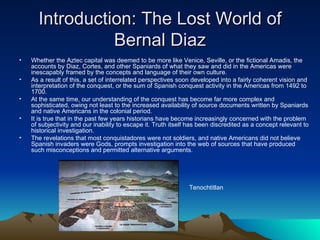
Introduction: The Lost World of Bernal Diaz Whether the Aztec capital was deemed to be more like Venice, Seville, or the fictional Amadis, the accounts by Diaz, Cortes, and other Spaniards of what they saw and did in the Americas were inescapably framed by the concepts and language of their own culture. As a result of this, a set of interrelated perspectives soon developed into a fairly coherent vision and interpretation of the conquest, or the sum of Spanish conquest activity in the Americas from 1492 to 1700. At the same time, our understanding of the conquest has become far more complex and sophisticated, owing not least to the increased availability of source documents written by Spaniards and native Americans in the colonial period. It is true that in the past few years historians have become increasingly concerned with the problem of subjectivity and our inability to escape it. Truth itself has been discredited as a concept relevant to historical investigation. The revelations that most conquistadores were not soldiers, and native Americans did not believe Spanish invaders were Gods, prompts investigation into the web of sources that have produced such misconceptions and permitted alternative arguments. Tenochtitlan
Chapter 1: A Handful of Adventurers The most exceptional thing about Columbus’ geographical vision was that it was wrong. His achievements were the result of a historical process that was far greater than he was. Along with Columbus, Cortes and Pizarro are by far the best known. The myth of great men is centered on these three figures who still enjoy extraordinary name recognition almost half a millennium after their deaths. But in its absolute form, using the “great men” approach ignores the roles played by larger processes of social change. Although men from Italian city-states were involved from the start, it was Portugal that dominated expansion. Italian navigators were systematically and most effectively co-opted by Portuguese monarchy. Allowing the New Portuguese empire to control Atlantic settlement and the agenda of expansion. Columbus tried to become part of this process but failed because he lacked the connections and persuasive ideas of other navigators. The fact that it was Columbus’ voyages, not Dagama’s, that would lead to the changing of the world history was not to Genoese's credit. His discoveries were and accidental geographical byproduct of Portuguese expansion.
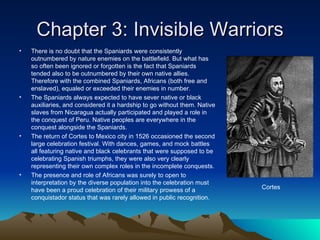
Chapter 3: Invisible Warriors There is no doubt that the Spaniards were consistently outnumbered by nature enemies on the battlefield. But what has so often been ignored or forgotten is the fact that Spaniards tended also to be outnumbered by their own native allies. Therefore with the combined Spaniards, Africans (both free and enslaved), equaled or exceeded their enemies in number. The Spaniards always expected to have sever native or black auxiliaries, and considered it a hardship to go without them. Native slaves from Nicaragua actually participated and played a role in the conquest of Peru. Native peoples are everywhere in the conquest alongside the Spaniards. The return of Cortes to Mexico city in 1526 occasioned the second large celebration festival. With dances, games, and mock battles all featuring native and black celebrants that were supposed to be celebrating Spanish triumphs, they were also very clearly representing their own complex roles in the incomplete conquests. The presence and role of Africans was surely to open to interpretation by the diverse population into the celebration must have been a proud celebration of their military prowess of a conquistador status that was rarely allowed in public recognition. Cortes
Chapter 5: The lost words of La Malinche Historically, the myth of communication was constructed by conquistadores and predominated during conquest and colonial times. It was convenient to Spaniards in that claims of communication with the native peoples drew up claims that natives were subjugated, co-opted, and converted. On some level, Spaniards believed that there was no real language barrier between them and Native Americans, a belief that underpinned the 1513 edict that required conquistadores to read a statement (in Spanish) to natives before attacking them. The requirement symbolizes the Spanish conviction in their ability to communicate with the natives, or at least to the extent that they deemed necessary. Juan De Betanzos observed that the conquistadores speak differently about many things, and how far removed they are from Indian practice. He believes this due to the fact that at the time they were not so much concerned with finding things out as with subjecting and acquiring the land.

Ning posting 4 HIST 140

  • 1.
    Seven Myths ofthe Spanish Conquest Andrew Elsey HIST 140 Summer 2011
  • 2.
    Introduction: The LostWorld of Bernal Diaz Whether the Aztec capital was deemed to be more like Venice, Seville, or the fictional Amadis, the accounts by Diaz, Cortes, and other Spaniards of what they saw and did in the Americas were inescapably framed by the concepts and language of their own culture. As a result of this, a set of interrelated perspectives soon developed into a fairly coherent vision and interpretation of the conquest, or the sum of Spanish conquest activity in the Americas from 1492 to 1700. At the same time, our understanding of the conquest has become far more complex and sophisticated, owing not least to the increased availability of source documents written by Spaniards and native Americans in the colonial period. It is true that in the past few years historians have become increasingly concerned with the problem of subjectivity and our inability to escape it. Truth itself has been discredited as a concept relevant to historical investigation. The revelations that most conquistadores were not soldiers, and native Americans did not believe Spanish invaders were Gods, prompts investigation into the web of sources that have produced such misconceptions and permitted alternative arguments. Tenochtitlan
  • 3.
    Chapter 1: AHandful of Adventurers The most exceptional thing about Columbus’ geographical vision was that it was wrong. His achievements were the result of a historical process that was far greater than he was. Along with Columbus, Cortes and Pizarro are by far the best known. The myth of great men is centered on these three figures who still enjoy extraordinary name recognition almost half a millennium after their deaths. But in its absolute form, using the “great men” approach ignores the roles played by larger processes of social change. Although men from Italian city-states were involved from the start, it was Portugal that dominated expansion. Italian navigators were systematically and most effectively co-opted by Portuguese monarchy. Allowing the New Portuguese empire to control Atlantic settlement and the agenda of expansion. Columbus tried to become part of this process but failed because he lacked the connections and persuasive ideas of other navigators. The fact that it was Columbus’ voyages, not Dagama’s, that would lead to the changing of the world history was not to Genoese's credit. His discoveries were and accidental geographical byproduct of Portuguese expansion.
  • 4.
    Chapter 3: InvisibleWarriors There is no doubt that the Spaniards were consistently outnumbered by nature enemies on the battlefield. But what has so often been ignored or forgotten is the fact that Spaniards tended also to be outnumbered by their own native allies. Therefore with the combined Spaniards, Africans (both free and enslaved), equaled or exceeded their enemies in number. The Spaniards always expected to have sever native or black auxiliaries, and considered it a hardship to go without them. Native slaves from Nicaragua actually participated and played a role in the conquest of Peru. Native peoples are everywhere in the conquest alongside the Spaniards. The return of Cortes to Mexico city in 1526 occasioned the second large celebration festival. With dances, games, and mock battles all featuring native and black celebrants that were supposed to be celebrating Spanish triumphs, they were also very clearly representing their own complex roles in the incomplete conquests. The presence and role of Africans was surely to open to interpretation by the diverse population into the celebration must have been a proud celebration of their military prowess of a conquistador status that was rarely allowed in public recognition. Cortes
  • 5.
    Chapter 5: Thelost words of La Malinche Historically, the myth of communication was constructed by conquistadores and predominated during conquest and colonial times. It was convenient to Spaniards in that claims of communication with the native peoples drew up claims that natives were subjugated, co-opted, and converted. On some level, Spaniards believed that there was no real language barrier between them and Native Americans, a belief that underpinned the 1513 edict that required conquistadores to read a statement (in Spanish) to natives before attacking them. The requirement symbolizes the Spanish conviction in their ability to communicate with the natives, or at least to the extent that they deemed necessary. Juan De Betanzos observed that the conquistadores speak differently about many things, and how far removed they are from Indian practice. He believes this due to the fact that at the time they were not so much concerned with finding things out as with subjecting and acquiring the land.