California:  A History Andrew Elsey HIST141  Summer 2011
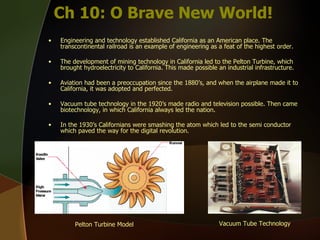
Ch 10: O Brave New World! Engineering and technology established California as an American place. The transcontinental railroad is an example of engineering as a feat of the highest order. The development of mining technology in California led to the Pelton Turbine, which brought hydroelectricity to California. This made possible an industrial infrastructure.  Aviation had been a preoccupation since the 1880’s, and when the airplane made it to California, it was adopted and perfected. Vacuum tube technology in the 1920’s made radio and television possible. Then came biotechnology, in which California always led the nation.  In the 1930’s Californians were smashing the atom which led to the semi conductor which paved the way for the digital revolution.   Pelton Turbine Model Vacuum Tube Technology
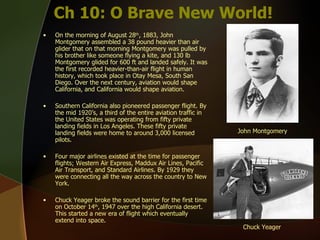
Ch 10: O Brave New World! On the morning of August 28 th , 1883, John Montgomery assembled a 38 pound heavier than air glider that on that morning Montgomery was pulled by his brother like someone flying a kite, and 130 lb Montgomery glided for 600 ft and landed safely. It was the first recorded heavier-than-air flight in human history, which took place in Otay Mesa, South San Diego. Over the next century, aviation would shape California, and California would shape aviation.  Southern California also pioneered passenger flight. By the mid 1920’s, a third of the entire aviation traffic in the United States was operating from fifty private landing fields in Los Angeles. These fifty private landing fields were home to around 3,000 licensed pilots.  Four major airlines existed at the time for passenger flights; Western Air Express, Maddux Air Lines, Pacific Air Transport, and Standard Airlines. By 1929 they were connecting all the way across the country to New York. Chuck Yeager broke the sound barrier for the first time on October 14 th , 1947 over the high California desert. This started a new era of flight which eventually extend into space.  John Montgomery Chuck Yeager
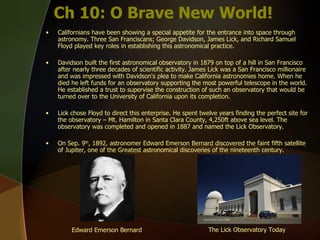
Ch 10: O Brave New World! Californians have been showing a special appetite for the entrance into space through astronomy. Three San Franciscans; George Davidson, James Lick, and Richard Samuel Floyd played key roles in establishing this astronomical practice. Davidson built the first astronomical observatory in 1879 on top of a hill in San Francisco after nearly three decades of scientific activity. James Lick was a San Francisco millionaire and was impressed with Davidson's plea to make California astronomies home. When he died he left funds for an observatory supporting the most powerful telescope in the world. He established a trust to supervise the construction of such an observatory that would be turned over to the University of California upon its completion.  Lick chose Floyd to direct this enterprise. He spent twelve years finding the perfect site for the observatory – Mt. Hamilton in Santa Clara County, 4,250ft above sea level. The observatory was completed and opened in 1887 and named the Lick Observatory.  On Sep. 9 th , 1892, astronomer Edward Emerson Bernard discovered the faint fifth satellite of Jupiter, one of the Greatest astronomical discoveries of the nineteenth century.  The Lick Observatory Today Edward Emerson Bernard

California Powerpoint Ning Site Posting 2

  • 1.
    California: AHistory Andrew Elsey HIST141 Summer 2011
  • 2.
    Ch 10: OBrave New World! Engineering and technology established California as an American place. The transcontinental railroad is an example of engineering as a feat of the highest order. The development of mining technology in California led to the Pelton Turbine, which brought hydroelectricity to California. This made possible an industrial infrastructure. Aviation had been a preoccupation since the 1880’s, and when the airplane made it to California, it was adopted and perfected. Vacuum tube technology in the 1920’s made radio and television possible. Then came biotechnology, in which California always led the nation. In the 1930’s Californians were smashing the atom which led to the semi conductor which paved the way for the digital revolution. Pelton Turbine Model Vacuum Tube Technology
  • 3.
    Ch 10: OBrave New World! On the morning of August 28 th , 1883, John Montgomery assembled a 38 pound heavier than air glider that on that morning Montgomery was pulled by his brother like someone flying a kite, and 130 lb Montgomery glided for 600 ft and landed safely. It was the first recorded heavier-than-air flight in human history, which took place in Otay Mesa, South San Diego. Over the next century, aviation would shape California, and California would shape aviation. Southern California also pioneered passenger flight. By the mid 1920’s, a third of the entire aviation traffic in the United States was operating from fifty private landing fields in Los Angeles. These fifty private landing fields were home to around 3,000 licensed pilots. Four major airlines existed at the time for passenger flights; Western Air Express, Maddux Air Lines, Pacific Air Transport, and Standard Airlines. By 1929 they were connecting all the way across the country to New York. Chuck Yeager broke the sound barrier for the first time on October 14 th , 1947 over the high California desert. This started a new era of flight which eventually extend into space. John Montgomery Chuck Yeager
  • 4.
    Ch 10: OBrave New World! Californians have been showing a special appetite for the entrance into space through astronomy. Three San Franciscans; George Davidson, James Lick, and Richard Samuel Floyd played key roles in establishing this astronomical practice. Davidson built the first astronomical observatory in 1879 on top of a hill in San Francisco after nearly three decades of scientific activity. James Lick was a San Francisco millionaire and was impressed with Davidson's plea to make California astronomies home. When he died he left funds for an observatory supporting the most powerful telescope in the world. He established a trust to supervise the construction of such an observatory that would be turned over to the University of California upon its completion. Lick chose Floyd to direct this enterprise. He spent twelve years finding the perfect site for the observatory – Mt. Hamilton in Santa Clara County, 4,250ft above sea level. The observatory was completed and opened in 1887 and named the Lick Observatory. On Sep. 9 th , 1892, astronomer Edward Emerson Bernard discovered the faint fifth satellite of Jupiter, one of the Greatest astronomical discoveries of the nineteenth century. The Lick Observatory Today Edward Emerson Bernard