
2013
         Training Report on
Mejia Thermal Power Station


              Pintu Khan
              Asansol Engineering College
              1/22/2013
Copyright Notice

Copyright © 2012 by AEC

All rights reserved. No part of this publication may be reproduced, distributed, or
transmitted in any form or by any means, including photocopying, recording, or other
electronic or mechanical methods, without the prior written permission of the
publisher, except in the case of brief quotations embodied in critical reviews and certain
other non-commercial uses permitted by copyright law.


                                                                                   Page | 1
Preface
This Project Report has been prepared in fulfilment of Industrial Training to be carried
out in third year of our four year B.TECH course. For preparing the Project Report, we
have visited Mejia Thermal Power Station under Damodar Valley Corporation during
the suggested duration for the period of 21 days, to avail the necessary information.
The blend of learning and knowledge acquired during our practical studies at the
company is presented in this Project Report.

The rationale behind visiting the power plant and preparing the Project Report is to
study the mechanical overview, electrical overview, various cycles and processes (viz.
Steam Generation, Turbo Generation and Balance of Plant) of power generation and
details of control and instrumentation required in thermal power plant.

We have carried out this training under well experienced and highly qualified engineers
of MTPS, DVC of various departments’ viz. Mechanical, Electrical, Chemical and Control
& Instrumentation depts. We have taken the opportunity to explore the Electrical
Department, its use, necessity in power plant and maintenance of various instruments
used for monitoring and controlling the numerous processes of power generation. We
have tried our best to cover all the aspects of the power plant and their brief detailing in
this project report.

All the above mentioned topics will be presented in the following pages of this report.
The main aim to carry out this training is to familiarize ourselves with the real industrial
scenario, so that we can relate with our engineering studies.


                                                                                     Page | 2
Acknowledgement
I take this opportunity to express my profound gratitude and deep regards to Mr. P.K.
Dubey for his exemplary guidance, monitoring and constant encouragement
throughout the course of this thesis. The blessing, help and guidance given by him time
to time shall carry me a long way in the journey of life on which I am about to embark.

I also take this opportunity to express a deep sense of gratitude to Mejia Thermal
Power Station, DVC, for their cordial support, valuable information and guidance, which
helped me in completing this task through various stages.

I am also thankful to the Director (HRD), the Chief Engineer and Project Head, Mr. G.
Nandesu (Asstt. Manager HR) for providing me opportunity to carry out my vocational
training in MTPS.

 I am obliged to staff members of Mejia Thermal Power Station, DVC for the valuable
information provided by them in their respective fields. I am grateful for their
cooperation during the period of my assignment.

Lastly, I thank almighty, my parents, brother, sisters and friends for their constant
encouragement without which this assignment would not be possible.


                                                           Signature of the Trainee


                                                                                Page | 3
Table of Contents                                    Page No.
   Introduction                                     5
        Damodar Valley Corporation                  5
        Basic needs and overview of a power plant   7
        Mejia Thermal power station                 9
        MTPS Unit Overview                          11
   Coal Handling Plant                              12
   Coal Mill                                        15
   Furnace and Boiler                               17
   Steam Turbine                                    20
   Introduction to Water Treatment                  23
        Pre Treatment of Water                      24
        DM Plant Treatment                          25
        Waste Water Treatment                       26
   Steam/Water Circuit of MTPS                      27
        Components of Steam/Water Cycle             29
   Cooling Towers                                   32
   Air and Flue Gas Path                            33
   Electrostatic Precipitators                      35
   Ash Handling Plant                               40
   Electrical System Overview                       43
        Generator                                   43
        Excitation System                           44
        Transformers                                45
        Control and Instrumentation                 50
        Automatic Voltage Regulator                 53
        AC and DC Power Flow in MTPS                55
        Switchyard                                  56
        Frequency Control                           60
        Voltage Control                             61
   National Grid                                    62
   Central Load Dispatch                            63
   DVC: Transmission and Distribution Network       65
   Conclusion                                       67
   Bibliography                                     68


                                                                Page | 4
INTRODUCTION
      Electricity generation is the process of generating electric power from sources of
energy. Electricity is most often generated at a power station by
electromechanical generators, primarily driven by heat engines fuelled by
chemical combustion or nuclear fission but also by other means such as the kinetic
energy of flowing water and wind. There are many other technologies that can be and
are used to generate electricity such as solar photovoltaic and geothermal power.
       In Indian subcontinent the abundance of coal leads to establishment of thermal
power stations and governing bodies namely DVC, NTPC, TATA power acts as pioneers
in the generation of electricity.

Damodar Valley Corporation
      Damodar Valley Corporation was established on 7th July 1947.It is the
most reputed company in the eastern zone of India. DVC is established on the
Damodar River.
Vision:
      To foster integrated development of Damodar Valley Command Area and achieve
par excellence in its multifaceted activities of control of floods, provision of irrigation,
generation, transmission and distribution of electrical energy and also soil conservation,
unified tourism, fisheries, socio-economic & health development of villages within a
radius of 10 KM of its projects.
      To establish DVC as one of the largest power majors of Eastern India while
discharging the responsibilities of its other projects adequately.
      In order to achieve this goal against the backdrop of the competitive market
scenario in the power sector, the objective of the Corporation has been redefined.
Generation:
       Entrusted with the responsibilities of providing the vital input power for industrial
growth in the resource rich Damodar Valley region, DVC has been practically operating
as a pioneer, using latest available technologies to supply bulk power at reasonable
rates to the major industries.
        DVC has maintained its lead role in the eastern region by adopting itself to the
challenges of time and technology during the course of last 64 years. DVC has been
generating and transmitting power since 1953 and has succeeded not only in meeting
the needs of consumers but has also helped to increase the demand of power which
itself is an index of development.
     Therefore, DVC, a legacy to the people of India, emerged as a culmination of
attempts made over a whole century to control the wild and erratic Damodar river. The


                                                                                     Page | 5
river spans over an area of 25,000 km2 covering the states of Bihar (now Jharkhand) &
West Bengal.
Infrastructure:
       With the time DVC developed and expanded its infrastructure, seven thermal
power stations with a capacity of 8910MW, three hydroelectric power stations with a
capacity of 147 MW. Presently DVC has more than 60 substations and receiving stations
more than 5500-circuit km of transmission and distribution lines.DVC has also four
dams, a barrage and a network of canals that play effective role in water management.
The construction of check dams, development of forests and farms and upland and
wasteland treatment developed by DVC play a vital role in eco conservation.

Thermal Power Stations:
 Sr.No.                   Plant                       State        Installed Capacity
                                                                         in MW
    1      Bokaro Thermal Power Station B          Jharkhand               630
    2      Chandrapura                             Jharkhand              1140
    3      Durgapur Thermal Power Station          West Bengal             350
    4      Mejia Thermal Power Station             West Bengal            2340
    5      Koderma Stage-1                         Jharkhand              1000
    6      Durgapur Steel Thermal Power            West Bengal            1000
           Station
    7      Raghunathpur phase-1 Thermal            West Bengal            1200
           Power Station
                                                                       Total : 8,910
Hydel Power Station:
 Sl. No.                   Plant                     State           Installed
                                                                  Capacity in MW
     1       Maithon Dam                           Jharkhand              63.2
     2       Panchet Dam                           Jharkhand               80
                                                                      Total : 147.2
Joint Venture Stations:
 Sl. No.                  Sl. No.                    State           Installed
                                                                  Capacity in MW
     1       Bokaro Power Supply Corporation       Jharkhand              302
             Limited(BPSCL)
     2       Maithon Power Limited                 Jharkhand              1050
                                                                       Total: 1352


                                                                                 Page | 6
Basic Needs and Overview of a Thermal Power Pl ant
The idea that STEAM has potential energy and can be converted into kinetic energy was
given by famous scientist, Sir. James Watt. This idea became the governing principal of
many mechanical processes and finally led to the success of Thermal Power Energy. The
need of establishing a Thermal Power Plant came to engineers by the realization of the
fact that Hydel Power could be utilized only for certain period of time in a year. This
section will give the basic requirements for Thermal Power Plant.

 SITE REQUIREMENT: - The basic requirements of thermal power plant is determined
  by the type, size and other specifications of the plant. It is required to know the
  immediate capacity of the power plant after construction and the extension of
  capacity in the future, to determine the area required for construction of the plant.
  The basic things that are taken into consideration are <1>Station Building
                                                           <2> Coal Store
                                                           <3>Cooling Towers
                                                           <4>Switch yard compound
                                                           <5>Surrounding areas and
                                                                         approaching.
 GEOLOGY: - The geology of the site should be cost effective and the subsoil must be
  able to with stand huge load of foundation.
 WATER REQUIREMENT: - Water is required in power plant for two basic needs, first is
  for steam generation and second is for cooling purpose. Thermal Power Plant
  requires huge volume of water, nearly of about 3 to 4 Tons/hr/MW only for steam
  generation. So site of plant must also have reliable and huge water sources located
  near to it.
 COAL: - Coal is the prime requirement of any thermal power plant, it is the main
  source of fuel as it is most economic and residue of coal after combustion is also
  used by many industries like cement industries, so the plant must have reliable
  sources of coal and regular supply in huge amount like 20,000 Tons per week.
 TRANSPORT: - It is one of the another vital factor of the plant as huge burden lies on
  transportation in daily basis because of huge need of coal, furnace oil, hydrochloric
  acid and other chemical products along with mechanical products.
 DISPOSAL OF EFFLUENTS: - Due to heavy rate of coal combustion residual volume is
  also high. The main residual product is ash. The plant must have facilities like ash
  pond to dispose them safely without harming the environment.
 TRANSMISSION: -The plant area must have route available for transmission over
  head cables to the nearest grid lines or load points which will be capable of
  accepting the generated power output of the power station.
 CLIMATIC CONDITION : - The tropical climate is best for erection of thermal power
  plant, because areas having high humidity and fluctuating temperature lead to dew
  point and condensation which as a result damages the electrical machines and
  corrodes the insulation and over head cables.


                                                                                  Page | 7
 PROXIMITY OF AIRFIELDS:- The airfields must be studied properly to avoid mishaps as
  the chimney height ranges from 500 to 600 fts and boiler housing is of 200 fts in
  general.
 PERSONNEL REQUIREMENTS: - To run a plant smoothly requirement of skilled and
  unskilled personnel is very important. So recruitment of workers and skilled
  personnel should be made carefully and in adequate amount.
 AMENITIES: -Some considerations like availability of hospital, educational institutes
  and other facilities must be taken into account.


                                                                                Page | 8
Mejia Thermal Power Station
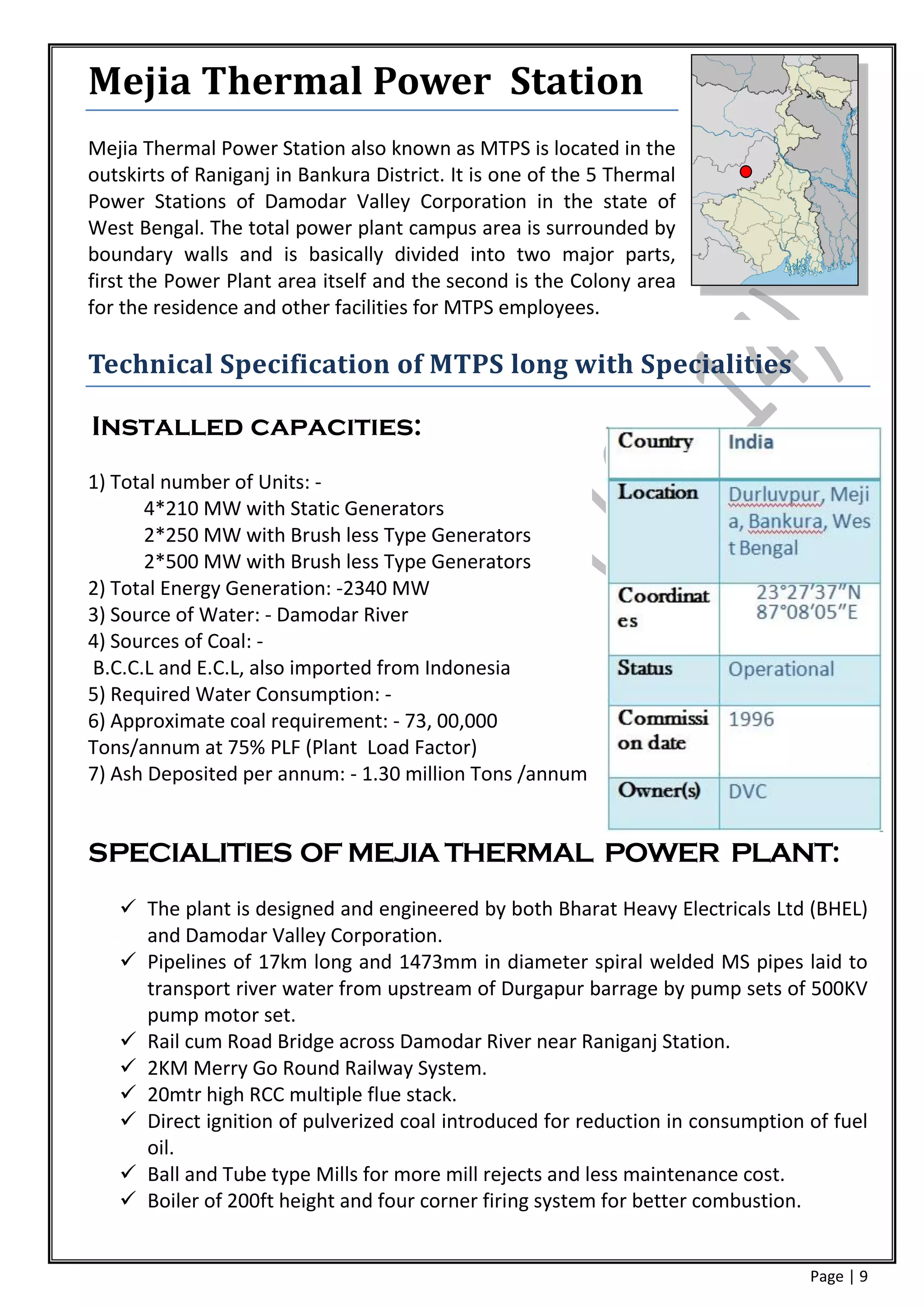
Mejia Thermal Power Station also known as MTPS is located in the
outskirts of Raniganj in Bankura District. It is one of the 5 Thermal
Power Stations of Damodar Valley Corporation in the state of
West Bengal. The total power plant campus area is surrounded by
boundary walls and is basically divided into two major parts,
first the Power Plant area itself and the second is the Colony area
for the residence and other facilities for MTPS employees.

Technical Specification of MTPS long with Specialities

Installed capacities:
1) Total number of Units: -
      4*210 MW with Static Generators
      2*250 MW with Brush less Type Generators
      2*500 MW with Brush less Type Generators
2) Total Energy Generation: -2340 MW
3) Source of Water: - Damodar River
4) Sources of Coal: -
B.C.C.L and E.C.L, also imported from Indonesia
5) Required Water Consumption: -
6) Approximate coal requirement: - 73, 00,000
Tons/annum at 75% PLF (Plant Load Factor)
7) Ash Deposited per annum: - 1.30 million Tons /annum


SPECIALITIES OF MEJIA THERMAL POWER PLANT:
    The plant is designed and engineered by both Bharat Heavy Electricals Ltd (BHEL)
     and Damodar Valley Corporation.
    Pipelines of 17km long and 1473mm in diameter spiral welded MS pipes laid to
     transport river water from upstream of Durgapur barrage by pump sets of 500KV
     pump motor set.
    Rail cum Road Bridge across Damodar River near Raniganj Station.
    2KM Merry Go Round Railway System.
    20mtr high RCC multiple flue stack.
    Direct ignition of pulverized coal introduced for reduction in consumption of fuel
     oil.
    Ball and Tube type Mills for more mill rejects and less maintenance cost.
    Boiler of 200ft height and four corner firing system for better combustion.


                                                                                Page | 9
 All major and hazardous systems like Steam Generation and Turbo Generation
       section are incorporated with FSSS (Furnace Safety Supervisory System) for
       better safety.
      Other logic systems like EAST and ATRS are also incorporated.
      Water treatment Plants along with two artificial water reservoirs and Two
       Demineralization Plants loaded with PLC system.
      Chimney height up to 600fts for less pollution.
      The plant is loaded with latest technology sensor, transducers and transmitters
       for more accurate analyzing of various processes.
      All the units are loaded with intelligent smart microprocessor based systems
       known to be DCS systems provided by KELTRON, SIEMENS and MAX-DNA for
       process control.
      Station Service Transformers of 6.6KV step-down type are also available for
       better distribution of power inside the plant for various requirements.
      Switchyard with individual step-up generator transformers of ONAN/ANOF/AFOF
       cooling Transformers of 220KV for supply to national grid, along with other safety
       instruments.

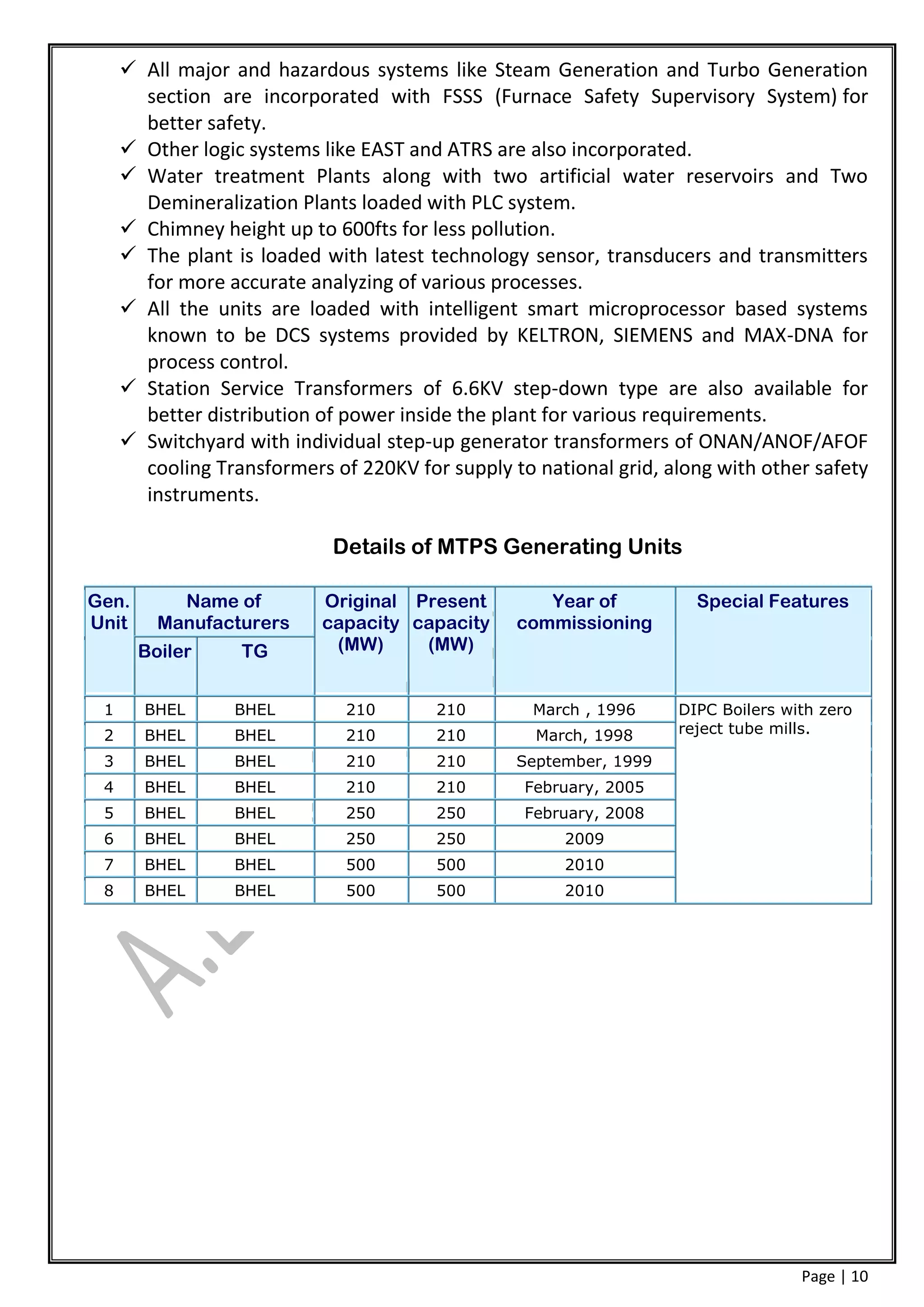
                            Details of MTPS Generating Units

Gen.       Name of         Original Present         Year of          Special Features
Unit     Manufacturers     capacity capacity     commissioning
       Boiler     TG        (MW)     (MW)


 1     BHEL      BHEL         210       210        March , 1996    DIPC Boilers with zero
 2     BHEL      BHEL         210       210        March, 1998     reject tube mills.

 3     BHEL      BHEL         210       210      September, 1999
 4     BHEL      BHEL         210       210       February, 2005
 5     BHEL      BHEL         250       250       February, 2008
 6     BHEL      BHEL         250       250           2009
 7     BHEL      BHEL         500       500           2010
 8     BHEL      BHEL         500       500           2010


                                                                                  Page | 10
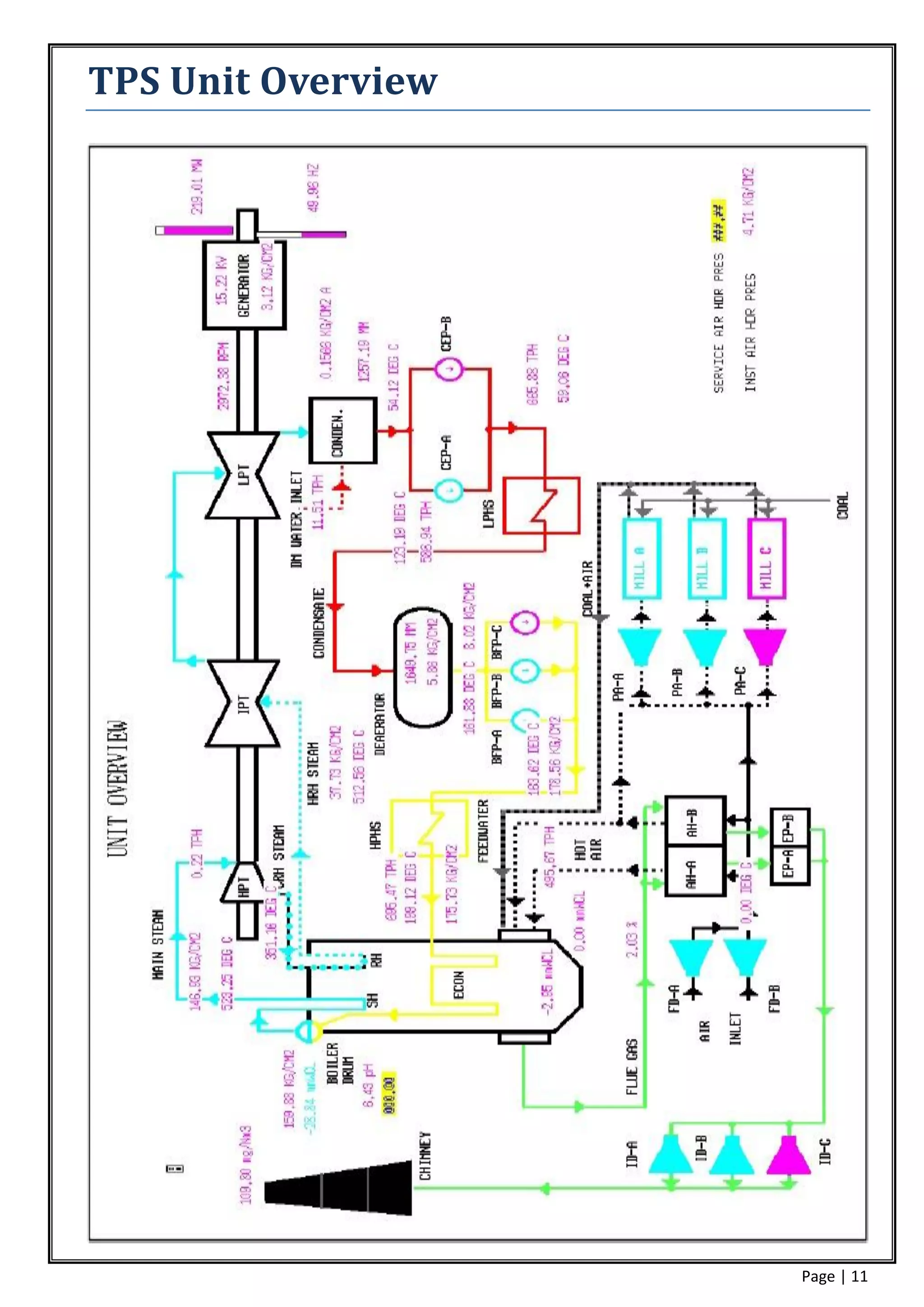
TPS Unit Overview


                    Page | 11
Coal Handling Plant
Coal: The Black Diamond
Coal is the basic and the oldest raw material used on large scale throughout the world.
Throughout history, coal has been a useful resource. It is primarily burned for the
production of electricity and/or heat, and is also used for industrial purposes, such as
refining metals. A fossil fuel, coal forms when dead plant matter is converted into peat,
which in turn is converted into lignite, then sub-bituminous coal, after that bituminous
coal, and lastly anthracite. This involves biological and geological processes that take
place over a long period.

Coal Handling Plant
In a coal based thermal power plant, the initial process in the power generation is “Coal
Handling”. Coal is extracted from the ground by coal mining, either underground by
shaft mining, or at ground level by open pit mining extraction. The huge amount of coal
is usually supplied through railways. A railway siding line is taken into the power station
and the coal is delivered in the storage yard. The coal is unloaded from the point of
delivery by means of wagon tippler. It is rack and pinion type. The coal is taken from the
unloading site to dead storage by belt conveyors. The belt delivers the coal to 0m level
to the pent house and further moves to transfer point 8.

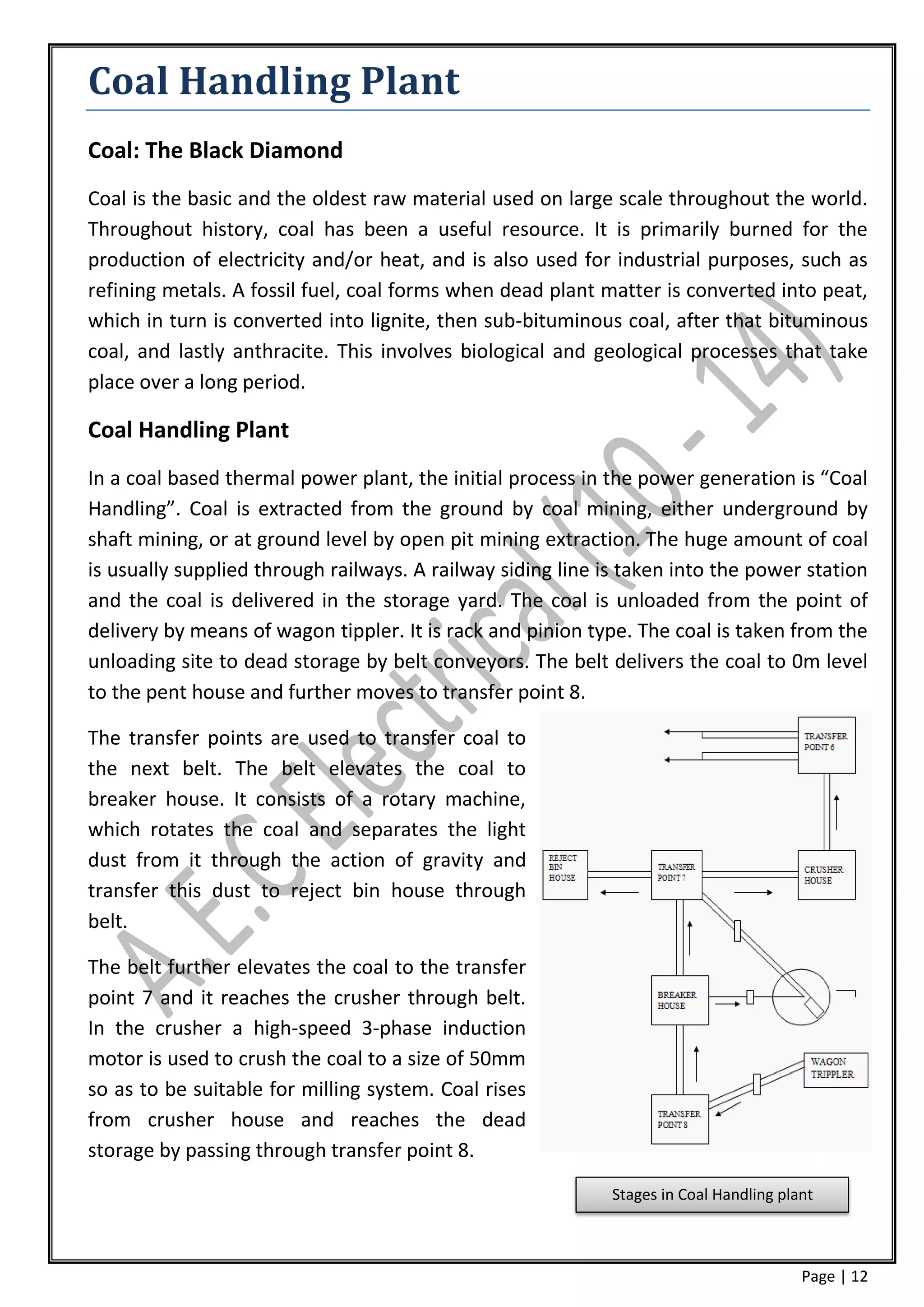
The transfer points are used to transfer coal to
the next belt. The belt elevates the coal to
breaker house. It consists of a rotary machine,
which rotates the coal and separates the light
dust from it through the action of gravity and
transfer this dust to reject bin house through
belt.

The belt further elevates the coal to the transfer
point 7 and it reaches the crusher through belt.
In the crusher a high-speed 3-phase induction
motor is used to crush the coal to a size of 50mm
so as to be suitable for milling system. Coal rises
from crusher house and reaches the dead
storage by passing through transfer point 8.
                                                             Stages in Coal Handling plant


                                                                                        Page | 12
Ultimate Analysis of Coal
Carbon      :     49.63%
Hydrogen    :     3.66%
Sulphur     :     0.47%
Nitrogen    :     0.91%
Oxygen      :     6.4%
Moisture    :     5.0%
Ash         :     34.0%

Total       :     100%


Operation of a Coal Handling Plant

 The purpose of the Coal handling plant in a thermal power plant is to process raw
  coal & insure against their regular supply of coal which is dependent on many
  players in the supply chain.
 The function of a CHP is to receive process, store, and feed the Coal bunkers
  consistently over the entire life of the Power plant.
 Coal is received from mines in the form of lumps, the sizes varying from 100mm to
  350mm, in two types of wagons through Rail; BOBR meaning Bogie Open Bottom
  Rapid discharge & BOXN meaning Bogie Open High Sided Side discharge Wagon
 BOBR wagons are unloaded in Track Hoppers & BOXN Wagons are unloaded by
  Wagon tipplers.
 Coal is then supplied to the crusher house through Roller screens or Vibrating
  feeders to sieve the coal before feeding to the crusher; 20% of the coal that is
  received is already <20mm size so this is separated & only larger lumps are fed to the
  Crusher.
 The crusher breaks the lumps to sizes <20mm which is the input size to the coal
  Pulverisers.
 The crushed coal is fed to the conveyors in the crusher house through Belt feeders;
  Coal is either directly fed to the coal bunkers or to the Stacker/Reclaimers for
  stocking when the bunkers are full.
 The stacking is done to insulate the plant against the erratic supply of coal;
 CERC allows stocking of1½months stock of coal for Pithead plants.
 In case of non-receipt of wagons the coal from the stockpile is reclaimed through the
  Stacker/Reclaimers & fed to the coal Bunkers.


                                                                                Page | 13
 To increase redundancy certain Plants also have Emergency reclaim Hoppers near
  the Crushed coal Stock pile where the dozers are used to feed coal to the bunkers
  when the Reclaimers breakdown.
 Coal is conveyed by means of conveyor Belts in the coal handling plant.

Components of a Coal Handling Plant

1. Stockpile: Stockpiles provide surge capacity to various parts of the CHP. Coal is
   delivered with large variations in production rate of tonnes per hour (tph). A
   stockpile is used to allow the washplant to be fed coal at lower, constant rate.
       A simple stockpile is formed by machinery dumping coal into a pile, either from
   dump trucks, pushed into heaps with bulldozers or from conveyor booms. Taller and
   wider stockpiles reduce the land area required to store a set tonnage of coal. Larger
   coal stockpiles have a reduced rate of heat loss, leading to a higher risk of
   spontaneous combustion.
2. Stack: Travelling, luffing boom stackers that straddle a feed conveyor are commonly
   used to create coal stockpiles.
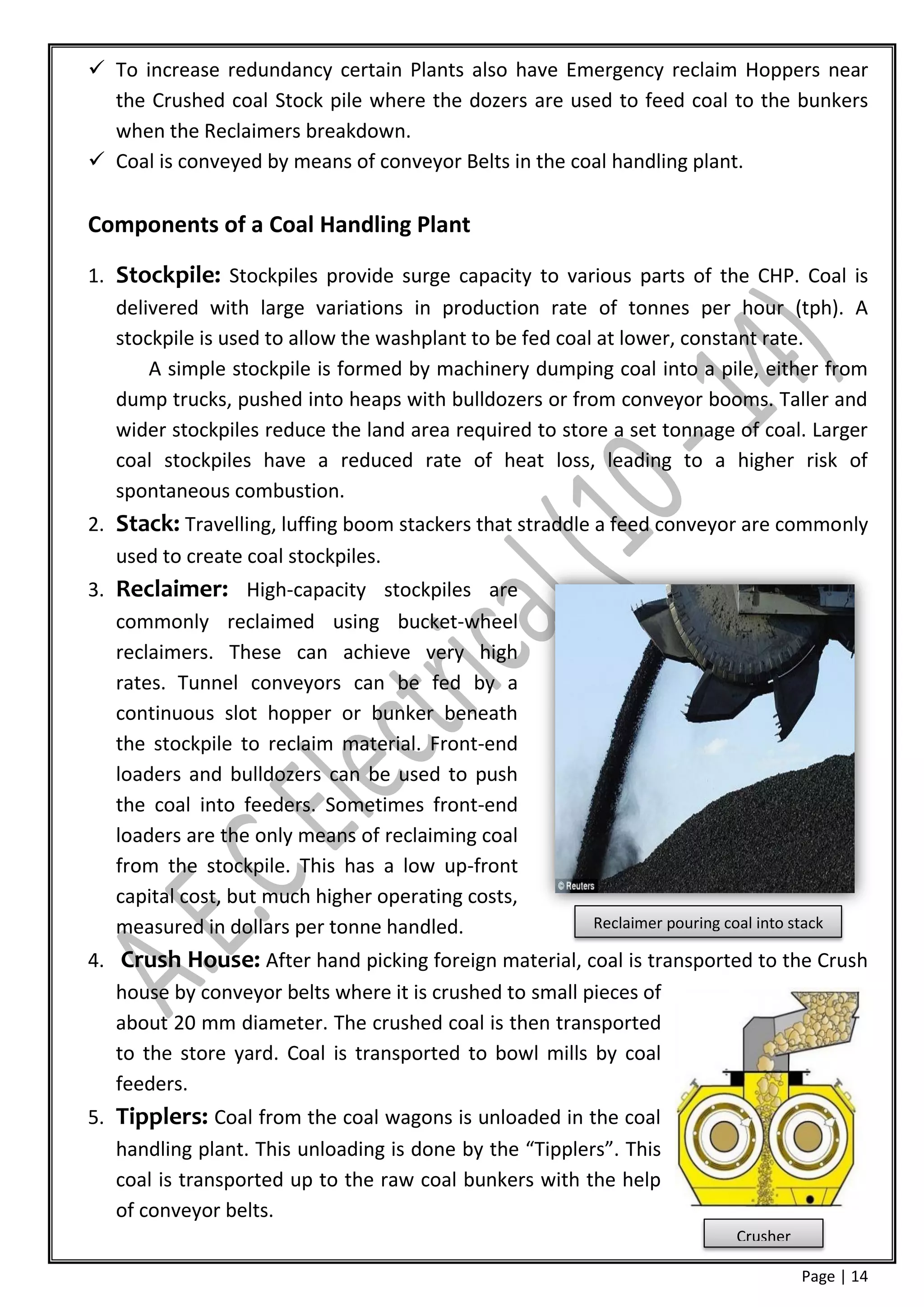
3. Reclaimer: High-capacity stockpiles are
   commonly reclaimed using bucket-wheel
   reclaimers. These can achieve very high
   rates. Tunnel conveyors can be fed by a
   continuous slot hopper or bunker beneath
   the stockpile to reclaim material. Front-end
   loaders and bulldozers can be used to push
   the coal into feeders. Sometimes front-end
   loaders are the only means of reclaiming coal
   from the stockpile. This has a low up-front
   capital cost, but much higher operating costs,
   measured in dollars per tonne handled.                Reclaimer pouring coal into stack

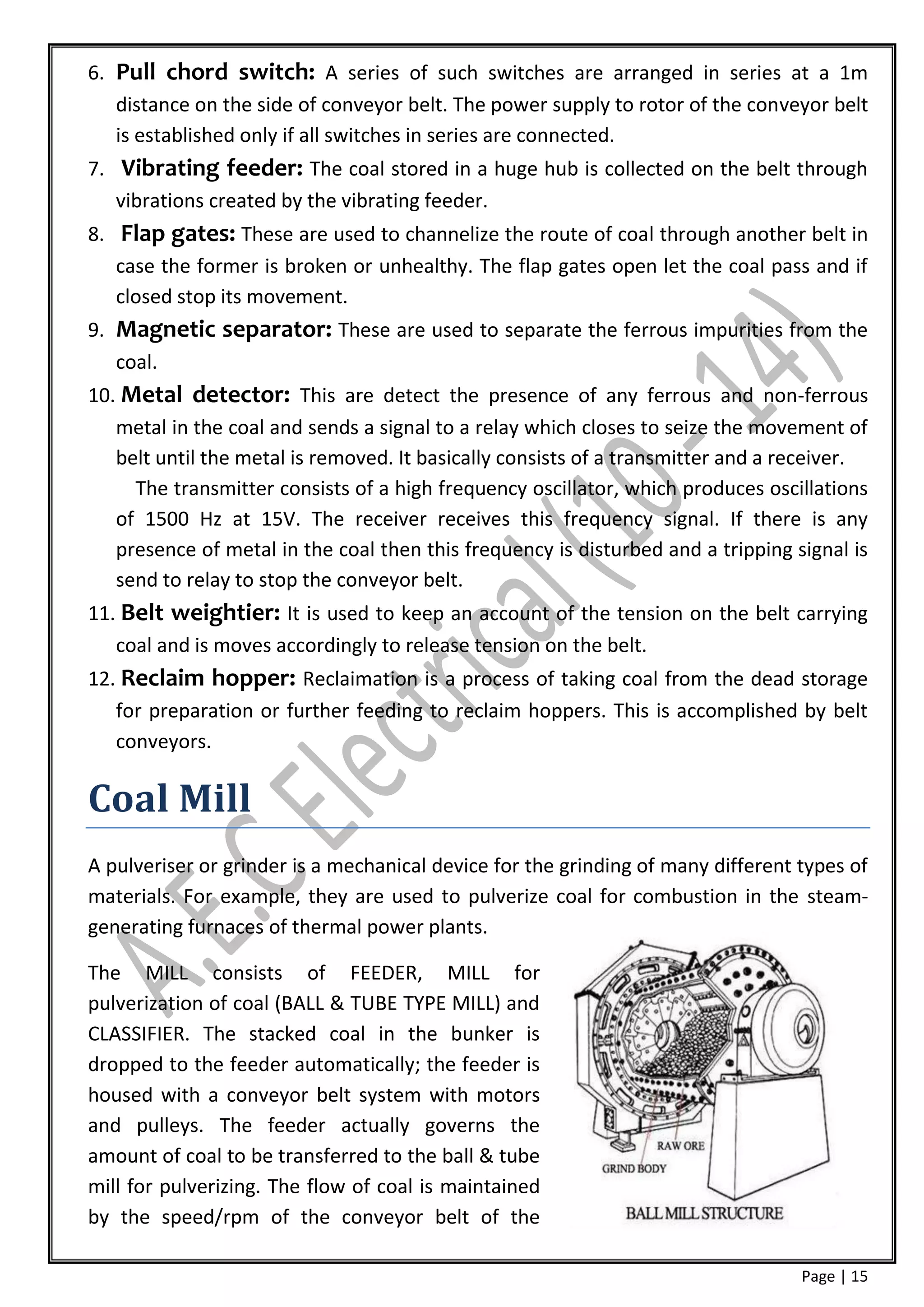
4. Crush House: After hand picking foreign material, coal is transported to the Crush
   house by conveyor belts where it is crushed to small pieces of
   about 20 mm diameter. The crushed coal is then transported
   to the store yard. Coal is transported to bowl mills by coal
   feeders.
5. Tipplers: Coal from the coal wagons is unloaded in the coal
   handling plant. This unloading is done by the “Tipplers”. This
   coal is transported up to the raw coal bunkers with the help
   of conveyor belts.
                                                                             Crusher

                                                                                       Page | 14
6. Pull chord switch: A series of such switches are arranged in series at a 1m
   distance on the side of conveyor belt. The power supply to rotor of the conveyor belt
   is established only if all switches in series are connected.
7. Vibrating feeder: The coal stored in a huge hub is collected on the belt through
   vibrations created by the vibrating feeder.
8. Flap gates: These are used to channelize the route of coal through another belt in
   case the former is broken or unhealthy. The flap gates open let the coal pass and if
   closed stop its movement.
9. Magnetic separator: These are used to separate the ferrous impurities from the
   coal.
10. Metal detector: This are detect the presence of any ferrous and non-ferrous
   metal in the coal and sends a signal to a relay which closes to seize the movement of
   belt until the metal is removed. It basically consists of a transmitter and a receiver.
     The transmitter consists of a high frequency oscillator, which produces oscillations
   of 1500 Hz at 15V. The receiver receives this frequency signal. If there is any
   presence of metal in the coal then this frequency is disturbed and a tripping signal is
   send to relay to stop the conveyor belt.
11. Belt weightier: It is used to keep an account of the tension on the belt carrying
   coal and is moves accordingly to release tension on the belt.
12. Reclaim hopper: Reclaimation is a process of taking coal from the dead storage
   for preparation or further feeding to reclaim hoppers. This is accomplished by belt
   conveyors.

Coal Mill
A pulveriser or grinder is a mechanical device for the grinding of many different types of
materials. For example, they are used to pulverize coal for combustion in the steam-
generating furnaces of thermal power plants.

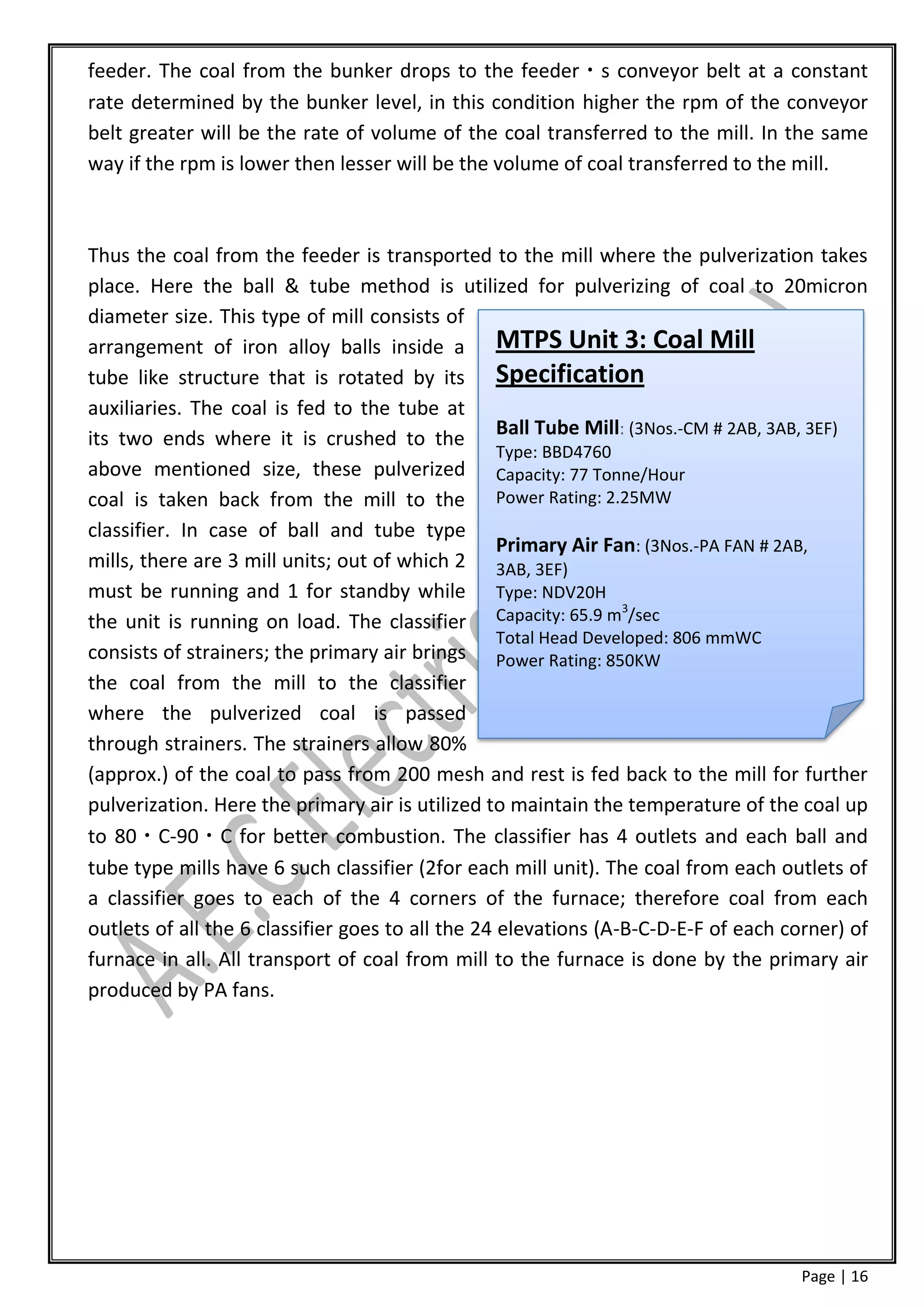
The MILL consists of FEEDER, MILL for
pulverization of coal (BALL & TUBE TYPE MILL) and
CLASSIFIER. The stacked coal in the bunker is
dropped to the feeder automatically; the feeder is
housed with a conveyor belt system with motors
and pulleys. The feeder actually governs the
amount of coal to be transferred to the ball & tube
mill for pulverizing. The flow of coal is maintained
by the speed/rpm of the conveyor belt of the

                                                                                  Page | 15
feeder. The coal from the bunker drops to the feeder s conveyor belt at a constant
rate determined by the bunker level, in this condition higher the rpm of the conveyor
belt greater will be the rate of volume of the coal transferred to the mill. In the same
way if the rpm is lower then lesser will be the volume of coal transferred to the mill.


Thus the coal from the feeder is transported to the mill where the pulverization takes
place. Here the ball & tube method is utilized for pulverizing of coal to 20micron
diameter size. This type of mill consists of
arrangement of iron alloy balls inside a MTPS Unit 3: Coal Mill
tube like structure that is rotated by its Specification
auxiliaries. The coal is fed to the tube at
its two ends where it is crushed to the Ball Tube Mill: (3Nos.-CM # 2AB, 3AB, 3EF)
                                                   Type: BBD4760
above mentioned size, these pulverized Capacity: 77 Tonne/Hour
coal is taken back from the mill to the Power Rating: 2.25MW
classifier. In case of ball and tube type
                                                   Primary Air Fan: (3Nos.-PA FAN # 2AB,
mills, there are 3 mill units; out of which 2 3AB, 3EF)
must be running and 1 for standby while Type: NDV20H
                                                                  3
the unit is running on load. The classifier Capacity: 65.9 m /sec
                                                   Total Head Developed: 806 mmWC
consists of strainers; the primary air brings Power Rating: 850KW
the coal from the mill to the classifier
where the pulverized coal is passed
through strainers. The strainers allow 80%
(approx.) of the coal to pass from 200 mesh and rest is fed back to the mill for further
pulverization. Here the primary air is utilized to maintain the temperature of the coal up
to 80 C-90 C for better combustion. The classifier has 4 outlets and each ball and
tube type mills have 6 such classifier (2for each mill unit). The coal from each outlets of
a classifier goes to each of the 4 corners of the furnace; therefore coal from each
outlets of all the 6 classifier goes to all the 24 elevations (A-B-C-D-E-F of each corner) of
furnace in all. All transport of coal from mill to the furnace is done by the primary air
produced by PA fans.


                                                                                     Page | 16
Furnace and Boiler
 What is Boiler?
A boiler is a closed vessel in which water or other fluid is heated. The heated or
vaporized fluid exits the boiler for use in various processes or heating
applications, including boiler-based power generation, cooking, and sanitation.
Here in MTPS, the boiler is a rectangular furnace about 50 feet (15 m) on a side and 130
feet (40 m) tall. Its walls are made of a web of high pressure steel tubes about 2.3
inches (58 mm) in diameter.

Types of Boiler:

Fire Tube Boiler:
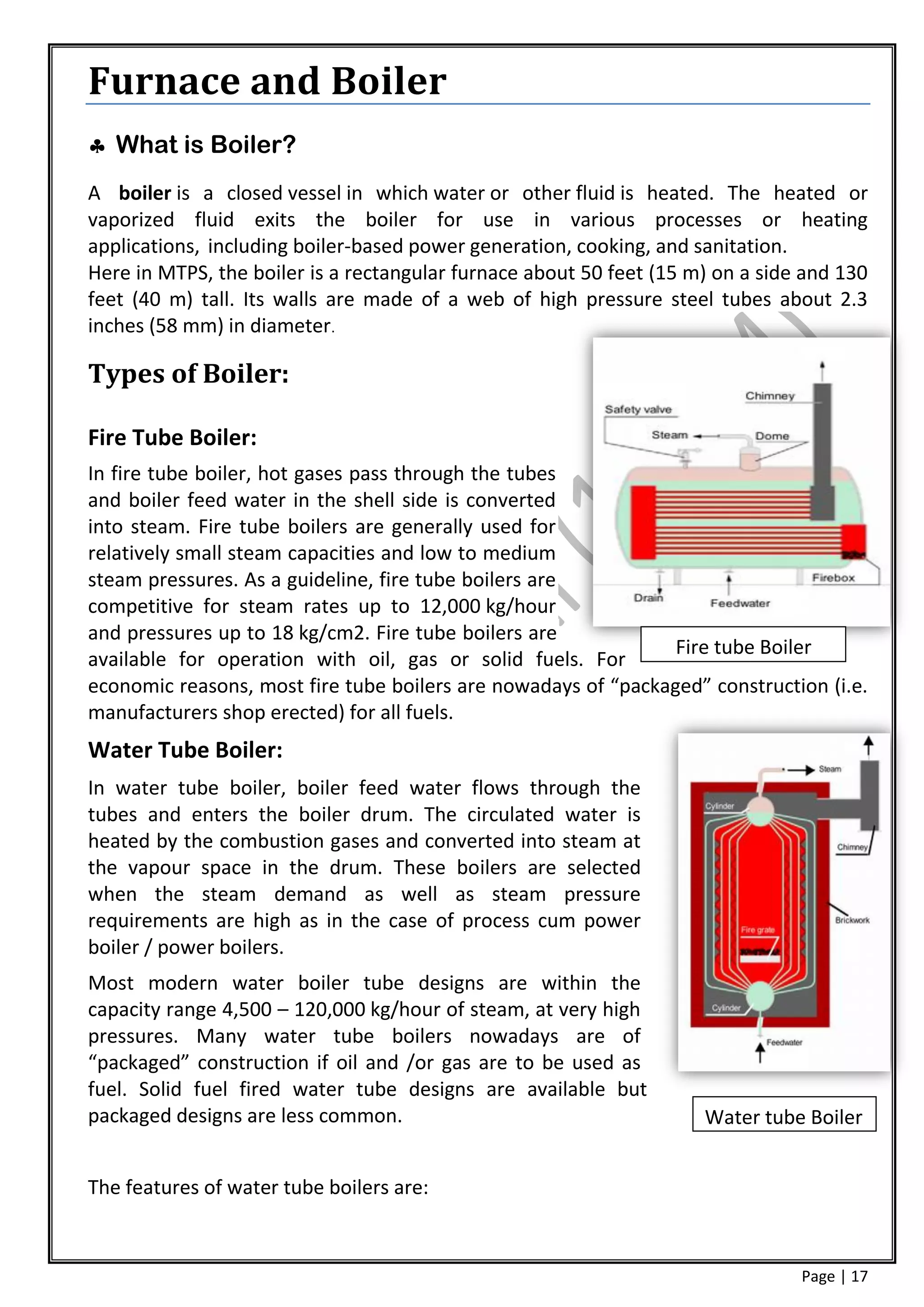
In fire tube boiler, hot gases pass through the tubes
and boiler feed water in the shell side is converted
into steam. Fire tube boilers are generally used for
relatively small steam capacities and low to medium
steam pressures. As a guideline, fire tube boilers are
competitive for steam rates up to 12,000 kg/hour
and pressures up to 18 kg/cm2. Fire tube boilers are
                                                                Fire tube Boiler
available for operation with oil, gas or solid fuels. For
economic reasons, most fire tube boilers are nowadays of “packaged” construction (i.e.
manufacturers shop erected) for all fuels.
Water Tube Boiler:
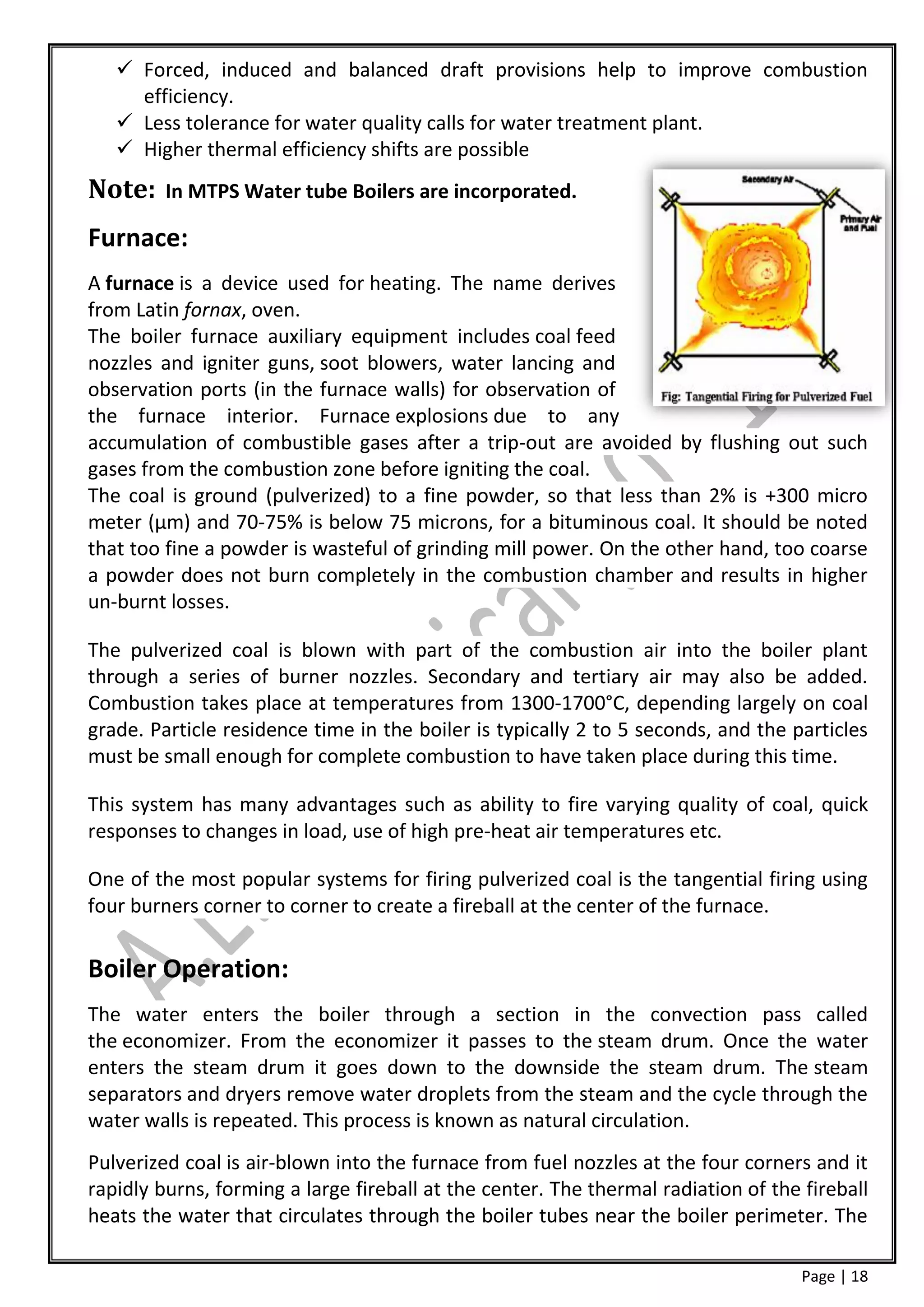
In water tube boiler, boiler feed water flows through the
tubes and enters the boiler drum. The circulated water is
heated by the combustion gases and converted into steam at
the vapour space in the drum. These boilers are selected
when the steam demand as well as steam pressure
requirements are high as in the case of process cum power
boiler / power boilers.
Most modern water boiler tube designs are within the
capacity range 4,500 – 120,000 kg/hour of steam, at very high
pressures. Many water tube boilers nowadays are of
“packaged” construction if oil and /or gas are to be used as
fuel. Solid fuel fired water tube designs are available but
packaged designs are less common.                                    Water tube Boiler


The features of water tube boilers are:


                                                                                Page | 17
 Forced, induced and balanced draft provisions help to improve combustion
     efficiency.
    Less tolerance for water quality calls for water treatment plant.
    Higher thermal efficiency shifts are possible
Note:    In MTPS Water tube Boilers are incorporated.

Furnace:
A furnace is a device used for heating. The name derives
from Latin fornax, oven.
The boiler furnace auxiliary equipment includes coal feed
nozzles and igniter guns, soot blowers, water lancing and
observation ports (in the furnace walls) for observation of
the furnace interior. Furnace explosions due to any
accumulation of combustible gases after a trip-out are avoided by flushing out such
gases from the combustion zone before igniting the coal.
The coal is ground (pulverized) to a fine powder, so that less than 2% is +300 micro
meter (μm) and 70-75% is below 75 microns, for a bituminous coal. It should be noted
that too fine a powder is wasteful of grinding mill power. On the other hand, too coarse
a powder does not burn completely in the combustion chamber and results in higher
un-burnt losses.

The pulverized coal is blown with part of the combustion air into the boiler plant
through a series of burner nozzles. Secondary and tertiary air may also be added.
Combustion takes place at temperatures from 1300-1700°C, depending largely on coal
grade. Particle residence time in the boiler is typically 2 to 5 seconds, and the particles
must be small enough for complete combustion to have taken place during this time.

This system has many advantages such as ability to fire varying quality of coal, quick
responses to changes in load, use of high pre-heat air temperatures etc.

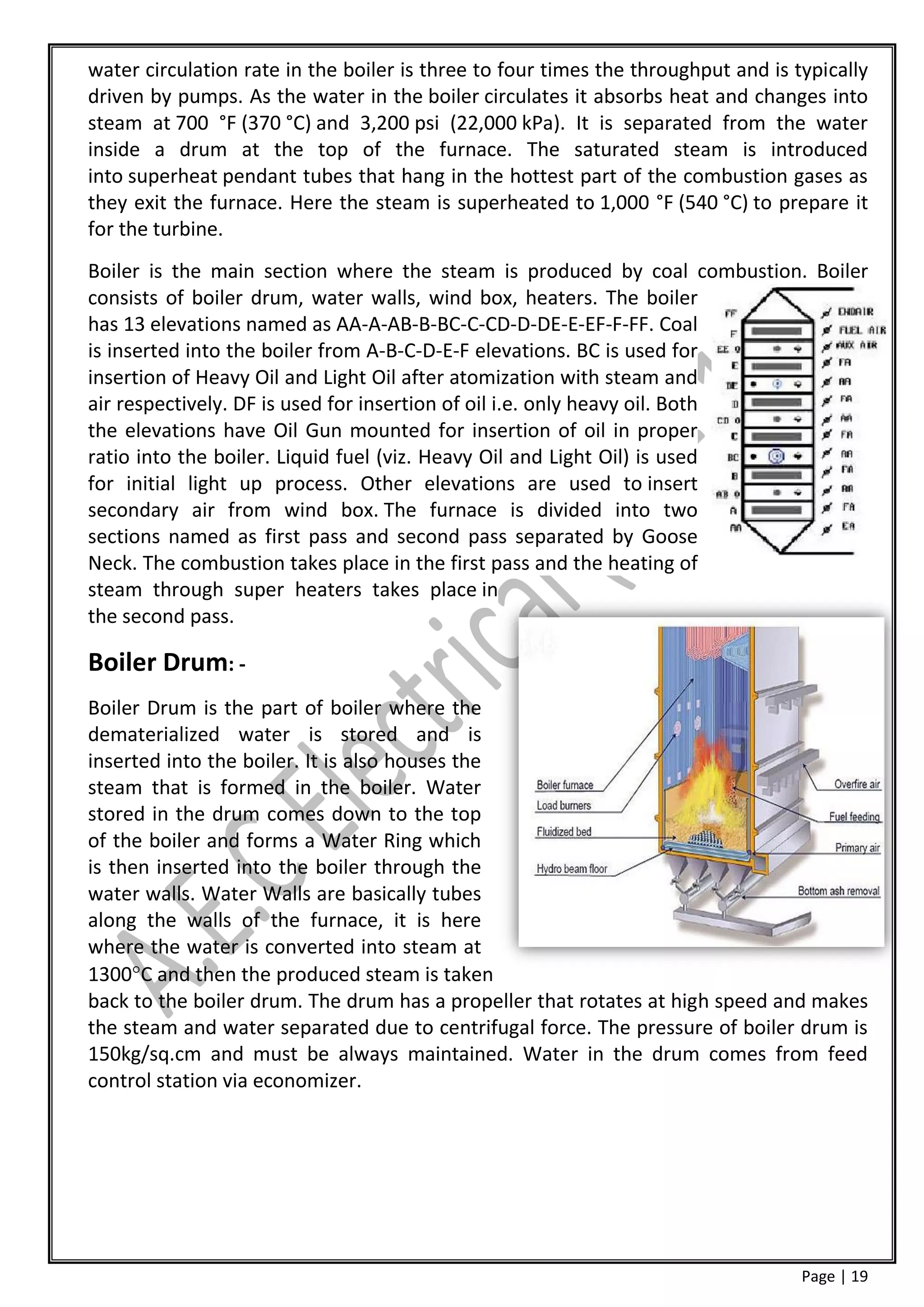
One of the most popular systems for firing pulverized coal is the tangential firing using
four burners corner to corner to create a fireball at the center of the furnace.

Boiler Operation:
The water enters the boiler through a section in the convection pass called
the economizer. From the economizer it passes to the steam drum. Once the water
enters the steam drum it goes down to the downside the steam drum. The steam
separators and dryers remove water droplets from the steam and the cycle through the
water walls is repeated. This process is known as natural circulation.
Pulverized coal is air-blown into the furnace from fuel nozzles at the four corners and it
rapidly burns, forming a large fireball at the center. The thermal radiation of the fireball
heats the water that circulates through the boiler tubes near the boiler perimeter. The

                                                                                    Page | 18
water circulation rate in the boiler is three to four times the throughput and is typically
driven by pumps. As the water in the boiler circulates it absorbs heat and changes into
steam at 700 °F (370 °C) and 3,200 psi (22,000 kPa). It is separated from the water
inside a drum at the top of the furnace. The saturated steam is introduced
into superheat pendant tubes that hang in the hottest part of the combustion gases as
they exit the furnace. Here the steam is superheated to 1,000 °F (540 °C) to prepare it
for the turbine.
Boiler is the main section where the steam is produced by coal combustion. Boiler
consists of boiler drum, water walls, wind box, heaters. The boiler
has 13 elevations named as AA-A-AB-B-BC-C-CD-D-DE-E-EF-F-FF. Coal
is inserted into the boiler from A-B-C-D-E-F elevations. BC is used for
insertion of Heavy Oil and Light Oil after atomization with steam and
air respectively. DF is used for insertion of oil i.e. only heavy oil. Both
the elevations have Oil Gun mounted for insertion of oil in proper
ratio into the boiler. Liquid fuel (viz. Heavy Oil and Light Oil) is used
for initial light up process. Other elevations are used to insert
secondary air from wind box. The furnace is divided into two
sections named as first pass and second pass separated by Goose
Neck. The combustion takes place in the first pass and the heating of
steam through super heaters takes place in
the second pass.

Boiler Drum: -
Boiler Drum is the part of boiler where the
dematerialized water is stored and is
inserted into the boiler. It is also houses the
steam that is formed in the boiler. Water
stored in the drum comes down to the top
of the boiler and forms a Water Ring which
is then inserted into the boiler through the
water walls. Water Walls are basically tubes
along the walls of the furnace, it is here
where the water is converted into steam at
1300C and then the produced steam is taken
back to the boiler drum. The drum has a propeller that rotates at high speed and makes
the steam and water separated due to centrifugal force. The pressure of boiler drum is
150kg/sq.cm and must be always maintained. Water in the drum comes from feed
control station via economizer.


                                                                                   Page | 19
Steam Turbine


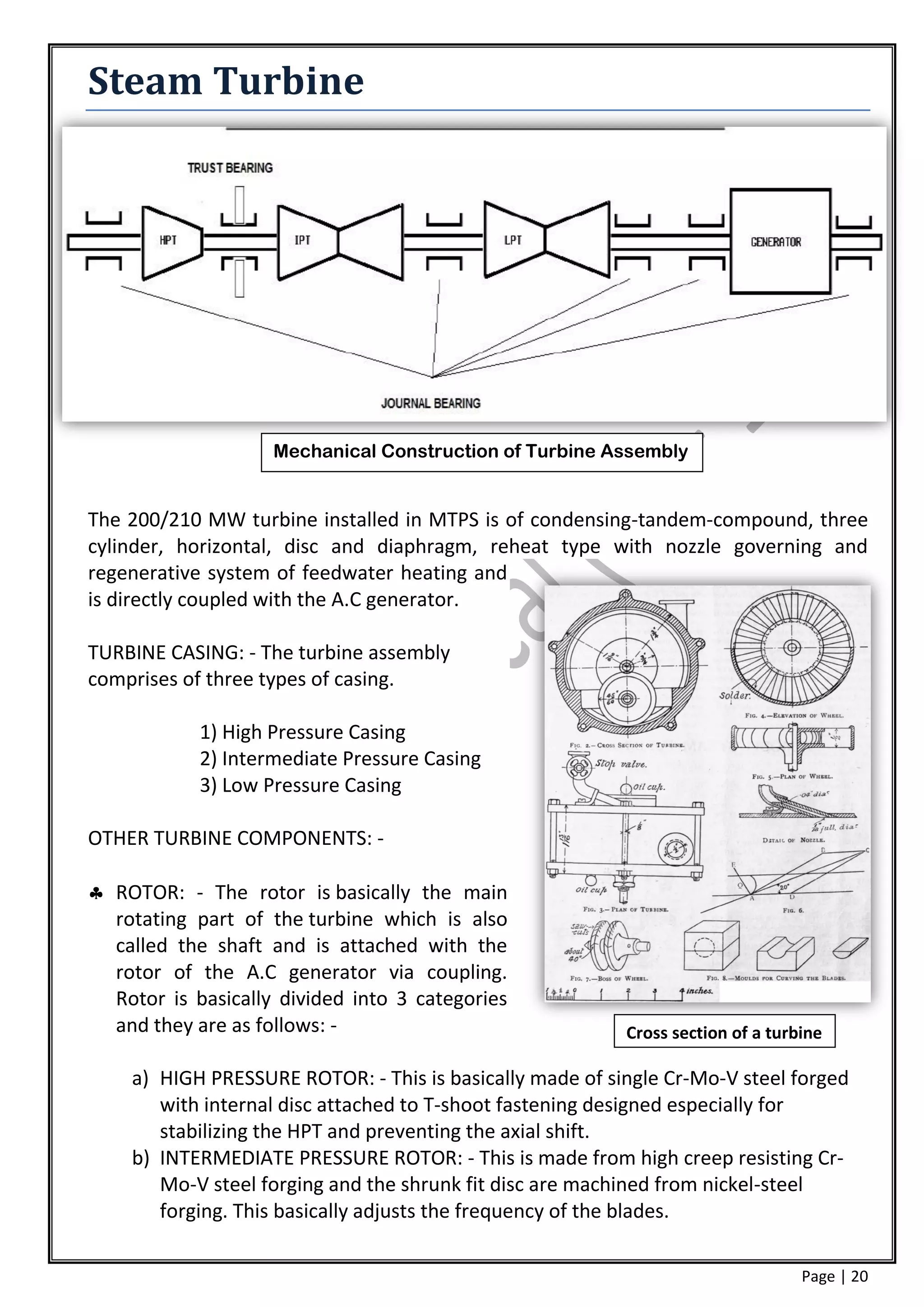
                    Mechanical Construction of Turbine Assembly


The 200/210 MW turbine installed in MTPS is of condensing-tandem-compound, three
cylinder, horizontal, disc and diaphragm, reheat type with nozzle governing and
regenerative system of feedwater heating and
is directly coupled with the A.C generator.

TURBINE CASING: - The turbine assembly
comprises of three types of casing.

            1) High Pressure Casing
            2) Intermediate Pressure Casing
            3) Low Pressure Casing

OTHER TURBINE COMPONENTS: -

 ROTOR: - The rotor is basically the main
  rotating part of the turbine which is also
  called the shaft and is attached with the
  rotor of the A.C generator via coupling.
  Rotor is basically divided into 3 categories
  and they are as follows: -                              Cross section of a turbine

    a) HIGH PRESSURE ROTOR: - This is basically made of single Cr-Mo-V steel forged
       with internal disc attached to T-shoot fastening designed especially for
       stabilizing the HPT and preventing the axial shift.
    b) INTERMEDIATE PRESSURE ROTOR: - This is made from high creep resisting Cr-
       Mo-V steel forging and the shrunk fit disc are machined from nickel-steel
       forging. This basically adjusts the frequency of the blades.

                                                                                 Page | 20
c) LOW PRESSURE ROTOR: - This is made from the above mention alloy used in
       IP Rotors; blades are secured to the respective disc by riveted fork root
       fastening. Wires are provided in all stages of this to adjust the frequency of the
       blades.
 BLADES: - Blades are single most costly element fitted in the turbine. Blades fitted in
  the stationary part are called guide blades and those fitted in the rotor are called
  moving or working blades. Blades are of basically three types, they are as follows: -

         a) Cylindrical ( constant profile) blade
         b) Tapered cylindrical blade
         c) Twisted and varying profile blade.

 SEALING GLANDS: - To eliminate the possibility of steam leakage to the atmosphere
  from the inlet and the exhaust end of the cylinder, labyrinth glands of the radial
  clearance type are provided which provide a trouble free frictionless sealing
  .
 EMERGENCY STOP VALVES AND CONTROL VALVES: - Turbine is equipped with
  emergency stop valves to cut off steam supply and with control valve regulate steam
  supply. Emergency stop valves are provided in main stream line and control valves
  are provided in the hot reheat line.

 COUPLING: - Since the rotor is made in small parts due to forging limitations and
  other technological and economic reasons, the couplings are required between any
  two rotors. The coupling permits angular misalignment, transmits axial thrust and
  ensures axial location.

 BEARING: - Journal bearing are manufactured in two halves and usually consist of
  bearing body faced with anti-friction tin based habiting to decrease coefficient of
  friction. Bearings are usually force lubricated and have provision for admission of
  jacking oil.
      Thrust bearing is normally Mitchell type and is usually combined with a journal
      bearing, housed in spherically machined steel shell. The bearing between HP
      and IP rotor is of this type. The rest is of journal type.

 BARRING GEAR: - The barring gear is mounted on the L.P rear bearing cover to mesh
  with spur gear L.P rotor rear coupling. The primary function of the barring gear is to
  rotate the rotor of the turbo generator slowly and continuously during the start-up
  and shut sown process when the temperature of the rotor changes.

 TURBINE LUBRICATION OIL SYSTEM: - The LUB-OIL system of turbine comprises of
  following category.

     a) MAIN OIL PUMP: - It is mounted on the front bearing pedestal and coupled
        through gear coupling to the rotor. When the turbine is running at its normal

                                                                                  Page | 21
speed of 3000rpmthen the oil to the governing system (at 20 kg/sq.cm) and to
          the lubrication system (at 1 kg/sq.cm) is supplied by this pump.

      b) STARTING OIL PUMP: - It is a multi-staged centrifugal oil pump driven by A.C
         powered electric motor. It provides the oil requirement for starting up and
         stopping of the turbine. It provides oil to the governing system and to the
         lubrication system until the turbine is running at speed lower than 2800rpm.

      c) STANDBY OIL PUMP: - This is a centrifugal pump driven by A.C motor. It runs for
         initial10 minutes at the starting to remove air from the governing system and
         fill up oil to it.

      d) EMERGENCY OIL PUMP: - This is a centrifugal pump driven by D.C motor. This
         pump is foreseen as a backup oil pump to A.C oil pumps. This pump
         automatically cuts in when the A.C power fails in the power station.

      e) JACKING OIL PUMP: - This pump enables the complete rotor assembly to be raised
         upor to be floated in the bearing assembly during the start-up and shut down
         process of the process. Thus this prevents the damage to the bearings when the
         shaft is too low for hydrodynamic lubrication to take place. JOP sucks and
         delivers oil to the journal bearings at 120kg/sq.cm for lifting of the rotor.

      f) OIL COOLERS: - The oil of governing and lubrication system is cooled in the oil
         coolers by the circulating water. There are five such coolers, 4 are for
         continuous operation and 1for standby.


                                                   Specification of Turbine
                                                   (LPT)
U #1 to U #4

Mega Watt                 :     210
R.P.M.                    :     3000
Steam Pressure            :     150 Kg/cm2 (Abs)
Steam Temperature         :     535 C
Reheat Steam              :     535 C
Make                      :     BHEL

U #5 & U #6

Mega Watt                 :     250
R.P.M.                    :     3000
Steam Pressure            :     150 Kg/cm2 (Abs)
Steam Temperature         :     537 C
Reheat Steam              :     537 C
Make                      :     BHEL

                                                                                    Page | 22
Introduction of Water Treatment in Thermal
Power Plants
In Thermal power plants, plenty of water is needed for generation of electricity.
Now question is for what purpose we need water here?

There are two purposes:
1. As a Working Fluid
2. As Cooling water

Water which is used as a working fluid needs some treatment.
Reasons to choose Water as a Working Fluid:

      • It is only common substance available & exists in 3 states (Ice, water, steam)at
      normal temperature.
      • Having high specific heat mean heat carrying capacity is high.
      • Having low specific volume than air.
      • Low Cost
      • High Availability
      • Non-reactive

But water is universal solvent; it dissolves many gases, salts, metals etc. so no source of
water is pure.
Water contamination depends upon source of water.

There are 3 sources of water mainly;
1. Surface Water
2. Ground Water
3. Recycled Water

Impurities in Water

Impurities present in water are grouped into 4 categories:
 1) Suspended Matter –
 • Mean any matter floating or suspended nature in water
 • Microorganisms
 • Grits

2) Dissolved Salts –
• Ca, Mg, K, Chlorates, Sulphates, Silicates etc.
3) Dissolved Gases –
• Oxygen, Carbon di oxide, Ammonia etc.


                                                                                    Page | 23
4) Silica
A 210 MW unit typically requires 30,000 to 33,000 m3/h of water. A large part of this
water is used for condenser cooling and a small quantity is used for boiler feed makeup
and other uses.

Total Water Management in Mejia Thermal Power station consists of:
1. Pre Treatment of Water
2. Treatment of water for boiler feed
3. Treatment of water for condenser cooling
4. Treatment of wastewater for disposal or recovery of water for reuse.

1. Pre Treatment of Water:

  Aerator: Aerators are various devices used for aeration, or mixing air with another
   substance, like water. It also converts turbulent water flow into laminar water flow.
  Coagulation & Flocculation Basin: One of the first steps in a conventional water
   purification process is the addition of chemicals to assist in the removal of particles
   suspended in water. Particles can be inorganic such as clay and silt or organic such
   as algae, bacteria, viruses, protozoa and natural organic matter. Inorganic and
   organic particles contribute to the turbidity and colour of water.
   The addition of inorganic coagulants such as aluminium sulphate (or alum) or iron
   (III) salts such as iron(III) chloride cause several simultaneous chemical and physical
   interactions on and among the particles. Within seconds, negative charges on the
   particles are neutralized by inorganic coagulants. Also within seconds, metal
   hydroxide precipitates of the aluminium and iron (III) ions begin to form. These
   precipitates combine into larger particles under natural processes such as Brownian
   motion and through induced mixing which is sometimes referred to as flocculation.
   The term most often used for the amorphous metal hydroxides is “floc.” Large,
   amorphous aluminium and iron (III) hydroxides adsorb and enmesh particles in
   suspension and facilitate the removal of particles by subsequent processes of
   sedimentation and filtration.
  Clarifiers: Waters exiting the flocculation basin may enter the sedimentation basin,
   also called a clarifier or settling basin. It is a large tank with low water velocities,
   allowing floc to settle to the bottom. The sedimentation basin is best located close
   to the flocculation basin so the transit between the two processes does not permit
   settlement or floc break up. Sedimentation basins may be rectangular, where water
   flows from end to end or circular where flow is from the centre outward.
   Sedimentation basin outflow is typically over a weir so only a thin top layer of
   water—that furthest from the sludge—exits.
  Gravitation Filter: The most common type of filter is a rapid sand filter(gravity
   filter). Water moves vertically through sand which often has a layer of activated
   carbon or anthracite coal above the sand. The top layer removes organic
   compounds, which contribute to taste and odour. The space between sand
   particles is larger than the smallest suspended particles, so simple filtration is not

                                                                                   Page | 24
enough. Most particles pass through surface layers but are trapped in pore spaces
    or adhere to sand particles.
    To clean the filter, water is passed quickly upward through the filter, opposite the
    normal direction (called back flushing or backwashing) to remove embedded
    particles.

2. Treatment of water for boiler feed:
   Boiler feed water treatment for high pressure boilers are almost standard. Raw
water is clarified and filtered for removal of un-dissolved impurities and demineralised
for removal of dissolved salts. Dissolved oxygen is removed in a thermal de-aerator.
Residual dissolved oxygen is removed by hydrazine.
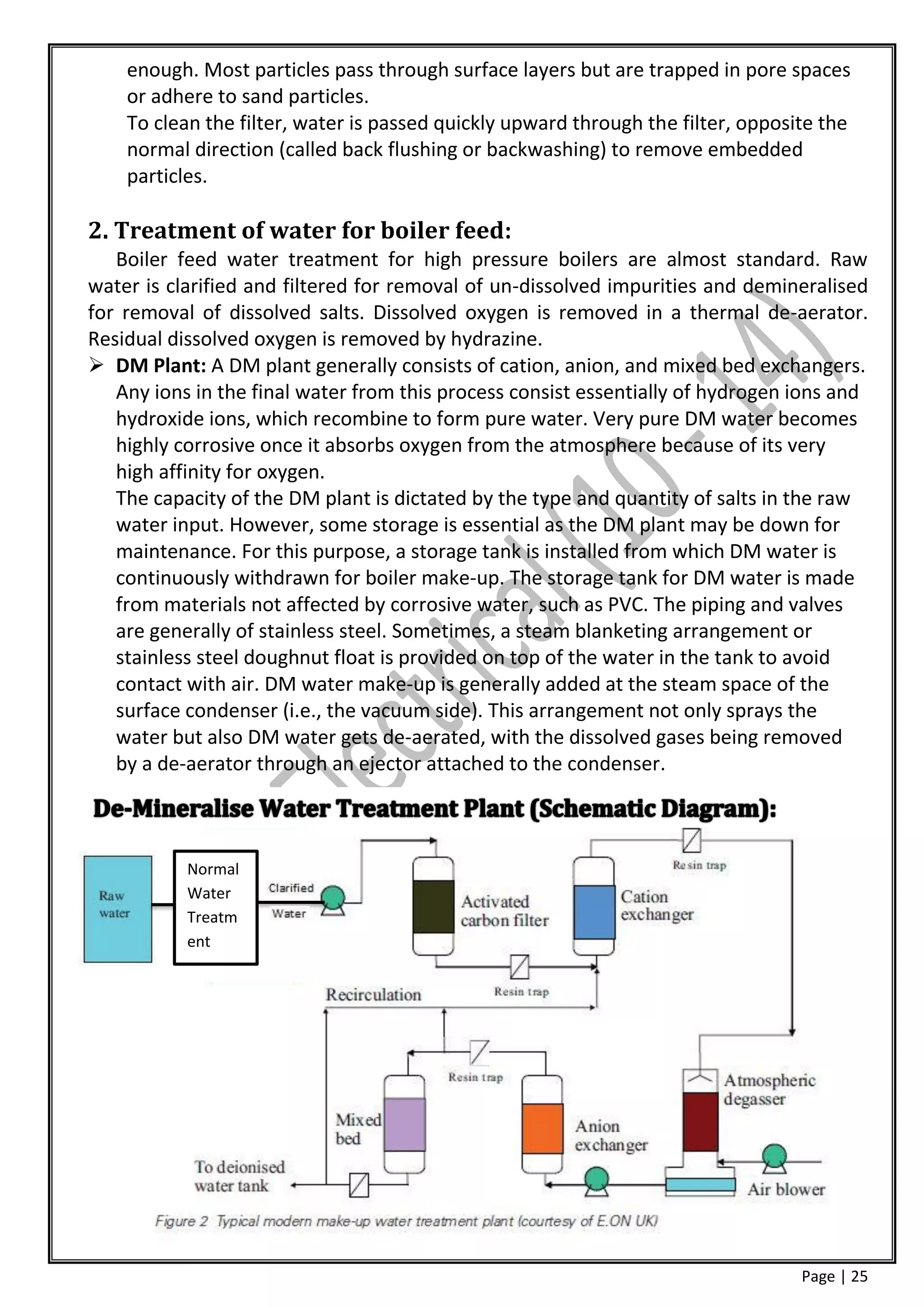
 DM Plant: A DM plant generally consists of cation, anion, and mixed bed exchangers.
   Any ions in the final water from this process consist essentially of hydrogen ions and
   hydroxide ions, which recombine to form pure water. Very pure DM water becomes
   highly corrosive once it absorbs oxygen from the atmosphere because of its very
   high affinity for oxygen.
   The capacity of the DM plant is dictated by the type and quantity of salts in the raw
   water input. However, some storage is essential as the DM plant may be down for
   maintenance. For this purpose, a storage tank is installed from which DM water is
   continuously withdrawn for boiler make-up. The storage tank for DM water is made
   from materials not affected by corrosive water, such as PVC. The piping and valves
   are generally of stainless steel. Sometimes, a steam blanketing arrangement or
   stainless steel doughnut float is provided on top of the water in the tank to avoid
   contact with air. DM water make-up is generally added at the steam space of the
   surface condenser (i.e., the vacuum side). This arrangement not only sprays the
   water but also DM water gets de-aerated, with the dissolved gases being removed
   by a de-aerator through an ejector attached to the condenser.


           Normal
           Water
           Treatm
           ent


                                                                                  Page | 25
 Presence of silica in boiler feed water is harmful as silica tends to volatilize along
  with steam and get deposited as glassy and hard deposits on the turbine blades. It
  has been established that concentrations of silica in excess of 0.03 mg/l invariably
  causes problems in turbine operation. Suitable lower silica level should be
  maintained boiler water to maintain silica less than 0.02 mg/l in steam leaving the
  drum.

 Silica in water is present mostly as reactive or dissolved silica. In surface waters, a
  small quantity of non-reactive silica (in colloidal dimensions) may also be present
  during parts of the year especially during the monsoon. A DM plant removes reactive
  silica almost completely, to less than 0.005 mg/l. However, non-reactive silica is not
  removed and finds its way into the boiler drum where it gets converted into reactive
  silica under the operating conditions of high pressure and temperature. The station
  chemists usually overcome this problem by having increased blow-downs during
  these periods.

   3. Treatment off wastewater and its disposal or recovery and
      reuse off water:

   Water is a scarce resource and Thermal Power stations are today being compelled to
minimise consumption of water to the extent possible. It is possible to recover and
reuse water from most of the waste streams generated in a thermal power station. The
main waste streams are:

   · Gravity filter backwash water
   · Wastewater generated from the DM plant
   · Ash pond overflows water
   · Boiler blow down and turbine drains.
   · Recovery of water from treated sewage


                                                                                   Page | 26
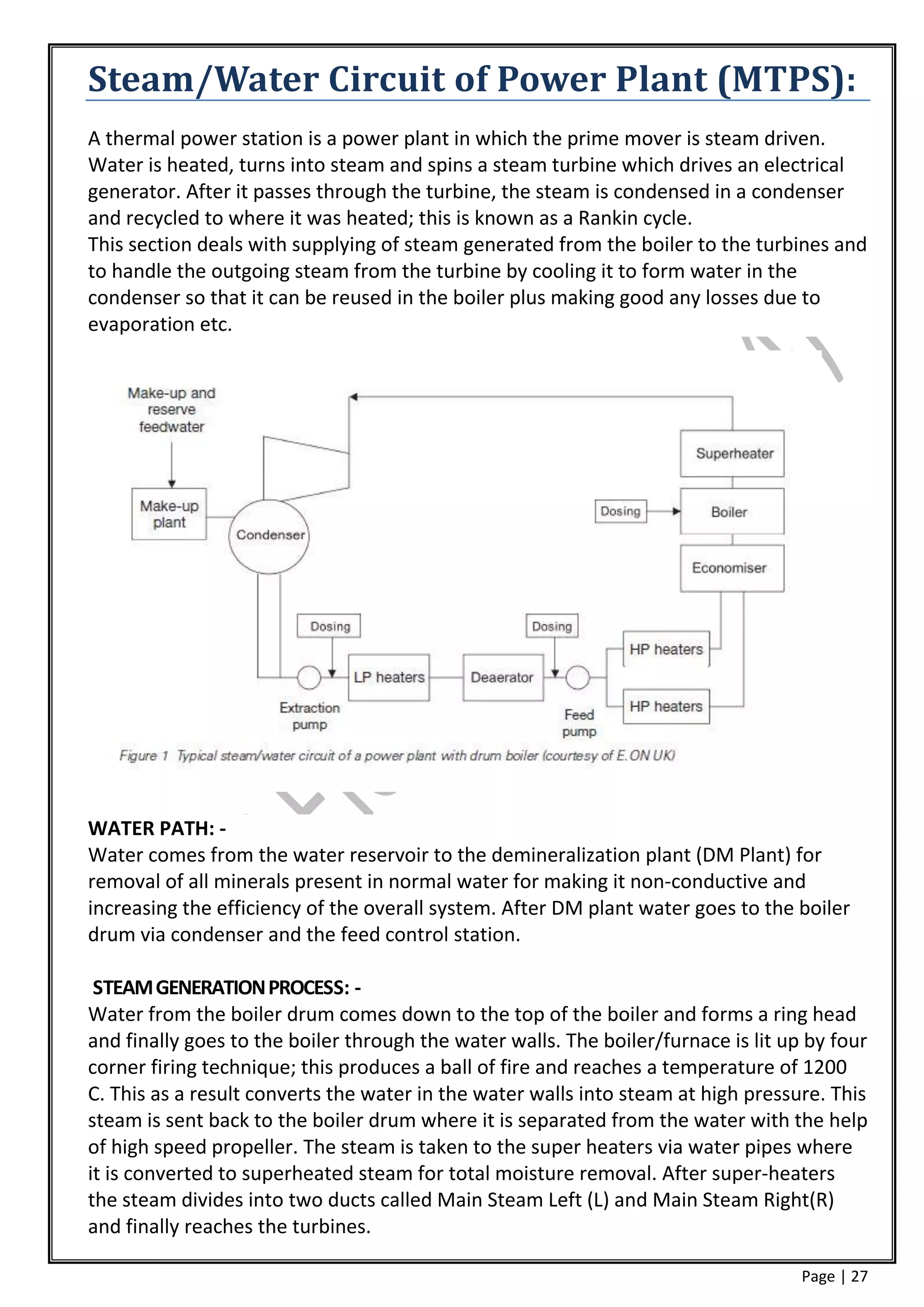
Steam/Water Circuit of Power Plant (MTPS):
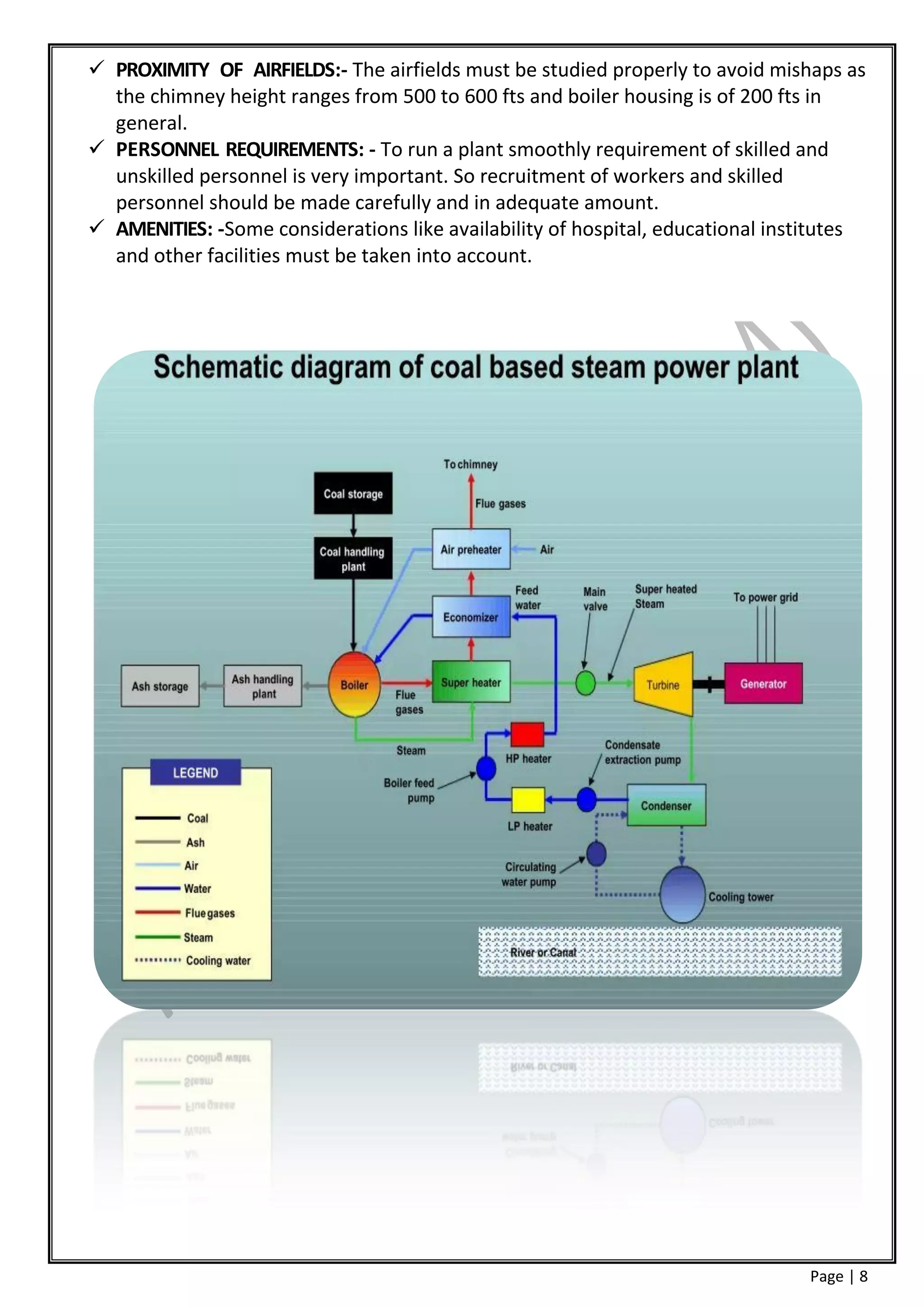
A thermal power station is a power plant in which the prime mover is steam driven.
Water is heated, turns into steam and spins a steam turbine which drives an electrical
generator. After it passes through the turbine, the steam is condensed in a condenser
and recycled to where it was heated; this is known as a Rankin cycle.
This section deals with supplying of steam generated from the boiler to the turbines and
to handle the outgoing steam from the turbine by cooling it to form water in the
condenser so that it can be reused in the boiler plus making good any losses due to
evaporation etc.


WATER PATH: -
Water comes from the water reservoir to the demineralization plant (DM Plant) for
removal of all minerals present in normal water for making it non-conductive and
increasing the efficiency of the overall system. After DM plant water goes to the boiler
drum via condenser and the feed control station.

 STEAM GENERATION PROCESS: -
Water from the boiler drum comes down to the top of the boiler and forms a ring head
and finally goes to the boiler through the water walls. The boiler/furnace is lit up by four
corner firing technique; this produces a ball of fire and reaches a temperature of 1200
C. This as a result converts the water in the water walls into steam at high pressure. This
steam is sent back to the boiler drum where it is separated from the water with the help
of high speed propeller. The steam is taken to the super heaters via water pipes where
it is converted to superheated steam for total moisture removal. After super-heaters
the steam divides into two ducts called Main Steam Left (L) and Main Steam Right(R)
and finally reaches the turbines.

                                                                                    Page | 27
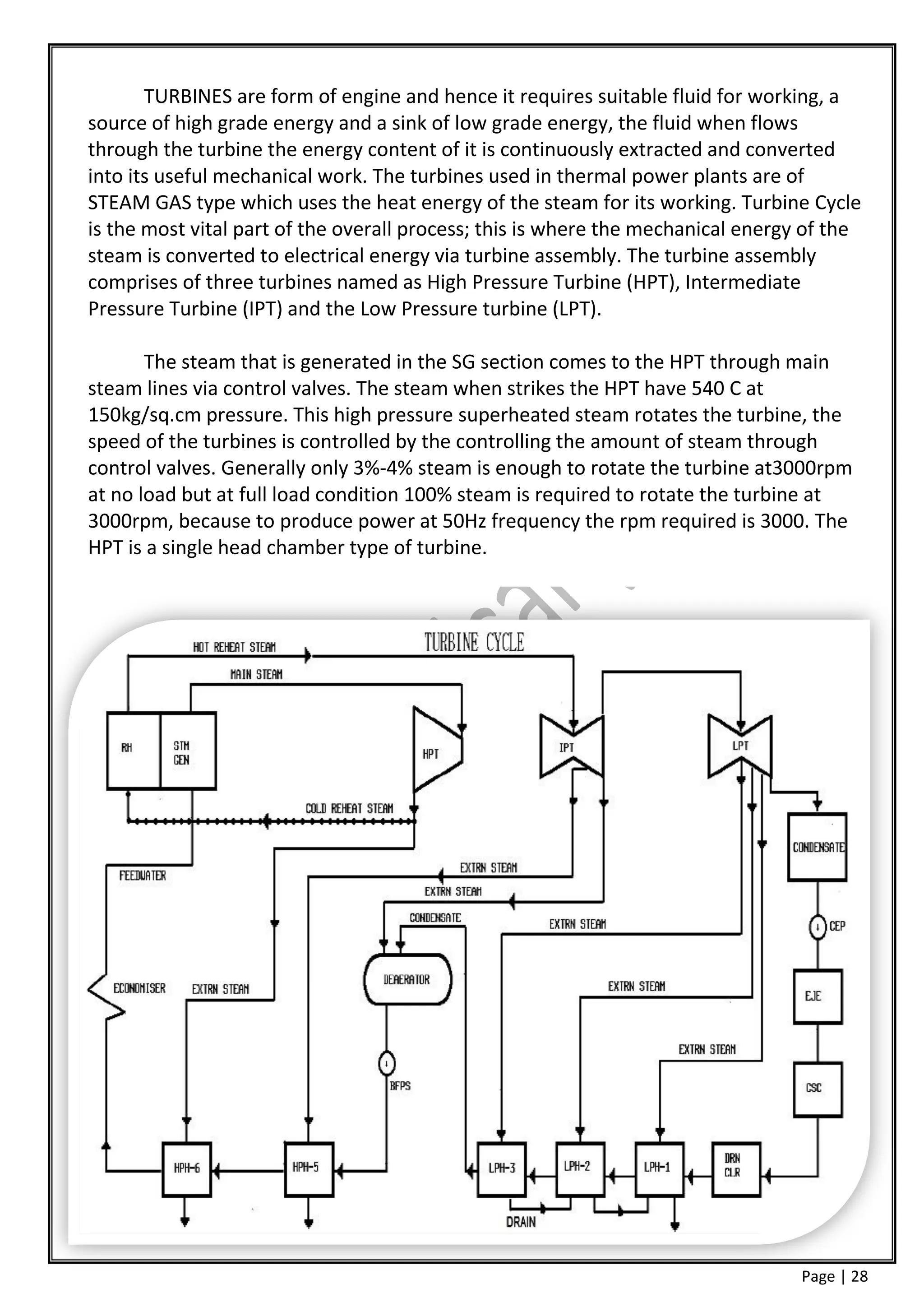
TURBINES are form of engine and hence it requires suitable fluid for working, a
source of high grade energy and a sink of low grade energy, the fluid when flows
through the turbine the energy content of it is continuously extracted and converted
into its useful mechanical work. The turbines used in thermal power plants are of
STEAM GAS type which uses the heat energy of the steam for its working. Turbine Cycle
is the most vital part of the overall process; this is where the mechanical energy of the
steam is converted to electrical energy via turbine assembly. The turbine assembly
comprises of three turbines named as High Pressure Turbine (HPT), Intermediate
Pressure Turbine (IPT) and the Low Pressure turbine (LPT).

       The steam that is generated in the SG section comes to the HPT through main
steam lines via control valves. The steam when strikes the HPT have 540 C at
150kg/sq.cm pressure. This high pressure superheated steam rotates the turbine, the
speed of the turbines is controlled by the controlling the amount of steam through
control valves. Generally only 3%-4% steam is enough to rotate the turbine at3000rpm
at no load but at full load condition 100% steam is required to rotate the turbine at
3000rpm, because to produce power at 50Hz frequency the rpm required is 3000. The
HPT is a single head chamber type of turbine.


                                                                                  Page | 28
One part of the exhaust steam from HPT is taken to re-heaters through cold
reheat line (CRH line) which are again of mechanical type; for restoring the superheated
properties of the steam for further use. The reheated steam is brought back to the IPT
via HRH (hot reheat steam) line. And the other part of the exhaust steam is taken to the
HP heaters (i.e. to HPH-6)


      The reheated steam is mechanical energy is utilized by the IPT which is a double
head chamber type turbine, where steam enters from the top-mid section of the
turbine and leaves the turbine from the front and back section. The exhaust of IPT is
divided into 3 parts, one goes for the HP heaters (HPH-5), another goes to the de-
aerator and the last part goes to the LPT.

       The exhaust steam of the LPT Is divided into 4 parts, 3 of them goes for the Low
Pressure Heaters (LPH-1, LPH-2, LPH-3) for heating the condensate, and the last part
goes to the condenser for the steam condensation process and regeneration of water.
The condensation is done to minimize the production of DM water to make the process
cost effective. The steam is converted to water and extracted by CEP from the
condenser and transported to Gland Sealing Coolers (GSC) via Ejectors (EJE). The GSC
cools the sealing of the ducts; the condensate is taken to the LPH from the GSC for
heating at lower pressure to increase the enthalpy of the water for better efficiency.
Water after LPH reaches the de-aerator where the oxygen is removed from it and is
taken to the BFPs, the BFPs increases the pressure of the water up to 160kg/sq.cm and
sends it the high pressure heaters (HPH-5 & HPH-6). HPH increases the temperature of
the water once more and transfers it to the Economizer, in economizer the temperature
of water is again increased by the flue gas and is finally is transported to the steam
generation process via the Feed Control Station


SOME IMPORTANT COMPONENT OF STEAM/WATER CYCLE:
A fossil fuel steam generator includes an economizer, a steam drum, and the furnace
with its steam generating tubes and super-heater coils. Necessary safety valves are
located at suitable points to avoid excessive boiler pressure.

 De-aerator: Typically, the condensate plus the makeup water then flows through a
  de-aerator that removes dissolved air from the water, further purifying and reducing
  its corrosiveness. The water may be dosed following this point with hydrazine, a
  chemical that removes the remaining oxygen in the water to below 5 parts per
  billion (ppb)


                                                                                Page | 29
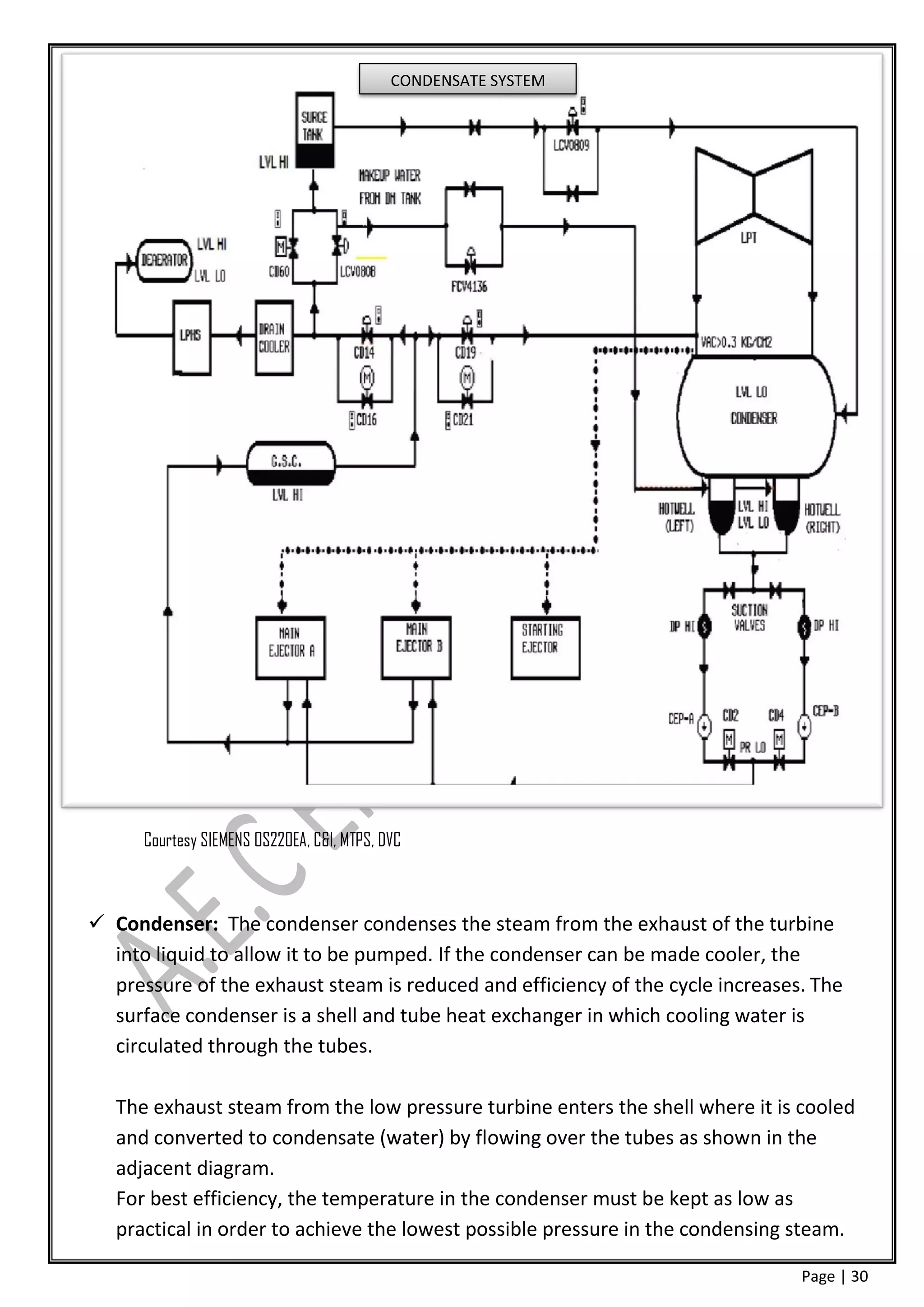
CONDENSATE SYSTEM


      Courtesy SIEMENS OS220EA, C&I, MTPS, DVC


 Condenser: The condenser condenses the steam from the exhaust of the turbine
  into liquid to allow it to be pumped. If the condenser can be made cooler, the
  pressure of the exhaust steam is reduced and efficiency of the cycle increases. The
  surface condenser is a shell and tube heat exchanger in which cooling water is
  circulated through the tubes.

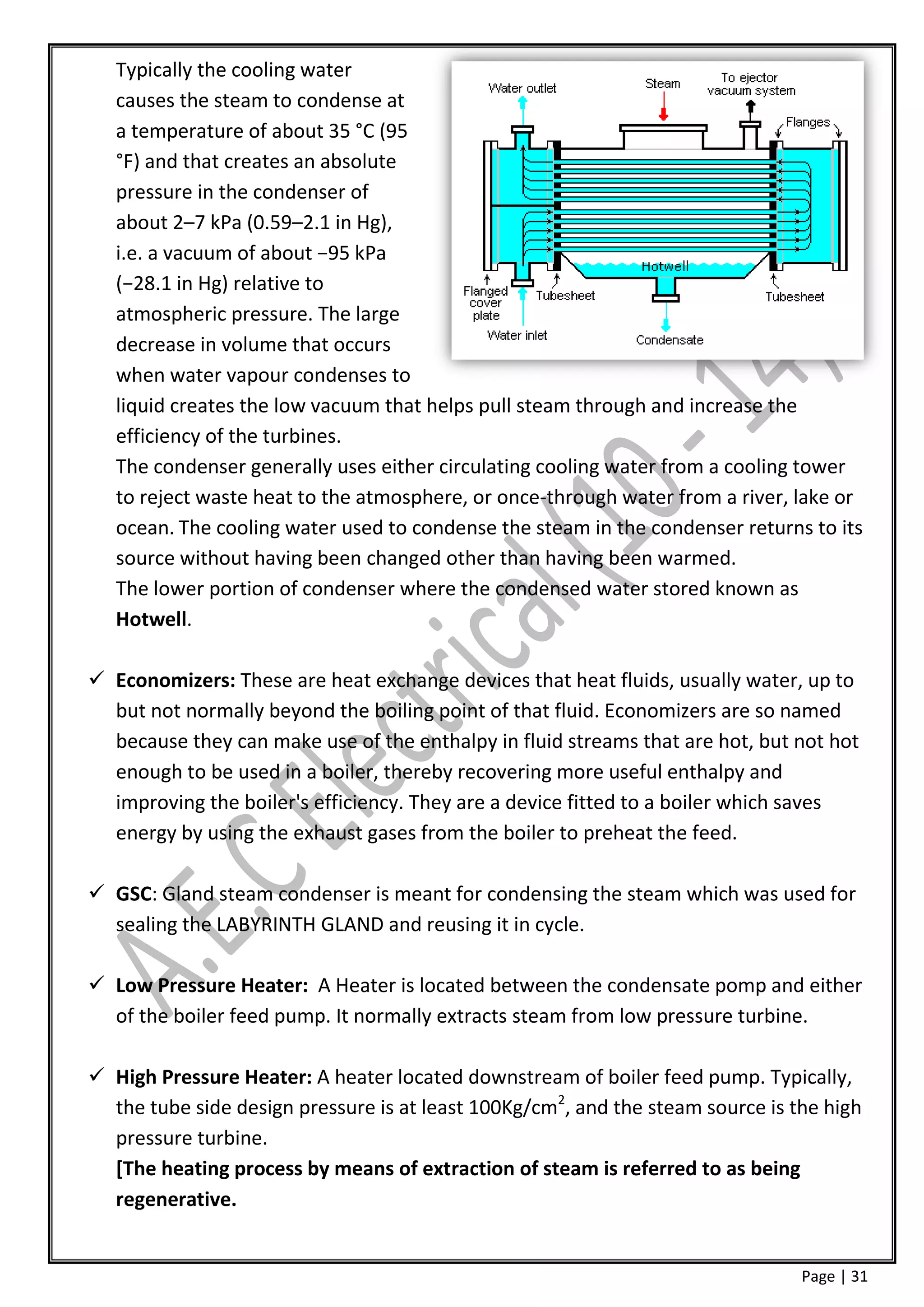
   The exhaust steam from the low pressure turbine enters the shell where it is cooled
   and converted to condensate (water) by flowing over the tubes as shown in the
   adjacent diagram.
   For best efficiency, the temperature in the condenser must be kept as low as
   practical in order to achieve the lowest possible pressure in the condensing steam.

                                                                                Page | 30
Typically the cooling water
   causes the steam to condense at
   a temperature of about 35 °C (95
   °F) and that creates an absolute
   pressure in the condenser of
   about 2–7 kPa (0.59–2.1 in Hg),
   i.e. a vacuum of about −95 kPa
   (−28.1 in Hg) relative to
   atmospheric pressure. The large
   decrease in volume that occurs
   when water vapour condenses to
   liquid creates the low vacuum that helps pull steam through and increase the
   efficiency of the turbines.
   The condenser generally uses either circulating cooling water from a cooling tower
   to reject waste heat to the atmosphere, or once-through water from a river, lake or
   ocean. The cooling water used to condense the steam in the condenser returns to its
   source without having been changed other than having been warmed.
   The lower portion of condenser where the condensed water stored known as
   Hotwell.

 Economizers: These are heat exchange devices that heat fluids, usually water, up to
  but not normally beyond the boiling point of that fluid. Economizers are so named
  because they can make use of the enthalpy in fluid streams that are hot, but not hot
  enough to be used in a boiler, thereby recovering more useful enthalpy and
  improving the boiler's efficiency. They are a device fitted to a boiler which saves
  energy by using the exhaust gases from the boiler to preheat the feed.

 GSC: Gland steam condenser is meant for condensing the steam which was used for
  sealing the LABYRINTH GLAND and reusing it in cycle.

 Low Pressure Heater: A Heater is located between the condensate pomp and either
  of the boiler feed pump. It normally extracts steam from low pressure turbine.

 High Pressure Heater: A heater located downstream of boiler feed pump. Typically,
  the tube side design pressure is at least 100Kg/cm2, and the steam source is the high
  pressure turbine.
  [The heating process by means of extraction of steam is referred to as being
  regenerative.


                                                                                Page | 31
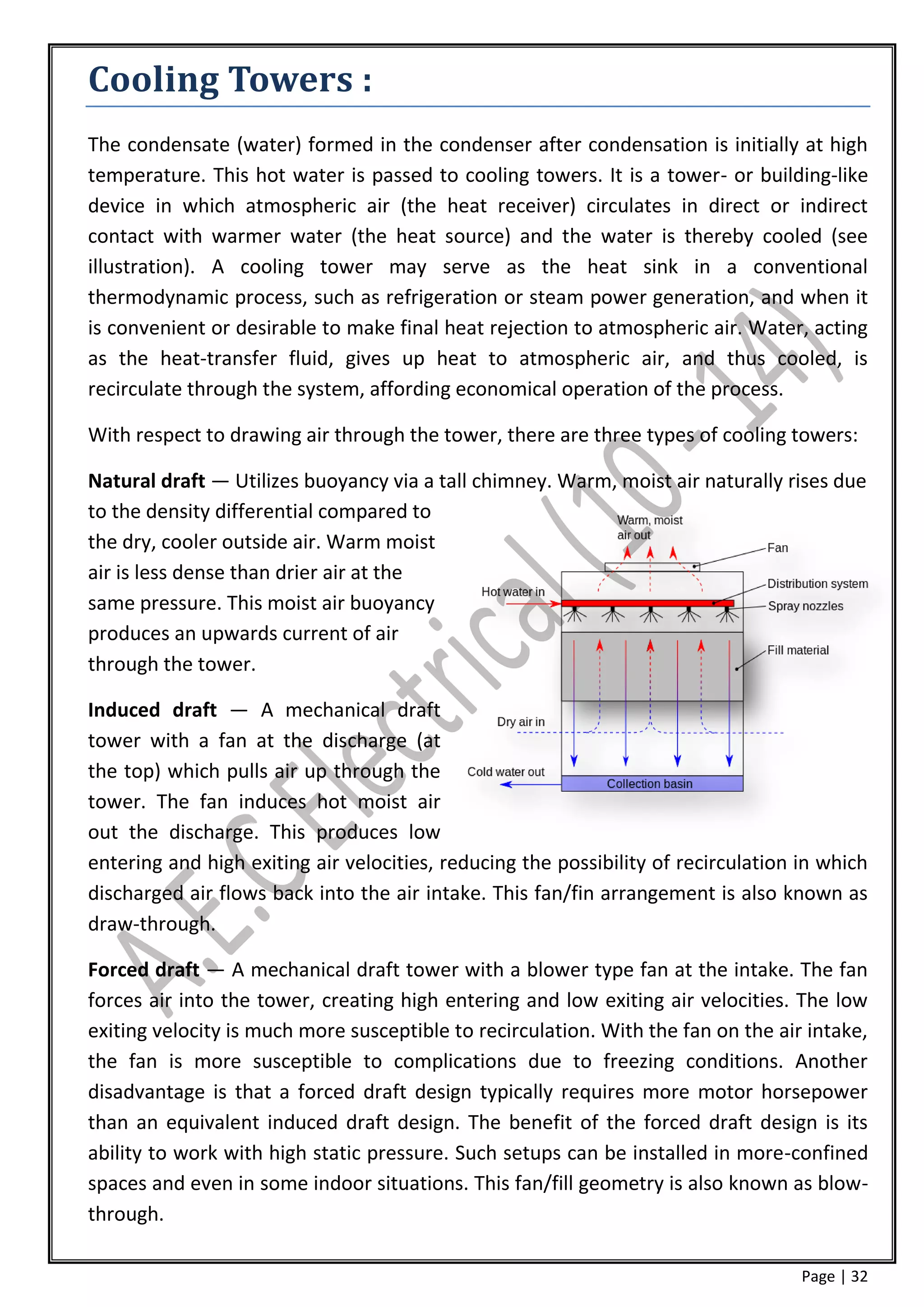
Cooling Towers :
The condensate (water) formed in the condenser after condensation is initially at high
temperature. This hot water is passed to cooling towers. It is a tower- or building-like
device in which atmospheric air (the heat receiver) circulates in direct or indirect
contact with warmer water (the heat source) and the water is thereby cooled (see
illustration). A cooling tower may serve as the heat sink in a conventional
thermodynamic process, such as refrigeration or steam power generation, and when it
is convenient or desirable to make final heat rejection to atmospheric air. Water, acting
as the heat-transfer fluid, gives up heat to atmospheric air, and thus cooled, is
recirculate through the system, affording economical operation of the process.

With respect to drawing air through the tower, there are three types of cooling towers:

Natural draft — Utilizes buoyancy via a tall chimney. Warm, moist air naturally rises due
to the density differential compared to
the dry, cooler outside air. Warm moist
air is less dense than drier air at the
same pressure. This moist air buoyancy
produces an upwards current of air
through the tower.

Induced draft — A mechanical draft
tower with a fan at the discharge (at
the top) which pulls air up through the
tower. The fan induces hot moist air
out the discharge. This produces low
entering and high exiting air velocities, reducing the possibility of recirculation in which
discharged air flows back into the air intake. This fan/fin arrangement is also known as
draw-through.

Forced draft — A mechanical draft tower with a blower type fan at the intake. The fan
forces air into the tower, creating high entering and low exiting air velocities. The low
exiting velocity is much more susceptible to recirculation. With the fan on the air intake,
the fan is more susceptible to complications due to freezing conditions. Another
disadvantage is that a forced draft design typically requires more motor horsepower
than an equivalent induced draft design. The benefit of the forced draft design is its
ability to work with high static pressure. Such setups can be installed in more-confined
spaces and even in some indoor situations. This fan/fill geometry is also known as blow-
through.

                                                                                    Page | 32
Air and Flue Gas Path
In fossil-fuelled power plants, water is taken to the boiler or steam generator where
coal is burnt. The boiler transfers heat energy to the water in form of latent heat of
vaporization or enthalpy by the chemical reaction of burning coal. External fans, such as
PA fans and FD fans, are provided to give sufficient air for combustion. The air and flue
gas path equipment include: forced draft (FD) fan, air preheater (APH), boiler furnace,
induced draft (ID) fan, fly ash collectors (ESP or electrostatic precipitator), flue gas stack,
etc. External fans re provided to give sufficient air for combustion.

INDUCED DRAFT (ID) FAN: -
                                                           FD & ID Fan
This fan is used to create negative pressure in the 3 Phase Asynchronous Motor
furnace, i.e. furnace pressure is lower than the Make                 :      BHEL
                                                         Connection :        Y
atmospheric pressure, as a result of which the fire Type              :      S. Cage
ball inside the furnace cannot come out of the Insul. Class :                F
                                                         Frequency :         50Hz
furnace. ID fan also drives the flue gas throughout
its path and above processes and finally ejects it
out of the chimney. It sucks air from inside the furnace and ejects it to the atmosphere.
Mechanically ID fan consists of one 3-phase asynchronous type motor, a hydro coupling
unit for coupling rotor shaft of the motor and the rotor shaft of the fan, scoop unit, a
pair of journal bearings and lubrication oil system. It is the only fan which have hydro
coupling because this gives more accurate control to its speed for maintaining the
negative pressure more precisely since controlling of negative pressure is the most vital
factor in any thermal power unit. The lube-oil system has two motors out of which one
remains standby; for maintaining perfect pressure of lubrication throughout the ID fan
assembly. The second motor automatically starts up when the oil pressure drops below
a certain level; this motor increases the oil pressure in the system. Water cools down
the oil flowing in the tubes inside the coolers. There are three ID Fans in each unit of
thermal power plant, named as ID-A, ID-B, ID-C.

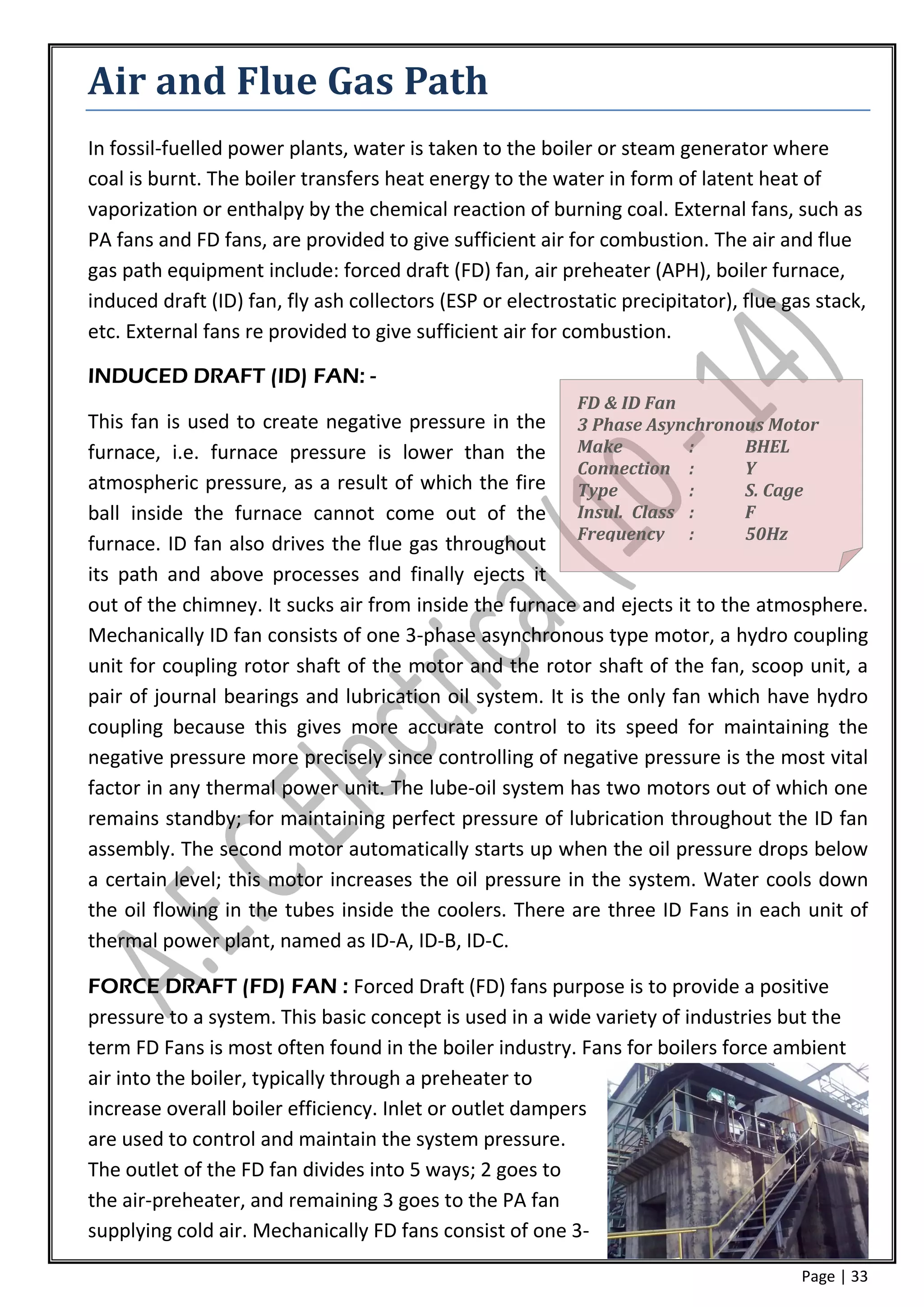
FORCE DRAFT (FD) FAN : Forced Draft (FD) fans purpose is to provide a positive
pressure to a system. This basic concept is used in a wide variety of industries but the
term FD Fans is most often found in the boiler industry. Fans for boilers force ambient
air into the boiler, typically through a preheater to
increase overall boiler efficiency. Inlet or outlet dampers
are used to control and maintain the system pressure.
The outlet of the FD fan divides into 5 ways; 2 goes to
the air-preheater, and remaining 3 goes to the PA fan
supplying cold air. Mechanically FD fans consist of one 3-

                                                                                       Page | 33
phase asynchronous type motor, a pair of journal bearings and lube-oil system. Unlike
ID fan these fans have direct coupling of rotor shaft of the motor and rotor shaft of the
fan. The lube-oil system is designed same as ID fans. There are 2 FD fans in a single unit.
***NOTE: -
THE SYNCHRONIZATION OF ID-FAN AND FD-FAN IS VERY IMPORTANT AS THESE TWO FANS COMBINELY
BALANCE THE PLANT. WHEN WORKING TOGETHER IT IS CALLED BALACED DRAFT.

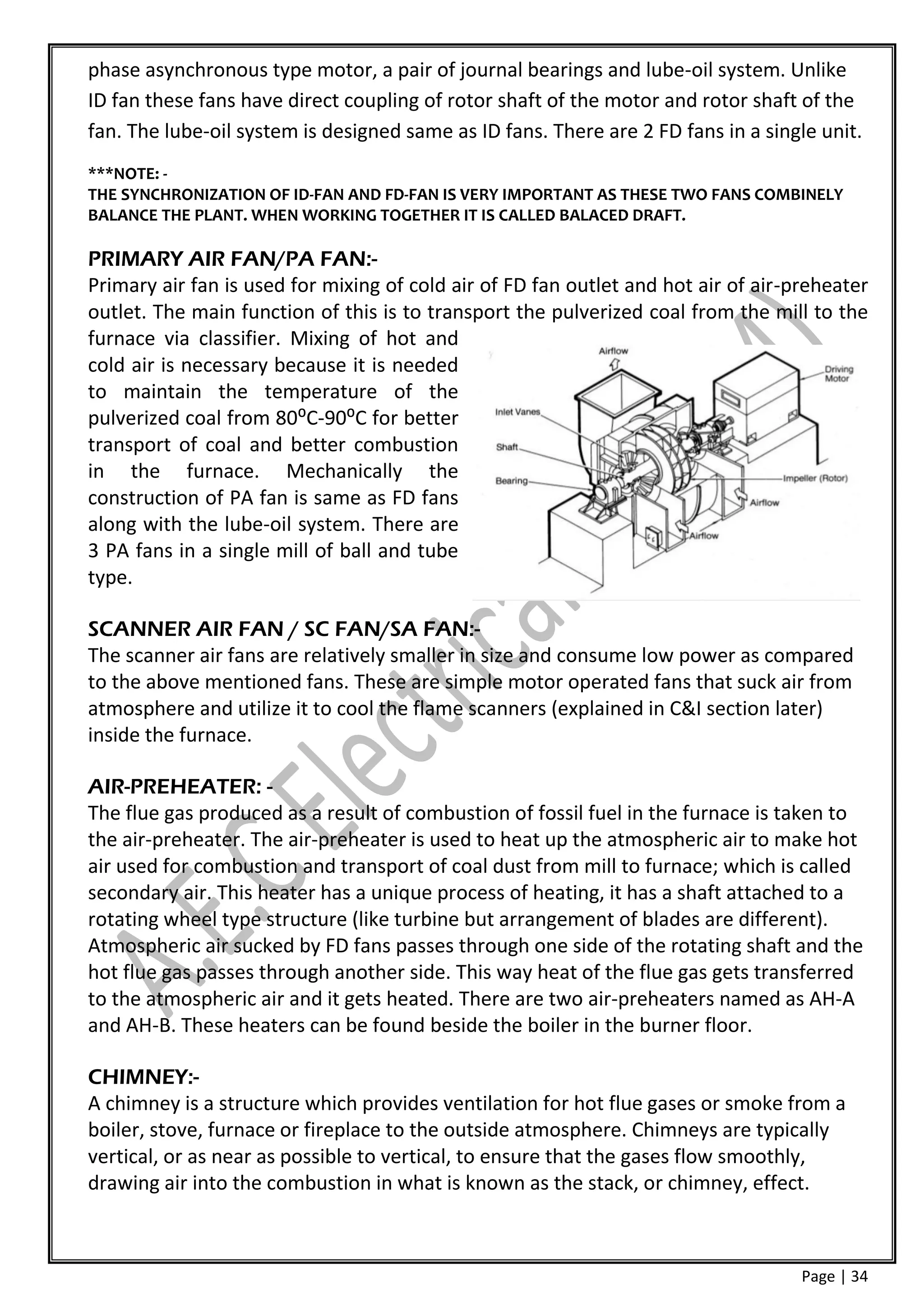
PRIMARY AIR FAN/PA FAN:-
Primary air fan is used for mixing of cold air of FD fan outlet and hot air of air-preheater
outlet. The main function of this is to transport the pulverized coal from the mill to the
furnace via classifier. Mixing of hot and
cold air is necessary because it is needed
to maintain the temperature of the
pulverized coal from 80⁰C-90⁰C for better
transport of coal and better combustion
in the furnace. Mechanically the
construction of PA fan is same as FD fans
along with the lube-oil system. There are
3 PA fans in a single mill of ball and tube
type.

SCANNER AIR FAN / SC FAN/SA FAN:-
The scanner air fans are relatively smaller in size and consume low power as compared
to the above mentioned fans. These are simple motor operated fans that suck air from
atmosphere and utilize it to cool the flame scanners (explained in C&I section later)
inside the furnace.

AIR-PREHEATER: -
The flue gas produced as a result of combustion of fossil fuel in the furnace is taken to
the air-preheater. The air-preheater is used to heat up the atmospheric air to make hot
air used for combustion and transport of coal dust from mill to furnace; which is called
secondary air. This heater has a unique process of heating, it has a shaft attached to a
rotating wheel type structure (like turbine but arrangement of blades are different).
Atmospheric air sucked by FD fans passes through one side of the rotating shaft and the
hot flue gas passes through another side. This way heat of the flue gas gets transferred
to the atmospheric air and it gets heated. There are two air-preheaters named as AH-A
and AH-B. These heaters can be found beside the boiler in the burner floor.

CHIMNEY:-
A chimney is a structure which provides ventilation for hot flue gases or smoke from a
boiler, stove, furnace or fireplace to the outside atmosphere. Chimneys are typically
vertical, or as near as possible to vertical, to ensure that the gases flow smoothly,
drawing air into the combustion in what is known as the stack, or chimney, effect.


                                                                                    Page | 34
Electrostatic Precipitators
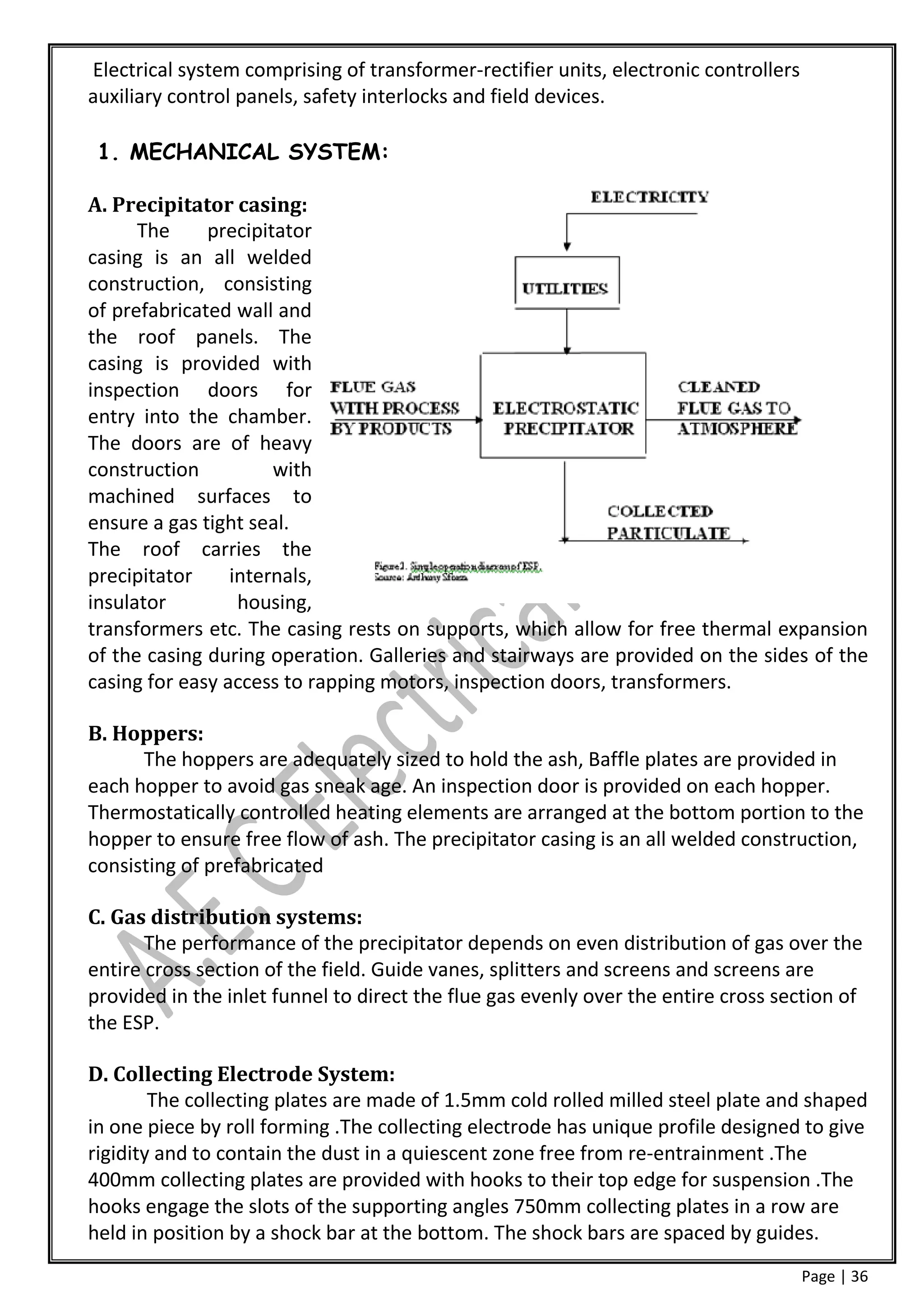
An electrostatic precipitator (ESP) or electrostatic air cleaner is a particulate collection
device that removes particles from a flowing gas (such as air) using the force of an
induced electrostatic charge. Electrostatic precipitators are highly efficient filtration
devices that minimally impede the flow of gases through the device, and can easily
remove fine particulate matter such as dust and smoke from the air stream. In contrast
to wet scrubbers which apply energy directly to the flowing fluid medium, an ESP
applies energy only to the particulate matter being collected and therefore is very
efficient in its consumption of energy (in the form of electricity).

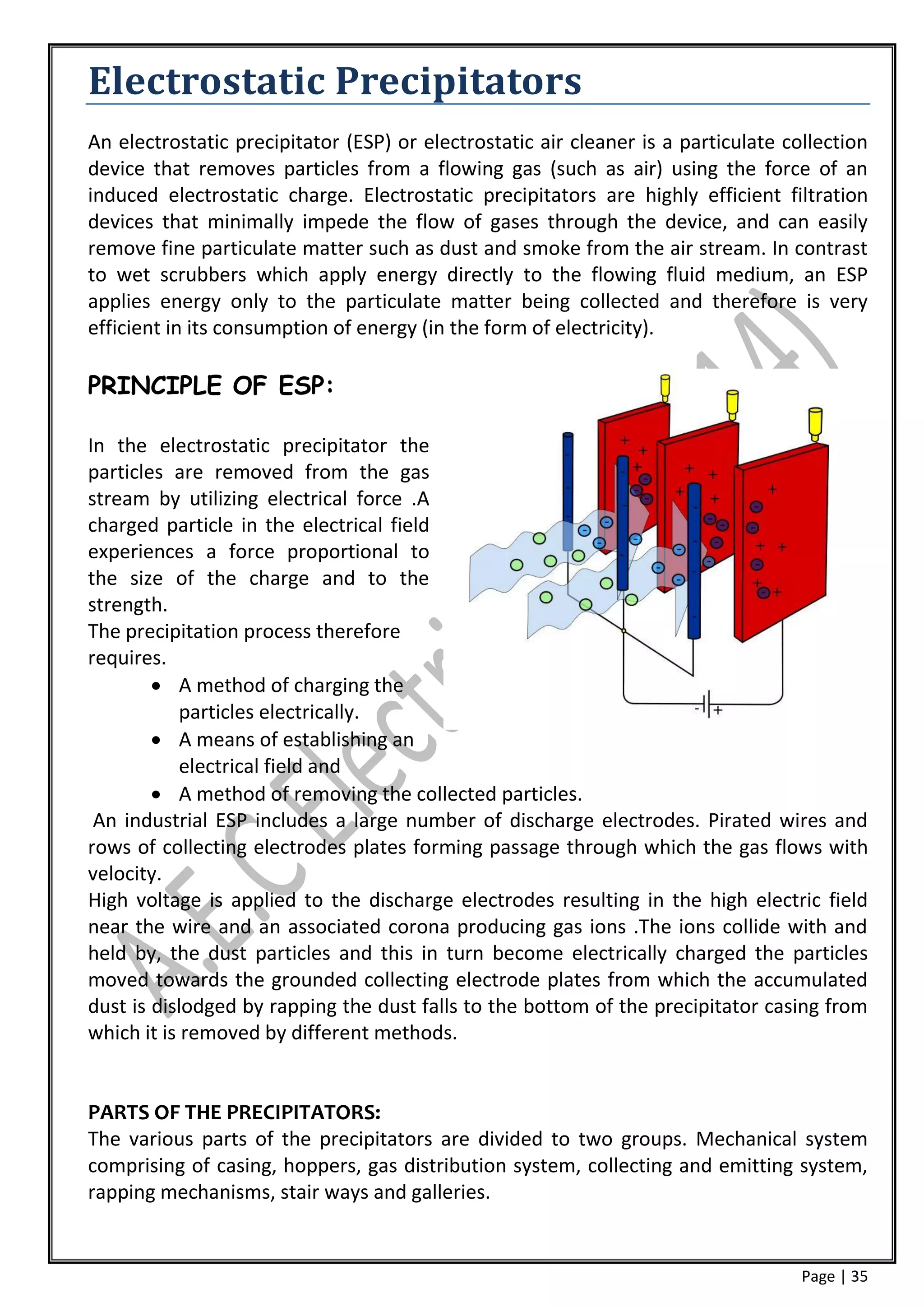
PRINCIPLE OF ESP:

In the electrostatic precipitator the
particles are removed from the gas
stream by utilizing electrical force .A
charged particle in the electrical field
experiences a force proportional to
the size of the charge and to the
strength.
The precipitation process therefore
requires.
         A method of charging the
            particles electrically.
         A means of establishing an
            electrical field and
         A method of removing the collected particles.
 An industrial ESP includes a large number of discharge electrodes. Pirated wires and
rows of collecting electrodes plates forming passage through which the gas flows with
velocity.
High voltage is applied to the discharge electrodes resulting in the high electric field
near the wire and an associated corona producing gas ions .The ions collide with and
held by, the dust particles and this in turn become electrically charged the particles
moved towards the grounded collecting electrode plates from which the accumulated
dust is dislodged by rapping the dust falls to the bottom of the precipitator casing from
which it is removed by different methods.


PARTS OF THE PRECIPITATORS:
The various parts of the precipitators are divided to two groups. Mechanical system
comprising of casing, hoppers, gas distribution system, collecting and emitting system,
rapping mechanisms, stair ways and galleries.


                                                                                    Page | 35
Electrical system comprising of transformer-rectifier units, electronic controllers
auxiliary control panels, safety interlocks and field devices.

 1. MECHANICAL SYSTEM:

A. Precipitator casing:
      The     precipitator
casing is an all welded
construction, consisting
of prefabricated wall and
the roof panels. The
casing is provided with
inspection doors for
entry into the chamber.
The doors are of heavy
construction          with
machined surfaces to
ensure a gas tight seal.
The roof carries the
precipitator     internals,
insulator         housing,
transformers etc. The casing rests on supports, which allow for free thermal expansion
of the casing during operation. Galleries and stairways are provided on the sides of the
casing for easy access to rapping motors, inspection doors, transformers.

B. Hoppers:
      The hoppers are adequately sized to hold the ash, Baffle plates are provided in
each hopper to avoid gas sneak age. An inspection door is provided on each hopper.
Thermostatically controlled heating elements are arranged at the bottom portion to the
hopper to ensure free flow of ash. The precipitator casing is an all welded construction,
consisting of prefabricated

C. Gas distribution systems:
       The performance of the precipitator depends on even distribution of gas over the
entire cross section of the field. Guide vanes, splitters and screens and screens are
provided in the inlet funnel to direct the flue gas evenly over the entire cross section of
the ESP.

D. Collecting Electrode System:
        The collecting plates are made of 1.5mm cold rolled milled steel plate and shaped
in one piece by roll forming .The collecting electrode has unique profile designed to give
rigidity and to contain the dust in a quiescent zone free from re-entrainment .The
400mm collecting plates are provided with hooks to their top edge for suspension .The
hooks engage the slots of the supporting angles 750mm collecting plates in a row are
held in position by a shock bar at the bottom. The shock bars are spaced by guides.
                                                                                      Page | 36
E. Emitting Electrode System:
       The most essential part of the precipitator is emitting electrode system.4
insulators support this. The frames for holding the emitting electrodes are located
centrally between collecting electrode curtains. The entire discharge frames are welded
to form rigid bars

F) Rapping Systems:
       Rapping systems are provided for collecting and emitting electrodes. Geared
motors drive these rappers. The rapping system employs tumbling hammers, which are
mounted on the horizontal shaft. As the shaft rotates slowly the hammers tumble on
the shaft will clean the entire field. The rapper programmer decides the rapping
frequency. The tumbling hammers disposition and the periodicity of rapping are
selected in such a way that less than 2% of the collecting area is rapped at any instant.
This avoids re-entrainment of dust and puffing at the stack. The rapping shaft from the
gear motor drive by a shaft insulator. The space around the shaft insulator is
continuously heated to avoid condensation.

G) Insulator Housing:
       The support insulators, supporting the emitting electrodes housed in insulator
housings. The HVDC connection is taken through a bushing insulator mounted on the
insulator housing wall.
In order to avoid the condensation on the support insulators, each insulator is provided
with one electrical heating element. Heating elements of one pass are controlled by
one thermostat.

2) ELECTRICAL SYSTEM:

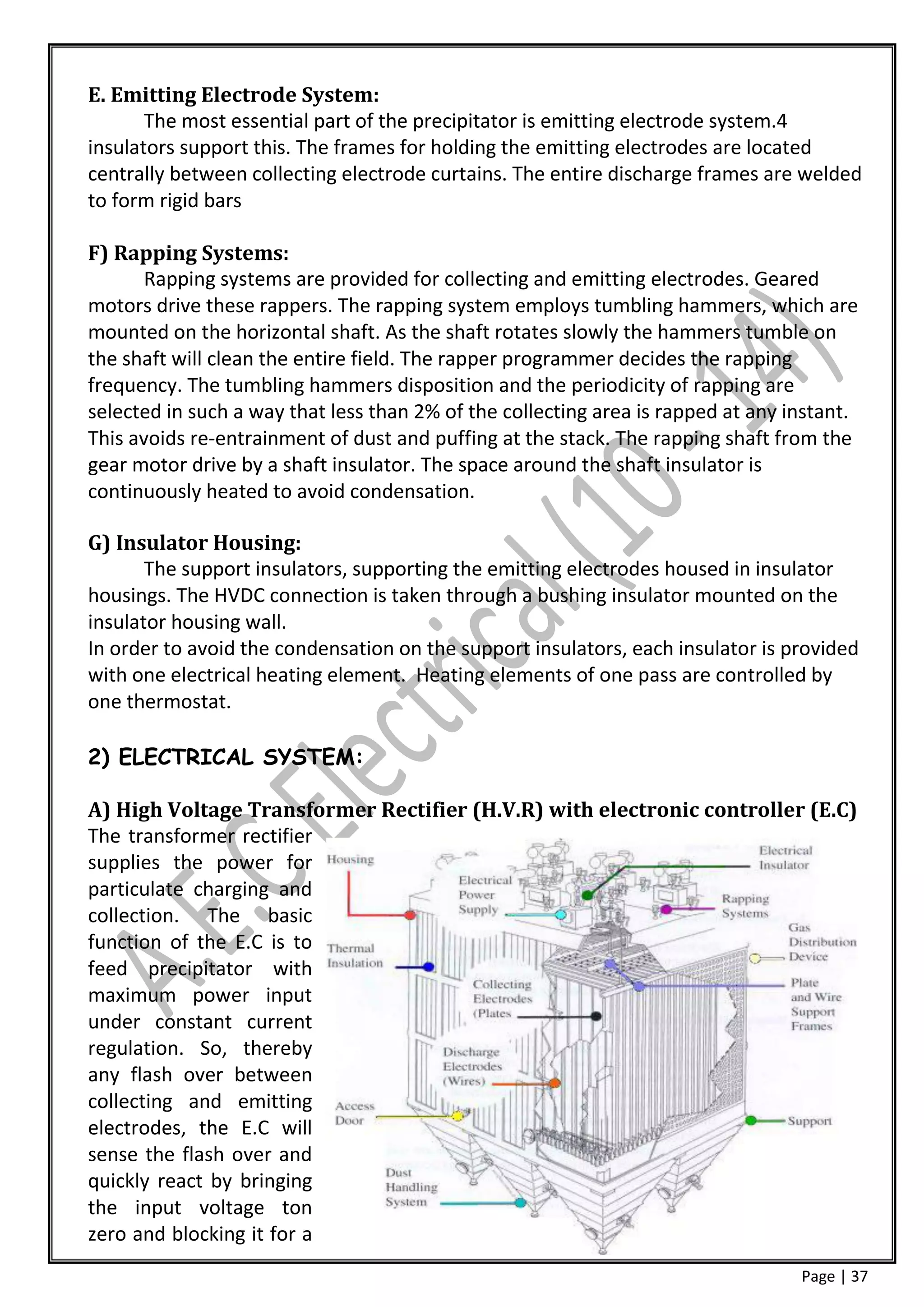
A) High Voltage Transformer Rectifier (H.V.R) with electronic controller (E.C)
The transformer rectifier
supplies the power for
particulate charging and
collection. The basic
function of the E.C is to
feed precipitator with
maximum power input
under constant current
regulation. So, thereby
any flash over between
collecting and emitting
electrodes, the E.C will
sense the flash over and
quickly react by bringing
the input voltage ton
zero and blocking it for a
                                                                                  Page | 37
specific period. After the ionized gases are cleared and the dielectric strength restored,
the control will quickly bring back the power to the present value and raise it to the
original non-sparking level. Thus the E.C ensures adequate power input to the
precipitator while reckoning the electrical disturbances within the precipitator.
Regulated ac power from E.C is fed to the primary of the transformer, which is stepped
up and rectified to give a full wave power output. The transformer rectifier is mounted
on the roof of the precipitator while the E.C is located in an air-conditioned control
room.

B) Auxiliary control panel (A.C.P)
      The A.C.P controls the power supply to the EP auxiliary i.e. rapping motors and
heating element dampers etc. The complete A.C.P. is of modular type with individual
modules for each feeder. Each module houses the power and control circuits with
meters, push buttons, switches and indicating lamps.
Following are the modules for the outgoing feeders
    Hopper heaters for each field
    Support insulator heaters
    Shaft insulator heaters
    Collecting electrode rapping motor for each field

The program control circuit for the sequence and timing of operation for rapping
motors is included in the A.C.P.
 For continuous operation of the rapping motors, the programmer can be bypassed
through a switch. Thermal overload relay is provided for overload protection to the
rapping motors. Local push buttons are available for tripping the motors to meet the
exigencies and for maintenance purposes.
 Ammeters with selector switches to indicate line currents of motors and heating
element feeders are provided. Indicating lamps are provided “main supply on”,
“overload trip”, “local push button activated”, “space meter on”, and “control supply
on”.
 Potential free contacts are provided for remote indication for rapping motor trip due to
overload.

C) Safety Interlock:
       A safety interlock system is incorporated to prevent accidental contact with live
parts of the precipitator and enable energisation only when the ESP is boxed up. The
interlock system covers all the inspection doors of casing, insulator housing and
disconnecting switches.
 Warning: familiarity with this system may felon the operating personnel bypass the
interlock. As this would defend the very purpose of the interlocking system, such a
temptation should be resisted and the sequence of operation at every stage should be
systematically followed.


                                                                                  Page | 38
D) Disconnecting switch:
  Each field is provided with one disconnecting switch for isolation of emitting system
 from the associated transformer .In the on position the emitting system is connected to
 the transformer and in the OFF position it is grounded.

 ESP in MTPS:
 ESPs continue to be excellent devices for control of many industrial particulate
 emissions, including smoke from electricity-generating utilities (coal and oil fired), salt
 cake collection from black liquor boilers in pulp mills, and catalyst collection from
 fluidized bed catalytic cracker units in oil refineries to name a few. These devices treat
 gas volumes from several hundred thousand ACFM to 2.5 million ACFM (1,180 m³/s) in
 the largest coal-fired boiler applications. For a coal-fired boiler the collection is usually
 performed downstream of the air preheater at about 160 °C (320 deg.F) which provides
 optimal resistivity of the coal-ash particles. For some difficult applications with low-
 sulphur fuel hot-end units have been built operating above 371 °C (700 deg.F).
 The flue gas after passing through the air-preheaters comes down to lower temperature
 that is feasible for releasing into the atmosphere, but one vital job remains still left out,
 i.e. to remove the carbon content of the gas so that it does not harm the atmosphere.
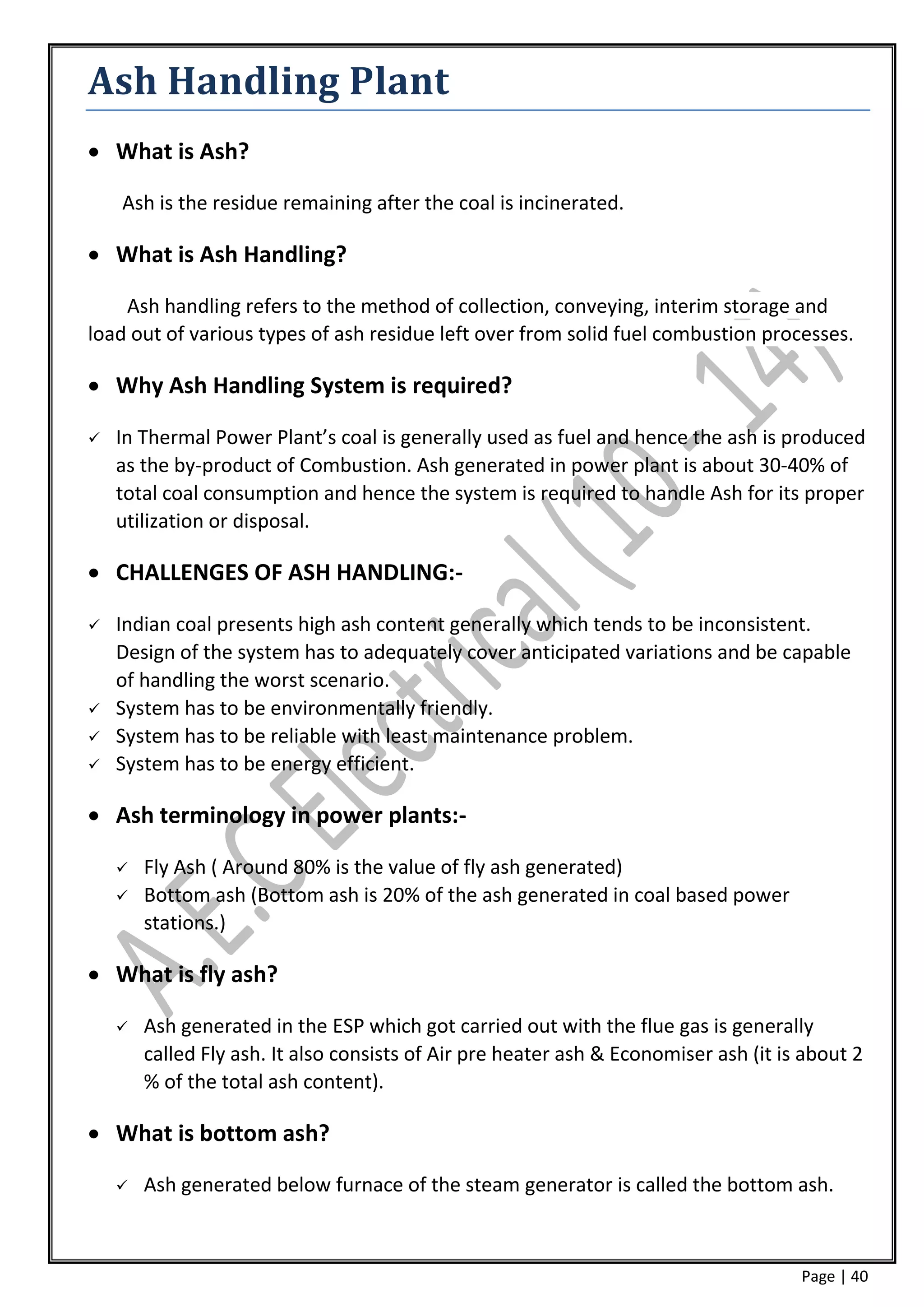
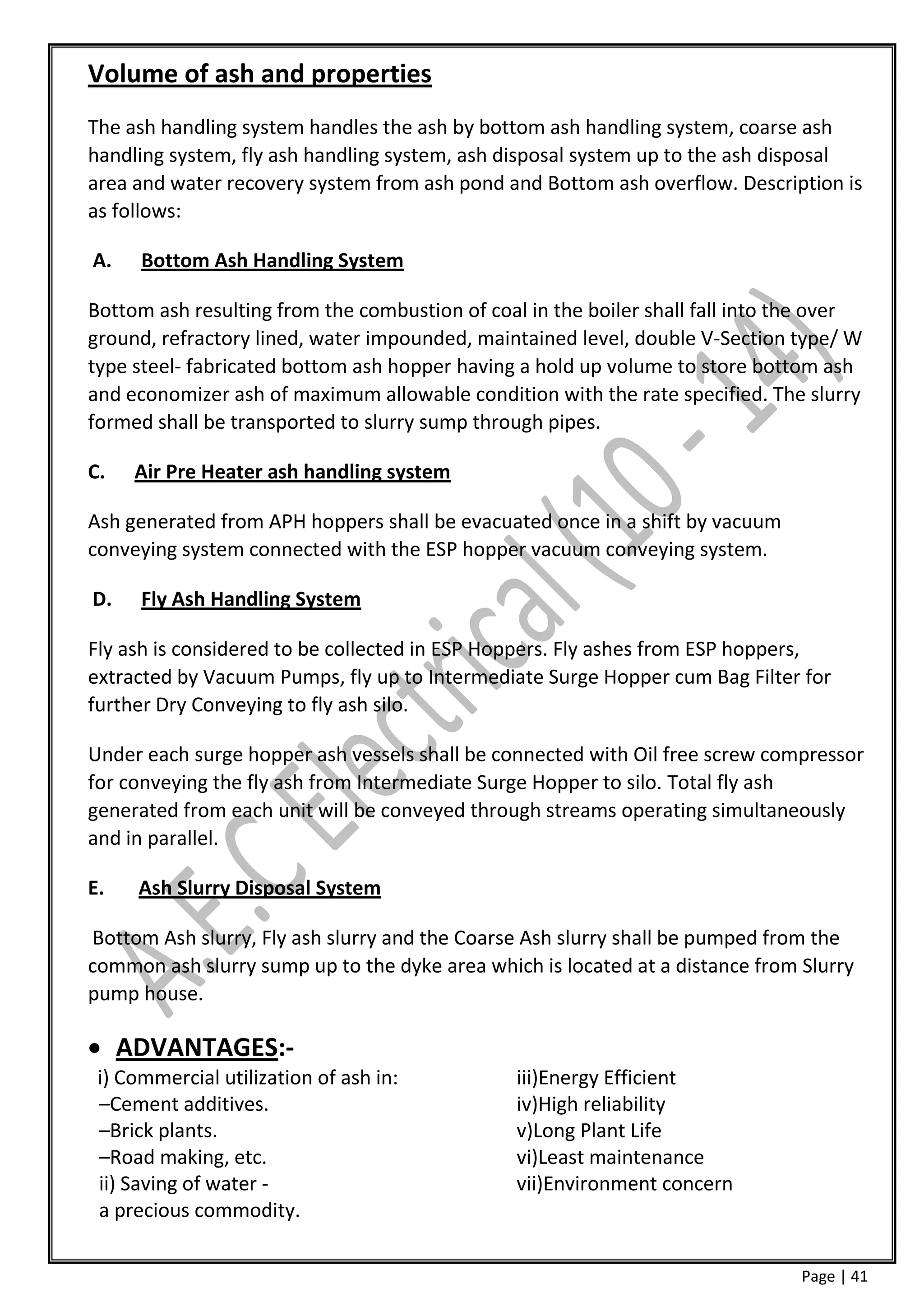
 This job is done by ESP, the flue gas after air-preheater comes
 to the ESP unit. ESP actually works on the principal of
 CORONA DISCHARGE EFFECT ; the ESP unit houses two
 electrode plates called emitting plate and collecting plate.
 The emitting plate is supplied with a very high DC negative
 potential (in order of**), this results into ionizing of air
 molecules surrounding the emitting plate which is called
 corona effect. The collecting plate is grounded and a positive
 potential develops on it, as a result when the flue gas pass
                                    through between them the
                                       carbon       particles   are
                                       attracted to the collecting
                                       plates.     The collecting            Inside ESP, MTPS
                                       plates are attached to hopper
                                       where the ashes get deposited by hammering action
                                       on the collecting plate. For a 210MW unit 24 such
                                       hoppers are present in each ESP; these hoppers have
                                       mechanical transport system for proper disposal of
                                       ash. For better corona effect the emitting plate is
                                       made corrugated because this way more air
                                       molecules get ionized as corona discharge points are
                                       more in number in corrugated plate.


Exciter Transformer of ESP, MTPS

                                                                                      Page | 39
Ash Handling Plant
 What is Ash?

    Ash is the residue remaining after the coal is incinerated.

 What is Ash Handling?

    Ash handling refers to the method of collection, conveying, interim storage and
load out of various types of ash residue left over from solid fuel combustion processes.

 Why Ash Handling System is required?

   In Thermal Power Plant’s coal is generally used as fuel and hence the ash is produced
    as the by-product of Combustion. Ash generated in power plant is about 30-40% of
    total coal consumption and hence the system is required to handle Ash for its proper
    utilization or disposal.

 CHALLENGES OF ASH HANDLING:-

   Indian coal presents high ash content generally which tends to be inconsistent.
    Design of the system has to adequately cover anticipated variations and be capable
    of handling the worst scenario.
   System has to be environmentally friendly.
   System has to be reliable with least maintenance problem.
   System has to be energy efficient.

 Ash terminology in power plants:-

       Fly Ash ( Around 80% is the value of fly ash generated)
       Bottom ash (Bottom ash is 20% of the ash generated in coal based power
        stations.)

 What is fly ash?

       Ash generated in the ESP which got carried out with the flue gas is generally
        called Fly ash. It also consists of Air pre heater ash & Economiser ash (it is about 2
        % of the total ash content).

 What is bottom ash?

       Ash generated below furnace of the steam generator is called the bottom ash.


                                                                                      Page | 40
Volume of ash and properties
The ash handling system handles the ash by bottom ash handling system, coarse ash
handling system, fly ash handling system, ash disposal system up to the ash disposal
area and water recovery system from ash pond and Bottom ash overflow. Description is
as follows:

A.    Bottom Ash Handling System

Bottom ash resulting from the combustion of coal in the boiler shall fall into the over
ground, refractory lined, water impounded, maintained level, double V-Section type/ W
type steel- fabricated bottom ash hopper having a hold up volume to store bottom ash
and economizer ash of maximum allowable condition with the rate specified. The slurry
formed shall be transported to slurry sump through pipes.

C.   Air Pre Heater ash handling system

Ash generated from APH hoppers shall be evacuated once in a shift by vacuum
conveying system connected with the ESP hopper vacuum conveying system.

D.    Fly Ash Handling System

Fly ash is considered to be collected in ESP Hoppers. Fly ashes from ESP hoppers,
extracted by Vacuum Pumps, fly up to Intermediate Surge Hopper cum Bag Filter for
further Dry Conveying to fly ash silo.

Under each surge hopper ash vessels shall be connected with Oil free screw compressor
for conveying the fly ash from Intermediate Surge Hopper to silo. Total fly ash
generated from each unit will be conveyed through streams operating simultaneously
and in parallel.

E.   Ash Slurry Disposal System

Bottom Ash slurry, Fly ash slurry and the Coarse Ash slurry shall be pumped from the
common ash slurry sump up to the dyke area which is located at a distance from Slurry
pump house.

 ADVANTAGES:-
 i) Commercial utilization of ash in:           iii)Energy Efficient
 –Cement additives.                             iv)High reliability
 –Brick plants.                                 v)Long Plant Life
 –Road making, etc.                             vi)Least maintenance
 ii) Saving of water -                          vii)Environment concern
 a precious commodity.

                                                                                Page | 41
ELECTRICAL SYSTEM OVERVIEW
ELECTRICAL SYSTEM OF A THERMAL POWER PLANT BASICALLY CONSISTS OF THE
FOLLOWING PARTS:-

    GENERATOR
    SWITCHYARD
    POWER DISTRIDUTION SYSTEM

 GENERATOR
      The transformation of mechanical energy into electrical energy is carried out by
    generator. The A.C generator or alternator is based on the principal of
    electromagnetic induction and generally consists of a stationary part called stator
    and a rotating part called rotor. The stator houses the armature windings and the
    rotor houses the field windings. A D.C voltage is applied to the field winding in the
    rotor through slip rings, when the rotor is rotated, the lines of magnetic flux is cut
    through the stator windings. This as a result produces an induced e.m.f
    (electromotive force) in the stator winding which is tapped out as output. The
    magnitude of this output is determined by the following equation:-

                   E = 4.44/O f N volts

Where E = e.m.f. induced;
      O =Strength of magnetic field in Weber;
      f= Frequency in cycles per second or in hertz;
      N = Number of turns in the winding of the stator;
Again, f = P n/120;
Where P = Number of poles;
        n = revolutions per second of the rotor.
From the above expression it is clear that for the same frequency number of poles
increases with decrease in speed and vice versa. Therefore low speed hydro turbine
drives generators have 14to 20poles where as for high speed steam turbine driven
generators have 2 poles.

Generator Components

 Rotor:       Rotor is the most difficult part to construct; it revolves at a speed of
 3000rpm. The massive non-uniform shaft subjected to a multiplicity of differential
 stresses must operate in oil lubricated sleeve bearings supported by a structure
 mounted on foundations all of which poses complex dynamic behaviour peculiar to
 them. It is also an electromagnet and to give it the necessary magnetic strength the

                                                                                    Page | 42
windings must carry a fairly high current. The rotor is a cast steel ingot and it is further
 forged and machined. Very often a hole bored through the centre of the rotor axially
 from one end to the other for inspection. Slots are then machined for windings and
 ventilation.


Rotor winding:        Silver bearing copper is used for the winding with mica as insulation
between conductors. A mechanically strong insulator such as micanite is used for lining
the slots. For cooling purpose slots and holes are provided for circulation of cooling gas.
The wedges the windings when the centrifugal force developed due to high speed
rotation tries to lift the windings. The two ends of the winding are connected to slip
rings made of forged steel and mounted on insulated sleeves.


Stator:       The major part of the stator frame is the stator core, it comprises of inner
and outer frame. The stator core is built up of a large number of punching or section of
thin steel plates. The use of cold rolled grain-oriented steel can contribute to reduction
of stator core.

Stator windings:        Each stator conductor must be capable of carrying the rated
current without overheating. The insulation must be sufficient to prevent leakage
current flowing between the phases to earth. Windings for the stator are made up from
copper strips wound with insulated tape switch is impregnated with varnish, dried
under vacuum and hot pressed to form a solid insulation bar. In 210MW generators the
windings are made up of copper tubes through which water is circulated for cooling
purpose.

Generator Cooling and Sealing System
1) HYDROGEN COOLING SYSTEM: Hydrogen is used as cooling medium in large
   capacity generators in view of its high heat carrying capacity and low density. But in
   view of its explosive mixture with oxygen, proper arrangement for filling, purging
   and maintaining its purity inside the generator have to be made. Also in order to
   prevent escape of hydrogen from the generator casing, shaft sealing system is used
   to provide oil sealing. The system is capable of performing the following functions:-
a) Filling in and purging of hydrogen safely.
b) Maintaining the gas pressure inside the machine at the desired value all the time.
c) Provide indication of pressure, temperature and purity of hydrogen.
d) Indication of liquid level inside the generator.

2) Generator Sealing System:          Seals are employed to prevent leakage of
hydrogen from the stator at the point of rotor exit. A continuous film between the

                                                                                     Page | 43
rotor collar and the seal liner is maintained by means of oil at the pressure which is
about above the casing hydrogen gas pressure. The thrust pad is held against the collar
of rotor by means of thrust oil pressure, which is regulated in relation to the hydrogen
pressure and provides the positive maintenance of the oil film thickness. The shaft
sealing system contains the following components.

a)      A.C oil pump.
b)      D.C oil pump.
c)      Oil injector.
d)      Differential Pressure Regulator
e)      Damper tank.


Excitation System
1) STATIC EXCITATION:
      Alternator terminal voltage is used here.
      SCR- based controlled rectifier is supplied is supplied from alternator output
       through step down transformer.
      SCR gate signal are derived from alternator output through CT & PT.
      Rectifier output voltage is fed to the alternator field winding.
      To generate the alternator output, it is run at rated speed with its field supplied
       from a separate D.C supply bank.
      This scheme is less expensive & requires little maintenance.
      Excitation energy depends on alternator speed.


2) BRUSHLESS EXCITATION:
      Main shaft of prime movers drives pilot exciter, main exciter & the main
       alternator.
      Pilot exciter is a permanent magnet alternator.
      Pilot exciter feeds 3-phase power to main exciter.
      Main exciter supplies A.C power to silicon diode bridge rectifier through hollow
       shaft which feeds the D.C to the field of main alternator.
      SCR gate signals are derived from alternator output through CT & PT.
      This scheme is mainly employed in turbo alternators.


                                                                                  Page | 44
Specification of Generators
PARAMETERS        UNIT-1       UNIT-2      UNIT-3     UNIT-4      UNIT-5      UNIT-6
Maker               BHEL      BHEL     BHEL     BHEL     BHEL     BHEL
Kw                210000    210000   210000    210000   250000   250000
P.F               0.85 Lag  0.85 Lag 0.85 Lag 0.85 Lag 0.85 Lag 0.85 Lag
KVA               247000    247000   247000    247000   294100   294100
Stator             Volts-    Volts-   Volts-    Volts-   Volts-   Volts-
                   15750     15750    15750    15750    15750    16500
                   Amps-     Amps-    Amps-    Amps-    Amps-    Amps-
                    9050      9050     9050     9054    10781    10291
Rotor            Volts- 310  Volts-   Volts-    Volts-   Volts-   Volts-
                   Amps-       310      310      256      292      292
                    2600     Amps-    Amps-    Amps-    Amps-    Amps-
                              2600     2600     2088     2395     2395
R.P.M.              3000      3000     3000     3000     3000     3000
Hz                   50        50       50       50       50       50
Phase                 3         3        3        3        3        3
Connection           YY         YY       YY       YY       YY       YY
Coolant          Hydrogen Hydrogen Hydrogen Hydrogen Hydrogen Hydrogen
                  & water   & water & water
Gas pressure     3.5 BAR(G)    3.5      3.5   2 BAR(G) 3 BAR(G) 3 BAR(G)
                            BAR(G)   BAR(G)
Insulation            B         B        B         F        F        F
class
Year of             1994        1994        1992-       2004       2006        2006
manufacture                                 1993


TRANSFORMERS
   It is a static device which transfers electric powers from one circuit to the other
    without any change in frequency, but with a change in voltage and corresponding
    current levels also.
   Here the transformers used are to transfer electric power from 15.75KV to 220KV
    or 400KVthat are provided to the national grid.
   The step-up generator transformers are of ONAN/ANOF/AFOF cooling type.


                                                                               Page | 45
Neutral Grounding Transformer(NGT):
     The NGT is used to prevent the generator from earth faults.
     It comprises of primary winding and secondary winding, the secondary
      winding is connected with a high value resistance. Whenever earth fault arises
      heavy current flows to the primary winding and as a result an e.m.f is induced
      in the secondary.
     The voltage drop across the resistance is sensed by the NGT relay and it
      actuates to actuate the Generator Circuit Breaker (GCB) and thus the
      generator is tripped.
     Limited Earth-Fault Earthling System: Generators and other apparatus
      installed at higher voltage levels are exposed to much greater fault energy…
      in the order of thousands of MVA. Earth-fault currents could damage iron
      structures in generators, motors, and transformers, so that they can't be
      repaired, but instead must be replaced… at great cost! Hence, some method
      of current limiting, like NGT (Neutral Grounding Transformer) or NGR (Neutral
      Grounding Resistor) is beneficial.

Power Transformer:
     Power Transformers enhances the productivity as well as maximizes the
      capacity level of the high power supply equipments.
     These are ultimate for the regular power without any cut off. They are used
      for control high voltage and frequency for the different systems.
     Power transformers having the following standards:
      They can assist three phases.
      There ratings are up to 2000 KVA.
      Copper and aluminium winding material is used in this.
      Applicable Standards are IS, IEC, ANSI, JIS, etc.
      It is sufficient for primary as well as secondary voltage.

Auto Transformer:
     High voltage auto-transformers represent an important component of bulk
      transmission systems and are used to transform voltage from one level to
      another.
     These auto-transformers are critical for regional load supply, inter-regional
      load transfers and for certain generator/load connections.
     Major or catastrophic failures to this equipment can have severe
      consequences to electric utilities in terms of increased operating costs and
      customer load losses.
     To minimize the impact of this type of failures, utilities may carry some spare
      units to guard against such events. These spare units are going to cost utilities
      money (utility cost) to purchase, to store and to maintain and utilities should
      try to strike the right balance between the utility cost and the risk cost (if
      spare units are not there).

                                                                                Page | 46
Advantages of Autotransformers:
     1.     Its efficiency is more when compared with the conventional one.
     2.     Its size is relatively very smaller.
     3.     Voltage regulation of autotransformer is much better.
     4.     Lower cost.
     5.     Low requirements of excitation current.
     6.     Less copper is used in its design and construction.
     7.     In conventional transformer the voltage step up or step down value is fixed
     while in autotransformer, we can vary the output voltage as per out requirements
     and can smoothly increase or decrease its value as per our requirement.
Applications:
    1. Used in both Synchronous Motor and Induction Motor.
    2. Used in electrical apparatus testing labs since the voltage can be smoothly and
       continuously varied.
    3. They find application as boosters in AC feeders to increase the voltage levels.

Generating Transformer (GT):
    This is a type of Power Transformer where the LV winding is connected to the
     generator through the bus duct and HV winding to the transmission system. In
     addition to the features of Power Transformer, our Generator Transformer is
     designed to withstand over voltage caused by sudden load throw off from the
     generator. It is built as a single or three phase unit and located in power stations.
    Normally generating voltage is 15.75KV from generator. If we want to transmit
     that power to 220 KV busbar. This voltage must be stepped up, otherwise if we
     transmit at same voltage level as generation voltages that is associated with high
     transmission loss so the transformer which is used at generator terminal for
     stepping up the voltage is called Generating transformer.


                                Specification of GT
               MAKER                                     BHEL
                MVA                               HV- 150/200/250
                                                   LV- 150/200/250
               VOLTS                                  HV- 245 KV
                                                     LV- 15.75 KV
         RATED CURRENT                            HV- 151/482/602
                                                 LV- 3505/7340/9175
             PHASE                                         3
          FREQUENCY                                       50
        TYPE OF COOLING                              OFAF/ONAF

                                                                                  Page | 47
Station Service Transformer (SST):
  Station service voltage transformers (SSVTs) are intended to provide low voltage
   control power for substations, cell tower installations, and at switching stations by
   tapping directly from the high voltage line (220 KV BUSBAR).

  Solidly-Earthed: The typical Station Service Transformer's (SST) secondary fault
   levels are in the order of thousands of kVA. Earth-fault currents resulting from
   solidly-earthed neutrals are high enough to operate fuses and circuit breakers
   protecting low voltage cables and utilization apparatus. Separate earth-fault
   protection devices are not necessary, except when fault currents are too low.

                               Specification of SST
               MAKER                                       BHEL
                MVA                                   H.V- 31.5/25.2
                                                      L.V- 31.5/25.2
                VOLTS                                 H.V (KV)- 230
                                                       T.V (KV)- 11
                                                       L.V (KV)- 6.9
          RATED CURRENT                             H.V (Amps)- 79.1
                                                    T.V (Amps)- 551.1
                                                   L.V (Amps)- 2635.8
              PHASE                                          3
          FREQUENCY(Hz)                                     50
         TYPE OF COOLING                               ONAF/ONAN


Unit Auxiliary Transformers (UAT):
 The Unit Auxiliary Transformer is the Power Transformer that provides power to the
auxiliary equipment of a power generating station during its normal operation. This
transformer is connected directly to the generator out-put by a tap-off of the isolated
phase bus duct and thus becomes cheapest source of power to the generating station.
    It is generally a three-winding transformer i.e. one primary and two separate
     secondary windings. Primary winding of UAT is equal to the main generator
     voltage rating. The secondary windings can have same or different voltages i.e.
     generally 11KV and or 6.9KV as per plant layout.


                                                                                 Page | 48
SPECIFICATION OF UAT
                   MAKER                        ATLANTA ELECTRICALS PVT. LTD.
                    MVA                                    12.5/16
                   VOLTS                                 H.V- 15750
                                                          L.V- 6900
             RATED CURRENT                            H.V- 458.2/586.5
                                                     L.V- 1045.9/1338.8
                  PHASE                                       3
              FREQUENCY(Hz)                                   50
             TYPE OF COOLING                            ONAN/ONAF

Transformer Cooling
The load that a transformer carries without heat damage can be increased by using an
adequate cooling system. This is due to the fact that a transformer's loading capacity is
partly decided by its ability to dissipate heat.
   1. Dry Type Cooling
   2. Air Forced/Air Naturel(AF/AN) - Transformer's temperature is being kept at
      acceptable levels by forced/naturel air from a fan/air circulation. Cooling fins are
      attached to increase the surface area of heat radiation.
   3. Oil Forced/Oil Naturel (OF/ON) – Oil are used in transformer to provide
      insulation and as a coolent agent. If the oil is circulated by pump thanit is known
      as Oil Forced cooling system, otherwise Oil Naturel Cooling System.
In MTPS naturally ONAN, ONAF, OFAN, OFAF and dry cooling system are used
for transformer cooling purpose


                                                                                  Page | 49
CONTROL AND INSTRUMENTATION (C & I)
COMMON INSTRUMENTS USED IN INDUSTRIES
There are mainly four types of parameters to be measured, controlled and monitored.
These are as follows.
a) FLOW: - Flow means flow of any fluid like water, oil, flue gas, steam etc.
b) TEMPERATURE: - Temperature of boiler, turbine shaft, flue gas, coal, steam etc.
c) PRESSURE: - Pressure of boiler and boiler drum, steam, lube-oil, water etc.
d) LEVEL: - Level of boiler drum, hydrogen, water, lube-oil tank etc.


Pressure Gauges
 Bourdon Tube:
Usually C-type Bourdon tubes are used to measure pressure locally. Pressure taps are
generally taken from side wall of the pipes so that corrosive materials can not affect the
bourdon pipe. These types of gauges are basically used in the following.
a) Boiler and Boiler Drum
b) Steam Lines
c) Water Lines
d) Flue Gas Path
e) Oil Lubrication System and Oil Lines

 Diaphragm Bellow Pressure Gauge:
      Single probe tapping is taken from pipe wall which is in turn fed to diaphragm
      gauge which acts as the sensor. When the diaphragm bends, the capacitance
      between the plates changes which transmits the pressure.
 Differential Pressure Transmitter:
      To measure differential pressure, two tapping’s from desired pipes are taken and
      then fed to the differential pressure transmitter. This is also used in level and flow
      transmitter.


Temperature Gauges

 Resistance Temperature Detector(RTD):
         It is used to measure temperature which uses platinum resistance. It is mainly
      used to measure moderate temperatures (-200oC to 650oC).Here, basically, pt-100
      type RTDs are used. At 0oC, temperature, its resistance is 100 ohms up to 250oC, it
      shows linearity.

     Advantage:            1)     Higher accuracy

                                                                                    Page | 50
2)     Can be used over wide range from -200oC-500oC
    Disadvantage:         1)     Not suitable for high temperature and vibrational site
                          2)     Circuits to be made low voltage driven otherwise self-
                                 heating take place
 Thermocouple:
     Thermocouple is used to measure high temperatures. It consists of two wires of
     different materials which are joined together at the end by twisting together and
     then joining the tip by grazing or welding. Two wires are insulated by an insulating
     material and the cold junction connected with the meter. It’s hot junction is kept
     at Thermo well for protection purpose. In plants, the reference junction
     temperature is kept at 60oC, which is maintained by a heater situated in local
     Junction box. Generally K-type thermocouple is used in industries.

 Mercury-Filled Thermometer:
     It is completely filled with mercury and operates on the principle of linear
expansion of mercury with increase of temperature. It consists of a Bourdon tube,
capillary tube and thermometer bulb containing mercury, all interconnected. Mercury
provides rapid response, accuracy, and plenty of power for operating control elements.

Flow Gauges

 Concentric Orifice Plates:             A universally used method of making an abrupt
   change in the cross-sectional area of fluid stream flowing in a pipe is the concentric
   orifice plates. This involves a circular metal plate with a central hole or orifice
   cantered within a place. It is fixed between the pipe flanges and is located by the
   flange bolts. The orifice is then concentric with the internal bore of the pipe.

 Mass Flow meter: The mass flow meter utilises the principle of angular
   momentum. These are rarely found in industrial applications at present.
   Commercially available mass flow devices include the impeller-turbine and twin
   turbine types and operate on the principle of gyroscope. Industrial use of this type is
   limited because of their high cost and relative ease, convenience of calculation by
   other methods.

 Venturi Meter: A venturi tubes is used where maximum accuracy is desired in the
   measurement of high viscous fluid. It can be used to handle a fluid which is handled
   by an orifice plate, fluids containing some solids, slurries & dirty liquids that build up
   around other primary elements. Venturi tubes are usually made of cast iron or steel.

 Aerofoil: Aerofoil is used to measure flow of air of secondary air chamber. Two
   convex plates are connected together face to face to create differential pressure.


                                                                                     Page | 51
Mechanical Type Flow Meter:
      1) Turbine Type Flow Meter.
      2) Target Flow Meter
      3) Open Channel Flow Meter
      4) Mass flow Meter
      5) Ultrasonic Flow Meter

Level Gauges

 Float-operated Switch: Where it is required to initiate an alarm, start or stop a
   pump or open or shut a valve at a high or low level, the magnetically operated switch
   or air-pilot maybe used. The float assembly carried with a permanent magnet which
   is opposed by a similar magnet which operates the switch or air-pilot valve. These
   adjacent poles of two magnets are of same polarity so that they repel each other
   thus giving the mechanism a snap action. In the level switch mechanism, the
   contacts change over with snap action when the float passes the mid position. In the
   air-pilot valve, compressed air supply is led into the unit and when the float is in its
   highest position, the air valve permits the passage of air to the diaphragm or
   position-operated valve causing the valve to close. A fall in liquid level causes the air
   valve to change over, shutting off the air supply and venting the air in the diaphragm
   valve to atmosphere permitting the valve to open.

 Capacitance Level Indicator: The principle of operation of capacitance level
   indicator is based upon the familiar capacitance equation of a parallel plate capacitor
   given by:
                           C=K (A/D)
      Where,       C=capacitance, in farads
                  K=Dielectric constant
                 A=Area of plates, in m2
                 D=Distance between two plates, in m
It consists of an insulated capacitance probe firmly fixed near and parallel to the metal
wall of the tank. A capacitance measuring device is connected with the probe and the
tank wall which is calibrated in terms of the level of liquid in the tank. It is very useful in
a small system.

 BHEL vision: In some containers, steam and water mixture is there. So, sometimes
   it is necessary to measure and control the level of water in the container. This is very
   essential in some cases like boiler drum & condenser. Here, a special instrument is
   used for this purpose. Some conductive measuring instruments are placed in the wall

                                                                                       Page | 52
of the container in different equispaced elevation. Since the conductivity of steam
  and water is different so we can sense the level of water from outside a control
  room. The level of water is displayed by green light whereas red signifies the steam.

Pneumatic system
   The Fielded I/P Converter: The fielded i/p converter is a force-balance device
    without feedback. Because of the lack of feedback, the setting of the nozzle is
    critical. The device is supplied with a current source of 4 to 20 mA and converts it
    into a pressure of 3 to 15 psi. The beam is pivoted at one end and the other end is
    attached with a permanent magnet. The plug of the primary valve is also
    connected to a beam. Zero adjustment is achieved by varying the spring tension
    and positioning the primary valve plug relative to its seat(nozzle).Current is
    applied to the coil and a magnetic field is set up(the strength of which depends
    upon the current).The permanent magnet is forced down which brings the
    primary valve closer to its seat. Pressure builds up and forces the diaphragm down
    which seals off the exhaust valve and opens the secondary valve, resulting in an
    increasing output pressure. If the valve of current fails, the permanent magnet will
    rise relieving the pressure on top of the diaphragm which closes the secondary
    valve in. Excess pressure is vented through the exhaust, resulting in a drop in
    pressure. Oil damping is provided on the magnet to give smooth operation.


   Control valve:       Command is given from the control room in mA, which is
    carried to the i/p converter in the control valve. The i/p converter converts the
    current signal into a pressure signal(in the range of 0.2 to 1kg/cm2), which is used
    to actuate a positioner, thus opening or closing the valve by exerting pressure on
    the diaphragm spring inside the valve. As the stem of the control valve rises or
    falls, the feedback from the control valve goes to the feedback transmitter, which
    generates a current signal. This signal is then sent to the control room.


 Solenoid valve:             It is used to open or close a duct like air duct. When it
  receives 220V power supply, the solenoid inside the valve gets magnetised & the
  valve open.

AUTOMATIC VOLTAGE REGULATOR (AVR)
 It is a regulator which regulates the output voltage at a nominal constant
voltage level.


 Role of AVR
     AVR (Automatic voltage regulator) has following roles.

                                                                                 Page | 53
1) To regulate generator terminal voltage.
Mainly generator under no-load condition, AVR regulates the generator voltage to
voltage setter (90R).


*AVR detects terminal voltage
and compare with voltage setter (90R).
*AVR regulates field current via the Exciter.
*Generator terminal voltage is regulated by field current.

                         Vt < 90R _ Field current will be increase
                         Vt > 90R _ Field current will be decrease

2) To adjust MVars (Reactive power)
When the generator connected to power grid, AVR adjust reactive power by regulate
generator voltage.


MVar (Reactive power: Q) is regulated by generator terminal voltage. Therefore AVR
can regulate MVars.

                        Vt is increased _ MVars will be increase
                        Vt is decreased _ MVars will be decrease

                                         Hence;

                             To increase MVars _ 90R raise
                            To decrease MVars _ 90R lower

3) To improve the power system stability.
There are two stability
-Transient stability …… Improved by AVR
-Dynamic stability ……. Improved by PSS (power system stabilizer)


                                                                           Page | 54
AC Power Flow in Power Station


From the above diagram we can clearly see that there are mainly four voltage step are
used in MTPS.

15.75 KV Generated Voltage.
220 KV Busbar Voltage.
6.6 KV for many types of high voltage drives in power station. (Such as Boiler Feed
Pump (3500KW))
And 415 Volt for different low voltage drive & all sorts of common application (like
lights, etc.)


DC Power Flow
In MTPS there are mainly 3 steps of DC voltages are used.

310 Volt DC is used for Field excitation purpose of Alternator. This is controlled by AVR.
By means of static or brushless excitation system the DC power is delivered to the
rotating field of Alternator. To get desired output voltage of alternator excitation
voltage may vary.

220 V DC is used for operating all types of circuit breaker /switch gear and some drive
(motor).
In circuit breaker the auxiliary circuit and the motor drive is run by 220V DC.
Some Regulator and motor (like seal oil pump) is run by this voltage.

And, 24V DC is used for all types of signaling system. All types of indicator, alarm is run
by 24V DC.


                                                                                     Page | 55
Switch Yard
What is Switch Yard?

The switchyard is a junction connecting the Transmission & Distribution system to the power
plant. It means collection of electrical equipment where high voltage electricity is
switched using of various component.

Function of Switch Yard

The function of electrical switch yard is to deliver the generated power from power
plant at desired voltage level to the nearest grid. or In Another way we can say Simply
switching the received power supply from various generating stations to various
locations with respect to their requirement.

Equipment’s Switch Yard
1. Isolator :
It is a disconnection switch and to be operated on no
load. Isolator is also capable of switching with the
charging current and also breaks the bus transfer current
which is its functional requirement.
An isolator switch is used to make sure that an electrical circuit can be completely de-
energized for service or maintenance.

USES OF ISOLATOR
 It provide electrical isolation of the equipment, bus bar, and circuit from the live
  parts for maintenance purpose.
 It is using for transfer of load from one bus to another.

2. Circuit Breaker :
A circuit breaker is an automatically-operated electrical
switch designed to protect an electrical circuit from damage
caused by overload or short circuit. Its basic function is to
detect a fault condition and, by interrupting continuity, to
immediately discontinue electrical flow. It can make or break
a circuit either manually or by remote under normal or fault
conditions.
Actuator lever - used to manually trip and reset the circuit breaker.
Actuator mechanism - forces the contacts together or apart
Contacts - Allow current when touching and break the current when moved apart
Terminals Bimetallic strip.
Calibration screw - allows the manufacturer to precisely adjust the trip current of the
device after assembly.

                                                                                     Page | 56
Arc divider/extinguisher – SF6 gas is used as arc extinguisher. Now a days Vacuum arc
extinguisher is used.
Driver – A 220v dc motor is used for switching purpose.

USES OF CIRCUIT BREAKER
 Circuit breaker are used for all type of voltage.
 It is using in high power laboratories.
 It is using outdoor as well as indoor protection.

3. Current Transformer :
CT is a type of instrument transformer that is used in
power system for measurement, detection, protection the
system. Current transformers are used extensively for
measuring current and monitoring the operation of the
power grid.
Design                                                                Current Transformer
A CT has a ring core of continuously owned magnetic material
strip. The primary bar conductor passes through the core the secondary winding is
wound the core. The most common design of CT consists of a length of wire wrapped
many times around a silicon steel ring passed over the circuit being measured. The CT's
primary circuit therefore consists of a single 'turn' of conductor, with a secondary of
many tens or hundreds of turns. The primary winding may be a permanent part of the
current transformer, with a heavy copper bar to carry current through the magnetic
core. Window-type current transformers (aka zero sequence current transformers, or
ZSCT) are also common, which can have circuit cables run through the middle of an
opening in the core to provide a single-turn primary winding. When conductors passing
through a CT are not centred in the circular (or oval) opening, slight inaccuracies may
occur.

USES OF CURRENT TRANSFORMER
 Current Transformer are used for electronic meter whose VA are very less.
 Unit protection such as bus zone, differential protection it is use.
 Current transformers are used extensively for measuring
  current and monitoring the operation of the power grid.
 Protection devices and revenue metering may use separate
  CTs to provide isolation between metering and protection
  circuits.

4. Potential Transformer :
Voltage transformers (VT) (also called potential transformers (PT)
are a parallel connected type of instrument transformer, used for
metering and protection in high-voltage circuits or phasor phase
shift isolation. They are designed to present negligible load to the
supply being measured and to have an accurate voltage ratio to          Potential Transformer

enable accurate metering.
                                                                                   Page | 57
5. Lightning Arrestor :
A lightning arrester is a device used on electrical power systems to protect the
                           insulation on the system from the damaging effect of lightning.
                             It is a protective device for limiting surge voltages by
                             discharging or bypassing surge current, and it also prevents
                             the flow of follow current while remaining capable of
                             repeating these functions.

                            USES OF LIGHTNING ARRESTER
                             It protects the equipment from lightning stroke.
  It is use to give electrostatic shielding against external field.
  Lightning arrester is used to provide path to unwanted excessive currents.

6. Busbar :
In electrical power distribution, a busbar is a thick strip of copper
or aluminium that conducts electricity within a switchboard,
distribution board, substation or other electrical apparatus.
Busbars are used to carry very large currents, or to distribute
current to multiple devices within switchgear or equipment.
Constant frequency and voltage are always maintained in the
busbar system.
 In MTPS Two Mainbus system used Main bus 1(MB#1)
 named as                               Main bus 2(MB#1).

For Unit # 1 to #6 MTPS used 220KV, 50Hz busbar system                        Busbar
For Unit # 7, #8 MTPS used 400KV, 50 Hz busbar system

USES OF BUSBAR
   Bus bar are used to carry high current.
   It can be used for protection of generator and transformer .

7. Transfer Bus :
A back-up busbar to which any circuit can be connected independently of its bay
equipment (circuit-breaker, instrument transformer), the control of this circuit being
ensured by another specific bay, available for any circuit.

8. Wave Trap :
Power plants and substations are connected by high voltage power
transmission lines which transmit power typically at 50 Hz. These
lines are also used to carry communication and control signals for the
operation of the grid (local equipment status, readings, alarms and
switching signals). These signals which are of much lower voltage
than the power, use high frequency carriers and wave trap filters are
employed to separate the power and communication signals at every receiving end.
                                                                                  Page | 58
9. Capacitor Voltage Transformer :


The CVT is useful in communication systems. CVTs in combination with wave traps are
used for filtering high frequency communication signals from power frequency. This
forms a carrier communication network throughout the transmission network.

10. Switchgear :

   In an electric power system, switchgear is the combination of electrical disconnect
switches, fuses or circuit breakers used to control, protect and isolate electrical
equipment. Switchgear is used both to de-energize equipment to allow work to be done
and to clear faults downstream. This type of equipment is important because it is
directly linked to the reliability of the electricity supply.
Typically, the switchgear in substations is located on both the high voltage and the low
voltage side of large power transformers. The switchgear on the low voltage side of the
transformers may be located in a building, with medium-voltage circuit breakers for
distribution circuits, along with metering, control, and protection equipment. For
industrial applications, a transformer and switchgear line-up may be combined in one
housing, called a unitized substation or USS.

Types
1. Oil : Oil circuit breakers rely upon vaporization of some of the oil to blast a jet of oil
   through the arc.
2. Gas : Gas (SF6) circuit breakers sometimes stretch the arc using a magnetic field, and
   then rely upon the dielectric strength of the SF6 to quench the stretched arc.
3. Vaccume : Vacuum circuit breakers have minimal arcing (as there is nothing to ionize
   other than the contact material), so the arc quenches when it is stretched by a small
   amount (<2–3 mm). Vacuum circuit breakers are frequently used in modern
   medium-voltage switchgear to 35,000 volts. Unlike the other types, they are
   inherently unsuitable for interrupting DC faults.
4. Air : Air circuit breakers may use compressed air (puff)or the magnetic force of the
   arc itself to elongate the arc. As the length of the sustainable arc is dependent on the
   available voltage, the elongated arc will eventually exhaust itself.
                                                                                     Page | 59
Use :
Basic use of switchgear is protection, which is interruption of short-circuit and overload
fault currents while maintaining service to unaffected circuits.
Switchgear also provides isolation of circuits from power supplies.
Switchgear is also used to enhance system availability by allowing more than one source
to feed a load.

Specification :
                      SULPHUR – HEXAFLUORIDE CIRCUIT BREAKER

Rated Voltage                    : 6.6 kV,   Rated Pressure of SF6            :3.4 bar abs

Rated Current                    : 800A      Motor Supply Voltage             : 220 V/D.C

Rated Frequency                  : 50 Hz,    Auxiliary Circuit                : 220 V/D.C

Rated Peak Making Current        : 103 kV,   Trip/Closed Coil                 : 220 V/D.C

Rated Braking Current            : 40 kA,    Rated Short Time Current for 3 sec:40 kA

Maker         : NGEF in technical collaboration with ABB SPACE Italy

Note: Vacuum circuit breakers of Siemens instead of NGEF are incorporated in MTPS.

FREQUENCY CONTROL
Frequency is closed related to the real power balance in the overall network.Frequency
can be controlled by the following ways.

 Immediate measures:
   1.   Governor action : (FGMO)
   2.   Under frequency relay and dF/dt relay
   3.   Frequency regulation
   4.   Contingency Reserve
   5.   Backing down, load restriction and load shedding.


 Medium Term Measure:
1. Establishment of HVDC link with other region.

2. High speed communication and Data acquisition for taking immediate action.


                                                                                  Page | 60
3. By imposing proper Tariff structure (Availability Based Tariff).

4. Staggering of load from peak to peak off hours (establishment of reversible Motor
Generator set to reduce peak-off peak problem).

VOLTAGE CONTROL
Ultimately related with reactive power control.

Under voltage: Induction motor torque is proportional to square of terminal voltage.
The light flux from a lamp varies strongly with the voltage. Under voltage situation will
result in tripping of thermal station auxiliaries which internal tripping the unit. Under
voltage cause higher stator and rotor current and in consequence faster thermal ageing
of insulation .Over voltage is a dangerous condition because of the risk of flashover or
breakdown of insulation. Saturation of transformer subjected to over voltage can
produce high current rich in harmonics and in the presence of sufficient capacitance.
There is a risk of Ferro resonance and harmonic resonance. Over voltage will shorten
the useful life of insulation even if the breakdown voltage is not reached.

Over voltage arises from several causes:

 Reduction of loading during certain part of the daily load cycle (off peak hours)
  causes a gradual voltage rise.
 Sudden over voltage is the result of disconnection of loads or others equipment
  switching of transmission lines, faults & lighting in long distance transmission
  System. Ferranti effect (over voltage at light load) would limit the power transfer.
 The total generated reactive power has to match with the reactive power demand. If
  the balance is upset it will affect the voltage at concerned bus. If the reactive power
  generated is less than the reactive power demand, voltage will reduce and vice
  versa.

As per IEGC voltage (KV rms) profile is as follows:

Nominal                         Maximum                          Minimum

400 KV                           420 KV                           360 KV

220 KV                           245 KV                           200 KV

132 KV                           145 KV                           120 KV


                                                                                  Page | 61
Voltage can be controlled by reactive power management tolls:
  1. Switching of static capacitor band/shunt reactor.
  2. Synchronous Condenser (over or under excited).
  3. Operation of Static VAR compensator.

Beyond these, voltage can also be controlled by:
     1. Excitation system of generator.
     2. Tap changing of transformers (off load or on load tap change).
     3. Switching of transmission lines.
     4. Manual load shedding.


NATIONAL GRID
ER-NR             400 KV AC Link (Muzaffarpur-Gorakhpur)
                  synchronized at 12:22 Hrs. of 26 August ’06.
                  400 KV AC Link (Patna-Balia)
                  500 KV HVDC at Sasaram-Pusauli.

ER-WR             400 KV AC Link (Rourkela-Raipur)
                  220 KV AC Link (Budipadar-Korba)

ER-SR             500 KV HVDC (Talcher-Kolar)
                  500 KV HVDC (Jeypur Gajuwaka)

ER-NER            220 KV AC Link (Birapara- Salakati)
                  400 KV AC Link (Binaguri- Bongaigaon)


                                                                         Page | 62
CENTRAL LOAD DISPATCH (CLD)
The objectives of Load Dispatching:-
      Reliability of Power
      Quality Power
      Uninterrupted Power
      To supply power in most economic manner possible


Function done by Load Dispatchers:-
The main objectives of the system operatives of CLD are to maintain the Grid discipline
among the various generating station and transmission system.
1. Overall monitoring and controlling the system under normal as well as emergency
   condition.
2. Monitoring of frequency, voltage and current loading through different lines and
   taking necessary action.
3. Maintaining of statutory drawl of power from central sector.
4. Imposition of load restriction and load shedding to different consumers under
   extreme emergency condition.
5. Request for increase of generation as well as necessary backing down of generation
   from different power houses satisfying system constraints.
6. Provide shut down clearance as per system condition.
7. Prepare Requisition Schedule from central sector, Wheeling Schedule and Export
   Schedule for Power Trader etc.
8. Day to day demand forecast for generation scheduling through statistical analysis.
9. Interaction with ERLDC and EREB, Kolkata.
10.Preparation of different system reports for higher ups of the own utility and for EREB,
   ERLDC, CEA and Ministry of Power etc.

For centralized operation of the functions, the load dispatchers must have adequate
facilities.

(i)Communication facilities:-
       a)   PLCC (Power Line Carrier Communication).
       b)   Microwave communication.
       c)   Fiber optic communication.
       d)   VSAT (Very Small Aperture Terminal) communication through satellite.
                                                                                   Page | 63
e) Radio communication in HF, VHF bands.
      f) Internet Accessibility.
      g) P & T phone and Fax.

(ii)Dispatching Boards:-
      a) Automatic board.
      b) SCADA (Supervisory Control and Data Acquisition).

Presently Unified Load Dispatch concept coming into the picture based on SCADA and
EMS.

(iii) System Metering and Chart Recording.
(iv) Organization: sub LDC.
Commercial aspect
1. Load dispatch unit should always keep in mind that a good voltage profile is to be
   maintained so that transmission loss is minimum.
2. While giving restriction to the consumers, drawl by consumers should be monitored.
3. In case of load shedding, priority must be given to those feeders which are the direct
   consumers of DVC as they are very particular of regular payment. Maximum priority
   has to be given to rail steel and coal.
4. While running gas turbine units whose running cost is very high, careful vigilance to
   be kept on net exchange and frequency. We should not sacrifice our central sector
   share running costly units.
5. Load dispatch personnel should be more vigilant on Net Drawl a frequency to get
   maximum benefit from UI charges of ABT structure.


                                                                                 Page | 64
DVC : Transmission & Distribution Network
Charged with the responsibilities of providing electricity, the vital input for industrial
growth in the resource-rich Damodar Valley region, DVC over the last 60 years has
developed a big and robust transmission network consisting of 132 KV and 220 KV grids.
DVC grids operated in unison with the Eastern Regional grid through 132 KV and 220 KV
Tie lines. All the power stations and Sub-stations of DVC are connected with the DVC
grids. DVC power consumers are provided supply at 33 KV, 132 KV and 220 KV pressure.

                   DVC Transmission Lines in service at a Glance

            State                      Transmission line length in KM
                                        220 KV                         132 KV
Jharkhand                                780                            2533
West Bengal                               1037                          1096
Orissa                                     35                              -
TOTAL                                     1852                          3629


                    Interconnecting Tie Lines with DVC Network
                   Tie-line             Voltage      Other Utility      Length (km)
D/C DTPS - Bidhannagar                   220 KV         WBSEB              34.52
S/C Jamshedpur – Joda                    220 KV         GRIDCO             135.00
D/C Kalyaneswari – Pithakari             220 KV          PGCIL               15.2
D/C Parulia – Parulia                    220 KV          PGCIL              2.00
D/C Dhanbad – Pithakari                  220 KV          PGCIL              103.4
S/C CTPS – STPS*                         220 KV         WBSEB               12.64
S/C Barhi – Biharsarif                   132 KV          JSEB              95.00
S/C Barhi – Rajgir                       132 KV          JSEB              80.00
S/C Maithon – Sultanganj                 132 KV          JSEB              107.00
D/C Patratu – PTPS                       132 KV          JSEB              20.00
S/C Chandil – Manique                    132 KV          JSEB               3.00
S/C Kolkaghat – Kolaghat                 132 KV         WBSEB               3.00
S/C Kharagpur – Kharagpur                132 KV         WBSEB                1.00
S/C Purulia – Purulia                    132 KV         WBSEB               0.00
*Out of service.


                                                                                  Page | 65
DVC Substations in service (Nos.) at a glance
     State               33KV             132KV               220KV
Jharkhand                 9                   18               5
West Bengal               7                   10               5
Total                     16                  28               10


                               DVC Grid Map


               Single Line Diagram of 220 KV MTPS GRID


                                                                    Page | 66
Conclusion
The vocational training had been concluded in a very efficient way. We have acquired
thorough knowledge about generation, transmission and distribution of power. Mejia
Thermal Power Station, being the largest power station in the Eastern India, had been
acting as a pioneer in power generation over a decade.

MTPS is a part of Damodar Valley Corporation which governs the power generation for
Industrial and Commercial requirement and attenuate the economic as well as social
well-being of humankind.

We have carried out this training under well experienced and highly qualified engineers
of MTPS, DVC of various departments’ viz. Mechanical, Electrical, Chemical and Control
& Instrumentation depts. The work culture of DVC is very noticeable and very energetic.
Although this is an old power plant, the machines and entire instruments are
functioning very well due to proper maintenance and skill in handling them. I was able
to acquire practical knowledge of the industry and about some theoretical engineering
studies.

The Project Report has covered the mechanical overview, electrical overview, various
cycles and processes (viz. Steam Generation, Turbo Generation and Balance of Plant)
of power generation and details of control and instrumentation required in thermal
power plant.


                                                                               Page | 67
Bibliography
List of Websites:

     www.google.com
     www.dvcindia.org
     portal.dvc.gov.in/
     www.wikipedia.org/
      Etc.


List of Books:

   Power Plant Engineering : P.K. Nag
   Power Plant Engineering : P.L. Balleney
    Etc.


                                              Page | 68

Training Report

  • 1.
    2013 Training Report on Mejia Thermal Power Station Pintu Khan Asansol Engineering College 1/22/2013
  • 2.
    Copyright Notice Copyright ©2012 by AEC All rights reserved. No part of this publication may be reproduced, distributed, or transmitted in any form or by any means, including photocopying, recording, or other electronic or mechanical methods, without the prior written permission of the publisher, except in the case of brief quotations embodied in critical reviews and certain other non-commercial uses permitted by copyright law. Page | 1
  • 3.
    Preface This Project Reporthas been prepared in fulfilment of Industrial Training to be carried out in third year of our four year B.TECH course. For preparing the Project Report, we have visited Mejia Thermal Power Station under Damodar Valley Corporation during the suggested duration for the period of 21 days, to avail the necessary information. The blend of learning and knowledge acquired during our practical studies at the company is presented in this Project Report. The rationale behind visiting the power plant and preparing the Project Report is to study the mechanical overview, electrical overview, various cycles and processes (viz. Steam Generation, Turbo Generation and Balance of Plant) of power generation and details of control and instrumentation required in thermal power plant. We have carried out this training under well experienced and highly qualified engineers of MTPS, DVC of various departments’ viz. Mechanical, Electrical, Chemical and Control & Instrumentation depts. We have taken the opportunity to explore the Electrical Department, its use, necessity in power plant and maintenance of various instruments used for monitoring and controlling the numerous processes of power generation. We have tried our best to cover all the aspects of the power plant and their brief detailing in this project report. All the above mentioned topics will be presented in the following pages of this report. The main aim to carry out this training is to familiarize ourselves with the real industrial scenario, so that we can relate with our engineering studies. Page | 2
  • 4.
    Acknowledgement I take thisopportunity to express my profound gratitude and deep regards to Mr. P.K. Dubey for his exemplary guidance, monitoring and constant encouragement throughout the course of this thesis. The blessing, help and guidance given by him time to time shall carry me a long way in the journey of life on which I am about to embark. I also take this opportunity to express a deep sense of gratitude to Mejia Thermal Power Station, DVC, for their cordial support, valuable information and guidance, which helped me in completing this task through various stages. I am also thankful to the Director (HRD), the Chief Engineer and Project Head, Mr. G. Nandesu (Asstt. Manager HR) for providing me opportunity to carry out my vocational training in MTPS. I am obliged to staff members of Mejia Thermal Power Station, DVC for the valuable information provided by them in their respective fields. I am grateful for their cooperation during the period of my assignment. Lastly, I thank almighty, my parents, brother, sisters and friends for their constant encouragement without which this assignment would not be possible. Signature of the Trainee Page | 3
  • 5.
    Table of Contents Page No.  Introduction 5  Damodar Valley Corporation 5  Basic needs and overview of a power plant 7  Mejia Thermal power station 9  MTPS Unit Overview 11  Coal Handling Plant 12  Coal Mill 15  Furnace and Boiler 17  Steam Turbine 20  Introduction to Water Treatment 23  Pre Treatment of Water 24  DM Plant Treatment 25  Waste Water Treatment 26  Steam/Water Circuit of MTPS 27  Components of Steam/Water Cycle 29  Cooling Towers 32  Air and Flue Gas Path 33  Electrostatic Precipitators 35  Ash Handling Plant 40  Electrical System Overview 43  Generator 43  Excitation System 44  Transformers 45  Control and Instrumentation 50  Automatic Voltage Regulator 53  AC and DC Power Flow in MTPS 55  Switchyard 56  Frequency Control 60  Voltage Control 61  National Grid 62  Central Load Dispatch 63  DVC: Transmission and Distribution Network 65  Conclusion 67  Bibliography 68 Page | 4
  • 6.
    INTRODUCTION Electricity generation is the process of generating electric power from sources of energy. Electricity is most often generated at a power station by electromechanical generators, primarily driven by heat engines fuelled by chemical combustion or nuclear fission but also by other means such as the kinetic energy of flowing water and wind. There are many other technologies that can be and are used to generate electricity such as solar photovoltaic and geothermal power. In Indian subcontinent the abundance of coal leads to establishment of thermal power stations and governing bodies namely DVC, NTPC, TATA power acts as pioneers in the generation of electricity. Damodar Valley Corporation Damodar Valley Corporation was established on 7th July 1947.It is the most reputed company in the eastern zone of India. DVC is established on the Damodar River. Vision: To foster integrated development of Damodar Valley Command Area and achieve par excellence in its multifaceted activities of control of floods, provision of irrigation, generation, transmission and distribution of electrical energy and also soil conservation, unified tourism, fisheries, socio-economic & health development of villages within a radius of 10 KM of its projects. To establish DVC as one of the largest power majors of Eastern India while discharging the responsibilities of its other projects adequately. In order to achieve this goal against the backdrop of the competitive market scenario in the power sector, the objective of the Corporation has been redefined. Generation: Entrusted with the responsibilities of providing the vital input power for industrial growth in the resource rich Damodar Valley region, DVC has been practically operating as a pioneer, using latest available technologies to supply bulk power at reasonable rates to the major industries. DVC has maintained its lead role in the eastern region by adopting itself to the challenges of time and technology during the course of last 64 years. DVC has been generating and transmitting power since 1953 and has succeeded not only in meeting the needs of consumers but has also helped to increase the demand of power which itself is an index of development. Therefore, DVC, a legacy to the people of India, emerged as a culmination of attempts made over a whole century to control the wild and erratic Damodar river. The Page | 5
  • 7.
    river spans overan area of 25,000 km2 covering the states of Bihar (now Jharkhand) & West Bengal. Infrastructure: With the time DVC developed and expanded its infrastructure, seven thermal power stations with a capacity of 8910MW, three hydroelectric power stations with a capacity of 147 MW. Presently DVC has more than 60 substations and receiving stations more than 5500-circuit km of transmission and distribution lines.DVC has also four dams, a barrage and a network of canals that play effective role in water management. The construction of check dams, development of forests and farms and upland and wasteland treatment developed by DVC play a vital role in eco conservation. Thermal Power Stations: Sr.No. Plant State Installed Capacity in MW 1 Bokaro Thermal Power Station B Jharkhand 630 2 Chandrapura Jharkhand 1140 3 Durgapur Thermal Power Station West Bengal 350 4 Mejia Thermal Power Station West Bengal 2340 5 Koderma Stage-1 Jharkhand 1000 6 Durgapur Steel Thermal Power West Bengal 1000 Station 7 Raghunathpur phase-1 Thermal West Bengal 1200 Power Station Total : 8,910 Hydel Power Station: Sl. No. Plant State Installed Capacity in MW 1 Maithon Dam Jharkhand 63.2 2 Panchet Dam Jharkhand 80 Total : 147.2 Joint Venture Stations: Sl. No. Sl. No. State Installed Capacity in MW 1 Bokaro Power Supply Corporation Jharkhand 302 Limited(BPSCL) 2 Maithon Power Limited Jharkhand 1050 Total: 1352 Page | 6
  • 8.
    Basic Needs andOverview of a Thermal Power Pl ant The idea that STEAM has potential energy and can be converted into kinetic energy was given by famous scientist, Sir. James Watt. This idea became the governing principal of many mechanical processes and finally led to the success of Thermal Power Energy. The need of establishing a Thermal Power Plant came to engineers by the realization of the fact that Hydel Power could be utilized only for certain period of time in a year. This section will give the basic requirements for Thermal Power Plant.  SITE REQUIREMENT: - The basic requirements of thermal power plant is determined by the type, size and other specifications of the plant. It is required to know the immediate capacity of the power plant after construction and the extension of capacity in the future, to determine the area required for construction of the plant. The basic things that are taken into consideration are <1>Station Building <2> Coal Store <3>Cooling Towers <4>Switch yard compound <5>Surrounding areas and approaching.  GEOLOGY: - The geology of the site should be cost effective and the subsoil must be able to with stand huge load of foundation.  WATER REQUIREMENT: - Water is required in power plant for two basic needs, first is for steam generation and second is for cooling purpose. Thermal Power Plant requires huge volume of water, nearly of about 3 to 4 Tons/hr/MW only for steam generation. So site of plant must also have reliable and huge water sources located near to it.  COAL: - Coal is the prime requirement of any thermal power plant, it is the main source of fuel as it is most economic and residue of coal after combustion is also used by many industries like cement industries, so the plant must have reliable sources of coal and regular supply in huge amount like 20,000 Tons per week.  TRANSPORT: - It is one of the another vital factor of the plant as huge burden lies on transportation in daily basis because of huge need of coal, furnace oil, hydrochloric acid and other chemical products along with mechanical products.  DISPOSAL OF EFFLUENTS: - Due to heavy rate of coal combustion residual volume is also high. The main residual product is ash. The plant must have facilities like ash pond to dispose them safely without harming the environment.  TRANSMISSION: -The plant area must have route available for transmission over head cables to the nearest grid lines or load points which will be capable of accepting the generated power output of the power station.  CLIMATIC CONDITION : - The tropical climate is best for erection of thermal power plant, because areas having high humidity and fluctuating temperature lead to dew point and condensation which as a result damages the electrical machines and corrodes the insulation and over head cables. Page | 7
  • 9.
     PROXIMITY OFAIRFIELDS:- The airfields must be studied properly to avoid mishaps as the chimney height ranges from 500 to 600 fts and boiler housing is of 200 fts in general.  PERSONNEL REQUIREMENTS: - To run a plant smoothly requirement of skilled and unskilled personnel is very important. So recruitment of workers and skilled personnel should be made carefully and in adequate amount.  AMENITIES: -Some considerations like availability of hospital, educational institutes and other facilities must be taken into account. Page | 8
  • 10.
    Mejia Thermal PowerStation Mejia Thermal Power Station also known as MTPS is located in the outskirts of Raniganj in Bankura District. It is one of the 5 Thermal Power Stations of Damodar Valley Corporation in the state of West Bengal. The total power plant campus area is surrounded by boundary walls and is basically divided into two major parts, first the Power Plant area itself and the second is the Colony area for the residence and other facilities for MTPS employees. Technical Specification of MTPS long with Specialities Installed capacities: 1) Total number of Units: - 4*210 MW with Static Generators 2*250 MW with Brush less Type Generators 2*500 MW with Brush less Type Generators 2) Total Energy Generation: -2340 MW 3) Source of Water: - Damodar River 4) Sources of Coal: - B.C.C.L and E.C.L, also imported from Indonesia 5) Required Water Consumption: - 6) Approximate coal requirement: - 73, 00,000 Tons/annum at 75% PLF (Plant Load Factor) 7) Ash Deposited per annum: - 1.30 million Tons /annum SPECIALITIES OF MEJIA THERMAL POWER PLANT:  The plant is designed and engineered by both Bharat Heavy Electricals Ltd (BHEL) and Damodar Valley Corporation.  Pipelines of 17km long and 1473mm in diameter spiral welded MS pipes laid to transport river water from upstream of Durgapur barrage by pump sets of 500KV pump motor set.  Rail cum Road Bridge across Damodar River near Raniganj Station.  2KM Merry Go Round Railway System.  20mtr high RCC multiple flue stack.  Direct ignition of pulverized coal introduced for reduction in consumption of fuel oil.  Ball and Tube type Mills for more mill rejects and less maintenance cost.  Boiler of 200ft height and four corner firing system for better combustion. Page | 9
  • 11.
     All majorand hazardous systems like Steam Generation and Turbo Generation section are incorporated with FSSS (Furnace Safety Supervisory System) for better safety.  Other logic systems like EAST and ATRS are also incorporated.  Water treatment Plants along with two artificial water reservoirs and Two Demineralization Plants loaded with PLC system.  Chimney height up to 600fts for less pollution.  The plant is loaded with latest technology sensor, transducers and transmitters for more accurate analyzing of various processes.  All the units are loaded with intelligent smart microprocessor based systems known to be DCS systems provided by KELTRON, SIEMENS and MAX-DNA for process control.  Station Service Transformers of 6.6KV step-down type are also available for better distribution of power inside the plant for various requirements.  Switchyard with individual step-up generator transformers of ONAN/ANOF/AFOF cooling Transformers of 220KV for supply to national grid, along with other safety instruments. Details of MTPS Generating Units Gen. Name of Original Present Year of Special Features Unit Manufacturers capacity capacity commissioning Boiler TG (MW) (MW) 1 BHEL BHEL 210 210 March , 1996 DIPC Boilers with zero 2 BHEL BHEL 210 210 March, 1998 reject tube mills. 3 BHEL BHEL 210 210 September, 1999 4 BHEL BHEL 210 210 February, 2005 5 BHEL BHEL 250 250 February, 2008 6 BHEL BHEL 250 250 2009 7 BHEL BHEL 500 500 2010 8 BHEL BHEL 500 500 2010 Page | 10
  • 12.
  • 13.
    Coal Handling Plant Coal:The Black Diamond Coal is the basic and the oldest raw material used on large scale throughout the world. Throughout history, coal has been a useful resource. It is primarily burned for the production of electricity and/or heat, and is also used for industrial purposes, such as refining metals. A fossil fuel, coal forms when dead plant matter is converted into peat, which in turn is converted into lignite, then sub-bituminous coal, after that bituminous coal, and lastly anthracite. This involves biological and geological processes that take place over a long period. Coal Handling Plant In a coal based thermal power plant, the initial process in the power generation is “Coal Handling”. Coal is extracted from the ground by coal mining, either underground by shaft mining, or at ground level by open pit mining extraction. The huge amount of coal is usually supplied through railways. A railway siding line is taken into the power station and the coal is delivered in the storage yard. The coal is unloaded from the point of delivery by means of wagon tippler. It is rack and pinion type. The coal is taken from the unloading site to dead storage by belt conveyors. The belt delivers the coal to 0m level to the pent house and further moves to transfer point 8. The transfer points are used to transfer coal to the next belt. The belt elevates the coal to breaker house. It consists of a rotary machine, which rotates the coal and separates the light dust from it through the action of gravity and transfer this dust to reject bin house through belt. The belt further elevates the coal to the transfer point 7 and it reaches the crusher through belt. In the crusher a high-speed 3-phase induction motor is used to crush the coal to a size of 50mm so as to be suitable for milling system. Coal rises from crusher house and reaches the dead storage by passing through transfer point 8. Stages in Coal Handling plant Page | 12
  • 14.
    Ultimate Analysis ofCoal Carbon : 49.63% Hydrogen : 3.66% Sulphur : 0.47% Nitrogen : 0.91% Oxygen : 6.4% Moisture : 5.0% Ash : 34.0% Total : 100% Operation of a Coal Handling Plant  The purpose of the Coal handling plant in a thermal power plant is to process raw coal & insure against their regular supply of coal which is dependent on many players in the supply chain.  The function of a CHP is to receive process, store, and feed the Coal bunkers consistently over the entire life of the Power plant.  Coal is received from mines in the form of lumps, the sizes varying from 100mm to 350mm, in two types of wagons through Rail; BOBR meaning Bogie Open Bottom Rapid discharge & BOXN meaning Bogie Open High Sided Side discharge Wagon  BOBR wagons are unloaded in Track Hoppers & BOXN Wagons are unloaded by Wagon tipplers.  Coal is then supplied to the crusher house through Roller screens or Vibrating feeders to sieve the coal before feeding to the crusher; 20% of the coal that is received is already <20mm size so this is separated & only larger lumps are fed to the Crusher.  The crusher breaks the lumps to sizes <20mm which is the input size to the coal Pulverisers.  The crushed coal is fed to the conveyors in the crusher house through Belt feeders; Coal is either directly fed to the coal bunkers or to the Stacker/Reclaimers for stocking when the bunkers are full.  The stacking is done to insulate the plant against the erratic supply of coal;  CERC allows stocking of1½months stock of coal for Pithead plants.  In case of non-receipt of wagons the coal from the stockpile is reclaimed through the Stacker/Reclaimers & fed to the coal Bunkers. Page | 13
  • 15.
     To increaseredundancy certain Plants also have Emergency reclaim Hoppers near the Crushed coal Stock pile where the dozers are used to feed coal to the bunkers when the Reclaimers breakdown.  Coal is conveyed by means of conveyor Belts in the coal handling plant. Components of a Coal Handling Plant 1. Stockpile: Stockpiles provide surge capacity to various parts of the CHP. Coal is delivered with large variations in production rate of tonnes per hour (tph). A stockpile is used to allow the washplant to be fed coal at lower, constant rate. A simple stockpile is formed by machinery dumping coal into a pile, either from dump trucks, pushed into heaps with bulldozers or from conveyor booms. Taller and wider stockpiles reduce the land area required to store a set tonnage of coal. Larger coal stockpiles have a reduced rate of heat loss, leading to a higher risk of spontaneous combustion. 2. Stack: Travelling, luffing boom stackers that straddle a feed conveyor are commonly used to create coal stockpiles. 3. Reclaimer: High-capacity stockpiles are commonly reclaimed using bucket-wheel reclaimers. These can achieve very high rates. Tunnel conveyors can be fed by a continuous slot hopper or bunker beneath the stockpile to reclaim material. Front-end loaders and bulldozers can be used to push the coal into feeders. Sometimes front-end loaders are the only means of reclaiming coal from the stockpile. This has a low up-front capital cost, but much higher operating costs, measured in dollars per tonne handled. Reclaimer pouring coal into stack 4. Crush House: After hand picking foreign material, coal is transported to the Crush house by conveyor belts where it is crushed to small pieces of about 20 mm diameter. The crushed coal is then transported to the store yard. Coal is transported to bowl mills by coal feeders. 5. Tipplers: Coal from the coal wagons is unloaded in the coal handling plant. This unloading is done by the “Tipplers”. This coal is transported up to the raw coal bunkers with the help of conveyor belts. Crusher Page | 14
  • 16.
    6. Pull chordswitch: A series of such switches are arranged in series at a 1m distance on the side of conveyor belt. The power supply to rotor of the conveyor belt is established only if all switches in series are connected. 7. Vibrating feeder: The coal stored in a huge hub is collected on the belt through vibrations created by the vibrating feeder. 8. Flap gates: These are used to channelize the route of coal through another belt in case the former is broken or unhealthy. The flap gates open let the coal pass and if closed stop its movement. 9. Magnetic separator: These are used to separate the ferrous impurities from the coal. 10. Metal detector: This are detect the presence of any ferrous and non-ferrous metal in the coal and sends a signal to a relay which closes to seize the movement of belt until the metal is removed. It basically consists of a transmitter and a receiver. The transmitter consists of a high frequency oscillator, which produces oscillations of 1500 Hz at 15V. The receiver receives this frequency signal. If there is any presence of metal in the coal then this frequency is disturbed and a tripping signal is send to relay to stop the conveyor belt. 11. Belt weightier: It is used to keep an account of the tension on the belt carrying coal and is moves accordingly to release tension on the belt. 12. Reclaim hopper: Reclaimation is a process of taking coal from the dead storage for preparation or further feeding to reclaim hoppers. This is accomplished by belt conveyors. Coal Mill A pulveriser or grinder is a mechanical device for the grinding of many different types of materials. For example, they are used to pulverize coal for combustion in the steam- generating furnaces of thermal power plants. The MILL consists of FEEDER, MILL for pulverization of coal (BALL & TUBE TYPE MILL) and CLASSIFIER. The stacked coal in the bunker is dropped to the feeder automatically; the feeder is housed with a conveyor belt system with motors and pulleys. The feeder actually governs the amount of coal to be transferred to the ball & tube mill for pulverizing. The flow of coal is maintained by the speed/rpm of the conveyor belt of the Page | 15
  • 17.
    feeder. The coalfrom the bunker drops to the feeder s conveyor belt at a constant rate determined by the bunker level, in this condition higher the rpm of the conveyor belt greater will be the rate of volume of the coal transferred to the mill. In the same way if the rpm is lower then lesser will be the volume of coal transferred to the mill. Thus the coal from the feeder is transported to the mill where the pulverization takes place. Here the ball & tube method is utilized for pulverizing of coal to 20micron diameter size. This type of mill consists of arrangement of iron alloy balls inside a MTPS Unit 3: Coal Mill tube like structure that is rotated by its Specification auxiliaries. The coal is fed to the tube at its two ends where it is crushed to the Ball Tube Mill: (3Nos.-CM # 2AB, 3AB, 3EF) Type: BBD4760 above mentioned size, these pulverized Capacity: 77 Tonne/Hour coal is taken back from the mill to the Power Rating: 2.25MW classifier. In case of ball and tube type Primary Air Fan: (3Nos.-PA FAN # 2AB, mills, there are 3 mill units; out of which 2 3AB, 3EF) must be running and 1 for standby while Type: NDV20H 3 the unit is running on load. The classifier Capacity: 65.9 m /sec Total Head Developed: 806 mmWC consists of strainers; the primary air brings Power Rating: 850KW the coal from the mill to the classifier where the pulverized coal is passed through strainers. The strainers allow 80% (approx.) of the coal to pass from 200 mesh and rest is fed back to the mill for further pulverization. Here the primary air is utilized to maintain the temperature of the coal up to 80 C-90 C for better combustion. The classifier has 4 outlets and each ball and tube type mills have 6 such classifier (2for each mill unit). The coal from each outlets of a classifier goes to each of the 4 corners of the furnace; therefore coal from each outlets of all the 6 classifier goes to all the 24 elevations (A-B-C-D-E-F of each corner) of furnace in all. All transport of coal from mill to the furnace is done by the primary air produced by PA fans. Page | 16
  • 18.
    Furnace and Boiler What is Boiler? A boiler is a closed vessel in which water or other fluid is heated. The heated or vaporized fluid exits the boiler for use in various processes or heating applications, including boiler-based power generation, cooking, and sanitation. Here in MTPS, the boiler is a rectangular furnace about 50 feet (15 m) on a side and 130 feet (40 m) tall. Its walls are made of a web of high pressure steel tubes about 2.3 inches (58 mm) in diameter. Types of Boiler: Fire Tube Boiler: In fire tube boiler, hot gases pass through the tubes and boiler feed water in the shell side is converted into steam. Fire tube boilers are generally used for relatively small steam capacities and low to medium steam pressures. As a guideline, fire tube boilers are competitive for steam rates up to 12,000 kg/hour and pressures up to 18 kg/cm2. Fire tube boilers are Fire tube Boiler available for operation with oil, gas or solid fuels. For economic reasons, most fire tube boilers are nowadays of “packaged” construction (i.e. manufacturers shop erected) for all fuels. Water Tube Boiler: In water tube boiler, boiler feed water flows through the tubes and enters the boiler drum. The circulated water is heated by the combustion gases and converted into steam at the vapour space in the drum. These boilers are selected when the steam demand as well as steam pressure requirements are high as in the case of process cum power boiler / power boilers. Most modern water boiler tube designs are within the capacity range 4,500 – 120,000 kg/hour of steam, at very high pressures. Many water tube boilers nowadays are of “packaged” construction if oil and /or gas are to be used as fuel. Solid fuel fired water tube designs are available but packaged designs are less common. Water tube Boiler The features of water tube boilers are: Page | 17
  • 19.
     Forced, inducedand balanced draft provisions help to improve combustion efficiency.  Less tolerance for water quality calls for water treatment plant.  Higher thermal efficiency shifts are possible Note: In MTPS Water tube Boilers are incorporated. Furnace: A furnace is a device used for heating. The name derives from Latin fornax, oven. The boiler furnace auxiliary equipment includes coal feed nozzles and igniter guns, soot blowers, water lancing and observation ports (in the furnace walls) for observation of the furnace interior. Furnace explosions due to any accumulation of combustible gases after a trip-out are avoided by flushing out such gases from the combustion zone before igniting the coal. The coal is ground (pulverized) to a fine powder, so that less than 2% is +300 micro meter (μm) and 70-75% is below 75 microns, for a bituminous coal. It should be noted that too fine a powder is wasteful of grinding mill power. On the other hand, too coarse a powder does not burn completely in the combustion chamber and results in higher un-burnt losses. The pulverized coal is blown with part of the combustion air into the boiler plant through a series of burner nozzles. Secondary and tertiary air may also be added. Combustion takes place at temperatures from 1300-1700°C, depending largely on coal grade. Particle residence time in the boiler is typically 2 to 5 seconds, and the particles must be small enough for complete combustion to have taken place during this time. This system has many advantages such as ability to fire varying quality of coal, quick responses to changes in load, use of high pre-heat air temperatures etc. One of the most popular systems for firing pulverized coal is the tangential firing using four burners corner to corner to create a fireball at the center of the furnace. Boiler Operation: The water enters the boiler through a section in the convection pass called the economizer. From the economizer it passes to the steam drum. Once the water enters the steam drum it goes down to the downside the steam drum. The steam separators and dryers remove water droplets from the steam and the cycle through the water walls is repeated. This process is known as natural circulation. Pulverized coal is air-blown into the furnace from fuel nozzles at the four corners and it rapidly burns, forming a large fireball at the center. The thermal radiation of the fireball heats the water that circulates through the boiler tubes near the boiler perimeter. The Page | 18
  • 20.
    water circulation ratein the boiler is three to four times the throughput and is typically driven by pumps. As the water in the boiler circulates it absorbs heat and changes into steam at 700 °F (370 °C) and 3,200 psi (22,000 kPa). It is separated from the water inside a drum at the top of the furnace. The saturated steam is introduced into superheat pendant tubes that hang in the hottest part of the combustion gases as they exit the furnace. Here the steam is superheated to 1,000 °F (540 °C) to prepare it for the turbine. Boiler is the main section where the steam is produced by coal combustion. Boiler consists of boiler drum, water walls, wind box, heaters. The boiler has 13 elevations named as AA-A-AB-B-BC-C-CD-D-DE-E-EF-F-FF. Coal is inserted into the boiler from A-B-C-D-E-F elevations. BC is used for insertion of Heavy Oil and Light Oil after atomization with steam and air respectively. DF is used for insertion of oil i.e. only heavy oil. Both the elevations have Oil Gun mounted for insertion of oil in proper ratio into the boiler. Liquid fuel (viz. Heavy Oil and Light Oil) is used for initial light up process. Other elevations are used to insert secondary air from wind box. The furnace is divided into two sections named as first pass and second pass separated by Goose Neck. The combustion takes place in the first pass and the heating of steam through super heaters takes place in the second pass. Boiler Drum: - Boiler Drum is the part of boiler where the dematerialized water is stored and is inserted into the boiler. It is also houses the steam that is formed in the boiler. Water stored in the drum comes down to the top of the boiler and forms a Water Ring which is then inserted into the boiler through the water walls. Water Walls are basically tubes along the walls of the furnace, it is here where the water is converted into steam at 1300C and then the produced steam is taken back to the boiler drum. The drum has a propeller that rotates at high speed and makes the steam and water separated due to centrifugal force. The pressure of boiler drum is 150kg/sq.cm and must be always maintained. Water in the drum comes from feed control station via economizer. Page | 19
  • 21.
    Steam Turbine Mechanical Construction of Turbine Assembly The 200/210 MW turbine installed in MTPS is of condensing-tandem-compound, three cylinder, horizontal, disc and diaphragm, reheat type with nozzle governing and regenerative system of feedwater heating and is directly coupled with the A.C generator. TURBINE CASING: - The turbine assembly comprises of three types of casing. 1) High Pressure Casing 2) Intermediate Pressure Casing 3) Low Pressure Casing OTHER TURBINE COMPONENTS: -  ROTOR: - The rotor is basically the main rotating part of the turbine which is also called the shaft and is attached with the rotor of the A.C generator via coupling. Rotor is basically divided into 3 categories and they are as follows: - Cross section of a turbine a) HIGH PRESSURE ROTOR: - This is basically made of single Cr-Mo-V steel forged with internal disc attached to T-shoot fastening designed especially for stabilizing the HPT and preventing the axial shift. b) INTERMEDIATE PRESSURE ROTOR: - This is made from high creep resisting Cr- Mo-V steel forging and the shrunk fit disc are machined from nickel-steel forging. This basically adjusts the frequency of the blades. Page | 20
  • 22.
    c) LOW PRESSUREROTOR: - This is made from the above mention alloy used in IP Rotors; blades are secured to the respective disc by riveted fork root fastening. Wires are provided in all stages of this to adjust the frequency of the blades.  BLADES: - Blades are single most costly element fitted in the turbine. Blades fitted in the stationary part are called guide blades and those fitted in the rotor are called moving or working blades. Blades are of basically three types, they are as follows: - a) Cylindrical ( constant profile) blade b) Tapered cylindrical blade c) Twisted and varying profile blade.  SEALING GLANDS: - To eliminate the possibility of steam leakage to the atmosphere from the inlet and the exhaust end of the cylinder, labyrinth glands of the radial clearance type are provided which provide a trouble free frictionless sealing .  EMERGENCY STOP VALVES AND CONTROL VALVES: - Turbine is equipped with emergency stop valves to cut off steam supply and with control valve regulate steam supply. Emergency stop valves are provided in main stream line and control valves are provided in the hot reheat line.  COUPLING: - Since the rotor is made in small parts due to forging limitations and other technological and economic reasons, the couplings are required between any two rotors. The coupling permits angular misalignment, transmits axial thrust and ensures axial location.  BEARING: - Journal bearing are manufactured in two halves and usually consist of bearing body faced with anti-friction tin based habiting to decrease coefficient of friction. Bearings are usually force lubricated and have provision for admission of jacking oil. Thrust bearing is normally Mitchell type and is usually combined with a journal bearing, housed in spherically machined steel shell. The bearing between HP and IP rotor is of this type. The rest is of journal type.  BARRING GEAR: - The barring gear is mounted on the L.P rear bearing cover to mesh with spur gear L.P rotor rear coupling. The primary function of the barring gear is to rotate the rotor of the turbo generator slowly and continuously during the start-up and shut sown process when the temperature of the rotor changes.  TURBINE LUBRICATION OIL SYSTEM: - The LUB-OIL system of turbine comprises of following category. a) MAIN OIL PUMP: - It is mounted on the front bearing pedestal and coupled through gear coupling to the rotor. When the turbine is running at its normal Page | 21
  • 23.
    speed of 3000rpmthenthe oil to the governing system (at 20 kg/sq.cm) and to the lubrication system (at 1 kg/sq.cm) is supplied by this pump. b) STARTING OIL PUMP: - It is a multi-staged centrifugal oil pump driven by A.C powered electric motor. It provides the oil requirement for starting up and stopping of the turbine. It provides oil to the governing system and to the lubrication system until the turbine is running at speed lower than 2800rpm. c) STANDBY OIL PUMP: - This is a centrifugal pump driven by A.C motor. It runs for initial10 minutes at the starting to remove air from the governing system and fill up oil to it. d) EMERGENCY OIL PUMP: - This is a centrifugal pump driven by D.C motor. This pump is foreseen as a backup oil pump to A.C oil pumps. This pump automatically cuts in when the A.C power fails in the power station. e) JACKING OIL PUMP: - This pump enables the complete rotor assembly to be raised upor to be floated in the bearing assembly during the start-up and shut down process of the process. Thus this prevents the damage to the bearings when the shaft is too low for hydrodynamic lubrication to take place. JOP sucks and delivers oil to the journal bearings at 120kg/sq.cm for lifting of the rotor. f) OIL COOLERS: - The oil of governing and lubrication system is cooled in the oil coolers by the circulating water. There are five such coolers, 4 are for continuous operation and 1for standby. Specification of Turbine (LPT) U #1 to U #4 Mega Watt : 210 R.P.M. : 3000 Steam Pressure : 150 Kg/cm2 (Abs) Steam Temperature : 535 C Reheat Steam : 535 C Make : BHEL U #5 & U #6 Mega Watt : 250 R.P.M. : 3000 Steam Pressure : 150 Kg/cm2 (Abs) Steam Temperature : 537 C Reheat Steam : 537 C Make : BHEL Page | 22
  • 24.
    Introduction of WaterTreatment in Thermal Power Plants In Thermal power plants, plenty of water is needed for generation of electricity. Now question is for what purpose we need water here? There are two purposes: 1. As a Working Fluid 2. As Cooling water Water which is used as a working fluid needs some treatment. Reasons to choose Water as a Working Fluid: • It is only common substance available & exists in 3 states (Ice, water, steam)at normal temperature. • Having high specific heat mean heat carrying capacity is high. • Having low specific volume than air. • Low Cost • High Availability • Non-reactive But water is universal solvent; it dissolves many gases, salts, metals etc. so no source of water is pure. Water contamination depends upon source of water. There are 3 sources of water mainly; 1. Surface Water 2. Ground Water 3. Recycled Water Impurities in Water Impurities present in water are grouped into 4 categories: 1) Suspended Matter – • Mean any matter floating or suspended nature in water • Microorganisms • Grits 2) Dissolved Salts – • Ca, Mg, K, Chlorates, Sulphates, Silicates etc. 3) Dissolved Gases – • Oxygen, Carbon di oxide, Ammonia etc. Page | 23
  • 25.
    4) Silica A 210MW unit typically requires 30,000 to 33,000 m3/h of water. A large part of this water is used for condenser cooling and a small quantity is used for boiler feed makeup and other uses. Total Water Management in Mejia Thermal Power station consists of: 1. Pre Treatment of Water 2. Treatment of water for boiler feed 3. Treatment of water for condenser cooling 4. Treatment of wastewater for disposal or recovery of water for reuse. 1. Pre Treatment of Water:  Aerator: Aerators are various devices used for aeration, or mixing air with another substance, like water. It also converts turbulent water flow into laminar water flow.  Coagulation & Flocculation Basin: One of the first steps in a conventional water purification process is the addition of chemicals to assist in the removal of particles suspended in water. Particles can be inorganic such as clay and silt or organic such as algae, bacteria, viruses, protozoa and natural organic matter. Inorganic and organic particles contribute to the turbidity and colour of water. The addition of inorganic coagulants such as aluminium sulphate (or alum) or iron (III) salts such as iron(III) chloride cause several simultaneous chemical and physical interactions on and among the particles. Within seconds, negative charges on the particles are neutralized by inorganic coagulants. Also within seconds, metal hydroxide precipitates of the aluminium and iron (III) ions begin to form. These precipitates combine into larger particles under natural processes such as Brownian motion and through induced mixing which is sometimes referred to as flocculation. The term most often used for the amorphous metal hydroxides is “floc.” Large, amorphous aluminium and iron (III) hydroxides adsorb and enmesh particles in suspension and facilitate the removal of particles by subsequent processes of sedimentation and filtration.  Clarifiers: Waters exiting the flocculation basin may enter the sedimentation basin, also called a clarifier or settling basin. It is a large tank with low water velocities, allowing floc to settle to the bottom. The sedimentation basin is best located close to the flocculation basin so the transit between the two processes does not permit settlement or floc break up. Sedimentation basins may be rectangular, where water flows from end to end or circular where flow is from the centre outward. Sedimentation basin outflow is typically over a weir so only a thin top layer of water—that furthest from the sludge—exits.  Gravitation Filter: The most common type of filter is a rapid sand filter(gravity filter). Water moves vertically through sand which often has a layer of activated carbon or anthracite coal above the sand. The top layer removes organic compounds, which contribute to taste and odour. The space between sand particles is larger than the smallest suspended particles, so simple filtration is not Page | 24
  • 26.
    enough. Most particlespass through surface layers but are trapped in pore spaces or adhere to sand particles. To clean the filter, water is passed quickly upward through the filter, opposite the normal direction (called back flushing or backwashing) to remove embedded particles. 2. Treatment of water for boiler feed: Boiler feed water treatment for high pressure boilers are almost standard. Raw water is clarified and filtered for removal of un-dissolved impurities and demineralised for removal of dissolved salts. Dissolved oxygen is removed in a thermal de-aerator. Residual dissolved oxygen is removed by hydrazine.  DM Plant: A DM plant generally consists of cation, anion, and mixed bed exchangers. Any ions in the final water from this process consist essentially of hydrogen ions and hydroxide ions, which recombine to form pure water. Very pure DM water becomes highly corrosive once it absorbs oxygen from the atmosphere because of its very high affinity for oxygen. The capacity of the DM plant is dictated by the type and quantity of salts in the raw water input. However, some storage is essential as the DM plant may be down for maintenance. For this purpose, a storage tank is installed from which DM water is continuously withdrawn for boiler make-up. The storage tank for DM water is made from materials not affected by corrosive water, such as PVC. The piping and valves are generally of stainless steel. Sometimes, a steam blanketing arrangement or stainless steel doughnut float is provided on top of the water in the tank to avoid contact with air. DM water make-up is generally added at the steam space of the surface condenser (i.e., the vacuum side). This arrangement not only sprays the water but also DM water gets de-aerated, with the dissolved gases being removed by a de-aerator through an ejector attached to the condenser. Normal Water Treatm ent Page | 25
  • 27.
     Presence ofsilica in boiler feed water is harmful as silica tends to volatilize along with steam and get deposited as glassy and hard deposits on the turbine blades. It has been established that concentrations of silica in excess of 0.03 mg/l invariably causes problems in turbine operation. Suitable lower silica level should be maintained boiler water to maintain silica less than 0.02 mg/l in steam leaving the drum.  Silica in water is present mostly as reactive or dissolved silica. In surface waters, a small quantity of non-reactive silica (in colloidal dimensions) may also be present during parts of the year especially during the monsoon. A DM plant removes reactive silica almost completely, to less than 0.005 mg/l. However, non-reactive silica is not removed and finds its way into the boiler drum where it gets converted into reactive silica under the operating conditions of high pressure and temperature. The station chemists usually overcome this problem by having increased blow-downs during these periods. 3. Treatment off wastewater and its disposal or recovery and reuse off water: Water is a scarce resource and Thermal Power stations are today being compelled to minimise consumption of water to the extent possible. It is possible to recover and reuse water from most of the waste streams generated in a thermal power station. The main waste streams are: · Gravity filter backwash water · Wastewater generated from the DM plant · Ash pond overflows water · Boiler blow down and turbine drains. · Recovery of water from treated sewage Page | 26
  • 28.
    Steam/Water Circuit ofPower Plant (MTPS): A thermal power station is a power plant in which the prime mover is steam driven. Water is heated, turns into steam and spins a steam turbine which drives an electrical generator. After it passes through the turbine, the steam is condensed in a condenser and recycled to where it was heated; this is known as a Rankin cycle. This section deals with supplying of steam generated from the boiler to the turbines and to handle the outgoing steam from the turbine by cooling it to form water in the condenser so that it can be reused in the boiler plus making good any losses due to evaporation etc. WATER PATH: - Water comes from the water reservoir to the demineralization plant (DM Plant) for removal of all minerals present in normal water for making it non-conductive and increasing the efficiency of the overall system. After DM plant water goes to the boiler drum via condenser and the feed control station. STEAM GENERATION PROCESS: - Water from the boiler drum comes down to the top of the boiler and forms a ring head and finally goes to the boiler through the water walls. The boiler/furnace is lit up by four corner firing technique; this produces a ball of fire and reaches a temperature of 1200 C. This as a result converts the water in the water walls into steam at high pressure. This steam is sent back to the boiler drum where it is separated from the water with the help of high speed propeller. The steam is taken to the super heaters via water pipes where it is converted to superheated steam for total moisture removal. After super-heaters the steam divides into two ducts called Main Steam Left (L) and Main Steam Right(R) and finally reaches the turbines. Page | 27
  • 29.
    TURBINES are formof engine and hence it requires suitable fluid for working, a source of high grade energy and a sink of low grade energy, the fluid when flows through the turbine the energy content of it is continuously extracted and converted into its useful mechanical work. The turbines used in thermal power plants are of STEAM GAS type which uses the heat energy of the steam for its working. Turbine Cycle is the most vital part of the overall process; this is where the mechanical energy of the steam is converted to electrical energy via turbine assembly. The turbine assembly comprises of three turbines named as High Pressure Turbine (HPT), Intermediate Pressure Turbine (IPT) and the Low Pressure turbine (LPT). The steam that is generated in the SG section comes to the HPT through main steam lines via control valves. The steam when strikes the HPT have 540 C at 150kg/sq.cm pressure. This high pressure superheated steam rotates the turbine, the speed of the turbines is controlled by the controlling the amount of steam through control valves. Generally only 3%-4% steam is enough to rotate the turbine at3000rpm at no load but at full load condition 100% steam is required to rotate the turbine at 3000rpm, because to produce power at 50Hz frequency the rpm required is 3000. The HPT is a single head chamber type of turbine. Page | 28
  • 30.
    One part ofthe exhaust steam from HPT is taken to re-heaters through cold reheat line (CRH line) which are again of mechanical type; for restoring the superheated properties of the steam for further use. The reheated steam is brought back to the IPT via HRH (hot reheat steam) line. And the other part of the exhaust steam is taken to the HP heaters (i.e. to HPH-6) The reheated steam is mechanical energy is utilized by the IPT which is a double head chamber type turbine, where steam enters from the top-mid section of the turbine and leaves the turbine from the front and back section. The exhaust of IPT is divided into 3 parts, one goes for the HP heaters (HPH-5), another goes to the de- aerator and the last part goes to the LPT. The exhaust steam of the LPT Is divided into 4 parts, 3 of them goes for the Low Pressure Heaters (LPH-1, LPH-2, LPH-3) for heating the condensate, and the last part goes to the condenser for the steam condensation process and regeneration of water. The condensation is done to minimize the production of DM water to make the process cost effective. The steam is converted to water and extracted by CEP from the condenser and transported to Gland Sealing Coolers (GSC) via Ejectors (EJE). The GSC cools the sealing of the ducts; the condensate is taken to the LPH from the GSC for heating at lower pressure to increase the enthalpy of the water for better efficiency. Water after LPH reaches the de-aerator where the oxygen is removed from it and is taken to the BFPs, the BFPs increases the pressure of the water up to 160kg/sq.cm and sends it the high pressure heaters (HPH-5 & HPH-6). HPH increases the temperature of the water once more and transfers it to the Economizer, in economizer the temperature of water is again increased by the flue gas and is finally is transported to the steam generation process via the Feed Control Station SOME IMPORTANT COMPONENT OF STEAM/WATER CYCLE: A fossil fuel steam generator includes an economizer, a steam drum, and the furnace with its steam generating tubes and super-heater coils. Necessary safety valves are located at suitable points to avoid excessive boiler pressure.  De-aerator: Typically, the condensate plus the makeup water then flows through a de-aerator that removes dissolved air from the water, further purifying and reducing its corrosiveness. The water may be dosed following this point with hydrazine, a chemical that removes the remaining oxygen in the water to below 5 parts per billion (ppb) Page | 29
  • 31.
    CONDENSATE SYSTEM Courtesy SIEMENS OS220EA, C&I, MTPS, DVC  Condenser: The condenser condenses the steam from the exhaust of the turbine into liquid to allow it to be pumped. If the condenser can be made cooler, the pressure of the exhaust steam is reduced and efficiency of the cycle increases. The surface condenser is a shell and tube heat exchanger in which cooling water is circulated through the tubes. The exhaust steam from the low pressure turbine enters the shell where it is cooled and converted to condensate (water) by flowing over the tubes as shown in the adjacent diagram. For best efficiency, the temperature in the condenser must be kept as low as practical in order to achieve the lowest possible pressure in the condensing steam. Page | 30
  • 32.
    Typically the coolingwater causes the steam to condense at a temperature of about 35 °C (95 °F) and that creates an absolute pressure in the condenser of about 2–7 kPa (0.59–2.1 in Hg), i.e. a vacuum of about −95 kPa (−28.1 in Hg) relative to atmospheric pressure. The large decrease in volume that occurs when water vapour condenses to liquid creates the low vacuum that helps pull steam through and increase the efficiency of the turbines. The condenser generally uses either circulating cooling water from a cooling tower to reject waste heat to the atmosphere, or once-through water from a river, lake or ocean. The cooling water used to condense the steam in the condenser returns to its source without having been changed other than having been warmed. The lower portion of condenser where the condensed water stored known as Hotwell.  Economizers: These are heat exchange devices that heat fluids, usually water, up to but not normally beyond the boiling point of that fluid. Economizers are so named because they can make use of the enthalpy in fluid streams that are hot, but not hot enough to be used in a boiler, thereby recovering more useful enthalpy and improving the boiler's efficiency. They are a device fitted to a boiler which saves energy by using the exhaust gases from the boiler to preheat the feed.  GSC: Gland steam condenser is meant for condensing the steam which was used for sealing the LABYRINTH GLAND and reusing it in cycle.  Low Pressure Heater: A Heater is located between the condensate pomp and either of the boiler feed pump. It normally extracts steam from low pressure turbine.  High Pressure Heater: A heater located downstream of boiler feed pump. Typically, the tube side design pressure is at least 100Kg/cm2, and the steam source is the high pressure turbine. [The heating process by means of extraction of steam is referred to as being regenerative. Page | 31
  • 33.
    Cooling Towers : Thecondensate (water) formed in the condenser after condensation is initially at high temperature. This hot water is passed to cooling towers. It is a tower- or building-like device in which atmospheric air (the heat receiver) circulates in direct or indirect contact with warmer water (the heat source) and the water is thereby cooled (see illustration). A cooling tower may serve as the heat sink in a conventional thermodynamic process, such as refrigeration or steam power generation, and when it is convenient or desirable to make final heat rejection to atmospheric air. Water, acting as the heat-transfer fluid, gives up heat to atmospheric air, and thus cooled, is recirculate through the system, affording economical operation of the process. With respect to drawing air through the tower, there are three types of cooling towers: Natural draft — Utilizes buoyancy via a tall chimney. Warm, moist air naturally rises due to the density differential compared to the dry, cooler outside air. Warm moist air is less dense than drier air at the same pressure. This moist air buoyancy produces an upwards current of air through the tower. Induced draft — A mechanical draft tower with a fan at the discharge (at the top) which pulls air up through the tower. The fan induces hot moist air out the discharge. This produces low entering and high exiting air velocities, reducing the possibility of recirculation in which discharged air flows back into the air intake. This fan/fin arrangement is also known as draw-through. Forced draft — A mechanical draft tower with a blower type fan at the intake. The fan forces air into the tower, creating high entering and low exiting air velocities. The low exiting velocity is much more susceptible to recirculation. With the fan on the air intake, the fan is more susceptible to complications due to freezing conditions. Another disadvantage is that a forced draft design typically requires more motor horsepower than an equivalent induced draft design. The benefit of the forced draft design is its ability to work with high static pressure. Such setups can be installed in more-confined spaces and even in some indoor situations. This fan/fill geometry is also known as blow- through. Page | 32
  • 34.
    Air and FlueGas Path In fossil-fuelled power plants, water is taken to the boiler or steam generator where coal is burnt. The boiler transfers heat energy to the water in form of latent heat of vaporization or enthalpy by the chemical reaction of burning coal. External fans, such as PA fans and FD fans, are provided to give sufficient air for combustion. The air and flue gas path equipment include: forced draft (FD) fan, air preheater (APH), boiler furnace, induced draft (ID) fan, fly ash collectors (ESP or electrostatic precipitator), flue gas stack, etc. External fans re provided to give sufficient air for combustion. INDUCED DRAFT (ID) FAN: - FD & ID Fan This fan is used to create negative pressure in the 3 Phase Asynchronous Motor furnace, i.e. furnace pressure is lower than the Make : BHEL Connection : Y atmospheric pressure, as a result of which the fire Type : S. Cage ball inside the furnace cannot come out of the Insul. Class : F Frequency : 50Hz furnace. ID fan also drives the flue gas throughout its path and above processes and finally ejects it out of the chimney. It sucks air from inside the furnace and ejects it to the atmosphere. Mechanically ID fan consists of one 3-phase asynchronous type motor, a hydro coupling unit for coupling rotor shaft of the motor and the rotor shaft of the fan, scoop unit, a pair of journal bearings and lubrication oil system. It is the only fan which have hydro coupling because this gives more accurate control to its speed for maintaining the negative pressure more precisely since controlling of negative pressure is the most vital factor in any thermal power unit. The lube-oil system has two motors out of which one remains standby; for maintaining perfect pressure of lubrication throughout the ID fan assembly. The second motor automatically starts up when the oil pressure drops below a certain level; this motor increases the oil pressure in the system. Water cools down the oil flowing in the tubes inside the coolers. There are three ID Fans in each unit of thermal power plant, named as ID-A, ID-B, ID-C. FORCE DRAFT (FD) FAN : Forced Draft (FD) fans purpose is to provide a positive pressure to a system. This basic concept is used in a wide variety of industries but the term FD Fans is most often found in the boiler industry. Fans for boilers force ambient air into the boiler, typically through a preheater to increase overall boiler efficiency. Inlet or outlet dampers are used to control and maintain the system pressure. The outlet of the FD fan divides into 5 ways; 2 goes to the air-preheater, and remaining 3 goes to the PA fan supplying cold air. Mechanically FD fans consist of one 3- Page | 33
  • 35.
    phase asynchronous typemotor, a pair of journal bearings and lube-oil system. Unlike ID fan these fans have direct coupling of rotor shaft of the motor and rotor shaft of the fan. The lube-oil system is designed same as ID fans. There are 2 FD fans in a single unit. ***NOTE: - THE SYNCHRONIZATION OF ID-FAN AND FD-FAN IS VERY IMPORTANT AS THESE TWO FANS COMBINELY BALANCE THE PLANT. WHEN WORKING TOGETHER IT IS CALLED BALACED DRAFT. PRIMARY AIR FAN/PA FAN:- Primary air fan is used for mixing of cold air of FD fan outlet and hot air of air-preheater outlet. The main function of this is to transport the pulverized coal from the mill to the furnace via classifier. Mixing of hot and cold air is necessary because it is needed to maintain the temperature of the pulverized coal from 80⁰C-90⁰C for better transport of coal and better combustion in the furnace. Mechanically the construction of PA fan is same as FD fans along with the lube-oil system. There are 3 PA fans in a single mill of ball and tube type. SCANNER AIR FAN / SC FAN/SA FAN:- The scanner air fans are relatively smaller in size and consume low power as compared to the above mentioned fans. These are simple motor operated fans that suck air from atmosphere and utilize it to cool the flame scanners (explained in C&I section later) inside the furnace. AIR-PREHEATER: - The flue gas produced as a result of combustion of fossil fuel in the furnace is taken to the air-preheater. The air-preheater is used to heat up the atmospheric air to make hot air used for combustion and transport of coal dust from mill to furnace; which is called secondary air. This heater has a unique process of heating, it has a shaft attached to a rotating wheel type structure (like turbine but arrangement of blades are different). Atmospheric air sucked by FD fans passes through one side of the rotating shaft and the hot flue gas passes through another side. This way heat of the flue gas gets transferred to the atmospheric air and it gets heated. There are two air-preheaters named as AH-A and AH-B. These heaters can be found beside the boiler in the burner floor. CHIMNEY:- A chimney is a structure which provides ventilation for hot flue gases or smoke from a boiler, stove, furnace or fireplace to the outside atmosphere. Chimneys are typically vertical, or as near as possible to vertical, to ensure that the gases flow smoothly, drawing air into the combustion in what is known as the stack, or chimney, effect. Page | 34
  • 36.
    Electrostatic Precipitators An electrostaticprecipitator (ESP) or electrostatic air cleaner is a particulate collection device that removes particles from a flowing gas (such as air) using the force of an induced electrostatic charge. Electrostatic precipitators are highly efficient filtration devices that minimally impede the flow of gases through the device, and can easily remove fine particulate matter such as dust and smoke from the air stream. In contrast to wet scrubbers which apply energy directly to the flowing fluid medium, an ESP applies energy only to the particulate matter being collected and therefore is very efficient in its consumption of energy (in the form of electricity). PRINCIPLE OF ESP: In the electrostatic precipitator the particles are removed from the gas stream by utilizing electrical force .A charged particle in the electrical field experiences a force proportional to the size of the charge and to the strength. The precipitation process therefore requires.  A method of charging the particles electrically.  A means of establishing an electrical field and  A method of removing the collected particles. An industrial ESP includes a large number of discharge electrodes. Pirated wires and rows of collecting electrodes plates forming passage through which the gas flows with velocity. High voltage is applied to the discharge electrodes resulting in the high electric field near the wire and an associated corona producing gas ions .The ions collide with and held by, the dust particles and this in turn become electrically charged the particles moved towards the grounded collecting electrode plates from which the accumulated dust is dislodged by rapping the dust falls to the bottom of the precipitator casing from which it is removed by different methods. PARTS OF THE PRECIPITATORS: The various parts of the precipitators are divided to two groups. Mechanical system comprising of casing, hoppers, gas distribution system, collecting and emitting system, rapping mechanisms, stair ways and galleries. Page | 35
  • 37.
    Electrical system comprisingof transformer-rectifier units, electronic controllers auxiliary control panels, safety interlocks and field devices. 1. MECHANICAL SYSTEM: A. Precipitator casing: The precipitator casing is an all welded construction, consisting of prefabricated wall and the roof panels. The casing is provided with inspection doors for entry into the chamber. The doors are of heavy construction with machined surfaces to ensure a gas tight seal. The roof carries the precipitator internals, insulator housing, transformers etc. The casing rests on supports, which allow for free thermal expansion of the casing during operation. Galleries and stairways are provided on the sides of the casing for easy access to rapping motors, inspection doors, transformers. B. Hoppers: The hoppers are adequately sized to hold the ash, Baffle plates are provided in each hopper to avoid gas sneak age. An inspection door is provided on each hopper. Thermostatically controlled heating elements are arranged at the bottom portion to the hopper to ensure free flow of ash. The precipitator casing is an all welded construction, consisting of prefabricated C. Gas distribution systems: The performance of the precipitator depends on even distribution of gas over the entire cross section of the field. Guide vanes, splitters and screens and screens are provided in the inlet funnel to direct the flue gas evenly over the entire cross section of the ESP. D. Collecting Electrode System: The collecting plates are made of 1.5mm cold rolled milled steel plate and shaped in one piece by roll forming .The collecting electrode has unique profile designed to give rigidity and to contain the dust in a quiescent zone free from re-entrainment .The 400mm collecting plates are provided with hooks to their top edge for suspension .The hooks engage the slots of the supporting angles 750mm collecting plates in a row are held in position by a shock bar at the bottom. The shock bars are spaced by guides. Page | 36
  • 38.
    E. Emitting ElectrodeSystem: The most essential part of the precipitator is emitting electrode system.4 insulators support this. The frames for holding the emitting electrodes are located centrally between collecting electrode curtains. The entire discharge frames are welded to form rigid bars F) Rapping Systems: Rapping systems are provided for collecting and emitting electrodes. Geared motors drive these rappers. The rapping system employs tumbling hammers, which are mounted on the horizontal shaft. As the shaft rotates slowly the hammers tumble on the shaft will clean the entire field. The rapper programmer decides the rapping frequency. The tumbling hammers disposition and the periodicity of rapping are selected in such a way that less than 2% of the collecting area is rapped at any instant. This avoids re-entrainment of dust and puffing at the stack. The rapping shaft from the gear motor drive by a shaft insulator. The space around the shaft insulator is continuously heated to avoid condensation. G) Insulator Housing: The support insulators, supporting the emitting electrodes housed in insulator housings. The HVDC connection is taken through a bushing insulator mounted on the insulator housing wall. In order to avoid the condensation on the support insulators, each insulator is provided with one electrical heating element. Heating elements of one pass are controlled by one thermostat. 2) ELECTRICAL SYSTEM: A) High Voltage Transformer Rectifier (H.V.R) with electronic controller (E.C) The transformer rectifier supplies the power for particulate charging and collection. The basic function of the E.C is to feed precipitator with maximum power input under constant current regulation. So, thereby any flash over between collecting and emitting electrodes, the E.C will sense the flash over and quickly react by bringing the input voltage ton zero and blocking it for a Page | 37
  • 39.
    specific period. Afterthe ionized gases are cleared and the dielectric strength restored, the control will quickly bring back the power to the present value and raise it to the original non-sparking level. Thus the E.C ensures adequate power input to the precipitator while reckoning the electrical disturbances within the precipitator. Regulated ac power from E.C is fed to the primary of the transformer, which is stepped up and rectified to give a full wave power output. The transformer rectifier is mounted on the roof of the precipitator while the E.C is located in an air-conditioned control room. B) Auxiliary control panel (A.C.P) The A.C.P controls the power supply to the EP auxiliary i.e. rapping motors and heating element dampers etc. The complete A.C.P. is of modular type with individual modules for each feeder. Each module houses the power and control circuits with meters, push buttons, switches and indicating lamps. Following are the modules for the outgoing feeders  Hopper heaters for each field  Support insulator heaters  Shaft insulator heaters  Collecting electrode rapping motor for each field The program control circuit for the sequence and timing of operation for rapping motors is included in the A.C.P. For continuous operation of the rapping motors, the programmer can be bypassed through a switch. Thermal overload relay is provided for overload protection to the rapping motors. Local push buttons are available for tripping the motors to meet the exigencies and for maintenance purposes. Ammeters with selector switches to indicate line currents of motors and heating element feeders are provided. Indicating lamps are provided “main supply on”, “overload trip”, “local push button activated”, “space meter on”, and “control supply on”. Potential free contacts are provided for remote indication for rapping motor trip due to overload. C) Safety Interlock: A safety interlock system is incorporated to prevent accidental contact with live parts of the precipitator and enable energisation only when the ESP is boxed up. The interlock system covers all the inspection doors of casing, insulator housing and disconnecting switches. Warning: familiarity with this system may felon the operating personnel bypass the interlock. As this would defend the very purpose of the interlocking system, such a temptation should be resisted and the sequence of operation at every stage should be systematically followed. Page | 38
  • 40.
    D) Disconnecting switch: Each field is provided with one disconnecting switch for isolation of emitting system from the associated transformer .In the on position the emitting system is connected to the transformer and in the OFF position it is grounded. ESP in MTPS: ESPs continue to be excellent devices for control of many industrial particulate emissions, including smoke from electricity-generating utilities (coal and oil fired), salt cake collection from black liquor boilers in pulp mills, and catalyst collection from fluidized bed catalytic cracker units in oil refineries to name a few. These devices treat gas volumes from several hundred thousand ACFM to 2.5 million ACFM (1,180 m³/s) in the largest coal-fired boiler applications. For a coal-fired boiler the collection is usually performed downstream of the air preheater at about 160 °C (320 deg.F) which provides optimal resistivity of the coal-ash particles. For some difficult applications with low- sulphur fuel hot-end units have been built operating above 371 °C (700 deg.F). The flue gas after passing through the air-preheaters comes down to lower temperature that is feasible for releasing into the atmosphere, but one vital job remains still left out, i.e. to remove the carbon content of the gas so that it does not harm the atmosphere. This job is done by ESP, the flue gas after air-preheater comes to the ESP unit. ESP actually works on the principal of CORONA DISCHARGE EFFECT ; the ESP unit houses two electrode plates called emitting plate and collecting plate. The emitting plate is supplied with a very high DC negative potential (in order of**), this results into ionizing of air molecules surrounding the emitting plate which is called corona effect. The collecting plate is grounded and a positive potential develops on it, as a result when the flue gas pass through between them the carbon particles are attracted to the collecting plates. The collecting Inside ESP, MTPS plates are attached to hopper where the ashes get deposited by hammering action on the collecting plate. For a 210MW unit 24 such hoppers are present in each ESP; these hoppers have mechanical transport system for proper disposal of ash. For better corona effect the emitting plate is made corrugated because this way more air molecules get ionized as corona discharge points are more in number in corrugated plate. Exciter Transformer of ESP, MTPS Page | 39
  • 41.
    Ash Handling Plant What is Ash? Ash is the residue remaining after the coal is incinerated.  What is Ash Handling? Ash handling refers to the method of collection, conveying, interim storage and load out of various types of ash residue left over from solid fuel combustion processes.  Why Ash Handling System is required?  In Thermal Power Plant’s coal is generally used as fuel and hence the ash is produced as the by-product of Combustion. Ash generated in power plant is about 30-40% of total coal consumption and hence the system is required to handle Ash for its proper utilization or disposal.  CHALLENGES OF ASH HANDLING:-  Indian coal presents high ash content generally which tends to be inconsistent. Design of the system has to adequately cover anticipated variations and be capable of handling the worst scenario.  System has to be environmentally friendly.  System has to be reliable with least maintenance problem.  System has to be energy efficient.  Ash terminology in power plants:-  Fly Ash ( Around 80% is the value of fly ash generated)  Bottom ash (Bottom ash is 20% of the ash generated in coal based power stations.)  What is fly ash?  Ash generated in the ESP which got carried out with the flue gas is generally called Fly ash. It also consists of Air pre heater ash & Economiser ash (it is about 2 % of the total ash content).  What is bottom ash?  Ash generated below furnace of the steam generator is called the bottom ash. Page | 40
  • 42.
    Volume of ashand properties The ash handling system handles the ash by bottom ash handling system, coarse ash handling system, fly ash handling system, ash disposal system up to the ash disposal area and water recovery system from ash pond and Bottom ash overflow. Description is as follows: A. Bottom Ash Handling System Bottom ash resulting from the combustion of coal in the boiler shall fall into the over ground, refractory lined, water impounded, maintained level, double V-Section type/ W type steel- fabricated bottom ash hopper having a hold up volume to store bottom ash and economizer ash of maximum allowable condition with the rate specified. The slurry formed shall be transported to slurry sump through pipes. C. Air Pre Heater ash handling system Ash generated from APH hoppers shall be evacuated once in a shift by vacuum conveying system connected with the ESP hopper vacuum conveying system. D. Fly Ash Handling System Fly ash is considered to be collected in ESP Hoppers. Fly ashes from ESP hoppers, extracted by Vacuum Pumps, fly up to Intermediate Surge Hopper cum Bag Filter for further Dry Conveying to fly ash silo. Under each surge hopper ash vessels shall be connected with Oil free screw compressor for conveying the fly ash from Intermediate Surge Hopper to silo. Total fly ash generated from each unit will be conveyed through streams operating simultaneously and in parallel. E. Ash Slurry Disposal System Bottom Ash slurry, Fly ash slurry and the Coarse Ash slurry shall be pumped from the common ash slurry sump up to the dyke area which is located at a distance from Slurry pump house.  ADVANTAGES:- i) Commercial utilization of ash in: iii)Energy Efficient –Cement additives. iv)High reliability –Brick plants. v)Long Plant Life –Road making, etc. vi)Least maintenance ii) Saving of water - vii)Environment concern a precious commodity. Page | 41
  • 43.
    ELECTRICAL SYSTEM OVERVIEW ELECTRICALSYSTEM OF A THERMAL POWER PLANT BASICALLY CONSISTS OF THE FOLLOWING PARTS:-  GENERATOR  SWITCHYARD  POWER DISTRIDUTION SYSTEM GENERATOR The transformation of mechanical energy into electrical energy is carried out by generator. The A.C generator or alternator is based on the principal of electromagnetic induction and generally consists of a stationary part called stator and a rotating part called rotor. The stator houses the armature windings and the rotor houses the field windings. A D.C voltage is applied to the field winding in the rotor through slip rings, when the rotor is rotated, the lines of magnetic flux is cut through the stator windings. This as a result produces an induced e.m.f (electromotive force) in the stator winding which is tapped out as output. The magnitude of this output is determined by the following equation:- E = 4.44/O f N volts Where E = e.m.f. induced; O =Strength of magnetic field in Weber; f= Frequency in cycles per second or in hertz; N = Number of turns in the winding of the stator; Again, f = P n/120; Where P = Number of poles; n = revolutions per second of the rotor. From the above expression it is clear that for the same frequency number of poles increases with decrease in speed and vice versa. Therefore low speed hydro turbine drives generators have 14to 20poles where as for high speed steam turbine driven generators have 2 poles. Generator Components Rotor: Rotor is the most difficult part to construct; it revolves at a speed of 3000rpm. The massive non-uniform shaft subjected to a multiplicity of differential stresses must operate in oil lubricated sleeve bearings supported by a structure mounted on foundations all of which poses complex dynamic behaviour peculiar to them. It is also an electromagnet and to give it the necessary magnetic strength the Page | 42
  • 44.
    windings must carrya fairly high current. The rotor is a cast steel ingot and it is further forged and machined. Very often a hole bored through the centre of the rotor axially from one end to the other for inspection. Slots are then machined for windings and ventilation. Rotor winding: Silver bearing copper is used for the winding with mica as insulation between conductors. A mechanically strong insulator such as micanite is used for lining the slots. For cooling purpose slots and holes are provided for circulation of cooling gas. The wedges the windings when the centrifugal force developed due to high speed rotation tries to lift the windings. The two ends of the winding are connected to slip rings made of forged steel and mounted on insulated sleeves. Stator: The major part of the stator frame is the stator core, it comprises of inner and outer frame. The stator core is built up of a large number of punching or section of thin steel plates. The use of cold rolled grain-oriented steel can contribute to reduction of stator core. Stator windings: Each stator conductor must be capable of carrying the rated current without overheating. The insulation must be sufficient to prevent leakage current flowing between the phases to earth. Windings for the stator are made up from copper strips wound with insulated tape switch is impregnated with varnish, dried under vacuum and hot pressed to form a solid insulation bar. In 210MW generators the windings are made up of copper tubes through which water is circulated for cooling purpose. Generator Cooling and Sealing System 1) HYDROGEN COOLING SYSTEM: Hydrogen is used as cooling medium in large capacity generators in view of its high heat carrying capacity and low density. But in view of its explosive mixture with oxygen, proper arrangement for filling, purging and maintaining its purity inside the generator have to be made. Also in order to prevent escape of hydrogen from the generator casing, shaft sealing system is used to provide oil sealing. The system is capable of performing the following functions:- a) Filling in and purging of hydrogen safely. b) Maintaining the gas pressure inside the machine at the desired value all the time. c) Provide indication of pressure, temperature and purity of hydrogen. d) Indication of liquid level inside the generator. 2) Generator Sealing System: Seals are employed to prevent leakage of hydrogen from the stator at the point of rotor exit. A continuous film between the Page | 43
  • 45.
    rotor collar andthe seal liner is maintained by means of oil at the pressure which is about above the casing hydrogen gas pressure. The thrust pad is held against the collar of rotor by means of thrust oil pressure, which is regulated in relation to the hydrogen pressure and provides the positive maintenance of the oil film thickness. The shaft sealing system contains the following components. a) A.C oil pump. b) D.C oil pump. c) Oil injector. d) Differential Pressure Regulator e) Damper tank. Excitation System 1) STATIC EXCITATION:  Alternator terminal voltage is used here.  SCR- based controlled rectifier is supplied is supplied from alternator output through step down transformer.  SCR gate signal are derived from alternator output through CT & PT.  Rectifier output voltage is fed to the alternator field winding.  To generate the alternator output, it is run at rated speed with its field supplied from a separate D.C supply bank.  This scheme is less expensive & requires little maintenance.  Excitation energy depends on alternator speed. 2) BRUSHLESS EXCITATION:  Main shaft of prime movers drives pilot exciter, main exciter & the main alternator.  Pilot exciter is a permanent magnet alternator.  Pilot exciter feeds 3-phase power to main exciter.  Main exciter supplies A.C power to silicon diode bridge rectifier through hollow shaft which feeds the D.C to the field of main alternator.  SCR gate signals are derived from alternator output through CT & PT.  This scheme is mainly employed in turbo alternators. Page | 44
  • 46.
    Specification of Generators PARAMETERS UNIT-1 UNIT-2 UNIT-3 UNIT-4 UNIT-5 UNIT-6 Maker BHEL BHEL BHEL BHEL BHEL BHEL Kw 210000 210000 210000 210000 250000 250000 P.F 0.85 Lag 0.85 Lag 0.85 Lag 0.85 Lag 0.85 Lag 0.85 Lag KVA 247000 247000 247000 247000 294100 294100 Stator Volts- Volts- Volts- Volts- Volts- Volts- 15750 15750 15750 15750 15750 16500 Amps- Amps- Amps- Amps- Amps- Amps- 9050 9050 9050 9054 10781 10291 Rotor Volts- 310 Volts- Volts- Volts- Volts- Volts- Amps- 310 310 256 292 292 2600 Amps- Amps- Amps- Amps- Amps- 2600 2600 2088 2395 2395 R.P.M. 3000 3000 3000 3000 3000 3000 Hz 50 50 50 50 50 50 Phase 3 3 3 3 3 3 Connection YY YY YY YY YY YY Coolant Hydrogen Hydrogen Hydrogen Hydrogen Hydrogen Hydrogen & water & water & water Gas pressure 3.5 BAR(G) 3.5 3.5 2 BAR(G) 3 BAR(G) 3 BAR(G) BAR(G) BAR(G) Insulation B B B F F F class Year of 1994 1994 1992- 2004 2006 2006 manufacture 1993 TRANSFORMERS  It is a static device which transfers electric powers from one circuit to the other without any change in frequency, but with a change in voltage and corresponding current levels also.  Here the transformers used are to transfer electric power from 15.75KV to 220KV or 400KVthat are provided to the national grid.  The step-up generator transformers are of ONAN/ANOF/AFOF cooling type. Page | 45
  • 47.
    Neutral Grounding Transformer(NGT):  The NGT is used to prevent the generator from earth faults.  It comprises of primary winding and secondary winding, the secondary winding is connected with a high value resistance. Whenever earth fault arises heavy current flows to the primary winding and as a result an e.m.f is induced in the secondary.  The voltage drop across the resistance is sensed by the NGT relay and it actuates to actuate the Generator Circuit Breaker (GCB) and thus the generator is tripped.  Limited Earth-Fault Earthling System: Generators and other apparatus installed at higher voltage levels are exposed to much greater fault energy… in the order of thousands of MVA. Earth-fault currents could damage iron structures in generators, motors, and transformers, so that they can't be repaired, but instead must be replaced… at great cost! Hence, some method of current limiting, like NGT (Neutral Grounding Transformer) or NGR (Neutral Grounding Resistor) is beneficial. Power Transformer:  Power Transformers enhances the productivity as well as maximizes the capacity level of the high power supply equipments.  These are ultimate for the regular power without any cut off. They are used for control high voltage and frequency for the different systems.  Power transformers having the following standards: They can assist three phases. There ratings are up to 2000 KVA. Copper and aluminium winding material is used in this. Applicable Standards are IS, IEC, ANSI, JIS, etc. It is sufficient for primary as well as secondary voltage. Auto Transformer:  High voltage auto-transformers represent an important component of bulk transmission systems and are used to transform voltage from one level to another.  These auto-transformers are critical for regional load supply, inter-regional load transfers and for certain generator/load connections.  Major or catastrophic failures to this equipment can have severe consequences to electric utilities in terms of increased operating costs and customer load losses.  To minimize the impact of this type of failures, utilities may carry some spare units to guard against such events. These spare units are going to cost utilities money (utility cost) to purchase, to store and to maintain and utilities should try to strike the right balance between the utility cost and the risk cost (if spare units are not there). Page | 46
  • 48.
    Advantages of Autotransformers: 1. Its efficiency is more when compared with the conventional one. 2. Its size is relatively very smaller. 3. Voltage regulation of autotransformer is much better. 4. Lower cost. 5. Low requirements of excitation current. 6. Less copper is used in its design and construction. 7. In conventional transformer the voltage step up or step down value is fixed while in autotransformer, we can vary the output voltage as per out requirements and can smoothly increase or decrease its value as per our requirement. Applications: 1. Used in both Synchronous Motor and Induction Motor. 2. Used in electrical apparatus testing labs since the voltage can be smoothly and continuously varied. 3. They find application as boosters in AC feeders to increase the voltage levels. Generating Transformer (GT):  This is a type of Power Transformer where the LV winding is connected to the generator through the bus duct and HV winding to the transmission system. In addition to the features of Power Transformer, our Generator Transformer is designed to withstand over voltage caused by sudden load throw off from the generator. It is built as a single or three phase unit and located in power stations.  Normally generating voltage is 15.75KV from generator. If we want to transmit that power to 220 KV busbar. This voltage must be stepped up, otherwise if we transmit at same voltage level as generation voltages that is associated with high transmission loss so the transformer which is used at generator terminal for stepping up the voltage is called Generating transformer. Specification of GT MAKER BHEL MVA HV- 150/200/250 LV- 150/200/250 VOLTS HV- 245 KV LV- 15.75 KV RATED CURRENT HV- 151/482/602 LV- 3505/7340/9175 PHASE 3 FREQUENCY 50 TYPE OF COOLING OFAF/ONAF Page | 47
  • 49.
    Station Service Transformer(SST):  Station service voltage transformers (SSVTs) are intended to provide low voltage control power for substations, cell tower installations, and at switching stations by tapping directly from the high voltage line (220 KV BUSBAR).  Solidly-Earthed: The typical Station Service Transformer's (SST) secondary fault levels are in the order of thousands of kVA. Earth-fault currents resulting from solidly-earthed neutrals are high enough to operate fuses and circuit breakers protecting low voltage cables and utilization apparatus. Separate earth-fault protection devices are not necessary, except when fault currents are too low. Specification of SST MAKER BHEL MVA H.V- 31.5/25.2 L.V- 31.5/25.2 VOLTS H.V (KV)- 230 T.V (KV)- 11 L.V (KV)- 6.9 RATED CURRENT H.V (Amps)- 79.1 T.V (Amps)- 551.1 L.V (Amps)- 2635.8 PHASE 3 FREQUENCY(Hz) 50 TYPE OF COOLING ONAF/ONAN Unit Auxiliary Transformers (UAT): The Unit Auxiliary Transformer is the Power Transformer that provides power to the auxiliary equipment of a power generating station during its normal operation. This transformer is connected directly to the generator out-put by a tap-off of the isolated phase bus duct and thus becomes cheapest source of power to the generating station.  It is generally a three-winding transformer i.e. one primary and two separate secondary windings. Primary winding of UAT is equal to the main generator voltage rating. The secondary windings can have same or different voltages i.e. generally 11KV and or 6.9KV as per plant layout. Page | 48
  • 50.
    SPECIFICATION OF UAT MAKER ATLANTA ELECTRICALS PVT. LTD. MVA 12.5/16 VOLTS H.V- 15750 L.V- 6900 RATED CURRENT H.V- 458.2/586.5 L.V- 1045.9/1338.8 PHASE 3 FREQUENCY(Hz) 50 TYPE OF COOLING ONAN/ONAF Transformer Cooling The load that a transformer carries without heat damage can be increased by using an adequate cooling system. This is due to the fact that a transformer's loading capacity is partly decided by its ability to dissipate heat. 1. Dry Type Cooling 2. Air Forced/Air Naturel(AF/AN) - Transformer's temperature is being kept at acceptable levels by forced/naturel air from a fan/air circulation. Cooling fins are attached to increase the surface area of heat radiation. 3. Oil Forced/Oil Naturel (OF/ON) – Oil are used in transformer to provide insulation and as a coolent agent. If the oil is circulated by pump thanit is known as Oil Forced cooling system, otherwise Oil Naturel Cooling System. In MTPS naturally ONAN, ONAF, OFAN, OFAF and dry cooling system are used for transformer cooling purpose Page | 49
  • 51.
    CONTROL AND INSTRUMENTATION(C & I) COMMON INSTRUMENTS USED IN INDUSTRIES There are mainly four types of parameters to be measured, controlled and monitored. These are as follows. a) FLOW: - Flow means flow of any fluid like water, oil, flue gas, steam etc. b) TEMPERATURE: - Temperature of boiler, turbine shaft, flue gas, coal, steam etc. c) PRESSURE: - Pressure of boiler and boiler drum, steam, lube-oil, water etc. d) LEVEL: - Level of boiler drum, hydrogen, water, lube-oil tank etc. Pressure Gauges  Bourdon Tube: Usually C-type Bourdon tubes are used to measure pressure locally. Pressure taps are generally taken from side wall of the pipes so that corrosive materials can not affect the bourdon pipe. These types of gauges are basically used in the following. a) Boiler and Boiler Drum b) Steam Lines c) Water Lines d) Flue Gas Path e) Oil Lubrication System and Oil Lines  Diaphragm Bellow Pressure Gauge: Single probe tapping is taken from pipe wall which is in turn fed to diaphragm gauge which acts as the sensor. When the diaphragm bends, the capacitance between the plates changes which transmits the pressure.  Differential Pressure Transmitter: To measure differential pressure, two tapping’s from desired pipes are taken and then fed to the differential pressure transmitter. This is also used in level and flow transmitter. Temperature Gauges  Resistance Temperature Detector(RTD): It is used to measure temperature which uses platinum resistance. It is mainly used to measure moderate temperatures (-200oC to 650oC).Here, basically, pt-100 type RTDs are used. At 0oC, temperature, its resistance is 100 ohms up to 250oC, it shows linearity. Advantage: 1) Higher accuracy Page | 50
  • 52.
    2) Can be used over wide range from -200oC-500oC Disadvantage: 1) Not suitable for high temperature and vibrational site 2) Circuits to be made low voltage driven otherwise self- heating take place  Thermocouple: Thermocouple is used to measure high temperatures. It consists of two wires of different materials which are joined together at the end by twisting together and then joining the tip by grazing or welding. Two wires are insulated by an insulating material and the cold junction connected with the meter. It’s hot junction is kept at Thermo well for protection purpose. In plants, the reference junction temperature is kept at 60oC, which is maintained by a heater situated in local Junction box. Generally K-type thermocouple is used in industries.  Mercury-Filled Thermometer: It is completely filled with mercury and operates on the principle of linear expansion of mercury with increase of temperature. It consists of a Bourdon tube, capillary tube and thermometer bulb containing mercury, all interconnected. Mercury provides rapid response, accuracy, and plenty of power for operating control elements. Flow Gauges  Concentric Orifice Plates: A universally used method of making an abrupt change in the cross-sectional area of fluid stream flowing in a pipe is the concentric orifice plates. This involves a circular metal plate with a central hole or orifice cantered within a place. It is fixed between the pipe flanges and is located by the flange bolts. The orifice is then concentric with the internal bore of the pipe.  Mass Flow meter: The mass flow meter utilises the principle of angular momentum. These are rarely found in industrial applications at present. Commercially available mass flow devices include the impeller-turbine and twin turbine types and operate on the principle of gyroscope. Industrial use of this type is limited because of their high cost and relative ease, convenience of calculation by other methods.  Venturi Meter: A venturi tubes is used where maximum accuracy is desired in the measurement of high viscous fluid. It can be used to handle a fluid which is handled by an orifice plate, fluids containing some solids, slurries & dirty liquids that build up around other primary elements. Venturi tubes are usually made of cast iron or steel.  Aerofoil: Aerofoil is used to measure flow of air of secondary air chamber. Two convex plates are connected together face to face to create differential pressure. Page | 51
  • 53.
    Mechanical Type FlowMeter: 1) Turbine Type Flow Meter. 2) Target Flow Meter 3) Open Channel Flow Meter 4) Mass flow Meter 5) Ultrasonic Flow Meter Level Gauges  Float-operated Switch: Where it is required to initiate an alarm, start or stop a pump or open or shut a valve at a high or low level, the magnetically operated switch or air-pilot maybe used. The float assembly carried with a permanent magnet which is opposed by a similar magnet which operates the switch or air-pilot valve. These adjacent poles of two magnets are of same polarity so that they repel each other thus giving the mechanism a snap action. In the level switch mechanism, the contacts change over with snap action when the float passes the mid position. In the air-pilot valve, compressed air supply is led into the unit and when the float is in its highest position, the air valve permits the passage of air to the diaphragm or position-operated valve causing the valve to close. A fall in liquid level causes the air valve to change over, shutting off the air supply and venting the air in the diaphragm valve to atmosphere permitting the valve to open.  Capacitance Level Indicator: The principle of operation of capacitance level indicator is based upon the familiar capacitance equation of a parallel plate capacitor given by: C=K (A/D) Where, C=capacitance, in farads K=Dielectric constant A=Area of plates, in m2 D=Distance between two plates, in m It consists of an insulated capacitance probe firmly fixed near and parallel to the metal wall of the tank. A capacitance measuring device is connected with the probe and the tank wall which is calibrated in terms of the level of liquid in the tank. It is very useful in a small system.  BHEL vision: In some containers, steam and water mixture is there. So, sometimes it is necessary to measure and control the level of water in the container. This is very essential in some cases like boiler drum & condenser. Here, a special instrument is used for this purpose. Some conductive measuring instruments are placed in the wall Page | 52
  • 54.
    of the containerin different equispaced elevation. Since the conductivity of steam and water is different so we can sense the level of water from outside a control room. The level of water is displayed by green light whereas red signifies the steam. Pneumatic system  The Fielded I/P Converter: The fielded i/p converter is a force-balance device without feedback. Because of the lack of feedback, the setting of the nozzle is critical. The device is supplied with a current source of 4 to 20 mA and converts it into a pressure of 3 to 15 psi. The beam is pivoted at one end and the other end is attached with a permanent magnet. The plug of the primary valve is also connected to a beam. Zero adjustment is achieved by varying the spring tension and positioning the primary valve plug relative to its seat(nozzle).Current is applied to the coil and a magnetic field is set up(the strength of which depends upon the current).The permanent magnet is forced down which brings the primary valve closer to its seat. Pressure builds up and forces the diaphragm down which seals off the exhaust valve and opens the secondary valve, resulting in an increasing output pressure. If the valve of current fails, the permanent magnet will rise relieving the pressure on top of the diaphragm which closes the secondary valve in. Excess pressure is vented through the exhaust, resulting in a drop in pressure. Oil damping is provided on the magnet to give smooth operation.  Control valve: Command is given from the control room in mA, which is carried to the i/p converter in the control valve. The i/p converter converts the current signal into a pressure signal(in the range of 0.2 to 1kg/cm2), which is used to actuate a positioner, thus opening or closing the valve by exerting pressure on the diaphragm spring inside the valve. As the stem of the control valve rises or falls, the feedback from the control valve goes to the feedback transmitter, which generates a current signal. This signal is then sent to the control room.  Solenoid valve: It is used to open or close a duct like air duct. When it receives 220V power supply, the solenoid inside the valve gets magnetised & the valve open. AUTOMATIC VOLTAGE REGULATOR (AVR) It is a regulator which regulates the output voltage at a nominal constant voltage level.  Role of AVR AVR (Automatic voltage regulator) has following roles. Page | 53
  • 55.
    1) To regulategenerator terminal voltage. Mainly generator under no-load condition, AVR regulates the generator voltage to voltage setter (90R). *AVR detects terminal voltage and compare with voltage setter (90R). *AVR regulates field current via the Exciter. *Generator terminal voltage is regulated by field current. Vt < 90R _ Field current will be increase Vt > 90R _ Field current will be decrease 2) To adjust MVars (Reactive power) When the generator connected to power grid, AVR adjust reactive power by regulate generator voltage. MVar (Reactive power: Q) is regulated by generator terminal voltage. Therefore AVR can regulate MVars. Vt is increased _ MVars will be increase Vt is decreased _ MVars will be decrease Hence; To increase MVars _ 90R raise To decrease MVars _ 90R lower 3) To improve the power system stability. There are two stability -Transient stability …… Improved by AVR -Dynamic stability ……. Improved by PSS (power system stabilizer) Page | 54
  • 56.
    AC Power Flowin Power Station From the above diagram we can clearly see that there are mainly four voltage step are used in MTPS. 15.75 KV Generated Voltage. 220 KV Busbar Voltage. 6.6 KV for many types of high voltage drives in power station. (Such as Boiler Feed Pump (3500KW)) And 415 Volt for different low voltage drive & all sorts of common application (like lights, etc.) DC Power Flow In MTPS there are mainly 3 steps of DC voltages are used. 310 Volt DC is used for Field excitation purpose of Alternator. This is controlled by AVR. By means of static or brushless excitation system the DC power is delivered to the rotating field of Alternator. To get desired output voltage of alternator excitation voltage may vary. 220 V DC is used for operating all types of circuit breaker /switch gear and some drive (motor). In circuit breaker the auxiliary circuit and the motor drive is run by 220V DC. Some Regulator and motor (like seal oil pump) is run by this voltage. And, 24V DC is used for all types of signaling system. All types of indicator, alarm is run by 24V DC. Page | 55
  • 57.
    Switch Yard What isSwitch Yard? The switchyard is a junction connecting the Transmission & Distribution system to the power plant. It means collection of electrical equipment where high voltage electricity is switched using of various component. Function of Switch Yard The function of electrical switch yard is to deliver the generated power from power plant at desired voltage level to the nearest grid. or In Another way we can say Simply switching the received power supply from various generating stations to various locations with respect to their requirement. Equipment’s Switch Yard 1. Isolator : It is a disconnection switch and to be operated on no load. Isolator is also capable of switching with the charging current and also breaks the bus transfer current which is its functional requirement. An isolator switch is used to make sure that an electrical circuit can be completely de- energized for service or maintenance. USES OF ISOLATOR  It provide electrical isolation of the equipment, bus bar, and circuit from the live parts for maintenance purpose.  It is using for transfer of load from one bus to another. 2. Circuit Breaker : A circuit breaker is an automatically-operated electrical switch designed to protect an electrical circuit from damage caused by overload or short circuit. Its basic function is to detect a fault condition and, by interrupting continuity, to immediately discontinue electrical flow. It can make or break a circuit either manually or by remote under normal or fault conditions. Actuator lever - used to manually trip and reset the circuit breaker. Actuator mechanism - forces the contacts together or apart Contacts - Allow current when touching and break the current when moved apart Terminals Bimetallic strip. Calibration screw - allows the manufacturer to precisely adjust the trip current of the device after assembly. Page | 56
  • 58.
    Arc divider/extinguisher –SF6 gas is used as arc extinguisher. Now a days Vacuum arc extinguisher is used. Driver – A 220v dc motor is used for switching purpose. USES OF CIRCUIT BREAKER  Circuit breaker are used for all type of voltage.  It is using in high power laboratories.  It is using outdoor as well as indoor protection. 3. Current Transformer : CT is a type of instrument transformer that is used in power system for measurement, detection, protection the system. Current transformers are used extensively for measuring current and monitoring the operation of the power grid. Design Current Transformer A CT has a ring core of continuously owned magnetic material strip. The primary bar conductor passes through the core the secondary winding is wound the core. The most common design of CT consists of a length of wire wrapped many times around a silicon steel ring passed over the circuit being measured. The CT's primary circuit therefore consists of a single 'turn' of conductor, with a secondary of many tens or hundreds of turns. The primary winding may be a permanent part of the current transformer, with a heavy copper bar to carry current through the magnetic core. Window-type current transformers (aka zero sequence current transformers, or ZSCT) are also common, which can have circuit cables run through the middle of an opening in the core to provide a single-turn primary winding. When conductors passing through a CT are not centred in the circular (or oval) opening, slight inaccuracies may occur. USES OF CURRENT TRANSFORMER  Current Transformer are used for electronic meter whose VA are very less.  Unit protection such as bus zone, differential protection it is use.  Current transformers are used extensively for measuring current and monitoring the operation of the power grid.  Protection devices and revenue metering may use separate CTs to provide isolation between metering and protection circuits. 4. Potential Transformer : Voltage transformers (VT) (also called potential transformers (PT) are a parallel connected type of instrument transformer, used for metering and protection in high-voltage circuits or phasor phase shift isolation. They are designed to present negligible load to the supply being measured and to have an accurate voltage ratio to Potential Transformer enable accurate metering. Page | 57
  • 59.
    5. Lightning Arrestor: A lightning arrester is a device used on electrical power systems to protect the insulation on the system from the damaging effect of lightning. It is a protective device for limiting surge voltages by discharging or bypassing surge current, and it also prevents the flow of follow current while remaining capable of repeating these functions. USES OF LIGHTNING ARRESTER  It protects the equipment from lightning stroke.  It is use to give electrostatic shielding against external field.  Lightning arrester is used to provide path to unwanted excessive currents. 6. Busbar : In electrical power distribution, a busbar is a thick strip of copper or aluminium that conducts electricity within a switchboard, distribution board, substation or other electrical apparatus. Busbars are used to carry very large currents, or to distribute current to multiple devices within switchgear or equipment. Constant frequency and voltage are always maintained in the busbar system. In MTPS Two Mainbus system used Main bus 1(MB#1) named as Main bus 2(MB#1). For Unit # 1 to #6 MTPS used 220KV, 50Hz busbar system Busbar For Unit # 7, #8 MTPS used 400KV, 50 Hz busbar system USES OF BUSBAR  Bus bar are used to carry high current.  It can be used for protection of generator and transformer . 7. Transfer Bus : A back-up busbar to which any circuit can be connected independently of its bay equipment (circuit-breaker, instrument transformer), the control of this circuit being ensured by another specific bay, available for any circuit. 8. Wave Trap : Power plants and substations are connected by high voltage power transmission lines which transmit power typically at 50 Hz. These lines are also used to carry communication and control signals for the operation of the grid (local equipment status, readings, alarms and switching signals). These signals which are of much lower voltage than the power, use high frequency carriers and wave trap filters are employed to separate the power and communication signals at every receiving end. Page | 58
  • 60.
    9. Capacitor VoltageTransformer : The CVT is useful in communication systems. CVTs in combination with wave traps are used for filtering high frequency communication signals from power frequency. This forms a carrier communication network throughout the transmission network. 10. Switchgear : In an electric power system, switchgear is the combination of electrical disconnect switches, fuses or circuit breakers used to control, protect and isolate electrical equipment. Switchgear is used both to de-energize equipment to allow work to be done and to clear faults downstream. This type of equipment is important because it is directly linked to the reliability of the electricity supply. Typically, the switchgear in substations is located on both the high voltage and the low voltage side of large power transformers. The switchgear on the low voltage side of the transformers may be located in a building, with medium-voltage circuit breakers for distribution circuits, along with metering, control, and protection equipment. For industrial applications, a transformer and switchgear line-up may be combined in one housing, called a unitized substation or USS. Types 1. Oil : Oil circuit breakers rely upon vaporization of some of the oil to blast a jet of oil through the arc. 2. Gas : Gas (SF6) circuit breakers sometimes stretch the arc using a magnetic field, and then rely upon the dielectric strength of the SF6 to quench the stretched arc. 3. Vaccume : Vacuum circuit breakers have minimal arcing (as there is nothing to ionize other than the contact material), so the arc quenches when it is stretched by a small amount (<2–3 mm). Vacuum circuit breakers are frequently used in modern medium-voltage switchgear to 35,000 volts. Unlike the other types, they are inherently unsuitable for interrupting DC faults. 4. Air : Air circuit breakers may use compressed air (puff)or the magnetic force of the arc itself to elongate the arc. As the length of the sustainable arc is dependent on the available voltage, the elongated arc will eventually exhaust itself. Page | 59
  • 61.
    Use : Basic useof switchgear is protection, which is interruption of short-circuit and overload fault currents while maintaining service to unaffected circuits. Switchgear also provides isolation of circuits from power supplies. Switchgear is also used to enhance system availability by allowing more than one source to feed a load. Specification : SULPHUR – HEXAFLUORIDE CIRCUIT BREAKER Rated Voltage : 6.6 kV, Rated Pressure of SF6 :3.4 bar abs Rated Current : 800A Motor Supply Voltage : 220 V/D.C Rated Frequency : 50 Hz, Auxiliary Circuit : 220 V/D.C Rated Peak Making Current : 103 kV, Trip/Closed Coil : 220 V/D.C Rated Braking Current : 40 kA, Rated Short Time Current for 3 sec:40 kA Maker : NGEF in technical collaboration with ABB SPACE Italy Note: Vacuum circuit breakers of Siemens instead of NGEF are incorporated in MTPS. FREQUENCY CONTROL Frequency is closed related to the real power balance in the overall network.Frequency can be controlled by the following ways.  Immediate measures: 1. Governor action : (FGMO) 2. Under frequency relay and dF/dt relay 3. Frequency regulation 4. Contingency Reserve 5. Backing down, load restriction and load shedding.  Medium Term Measure: 1. Establishment of HVDC link with other region. 2. High speed communication and Data acquisition for taking immediate action. Page | 60
  • 62.
    3. By imposingproper Tariff structure (Availability Based Tariff). 4. Staggering of load from peak to peak off hours (establishment of reversible Motor Generator set to reduce peak-off peak problem). VOLTAGE CONTROL Ultimately related with reactive power control. Under voltage: Induction motor torque is proportional to square of terminal voltage. The light flux from a lamp varies strongly with the voltage. Under voltage situation will result in tripping of thermal station auxiliaries which internal tripping the unit. Under voltage cause higher stator and rotor current and in consequence faster thermal ageing of insulation .Over voltage is a dangerous condition because of the risk of flashover or breakdown of insulation. Saturation of transformer subjected to over voltage can produce high current rich in harmonics and in the presence of sufficient capacitance. There is a risk of Ferro resonance and harmonic resonance. Over voltage will shorten the useful life of insulation even if the breakdown voltage is not reached. Over voltage arises from several causes:  Reduction of loading during certain part of the daily load cycle (off peak hours) causes a gradual voltage rise.  Sudden over voltage is the result of disconnection of loads or others equipment switching of transmission lines, faults & lighting in long distance transmission System. Ferranti effect (over voltage at light load) would limit the power transfer.  The total generated reactive power has to match with the reactive power demand. If the balance is upset it will affect the voltage at concerned bus. If the reactive power generated is less than the reactive power demand, voltage will reduce and vice versa. As per IEGC voltage (KV rms) profile is as follows: Nominal Maximum Minimum 400 KV 420 KV 360 KV 220 KV 245 KV 200 KV 132 KV 145 KV 120 KV Page | 61
  • 63.
    Voltage can becontrolled by reactive power management tolls: 1. Switching of static capacitor band/shunt reactor. 2. Synchronous Condenser (over or under excited). 3. Operation of Static VAR compensator. Beyond these, voltage can also be controlled by: 1. Excitation system of generator. 2. Tap changing of transformers (off load or on load tap change). 3. Switching of transmission lines. 4. Manual load shedding. NATIONAL GRID ER-NR 400 KV AC Link (Muzaffarpur-Gorakhpur) synchronized at 12:22 Hrs. of 26 August ’06. 400 KV AC Link (Patna-Balia) 500 KV HVDC at Sasaram-Pusauli. ER-WR 400 KV AC Link (Rourkela-Raipur) 220 KV AC Link (Budipadar-Korba) ER-SR 500 KV HVDC (Talcher-Kolar) 500 KV HVDC (Jeypur Gajuwaka) ER-NER 220 KV AC Link (Birapara- Salakati) 400 KV AC Link (Binaguri- Bongaigaon) Page | 62
  • 64.
    CENTRAL LOAD DISPATCH(CLD) The objectives of Load Dispatching:-  Reliability of Power  Quality Power  Uninterrupted Power  To supply power in most economic manner possible Function done by Load Dispatchers:- The main objectives of the system operatives of CLD are to maintain the Grid discipline among the various generating station and transmission system. 1. Overall monitoring and controlling the system under normal as well as emergency condition. 2. Monitoring of frequency, voltage and current loading through different lines and taking necessary action. 3. Maintaining of statutory drawl of power from central sector. 4. Imposition of load restriction and load shedding to different consumers under extreme emergency condition. 5. Request for increase of generation as well as necessary backing down of generation from different power houses satisfying system constraints. 6. Provide shut down clearance as per system condition. 7. Prepare Requisition Schedule from central sector, Wheeling Schedule and Export Schedule for Power Trader etc. 8. Day to day demand forecast for generation scheduling through statistical analysis. 9. Interaction with ERLDC and EREB, Kolkata. 10.Preparation of different system reports for higher ups of the own utility and for EREB, ERLDC, CEA and Ministry of Power etc. For centralized operation of the functions, the load dispatchers must have adequate facilities. (i)Communication facilities:- a) PLCC (Power Line Carrier Communication). b) Microwave communication. c) Fiber optic communication. d) VSAT (Very Small Aperture Terminal) communication through satellite. Page | 63
  • 65.
    e) Radio communicationin HF, VHF bands. f) Internet Accessibility. g) P & T phone and Fax. (ii)Dispatching Boards:- a) Automatic board. b) SCADA (Supervisory Control and Data Acquisition). Presently Unified Load Dispatch concept coming into the picture based on SCADA and EMS. (iii) System Metering and Chart Recording. (iv) Organization: sub LDC. Commercial aspect 1. Load dispatch unit should always keep in mind that a good voltage profile is to be maintained so that transmission loss is minimum. 2. While giving restriction to the consumers, drawl by consumers should be monitored. 3. In case of load shedding, priority must be given to those feeders which are the direct consumers of DVC as they are very particular of regular payment. Maximum priority has to be given to rail steel and coal. 4. While running gas turbine units whose running cost is very high, careful vigilance to be kept on net exchange and frequency. We should not sacrifice our central sector share running costly units. 5. Load dispatch personnel should be more vigilant on Net Drawl a frequency to get maximum benefit from UI charges of ABT structure. Page | 64
  • 66.
    DVC : Transmission& Distribution Network Charged with the responsibilities of providing electricity, the vital input for industrial growth in the resource-rich Damodar Valley region, DVC over the last 60 years has developed a big and robust transmission network consisting of 132 KV and 220 KV grids. DVC grids operated in unison with the Eastern Regional grid through 132 KV and 220 KV Tie lines. All the power stations and Sub-stations of DVC are connected with the DVC grids. DVC power consumers are provided supply at 33 KV, 132 KV and 220 KV pressure. DVC Transmission Lines in service at a Glance State Transmission line length in KM 220 KV 132 KV Jharkhand 780 2533 West Bengal 1037 1096 Orissa 35 - TOTAL 1852 3629 Interconnecting Tie Lines with DVC Network Tie-line Voltage Other Utility Length (km) D/C DTPS - Bidhannagar 220 KV WBSEB 34.52 S/C Jamshedpur – Joda 220 KV GRIDCO 135.00 D/C Kalyaneswari – Pithakari 220 KV PGCIL 15.2 D/C Parulia – Parulia 220 KV PGCIL 2.00 D/C Dhanbad – Pithakari 220 KV PGCIL 103.4 S/C CTPS – STPS* 220 KV WBSEB 12.64 S/C Barhi – Biharsarif 132 KV JSEB 95.00 S/C Barhi – Rajgir 132 KV JSEB 80.00 S/C Maithon – Sultanganj 132 KV JSEB 107.00 D/C Patratu – PTPS 132 KV JSEB 20.00 S/C Chandil – Manique 132 KV JSEB 3.00 S/C Kolkaghat – Kolaghat 132 KV WBSEB 3.00 S/C Kharagpur – Kharagpur 132 KV WBSEB 1.00 S/C Purulia – Purulia 132 KV WBSEB 0.00 *Out of service. Page | 65
  • 67.
    DVC Substations inservice (Nos.) at a glance State 33KV 132KV 220KV Jharkhand 9 18 5 West Bengal 7 10 5 Total 16 28 10 DVC Grid Map Single Line Diagram of 220 KV MTPS GRID Page | 66
  • 68.
    Conclusion The vocational traininghad been concluded in a very efficient way. We have acquired thorough knowledge about generation, transmission and distribution of power. Mejia Thermal Power Station, being the largest power station in the Eastern India, had been acting as a pioneer in power generation over a decade. MTPS is a part of Damodar Valley Corporation which governs the power generation for Industrial and Commercial requirement and attenuate the economic as well as social well-being of humankind. We have carried out this training under well experienced and highly qualified engineers of MTPS, DVC of various departments’ viz. Mechanical, Electrical, Chemical and Control & Instrumentation depts. The work culture of DVC is very noticeable and very energetic. Although this is an old power plant, the machines and entire instruments are functioning very well due to proper maintenance and skill in handling them. I was able to acquire practical knowledge of the industry and about some theoretical engineering studies. The Project Report has covered the mechanical overview, electrical overview, various cycles and processes (viz. Steam Generation, Turbo Generation and Balance of Plant) of power generation and details of control and instrumentation required in thermal power plant. Page | 67
  • 69.
    Bibliography List of Websites:  www.google.com  www.dvcindia.org  portal.dvc.gov.in/  www.wikipedia.org/ Etc. List of Books:  Power Plant Engineering : P.K. Nag  Power Plant Engineering : P.L. Balleney Etc. Page | 68