Starter:

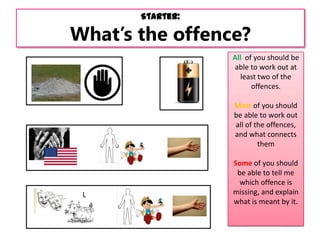
What‟s the offence?
All of you should be
able to work out at
least two of the
offences.
Most of you should
be able to work out
all of the offences,
and what connects
them

L

Some of you should
be able to tell me
which offence is
missing, and explain
what is meant by it.
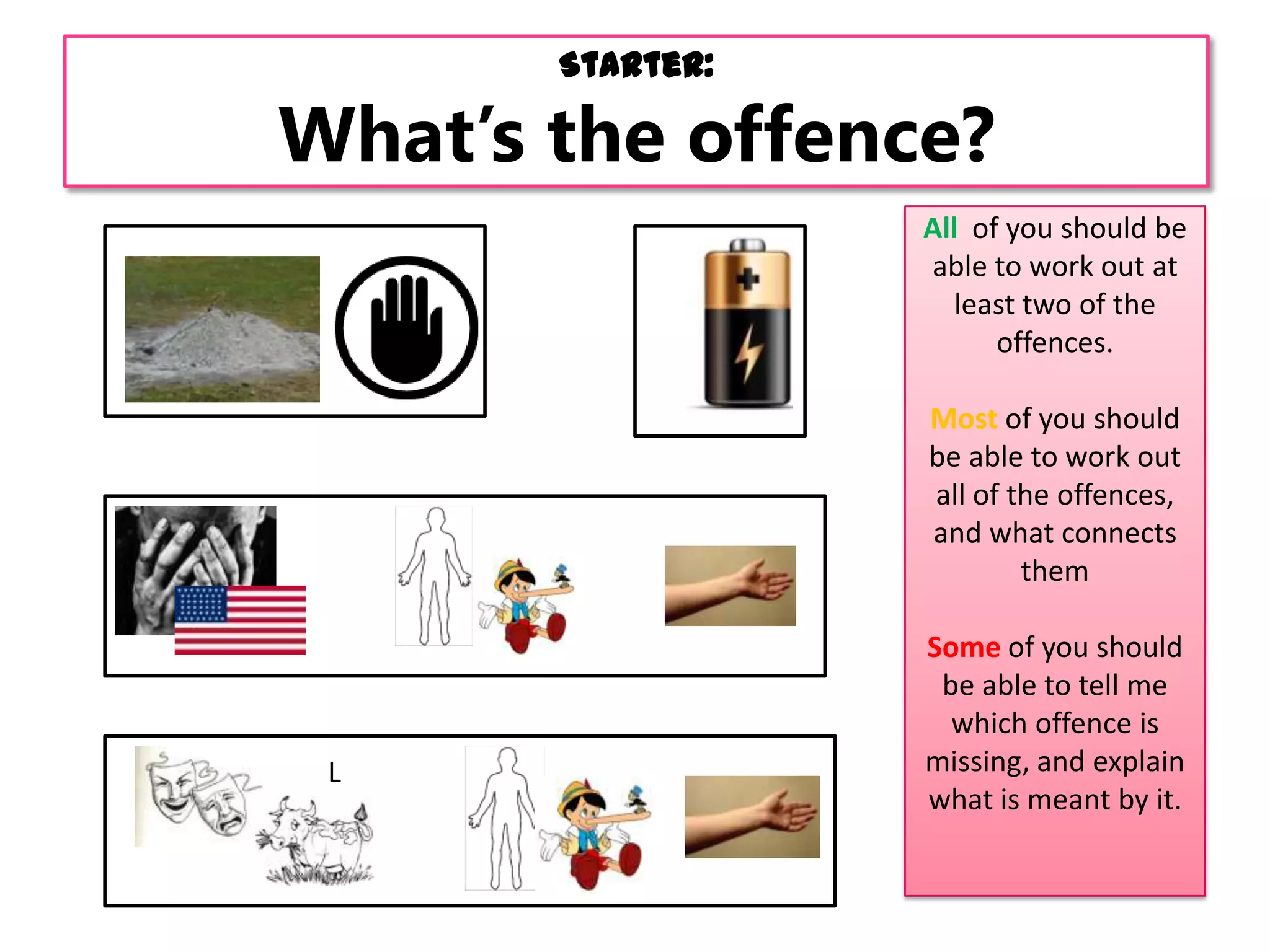
Offence Two:

Battery
“It has long been established that any touching of another, however slight, may amount to battery”

 How is it applied?

 Can you omit a battery?

 Does it have to be hostile?

 Does motive matter?
What about all those everyday batteries on
your way to work or school?
Got it?

Were you listening?
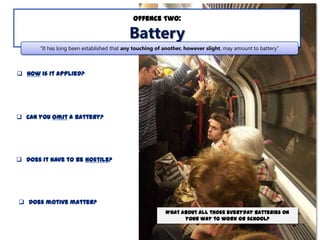
All of you are going to see 10 crimes, and you need to decide whether it is battery, assault or no crime.
Some of you should be able to support your conclusion with reference to a case.

D has an argument with V and
throws a drink in her face
D is on a bus and trips getting
up, falling into V

D says to V “If it wasn‟t for the
police in the street, I‟d take
out this knife and use it on
you,” whilst putting his hand
in his pocket.

D picks up gun and holds it in
V‟s face, without saying
anything. Neither think that it
is loaded

D texts V every
hour claiming
that they are
coming to kill V.
It has been 12
hours since they
started

D puts a metal
bar across the
door and shouts
fire

D likes to touch
freshly dried
clothes, when they
are on the line.

D sings
threatening
songs outside
V‟s house every
night for an
hour.
D sneaks up on
V while they are
sleeping and
cuts their hair.
D climbs up a
ladder and
stares in V‟s
window every
night.
Offence Three:

Assault occasioning Actual Bodily Harm
The offence is committed when a person assaults another, thereby
causing actual bodily harm, which is an either way offence and
carries a maximum penalty on indictment of five years' imprisonment
and/or an unlimited fine not exceeding the statutory maximum

s.47 Offences Against the Person Act 1861
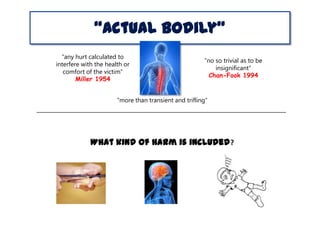
“Actual bodily”
“any hurt calculated to
interfere with the health or
comfort of the victim”
Miller 1954

“no so trivial as to be
insignificant”
Chan-Fook 1994

“more than transient and trifling”

What kind of harm is included?
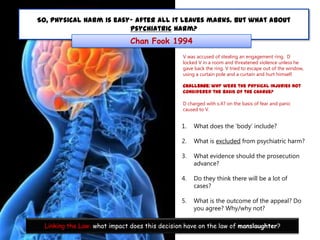
So, physical harm is easy- after all it leaves marks. But what about
psychiatric harm?

Chan Fook 1994
V was accused of stealing an engagement ring. D
locked V in a room and threatened violence unless he
gave back the ring. V tried to escape out of the window,
using a curtain pole and a curtain and hurt himself.
Challenge: why were the physical injuries not
considered the basis of the charge?
D charged with s.47 on the basis of fear and panic
caused to V.

1.

What does the „body‟ include?

2.

What is excluded from psychiatric harm?

3.

What evidence should the prosecution
advance?

4.

Do they think there will be a lot of
cases?

5.

What is the outcome of the appeal? Do
you agree? Why/why not?

Linking the Law: what impact does this decision have on the law of manslaughter?
What about that all important guilty mind?
There is no mention of this in the section, but as it relies on assualt or battery, the
mens rea is the same as for those offences.

Savage

An issue: Does D have to intend or be reckless as to the higher level of harm he causes?
… the short answer is no! Roberts
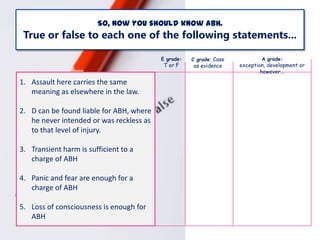
So, now you should know ABH.

True or false to each one of the following statements...
E grade:

T or F

1. Assault here carries the same
meaning as elsewhere in the law.
2. D can be found liable for ABH, where
he never intended or was reckless as
to that level of injury.
3. Transient harm is sufficient to a
charge of ABH
4. Panic and fear are enough for a
charge of ABH
5. Loss of consciousness is enough for
ABH

C grade: Case

as evidence

A grade:

exception, development or
however...
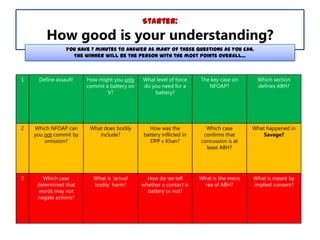
Starter:

How good is your understanding?
You have 7 minutes to answer as many of these questions as you can.
The winner will be the person with the most points overall…

1

Define assault!

How might you only
commit a battery on
V?

What level of force
do you need for a
battery?

The key case on
NFOAP?

Which section
defines ABH?

2

Which NFOAP can
you not commit by
omission?

What does bodily
include?

How was the
battery inflicted in
DPP v Khan?

Which case
confirms that
concussion is at
least ABH?

What happened in
Savage?

3

Which case
determined that
words may not
negate actions?

What is „actual
bodily‟ harm?

How do we tell
whether a contact is
battery or not?

What is the mens
rea of ABH?

What is meant by
implied consent?
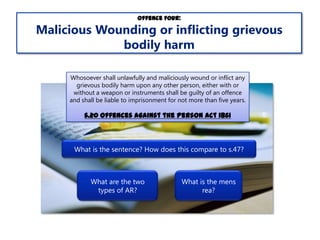
Offence Four:

Malicious Wounding or inflicting grievous
bodily harm
Whosoever shall unlawfully and maliciously wound or inflict any
grievous bodily harm upon any other person, either with or
without a weapon or instruments shall be guilty of an offence
and shall be liable to imprisonment for not more than five years.

s.20 Offences Against the Person Act 1861

What is the sentence? How does this compare to s.47?

What are the two
types of AR?

What is the mens
rea?
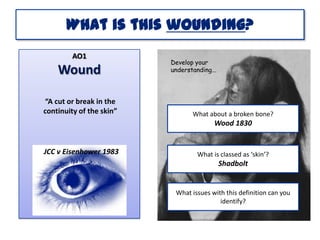
What is this wounding?
AO1

Wound
“A cut or break in the
continuity of the skin”

Develop your
understanding...

What about a broken bone?

Wood 1830

JCC v Eisenhower 1983

What is classed as ‘skin’?

Shadbolt

What issues with this definition can you
identify?
„Grievous‟ Harm

“no more and no less than serious”

Saunders 1985,
confirmed in

Brown 1994
Thinking:
What if the harm would be less on
another, does that matter?

Bollom 2004

Linking the Law:
which other legal rule could explain the
decision in this case?

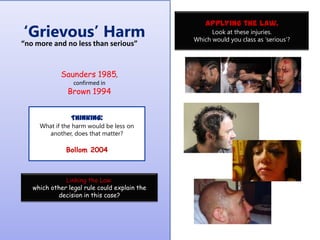
Applying the law.
Look at these injuries.
Which would you class as „serious‟?
“Inflict”
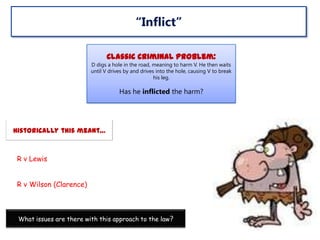
Classic Criminal Problem:
D digs a hole in the road, meaning to harm V. He then waits
until V drives by and drives into the hole, causing V to break
his leg.

Has he inflicted the harm?

Historically this meant…

R v Lewis
R v Wilson (Clarence)

What issues are there with this approach to the law?
The consequences of this
decision…

Burstow 1997
“I am not saying that the
words cause and inflict are
exactly synonymous. They are
not. What I am saying is that in
the context of the Act of 1861
one can nowadays quite
naturally speak of inflicting
psychiatric injury. Moreover,
there is internal contextual
support in the statute for this
view. It would be absurd to
differentiate between
sections 18 and 20 in the way
argued on behalf of Burstow.”

Psychiatric Injury
1.

Is an assault necessary
for a conviction under
s.20?

2.

Can you „inflict‟ a
psychiatric injury?

Biological GBH
1.

What does it mean?

2.

Why is this reliant on the broad
interpretation?

3.

How can you inflict it recklessly
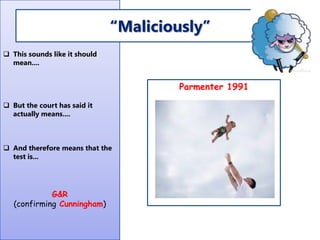
“Maliciously”
 This sounds like it should
mean....

Parmenter 1991
 But the court has said it
actually means....

 And therefore means that the
test is...

G&R
(confirming Cunningham)
Plenary:

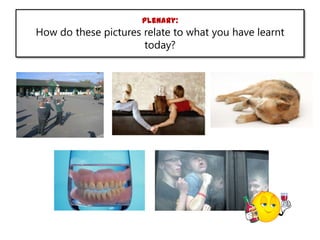
How do these pictures relate to what you have learnt
today?
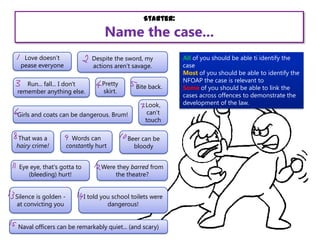
Starter:

Name the case...
Love doesn‟t
pease everyone

Despite the sword, my
actions aren‟t savage.

Run... fall... I don't
remember anything else.

Pretty
skirt.

Bite back.

Girls and coats can be dangerous. Brum!
That was a
hairy crime!

Words can
constantly hurt

Eye eye, that's gotta to
(bleeding) hurt!
Silence is golden at convicting you

Look,
can‟t
touch

Beer can be
bloody

Were they barred from
the theatre?
I told you school toilets were
dangerous!

Naval officers can be remarkably quiet... (and scary)

All of you should be able ti identify the
case
Most of you should be able to identify the
NFOAP the case is relevant to
Some of you should be able to link the
cases across offences to demonstrate the
development of the law.
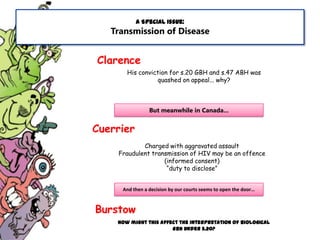
A Special Issue:

Transmission of Disease

Clarence
His conviction for s.20 GBH and s.47 ABH was
quashed on appeal... why?

But meanwhile in Canada...

Cuerrier
Charged with aggravated assault
Fraudulent transmission of HIV may be an offence
(informed consent)
“duty to disclose”
And then a decision by our courts seems to open the door…

Burstow
How might this affect the interpretation of biological
GBH under s.20?
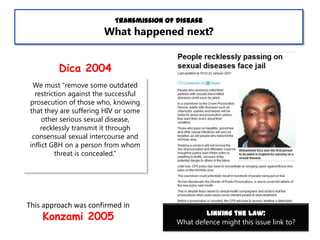
Transmission of Disease

What happened next?
Dica 2004
We must “remove some outdated
restriction against the successful
prosecution of those who, knowing
that they are suffering HIV or some
other serious sexual disease,
recklessly transmit it through
consensual sexual intercourse and
inflict GBH on a person from whom
threat is concealed.”

This approach was confirmed in

Konzami 2005

Linking the Law:
What defence might this issue link to?
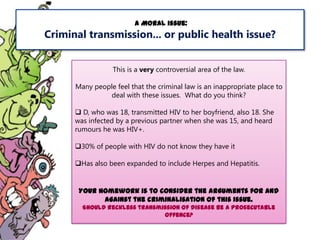
A Moral issue:

Criminal transmission... or public health issue?
This is a very controversial area of the law.

Many people feel that the criminal law is an inappropriate place to
deal with these issues. What do you think?
 D, who was 18, transmitted HIV to her boyfriend, also 18. She
was infected by a previous partner when she was 15, and heard
rumours he was HIV+.
30% of people with HIV do not know they have it
Has also been expanded to include Herpes and Hepatitis.

Your homework is to consider the arguments for and
against the criminalisation of this issue.
Should reckless transmission of disease be a prosecutable
offence?
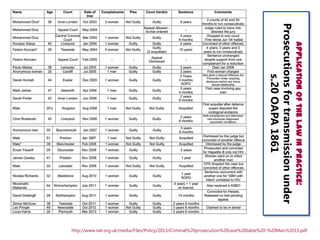
Application of the Law in Practice:

Prosecutions for transmission under
s.20 OAPA 1861

http://www.nat.org.uk/media/Files/Policy/2013/Criminal%20prosecution%20case%20table%20-%20March2013.pdf
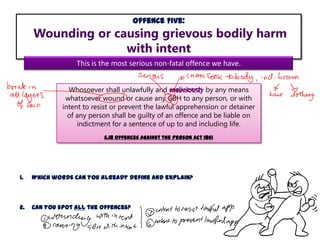
Offence Five:

Wounding or causing grievous bodily harm
with intent
This is the most serious non-fatal offence we have.
Whosoever shall unlawfully and maliciously by any means
whatsoever wound or cause any GBH to any person, or with
intent to resist or prevent the lawful apprehension or detainer
of any person shall be guilty of an offence and be liable on
indictment for a sentence of up to and including life.
s.18 Offences Against the Person Act 1861

1.

Which words can you already define and explain?

2.

Can you spot all the offences?
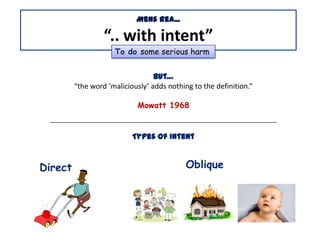
Mens Rea...

“.. with intent”
To do some serious harm

but…
“the word ‘maliciously’ adds nothing to the definition.”
Mowatt 1968

Types of Intent

Direct

Oblique
Let’s start with the odd offence…

“…with intent to resist or prevent the lawful apprehension or detainer of
any person.”

Morrison 1989

s.18 requires an unlawful and malicious wounding with intent
apprehension of the person.

to resist the lawful
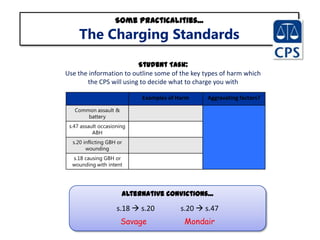
Some Practicalities...

The Charging Standards
Student Task:
Use the information to outline some of the key types of harm which
the CPS will using to decide what to charge you with
Examples of Harm

Aggravating factors?

Common assault &
battery
s.47 assault occasioning
ABH
s.20 inflicting GBH or
wounding
s.18 causing GBH or
wounding with intent

Alternative convictions...

s.18  s.20

s.20  s.47

Savage

Mondair
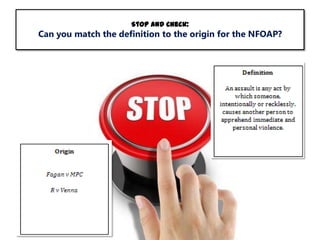
Stop and Check:

Can you match the definition to the origin for the NFOAP?
Got it?

Applying what you have learnt

Working in pairs or threes, you are going to
answer one section C question using paper
chains

But before the creative bit...
What are the essential things to remember
when answering a section C?
Our list for success:
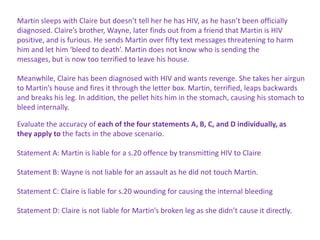
Martin sleeps with Claire but doesn’t tell her he has HIV, as he hasn’t been officially
diagnosed. Claire’s brother, Wayne, later finds out from a friend that Martin is HIV
positive, and is furious. He sends Martin over fifty text messages threatening to harm
him and let him ‘bleed to death’. Martin does not know who is sending the
messages, but is now too terrified to leave his house.
Meanwhile, Claire has been diagnosed with HIV and wants revenge. She takes her airgun
to Martin’s house and fires it through the letter box. Martin, terrified, leaps backwards
and breaks his leg. In addition, the pellet hits him in the stomach, causing his stomach to
bleed internally.
Evaluate the accuracy of each of the four statements A, B, C, and D individually, as
they apply to the facts in the above scenario.
Statement A: Martin is liable for a s.20 offence by transmitting HIV to Claire
Statement B: Wayne is not liable for an assault as he did not touch Martin.
Statement C: Claire is liable for s.20 wounding for causing the internal bleeding
Statement D: Claire is not liable for Martin’s broken leg as she didn’t cause it directly.
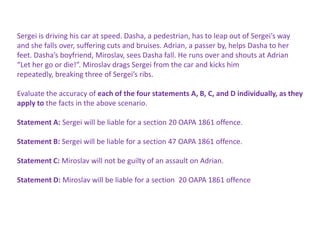
Sergei is driving his car at speed. Dasha, a pedestrian, has to leap out of Sergei’s way
and she falls over, suffering cuts and bruises. Adrian, a passer by, helps Dasha to her
feet. Dasha’s boyfriend, Miroslav, sees Dasha fall. He runs over and shouts at Adrian
“Let her go or die!”. Miroslav drags Sergei from the car and kicks him
repeatedly, breaking three of Sergei’s ribs.
Evaluate the accuracy of each of the four statements A, B, C, and D individually, as they
apply to the facts in the above scenario.
Statement A: Sergei will be liable for a section 20 OAPA 1861 offence.
Statement B: Sergei will be liable for a section 47 OAPA 1861 offence.
Statement C: Miroslav will not be guilty of an assault on Adrian.
Statement D: Miroslav will be liable for a section 20 OAPA 1861 offence
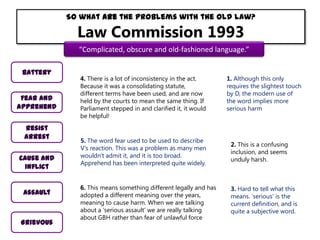
So what are the problems with the old law?

Law Commission 1993

“Complicated, obscure and old-fashioned language.”
Battery
Fear and
apprehend
Resist
arrest
Cause and
inflict
Assault

Grievous

4. There is a lot of inconsistency in the act.
Because it was a consolidating statute,
different terms have been used, and are now
held by the courts to mean the same thing. If
Parliament stepped in and clarified it, it would
be helpful!

1. Although this only
requires the slightest touch
by D, the modern use of
the word implies more
serious harm

5. The word fear used to be used to describe
V's reaction. This was a problem as many men
wouldn't admit it, and it is too broad.
Apprehend has been interpreted quite widely.

2. This is a confusing
inclusion, and seems
unduly harsh.

6. This means something different legally and has
adopted a different meaning over the years,
meaning to cause harm. When we are talking
about a 'serious assault' we are really talking
about GBH rather than fear of unlawful force

3. Hard to tell what this
means. 'serious' is the
current definition, and is
quite a subjective word.
Next step… a Draft Bill

Yes, that‟s right they actually took the next step!

The proposed
clauses…
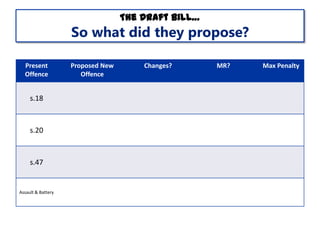
The Draft Bill…

So what did they propose?
Present
Offence

s.18

s.20

s.47

Assault & Battery

Proposed New
Offence

Changes?

MR?

Max Penalty
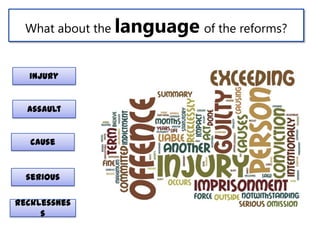
What about the language of the reforms?

injury

assault

cause

serious
recklessnes
s
Plenary:

True or False?

Based on your understanding of this lesson, answer the following
questions.
The government proposed a bill to reform non-fatal attempts
Serious was not defined in the bill
The maximum sentence for reckless serious injury would be 5 years
Assault would stay the same
The mens rea for clauses 2 and 3 would stay the same as for the current
offences (s.20 and s.47)
Transmission of a disease would still be an offence under the new act.
Injury would include physical and psychiatric harm
Wounding does not appear in the bill
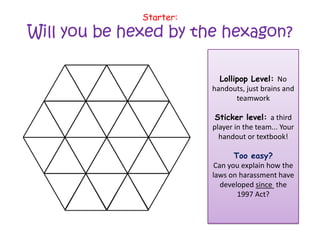
Starter:

Will you be hexed by the hexagon?
Lollipop Level: No
handouts, just brains and
teamwork
Sticker level: a third
player in the team... Your
handout or textbook!

Too easy?
Can you explain how the
laws on harassment have
developed since the
1997 Act?
Sinita and Mina share a flat. One night
Sinita finds Mina kissing Sinita’s
boyfriend, Alberto. She picks up a glass of
water, raises it in the air and shouts at
Mina, “You hussy, I’ll kill you!” She tries to
throw the water at Mina but the glass
slips from her hand and strikes Mina in
the face cutting her forehead.
Alberto is so angry that he pushes Sinita
and she falls backwards over a stool onto
the floor and is knocked unconscious for a
few seconds.
When Sinita recovers consciousness she is
still dizzy and stumbles towards Mina
knocking her onto the floor. Mina suffers
a fractured arm.
Later that evening, when Sinita is
sleeping, Mina gets a pair of scissors and
cuts off Sinita’s ponytail in an act of
revenge.
Discuss the potential criminal liability of
Sinita, Alberto and Mina for the above
incidents. [50]

This is a problem question and will
appear in part b of the paper.
You will have three and must answer one of them.
They are worth 50 marks (25 AO1, 20 AO2 and 5
Ao3) and should be logical, detailed and well
applied... In fifty minutes
You should refer to at least eight well explained
cases and will need to know your definitions to
help.
You should deal with each defendant seperately
(subheadings can be useful)
You need to remember:
O
C
D
In structuring your answer.
Stage One: highlight and annotate the problem, identifying relevant cases, statutes
and definitions.

Sinita and Mina share a flat. One night Sinita finds Mina kissing
Sinita’s boyfriend, Alberto. She picks up a glass of water, raises it
in the air and shouts at Mina, “You hussy, I’ll kill you!” She tries to
throw the water at Mina but the glass slips from her hand and
strikes Mina in the face cutting her forehead.
Alberto is so angry that he pushes Sinita and she falls backwards
over a stool onto the floor and is knocked unconscious for a few
seconds.
When Sinita recovers consciousness she is still dizzy and stumbles
towards Mina knocking her onto the floor. Mina suffers a
fractured arm.

Later that evening, when Sinita is sleeping, Mina gets a pair of
scissors and cuts off Sinita’s ponytail in an act of revenge.
Discuss the potential criminal liability of Sinita, Alberto and
Mina for the above incidents. [50]
Stage Two: Start planning your answer by noting down the OCD issues for each
defendant.

Sinita and Mina share a flat. One night Sinita finds Mina kissing
Sinita’s boyfriend, Alberto. She picks up a glass of water, raises it
in the air and shouts at Mina, “You hussy, I’ll kill you!” She tries to
throw the water at Mina but the glass slips from her hand and
strikes Mina in the face cutting her forehead.
Alberto is so angry that he pushes Sinita and she falls backwards
over a stool onto the floor and is knocked unconscious for a few
seconds.

Sinita

Mina:

When Sinita recovers consciousness she is still dizzy and stumbles
towards Mina knocking her onto the floor. Mina suffers a
fractured arm.

Later that evening, when Sinita is sleeping, Mina gets a pair of
scissors and cuts off Sinita’s ponytail in an act of revenge.
Discuss the potential criminal liability of Sinita, Alberto and
Mina for the above incidents. [50]

Alberto:
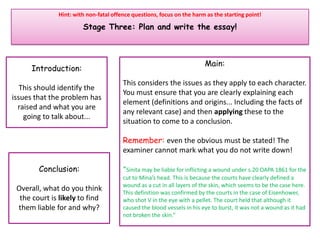
Hint: with non-fatal offence questions, focus on the harm as the starting point!

Stage Three: Plan and write the essay!

Introduction:
This should identify the
issues that the problem has
raised and what you are
going to talk about...

Main:
This considers the issues as they apply to each character.
You must ensure that you are clearly explaining each
element (definitions and origins... Including the facts of
any relevant case) and then applying these to the
situation to come to a conclusion.
Remember: even the obvious must be stated! The
examiner cannot mark what you do not write down!

Conclusion:

“Sinita may be liable for inflicting a wound under s.20 OAPA 1861 for the

Overall, what do you think
the court is likely to find
them liable for and why?

cut to Mina’s head. This is because the courts have clearly defined a
wound as a cut in all layers of the skin, which seems to be the case here.
This definition was confirmed by the courts in the case of Eisenhower,
who shot V in the eye with a pellet. The court held that although it
caused the blood vessels in his eye to burst, it was not a wound as it had
not broken the skin.”
Homework:

Finally...

1. Continue revising for your Mock
Criminal Law Exam next week
13A
13C

How confident are you with
what you’ve got to do for a
problem question?

25th April 2012
26th April 2012

2. Write up the problem question we
have just planned.
If you want it marked and back
before the mock exam ensure it
gets to me before the end of
school on Monday 23rd April.

Not at
all

Very

Nfoap2014

  • 1.
    Starter: What‟s the offence? Allof you should be able to work out at least two of the offences. Most of you should be able to work out all of the offences, and what connects them L Some of you should be able to tell me which offence is missing, and explain what is meant by it.
  • 2.
    Offence Two: Battery “It haslong been established that any touching of another, however slight, may amount to battery”  How is it applied?  Can you omit a battery?  Does it have to be hostile?  Does motive matter? What about all those everyday batteries on your way to work or school?
  • 3.
    Got it? Were youlistening? All of you are going to see 10 crimes, and you need to decide whether it is battery, assault or no crime. Some of you should be able to support your conclusion with reference to a case. D has an argument with V and throws a drink in her face D is on a bus and trips getting up, falling into V D says to V “If it wasn‟t for the police in the street, I‟d take out this knife and use it on you,” whilst putting his hand in his pocket. D picks up gun and holds it in V‟s face, without saying anything. Neither think that it is loaded D texts V every hour claiming that they are coming to kill V. It has been 12 hours since they started D puts a metal bar across the door and shouts fire D likes to touch freshly dried clothes, when they are on the line. D sings threatening songs outside V‟s house every night for an hour. D sneaks up on V while they are sleeping and cuts their hair. D climbs up a ladder and stares in V‟s window every night.
  • 4.
    Offence Three: Assault occasioningActual Bodily Harm The offence is committed when a person assaults another, thereby causing actual bodily harm, which is an either way offence and carries a maximum penalty on indictment of five years' imprisonment and/or an unlimited fine not exceeding the statutory maximum s.47 Offences Against the Person Act 1861
  • 5.
    “Actual bodily” “any hurtcalculated to interfere with the health or comfort of the victim” Miller 1954 “no so trivial as to be insignificant” Chan-Fook 1994 “more than transient and trifling” What kind of harm is included?
  • 6.
    So, physical harmis easy- after all it leaves marks. But what about psychiatric harm? Chan Fook 1994 V was accused of stealing an engagement ring. D locked V in a room and threatened violence unless he gave back the ring. V tried to escape out of the window, using a curtain pole and a curtain and hurt himself. Challenge: why were the physical injuries not considered the basis of the charge? D charged with s.47 on the basis of fear and panic caused to V. 1. What does the „body‟ include? 2. What is excluded from psychiatric harm? 3. What evidence should the prosecution advance? 4. Do they think there will be a lot of cases? 5. What is the outcome of the appeal? Do you agree? Why/why not? Linking the Law: what impact does this decision have on the law of manslaughter?
  • 7.
    What about thatall important guilty mind? There is no mention of this in the section, but as it relies on assualt or battery, the mens rea is the same as for those offences. Savage An issue: Does D have to intend or be reckless as to the higher level of harm he causes? … the short answer is no! Roberts
  • 8.
    So, now youshould know ABH. True or false to each one of the following statements... E grade: T or F 1. Assault here carries the same meaning as elsewhere in the law. 2. D can be found liable for ABH, where he never intended or was reckless as to that level of injury. 3. Transient harm is sufficient to a charge of ABH 4. Panic and fear are enough for a charge of ABH 5. Loss of consciousness is enough for ABH C grade: Case as evidence A grade: exception, development or however...
  • 9.
    Starter: How good isyour understanding? You have 7 minutes to answer as many of these questions as you can. The winner will be the person with the most points overall… 1 Define assault! How might you only commit a battery on V? What level of force do you need for a battery? The key case on NFOAP? Which section defines ABH? 2 Which NFOAP can you not commit by omission? What does bodily include? How was the battery inflicted in DPP v Khan? Which case confirms that concussion is at least ABH? What happened in Savage? 3 Which case determined that words may not negate actions? What is „actual bodily‟ harm? How do we tell whether a contact is battery or not? What is the mens rea of ABH? What is meant by implied consent?
  • 10.
    Offence Four: Malicious Woundingor inflicting grievous bodily harm Whosoever shall unlawfully and maliciously wound or inflict any grievous bodily harm upon any other person, either with or without a weapon or instruments shall be guilty of an offence and shall be liable to imprisonment for not more than five years. s.20 Offences Against the Person Act 1861 What is the sentence? How does this compare to s.47? What are the two types of AR? What is the mens rea?
  • 11.
    What is thiswounding? AO1 Wound “A cut or break in the continuity of the skin” Develop your understanding... What about a broken bone? Wood 1830 JCC v Eisenhower 1983 What is classed as ‘skin’? Shadbolt What issues with this definition can you identify?
  • 12.
    „Grievous‟ Harm “no moreand no less than serious” Saunders 1985, confirmed in Brown 1994 Thinking: What if the harm would be less on another, does that matter? Bollom 2004 Linking the Law: which other legal rule could explain the decision in this case? Applying the law. Look at these injuries. Which would you class as „serious‟?
  • 13.
    “Inflict” Classic Criminal Problem: Ddigs a hole in the road, meaning to harm V. He then waits until V drives by and drives into the hole, causing V to break his leg. Has he inflicted the harm? Historically this meant… R v Lewis R v Wilson (Clarence) What issues are there with this approach to the law?
  • 14.
    The consequences ofthis decision… Burstow 1997 “I am not saying that the words cause and inflict are exactly synonymous. They are not. What I am saying is that in the context of the Act of 1861 one can nowadays quite naturally speak of inflicting psychiatric injury. Moreover, there is internal contextual support in the statute for this view. It would be absurd to differentiate between sections 18 and 20 in the way argued on behalf of Burstow.” Psychiatric Injury 1. Is an assault necessary for a conviction under s.20? 2. Can you „inflict‟ a psychiatric injury? Biological GBH 1. What does it mean? 2. Why is this reliant on the broad interpretation? 3. How can you inflict it recklessly
  • 15.
    “Maliciously”  This soundslike it should mean.... Parmenter 1991  But the court has said it actually means....  And therefore means that the test is... G&R (confirming Cunningham)
  • 16.
    Plenary: How do thesepictures relate to what you have learnt today?
  • 17.
    Starter: Name the case... Lovedoesn‟t pease everyone Despite the sword, my actions aren‟t savage. Run... fall... I don't remember anything else. Pretty skirt. Bite back. Girls and coats can be dangerous. Brum! That was a hairy crime! Words can constantly hurt Eye eye, that's gotta to (bleeding) hurt! Silence is golden at convicting you Look, can‟t touch Beer can be bloody Were they barred from the theatre? I told you school toilets were dangerous! Naval officers can be remarkably quiet... (and scary) All of you should be able ti identify the case Most of you should be able to identify the NFOAP the case is relevant to Some of you should be able to link the cases across offences to demonstrate the development of the law.
  • 18.
    A Special Issue: Transmissionof Disease Clarence His conviction for s.20 GBH and s.47 ABH was quashed on appeal... why? But meanwhile in Canada... Cuerrier Charged with aggravated assault Fraudulent transmission of HIV may be an offence (informed consent) “duty to disclose” And then a decision by our courts seems to open the door… Burstow How might this affect the interpretation of biological GBH under s.20?
  • 19.
    Transmission of Disease Whathappened next? Dica 2004 We must “remove some outdated restriction against the successful prosecution of those who, knowing that they are suffering HIV or some other serious sexual disease, recklessly transmit it through consensual sexual intercourse and inflict GBH on a person from whom threat is concealed.” This approach was confirmed in Konzami 2005 Linking the Law: What defence might this issue link to?
  • 20.
    A Moral issue: Criminaltransmission... or public health issue? This is a very controversial area of the law. Many people feel that the criminal law is an inappropriate place to deal with these issues. What do you think?  D, who was 18, transmitted HIV to her boyfriend, also 18. She was infected by a previous partner when she was 15, and heard rumours he was HIV+. 30% of people with HIV do not know they have it Has also been expanded to include Herpes and Hepatitis. Your homework is to consider the arguments for and against the criminalisation of this issue. Should reckless transmission of disease be a prosecutable offence?
  • 21.
    Application of theLaw in Practice: Prosecutions for transmission under s.20 OAPA 1861 http://www.nat.org.uk/media/Files/Policy/2013/Criminal%20prosecution%20case%20table%20-%20March2013.pdf
  • 22.
    Offence Five: Wounding orcausing grievous bodily harm with intent This is the most serious non-fatal offence we have. Whosoever shall unlawfully and maliciously by any means whatsoever wound or cause any GBH to any person, or with intent to resist or prevent the lawful apprehension or detainer of any person shall be guilty of an offence and be liable on indictment for a sentence of up to and including life. s.18 Offences Against the Person Act 1861 1. Which words can you already define and explain? 2. Can you spot all the offences?
  • 23.
    Mens Rea... “.. withintent” To do some serious harm but… “the word ‘maliciously’ adds nothing to the definition.” Mowatt 1968 Types of Intent Direct Oblique
  • 24.
    Let’s start withthe odd offence… “…with intent to resist or prevent the lawful apprehension or detainer of any person.” Morrison 1989 s.18 requires an unlawful and malicious wounding with intent apprehension of the person. to resist the lawful
  • 25.
    Some Practicalities... The ChargingStandards Student Task: Use the information to outline some of the key types of harm which the CPS will using to decide what to charge you with Examples of Harm Aggravating factors? Common assault & battery s.47 assault occasioning ABH s.20 inflicting GBH or wounding s.18 causing GBH or wounding with intent Alternative convictions... s.18  s.20 s.20  s.47 Savage Mondair
  • 26.
    Stop and Check: Canyou match the definition to the origin for the NFOAP?
  • 27.
    Got it? Applying whatyou have learnt Working in pairs or threes, you are going to answer one section C question using paper chains But before the creative bit... What are the essential things to remember when answering a section C? Our list for success:
  • 28.
    Martin sleeps withClaire but doesn’t tell her he has HIV, as he hasn’t been officially diagnosed. Claire’s brother, Wayne, later finds out from a friend that Martin is HIV positive, and is furious. He sends Martin over fifty text messages threatening to harm him and let him ‘bleed to death’. Martin does not know who is sending the messages, but is now too terrified to leave his house. Meanwhile, Claire has been diagnosed with HIV and wants revenge. She takes her airgun to Martin’s house and fires it through the letter box. Martin, terrified, leaps backwards and breaks his leg. In addition, the pellet hits him in the stomach, causing his stomach to bleed internally. Evaluate the accuracy of each of the four statements A, B, C, and D individually, as they apply to the facts in the above scenario. Statement A: Martin is liable for a s.20 offence by transmitting HIV to Claire Statement B: Wayne is not liable for an assault as he did not touch Martin. Statement C: Claire is liable for s.20 wounding for causing the internal bleeding Statement D: Claire is not liable for Martin’s broken leg as she didn’t cause it directly.
  • 29.
    Sergei is drivinghis car at speed. Dasha, a pedestrian, has to leap out of Sergei’s way and she falls over, suffering cuts and bruises. Adrian, a passer by, helps Dasha to her feet. Dasha’s boyfriend, Miroslav, sees Dasha fall. He runs over and shouts at Adrian “Let her go or die!”. Miroslav drags Sergei from the car and kicks him repeatedly, breaking three of Sergei’s ribs. Evaluate the accuracy of each of the four statements A, B, C, and D individually, as they apply to the facts in the above scenario. Statement A: Sergei will be liable for a section 20 OAPA 1861 offence. Statement B: Sergei will be liable for a section 47 OAPA 1861 offence. Statement C: Miroslav will not be guilty of an assault on Adrian. Statement D: Miroslav will be liable for a section 20 OAPA 1861 offence
  • 30.
    So what arethe problems with the old law? Law Commission 1993 “Complicated, obscure and old-fashioned language.” Battery Fear and apprehend Resist arrest Cause and inflict Assault Grievous 4. There is a lot of inconsistency in the act. Because it was a consolidating statute, different terms have been used, and are now held by the courts to mean the same thing. If Parliament stepped in and clarified it, it would be helpful! 1. Although this only requires the slightest touch by D, the modern use of the word implies more serious harm 5. The word fear used to be used to describe V's reaction. This was a problem as many men wouldn't admit it, and it is too broad. Apprehend has been interpreted quite widely. 2. This is a confusing inclusion, and seems unduly harsh. 6. This means something different legally and has adopted a different meaning over the years, meaning to cause harm. When we are talking about a 'serious assault' we are really talking about GBH rather than fear of unlawful force 3. Hard to tell what this means. 'serious' is the current definition, and is quite a subjective word.
  • 31.
    Next step… aDraft Bill Yes, that‟s right they actually took the next step! The proposed clauses…
  • 32.
    The Draft Bill… Sowhat did they propose? Present Offence s.18 s.20 s.47 Assault & Battery Proposed New Offence Changes? MR? Max Penalty
  • 33.
    What about thelanguage of the reforms? injury assault cause serious recklessnes s
  • 34.
    Plenary: True or False? Basedon your understanding of this lesson, answer the following questions. The government proposed a bill to reform non-fatal attempts Serious was not defined in the bill The maximum sentence for reckless serious injury would be 5 years Assault would stay the same The mens rea for clauses 2 and 3 would stay the same as for the current offences (s.20 and s.47) Transmission of a disease would still be an offence under the new act. Injury would include physical and psychiatric harm Wounding does not appear in the bill
  • 35.
    Starter: Will you behexed by the hexagon? Lollipop Level: No handouts, just brains and teamwork Sticker level: a third player in the team... Your handout or textbook! Too easy? Can you explain how the laws on harassment have developed since the 1997 Act?
  • 36.
    Sinita and Minashare a flat. One night Sinita finds Mina kissing Sinita’s boyfriend, Alberto. She picks up a glass of water, raises it in the air and shouts at Mina, “You hussy, I’ll kill you!” She tries to throw the water at Mina but the glass slips from her hand and strikes Mina in the face cutting her forehead. Alberto is so angry that he pushes Sinita and she falls backwards over a stool onto the floor and is knocked unconscious for a few seconds. When Sinita recovers consciousness she is still dizzy and stumbles towards Mina knocking her onto the floor. Mina suffers a fractured arm. Later that evening, when Sinita is sleeping, Mina gets a pair of scissors and cuts off Sinita’s ponytail in an act of revenge. Discuss the potential criminal liability of Sinita, Alberto and Mina for the above incidents. [50] This is a problem question and will appear in part b of the paper. You will have three and must answer one of them. They are worth 50 marks (25 AO1, 20 AO2 and 5 Ao3) and should be logical, detailed and well applied... In fifty minutes You should refer to at least eight well explained cases and will need to know your definitions to help. You should deal with each defendant seperately (subheadings can be useful) You need to remember: O C D In structuring your answer.
  • 37.
    Stage One: highlightand annotate the problem, identifying relevant cases, statutes and definitions. Sinita and Mina share a flat. One night Sinita finds Mina kissing Sinita’s boyfriend, Alberto. She picks up a glass of water, raises it in the air and shouts at Mina, “You hussy, I’ll kill you!” She tries to throw the water at Mina but the glass slips from her hand and strikes Mina in the face cutting her forehead. Alberto is so angry that he pushes Sinita and she falls backwards over a stool onto the floor and is knocked unconscious for a few seconds. When Sinita recovers consciousness she is still dizzy and stumbles towards Mina knocking her onto the floor. Mina suffers a fractured arm. Later that evening, when Sinita is sleeping, Mina gets a pair of scissors and cuts off Sinita’s ponytail in an act of revenge. Discuss the potential criminal liability of Sinita, Alberto and Mina for the above incidents. [50]
  • 38.
    Stage Two: Startplanning your answer by noting down the OCD issues for each defendant. Sinita and Mina share a flat. One night Sinita finds Mina kissing Sinita’s boyfriend, Alberto. She picks up a glass of water, raises it in the air and shouts at Mina, “You hussy, I’ll kill you!” She tries to throw the water at Mina but the glass slips from her hand and strikes Mina in the face cutting her forehead. Alberto is so angry that he pushes Sinita and she falls backwards over a stool onto the floor and is knocked unconscious for a few seconds. Sinita Mina: When Sinita recovers consciousness she is still dizzy and stumbles towards Mina knocking her onto the floor. Mina suffers a fractured arm. Later that evening, when Sinita is sleeping, Mina gets a pair of scissors and cuts off Sinita’s ponytail in an act of revenge. Discuss the potential criminal liability of Sinita, Alberto and Mina for the above incidents. [50] Alberto:
  • 39.
    Hint: with non-fataloffence questions, focus on the harm as the starting point! Stage Three: Plan and write the essay! Introduction: This should identify the issues that the problem has raised and what you are going to talk about... Main: This considers the issues as they apply to each character. You must ensure that you are clearly explaining each element (definitions and origins... Including the facts of any relevant case) and then applying these to the situation to come to a conclusion. Remember: even the obvious must be stated! The examiner cannot mark what you do not write down! Conclusion: “Sinita may be liable for inflicting a wound under s.20 OAPA 1861 for the Overall, what do you think the court is likely to find them liable for and why? cut to Mina’s head. This is because the courts have clearly defined a wound as a cut in all layers of the skin, which seems to be the case here. This definition was confirmed by the courts in the case of Eisenhower, who shot V in the eye with a pellet. The court held that although it caused the blood vessels in his eye to burst, it was not a wound as it had not broken the skin.”
  • 40.
    Homework: Finally... 1. Continue revisingfor your Mock Criminal Law Exam next week 13A 13C How confident are you with what you’ve got to do for a problem question? 25th April 2012 26th April 2012 2. Write up the problem question we have just planned. If you want it marked and back before the mock exam ensure it gets to me before the end of school on Monday 23rd April. Not at all Very