Bail &
Pre-trial
So you’ve been stopped and searched, arrested, detained and charged...
What’s next?
MAH 2013-14
Starter:
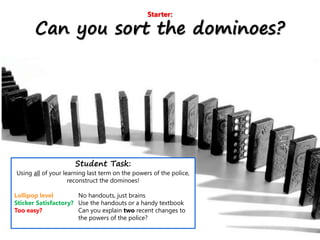
Can you sort the dominoes?
Student Task:
Using all of your learning last term on the powers of the police,
reconstruct the dominoes!
Lollipop level No handouts, just brains
Sticker Satisfactory? Use the handouts or a handy textbook
Too easy? Can you explain two recent changes to
the powers of the police?
Homework
1. Prepare revision notes and revise for an end of unit test on all of police powers
in two weeks time.
2. Watch the first episode of “24 hours in Police Custody” and write a review of the
program.
 Does it accurately reflect the law as you have been taught it?
 What key aspects of police powers are highlighted?
 How does the program show the police respecting the rights of the individual
and still trying to protect the public?
Introduction:
Dunstable and the Law on Bail
Student Task:
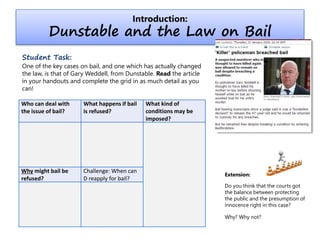
One of the key cases on bail, and one which has actually changed
the law, is that of Gary Weddell, from Dunstable. Read the article
in your handouts and complete the grid in as much detail as you
can!
Who can deal with
the issue of bail?
What happens if bail
is refused?
What kind of
conditions may be
imposed?
Why might bail be
refused?
Challenge: When can
D reapply for bail?
Extension:
Do you think that the courts got
the balance between protecting
the public and the presumption of
innocence right in this case?
Why? Why not?
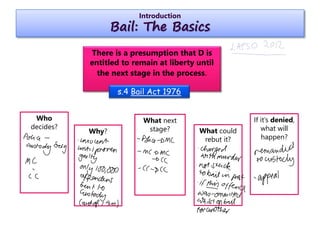
There is a presumption that D is
entitled to remain at liberty until
the next stage in the process.
Introduction
Bail: The Basics
Who
decides?
Why? What could
rebut it?
What next
stage?
s.4 Bail Act 1976
If it’s denied,
what will
happen?
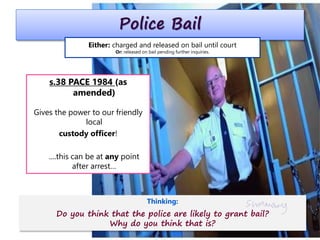
Police Bail
s.38 PACE 1984 (as
amended)
Gives the power to our friendly
local
custody officer!
....this can be at any point
after arrest…
Either: charged and released on bail until court
Or: released on bail pending further inquiries.
Thinking:
Do you think that the police are likely to grant bail?
Why do you think that is?
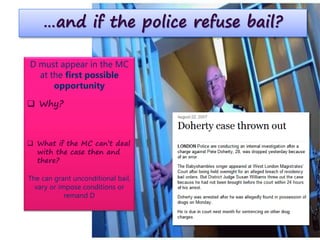
…and if the police refuse bail?
D must appear in the MC
at the first possible
opportunity
 Why?
 What if the MC can’t deal
with the case then and
there?
The can grant unconditional bail,
vary or impose conditions or
remand D
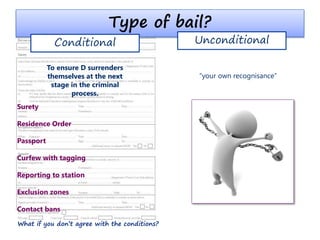
Type of bail?
Conditional Unconditional
“your own recognisance”
To ensure D surrenders
themselves at the next
stage in the criminal
process.
Surety
Residence Order
Passport
Curfew with tagging
Reporting to station
Exclusion zones
Contact bans
What if you don’t agree with the conditions?
Surety:
A Case Example
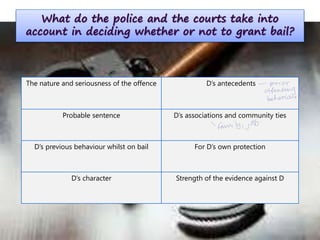
What do the police and the courts take into
account in deciding whether or not to grant bail?
The nature and seriousness of the offence D’s antecedents
Probable sentence D’s associations and community ties
D’s previous behaviour whilst on bail For D’s own protection
D’s character Strength of the evidence against D
Plenary:
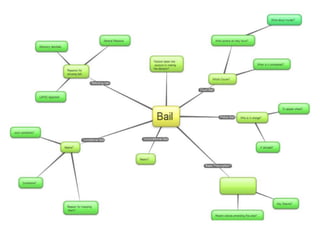
How do each of the following images link to today’s
lesson?
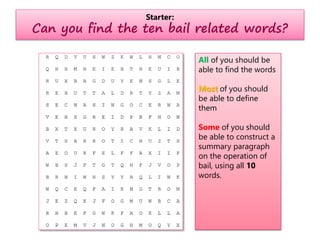
Starter:
Can you find the ten bail related words?
All of you should be
able to find the words
Most of you should
be able to define
them
Some of you should
be able to construct a
summary paragraph
on the operation of
bail, using all 10
words.
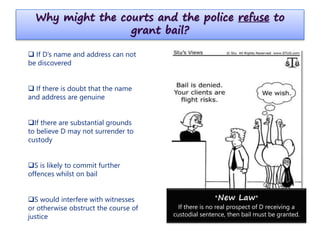
Why might the courts and the police refuse to
grant bail?
 If D’s name and address can not
be discovered
 If there is doubt that the name
and address are genuine
If there are substantial grounds
to believe D may not surrender to
custody
S is likely to commit further
offences whilst on bail
S would interfere with witnesses
or otherwise obstruct the course of
justice
*New Law*
If there is no real prospect of D receiving a
custodial sentence, then bail must be granted.
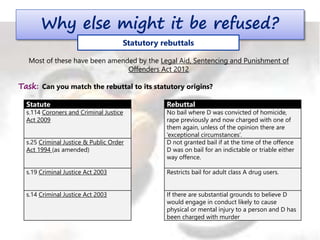
Why else might it be refused?
Statutory rebuttals
Statute Rebuttal
s.114 Coroners and Criminal Justice
Act 2009
No bail where D was convicted of homicide,
rape previously and now charged with one of
them again, unless of the opinion there are
‘exceptional circumstances’.
s.25 Criminal Justice & Public Order
Act 1994 (as amended)
D not granted bail if at the time of the offence
D was on bail for an indictable or triable either
way offence.
s.19 Criminal Justice Act 2003 Restricts bail for adult class A drug users.
s.14 Criminal Justice Act 2003 If there are substantial grounds to believe D
would engage in conduct likely to cause
physical or mental injury to a person and D has
been charged with murder
Most of these have been amended by the Legal Aid, Sentencing and Punishment of
Offenders Act 2012
Task: Can you match the rebuttal to its statutory origins?
Applying the Law:
Ok, so you kind of get it...
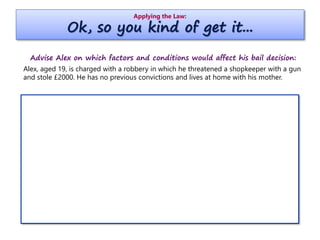
Advise Alex on which factors and conditions would affect his bail decision:
Alex, aged 19, is charged with a robbery in which he threatened a shopkeeper with a gun
and stole £2000. He has no previous convictions and lives at home with his mother.
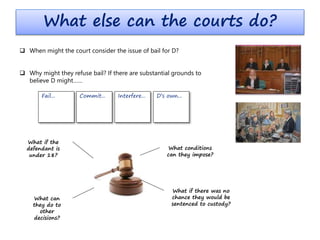
What else can the courts do?
 When might the court consider the issue of bail for D?
 Why might they refuse bail? If there are substantial grounds to
believe D might……
Fail... Commit... Interfere... D’s own...
What conditions
can they impose?
What if the
defendant is
under 18?
What if there was no
chance they would be
sentenced to custody?
What can
they do to
other
decisions?
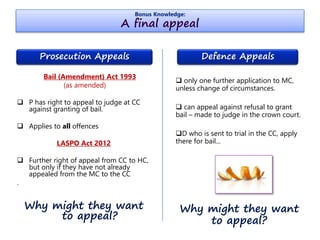
Bonus Knowledge:
A final appeal
Bail (Amendment) Act 1993
(as amended)
 P has right to appeal to judge at CC
against granting of bail.
 Applies to all offences
LASPO Act 2012
 Further right of appeal from CC to HC,
but only if they have not already
appealed from the MC to the CC
.
Why might they want
to appeal?
 only one further application to MC,
unless change of circumstances.
 can appeal against refusal to grant
bail – made to judge in the crown court.
D who is sent to trial in the CC, apply
there for bail...
Why might they want
to appeal?
Prosecution Appeals Defence Appeals
Starter:
Demonstrate your knowledge
Using your understanding,
complete the triangle...
There is only one correct
solution.
Lollipop level No handouts, just brains
Sticker Satisfactory?
Use the handouts or a handy textbook
Too easy? Can you spot what’s
missing from the triangle?
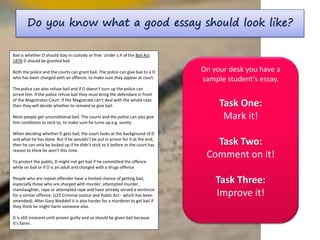
Do you know what a good essay should look like?
On your desk you have a
sample student’s essay.
Task One:
Mark it!
Task Two:
Comment on it!
Task Three:
Improve it!
Bail is whether D should stay in custody or free. Under s.4 of the Bail Act
1976 D should be granted bail.
Both the police and the courts can grant bail. The police can give bail to a D
who has been charged with an offence, to make sure they appear at court.
The police can also refuse bail and if D doesn’t turn up the police can
arrest him. If the police refuse bail they must bring the defendant in front
of the Magistrates Court. If the Magistrate can’t deal with the whole case
then they will decide whether to remand or give bail.
Most people get unconditional bail. The courts and the police can also give
him conditions to stick to, to make sure he turns up e.g. surety.
When deciding whether D gets bail, the court looks at the background of D
and what he has done. But if he wouldn’t be put in prison for it at the end,
then he can only be locked up if he didn’t stick to it before or the court has
reason to think he won’t this time.
To protect the public, D might not get bail if he committed the offence
while on bail or if D is an adult and charged with a drugs offence
People who are repeat offender have a limited chance of getting bail,
especially those who are charged with murder, attempted murder,
manslaughter, rape or attempted rape and have already served a sentence
for a similar offence. (s25 Criminal Justice and Public Act - which has been
amended). After Gary Weddell it is also harder for a murderer to get bail if
they think he might harm someone else.
D is still innocent until proven guilty and so should be given bail because
it’s fairer.
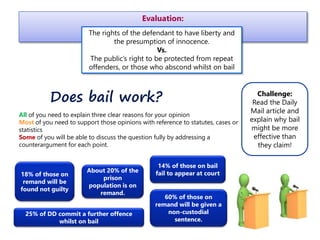
Evaluation:
The rights of the defendant to have liberty and
the presumption of innocence.
Vs.
The public’s right to be protected from repeat
offenders, or those who abscond whilst on bail
14% of those on bail
fail to appear at court
25% of DD commit a further offence
whilst on bail
About 20% of the
prison
population is on
remand.
60% of those on
remand will be given a
non-custodial
sentence.
18% of those on
remand will be
found not guilty
All of you need to explain three clear reasons for your opinion
Most of you need to support those opinions with reference to statutes, cases or
statistics
Some of you will be able to discuss the question fully by addressing a
counterargument for each point.
Does bail work? Challenge:
Read the Daily
Mail article and
explain why bail
might be more
effective than
they claim!
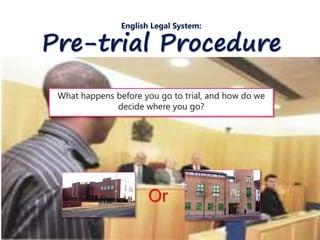
English Legal System:
Pre-trial Procedure
What happens before you go to trial, and how do we
decide where you go?
Or
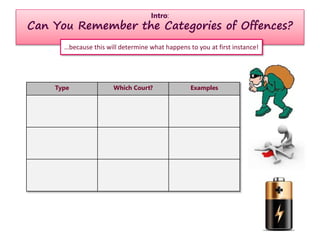
Intro:
Can You Remember the Categories of Offences?
…because this will determine what happens to you at first instance!
Type Which Court? Examples
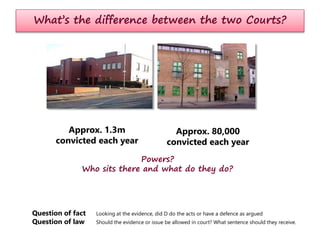
What’s the difference between the two Courts?
Approx. 1.3m
convicted each year
Approx. 80,000
convicted each year
Powers?
Who sits there and what do they do?
Question of fact Looking at the evidence, did D do the acts or have a defence as argued
Question of law Should the evidence or issue be allowed in court? What sentence should they receive.
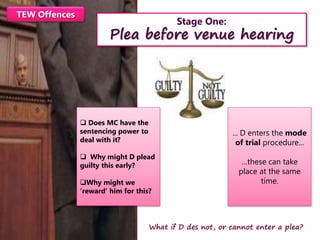
... D enters the mode
of trial procedure...
…these can take
place at the same
time.
 Does MC have the
sentencing power to
deal with it?
 Why might D plead
guilty this early?
Why might we
‘reward’ him for this?
TEW Offences
Stage One:
Plea before venue hearing
What if D des not, or cannot enter a plea?
Mode of Trial
You must be able to describe this in some detail.
Who can use it?
What do the Magistrates take into account?
Purpose is to...
representations from the
prosecution and the defence
the nature of the case
[complexities]
the seriousness of the offencewhether their sentencing
powers are sufficient
Following the Criminal Justice Act
2003, D’s previous convictions.
any other relevant
circumstances
TEW Offences
 Magistrates decide if they have jurisdiction. If they do, then you can
choose…
 If they do not, you automatically go to the Crown Court.
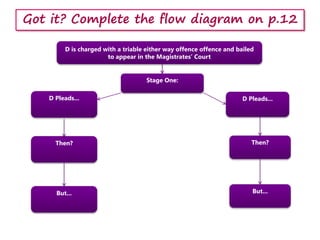
D is charged with a triable either way offence offence and bailed
to appear in the Magistrates’ Court
Stage One:
D Pleads... D Pleads...
Then?
But...
Then?
But...
Got it? Complete the flow diagram on p.12
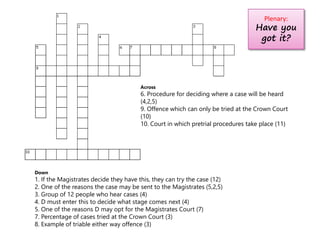
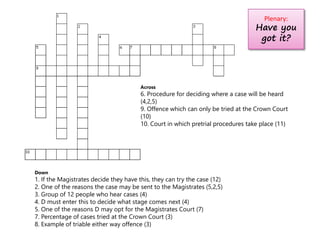
Plenary:
Have you
got it?
Across
6. Procedure for deciding where a case will be heard
(4,2,5)
9. Offence which can only be tried at the Crown Court
(10)
10. Court in which pretrial procedures take place (11)
Down
1. If the Magistrates decide they have this, they can try the case (12)
2. One of the reasons the case may be sent to the Magistrates (5,2,5)
3. Group of 12 people who hear cases (4)
4. D must enter this to decide what stage comes next (4)
5. One of the reasons D may opt for the Magistrates Court (7)
7. Percentage of cases tried at the Crown Court (3)
8. Example of triable either way offence (3)
Plenary:
Have you
got it?
Across
6. Procedure for deciding where a case will be heard
(4,2,5)
9. Offence which can only be tried at the Crown Court
(10)
10. Court in which pretrial procedures take place (11)
Down
1. If the Magistrates decide they have this, they can try the case (12)
2. One of the reasons the case may be sent to the Magistrates (5,2,5)
3. Group of 12 people who hear cases (4)
4. D must enter this to decide what stage comes next (4)
5. One of the reasons D may opt for the Magistrates Court (7)
7. Percentage of cases tried at the Crown Court (3)
8. Example of triable either way offence (3)
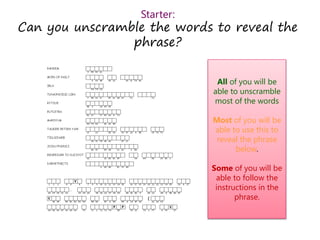
Starter:
Can you unscramble the words to reveal the
phrase?
All of you will be
able to unscramble
most of the words
Most of you will be
able to use this to
reveal the phrase
below.
Some of you will be
able to follow the
instructions in the
phrase.
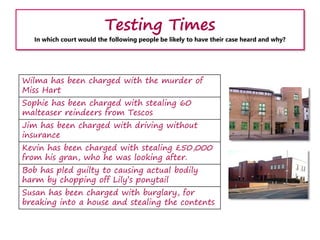
Testing Times
In which court would the following people be likely to have their case heard and why?
Wilma has been charged with the murder of
Miss Hart
Sophie has been charged with stealing 60
malteaser reindeers from Tescos
Jim has been charged with driving without
insurance
Kevin has been charged with stealing £50,000
from his gran, who he was looking after.
Bob has pled guilty to causing actual bodily
harm by chopping off Lily’s ponytail
Susan has been charged with burglary, for
breaking into a house and stealing the contents
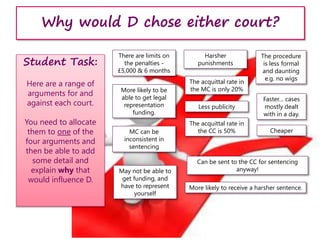
Why would D chose either court?
Student Task:
Here are a range of
arguments for and
against each court.
You need to allocate
them to one of the
four arguments and
then be able to add
some detail and
explain why that
would influence D.
There are limits on
the penalties -
£5,000 & 6 months
The acquittal rate in
the MC is only 20%
The acquittal rate in
the CC is 50%
Faster… cases
mostly dealt
with in a day.
More likely to be
able to get legal
representation
funding.
May not be able to
get funding, and
have to represent
yourself
Can be sent to the CC for sentencing
anyway!
Less publicity
MC can be
inconsistent in
sentencing
Harsher
punishments
The procedure
is less formal
and daunting
e.g. no wigs
Cheaper
More likely to receive a harsher sentence.
Consolidation:
All of you should be able to demonstrate your
understanding of the types of offences and
how mode of trial works.
Most of you should be able to explain why D
would opt for either court and the reasons for
the pre-trial process
Some of you will be able to evaluate the whole
process using your understanding and
employing correct legal terminology
Describe how it is decided in which court a criminal trial of an adult offender
will be heard. Include all categories of offence. [18]
End of Unit Assessment:
Can you plan your own response?
Key content to include: Key skills to demonstrate:
If you are confident
with the approach,
and structure of the
question, pick plan A
If you are ok with the
topic, but need some
help about the areas
to cover, pick plan B
If you were absent for
the topic, or you are
very unsure about
both the structure and
content, pick plan C
Challenge:
Look at the article on the proposed Mode of trial bill. How would it affect the current operation? Do you think it would
provide a more appropriate response?
And now to apply that knowledge...
Pedro is pleading not guilty to a charge of theft of a wallet from
his colleague’s desk at work. He has no previous convictions and
the wallet contained £100.
Discuss the matters Pedro should consider when choosing in
which court to be tried
Stage One:
Highlight and
annotate
Stage Two:
Order your
thoughts
Stage One:
Make sure you
have the law to
back you up
Stage One:
Conclude and
write up
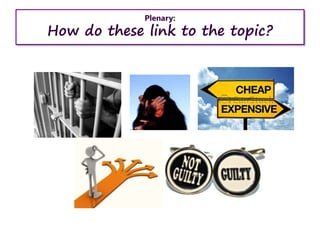
Plenary:
How do these link to the topic?

Bail and PreTrial

  • 1.
    Bail & Pre-trial So you’vebeen stopped and searched, arrested, detained and charged... What’s next? MAH 2013-14
  • 2.
    Starter: Can you sortthe dominoes? Student Task: Using all of your learning last term on the powers of the police, reconstruct the dominoes! Lollipop level No handouts, just brains Sticker Satisfactory? Use the handouts or a handy textbook Too easy? Can you explain two recent changes to the powers of the police?
  • 3.
    Homework 1. Prepare revisionnotes and revise for an end of unit test on all of police powers in two weeks time. 2. Watch the first episode of “24 hours in Police Custody” and write a review of the program.  Does it accurately reflect the law as you have been taught it?  What key aspects of police powers are highlighted?  How does the program show the police respecting the rights of the individual and still trying to protect the public?
  • 4.
    Introduction: Dunstable and theLaw on Bail Student Task: One of the key cases on bail, and one which has actually changed the law, is that of Gary Weddell, from Dunstable. Read the article in your handouts and complete the grid in as much detail as you can! Who can deal with the issue of bail? What happens if bail is refused? What kind of conditions may be imposed? Why might bail be refused? Challenge: When can D reapply for bail? Extension: Do you think that the courts got the balance between protecting the public and the presumption of innocence right in this case? Why? Why not?
  • 5.
    There is apresumption that D is entitled to remain at liberty until the next stage in the process. Introduction Bail: The Basics Who decides? Why? What could rebut it? What next stage? s.4 Bail Act 1976 If it’s denied, what will happen?
  • 6.
    Police Bail s.38 PACE1984 (as amended) Gives the power to our friendly local custody officer! ....this can be at any point after arrest… Either: charged and released on bail until court Or: released on bail pending further inquiries. Thinking: Do you think that the police are likely to grant bail? Why do you think that is?
  • 7.
    …and if thepolice refuse bail? D must appear in the MC at the first possible opportunity  Why?  What if the MC can’t deal with the case then and there? The can grant unconditional bail, vary or impose conditions or remand D
  • 8.
    Type of bail? ConditionalUnconditional “your own recognisance” To ensure D surrenders themselves at the next stage in the criminal process. Surety Residence Order Passport Curfew with tagging Reporting to station Exclusion zones Contact bans What if you don’t agree with the conditions?
  • 9.
  • 10.
    What do thepolice and the courts take into account in deciding whether or not to grant bail? The nature and seriousness of the offence D’s antecedents Probable sentence D’s associations and community ties D’s previous behaviour whilst on bail For D’s own protection D’s character Strength of the evidence against D
  • 11.
    Plenary: How do eachof the following images link to today’s lesson?
  • 12.
    Starter: Can you findthe ten bail related words? All of you should be able to find the words Most of you should be able to define them Some of you should be able to construct a summary paragraph on the operation of bail, using all 10 words.
  • 13.
    Why might thecourts and the police refuse to grant bail?  If D’s name and address can not be discovered  If there is doubt that the name and address are genuine If there are substantial grounds to believe D may not surrender to custody S is likely to commit further offences whilst on bail S would interfere with witnesses or otherwise obstruct the course of justice *New Law* If there is no real prospect of D receiving a custodial sentence, then bail must be granted.
  • 14.
    Why else mightit be refused? Statutory rebuttals Statute Rebuttal s.114 Coroners and Criminal Justice Act 2009 No bail where D was convicted of homicide, rape previously and now charged with one of them again, unless of the opinion there are ‘exceptional circumstances’. s.25 Criminal Justice & Public Order Act 1994 (as amended) D not granted bail if at the time of the offence D was on bail for an indictable or triable either way offence. s.19 Criminal Justice Act 2003 Restricts bail for adult class A drug users. s.14 Criminal Justice Act 2003 If there are substantial grounds to believe D would engage in conduct likely to cause physical or mental injury to a person and D has been charged with murder Most of these have been amended by the Legal Aid, Sentencing and Punishment of Offenders Act 2012 Task: Can you match the rebuttal to its statutory origins?
  • 15.
    Applying the Law: Ok,so you kind of get it... Advise Alex on which factors and conditions would affect his bail decision: Alex, aged 19, is charged with a robbery in which he threatened a shopkeeper with a gun and stole £2000. He has no previous convictions and lives at home with his mother.
  • 16.
    What else canthe courts do?  When might the court consider the issue of bail for D?  Why might they refuse bail? If there are substantial grounds to believe D might…… Fail... Commit... Interfere... D’s own... What conditions can they impose? What if the defendant is under 18? What if there was no chance they would be sentenced to custody? What can they do to other decisions?
  • 17.
    Bonus Knowledge: A finalappeal Bail (Amendment) Act 1993 (as amended)  P has right to appeal to judge at CC against granting of bail.  Applies to all offences LASPO Act 2012  Further right of appeal from CC to HC, but only if they have not already appealed from the MC to the CC . Why might they want to appeal?  only one further application to MC, unless change of circumstances.  can appeal against refusal to grant bail – made to judge in the crown court. D who is sent to trial in the CC, apply there for bail... Why might they want to appeal? Prosecution Appeals Defence Appeals
  • 19.
    Starter: Demonstrate your knowledge Usingyour understanding, complete the triangle... There is only one correct solution. Lollipop level No handouts, just brains Sticker Satisfactory? Use the handouts or a handy textbook Too easy? Can you spot what’s missing from the triangle?
  • 20.
    Do you knowwhat a good essay should look like? On your desk you have a sample student’s essay. Task One: Mark it! Task Two: Comment on it! Task Three: Improve it! Bail is whether D should stay in custody or free. Under s.4 of the Bail Act 1976 D should be granted bail. Both the police and the courts can grant bail. The police can give bail to a D who has been charged with an offence, to make sure they appear at court. The police can also refuse bail and if D doesn’t turn up the police can arrest him. If the police refuse bail they must bring the defendant in front of the Magistrates Court. If the Magistrate can’t deal with the whole case then they will decide whether to remand or give bail. Most people get unconditional bail. The courts and the police can also give him conditions to stick to, to make sure he turns up e.g. surety. When deciding whether D gets bail, the court looks at the background of D and what he has done. But if he wouldn’t be put in prison for it at the end, then he can only be locked up if he didn’t stick to it before or the court has reason to think he won’t this time. To protect the public, D might not get bail if he committed the offence while on bail or if D is an adult and charged with a drugs offence People who are repeat offender have a limited chance of getting bail, especially those who are charged with murder, attempted murder, manslaughter, rape or attempted rape and have already served a sentence for a similar offence. (s25 Criminal Justice and Public Act - which has been amended). After Gary Weddell it is also harder for a murderer to get bail if they think he might harm someone else. D is still innocent until proven guilty and so should be given bail because it’s fairer.
  • 21.
    Evaluation: The rights ofthe defendant to have liberty and the presumption of innocence. Vs. The public’s right to be protected from repeat offenders, or those who abscond whilst on bail 14% of those on bail fail to appear at court 25% of DD commit a further offence whilst on bail About 20% of the prison population is on remand. 60% of those on remand will be given a non-custodial sentence. 18% of those on remand will be found not guilty All of you need to explain three clear reasons for your opinion Most of you need to support those opinions with reference to statutes, cases or statistics Some of you will be able to discuss the question fully by addressing a counterargument for each point. Does bail work? Challenge: Read the Daily Mail article and explain why bail might be more effective than they claim!
  • 22.
    English Legal System: Pre-trialProcedure What happens before you go to trial, and how do we decide where you go? Or
  • 23.
    Intro: Can You Rememberthe Categories of Offences? …because this will determine what happens to you at first instance! Type Which Court? Examples
  • 24.
    What’s the differencebetween the two Courts? Approx. 1.3m convicted each year Approx. 80,000 convicted each year Powers? Who sits there and what do they do? Question of fact Looking at the evidence, did D do the acts or have a defence as argued Question of law Should the evidence or issue be allowed in court? What sentence should they receive.
  • 25.
    ... D entersthe mode of trial procedure... …these can take place at the same time.  Does MC have the sentencing power to deal with it?  Why might D plead guilty this early? Why might we ‘reward’ him for this? TEW Offences Stage One: Plea before venue hearing What if D des not, or cannot enter a plea?
  • 26.
    Mode of Trial Youmust be able to describe this in some detail. Who can use it? What do the Magistrates take into account? Purpose is to... representations from the prosecution and the defence the nature of the case [complexities] the seriousness of the offencewhether their sentencing powers are sufficient Following the Criminal Justice Act 2003, D’s previous convictions. any other relevant circumstances TEW Offences  Magistrates decide if they have jurisdiction. If they do, then you can choose…  If they do not, you automatically go to the Crown Court.
  • 27.
    D is chargedwith a triable either way offence offence and bailed to appear in the Magistrates’ Court Stage One: D Pleads... D Pleads... Then? But... Then? But... Got it? Complete the flow diagram on p.12
  • 28.
    Plenary: Have you got it? Across 6.Procedure for deciding where a case will be heard (4,2,5) 9. Offence which can only be tried at the Crown Court (10) 10. Court in which pretrial procedures take place (11) Down 1. If the Magistrates decide they have this, they can try the case (12) 2. One of the reasons the case may be sent to the Magistrates (5,2,5) 3. Group of 12 people who hear cases (4) 4. D must enter this to decide what stage comes next (4) 5. One of the reasons D may opt for the Magistrates Court (7) 7. Percentage of cases tried at the Crown Court (3) 8. Example of triable either way offence (3)
  • 29.
    Plenary: Have you got it? Across 6.Procedure for deciding where a case will be heard (4,2,5) 9. Offence which can only be tried at the Crown Court (10) 10. Court in which pretrial procedures take place (11) Down 1. If the Magistrates decide they have this, they can try the case (12) 2. One of the reasons the case may be sent to the Magistrates (5,2,5) 3. Group of 12 people who hear cases (4) 4. D must enter this to decide what stage comes next (4) 5. One of the reasons D may opt for the Magistrates Court (7) 7. Percentage of cases tried at the Crown Court (3) 8. Example of triable either way offence (3)
  • 30.
    Starter: Can you unscramblethe words to reveal the phrase? All of you will be able to unscramble most of the words Most of you will be able to use this to reveal the phrase below. Some of you will be able to follow the instructions in the phrase.
  • 31.
    Testing Times In whichcourt would the following people be likely to have their case heard and why? Wilma has been charged with the murder of Miss Hart Sophie has been charged with stealing 60 malteaser reindeers from Tescos Jim has been charged with driving without insurance Kevin has been charged with stealing £50,000 from his gran, who he was looking after. Bob has pled guilty to causing actual bodily harm by chopping off Lily’s ponytail Susan has been charged with burglary, for breaking into a house and stealing the contents
  • 32.
    Why would Dchose either court? Student Task: Here are a range of arguments for and against each court. You need to allocate them to one of the four arguments and then be able to add some detail and explain why that would influence D. There are limits on the penalties - £5,000 & 6 months The acquittal rate in the MC is only 20% The acquittal rate in the CC is 50% Faster… cases mostly dealt with in a day. More likely to be able to get legal representation funding. May not be able to get funding, and have to represent yourself Can be sent to the CC for sentencing anyway! Less publicity MC can be inconsistent in sentencing Harsher punishments The procedure is less formal and daunting e.g. no wigs Cheaper More likely to receive a harsher sentence.
  • 33.
    Consolidation: All of youshould be able to demonstrate your understanding of the types of offences and how mode of trial works. Most of you should be able to explain why D would opt for either court and the reasons for the pre-trial process Some of you will be able to evaluate the whole process using your understanding and employing correct legal terminology
  • 34.
    Describe how itis decided in which court a criminal trial of an adult offender will be heard. Include all categories of offence. [18] End of Unit Assessment: Can you plan your own response? Key content to include: Key skills to demonstrate: If you are confident with the approach, and structure of the question, pick plan A If you are ok with the topic, but need some help about the areas to cover, pick plan B If you were absent for the topic, or you are very unsure about both the structure and content, pick plan C Challenge: Look at the article on the proposed Mode of trial bill. How would it affect the current operation? Do you think it would provide a more appropriate response?
  • 35.
    And now toapply that knowledge... Pedro is pleading not guilty to a charge of theft of a wallet from his colleague’s desk at work. He has no previous convictions and the wallet contained £100. Discuss the matters Pedro should consider when choosing in which court to be tried Stage One: Highlight and annotate Stage Two: Order your thoughts Stage One: Make sure you have the law to back you up Stage One: Conclude and write up
  • 36.
    Plenary: How do theselink to the topic?

Editor's Notes

  • #13 BAIL CONDITIONAL CUSTODYOFFICER MAGISTRATES REBUTTAL RECOGNISANCE REMAND SURETY SURRENDER VARY
  • #33 You have correctly identified the words. Now define each of these key terms on the sheet (and collect a lollipop if you have found them all yourself!) remandmode of trialbailconditional bailsuretyrebuttalsummary triable either wayindictablejuridictionsurrender to custodyantecedents