Penal System 1:
Aims & Factors of Sentencing
G151 ELS MAH
What are we trying to accomplish by sentencing them?
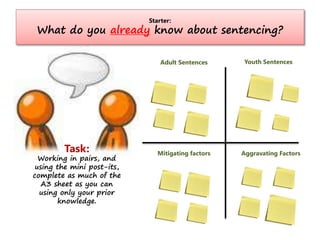
Starter:
What do you already know about sentencing?
Task:
Working in pairs, and
using the mini post-its,
complete as much of the
A3 sheet as you can
using only your prior
knowledge.
Adult Sentences Youth Sentences
Mitigating factors Aggravating Factors
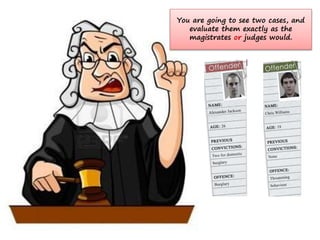
You are going to see two cases, and
evaluate them exactly as the
magistrates or judges would.
Challenge:
Which ‘aim’ is not in the act?
Why do you think that is?
Retribution; reparation; deterrence;
incapacitation; denunciation; rehabilitation.
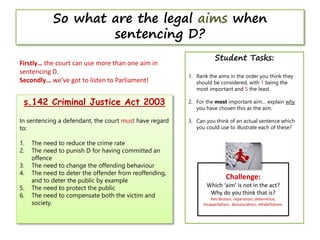
So what are the legal aims when
sentencing D?
s.142 Criminal Justice Act 2003
In sentencing a defendant, the court must have regard
to:
1. The need to reduce the crime rate
2. The need to punish D for having committed an
offence
3. The need to change the offending behaviour
4. The need to deter the offender from reoffending,
and to deter the public by example
5. The need to protect the public
6. The need to compensate both the victim and
society.
Firstly… the court can use more than one aim in
sentencing D.
Secondly… we’ve got to listen to Parliament!
Student Tasks:
1. Rank the aims in the order you think they
should be considered, with 1 being the
most important and 5 the least.
2. For the most important aim… explain why
you have chosen this as the aim.
3. Can you think of an actual sentence which
you could use to illustrate each of these?
Fines
Death Penalty
Chemical
castration
Life Sentence
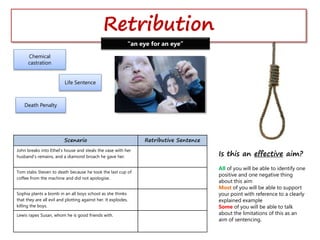
Retribution
“an eye for an eye”
Scenario Retributive Sentence
John breaks into Ethel’s house and steals the vase with her
husband’s remains, and a diamond broach he gave her.
Tom stabs Steven to death because he took the last cup of
coffee from the machine and did not apologise.
Sophia plants a bomb in an all boys school as she thinks
that they are all evil and plotting against her. It explodes,
killing the boys.
Lewis rapes Susan, whom he is good friends with.
Is this an effective aim?
All of you will be able to identify one
positive and one negative thing
about this aim
Most of you will be able to support
your point with reference to a clearly
explained example
Some of you will be able to talk
about the limitations of this as an
aim of sentencing.
Denunciation
“ Punishment is the is the way in which society expresses its
denunciation of what D is doing.”
Releasing the names of
child offenders
Megan’s Law
[Sarah’s Law]
Vests for community
payback
Is this an effective aim?
All of you will be able to identify one positive and one negative
thing about this aim
Most of you will be able to support your point with reference
to a clearly explained example
Some of you will be able to talk about the limitations of this as
an aim of sentencing.
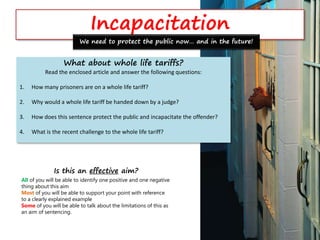
Incapacitation
What about whole life tariffs?
Read the enclosed article and answer the following questions:
1. How many prisoners are on a whole life tariff?
2. Why would a whole life tariff be handed down by a judge?
3. How does this sentence protect the public and incapacitate the offender?
4. What is the recent challenge to the whole life tariff?
We need to protect the public now… and in the future!
Is this an effective aim?
All of you will be able to identify one positive and one negative
thing about this aim
Most of you will be able to support your point with reference
to a clearly explained example
Some of you will be able to talk about the limitations of this as
an aim of sentencing.
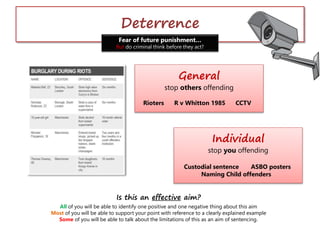
Deterrence
Fear of future punishment…
But do criminal think before they act?
General
stop others offending
Rioters R v Whitton 1985 CCTV
Individual
stop you offending
Custodial sentence ASBO posters
Naming Child offenders
Is this an effective aim?
All of you will be able to identify one positive and one negative thing about this aim
Most of you will be able to support your point with reference to a clearly explained example
Some of you will be able to talk about the limitations of this as an aim of sentencing.
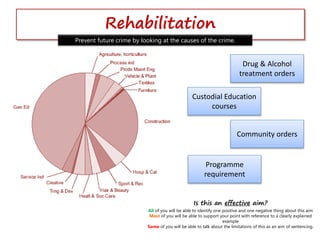
Rehabilitation
Prevent future crime by looking at the causes of the crime.
Drug & Alcohol
treatment orders
Custodial Education
courses
Community orders
Programme
requirement
Is this an effective aim?
All of you will be able to identify one positive and one negative thing about this aim
Most of you will be able to support your point with reference to a clearly explained
example
Some of you will be able to talk about the limitations of this as an aim of sentencing.
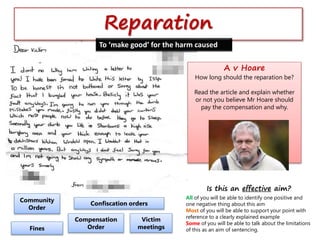
Reparation
To ‘make good’ for the harm caused
Community
Order
Compensation
OrderFines
Victim
meetings
Confiscation orders
Is this an effective aim?
All of you will be able to identify one positive and
one negative thing about this aim
Most of you will be able to support your point with
reference to a clearly explained example
Some of you will be able to talk about the limitations
of this as an aim of sentencing.
A v Hoare
How long should the reparation be?
Read the article and explain whether
or not you believe Mr Hoare should
pay the compensation and why.
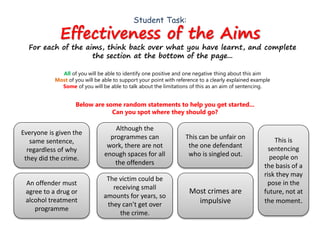
Student Task:
Effectiveness of the Aims
Below are some random statements to help you get started...
Can you spot where they should go?
Everyone is given the
same sentence,
regardless of why
they did the crime.
Although the
programmes can
work, there are not
enough spaces for all
the offenders
An offender must
agree to a drug or
alcohol treatment
programme
The victim could be
receiving small
amounts for years, so
they can’t get over
the crime.
This can be unfair on
the one defendant
who is singled out.
Most crimes are
impulsive
This is
sentencing
people on
the basis of a
risk they may
pose in the
future, not at
the moment.
For each of the aims, think back over what you have learnt, and complete
the section at the bottom of the page...
All of you will be able to identify one positive and one negative thing about this aim
Most of you will be able to support your point with reference to a clearly explained example
Some of you will be able to talk about the limitations of this as an aim of sentencing.
1. There are six main aims of sentencing contained in s.153 Criminal Justice Act
2003, in addition to the aim of reparation which is not contained in the Act.
2. The judge must select the most appropriate aim for each offender
3. Driving bans are an example of both retribution and incapacitation.
4. Some aims focus on the offender and why they have committed the crime, whilst
some focus on the crime committed by the offender.
5. Denunciation is carried out by the newspapers.
Have you got it?:
Right or Wrong?
What else do we take into account?
Watch the world’s best video and note down the mitigating and aggravating factors which may affect D’s sentence.
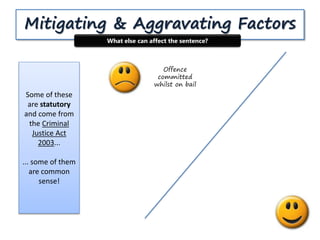
Mitigating & Aggravating Factors
What else can affect the sentence?
Some of these
are statutory
and come from
the Criminal
Justice Act
2003...
... some of them
are common
sense!
Offence
committed
whilst on bail
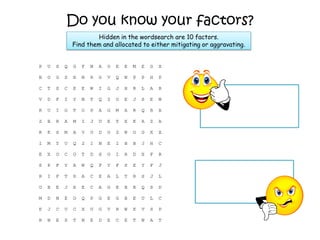
Do you know your factors?
Hidden in the wordsearch are 10 factors.
Find them and allocated to either mitigating or aggravating.
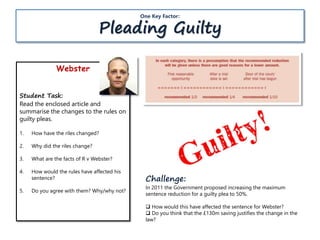
Webster
Student Task:
Read the enclosed article and
summarise the changes to the rules on
guilty pleas.
1. How have the riles changed?
2. Why did the riles change?
3. What are the facts of R v Webster?
4. How would the rules have affected his
sentence?
5. Do you agree with them? Why/why not?
One Key Factor:
Pleading Guilty
Challenge:
In 2011 the Government proposed increasing the maximum
sentence reduction for a guilty plea to 50%.
 How would this have affected the sentence for Webster?
 Do you think that the £130m saving justifies the change in the
law?
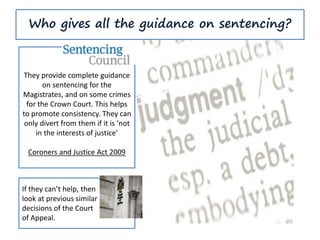
Who gives all the guidance on sentencing?
They provide complete guidance
on sentencing for the
Magistrates, and on some crimes
for the Crown Court. This helps
to promote consistency. They can
only divert from them if it is ‘not
in the interests of justice’
Coroners and Justice Act 2009
If they can’t help, then
look at previous similar
decisions of the Court
of Appeal.
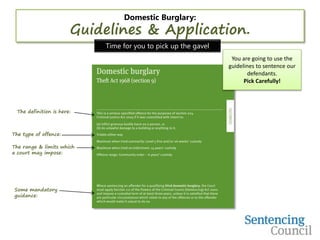
Domestic Burglary:
Guidelines & Application.
The definition is here:
The type of offence:
The range & limits which
a court may impose:
Some mandatory
guidance:
You are going to use the
guidelines to sentence our
defendants.
Pick Carefully!
Time for you to pick up the gavel
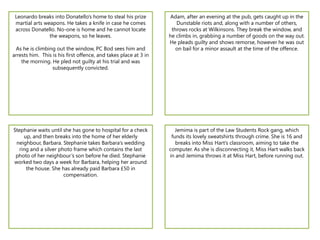
Leonardo breaks into Donatello’s home to steal his prize
martial arts weapons. He takes a knife in case he comes
across Donatello. No-one is home and he cannot locate
the weapons, so he leaves.
As he is climbing out the window, PC Bod sees him and
arrests him. This is his first offence, and takes place at 3 in
the morning. He pled not guilty at his trial and was
subsequently convicted.
Stephanie waits until she has gone to hospital for a check
up, and then breaks into the home of her elderly
neighbour, Barbara. Stephanie takes Barbara’s wedding
ring and a silver photo frame which contains the last
photo of her neighbour’s son before he died. Stephanie
worked two days a week for Barbara, helping her around
the house. She has already paid Barbara £50 in
compensation.
Adam, after an evening at the pub, gets caught up in the
Dunstable riots and, along with a number of others,
throws rocks at Wilkinsons. They break the window, and
he climbs in, grabbing a number of goods on the way out.
He pleads guilty and shows remorse, however he was out
on bail for a minor assault at the time of the offence.
Jemima is part of the Law Students Rock gang, which
funds its lovely sweatshirts through crime. She is 16 and
breaks into Miss Hart’s classroom, aiming to take the
computer. As she is disconnecting it, Miss Hart walks back
in and Jemima throws it at Miss Hart, before running out.
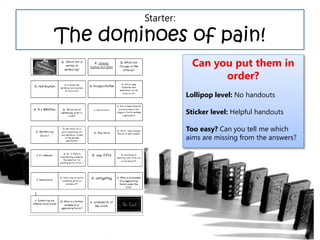
Starter:
The dominoes of pain!
Can you put them in
order?
Lollipop level: No handouts
Sticker level: Helpful handouts
Too easy? Can you tell me which
aims are missing from the answers?
Describe the aims and factors taken into account when
sentencing an offender. [18]
What can you tell me about how to answer this
question?
*if you ask nicely, I might even help!
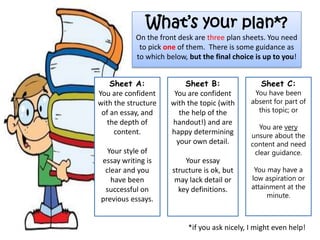
What’s your plan*?
On the front desk are three plan sheets. You need
to pick one of them. There is some guidance as
to which below, but the final choice is up to you!
Sheet A:
You are confident
with the structure
of an essay, and
the depth of
content.
Your style of
essay writing is
clear and you
have been
successful on
previous essays.
Sheet B:
You are confident
with the topic (with
the help of the
handout!) and are
happy determining
your own detail.
Your essay
structure is ok, but
may lack detail or
key definitions.
Sheet C:
You have been
absent for part of
this topic; or
You are very
unsure about the
content and need
clear guidance.
You may have a
low aspiration or
attainment at the
minute.
Describe the aims and factors taken into account when
sentencing an offender. [18]
Task:
Use your notes and
understanding to complete
your essay plan.
Need more of a challenge?
Take a look at the BBC article on new offences. Could you
incorporate any recent developments to develop the detail in your
response?
What’s left?
Answering the Question of course!
End
20 minutes.
Remember what you want to improve…
and demonstrate your brilliance!
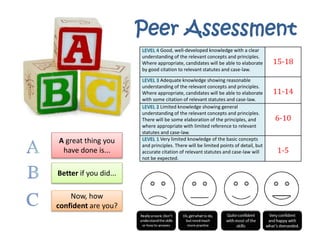
Peer Assessment
A great thing you
have done is...
Better if you did...
Now, how
confident are you?
LEVEL 4 Good, well-developed knowledge with a clear
understanding of the relevant concepts and principles.
Where appropriate, candidates will be able to elaborate
by good citation to relevant statutes and case-law.
15-18
LEVEL 3 Adequate knowledge showing reasonable
understanding of the relevant concepts and principles.
Where appropriate, candidates will be able to elaborate
with some citation of relevant statutes and case-law.
11-14
LEVEL 2 Limited knowledge showing general
understanding of the relevant concepts and principles.
There will be some elaboration of the principles, and
where appropriate with limited reference to relevant
statutes and case-law.
6-10
LEVEL 1 Very limited knowledge of the basic concepts
and principles. There will be limited points of detail, but
accurate citation of relevant statutes and case-law will
not be expected.
1-5
How bad is Mavis?
Mavis, who is a single
mother and a drug dealer,
steals Arthur’s wallet.
Arthur is a 24 year old
banker.
Snowballs of Application...
Each table has two problems
on their paper.
You have one minute to
annotate it with as many
mitigating and aggravating
factors as possible
You are then going to throw it
across the classroom and swap!
Watch out... Read the scenarios carefully!
Creating a problem answer.
Advise your defendant as to the factors and aims which would be
taken into account in sentencing them [12]
We are looking at least
5 applied points being
used.
Aim to include at least
three contradicted
points.
Use the defendant’s
name!
Conclude.
As Mavis is a single mother, this may work as a mitigating factor as if
she were sent to prison the children would be put into care
However, she is also a drug dealer which would act as a aggravating
factor as she is much more likely to reoffend.
In addition, as she is a drug dealer she is unlikely to have another
income and so be more likely to commit a further offence, so the
court would want to consider rehabilitation in her sentence, to try
and provide an alternative. However, Arthur is likely to want some
compensation for the loss, so the court may also consider
reparation as a theory, and she could pay him compensation as part
of the sentence.
As she has stolen his wallet, the harm is not likely to be high and this
may work as mitigating factor, and reduce her sentence accordingly.
Overall, it would seem that the most important aim in sentencing
Mavis is rehabilitation to enable her to keep her family and stop
being a drug dealer.
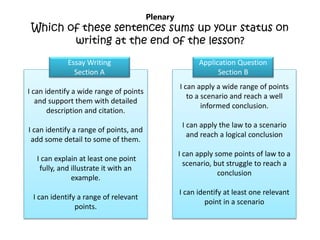
Plenary
Which of these sentences sums up your status on
writing at the end of the lesson?
I can apply a wide range of points
to a scenario and reach a well
informed conclusion.
I can apply the law to a scenario
and reach a logical conclusion
I can apply some points of law to a
scenario, but struggle to reach a
conclusion
I can identify at least one relevant
point in a scenario
I can identify a wide range of points
and support them with detailed
description and citation.
I can identify a range of points, and
add some detail to some of them.
I can explain at least one point
fully, and illustrate it with an
example.
I can identify a range of relevant
points.
Essay Writing
Section A
Application Question
Section B

Aims and Factors of Sentencing

  • 1.
    Penal System 1: Aims& Factors of Sentencing G151 ELS MAH What are we trying to accomplish by sentencing them?
  • 2.
    Starter: What do youalready know about sentencing? Task: Working in pairs, and using the mini post-its, complete as much of the A3 sheet as you can using only your prior knowledge. Adult Sentences Youth Sentences Mitigating factors Aggravating Factors
  • 3.
    You are goingto see two cases, and evaluate them exactly as the magistrates or judges would.
  • 4.
    Challenge: Which ‘aim’ isnot in the act? Why do you think that is? Retribution; reparation; deterrence; incapacitation; denunciation; rehabilitation. So what are the legal aims when sentencing D? s.142 Criminal Justice Act 2003 In sentencing a defendant, the court must have regard to: 1. The need to reduce the crime rate 2. The need to punish D for having committed an offence 3. The need to change the offending behaviour 4. The need to deter the offender from reoffending, and to deter the public by example 5. The need to protect the public 6. The need to compensate both the victim and society. Firstly… the court can use more than one aim in sentencing D. Secondly… we’ve got to listen to Parliament! Student Tasks: 1. Rank the aims in the order you think they should be considered, with 1 being the most important and 5 the least. 2. For the most important aim… explain why you have chosen this as the aim. 3. Can you think of an actual sentence which you could use to illustrate each of these?
  • 5.
    Fines Death Penalty Chemical castration Life Sentence Retribution “aneye for an eye” Scenario Retributive Sentence John breaks into Ethel’s house and steals the vase with her husband’s remains, and a diamond broach he gave her. Tom stabs Steven to death because he took the last cup of coffee from the machine and did not apologise. Sophia plants a bomb in an all boys school as she thinks that they are all evil and plotting against her. It explodes, killing the boys. Lewis rapes Susan, whom he is good friends with. Is this an effective aim? All of you will be able to identify one positive and one negative thing about this aim Most of you will be able to support your point with reference to a clearly explained example Some of you will be able to talk about the limitations of this as an aim of sentencing.
  • 7.
    Denunciation “ Punishment isthe is the way in which society expresses its denunciation of what D is doing.” Releasing the names of child offenders Megan’s Law [Sarah’s Law] Vests for community payback Is this an effective aim? All of you will be able to identify one positive and one negative thing about this aim Most of you will be able to support your point with reference to a clearly explained example Some of you will be able to talk about the limitations of this as an aim of sentencing.
  • 8.
    Incapacitation What about wholelife tariffs? Read the enclosed article and answer the following questions: 1. How many prisoners are on a whole life tariff? 2. Why would a whole life tariff be handed down by a judge? 3. How does this sentence protect the public and incapacitate the offender? 4. What is the recent challenge to the whole life tariff? We need to protect the public now… and in the future! Is this an effective aim? All of you will be able to identify one positive and one negative thing about this aim Most of you will be able to support your point with reference to a clearly explained example Some of you will be able to talk about the limitations of this as an aim of sentencing.
  • 9.
    Deterrence Fear of futurepunishment… But do criminal think before they act? General stop others offending Rioters R v Whitton 1985 CCTV Individual stop you offending Custodial sentence ASBO posters Naming Child offenders Is this an effective aim? All of you will be able to identify one positive and one negative thing about this aim Most of you will be able to support your point with reference to a clearly explained example Some of you will be able to talk about the limitations of this as an aim of sentencing.
  • 10.
    Rehabilitation Prevent future crimeby looking at the causes of the crime. Drug & Alcohol treatment orders Custodial Education courses Community orders Programme requirement Is this an effective aim? All of you will be able to identify one positive and one negative thing about this aim Most of you will be able to support your point with reference to a clearly explained example Some of you will be able to talk about the limitations of this as an aim of sentencing.
  • 11.
    Reparation To ‘make good’for the harm caused Community Order Compensation OrderFines Victim meetings Confiscation orders Is this an effective aim? All of you will be able to identify one positive and one negative thing about this aim Most of you will be able to support your point with reference to a clearly explained example Some of you will be able to talk about the limitations of this as an aim of sentencing. A v Hoare How long should the reparation be? Read the article and explain whether or not you believe Mr Hoare should pay the compensation and why.
  • 12.
    Student Task: Effectiveness ofthe Aims Below are some random statements to help you get started... Can you spot where they should go? Everyone is given the same sentence, regardless of why they did the crime. Although the programmes can work, there are not enough spaces for all the offenders An offender must agree to a drug or alcohol treatment programme The victim could be receiving small amounts for years, so they can’t get over the crime. This can be unfair on the one defendant who is singled out. Most crimes are impulsive This is sentencing people on the basis of a risk they may pose in the future, not at the moment. For each of the aims, think back over what you have learnt, and complete the section at the bottom of the page... All of you will be able to identify one positive and one negative thing about this aim Most of you will be able to support your point with reference to a clearly explained example Some of you will be able to talk about the limitations of this as an aim of sentencing.
  • 13.
    1. There aresix main aims of sentencing contained in s.153 Criminal Justice Act 2003, in addition to the aim of reparation which is not contained in the Act. 2. The judge must select the most appropriate aim for each offender 3. Driving bans are an example of both retribution and incapacitation. 4. Some aims focus on the offender and why they have committed the crime, whilst some focus on the crime committed by the offender. 5. Denunciation is carried out by the newspapers. Have you got it?: Right or Wrong?
  • 14.
    What else dowe take into account? Watch the world’s best video and note down the mitigating and aggravating factors which may affect D’s sentence.
  • 15.
    Mitigating & AggravatingFactors What else can affect the sentence? Some of these are statutory and come from the Criminal Justice Act 2003... ... some of them are common sense! Offence committed whilst on bail
  • 16.
    Do you knowyour factors? Hidden in the wordsearch are 10 factors. Find them and allocated to either mitigating or aggravating.
  • 17.
    Webster Student Task: Read theenclosed article and summarise the changes to the rules on guilty pleas. 1. How have the riles changed? 2. Why did the riles change? 3. What are the facts of R v Webster? 4. How would the rules have affected his sentence? 5. Do you agree with them? Why/why not? One Key Factor: Pleading Guilty Challenge: In 2011 the Government proposed increasing the maximum sentence reduction for a guilty plea to 50%.  How would this have affected the sentence for Webster?  Do you think that the £130m saving justifies the change in the law?
  • 18.
    Who gives allthe guidance on sentencing? They provide complete guidance on sentencing for the Magistrates, and on some crimes for the Crown Court. This helps to promote consistency. They can only divert from them if it is ‘not in the interests of justice’ Coroners and Justice Act 2009 If they can’t help, then look at previous similar decisions of the Court of Appeal.
  • 19.
    Domestic Burglary: Guidelines &Application. The definition is here: The type of offence: The range & limits which a court may impose: Some mandatory guidance: You are going to use the guidelines to sentence our defendants. Pick Carefully! Time for you to pick up the gavel
  • 20.
    Leonardo breaks intoDonatello’s home to steal his prize martial arts weapons. He takes a knife in case he comes across Donatello. No-one is home and he cannot locate the weapons, so he leaves. As he is climbing out the window, PC Bod sees him and arrests him. This is his first offence, and takes place at 3 in the morning. He pled not guilty at his trial and was subsequently convicted. Stephanie waits until she has gone to hospital for a check up, and then breaks into the home of her elderly neighbour, Barbara. Stephanie takes Barbara’s wedding ring and a silver photo frame which contains the last photo of her neighbour’s son before he died. Stephanie worked two days a week for Barbara, helping her around the house. She has already paid Barbara £50 in compensation. Adam, after an evening at the pub, gets caught up in the Dunstable riots and, along with a number of others, throws rocks at Wilkinsons. They break the window, and he climbs in, grabbing a number of goods on the way out. He pleads guilty and shows remorse, however he was out on bail for a minor assault at the time of the offence. Jemima is part of the Law Students Rock gang, which funds its lovely sweatshirts through crime. She is 16 and breaks into Miss Hart’s classroom, aiming to take the computer. As she is disconnecting it, Miss Hart walks back in and Jemima throws it at Miss Hart, before running out.
  • 21.
    Starter: The dominoes ofpain! Can you put them in order? Lollipop level: No handouts Sticker level: Helpful handouts Too easy? Can you tell me which aims are missing from the answers?
  • 22.
    Describe the aimsand factors taken into account when sentencing an offender. [18] What can you tell me about how to answer this question?
  • 23.
    *if you asknicely, I might even help! What’s your plan*? On the front desk are three plan sheets. You need to pick one of them. There is some guidance as to which below, but the final choice is up to you! Sheet A: You are confident with the structure of an essay, and the depth of content. Your style of essay writing is clear and you have been successful on previous essays. Sheet B: You are confident with the topic (with the help of the handout!) and are happy determining your own detail. Your essay structure is ok, but may lack detail or key definitions. Sheet C: You have been absent for part of this topic; or You are very unsure about the content and need clear guidance. You may have a low aspiration or attainment at the minute.
  • 24.
    Describe the aimsand factors taken into account when sentencing an offender. [18] Task: Use your notes and understanding to complete your essay plan. Need more of a challenge? Take a look at the BBC article on new offences. Could you incorporate any recent developments to develop the detail in your response?
  • 25.
    What’s left? Answering theQuestion of course! End 20 minutes. Remember what you want to improve… and demonstrate your brilliance!
  • 26.
    Peer Assessment A greatthing you have done is... Better if you did... Now, how confident are you? LEVEL 4 Good, well-developed knowledge with a clear understanding of the relevant concepts and principles. Where appropriate, candidates will be able to elaborate by good citation to relevant statutes and case-law. 15-18 LEVEL 3 Adequate knowledge showing reasonable understanding of the relevant concepts and principles. Where appropriate, candidates will be able to elaborate with some citation of relevant statutes and case-law. 11-14 LEVEL 2 Limited knowledge showing general understanding of the relevant concepts and principles. There will be some elaboration of the principles, and where appropriate with limited reference to relevant statutes and case-law. 6-10 LEVEL 1 Very limited knowledge of the basic concepts and principles. There will be limited points of detail, but accurate citation of relevant statutes and case-law will not be expected. 1-5
  • 27.
    How bad isMavis? Mavis, who is a single mother and a drug dealer, steals Arthur’s wallet. Arthur is a 24 year old banker.
  • 28.
    Snowballs of Application... Eachtable has two problems on their paper. You have one minute to annotate it with as many mitigating and aggravating factors as possible You are then going to throw it across the classroom and swap! Watch out... Read the scenarios carefully!
  • 29.
    Creating a problemanswer. Advise your defendant as to the factors and aims which would be taken into account in sentencing them [12] We are looking at least 5 applied points being used. Aim to include at least three contradicted points. Use the defendant’s name! Conclude. As Mavis is a single mother, this may work as a mitigating factor as if she were sent to prison the children would be put into care However, she is also a drug dealer which would act as a aggravating factor as she is much more likely to reoffend. In addition, as she is a drug dealer she is unlikely to have another income and so be more likely to commit a further offence, so the court would want to consider rehabilitation in her sentence, to try and provide an alternative. However, Arthur is likely to want some compensation for the loss, so the court may also consider reparation as a theory, and she could pay him compensation as part of the sentence. As she has stolen his wallet, the harm is not likely to be high and this may work as mitigating factor, and reduce her sentence accordingly. Overall, it would seem that the most important aim in sentencing Mavis is rehabilitation to enable her to keep her family and stop being a drug dealer.
  • 30.
    Plenary Which of thesesentences sums up your status on writing at the end of the lesson? I can apply a wide range of points to a scenario and reach a well informed conclusion. I can apply the law to a scenario and reach a logical conclusion I can apply some points of law to a scenario, but struggle to reach a conclusion I can identify at least one relevant point in a scenario I can identify a wide range of points and support them with detailed description and citation. I can identify a range of points, and add some detail to some of them. I can explain at least one point fully, and illustrate it with an example. I can identify a range of relevant points. Essay Writing Section A Application Question Section B