Police Powers 3:
Detention, Interviews,
Searches & Samples
G151 ELS
MAH 2013
You’ve been arrested...
What happens next? You are going to
watch an episode
from C4 Coppers
about life in a
custody suite.
You will need to
answer the
questions on the
sheet.
 The rights you
have in custody
The powers the
police have when
someone is in their
custody.
Jim, who is 14,
is interviewed
by the police on
his own.
Susie has her
fingerprints
and DNA taken
by force.
John refuses
to give the
police a blood
sample.
Area One:
Detention
So, you’ve been
arrested...
What next?
What is police
detention?
The police restricting the liberty of a suspect for a limited period...
Why might the
police wish to
detain someone?
...in order to investigate and prevent crime or the conduct of the
suspect.
What do we have to
balance, in giving
the police the
power to detain
someone?
...
Key Person:
Custody Officer
Is the Custody Officer a truly independent person?
Also responsible for:
Check that the arresting officer complied with PACE
Keep the custody record
May record all of D’s possessions and search D
Ensure that you are given adequate rest, meals and
reviews in accordance with Code C.
Tell you all of your rights, especially that to legal
advice.
Reviews of custody?
After checking that the arresting officer has complied with PACE, he will determine
whether the evidence is sufficient, and may then do one of three (main) things...
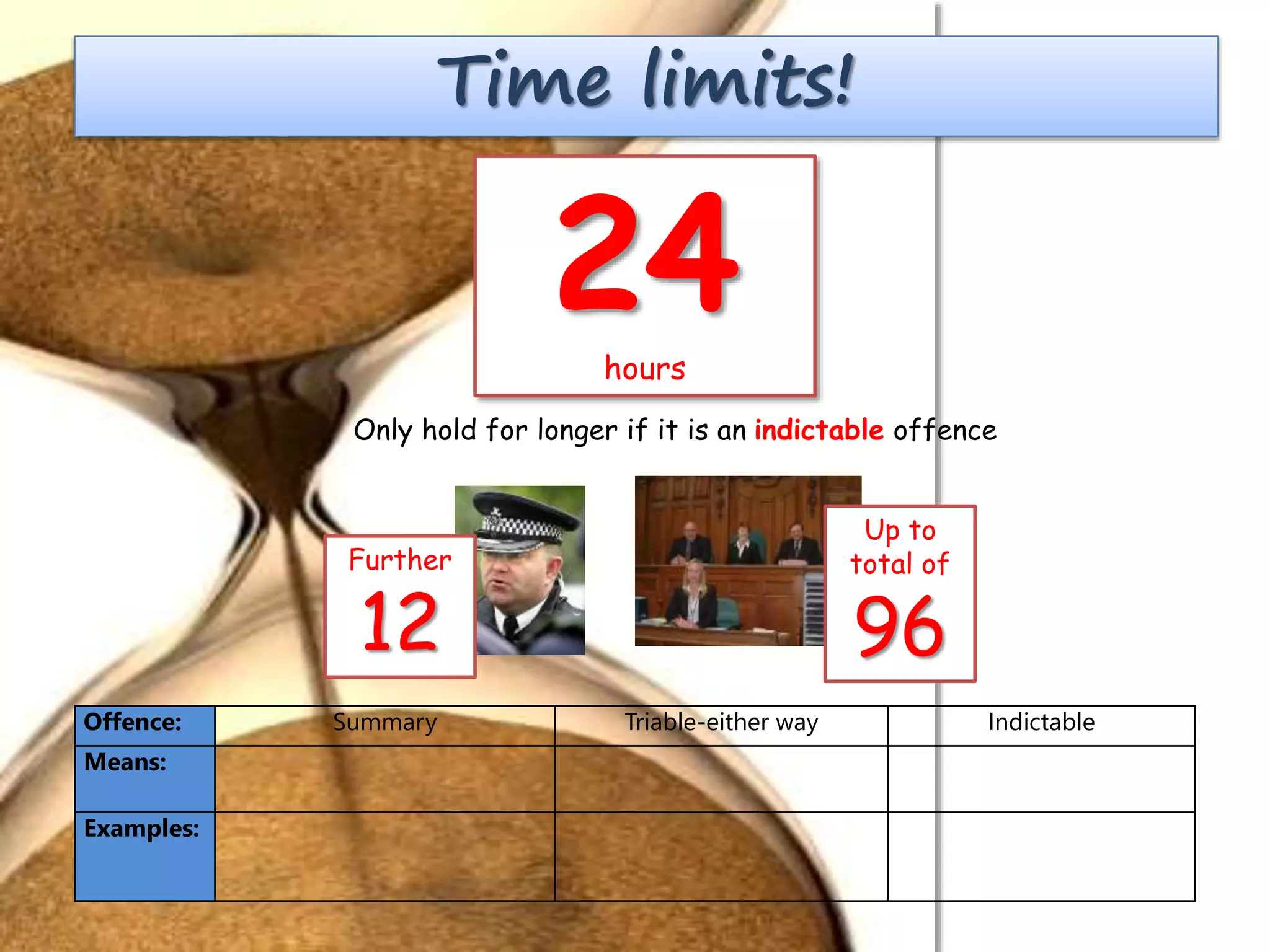
Time limits!
Only hold for longer if it is an indictable offence
Offence: Summary Triable-either way Indictable
Means:
Examples:
24hours
Further
12
Up to
total of
96
The detention will be legal, if among other reasons,
it is necessary...
“pending the results off an examination or analysis
of relevant evidence, or of anything which is being
examined or analysed with a view to obtaining
relevant evidence.”
Is this sufficiently limiting?
What about terrorist suspects and pre-trial
detention?
Protection of Freedoms Act 2012
14days
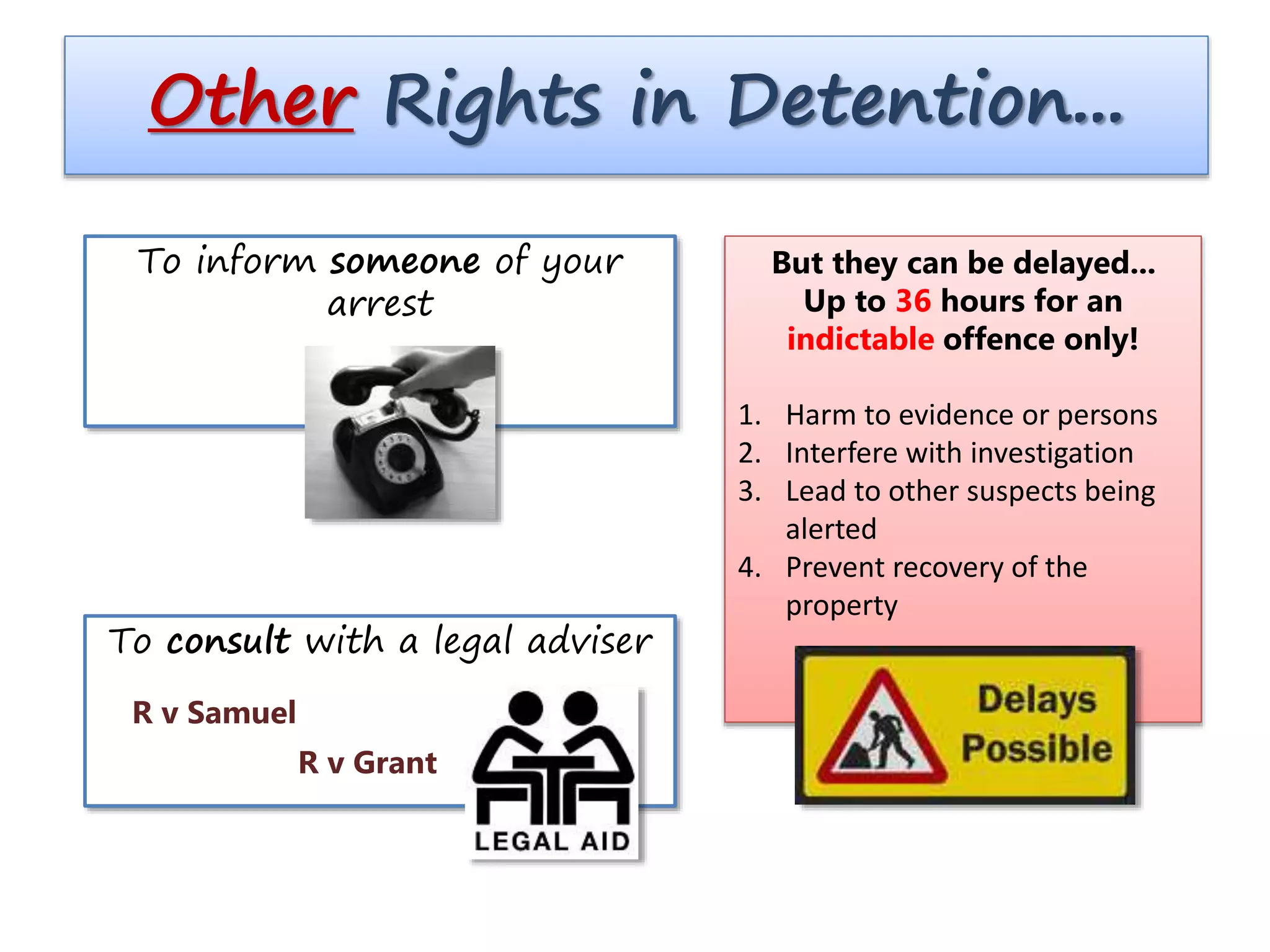
Other Rights in Detention...
But they can be delayed...
Up to 36 hours for an
indictable offence only!
1. Harm to evidence or persons
2. Interfere with investigation
3. Lead to other suspects being
alerted
4. Prevent recovery of the
property
To inform someone of your
arrest
To consult with a legal adviser
R v Samuel
R v Grant
Can you name the word or phrase?
CustodyIndictable
detention
A further safeguard...
Appropriate Adult
Who?
R v Aspinall 1999
Using your IS:
How has this
case affected
this protection?
Other Rights
Section Two:
Interviews
What is the purpose of the interview?
Tape Recorded
Video Recording?
Who else should be present?
How many questions?
Miller 1992
Thinking:
What about those ‘informal’ interviews
which take place before the suspect is
at the station? Many interviews seem to
take more place in police cars or
outside of the police station.
How do we incorporate those
more appropriately?
What conditions?
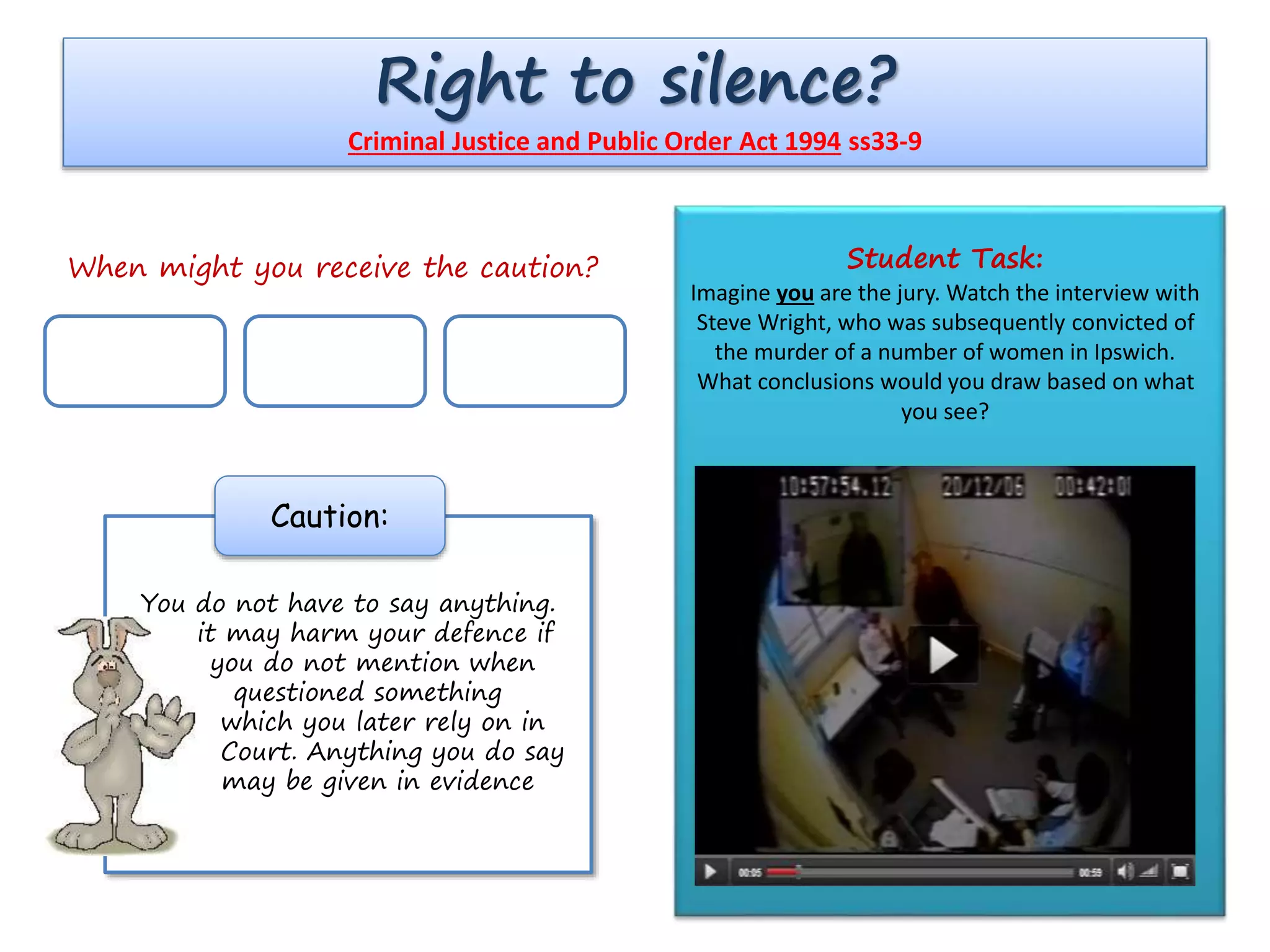
Right to silence?
Criminal Justice and Public Order Act 1994 ss33-9
You do not have to say anything.
But it may harm your defence if
you do not mention when
questioned something
which you later rely on in
Court. Anything you do say
may be given in evidence
Caution:
When might you receive the caution? Student Task:
Imagine you are the jury. Watch the interview with
Steve Wright, who was subsequently convicted of
the murder of a number of women in Ipswich.
What conclusions would you draw based on what
you see?
Are these actions lawful or not?
All of you will decide if they are lawful or not
Most of you will be able to explain why
Some of you will be able to use reference to the law to support your conclusions.
Joe is detained for the theft of a Yorkie. The police keep him for
60 hours then release him without charge
Bob is detained on suspicion of murdering Wilma. The police
suspect that he has an accomplice and refuse to let him tell
anyone that he is at the police station.
Ariel is a schizophrenic, whose medication controls her
symptoms. The police interview her in relation to a suspected
assault and she is lucid and alone.
The police detain Tamara, aged 11, over an alleged criminal
damage offence. Her mother is called and sits in on the
interview.
Fred is taken into an interview room. The police tell him that he
must answer these questions, and if he doesn’t he’ll be charged
with the murder of Pebbles.
A young girl has gone missing…
1. He was arrested on Tuesday at 15.30.
 How is he still in custody on Thursday, if the rule is 24 hours?
 How long could they hold him in total?
2. He was interviewed immediately after arrest, and before his
lawyer arrived.
 Is this legal?
 Why?
3. He has been interviewed twice whilst in custody without a
lawyer
 Why has he not been interviewed continuously?
 What rights would he have in the interview?
4. The police made it clear that this is one of their lines of inquiry.
 What might be the grounds for arrest under s.24?
 Why are they looking at other lines, if he is under arrest?
Consolidation:
Are these legal?
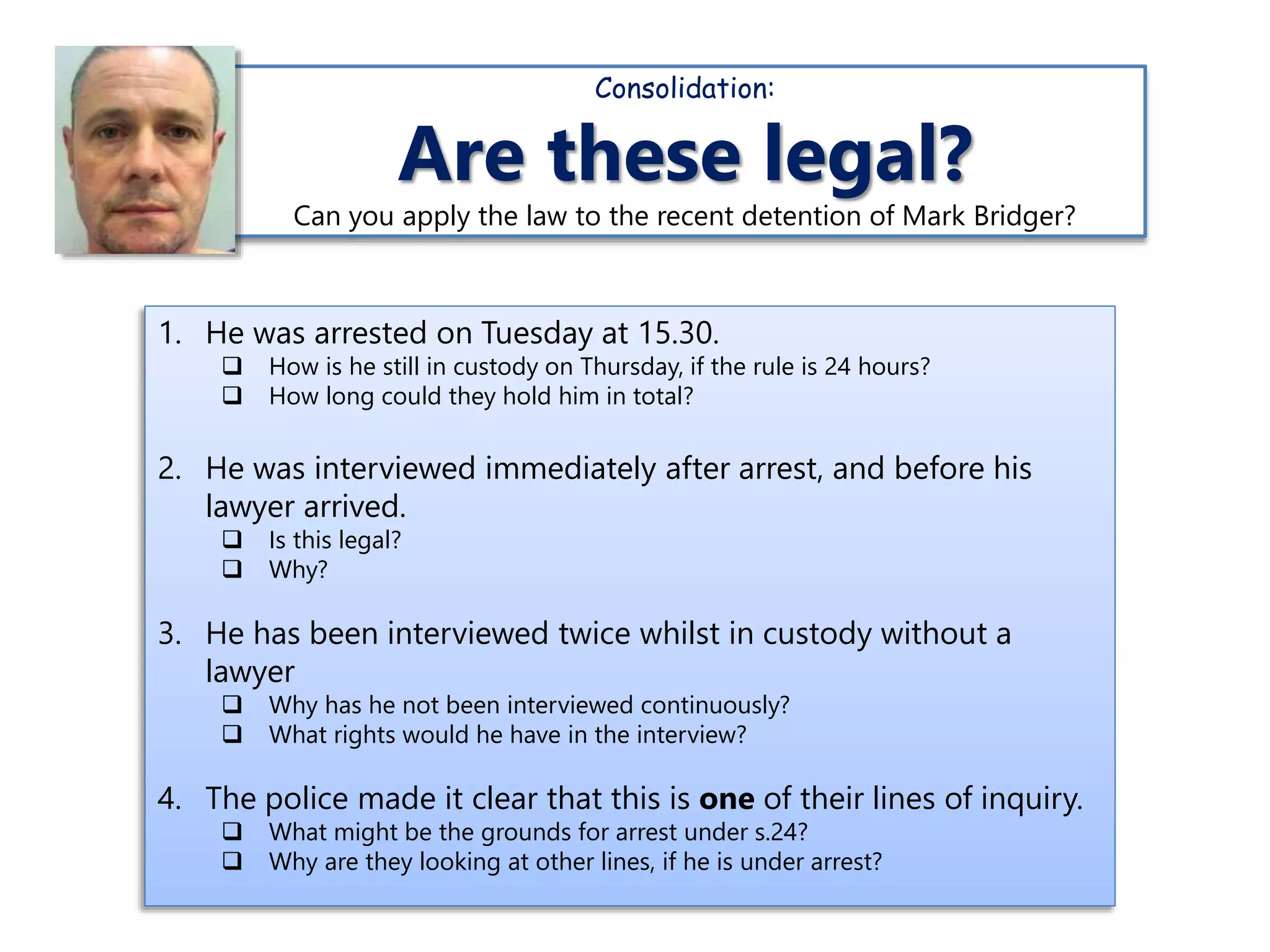
Can you apply the law to the recent detention of Mark Bridger?
Section three:
Searches & Samples
Fingerprints
Non intimate samples
DNA swab
Drug testsPhotographs
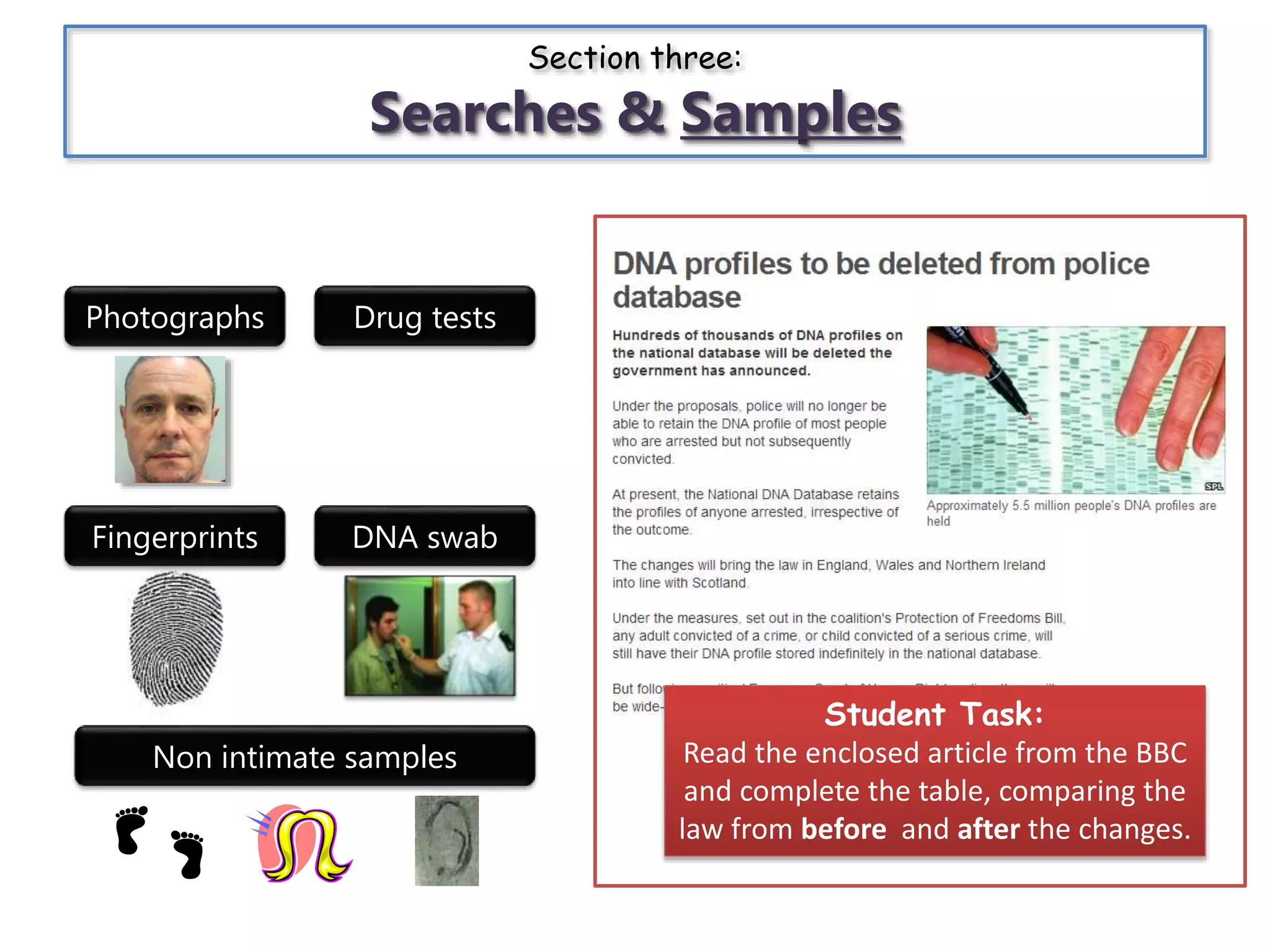
Student Task:
Read the enclosed article from the BBC
and complete the table, comparing the
law from before and after the changes.
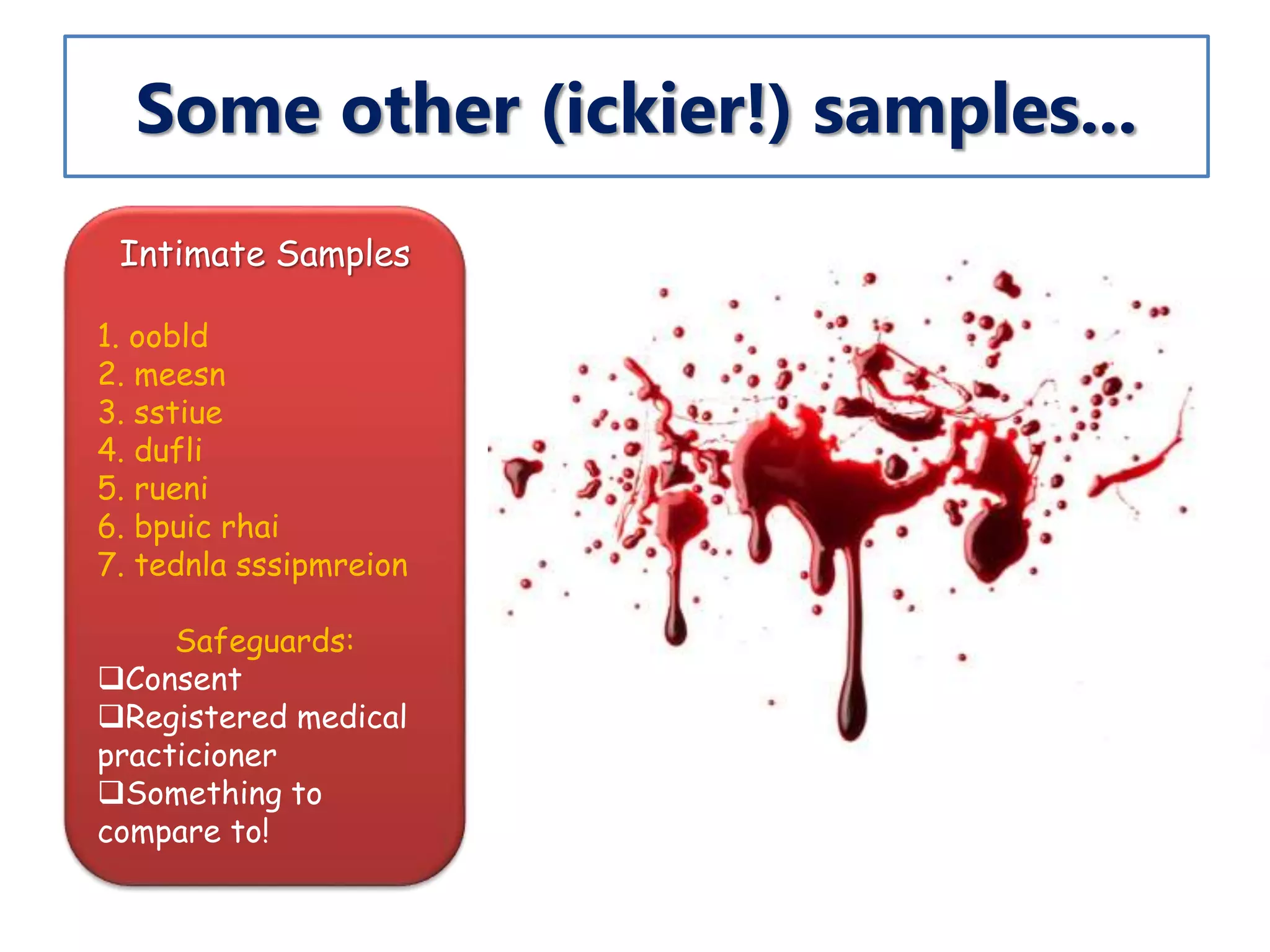
Some other (ickier!) samples...
Intimate Samples
1. oobld
2. meesn
3. sstiue
4. dufli
5. rueni
6. bpuic rhai
7. tednla sssipmreion
Safeguards:
Consent
Registered medical
practicioner
Something to
compare to!
Strip Search
Means:
Safeguards:
Not remove everything
Private
Same gender
Authorised by senior officer
Intimate Search
Two grounds:
1. Item to cause injury
2. Class A drug
Covers?
AO2
Why is the mouth
exempt?
Safeguards:
 Authorised by senior
officer
 Suitably qualified
person... which means?
General Search
What for?
Powers of the Police Limitations on Power Individual Rights
To detain an individual... Only for certain time limits Custody Officer
Can delay right to legal advice... Only if... Right to legal advice
Can delay right to inform.... Only if... Right to have someone informed of
detention
Can interview suspect Must be taped and... Appropriate adult
Interpreter
Can search suspect...
3 Types
Check in search
Strip search
Intimate search
Only if... Must be conducted in particular way to
protect dignity and privacy of S
Can take samples Non-intimate By
With permission from
Intimate By
With permission from
Consolidation...
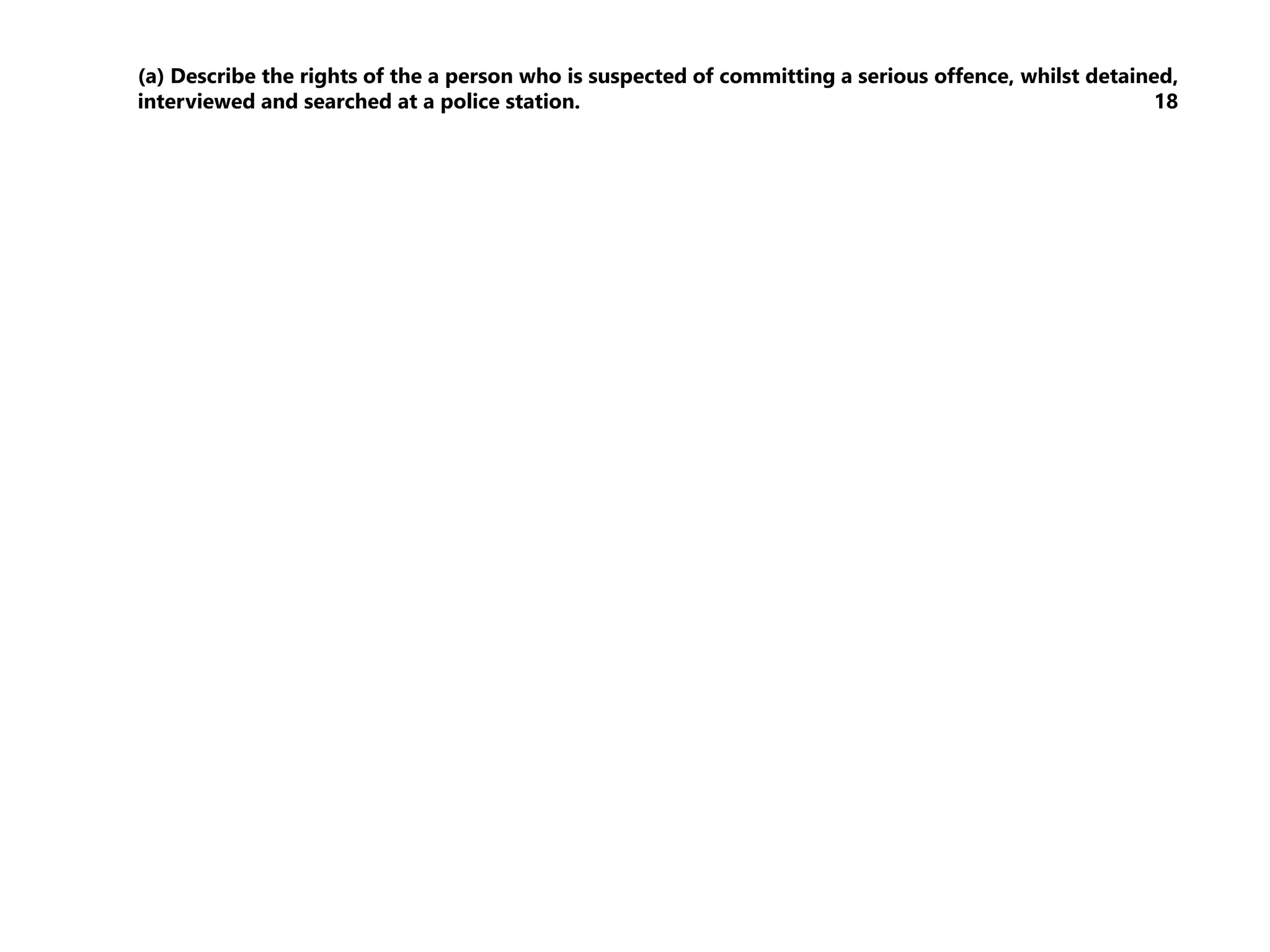
(a) Describe the rights of the a person who is suspected of committing a serious offence, whilst detained,
interviewed and searched at a police station. 18
Matilda is arrested on suspicion of burglary. She is taken to the police station and given an intimate search by a female
police officer to search for stolen credit cards. Fingerprints and a sample of blood are taken from Matilda by force. She is
detained for 30 hours before she is allowed access to legal advice.
Explain whether Matilda's treatment at the police station was lawful. [12]
Point or action? Lawful or not Why
In conclusion:
Plenary:
It’s Post-it time!
E
A
B
C
D
“The removal of the right to silence assumes everyone
is guilty” Discuss whether or not you agree with this
statement and why.
Joe, aged 16 is arrested and charged with arson.
Explain two safeguards which should be in place in his
interview.
Describe the role of the custody sergeant.
Explain the time limits affecting a defendant charged
with an indictable offence.
Identify what is meant by an indictable offence, and
give an example.

Detention

  • 1.
    Police Powers 3: Detention,Interviews, Searches & Samples G151 ELS MAH 2013
  • 2.
    You’ve been arrested... Whathappens next? You are going to watch an episode from C4 Coppers about life in a custody suite. You will need to answer the questions on the sheet.  The rights you have in custody The powers the police have when someone is in their custody. Jim, who is 14, is interviewed by the police on his own. Susie has her fingerprints and DNA taken by force. John refuses to give the police a blood sample.
  • 3.
    Area One: Detention So, you’vebeen arrested... What next? What is police detention? The police restricting the liberty of a suspect for a limited period... Why might the police wish to detain someone? ...in order to investigate and prevent crime or the conduct of the suspect. What do we have to balance, in giving the police the power to detain someone? ...
  • 4.
    Key Person: Custody Officer Isthe Custody Officer a truly independent person? Also responsible for: Check that the arresting officer complied with PACE Keep the custody record May record all of D’s possessions and search D Ensure that you are given adequate rest, meals and reviews in accordance with Code C. Tell you all of your rights, especially that to legal advice. Reviews of custody? After checking that the arresting officer has complied with PACE, he will determine whether the evidence is sufficient, and may then do one of three (main) things...
  • 5.
    Time limits! Only holdfor longer if it is an indictable offence Offence: Summary Triable-either way Indictable Means: Examples: 24hours Further 12 Up to total of 96
  • 6.
    The detention willbe legal, if among other reasons, it is necessary... “pending the results off an examination or analysis of relevant evidence, or of anything which is being examined or analysed with a view to obtaining relevant evidence.” Is this sufficiently limiting? What about terrorist suspects and pre-trial detention? Protection of Freedoms Act 2012 14days
  • 7.
    Other Rights inDetention... But they can be delayed... Up to 36 hours for an indictable offence only! 1. Harm to evidence or persons 2. Interfere with investigation 3. Lead to other suspects being alerted 4. Prevent recovery of the property To inform someone of your arrest To consult with a legal adviser R v Samuel R v Grant
  • 8.
    Can you namethe word or phrase? CustodyIndictable detention
  • 9.
    A further safeguard... AppropriateAdult Who? R v Aspinall 1999 Using your IS: How has this case affected this protection?
  • 10.
  • 11.
    Section Two: Interviews What isthe purpose of the interview? Tape Recorded Video Recording? Who else should be present? How many questions? Miller 1992 Thinking: What about those ‘informal’ interviews which take place before the suspect is at the station? Many interviews seem to take more place in police cars or outside of the police station. How do we incorporate those more appropriately? What conditions?
  • 12.
    Right to silence? CriminalJustice and Public Order Act 1994 ss33-9 You do not have to say anything. But it may harm your defence if you do not mention when questioned something which you later rely on in Court. Anything you do say may be given in evidence Caution: When might you receive the caution? Student Task: Imagine you are the jury. Watch the interview with Steve Wright, who was subsequently convicted of the murder of a number of women in Ipswich. What conclusions would you draw based on what you see?
  • 13.
    Are these actionslawful or not? All of you will decide if they are lawful or not Most of you will be able to explain why Some of you will be able to use reference to the law to support your conclusions. Joe is detained for the theft of a Yorkie. The police keep him for 60 hours then release him without charge Bob is detained on suspicion of murdering Wilma. The police suspect that he has an accomplice and refuse to let him tell anyone that he is at the police station. Ariel is a schizophrenic, whose medication controls her symptoms. The police interview her in relation to a suspected assault and she is lucid and alone. The police detain Tamara, aged 11, over an alleged criminal damage offence. Her mother is called and sits in on the interview. Fred is taken into an interview room. The police tell him that he must answer these questions, and if he doesn’t he’ll be charged with the murder of Pebbles.
  • 14.
    A young girlhas gone missing…
  • 15.
    1. He wasarrested on Tuesday at 15.30.  How is he still in custody on Thursday, if the rule is 24 hours?  How long could they hold him in total? 2. He was interviewed immediately after arrest, and before his lawyer arrived.  Is this legal?  Why? 3. He has been interviewed twice whilst in custody without a lawyer  Why has he not been interviewed continuously?  What rights would he have in the interview? 4. The police made it clear that this is one of their lines of inquiry.  What might be the grounds for arrest under s.24?  Why are they looking at other lines, if he is under arrest? Consolidation: Are these legal? Can you apply the law to the recent detention of Mark Bridger?
  • 16.
    Section three: Searches &Samples Fingerprints Non intimate samples DNA swab Drug testsPhotographs Student Task: Read the enclosed article from the BBC and complete the table, comparing the law from before and after the changes.
  • 17.
    Some other (ickier!)samples... Intimate Samples 1. oobld 2. meesn 3. sstiue 4. dufli 5. rueni 6. bpuic rhai 7. tednla sssipmreion Safeguards: Consent Registered medical practicioner Something to compare to!
  • 18.
    Strip Search Means: Safeguards: Not removeeverything Private Same gender Authorised by senior officer Intimate Search Two grounds: 1. Item to cause injury 2. Class A drug Covers? AO2 Why is the mouth exempt? Safeguards:  Authorised by senior officer  Suitably qualified person... which means? General Search What for?
  • 19.
    Powers of thePolice Limitations on Power Individual Rights To detain an individual... Only for certain time limits Custody Officer Can delay right to legal advice... Only if... Right to legal advice Can delay right to inform.... Only if... Right to have someone informed of detention Can interview suspect Must be taped and... Appropriate adult Interpreter Can search suspect... 3 Types Check in search Strip search Intimate search Only if... Must be conducted in particular way to protect dignity and privacy of S Can take samples Non-intimate By With permission from Intimate By With permission from Consolidation...
  • 20.
    (a) Describe therights of the a person who is suspected of committing a serious offence, whilst detained, interviewed and searched at a police station. 18
  • 21.
    Matilda is arrestedon suspicion of burglary. She is taken to the police station and given an intimate search by a female police officer to search for stolen credit cards. Fingerprints and a sample of blood are taken from Matilda by force. She is detained for 30 hours before she is allowed access to legal advice. Explain whether Matilda's treatment at the police station was lawful. [12] Point or action? Lawful or not Why In conclusion:
  • 23.
    Plenary: It’s Post-it time! E A B C D “Theremoval of the right to silence assumes everyone is guilty” Discuss whether or not you agree with this statement and why. Joe, aged 16 is arrested and charged with arson. Explain two safeguards which should be in place in his interview. Describe the role of the custody sergeant. Explain the time limits affecting a defendant charged with an indictable offence. Identify what is meant by an indictable offence, and give an example.