Police Powers 2:
Powers of
Arrest
Starter:
Can you demonstrate your understanding of the
previous topic?
Too easy? Can you annotate the summary to develop level four detail?
What is the purpose of an arrest?
All of you need to be able to describe the powers of the police to arrest
without a warrant under PACE.
Most of you need to be able to explain what is meant by the ‘necessity
condition’ for an arrest without a warrant.
Some of you need to be able to describe some of the other powers of
arrest available for officers.
To successfully complete an exam question on this, you will need to include
reference to the safeguards under code G as well.
In other words, why give the police this power?
s.110
SOCPA 2005
Key Power:
Arrest without a warrant
s.24
PACE 1984
As amended by
Code G
PACE 1984
SOCPA changed the
powers hugely!
Before, D could only be
arrested for an arrestable
offence.
For example:
rrdmue
htfet
ssoesspino fo nabcnis
rubylagr
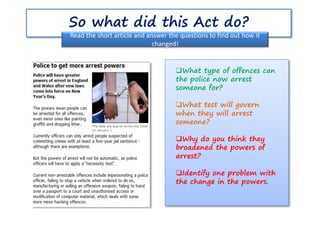
So what did this Act do?
Read the short article and answer the questions to find out how it
changed!
What type of offences can
the police now arrest
someone for?
What test will govern
when they will arrest
someone?
Why do you think they
broadened the powers of
arrest?
Identify one problem with
the change in the powers.
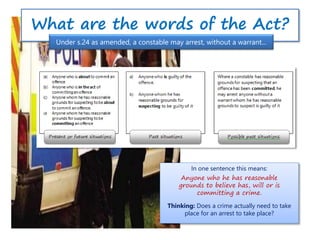
What are the words of the Act?
Under s.24 as amended, a constable may arrest, without a warrant...
In one sentence this means:
Thinking: Does a crime actually need to take
place for an arrest to take place?
Anyone who he has reasonable
grounds to believe has, will or is
committing a crime.
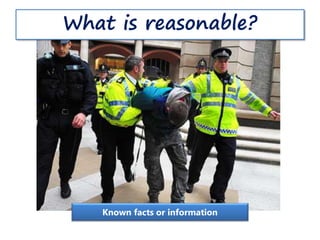
What is reasonable?
Known facts or information
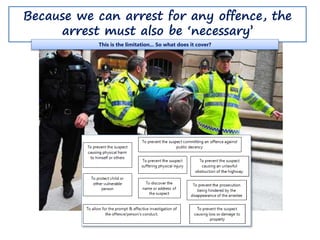
Because we can arrest for any offence, the
arrest must also be ‘necessary’
This is the limitation... So what does it cover?
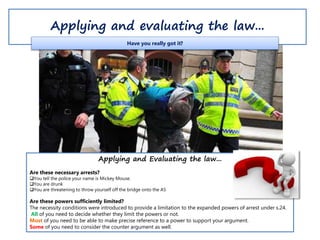
Applying and evaluating the law...
Have you really got it?
Applying and Evaluating the law...
Are these necessary arrests?
You tell the police your name is Mickey Mouse.
You are drunk
You are threatening to throw yourself off the bridge onto the A5
Are these powers sufficiently limited?
The necessity conditions were introduced to provide a limitation to the expanded powers of arrest under s.24.
All of you need to decide whether they limit the powers or not.
Most of you need to be able to make precise reference to a power to support your argument.
Some of you need to consider the counter argument as well.
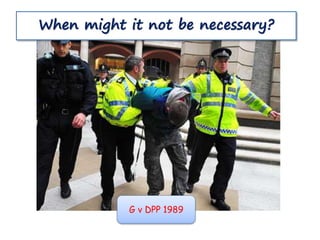
G v DPP 1989
When might it not be necessary?
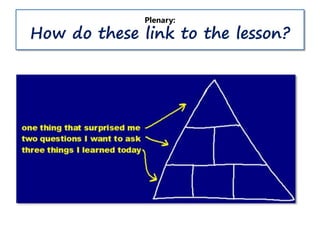
Plenary:
How do these link to the lesson?
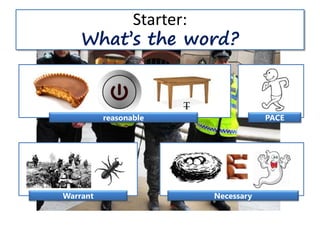
Starter:
What’s the word?
T
reasonable
Warrant Necessary
PACE
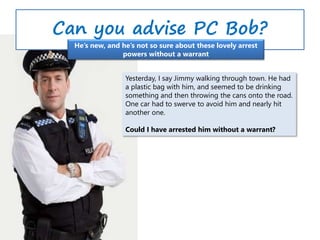
Can you advise PC Bob?
He’s new, and he’s not so sure about these lovely arrest
powers without a warrant
Yesterday, I say Jimmy walking through town. He had
a plastic bag with him, and seemed to be drinking
something and then throwing the cans onto the road.
One car had to swerve to avoid him and nearly hit
another one.
Could I have arrested him without a warrant?
Practice what you preach?
Are these arrests necessary?
PC Bob is walking past a house when he sees Jim up a ladder leaning in a window. He
asks him to come down and for some ID. However, Jim has no ID, and no keys. PC Bob
arrests him for attempted burglary.
PC Bob sees Jane hit John in the fact with a fist, breaking his nose. He arrests Jane. At trial
Jane is acquitted as it turned out she was defending herself after John tried to rob and
assault her.
PC Bob receives information that a tall man with green hair is wanted in connection with
a serious assault which took place earlier in the day. He sees Louis, who is 6ft 7 and has
green hair and arrests him.
Amanda is stopped by PC Bob for speeding. When he asks for her name, she replies
“Superwoman.” She is asked for her name and refuses to give it. She is arrested.
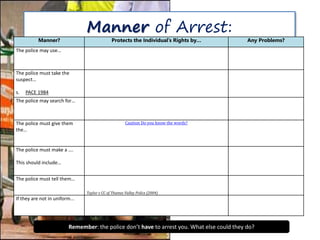
Manner of Arrest:
Remember: the police don’t have to arrest you. What else could they do?
Manner? Protects the Individual’s Rights by… Any Problems?
The police may use…
The police must take the
suspect…
s. PACE 1984
The police may search for…
The police must give them
the…
Caution Do you know the words?
The police must make a ….
This should include…
The police must tell them…
Taylor v CC of Thames Valley Police (2004)
If they are not in uniform...
You do not have to say anything. But it may
harm your defence if you do not mention
when questioned something which you
later rely on in court. Anything you do say
may be given in evidence
You do not have to say anything....
 A sufficiently real and present threat to the peace
 Threat must come from the person arrested
 D’s conduct must clearly interfere with the rights of others & its natural
consequence must be not wholly unreasonable violence
 The conduct of the person to be arrested must not be unreasonable.
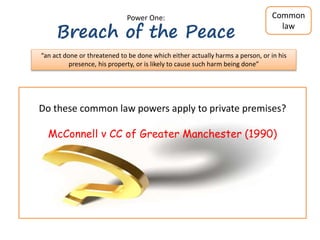
To arrest someone for breach of peace, there must be...
Bibby v Chief Constable of Essex Police (2000)
Power One:
Breach of the Peace
“an act done or threatened to be done which either actually harms a person, or in his
presence, his property, or is likely to cause such harm being done”
Common
law
Do these common law powers apply to private premises?
McConnell v CC of Greater Manchester (1990)
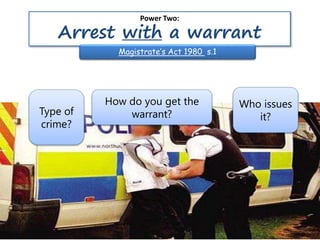
Power Two:
Arrest with a warrant
Magistrate’s Act 1980 s.1
Who issues
it?
How do you get the
warrant?Type of
crime?
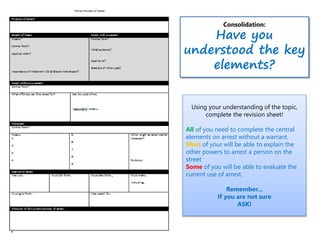
Consolidation:
Have you
understood the key
elements?
Using your understanding of the topic,
complete the revision sheet!
All of you need to complete the central
elements on arrest without a warrant.
Most of your will be able to explain the
other powers to arrest a person on the
street
Some of you will be able to evaluate the
current use of arrest.
Remember...
If you are not sure
ASK!
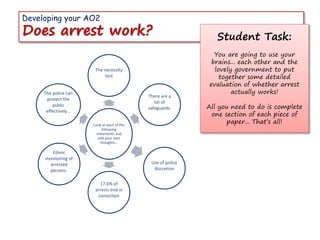
Developing your AO2
Does arrest work?
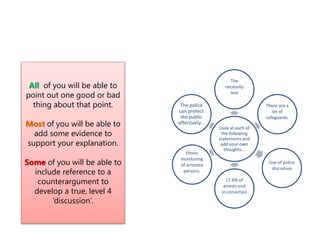
Look at each of the
following
statements and
add your own
thoughts...
The necessity
test
There are a
lot of
safeguards.
Use of police
discretion
17.6% of
arrests end in
conviction
Ethnic
monitoring of
arrested
persons.
The police can
protect the
public
effectively...
Student Task:
You are going to use your
brains... each other and the
lovely government to put
together some detailed
evaluation of whether arrest
actually works!
All you need to do is complete
one section of each piece of
paper... That’s all!
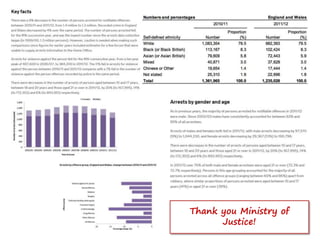
Thank you Ministry of
Justice!
Look at each of
the following
statements and
add your own
thoughts...
The
necessity
test
There are a
lot of
safeguards.
Use of police
discretion
17.6% of
arrests end
in conviction
Ethnic
monitoring
of arrested
persons.
The police
can protect
the public
effectively...
All of you will be able to
point out one good or bad
thing about that point.
Most of you will be able to
add some evidence to
support your explanation.
Some of you will be able to
include reference to a
counterargument to
develop a true, level 4
‘discussion’.
Circle of Knowledge:
Do you know arrest?
Lollipop level? Can you
construct the wheely hard
puzzle using only your
brain.
Sticker Satisfactory? You
may use one of the books,
or your own knowledge.
Too easy?
Can you complete the
bonus knowledge and
explain how it links to at
least one slice?
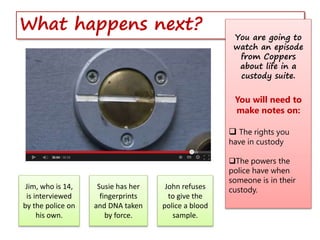
What happens next?
You are going to
watch an episode
from Coppers
about life in a
custody suite.
You will need to
make notes on:
 The rights you
have in custody
The powers the
police have when
someone is in their
custody.Jim, who is 14,
is interviewed
by the police on
his own.
Susie has her
fingerprints
and DNA taken
by force.
John refuses
to give the
police a blood
sample.

Powers of Arrest

  • 1.
  • 2.
    Starter: Can you demonstrateyour understanding of the previous topic? Too easy? Can you annotate the summary to develop level four detail?
  • 3.
    What is thepurpose of an arrest? All of you need to be able to describe the powers of the police to arrest without a warrant under PACE. Most of you need to be able to explain what is meant by the ‘necessity condition’ for an arrest without a warrant. Some of you need to be able to describe some of the other powers of arrest available for officers. To successfully complete an exam question on this, you will need to include reference to the safeguards under code G as well. In other words, why give the police this power?
  • 4.
    s.110 SOCPA 2005 Key Power: Arrestwithout a warrant s.24 PACE 1984 As amended by Code G PACE 1984 SOCPA changed the powers hugely! Before, D could only be arrested for an arrestable offence. For example: rrdmue htfet ssoesspino fo nabcnis rubylagr
  • 5.
    So what didthis Act do? Read the short article and answer the questions to find out how it changed! What type of offences can the police now arrest someone for? What test will govern when they will arrest someone? Why do you think they broadened the powers of arrest? Identify one problem with the change in the powers.
  • 6.
    What are thewords of the Act? Under s.24 as amended, a constable may arrest, without a warrant... In one sentence this means: Thinking: Does a crime actually need to take place for an arrest to take place? Anyone who he has reasonable grounds to believe has, will or is committing a crime.
  • 7.
    What is reasonable? Knownfacts or information
  • 8.
    Because we canarrest for any offence, the arrest must also be ‘necessary’ This is the limitation... So what does it cover?
  • 9.
    Applying and evaluatingthe law... Have you really got it? Applying and Evaluating the law... Are these necessary arrests? You tell the police your name is Mickey Mouse. You are drunk You are threatening to throw yourself off the bridge onto the A5 Are these powers sufficiently limited? The necessity conditions were introduced to provide a limitation to the expanded powers of arrest under s.24. All of you need to decide whether they limit the powers or not. Most of you need to be able to make precise reference to a power to support your argument. Some of you need to consider the counter argument as well.
  • 10.
    G v DPP1989 When might it not be necessary?
  • 11.
    Plenary: How do theselink to the lesson?
  • 12.
  • 13.
    Can you advisePC Bob? He’s new, and he’s not so sure about these lovely arrest powers without a warrant Yesterday, I say Jimmy walking through town. He had a plastic bag with him, and seemed to be drinking something and then throwing the cans onto the road. One car had to swerve to avoid him and nearly hit another one. Could I have arrested him without a warrant?
  • 14.
    Practice what youpreach? Are these arrests necessary? PC Bob is walking past a house when he sees Jim up a ladder leaning in a window. He asks him to come down and for some ID. However, Jim has no ID, and no keys. PC Bob arrests him for attempted burglary. PC Bob sees Jane hit John in the fact with a fist, breaking his nose. He arrests Jane. At trial Jane is acquitted as it turned out she was defending herself after John tried to rob and assault her. PC Bob receives information that a tall man with green hair is wanted in connection with a serious assault which took place earlier in the day. He sees Louis, who is 6ft 7 and has green hair and arrests him. Amanda is stopped by PC Bob for speeding. When he asks for her name, she replies “Superwoman.” She is asked for her name and refuses to give it. She is arrested.
  • 15.
    Manner of Arrest: Remember:the police don’t have to arrest you. What else could they do? Manner? Protects the Individual’s Rights by… Any Problems? The police may use… The police must take the suspect… s. PACE 1984 The police may search for… The police must give them the… Caution Do you know the words? The police must make a …. This should include… The police must tell them… Taylor v CC of Thames Valley Police (2004) If they are not in uniform...
  • 16.
    You do nothave to say anything. But it may harm your defence if you do not mention when questioned something which you later rely on in court. Anything you do say may be given in evidence You do not have to say anything....
  • 17.
     A sufficientlyreal and present threat to the peace  Threat must come from the person arrested  D’s conduct must clearly interfere with the rights of others & its natural consequence must be not wholly unreasonable violence  The conduct of the person to be arrested must not be unreasonable. To arrest someone for breach of peace, there must be... Bibby v Chief Constable of Essex Police (2000) Power One: Breach of the Peace “an act done or threatened to be done which either actually harms a person, or in his presence, his property, or is likely to cause such harm being done” Common law Do these common law powers apply to private premises? McConnell v CC of Greater Manchester (1990)
  • 18.
    Power Two: Arrest witha warrant Magistrate’s Act 1980 s.1 Who issues it? How do you get the warrant?Type of crime?
  • 19.
    Consolidation: Have you understood thekey elements? Using your understanding of the topic, complete the revision sheet! All of you need to complete the central elements on arrest without a warrant. Most of your will be able to explain the other powers to arrest a person on the street Some of you will be able to evaluate the current use of arrest. Remember... If you are not sure ASK!
  • 20.
    Developing your AO2 Doesarrest work? Look at each of the following statements and add your own thoughts... The necessity test There are a lot of safeguards. Use of police discretion 17.6% of arrests end in conviction Ethnic monitoring of arrested persons. The police can protect the public effectively... Student Task: You are going to use your brains... each other and the lovely government to put together some detailed evaluation of whether arrest actually works! All you need to do is complete one section of each piece of paper... That’s all!
  • 21.
    Thank you Ministryof Justice!
  • 22.
    Look at eachof the following statements and add your own thoughts... The necessity test There are a lot of safeguards. Use of police discretion 17.6% of arrests end in conviction Ethnic monitoring of arrested persons. The police can protect the public effectively... All of you will be able to point out one good or bad thing about that point. Most of you will be able to add some evidence to support your explanation. Some of you will be able to include reference to a counterargument to develop a true, level 4 ‘discussion’.
  • 23.
    Circle of Knowledge: Doyou know arrest? Lollipop level? Can you construct the wheely hard puzzle using only your brain. Sticker Satisfactory? You may use one of the books, or your own knowledge. Too easy? Can you complete the bonus knowledge and explain how it links to at least one slice?
  • 24.
    What happens next? Youare going to watch an episode from Coppers about life in a custody suite. You will need to make notes on:  The rights you have in custody The powers the police have when someone is in their custody.Jim, who is 14, is interviewed by the police on his own. Susie has her fingerprints and DNA taken by force. John refuses to give the police a blood sample.