Intoxication:
The Last General Defence
You already know quite a lot…
The courts have decided that there are two types of intent in intoxication –
and
. The general rule for a basic intent crime, such as
, is that
by taking the intoxicant, D is
and so has the mens rea. This is illustrated by
the case of , where even though he had no idea what he was actually doing, the taking of the
LSD would be enough. However, there is a clear exception where the substance has a different
effect on D than anticipated as in the case of
.
A
intent crime, like
is one which requires intent only as the
mens rea. For these crimes, D may have a defence if he was so intoxicated that he could not
at all. The courts have said that even if it was
self-induced, D may have a defence as in the case of
where he injected
himself with insulin and then did not eat.
If D is involuntarily intoxicated, then he may have a defence, but only if he never had the mens
rea to start with. The courts have made this clear in
, where the Private
detective drugged D and helped him to abuse a young boy.

Kingston

manslaughter

Bailey

Lipman

murder

form a mens rea

Hardie

specific
basic

specific

reckless
Can you now apply that knowledge?
Look at the scenarios…
D whilst intoxicated with alcohol, raped a 13 year old girl. Worried that she would
make a noise, he put his hand over her mouth, suffocating her.
D whilst intoxicated with alcohol, raped a 13 year old girl. Worried that she would
make a noise, he put his hand over her mouth, suffocating her.
DD in revenge for
an alleged theft
earlier that
evening, and whilst
drunk, poured
petrol over a
tramp and set fire
to him.

D wanted to kill his
wife and bought a
knife and a bottle of
whiskey. After
drinking a
substantial amount
of the whiskey, he
stabbed her to
death.

D and his wife went out for dinner. D drank a
good amount of wine, and when they came
home, raped the babysitter. He claimed that
he thought she was his wife.

D, who was a drug addict,
went on a 48 hour drinking
and drugs binge, which
resulted in him attacking the
pub landlord and the police
officer who came to arrest him.
DD, who were university
students, had been out
drinking with V. On returning
home, they did their usual, and
dangled V over the edge of a
second floor balcony. They
dropped V.

All of you should be able to use your prior
knowledge to determine whether or not
you think D would have a defence of
intoxication.
Most of you should be able to explain your
choices using the correct
terminology, using prior learning.

Some of you should be able to use your
conclusions to determine the impact public
policy has on the scope of this
defence, and how far you agree with the
current approach of the courts.
Summing up the essentials…
An intoxicant is....

It is not a ‘true defence’ because....

When argued it is because ....

Or....

It is governed very strictly by....

The general rule is....
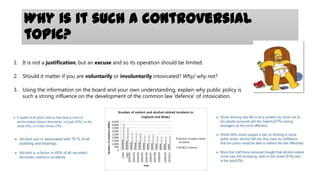
Why is it such a controversial
topic?
1. It is not a justification, but an excuse and so its operation should be limited.
2. Should it matter if you are voluntarily or involuntarily intoxicated? Why/ why not?
3. Using the information on the board and your own understanding, explain why public policy is
such a strong influence on the development of the common law ‘defence’ of intoxication.
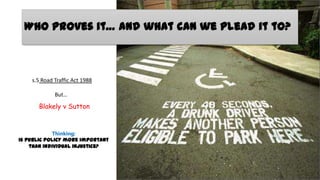
Who proves it… and what can we plead it to?

s.5 Road Traffic Act 1988
But…

Blakely v Sutton

Thinking:
Is public policy more important
than individual injustice?
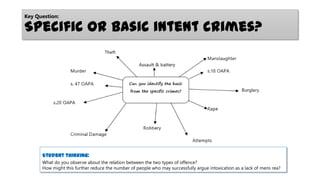
Key Question:

Specific or basic intent crimes?

Student thinking:
What do you observe about the relation between the two types of offence?
How might this further reduce the number of people who may successfully argue intoxication as a lack of mens rea?
How easy is it to tell them apart?
… more tricky than you think!

R v Heard 2007
s.3 Sexual Offences Act 2003
(1) A person (A) commits an offence if –
(a)
(b)
(c)
(d)

He intentionally touches another person (B)
The touching is sexual
B does not consent to the touching, and
A does not reasonably believe that B consents

 What kind of crime does it create? One of basic
intent or one of specific intent? How do you
know?
 What does this mean if D is sufficiently
intoxicated to affect his MR?
R v Heard 2007
1. What are the facts of the case?
2. According to the judges, was it a specific or basic intent
crime?
3. Was he successful in his appeal?
4. What do you think that the courts took into account in
making their decision?

5. What problems does this lead to for defendants?
Voluntary Intoxication:

Specific Intent Offences
DPP v Beard 1920

Sheehan & Moore 1975

“If D was so drunk that he was incapable of forming the intent
required, he could not be convicted of a crime which was
committed only if the intent was proved.”

“a drunken intent is nevertheless an intent”

So, in conclusion…
If D has been charged with a specific intent crime and is voluntarily intoxicated…
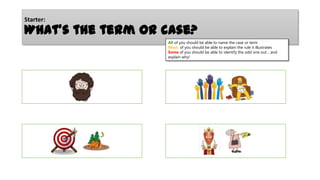
Starter:

What’s the term or case?
All of you should be able to name the case or term
Most of you should be able to explain the rule it illustrates
Some of you should be able to identify the odd one out… and
explain why!
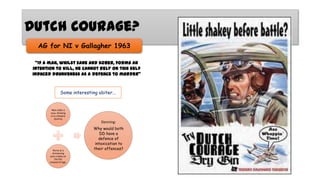
Dutch Courage?
AG for NI v Gallagher 1963
“If a man, whilst sane and sober, forms an
intention to kill, he cannot rely on this self
induced drunkeness as a defence to murder”

Some interesting obiter...

Man stabs a
man, thinking
it is a theatre
dummy

Nurse at a
christening
puts a baby on
the fire
instead of logs.

Denning:
Why would both
DD have a
defence of
intoxication to
their offences?
Voluntary Intoxication:

Basic Intent Offences
The key case…

DPP v Majewski 1977
“illogical though the present law may
be, it represents a compromise between
the imposition of liability upon inebriates
in complete disregard of their condition
(on the alleged ground that it was
brought on voluntarily) and the total
exculpation required by D’s actual state
of mind at the time he committed the
harm in issue.”
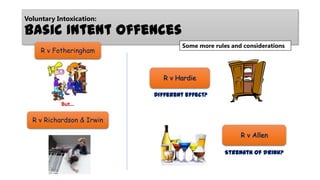
Voluntary Intoxication:

Basic Intent Offences
R v Fotheringham

Some more rules and considerations

R v Hardie
Different effect?
But…

R v Richardson & Irwin
R v Allen
Strength of drink?
Area Two:

Involuntary Intoxication

But: What if it merely removes boundaries
in your behaviour?

Should you be able to rely on the defence?
Key Case:

R v Kingston 1994

Read the case extract and answer the questions in as much detail as you can:

1.

What are the facts of the offences?

2.

What were D’s impulses, the resistance to which was
lowered by the intoxicant?

3.

Name two of the problems with the Court of Appeals
quashing of the conviction.

4.

What is meant by a ‘spurious’ defence?

5.

Do you agree with the decision of the Court of Appeal
or the House of Lords? Why?
Starter:

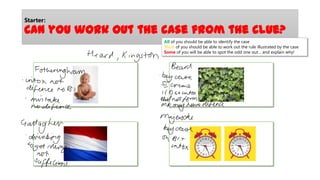
Can you work out the case from the clue?
All of you should be able to identify the case
Most of you should be able to work out the rule illustrated by the case
Some of you will be able to spot the odd one out… and explain why!
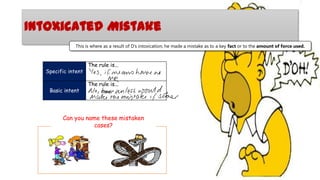
Intoxicated Mistake
This is where as a result of D’s intoxication, he made a mistake as to a key fact or to the amount of force used.

Specific intent
Basic intent

The rule is...

The rule is...

Can you name these mistaken
cases?
Force:
A particular problem?

Issue:
What if, due to your intoxication, you misjudge the amount of force
you need to use... Or even that you needed to use any to start with!

Student Task:
This area of the law needs to balance the
individual’s right to use honest necessary
force, with the rights of the innocent victim
who should be protected from injury or death
by another’s drunken mistake.
Who should win? Why?
Links to the topic of self defence!
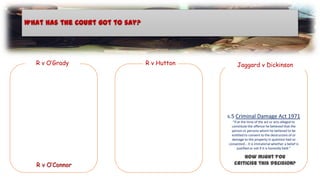
What has the Court got to say?

R v O’Grady

R v Hutton

Jaggard v Dickinson

s.5 Criminal Damage Act 1971
“if at the time of the act or acts alleged to
constitute the offence he believed that the
person or persons whom he believed to be
entitled to consent to the destruction of or
damage to the property in question had so
consented... it is immaterial whether a belief is
justified or not if it is honestly held.”

R v O’Connor

How might you
criticise this decision?
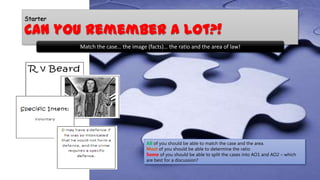
Starter

Can you remember a lot?!
Match the case… the image (facts)… the ratio and the area of law!

All of you should be able to match the case and the area.
Most of you should be able to determine the ratio
Some of you should be able to split the cases into AO1 and AO2 – which
are best for a discussion?
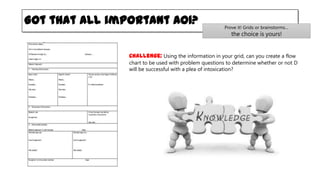
Got that all important AO1?

Prove it! Grids or brainstorms…

the choice is yours!

Challenge: Using the information in your grid, can you create a flow

chart to be used with problem questions to determine whether or not D
will be successful with a plea of intoxication?
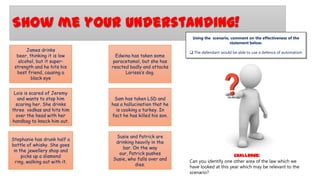
Show me your understanding!
Using the scenario, comment on the effectiveness of the
statement below:

James drinks
beer, thinking it is low
alcohol, but it superstrength and he hits his
best friend, causing a
black eye

Edwina has taken some
paracetamol, but she has
reacted badly and attacks
Larissa’s dog.

Lois is scared of Jeremy
and wants to stop him
scaring her. She drinks
three vodkas and hits him
over the head with her
handbag to knock him out.

Sam has taken LSD and
has a hallucination that he
is cooking a turkey. In
fact he has killed his son.

Stephanie has drunk half a
bottle of whisky. She goes
in the jewellery shop and
picks up a diamond
ring, walking out with it.

Susie and Patrick are
drinking heavily in the
bar. On the way
our, Patrick pushes
Susie, who falls over and
dies.

 The defendant would be able to use a defence of automatism

Challenge:
Can you identify one other area of the law which we
have looked at this year which may be relevant to the
scenario?
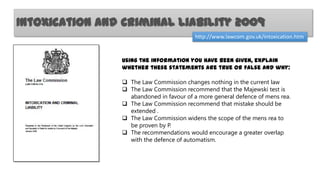
Intoxication and Criminal Liability 2009
http://www.lawcom.gov.uk/intoxication.htm

Using the information you have been given, explain
whether these statements are true or false and why:
 The Law Commission changes nothing in the current law
 The Law Commission recommend that the Majewski test is
abandoned in favour of a more general defence of mens rea.
 The Law Commission recommend that mistake should be
extended .
 The Law Commission widens the scope of the mens rea to
be proven by P.
 The recommendations would encourage a greater overlap
with the defence of automatism.
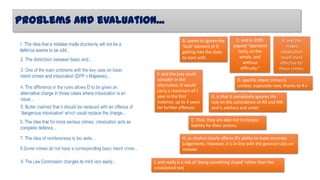
Problems and evaluation...
B. seems to ignore the
'fault' element of D
getting into the state
to start with.
F. and the jury could
consider in the
alternative. It would
carry a maximum of 1
year in the first
instance, up to 3 years
for further offences.

C. and in 1995
argued "operated
fairly, on the
whole, and
without
difficulty."

A. and this
makes
intoxication
much more
effective for
these crimes.

D. specific intent crimes is
unclear, especially now, thanks to R v
Heard.
G. is that it completely ignores the
rule on the coincidence of AR and MR.
and is arbitary and unfair

E. Thus, they are able not to escape
liability for their actions.
H. as alcohol clearly affects D's ability to make accurate
judgements. However, it is in line with the general rules on
mistake.
I. and really is a risk of 'doing something stupid' rather than the
established test
What about the rest of the world?
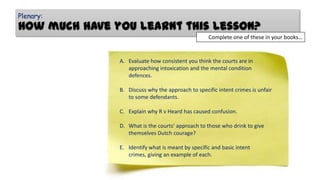
Plenary:

How much have you learnt this lesson?
Complete one of these in your books…

A. Evaluate how consistent you think the courts are in
approaching intoxication and the mental condition
defences.
B. Discuss why the approach to specific intent crimes is unfair
to some defendants.
C. Explain why R v Heard has caused confusion.
D. What is the courts’ approach to those who drink to give
themselves Dutch courage?
E. Identify what is meant by specific and basic intent
crimes, giving an example of each.
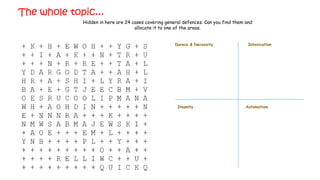
The whole topic...
Hidden in here are 24 cases covering general defences. Can you find them and
allocate it to one of the areas.
Duress & Necessity

Insanity

Intoxication

Automatism

Intox2014

  • 1.
  • 2.
    You already knowquite a lot… The courts have decided that there are two types of intent in intoxication – and . The general rule for a basic intent crime, such as , is that by taking the intoxicant, D is and so has the mens rea. This is illustrated by the case of , where even though he had no idea what he was actually doing, the taking of the LSD would be enough. However, there is a clear exception where the substance has a different effect on D than anticipated as in the case of . A intent crime, like is one which requires intent only as the mens rea. For these crimes, D may have a defence if he was so intoxicated that he could not at all. The courts have said that even if it was self-induced, D may have a defence as in the case of where he injected himself with insulin and then did not eat. If D is involuntarily intoxicated, then he may have a defence, but only if he never had the mens rea to start with. The courts have made this clear in , where the Private detective drugged D and helped him to abuse a young boy. Kingston manslaughter Bailey Lipman murder form a mens rea Hardie specific basic specific reckless
  • 3.
    Can you nowapply that knowledge? Look at the scenarios… D whilst intoxicated with alcohol, raped a 13 year old girl. Worried that she would make a noise, he put his hand over her mouth, suffocating her. D whilst intoxicated with alcohol, raped a 13 year old girl. Worried that she would make a noise, he put his hand over her mouth, suffocating her. DD in revenge for an alleged theft earlier that evening, and whilst drunk, poured petrol over a tramp and set fire to him. D wanted to kill his wife and bought a knife and a bottle of whiskey. After drinking a substantial amount of the whiskey, he stabbed her to death. D and his wife went out for dinner. D drank a good amount of wine, and when they came home, raped the babysitter. He claimed that he thought she was his wife. D, who was a drug addict, went on a 48 hour drinking and drugs binge, which resulted in him attacking the pub landlord and the police officer who came to arrest him. DD, who were university students, had been out drinking with V. On returning home, they did their usual, and dangled V over the edge of a second floor balcony. They dropped V. All of you should be able to use your prior knowledge to determine whether or not you think D would have a defence of intoxication. Most of you should be able to explain your choices using the correct terminology, using prior learning. Some of you should be able to use your conclusions to determine the impact public policy has on the scope of this defence, and how far you agree with the current approach of the courts.
  • 4.
    Summing up theessentials… An intoxicant is.... It is not a ‘true defence’ because.... When argued it is because .... Or.... It is governed very strictly by.... The general rule is....
  • 5.
    Why is itsuch a controversial topic? 1. It is not a justification, but an excuse and so its operation should be limited. 2. Should it matter if you are voluntarily or involuntarily intoxicated? Why/ why not? 3. Using the information on the board and your own understanding, explain why public policy is such a strong influence on the development of the common law ‘defence’ of intoxication.
  • 6.
    Who proves it…and what can we plead it to? s.5 Road Traffic Act 1988 But… Blakely v Sutton Thinking: Is public policy more important than individual injustice?
  • 7.
    Key Question: Specific orbasic intent crimes? Student thinking: What do you observe about the relation between the two types of offence? How might this further reduce the number of people who may successfully argue intoxication as a lack of mens rea?
  • 8.
    How easy isit to tell them apart? … more tricky than you think! R v Heard 2007 s.3 Sexual Offences Act 2003 (1) A person (A) commits an offence if – (a) (b) (c) (d) He intentionally touches another person (B) The touching is sexual B does not consent to the touching, and A does not reasonably believe that B consents  What kind of crime does it create? One of basic intent or one of specific intent? How do you know?  What does this mean if D is sufficiently intoxicated to affect his MR?
  • 9.
    R v Heard2007 1. What are the facts of the case? 2. According to the judges, was it a specific or basic intent crime? 3. Was he successful in his appeal? 4. What do you think that the courts took into account in making their decision? 5. What problems does this lead to for defendants?
  • 10.
    Voluntary Intoxication: Specific IntentOffences DPP v Beard 1920 Sheehan & Moore 1975 “If D was so drunk that he was incapable of forming the intent required, he could not be convicted of a crime which was committed only if the intent was proved.” “a drunken intent is nevertheless an intent” So, in conclusion… If D has been charged with a specific intent crime and is voluntarily intoxicated…
  • 11.
    Starter: What’s the termor case? All of you should be able to name the case or term Most of you should be able to explain the rule it illustrates Some of you should be able to identify the odd one out… and explain why!
  • 12.
    Dutch Courage? AG forNI v Gallagher 1963 “If a man, whilst sane and sober, forms an intention to kill, he cannot rely on this self induced drunkeness as a defence to murder” Some interesting obiter... Man stabs a man, thinking it is a theatre dummy Nurse at a christening puts a baby on the fire instead of logs. Denning: Why would both DD have a defence of intoxication to their offences?
  • 13.
    Voluntary Intoxication: Basic IntentOffences The key case… DPP v Majewski 1977 “illogical though the present law may be, it represents a compromise between the imposition of liability upon inebriates in complete disregard of their condition (on the alleged ground that it was brought on voluntarily) and the total exculpation required by D’s actual state of mind at the time he committed the harm in issue.”
  • 14.
    Voluntary Intoxication: Basic IntentOffences R v Fotheringham Some more rules and considerations R v Hardie Different effect? But… R v Richardson & Irwin R v Allen Strength of drink?
  • 15.
    Area Two: Involuntary Intoxication But:What if it merely removes boundaries in your behaviour? Should you be able to rely on the defence?
  • 16.
    Key Case: R vKingston 1994 Read the case extract and answer the questions in as much detail as you can: 1. What are the facts of the offences? 2. What were D’s impulses, the resistance to which was lowered by the intoxicant? 3. Name two of the problems with the Court of Appeals quashing of the conviction. 4. What is meant by a ‘spurious’ defence? 5. Do you agree with the decision of the Court of Appeal or the House of Lords? Why?
  • 17.
    Starter: Can you workout the case from the clue? All of you should be able to identify the case Most of you should be able to work out the rule illustrated by the case Some of you will be able to spot the odd one out… and explain why!
  • 18.
    Intoxicated Mistake This iswhere as a result of D’s intoxication, he made a mistake as to a key fact or to the amount of force used. Specific intent Basic intent The rule is... The rule is... Can you name these mistaken cases?
  • 19.
    Force: A particular problem? Issue: Whatif, due to your intoxication, you misjudge the amount of force you need to use... Or even that you needed to use any to start with! Student Task: This area of the law needs to balance the individual’s right to use honest necessary force, with the rights of the innocent victim who should be protected from injury or death by another’s drunken mistake. Who should win? Why? Links to the topic of self defence!
  • 20.
    What has theCourt got to say? R v O’Grady R v Hutton Jaggard v Dickinson s.5 Criminal Damage Act 1971 “if at the time of the act or acts alleged to constitute the offence he believed that the person or persons whom he believed to be entitled to consent to the destruction of or damage to the property in question had so consented... it is immaterial whether a belief is justified or not if it is honestly held.” R v O’Connor How might you criticise this decision?
  • 21.
    Starter Can you remembera lot?! Match the case… the image (facts)… the ratio and the area of law! All of you should be able to match the case and the area. Most of you should be able to determine the ratio Some of you should be able to split the cases into AO1 and AO2 – which are best for a discussion?
  • 22.
    Got that allimportant AO1? Prove it! Grids or brainstorms… the choice is yours! Challenge: Using the information in your grid, can you create a flow chart to be used with problem questions to determine whether or not D will be successful with a plea of intoxication?
  • 23.
    Show me yourunderstanding! Using the scenario, comment on the effectiveness of the statement below: James drinks beer, thinking it is low alcohol, but it superstrength and he hits his best friend, causing a black eye Edwina has taken some paracetamol, but she has reacted badly and attacks Larissa’s dog. Lois is scared of Jeremy and wants to stop him scaring her. She drinks three vodkas and hits him over the head with her handbag to knock him out. Sam has taken LSD and has a hallucination that he is cooking a turkey. In fact he has killed his son. Stephanie has drunk half a bottle of whisky. She goes in the jewellery shop and picks up a diamond ring, walking out with it. Susie and Patrick are drinking heavily in the bar. On the way our, Patrick pushes Susie, who falls over and dies.  The defendant would be able to use a defence of automatism Challenge: Can you identify one other area of the law which we have looked at this year which may be relevant to the scenario?
  • 24.
    Intoxication and CriminalLiability 2009 http://www.lawcom.gov.uk/intoxication.htm Using the information you have been given, explain whether these statements are true or false and why:  The Law Commission changes nothing in the current law  The Law Commission recommend that the Majewski test is abandoned in favour of a more general defence of mens rea.  The Law Commission recommend that mistake should be extended .  The Law Commission widens the scope of the mens rea to be proven by P.  The recommendations would encourage a greater overlap with the defence of automatism.
  • 25.
    Problems and evaluation... B.seems to ignore the 'fault' element of D getting into the state to start with. F. and the jury could consider in the alternative. It would carry a maximum of 1 year in the first instance, up to 3 years for further offences. C. and in 1995 argued "operated fairly, on the whole, and without difficulty." A. and this makes intoxication much more effective for these crimes. D. specific intent crimes is unclear, especially now, thanks to R v Heard. G. is that it completely ignores the rule on the coincidence of AR and MR. and is arbitary and unfair E. Thus, they are able not to escape liability for their actions. H. as alcohol clearly affects D's ability to make accurate judgements. However, it is in line with the general rules on mistake. I. and really is a risk of 'doing something stupid' rather than the established test
  • 26.
    What about therest of the world?
  • 27.
    Plenary: How much haveyou learnt this lesson? Complete one of these in your books… A. Evaluate how consistent you think the courts are in approaching intoxication and the mental condition defences. B. Discuss why the approach to specific intent crimes is unfair to some defendants. C. Explain why R v Heard has caused confusion. D. What is the courts’ approach to those who drink to give themselves Dutch courage? E. Identify what is meant by specific and basic intent crimes, giving an example of each.
  • 28.
    The whole topic... Hiddenin here are 24 cases covering general defences. Can you find them and allocate it to one of the areas. Duress & Necessity Insanity Intoxication Automatism

Editor's Notes

  • #12 Beard; voluntarhintox; specific intent;kingston
  • #29 BAILEYBEARDBOWENBRATTYCLARKECOLECONWAYGRAHAMHARDIEHASANHEARDHOWEJOHNSONKEMPKINGSTONLIPMANMAJEWSKIMNAUGHTENOGRADYQUAYLEQUICKREASULLIVANWILLER