What’s left?
Answering the Question of course!
End
20 minutes.
Remember what you want to improve… and
demonstrate your brilliance!
Describe the aims and factors taken into account when
sentencing an offender. [18]
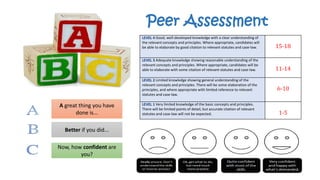
Peer Assessment
A great thing you have
done is...
Better if you did...
Now, how confident are
you?
LEVEL 4 Good, well-developed knowledge with a clear understanding of
the relevant concepts and principles. Where appropriate, candidates will
be able to elaborate by good citation to relevant statutes and case-law. 15-18
LEVEL 3 Adequate knowledge showing reasonable understanding of the
relevant concepts and principles. Where appropriate, candidates will be
able to elaborate with some citation of relevant statutes and case-law. 11-14
LEVEL 2 Limited knowledge showing general understanding of the
relevant concepts and principles. There will be some elaboration of the
principles, and where appropriate with limited reference to relevant
statutes and case-law.
6-10
LEVEL 1 Very limited knowledge of the basic concepts and principles.
There will be limited points of detail, but accurate citation of relevant
statutes and case-law will not be expected. 1-5
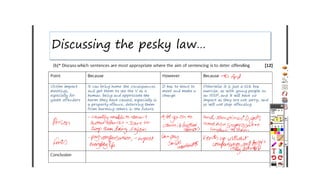
Discussing the pesky law…
(b)* Discuss which sentences are most appropriate where the aim of sentencing is to deter offending [12]
Point Because However Because
Victim impact
meetings,
especially for
youth offenders
It can bring home the consequences
and get them to see the V as a
human being and appreciate the
harm they have caused, especially in
a property offence, deterring them
from harming others in the future.
D has to want to
meet and make a
change
Otherwise it is just a tick box
exercise, as with young people on
an ISSP, and it will have no
impact as they are not sorry, and
so will not stop offending.
Conclusion
Adult SentencesWhat sentences can adult offenders be given?
You need to be able to describe a range of
adult sentences covering:
 Custodial
 Community
 Fines
 Other
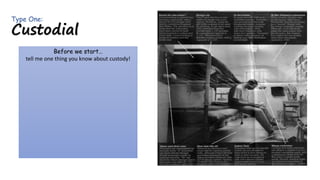
Type One:
Custodial
Before we start…
tell me one thing you know about custody!
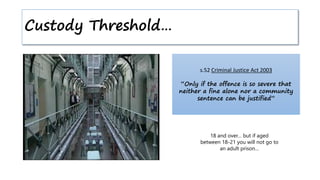
Custody Threshold…
s.52 Criminal Justice Act 2003
“Only if the offence is so severe that
neither a fine alone nor a community
sentence can be justified”
18 and over… but if aged
between 18-21 you will not go to
an adult prison…
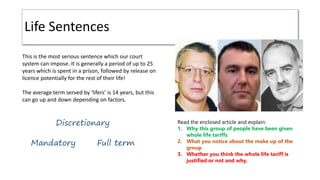
Life Sentences
Mandatory
Discretionary
Full term
Read the enclosed article and explain:
1. Why this group of people have been given
whole life tariffs
2. What you notice about the make up of the
group
3. Whether you think the whole life tariff is
justified or not and why.
This is the most serious sentence which our court
system can impose. It is generally a period of up to 25
years which is spent in a prison, followed by release on
licence potentially for the rest of their life!
The average term served by ‘lifers’ is 14 years, but this
can go up and down depending on factors.
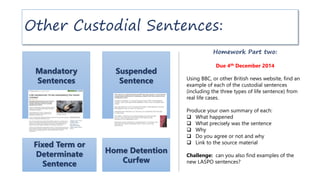
Other Custodial Sentences:
Mandatory
Sentences
Fixed Term or
Determinate
Sentence
Suspended
Sentence
Home Detention
Curfew
Homework Part two:
Due 4th December 2014
Using BBC, or other British news website, find an
example of each of the custodial sentences
(including the three types of life sentence) from
real life cases.
Produce your own summary of each:
 What happened
 What precisely was the sentence
 Why
 Do you agree or not and why
 Link to the source material
Challenge: can you also find examples of the
new LASPO sentences?
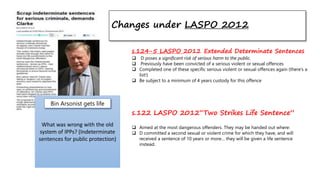
Changes under LASPO 2012
What was wrong with the old
system of IPPs? (Indeterminate
sentences for public protection)
Bin Arsonist gets life
s.124-5 LASPO 2012 Extended Determinate Sentences
 D poses a significant risk of serious harm to the public.
 Previously have been convicted of a serious violent or sexual offences
 Completed one of these specific serious violent or sexual offences again (there’s a
list!)
 Be subject to a minimum of 4 years custody for this offence
s.122 LASPO 2012“Two Strikes Life Sentence”
 Aimed at the most dangerous offenders. They may be handed out where:
 D committed a second sexual or violent crime for which they have, and will
received a sentence of 10 years or more… they will be given a life sentence
instead.
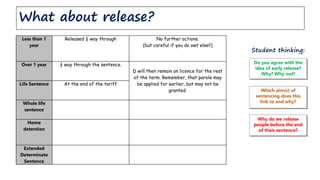
What about release?
Less than 1
year
Released ½ way through No further actions.
(but careful if you do owt else!!)
Over 1 year ½ way through the sentence.
D will then remain on licence for the rest
of the term. Remember, that parole may
be applied for earlier, but may not be
granted.
Life Sentence At the end of the tariff
Whole life
sentence
Home
detention
Extended
Determinate
Sentence
Why do we release
people before the end
of their sentence?
Do you agree with the
idea of early release?
Why? Why not?
Which aim(s) of
sentencing does this
link to and why?
Student thinking:
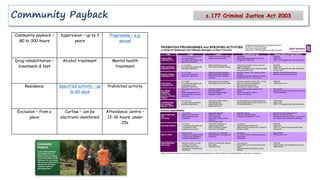
Community Payback s.177 Criminal Justice Act 2003
Community payback –
80 to 300 hours
Supervision – up to 3
years
Programme – e.g.
sexual
Drug rehabilitation –
treatment & test
Alcohol treatment Mental health
treatment
Residence Specified activity – up
to 60 days
Prohibited activity
Exclusion – from a
place
Curfew – can be
electronic monitored
Attendance centre –
12-36 hours, under
25s.
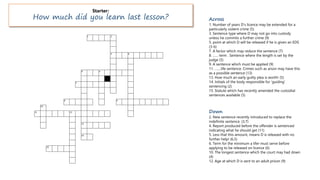
Starter:
How much did you learn last lesson? Across
1. Number of years D's licence may be extended for a
particularly violent crime (5)
3. Sentence type where D may not go into custody
unless he commits a further crime (9)
5. point at which D will be released if he is given an EDS
(3-6)
7. A factor which may reduce the sentence (7)
8. …… term . Sentence where the length is set by the
judge (5)
9. A sentence which must be applied (9)
11. …….life sentence. Crimes such as arson may have this
as a possible sentence (13)
13. How much an early guilty plea is worth! (5)
14. Initials of the body responsible for 'guiding'
sentencing (2)
15. Statute which has recently amended the custodial
sentences available (5)
Down
2. New sentence recently introduced to replace the
indefinite sentence. (3,7)
4. Report produced before the offender is sentenced
indicating what he should get (11)
5. Less that this amount, means D is released with no
further help! (6,5)
6. Term for the minimum a lifer must serve before
applying to be released on licence (6)
10. The longest sentence which the court may had down
(4)
12. Age at which D is sent to an adult prison (9)
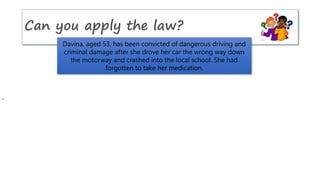
Can you apply the law?
Davina, aged 53, has been convicted of dangerous driving and
criminal damage after she drove her car the wrong way down
the motorway and crashed into the local school. She had
forgotten to take her medication.
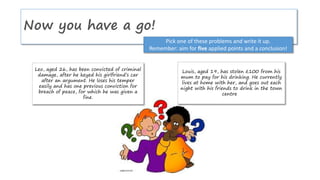
Now you have a go!
Pick one of these problems and write it up.
Remember: aim for five applied points and a conclusion!
Louis, aged 19, has stolen £100 from his
mum to pay for his drinking. He currently
lives at home with her, and goes out each
night with his friends to drink in the town
centre
Leo, aged 26, has been convicted of criminal
damage, after he keyed his girlfriend’s car
after an argument. He loses his temper
easily and has one previous conviction for
breach of peace, for which he was given a
fine.
Type of sentence (3)
Fines
THE most common type of punishment for an offender
(although it’s often combined with other punishments!)
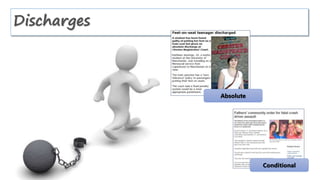
Discharges
Conditional
Absolute
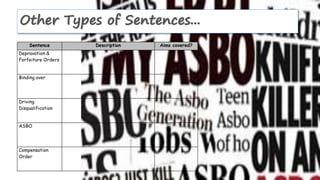
Other Types of Sentences...
Sentence Description Aims covered?
Depravation &
Forfeiture Orders
Binding over
Driving
Disqualification
ASBO
Compensation
Order
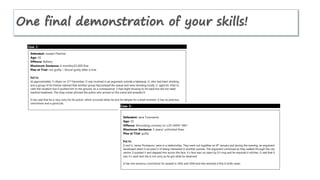
One final demonstration of your skills!
Plenary:
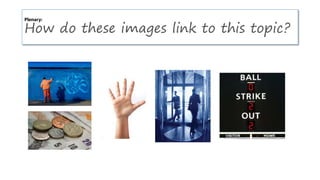
How do these images link to this topic?

Adult Sentencing

  • 1.
    What’s left? Answering theQuestion of course! End 20 minutes. Remember what you want to improve… and demonstrate your brilliance! Describe the aims and factors taken into account when sentencing an offender. [18]
  • 2.
    Peer Assessment A greatthing you have done is... Better if you did... Now, how confident are you? LEVEL 4 Good, well-developed knowledge with a clear understanding of the relevant concepts and principles. Where appropriate, candidates will be able to elaborate by good citation to relevant statutes and case-law. 15-18 LEVEL 3 Adequate knowledge showing reasonable understanding of the relevant concepts and principles. Where appropriate, candidates will be able to elaborate with some citation of relevant statutes and case-law. 11-14 LEVEL 2 Limited knowledge showing general understanding of the relevant concepts and principles. There will be some elaboration of the principles, and where appropriate with limited reference to relevant statutes and case-law. 6-10 LEVEL 1 Very limited knowledge of the basic concepts and principles. There will be limited points of detail, but accurate citation of relevant statutes and case-law will not be expected. 1-5
  • 3.
    Discussing the peskylaw… (b)* Discuss which sentences are most appropriate where the aim of sentencing is to deter offending [12] Point Because However Because Victim impact meetings, especially for youth offenders It can bring home the consequences and get them to see the V as a human being and appreciate the harm they have caused, especially in a property offence, deterring them from harming others in the future. D has to want to meet and make a change Otherwise it is just a tick box exercise, as with young people on an ISSP, and it will have no impact as they are not sorry, and so will not stop offending. Conclusion
  • 5.
    Adult SentencesWhat sentencescan adult offenders be given? You need to be able to describe a range of adult sentences covering:  Custodial  Community  Fines  Other
  • 6.
    Type One: Custodial Before westart… tell me one thing you know about custody!
  • 7.
    Custody Threshold… s.52 CriminalJustice Act 2003 “Only if the offence is so severe that neither a fine alone nor a community sentence can be justified” 18 and over… but if aged between 18-21 you will not go to an adult prison…
  • 8.
    Life Sentences Mandatory Discretionary Full term Readthe enclosed article and explain: 1. Why this group of people have been given whole life tariffs 2. What you notice about the make up of the group 3. Whether you think the whole life tariff is justified or not and why. This is the most serious sentence which our court system can impose. It is generally a period of up to 25 years which is spent in a prison, followed by release on licence potentially for the rest of their life! The average term served by ‘lifers’ is 14 years, but this can go up and down depending on factors.
  • 9.
    Other Custodial Sentences: Mandatory Sentences FixedTerm or Determinate Sentence Suspended Sentence Home Detention Curfew Homework Part two: Due 4th December 2014 Using BBC, or other British news website, find an example of each of the custodial sentences (including the three types of life sentence) from real life cases. Produce your own summary of each:  What happened  What precisely was the sentence  Why  Do you agree or not and why  Link to the source material Challenge: can you also find examples of the new LASPO sentences?
  • 10.
    Changes under LASPO2012 What was wrong with the old system of IPPs? (Indeterminate sentences for public protection) Bin Arsonist gets life s.124-5 LASPO 2012 Extended Determinate Sentences  D poses a significant risk of serious harm to the public.  Previously have been convicted of a serious violent or sexual offences  Completed one of these specific serious violent or sexual offences again (there’s a list!)  Be subject to a minimum of 4 years custody for this offence s.122 LASPO 2012“Two Strikes Life Sentence”  Aimed at the most dangerous offenders. They may be handed out where:  D committed a second sexual or violent crime for which they have, and will received a sentence of 10 years or more… they will be given a life sentence instead.
  • 11.
    What about release? Lessthan 1 year Released ½ way through No further actions. (but careful if you do owt else!!) Over 1 year ½ way through the sentence. D will then remain on licence for the rest of the term. Remember, that parole may be applied for earlier, but may not be granted. Life Sentence At the end of the tariff Whole life sentence Home detention Extended Determinate Sentence Why do we release people before the end of their sentence? Do you agree with the idea of early release? Why? Why not? Which aim(s) of sentencing does this link to and why? Student thinking:
  • 12.
    Community Payback s.177Criminal Justice Act 2003 Community payback – 80 to 300 hours Supervision – up to 3 years Programme – e.g. sexual Drug rehabilitation – treatment & test Alcohol treatment Mental health treatment Residence Specified activity – up to 60 days Prohibited activity Exclusion – from a place Curfew – can be electronic monitored Attendance centre – 12-36 hours, under 25s.
  • 13.
    Starter: How much didyou learn last lesson? Across 1. Number of years D's licence may be extended for a particularly violent crime (5) 3. Sentence type where D may not go into custody unless he commits a further crime (9) 5. point at which D will be released if he is given an EDS (3-6) 7. A factor which may reduce the sentence (7) 8. …… term . Sentence where the length is set by the judge (5) 9. A sentence which must be applied (9) 11. …….life sentence. Crimes such as arson may have this as a possible sentence (13) 13. How much an early guilty plea is worth! (5) 14. Initials of the body responsible for 'guiding' sentencing (2) 15. Statute which has recently amended the custodial sentences available (5) Down 2. New sentence recently introduced to replace the indefinite sentence. (3,7) 4. Report produced before the offender is sentenced indicating what he should get (11) 5. Less that this amount, means D is released with no further help! (6,5) 6. Term for the minimum a lifer must serve before applying to be released on licence (6) 10. The longest sentence which the court may had down (4) 12. Age at which D is sent to an adult prison (9)
  • 14.
    Can you applythe law? Davina, aged 53, has been convicted of dangerous driving and criminal damage after she drove her car the wrong way down the motorway and crashed into the local school. She had forgotten to take her medication.
  • 15.
    Now you havea go! Pick one of these problems and write it up. Remember: aim for five applied points and a conclusion! Louis, aged 19, has stolen £100 from his mum to pay for his drinking. He currently lives at home with her, and goes out each night with his friends to drink in the town centre Leo, aged 26, has been convicted of criminal damage, after he keyed his girlfriend’s car after an argument. He loses his temper easily and has one previous conviction for breach of peace, for which he was given a fine.
  • 16.
    Type of sentence(3) Fines THE most common type of punishment for an offender (although it’s often combined with other punishments!)
  • 17.
  • 18.
    Other Types ofSentences... Sentence Description Aims covered? Depravation & Forfeiture Orders Binding over Driving Disqualification ASBO Compensation Order
  • 19.
    One final demonstrationof your skills!
  • 20.
    Plenary: How do theseimages link to this topic?